- Anti-lock braking systems (ABS) help prevent wheel lockup and allow steering control during hard braking. ABS monitors wheel speed and regulates brake pressure to keep wheels rotating just below the lockup point.
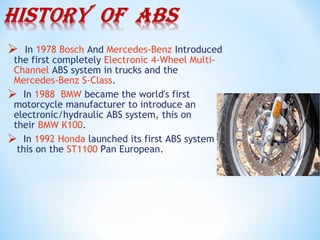
- ABS was first developed for aircraft in 1929 but did not see widespread automotive use until the 1970s and 1980s as the technology advanced. By the late 1980s and 1990s, ABS was becoming standard on higher-end cars.
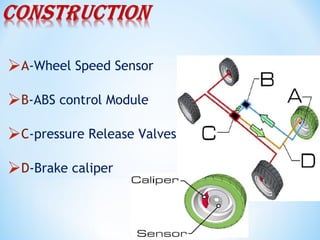
- ABS uses wheel speed sensors and hydraulic valves to regulate brake pressure hundreds of times per minute, allowing steering control even during hard braking on slippery surfaces. This improves vehicle stability and control during emergency braking situations.
![By: Koushik Paul Roll No.- 6O Mech. Engg.[3 rd Year] Bengal College Of Engineering & Technology](https://image.slidesharecdn.com/seminaronabsby-koushikpaul1-110510181049-phpapp01/85/Seminar-on-ABS-1-320.jpg)