INTRODUCTION
• In trying to keep up with emissions and fuel
efficiency laws, the fuel system used in
modern cars has changed a lot over the
years
• But fuel injection has been around since the
1950s, and electronic fuel injection was used
widely on European cars starting around
1980. Now, all cars sold in the United States
have fuel injection systems.
CARBURETOR: A HISTORY
• Carburetor is today just a history but once it served the supply source of fuel for the
engine but due to its complicated problems it needed to be replaced as for example it
required the following:
• Main circuit - Provides just enough fuel for fuel-efficient cruising
• Idle circuit - Provides just enough fuel to keep the engine idling
• Accelerator pump - Provides an extra burst of fuel when the accelerator pedal is first
depressed, reducing hesitation before the engine speeds up
• Power enrichment circuit - Provides extra fuel when the car is going up a hill or towing
a trailer
• Choke - Provides extra fuel when the engine is cold so that it will start
• In order to meet stricter emissions requirements, catalytic converters were introduced.
Very careful control of the air-to-fuel ratio was required for the catalytic converter to
be effective. Oxygen sensors monitor the amount of oxygen in the exhaust, and the
engine control unit (ECU) uses this information to adjust the air-to-fuel ratio in real-
time. This is called closed loop control -- it was not feasible to achieve this control with
carburetors. There was a brief period of electrically controlled carburetors before fuel
injection systems took over, but these electrical carbs were even more complicated than
the purely mechanical ones.
• A carburetor operates by pumping fuel into the intake manifold of the engine; when the
accelerator pedal is pushed, a linkage connects the pedal to the carburetor and fuel
distribution is controlled by the amount of pressure applied to the accelerator pedal.
The fuel is sucked into the combustion chamber through the intake manifold and past
THE FUEL INJECTOR:PRESENT
• A fuel injector is nothing but an electronically controlled
valve. It is supplied with pressurized fuel by the fuel pump in
your car, and it is capable of opening and closing many times
per second.
• At first, carburetors were replaced with throttle body fuel
injection systems (also known as single point or central fuel
injection systems) that incorporated electrically controlled
fuel-injector valves into the throttle body.
• Gradually, as new engines were designed, throttle body fuel
injection was replaced by multi-port fuel injection (also
known as port, multi-point or sequential fuel injection).
These systems have a fuel injector for each cylinder, usually
located so that they spray right at the intake valve. These
systems provide more accurate fuel metering and quicker
MECHANISM
• When you step on the gas pedal, the throttle valve opens up more, letting in more air.
The engine control unit (ECU, the computer that controls all of the electronic
components on your engine) "sees" the throttle valve open and increases the fuel rate in
anticipation of more air entering the engine. It is important to increase the fuel rate as
soon as the throttle valve opens; otherwise, when the gas pedal is first pressed, there may
be a hesitation as some air reaches the cylinders without enough fuel in it.
• Sensors monitor the mass of air entering the engine, as well as the amount of oxygen in
the exhaust. The ECU uses this information to fine-tune the fuel delivery so that the air-
to-fuel ratio is just right.
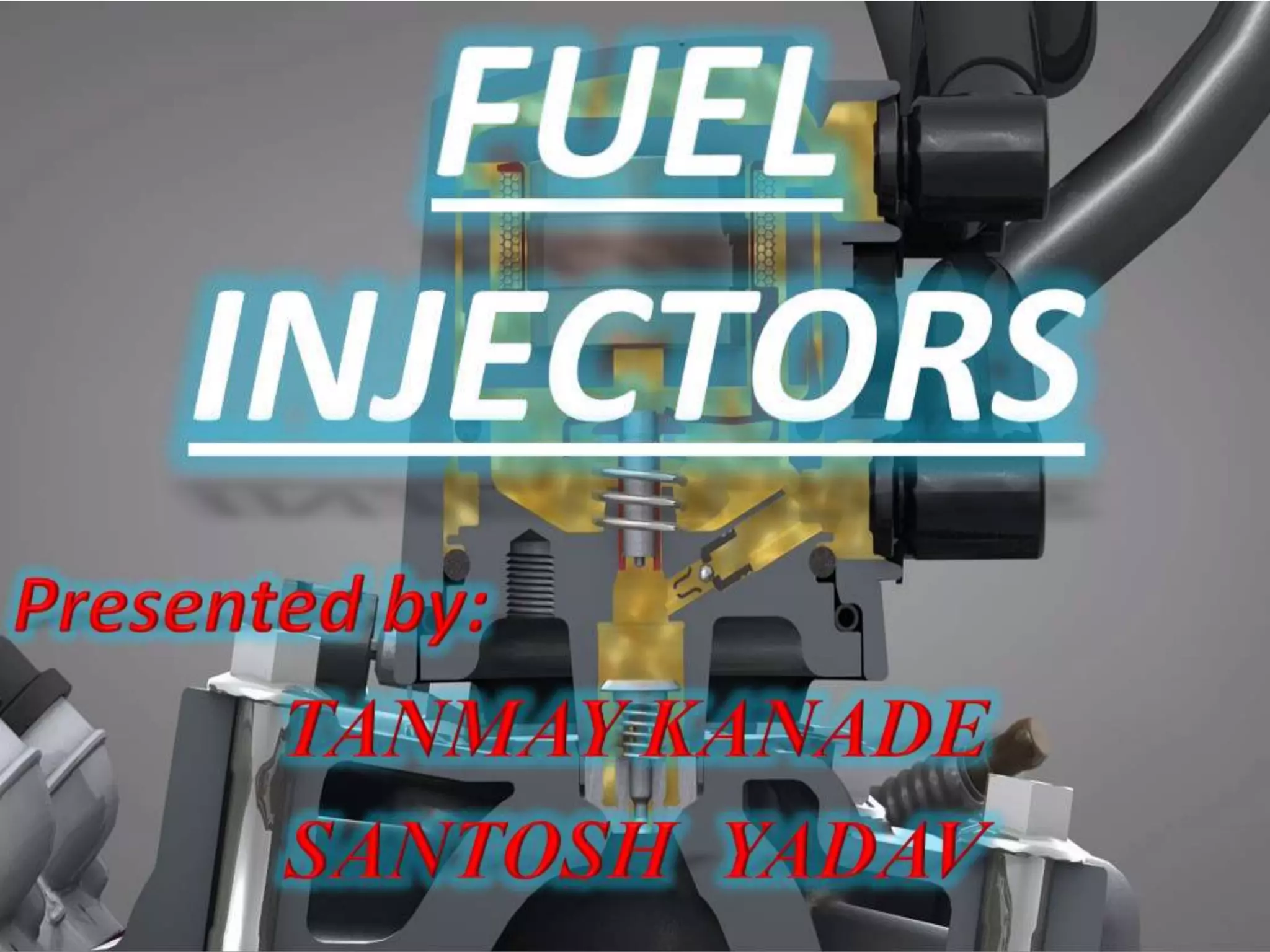
• When the injector is energized, an electromagnet moves a plunger that opens the valve,
allowing the pressurized fuel to squirt out through a tiny nozzle. The nozzle is designed
to atomize the fuel -- to make as fine a mist as possible so that it can burn easily.
• The injectors are mounted in the intake manifold so that they spray fuel directly at the
intake valves. A pipe called the fuel rail supplies pressurized fuel to all of the injectors.
• The amount of fuel supplied to the engine is determined by the amount of time the fuel
injector stays open. This is called the pulse width, and it is controlled by the ECU.
• As fuel injection systems have evolved, the goal of engineers has been to improve the
efficiency of the gas burned in the combustion chamber. By cutting down on unburnt
fuel, less internal engine carbon deposits are formed, vehicle emissions improve, fuel
economy improves, and performance improves.
Pulse width = (Base pulse width) x (Factor A) x (Factor B)
FEATURES
Engine Sensors
• In order to provide the correct amount of fuel for every operating condition,
the engine control unit (ECU) has to monitor a huge number of input sensors.
Here are just a few:
• Mass airflow sensor - Tells the ECU the mass of air entering the engine
• Oxygen sensor(s) - Monitors the amount of oxygen in the exhaust so the ECU
can determine how rich or lean the fuel mixture is and make adjustments
accordingly
• Throttle position sensor - Monitors the throttle valve position (which
determines how much air goes into the engine) so the ECU can respond
quickly to changes, increasing or decreasing the fuel rate as necessary
• Coolant temperature sensor - Allows the ECU to determine when the engine
has reached its proper operating temperature
• Voltage sensor - Monitors the system voltage in the car so the ECU can raise
the idle speed if voltage is dropping (which would indicate a high electrical
load)
• Manifold absolute pressure sensor - Monitors the pressure of the air in the
intake manifold.The amount of air being drawn into the engine is a good
indication of how much power it is producing; and the more air that goes into
the engine, the lower the manifold pressure, so this reading is used to gauge
how much power is being produced.
CONTROL SYSTEMS
• There are two main types of control for multi-
port systems: The fuel injectors can all open at
the same time, or each one can open just before
the intake valve for its cylinder opens (this is
called sequential multi-port fuel injection).
• The advantage of sequential fuel injection is
that if the driver makes a sudden change, the
system can respond more quickly because from
the time the change is made, it only has to wait
only until the next intake valve opens, instead
of for the next complete revolution of the
engine.
Different Types of Fuel Injection
Fuel injection systems vary greatly in design. Some older systems
are no longer produced, and late-model vehicles use different
types of fuel injection depending on their engineering design. Fuel
injection slowly began replacing carburetors during the late 1970s
and early 1980s, until carburetors were completely phased out of
production vehicles by the early 1990s. In this guide, the different
types of fuel injection systems are explained, including the early
designs from the ‘70s that have since been replaced by more
efficient systems.
• Types of Fuel Injectors:
• Top-Feed – Fuel enters from the in the top and exits the bottom.
• Side-Feed – Fuel enters on the side on the injector fitting inside the fuel
rail.
• Throttle Body Injectors – (TBI) Located directly in the throttle body.
TYPES OF INJECTIONS
• Throttle body or Single Point Injection aka TBI
This is the simplest and the foremost fuel injection system which was
employed in cars as a replacement for carburettors. This employs either
one or two fuel injectors in the throttle body which delivers the apt ratio
of fuel-air mixture to every fuel intake manifold in the engine. The
drawback if this system is that cylinders closest to the fuel injectors
would get a better mixture than the ones away from them. The reason
why TBI replaced carburetors was because these would easily adjust
according to air density and altitude, and were independent of the
vacuum manifold.
• Multi-point fuel injection or Port injection aka MPFI
The term MPFI is widely used by car manufacturers as a USP for their
cars. As the name suggests the multi point fuel injector denotes one
fuel injector for every cylinder - the fuel is misted at the intake manifold.
If an engine has six cylinders then it will have six fuel injectors - one for
each cylinder located at the intake port of the manifold. Since the fuel is
misted so closed to the intake manifold, it ensures the complete amount
is used for combustion, making it more efficient than TBI, hence aiding
in enhanced fuel economy as well. Multi-port fuel injectors fire fuel all
at the same time, with the fuel sitting at the intake manifold till the time
it’s needed. This happens for a split second, even during engine idling.
Late-Model Fuel Injection Design
• Sequential fuel injection aka SFI
Sequential fuel injection system is a type of MPFI. While in
an MPFI all the injectors are fired at the same time, in SFI
they are fired according to the intake timing of the
respective cylinder i.e. just before the intake valve of that
particular cylinder opens. This timing is matched
according to the camshaft and though it may seem as a
minor change it has helped improve efficiency and
emissions.
• Direct Injection aka DI
Direct injection is one of the most advanced fuel injection
systems. More commonly seen on diesel engines, this
technology is now making way in petrol engines. In a direct
injection system the fuel is injected directly in the
combustion chamber i.e the cylinder. The advantage of this
system is that there is no wastage of fuel or any carbon
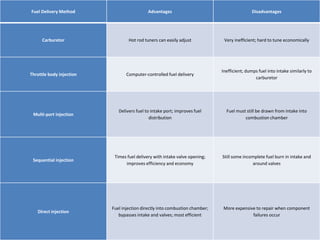
Fuel Delivery Method Advantages Disadvantages
Carburetor Hot rod tuners can easily adjust Very inefficient; hard to tune economically
Throttle body injection Computer-controlled fuel delivery
Inefficient; dumps fuel into intake similarly to
carburetor
Multi-port injection
Delivers fuel to intake port; improves fuel
distribution
Fuel must still be drawn from intake into
combustion chamber
Sequential injection
Times fuel delivery with intake valve opening;
improves efficiency and economy
Still some incomplete fuel burn in intake and
around valves
Direct injection
Fuel injection directly into combustion chamber;
bypasses intake and valves; most efficient
More expensive to repair when component
failures occur
DIESEL FUEL INJECTOR
• A diesel fuel injection system differs from a gas engine in that the diesel fuel
gets injected directly into the cylinder. In a gas engine, a port injection or a
carburetor is used to inject fuel prior to the intake stroke (outside the cylinder)
where the fuel mixes with air before it enters the cylinder.
• The injector on a diesel engine is its most complex part. The pressure and heat
within a cylinder are quite intense and the injector has to be able to handle
those conditions while still distributing the fuel in a fine mist. Equally
important, the mist needs to be distributed evenly throughout the cylinder.
Some diesel engines use induction valves, pre-combustion chambers or another
type of device to swirl air through the combustion chamber. This process helps
distribute the fuel mist evenly and keeps the ignition and combustion process
smooth.
• Most diesel fuel injectors use the same basic design, made from heat-treated
alloy steel. The actual shape will vary according to the application.
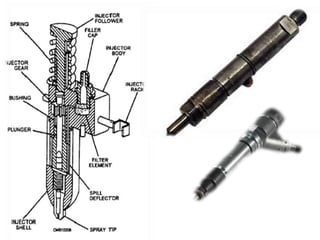
• The injector assembly has several main parts. The nozzle assembly is made up
of a needle and body. A pressure spring and spindle hold the needle on the seat
in the nozzle body. A nozzle holder, sometimes called the injector body, may
allow for mounting the injector on the engine, and some method of adjusting
DIESEL FUEL
INJECTOR:MECHANISM
• The injection pump delivers fuel to the injector. The fuel passes
through a drilling in the nozzle body, to a chamber above where
the needle-valve seats in the nozzle assembly. As fuel pressure in
the injector gallery rises, it acts on the tapered shoulder of the
needle valve, increasing the pressure until it overcomes the force
from the spring, and lifts the needle valve from its seat. The
highly pressurized fuel enters the engine at a high velocity, in an
atomized spray.
• As soon as delivery from the pump stops, pressure under the
needle tapered-shoulder drops, and the spring force pushes the
needle down on the seat, cutting off the fuel supply to the engine.
• Some of the fuel is allowed to leak between the nozzle needle and
the body, to cool and lubricate the injector. This fuel is collected
by the leak- off line, and returned to the fuel tank for later use.
DEVELOPMENTS
• Engine Controls and Performance Chips
The algorithms that control the engine are quite complicated. The software has to
allow the car to satisfy emissions requirements for 100,000 miles, meet EPA fuel
economy requirements and protect engines against abuse. And there are dozens of
other requirements to meet as well. The engine control unit uses a formula and a
large number of lookup tables to determine the pulse width for given operating
conditions. The equation will be a series of many factors multiplied by each other.
Many of these factors will come from lookup tables.
• Performance Chips
Performance chips are made by aftermarket companies, and are used to boost
engine power. There is a chip in the ECU that holds all of the lookup tables; the
performance chip replaces this chip. The tables in the performance chip will
contain values that result in higher fuel rates during certain driving conditions.
they may supply more fuel at full throttle at every engine speed. change the spark
timing Since the performance-chip makers are not as concerned with issues like
reliability, mileage and emissions controls as the carmakers are, they use more
aggressive settings in the fuel maps of their performance chips.
Supercritical fuel injection
Future diesel engines that exploit a novel
state of matter in which heated and
compressed diesel fuel behaves both like
a liquid and a gas could release as much
as 80% fewer exhaust emissions while
running 10% more efficiently
THANK
YOU

Fuel injectors ppt

  • 2.
    INTRODUCTION • In tryingto keep up with emissions and fuel efficiency laws, the fuel system used in modern cars has changed a lot over the years • But fuel injection has been around since the 1950s, and electronic fuel injection was used widely on European cars starting around 1980. Now, all cars sold in the United States have fuel injection systems.
  • 3.
    CARBURETOR: A HISTORY •Carburetor is today just a history but once it served the supply source of fuel for the engine but due to its complicated problems it needed to be replaced as for example it required the following: • Main circuit - Provides just enough fuel for fuel-efficient cruising • Idle circuit - Provides just enough fuel to keep the engine idling • Accelerator pump - Provides an extra burst of fuel when the accelerator pedal is first depressed, reducing hesitation before the engine speeds up • Power enrichment circuit - Provides extra fuel when the car is going up a hill or towing a trailer • Choke - Provides extra fuel when the engine is cold so that it will start • In order to meet stricter emissions requirements, catalytic converters were introduced. Very careful control of the air-to-fuel ratio was required for the catalytic converter to be effective. Oxygen sensors monitor the amount of oxygen in the exhaust, and the engine control unit (ECU) uses this information to adjust the air-to-fuel ratio in real- time. This is called closed loop control -- it was not feasible to achieve this control with carburetors. There was a brief period of electrically controlled carburetors before fuel injection systems took over, but these electrical carbs were even more complicated than the purely mechanical ones. • A carburetor operates by pumping fuel into the intake manifold of the engine; when the accelerator pedal is pushed, a linkage connects the pedal to the carburetor and fuel distribution is controlled by the amount of pressure applied to the accelerator pedal. The fuel is sucked into the combustion chamber through the intake manifold and past
  • 4.
    THE FUEL INJECTOR:PRESENT •A fuel injector is nothing but an electronically controlled valve. It is supplied with pressurized fuel by the fuel pump in your car, and it is capable of opening and closing many times per second. • At first, carburetors were replaced with throttle body fuel injection systems (also known as single point or central fuel injection systems) that incorporated electrically controlled fuel-injector valves into the throttle body. • Gradually, as new engines were designed, throttle body fuel injection was replaced by multi-port fuel injection (also known as port, multi-point or sequential fuel injection). These systems have a fuel injector for each cylinder, usually located so that they spray right at the intake valve. These systems provide more accurate fuel metering and quicker
  • 5.
    MECHANISM • When youstep on the gas pedal, the throttle valve opens up more, letting in more air. The engine control unit (ECU, the computer that controls all of the electronic components on your engine) "sees" the throttle valve open and increases the fuel rate in anticipation of more air entering the engine. It is important to increase the fuel rate as soon as the throttle valve opens; otherwise, when the gas pedal is first pressed, there may be a hesitation as some air reaches the cylinders without enough fuel in it. • Sensors monitor the mass of air entering the engine, as well as the amount of oxygen in the exhaust. The ECU uses this information to fine-tune the fuel delivery so that the air- to-fuel ratio is just right. • When the injector is energized, an electromagnet moves a plunger that opens the valve, allowing the pressurized fuel to squirt out through a tiny nozzle. The nozzle is designed to atomize the fuel -- to make as fine a mist as possible so that it can burn easily. • The injectors are mounted in the intake manifold so that they spray fuel directly at the intake valves. A pipe called the fuel rail supplies pressurized fuel to all of the injectors. • The amount of fuel supplied to the engine is determined by the amount of time the fuel injector stays open. This is called the pulse width, and it is controlled by the ECU. • As fuel injection systems have evolved, the goal of engineers has been to improve the efficiency of the gas burned in the combustion chamber. By cutting down on unburnt fuel, less internal engine carbon deposits are formed, vehicle emissions improve, fuel economy improves, and performance improves. Pulse width = (Base pulse width) x (Factor A) x (Factor B)
  • 6.
    FEATURES Engine Sensors • Inorder to provide the correct amount of fuel for every operating condition, the engine control unit (ECU) has to monitor a huge number of input sensors. Here are just a few: • Mass airflow sensor - Tells the ECU the mass of air entering the engine • Oxygen sensor(s) - Monitors the amount of oxygen in the exhaust so the ECU can determine how rich or lean the fuel mixture is and make adjustments accordingly • Throttle position sensor - Monitors the throttle valve position (which determines how much air goes into the engine) so the ECU can respond quickly to changes, increasing or decreasing the fuel rate as necessary • Coolant temperature sensor - Allows the ECU to determine when the engine has reached its proper operating temperature • Voltage sensor - Monitors the system voltage in the car so the ECU can raise the idle speed if voltage is dropping (which would indicate a high electrical load) • Manifold absolute pressure sensor - Monitors the pressure of the air in the intake manifold.The amount of air being drawn into the engine is a good indication of how much power it is producing; and the more air that goes into the engine, the lower the manifold pressure, so this reading is used to gauge how much power is being produced.
  • 7.
    CONTROL SYSTEMS • Thereare two main types of control for multi- port systems: The fuel injectors can all open at the same time, or each one can open just before the intake valve for its cylinder opens (this is called sequential multi-port fuel injection). • The advantage of sequential fuel injection is that if the driver makes a sudden change, the system can respond more quickly because from the time the change is made, it only has to wait only until the next intake valve opens, instead of for the next complete revolution of the engine.
  • 8.
    Different Types ofFuel Injection Fuel injection systems vary greatly in design. Some older systems are no longer produced, and late-model vehicles use different types of fuel injection depending on their engineering design. Fuel injection slowly began replacing carburetors during the late 1970s and early 1980s, until carburetors were completely phased out of production vehicles by the early 1990s. In this guide, the different types of fuel injection systems are explained, including the early designs from the ‘70s that have since been replaced by more efficient systems. • Types of Fuel Injectors: • Top-Feed – Fuel enters from the in the top and exits the bottom. • Side-Feed – Fuel enters on the side on the injector fitting inside the fuel rail. • Throttle Body Injectors – (TBI) Located directly in the throttle body.
  • 9.
    TYPES OF INJECTIONS •Throttle body or Single Point Injection aka TBI This is the simplest and the foremost fuel injection system which was employed in cars as a replacement for carburettors. This employs either one or two fuel injectors in the throttle body which delivers the apt ratio of fuel-air mixture to every fuel intake manifold in the engine. The drawback if this system is that cylinders closest to the fuel injectors would get a better mixture than the ones away from them. The reason why TBI replaced carburetors was because these would easily adjust according to air density and altitude, and were independent of the vacuum manifold. • Multi-point fuel injection or Port injection aka MPFI The term MPFI is widely used by car manufacturers as a USP for their cars. As the name suggests the multi point fuel injector denotes one fuel injector for every cylinder - the fuel is misted at the intake manifold. If an engine has six cylinders then it will have six fuel injectors - one for each cylinder located at the intake port of the manifold. Since the fuel is misted so closed to the intake manifold, it ensures the complete amount is used for combustion, making it more efficient than TBI, hence aiding in enhanced fuel economy as well. Multi-port fuel injectors fire fuel all at the same time, with the fuel sitting at the intake manifold till the time it’s needed. This happens for a split second, even during engine idling.
  • 10.
    Late-Model Fuel InjectionDesign • Sequential fuel injection aka SFI Sequential fuel injection system is a type of MPFI. While in an MPFI all the injectors are fired at the same time, in SFI they are fired according to the intake timing of the respective cylinder i.e. just before the intake valve of that particular cylinder opens. This timing is matched according to the camshaft and though it may seem as a minor change it has helped improve efficiency and emissions. • Direct Injection aka DI Direct injection is one of the most advanced fuel injection systems. More commonly seen on diesel engines, this technology is now making way in petrol engines. In a direct injection system the fuel is injected directly in the combustion chamber i.e the cylinder. The advantage of this system is that there is no wastage of fuel or any carbon
  • 11.
    Fuel Delivery MethodAdvantages Disadvantages Carburetor Hot rod tuners can easily adjust Very inefficient; hard to tune economically Throttle body injection Computer-controlled fuel delivery Inefficient; dumps fuel into intake similarly to carburetor Multi-port injection Delivers fuel to intake port; improves fuel distribution Fuel must still be drawn from intake into combustion chamber Sequential injection Times fuel delivery with intake valve opening; improves efficiency and economy Still some incomplete fuel burn in intake and around valves Direct injection Fuel injection directly into combustion chamber; bypasses intake and valves; most efficient More expensive to repair when component failures occur
  • 13.
    DIESEL FUEL INJECTOR •A diesel fuel injection system differs from a gas engine in that the diesel fuel gets injected directly into the cylinder. In a gas engine, a port injection or a carburetor is used to inject fuel prior to the intake stroke (outside the cylinder) where the fuel mixes with air before it enters the cylinder. • The injector on a diesel engine is its most complex part. The pressure and heat within a cylinder are quite intense and the injector has to be able to handle those conditions while still distributing the fuel in a fine mist. Equally important, the mist needs to be distributed evenly throughout the cylinder. Some diesel engines use induction valves, pre-combustion chambers or another type of device to swirl air through the combustion chamber. This process helps distribute the fuel mist evenly and keeps the ignition and combustion process smooth. • Most diesel fuel injectors use the same basic design, made from heat-treated alloy steel. The actual shape will vary according to the application. • The injector assembly has several main parts. The nozzle assembly is made up of a needle and body. A pressure spring and spindle hold the needle on the seat in the nozzle body. A nozzle holder, sometimes called the injector body, may allow for mounting the injector on the engine, and some method of adjusting
  • 14.
    DIESEL FUEL INJECTOR:MECHANISM • Theinjection pump delivers fuel to the injector. The fuel passes through a drilling in the nozzle body, to a chamber above where the needle-valve seats in the nozzle assembly. As fuel pressure in the injector gallery rises, it acts on the tapered shoulder of the needle valve, increasing the pressure until it overcomes the force from the spring, and lifts the needle valve from its seat. The highly pressurized fuel enters the engine at a high velocity, in an atomized spray. • As soon as delivery from the pump stops, pressure under the needle tapered-shoulder drops, and the spring force pushes the needle down on the seat, cutting off the fuel supply to the engine. • Some of the fuel is allowed to leak between the nozzle needle and the body, to cool and lubricate the injector. This fuel is collected by the leak- off line, and returned to the fuel tank for later use.
  • 16.
    DEVELOPMENTS • Engine Controlsand Performance Chips The algorithms that control the engine are quite complicated. The software has to allow the car to satisfy emissions requirements for 100,000 miles, meet EPA fuel economy requirements and protect engines against abuse. And there are dozens of other requirements to meet as well. The engine control unit uses a formula and a large number of lookup tables to determine the pulse width for given operating conditions. The equation will be a series of many factors multiplied by each other. Many of these factors will come from lookup tables. • Performance Chips Performance chips are made by aftermarket companies, and are used to boost engine power. There is a chip in the ECU that holds all of the lookup tables; the performance chip replaces this chip. The tables in the performance chip will contain values that result in higher fuel rates during certain driving conditions. they may supply more fuel at full throttle at every engine speed. change the spark timing Since the performance-chip makers are not as concerned with issues like reliability, mileage and emissions controls as the carmakers are, they use more aggressive settings in the fuel maps of their performance chips.
  • 17.
    Supercritical fuel injection Futurediesel engines that exploit a novel state of matter in which heated and compressed diesel fuel behaves both like a liquid and a gas could release as much as 80% fewer exhaust emissions while running 10% more efficiently
  • 18.