Michael ButzHonors Spanish 2Grammar Book
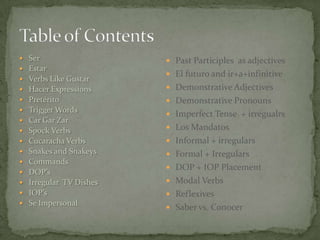
Table of ContentsSerEstarVerbs Like GustarHacer ExpressionsPretéritoTrigger WordsCar Gar ZarSpock VerbsCucaracha VerbsSnakes and SnakeysCommandsDOP’sIrregular  TV DishesIOP’sSe ImpersonalPast Participles  as adjectivesEl futuro and ir+a+infinitiveDemonstrative AdjectivesDemonstrative PronounsImperfect Tense  + irregualrsLos MandatosInformal + irregulars Formal + IrregularsDOP + IOP PlacementModal VerbsReflexivesSaber vs. Conocer
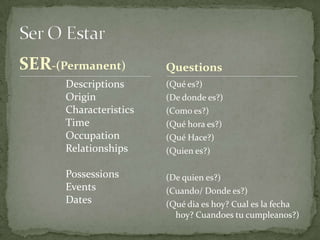
SER-(Permanent)DescriptionsOriginCharacteristicsTimeOccupationRelationshipsPossessionsEventsDates(Quées?)(De dondees?)(Como es?)(Quéhoraes?)(QuéHace?)(Quienes?)(De quienes?)(Cuando/ Dondees?)(Quédiaeshoy? Cuales la fechahoy? Cuandoestucumpleanos?)Ser O EstarQuestions
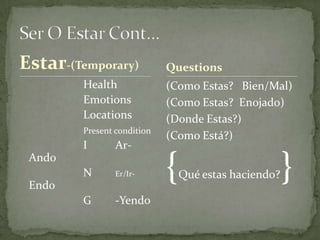
Estar-(Temporary) 			Health		Emotions		LocationsPresent condition			I	Ar- Ando		N	Er/Ir- Endo		G	-Yendo(Como Estas?   Bien/Mal)(Como Estas?  Enojado)(DondeEstas?)(Como Está?){Quéestashaciendo?}Ser O Estar Cont…Questions
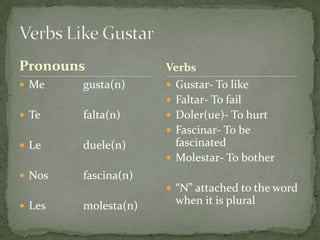
PronounsMe		gusta(n)Te		falta(n)Le		duele(n)Nosfascina(n)Les		molesta(n)Gustar- To likeFaltar- To failDoler(ue)- To hurtFascinar- To be fascinatedMolestar- To bother“N” attached to the word when it is pluralVerbs Like GustarVerbs
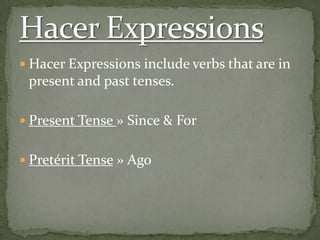
Hacer Expressions include verbs that are in present and past tenses.Present Tense » Since & ForPretérit Tense » AgoHacer Expressions
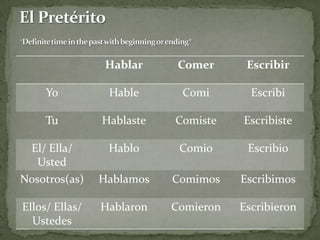
El Pretérito*Definite time in the past with beginning or ending*
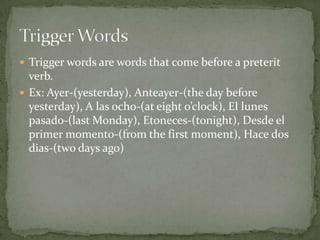
Trigger words are words that come before a preterit verb.Ex: Ayer-(yesterday), Anteayer-(the day before yesterday), A lasocho-(at eight o’clock), El lunespasado-(last Monday), Etoneces-(tonight), Desde el primer momento-(from the first moment), Hace dos dias-(two days ago)Trigger Words
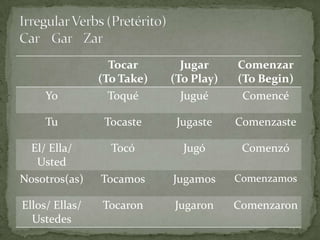
Irregular Verbs (Pretérito)Car	Gar	Zar
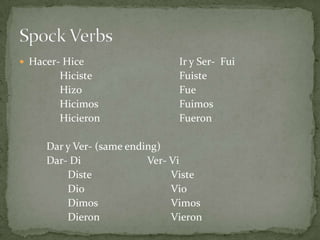
Hacer- HiceIr y Ser-  FuiHicisteFuisteHizoFueHicimosFuimosHicieronFueronDar y Ver- (same ending)Dar- Di			Ver- ViDisteVisteDioVioDimosVimosDieronVieronSpock Verbs
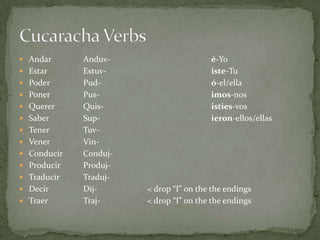
AndarAnduv-				é-YoEstarEstuv-				iste-TuPoderPud-				ó-el/ellaPoner		Pus-				imos-nosQuererQuis-				isties-vosSaber		Sup-				ieron-ellos/ellasTenerTuv-Vener		Vin-ConducirConduj-ProducirProduj-TraducirTraduj-DecirDij-		< drop “I” on the the endingsTraer		Traj-		< drop “I” on the the endingsCucaracha Verbs
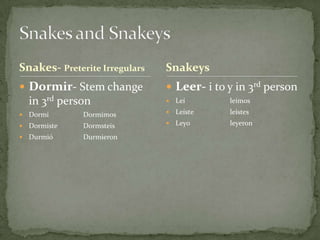
Snakes- Preterite IrregularsDormir- Stem change in 3rd personDormiDormimosDormisteDormsteisDurmióDurmieronLeer- i to y in 3rd personLeíleímosLeísteleístesLeyoleyeronSnakes and SnakeysSnakeys
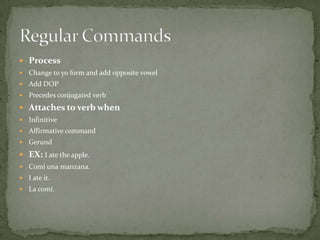
ProcessChange to yo form and add opposite vowelAdd DOP Precedes conjugated verbAttaches to verb whenInfinitiveAffirmative commandGerundEX: I ate the apple.Comíunamanzana.I ate it.La comí.Regular Commands
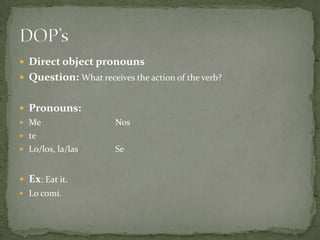
Direct object pronounsQuestion: What receives the action of the verb?Pronouns:Me			NosteLo/los, la/las		SeEx: Eat it.Lo comí.DOP’s
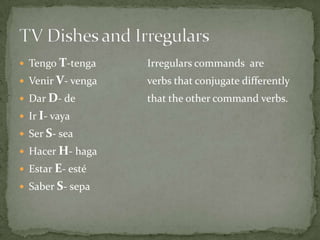
TengoT-tenga		Irregulars commands  are VenirV- venga		verbs that conjugate differentlyDar D- de			that the other command verbs.IrI- vayaSer S- seaHacerH- hagaEstarE- estéSaber S- sepaTV Dishes and Irregulars
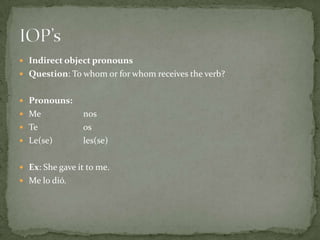
Indirect object pronounsQuestion: To whom or for whom receives the verb?Pronouns:Me		nosTe		osLe(se)	les(se)Ex: She gave it to me.Me lo dió.IOP’s
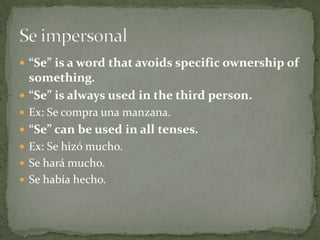
“Se” is a word that avoids specific ownership of something.“Se” is always used in the third person.Ex: Se compraunamanzana.“Se” can be used in all tenses.Ex: Se hizó mucho.Se hará mucho.Se habíahecho.Se impersonal
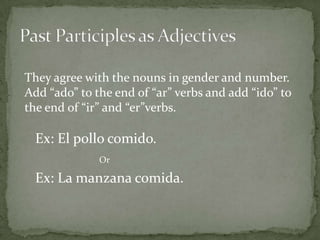
Past Participles as AdjectivesThey agree with the nouns in gender and number. Add “ado” to the end of “ar” verbs and add “ido” to the end of “ir” and “er”verbs.Ex: El pollocomido.OrEx: La manzana comida.
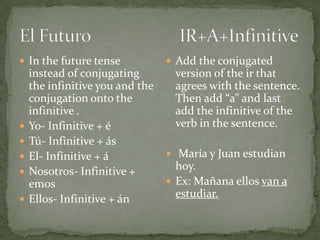
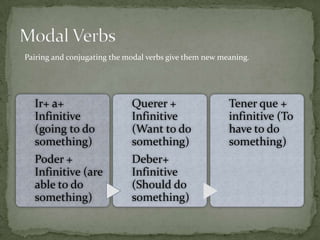
El FuturoIR+A+InfinitiveIn the future tense instead of conjugating the infinitive you and the conjugation onto the infinitive .Yo- Infinitive + éTú- Infinitive + ásEl- Infinitive + áNosotros- Infinitive + emosEllos- Infinitive + ánAdd the conjugated version of the ir that agrees with the sentence. Then add “a” and last add the infinitive of the verb in the sentence.  María y Juan estudianhoy. Ex: Mañanaellosvan a estudiar.
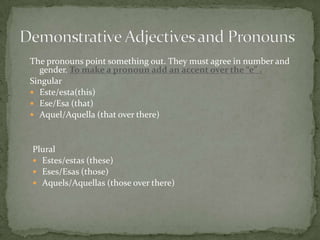
Demonstrative Adjectives and PronounsThe pronouns point something out. They must agree in number and gender. To make a pronoun add an accent over the “e” .SingularEste/esta(this)Ese/Esa (that)Aquel/Aquella (that over there)PluralEstes/estas (these)Eses/Esas (those)Aquels/Aquellas (those over there)
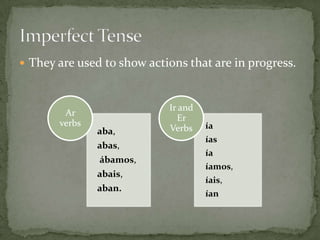
Imperfect Tense 		 They are used to show actions that are in progress.
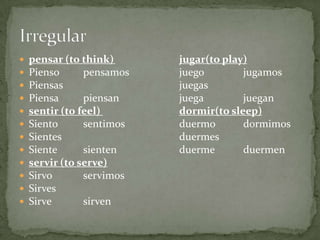
Irregularpensar (to think)	jugar(to play)PiensopensamosjuegojugamosPiensasjuegasPiensapiensanjuegajuegansentir (to feel) dormir(to sleep)SientosentimosduermodormimosSientesduermesSientesientenduermeduermenservir (to serve) SirvoservimosSirvesSirvesirven
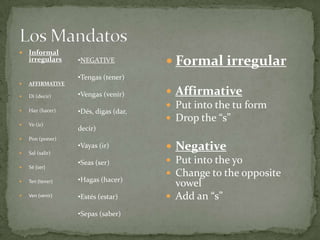
Los MandatosInformal irregularsAFFIRMATIVEDi (decir)Haz (hacer)Ve (ir)Pon (poner)Sal (salir)Sé (ser)Ten (tener)Ven (venir)Formal irregularAffirmativePut into the tu formDrop the “s”NegativePut into the yoChange to the opposite vowelAdd an “s”NEGATIVE
Tengas (tener)
Vengas (venir)
Dés, digas (dar, decir)
Vayas (ir)

Semesterprojmtb 101208080128-phpapp01