Michael ButzHonors Spanish 2Grammar Book
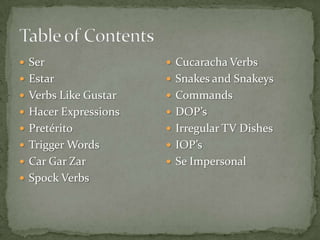
Table of ContentsSerEstarVerbs Like GustarHacer ExpressionsPretéritoTrigger WordsCar Gar ZarSpock VerbsCucaracha VerbsSnakes and SnakeysCommandsDOP’sIrregular TV DishesIOP’sSe Impersonal
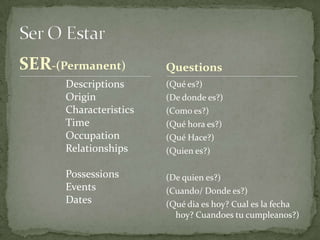
SER-(Permanent)DescriptionsOriginCharacteristicsTimeOccupationRelationshipsPossessionsEventsDates(Quées?)(De dondees?)(Como es?)(Quéhoraes?)(QuéHace?)(Quienes?)(De quienes?)(Cuando/ Dondees?)(Quédiaeshoy? Cuales la fechahoy? Cuandoestucumpleanos?)Ser O EstarQuestions
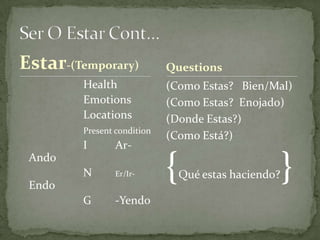
Estar-(Temporary) 			Health		Emotions		LocationsPresent condition			I	Ar- Ando		N	Er/Ir- Endo		G	-Yendo(Como Estas?   Bien/Mal)(Como Estas?  Enojado)(DondeEstas?)(Como Está?){Quéestashaciendo?}Ser O Estar Cont…Questions
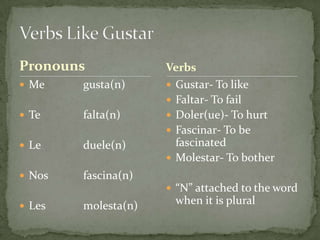
PronounsMe		gusta(n)Te		falta(n)Le		duele(n)Nosfascina(n)Les		molesta(n)Gustar- To likeFaltar- To failDoler(ue)- To hurtFascinar- To be fascinatedMolestar- To bother“N” attached to the word when it is pluralVerbs Like GustarVerbs
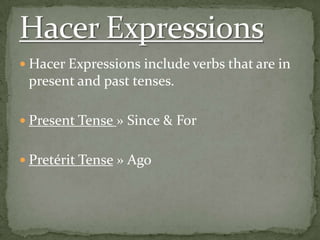
Hacer Expressions include verbs that are in present and past tenses.Present Tense » Since & ForPretérit Tense » AgoHacer Expressions
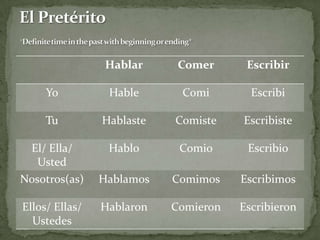
El Pretérito*Definite time in the past with beginning or ending*
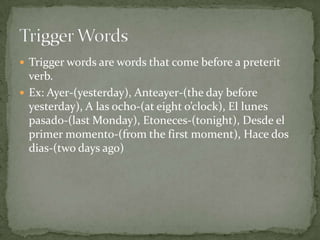
Trigger words are words that come before a preterit verb.Ex: Ayer-(yesterday), Anteayer-(the day before yesterday), A lasocho-(at eight o’clock), El lunespasado-(last Monday), Etoneces-(tonight), Desde el primer momento-(from the first moment), Hace dos dias-(two days ago)Trigger Words
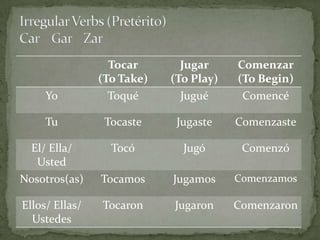
Irregular Verbs (Pretérito)Car	Gar	Zar
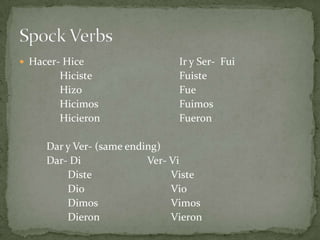
Hacer- HiceIr y Ser-  FuiHicisteFuisteHizoFueHicimosFuimosHicieronFueronDar y Ver- (same ending)Dar- Di			Ver- ViDisteVisteDioVioDimosVimosDieronVieronSpock Verbs
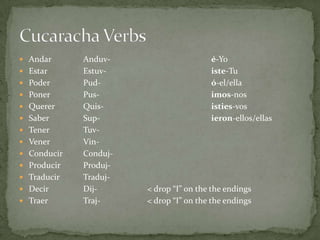
AndarAnduv-				é-YoEstarEstuv-				iste-TuPoderPud-				ó-el/ellaPoner		Pus-				imos-nosQuererQuis-				isties-vosSaber		Sup-				ieron-ellos/ellasTenerTuv-Vener		Vin-ConducirConduj-ProducirProduj-TraducirTraduj-DecirDij-		< drop “I” on the the endingsTraer		Traj-		< drop “I” on the the endingsCucaracha Verbs
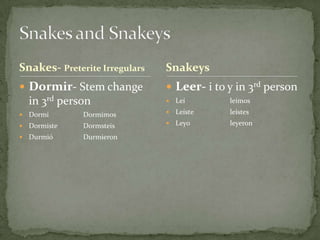
Snakes- Preterite IrregularsDormir- Stem change in 3rd personDormiDormimosDormisteDormsteisDurmióDurmieronLeer- i to y in 3rd personLeíleímosLeísteleístesLeyoleyeronSnakes and SnakeysSnakeys
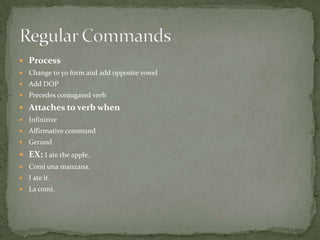
ProcessChange to yo form and add opposite vowelAdd DOP Precedes conjugated verbAttaches to verb whenInfinitiveAffirmative commandGerundEX: I ate the apple.Comíunamanzana.I ate it.La comí.Regular Commands
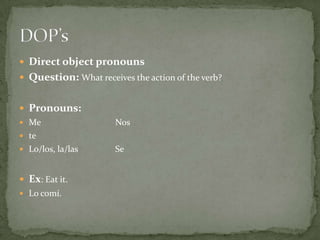
Direct object pronounsQuestion: What receives the action of the verb?Pronouns:Me			NosteLo/los, la/las		SeEx: Eat it.Lo comí.DOP’s
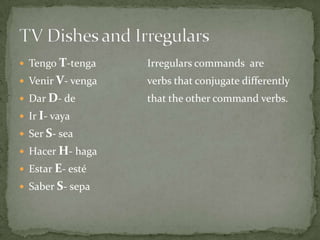
TengoT-tenga		Irregulars commands  are VenirV- venga		verbs that conjugate differentlyDar D- de			that the other command verbs.IrI- vayaSer S- seaHacerH- hagaEstarE- estéSaber S- sepaTV Dishes and Irregulars
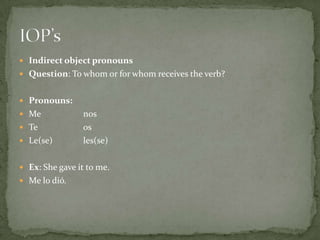
Indirect object pronounsQuestion: To whom or for whom receives the verb?Pronouns:Me		nosTe		osLe(se)	les(se)Ex: She gave it to me.Me lo dió.IOP’s
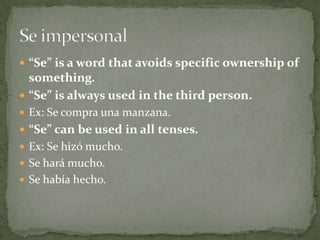
“Se” is a word that avoids specific ownership of something.“Se” is always used in the third person.Ex: Se compraunamanzana.“Se” can be used in all tenses.Ex: Se hizó mucho.Se hará mucho.Se habíahecho.Se impersonal

Semester proj mtb