GRAMÁTICA LIBRO
Por: Isabel Trammell
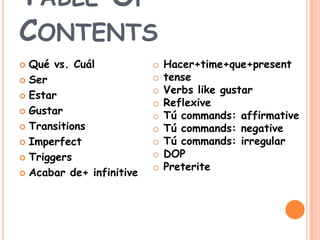
TABLE OF
CONTENTS
 Qué vs. Cuál            o   Hacer+time+que+present
 Ser                     o   tense
                          o   Verbs like gustar
 Estar
                          o   Reflexive
 Gustar
                          o   Tú commands: affirmative
 Transitions             o   Tú commands: negative
 Imperfect               o   Tú commands: irregular
 Triggers                o   DOP
                          o   Preterite
 Acabar de+ infinitive
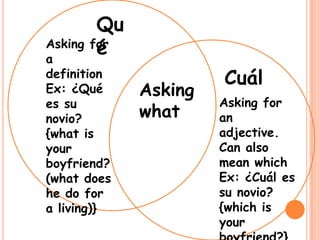
Qu
        é
Asking for
a
definition
                      Cuál
Ex: ¿Qué     Asking
es su                 Asking for
novio?       what     an
{what is              adjective.
your                  Can also
boyfriend?            mean which
(what does            Ex: ¿Cuál es
he do for             su novio?
a living)}            {which is
                      your
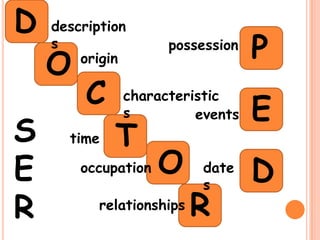
D   description
    s                possession
                                  P
    O   origin

         C    characteristic
              s         events    E
S     time   T
E       occupation   O     date
                                  D
                           s

R          relationships   R
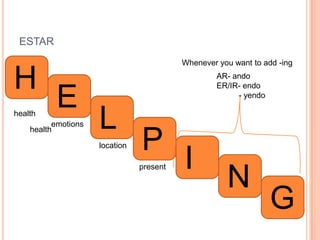
ESTAR
                                          Whenever you want to add -ing

H                                                  AR- ando
                                                   ER/IR- endo

          E                                             - yendo

health
    health
          emotions   L
                     location   P
                                present   I
                                                     N
                                                                  G
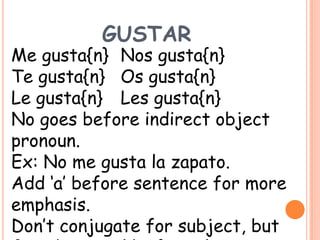
GUSTAR
Me gusta{n} Nos gusta{n}
Te gusta{n} Os gusta{n}
Le gusta{n} Les gusta{n}
No goes before indirect object
pronoun.
Ex: No me gusta la zapato.
Add ‘a’ before sentence for more
emphasis.
Don’t conjugate for subject, but
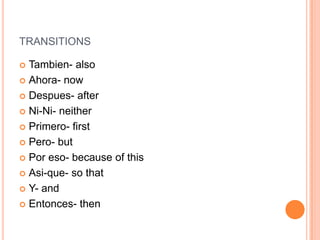
TRANSITIONS

 Tambien- also
 Ahora- now

 Despues- after

 Ni-Ni- neither

 Primero- first

 Pero- but

 Por eso- because of this

 Asi-que- so that

 Y- and

 Entonces- then
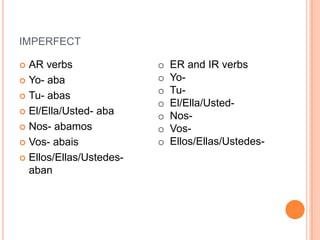
IMPERFECT

 AR verbs               o   ER and IR verbs
 Yo- aba                o   Yo-
                         o   Tu-
 Tu- abas
                         o   El/Ella/Usted-
 El/Ella/Usted- aba
                         o   Nos-
 Nos- abamos            o   Vos-
 Vos- abais             o   Ellos/Ellas/Ustedes-
 Ellos/Ellas/Ustedes-
  aban
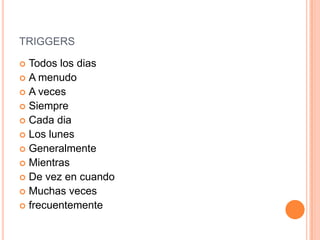
TRIGGERS

 Todos los dias
 A menudo
 A veces
 Siempre
 Cada dia
 Los lunes
 Generalmente
 Mientras
 De vez en cuando
 Muchas veces
 frecuentemente
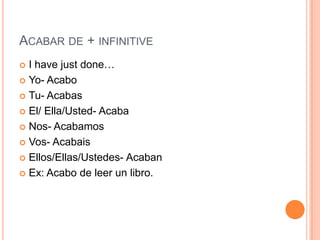
ACABAR DE + INFINITIVE
 I have just done…
 Yo- Acabo

 Tu- Acabas

 El/ Ella/Usted- Acaba

 Nos- Acabamos

 Vos- Acabais

 Ellos/Ellas/Ustedes- Acaban

 Ex: Acabo de leer un libro.
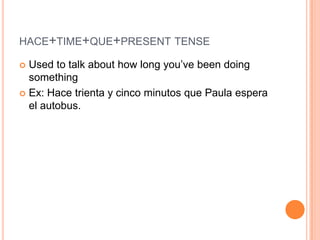
HACE+TIME+QUE+PRESENT TENSE

 Used to talk about how long you‟ve been doing
  something
 Ex: Hace trienta y cinco minutos que Paula espera
  el autobus.
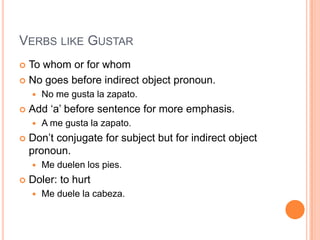
VERBS LIKE GUSTAR
 To whom or for whom
 No goes before indirect object pronoun.
       No me gusta la zapato.
   Add „a‟ before sentence for more emphasis.
       A me gusta la zapato.
   Don‟t conjugate for subject but for indirect object
    pronoun.
       Me duelen los pies.
   Doler: to hurt
       Me duele la cabeza.
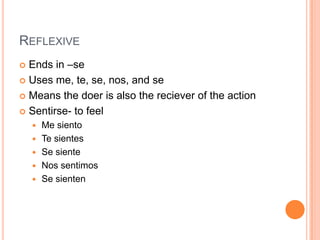
REFLEXIVE
 Ends in –se
 Uses me, te, se, nos, and se

 Means the doer is also the reciever of the action

 Sentirse- to feel
       Me siento
       Te sientes
       Se siente
       Nos sentimos
       Se sienten
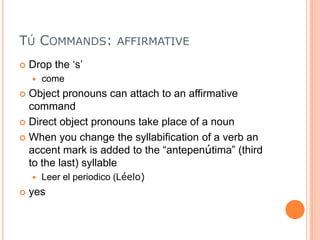
TÚ COMMANDS: AFFIRMATIVE
   Drop the „s‟
       come
 Object pronouns can attach to an affirmative
  command
 Direct object pronouns take place of a noun

 When you change the syllabification of a verb an
  accent mark is added to the “antepenútima” (third
  to the last) syllable
       Leer el periodico (Léelo)
   yes
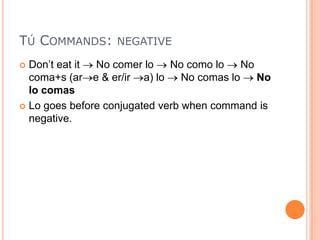
TÚ COMMANDS: NEGATIVE
 Don‟t eat it No comer lo    No como lo     No
  coma+s (ar e & er/ir a) lo     No comas lo    No
  lo comas
 Lo goes before conjugated verb when command is
  negative.
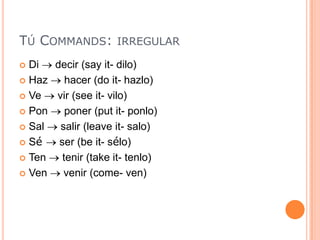
TÚ COMMANDS: IRREGULAR
 Di  decir (say it- dilo)
 Haz    hacer (do it- hazlo)
 Ve  vir (see it- vilo)
 Pon    poner (put it- ponlo)
 Sal  salir (leave it- salo)
 Sé   ser (be it- sélo)
 Ten   tenir (take it- tenlo)
 Ven   venir (come- ven)
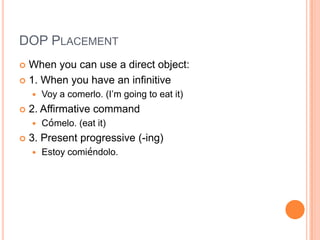
DOP PLACEMENT
 When you can use a direct object:
 1. When you have an infinitive
       Voy a comerlo. (I‟m going to eat it)
   2. Affirmative command
       Cómelo. (eat it)
   3. Present progressive (-ing)
       Estoy comiéndolo.
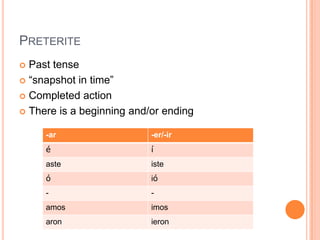
PRETERITE
 Past tense
 “snapshot in time”

 Completed action

 There is a beginning and/or ending


     -ar                   -er/-ir
     é                     í
     aste                  iste
     ó                     ió
     -                     -
     amos                  imos
     aron                  ieron

Grammar book

  • 1.
  • 2.
    TABLE OF CONTENTS  Quévs. Cuál o Hacer+time+que+present  Ser o tense o Verbs like gustar  Estar o Reflexive  Gustar o Tú commands: affirmative  Transitions o Tú commands: negative  Imperfect o Tú commands: irregular  Triggers o DOP o Preterite  Acabar de+ infinitive
  • 3.
    Qu é Asking for a definition Cuál Ex: ¿Qué Asking es su Asking for novio? what an {what is adjective. your Can also boyfriend? mean which (what does Ex: ¿Cuál es he do for su novio? a living)} {which is your
  • 4.
    D description s possession P O origin C characteristic s events E S time T E occupation O date D s R relationships R
  • 5.
    ESTAR Whenever you want to add -ing H AR- ando ER/IR- endo E - yendo health health emotions L location P present I N G
  • 6.
    GUSTAR Me gusta{n} Nosgusta{n} Te gusta{n} Os gusta{n} Le gusta{n} Les gusta{n} No goes before indirect object pronoun. Ex: No me gusta la zapato. Add ‘a’ before sentence for more emphasis. Don’t conjugate for subject, but
  • 7.
    TRANSITIONS  Tambien- also Ahora- now  Despues- after  Ni-Ni- neither  Primero- first  Pero- but  Por eso- because of this  Asi-que- so that  Y- and  Entonces- then
  • 8.
    IMPERFECT  AR verbs o ER and IR verbs  Yo- aba o Yo- o Tu-  Tu- abas o El/Ella/Usted-  El/Ella/Usted- aba o Nos-  Nos- abamos o Vos-  Vos- abais o Ellos/Ellas/Ustedes-  Ellos/Ellas/Ustedes- aban
  • 9.
    TRIGGERS  Todos losdias  A menudo  A veces  Siempre  Cada dia  Los lunes  Generalmente  Mientras  De vez en cuando  Muchas veces  frecuentemente
  • 10.
    ACABAR DE +INFINITIVE  I have just done…  Yo- Acabo  Tu- Acabas  El/ Ella/Usted- Acaba  Nos- Acabamos  Vos- Acabais  Ellos/Ellas/Ustedes- Acaban  Ex: Acabo de leer un libro.
  • 11.
    HACE+TIME+QUE+PRESENT TENSE  Usedto talk about how long you‟ve been doing something  Ex: Hace trienta y cinco minutos que Paula espera el autobus.
  • 12.
    VERBS LIKE GUSTAR To whom or for whom  No goes before indirect object pronoun.  No me gusta la zapato.  Add „a‟ before sentence for more emphasis.  A me gusta la zapato.  Don‟t conjugate for subject but for indirect object pronoun.  Me duelen los pies.  Doler: to hurt  Me duele la cabeza.
  • 13.
    REFLEXIVE  Ends in–se  Uses me, te, se, nos, and se  Means the doer is also the reciever of the action  Sentirse- to feel  Me siento  Te sientes  Se siente  Nos sentimos  Se sienten
  • 14.
    TÚ COMMANDS: AFFIRMATIVE  Drop the „s‟  come  Object pronouns can attach to an affirmative command  Direct object pronouns take place of a noun  When you change the syllabification of a verb an accent mark is added to the “antepenútima” (third to the last) syllable  Leer el periodico (Léelo)  yes
  • 15.
    TÚ COMMANDS: NEGATIVE Don‟t eat it No comer lo No como lo No coma+s (ar e & er/ir a) lo No comas lo No lo comas  Lo goes before conjugated verb when command is negative.
  • 16.
    TÚ COMMANDS: IRREGULAR Di decir (say it- dilo)  Haz hacer (do it- hazlo)  Ve vir (see it- vilo)  Pon poner (put it- ponlo)  Sal salir (leave it- salo)  Sé ser (be it- sélo)  Ten tenir (take it- tenlo)  Ven venir (come- ven)
  • 17.
    DOP PLACEMENT  Whenyou can use a direct object:  1. When you have an infinitive  Voy a comerlo. (I‟m going to eat it)  2. Affirmative command  Cómelo. (eat it)  3. Present progressive (-ing)  Estoy comiéndolo.
  • 18.
    PRETERITE  Past tense “snapshot in time”  Completed action  There is a beginning and/or ending -ar -er/-ir é í aste iste ó ió - - amos imos aron ieron