Reading
Comprehension
Assessments
University of the Punjab , Department of
Language & Literature. Lahore, Pakistan
Reading is a Purposeful
Activity
A person may read in order
to:
 gain information
 verify existing knowledge
 enhance knowledge
have access to the literature
for enjoyment
Reading Speed
• Normal :
200 to 220 words per
minute
Average:
250 and 350 WPM
• A Good:
500 to 700 WPM
• Exceptional Speed:
1000 WPM or more
Reading
ComprehensionInteractive Process: between the reader and
the text
The Text Presents:
Letters ,Words
Sentences
Paragraphs that encode
meaning
The Reader Uses:
Knowledge
Skills
Strategies to determine what that
meaning is resulted in
Comprehension (understanding of text)
Types of
Comprehension
 Literal
Comprehensio
n
 Reorganizati
on
 Prediction
 Inference
 Evaluation
 Personal
Types of
ComprehensionLiteral Comprehension:
An understanding of the straightforward
meaning of the text:
Facts
Vocabulary
Dates, Times
Locations
Types of
Comprehension
Reorganization:
 A literal understanding of
the text
Student use information
from various parts of the
text for additional
understanding
Types of
ComprehensionPrediction:
• To determine what might
happen next or after a story
ends
• Students use their
Understanding of the
passage
Knowledge of the topic and
Related matters
In a systematic fashion
Varieties of Prediction:
 While-reading
Post- reading
Types of
ComprehensionInference:
It involves students
combining
their literal
understanding of the text
with
 their own knowledge
and intuitions
Types of
ComprehensionEvaluation:
It requires the learner to
give a global or
comprehensive judgment
about some aspect of the
text
Personal Response:
It requires readers to
respond with their
feelings for the text
and the subject
The answers are not
found in the text; they
come strictly from the
readers
Types of
Comprehension
Objectives of Reading
Tests
• Reading comprehension test can
help you to:
– improve vocabulary
– grammar
– logical thought ability
Some tips for Improving
Reading Skills• Practice reading every day
• You should read different fields to improve
your vocabulary
• Take note all new words and learn them
• Try to answer all the questions
• After answer all the questions
• Check the key and read the passage again to
find out the mistake you have faced and deeply
understand the passage you have read
Reading Techniques
• Scanning: You try to find a particular piece of information.
You read from top to down of the text quickly to find the
specific information you need to answer questions.
• Skimming: You try to gather the most important information as
quickly as possible. You read from top to down of the text
quickly and note important information.
• Intensive reading: You try to find the details of a specific
information. Example question: What does "intensive" in line 5
mean?
• Extensive reading: You try to find general information of a
passage. Example question: What is the best title for this
passage?
Types of Reading
Comprehension Test
• Multiple Choice
Questions
• Short Answer
Questions
• True/False
Questions
Multiple Choice Questions
A student chooses one answer from
a number of choices
Parts of a MCQ :
A stem the text of the question
An options the choices provided
after the stem
The key the correct answer in the
list of options
Distracters the incorrect answers in
the list of options
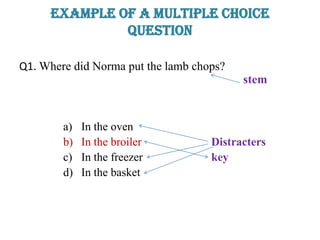
Example of a Multiple Choice
Question
Q1. Where did Norma put the lamb chops?
stem
a) In the oven
b) In the broiler Distracters
c) In the freezer key
d) In the basket
Assessments
Students’ knowledge :
to assess the depth and breadth
Components of Blooms taxonomy:
Knowledge
Comprehension
Application
Analysis and
Evaluation can be tested
through MCQs
It require less time:
to administer for a given
amount of material
Assessments
A comprehensive Evaluation
of the candidate's extent of
knowledge
Better Measurement Tool :
MCQs responses are easily
scored with accuracy and
objectivity
The strongest predictors : of
overall student performance
Creativity : cannot be tested
Rote Learning: some students
engage in rote learning
Limited Types of Knowledge:
is assessed by MCQ tests
Low-order Skills: MCQs are
best for testing well-defined or
lower-order
skills
Disadvantages
No Credit for knowing :
If student selects the wrong answer
A Chance of Receiving A Mark:
To select a random answer
Changing Answers
“right to wrong" changes is 20.2%
"wrong to right" changes is
57.8%, nearly triple
Conclusion
• MCQs have been criticized as a
"ridiculous kind of
mechanization" that transforms
knowledge in crossword puzzles
• MCQs area legitimate method of
competence testing
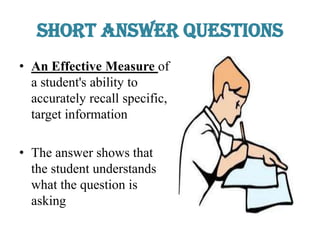
Short Answer Questions
• An Effective Measure of
a student's ability to
accurately recall specific,
target information
• The answer shows that
the student understands
what the question is
asking
Advantages
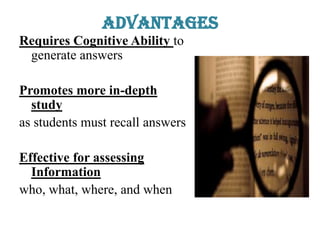
Requires Cognitive Ability to
generate answers
Promotes more in-depth
study
as students must recall answers
Effective for assessing
Information
who, what, where, and when
Provide diagnostic information
when looking at types of errors
Quicker for students
to complete than MCQs
Effective
as either a written or oral
assessment
Disadvantages
Generally Limited
To knowledge
To comprehension questions
Rote Learning:
Encouraging rote memorization
May overestimate learning
 due to bluffing
Accuracy of Assessment
may be influenced by
Handwriting
Spelling skills
Difficult to Write
items so that desired knowledge
is clear
Conclusion
One means of measuring this
type of higher-order
understanding
short answer items can also
be utilized to assess
 knowledge
 Comprehension
understanding
 Application
 Synthesis
 Analysis, and
Evaluation levels
True/False (binary-choice)
Questions
• A true-false questions is
a form of the multiple-
choice format
• There are only two
possible alternatives
Advantages
Efficient Method of
Testing
a wide range of material
in a short period of time
Well Suited for Measuring
knowledge,
comprehensive, and
Application levels of
understanding
Advantages
To measure a student’s
ability:
To identify whether
statements of fact are
accurate or not
To recognize the accuracy of
a declarative statement
Disadvantages
May overestimate learning
due to the influence of
guessing
Difficult to differentiate
between effective difficult
items and trick items
Often leads to testing of
trivial facts or bits of
information
Disadvantages
Generally less Discriminating
than multiple-choice items
Often criticized for
encouraging
rote memorization
Conclusion
They can also be combined
within a multiple-choice to
create the more complex
assertion-reason item
However, true-false questions
do have a number of
limitations
Reading Comprehension Assessment

Reading Comprehension Assessment

  • 1.
    Reading Comprehension Assessments University of thePunjab , Department of Language & Literature. Lahore, Pakistan
  • 2.
    Reading is aPurposeful Activity A person may read in order to:  gain information  verify existing knowledge  enhance knowledge have access to the literature for enjoyment
  • 3.
    Reading Speed • Normal: 200 to 220 words per minute Average: 250 and 350 WPM • A Good: 500 to 700 WPM • Exceptional Speed: 1000 WPM or more
  • 4.
    Reading ComprehensionInteractive Process: betweenthe reader and the text The Text Presents: Letters ,Words Sentences Paragraphs that encode meaning The Reader Uses: Knowledge Skills Strategies to determine what that meaning is resulted in Comprehension (understanding of text)
  • 5.
    Types of Comprehension  Literal Comprehensio n Reorganizati on  Prediction  Inference  Evaluation  Personal
  • 6.
    Types of ComprehensionLiteral Comprehension: Anunderstanding of the straightforward meaning of the text: Facts Vocabulary Dates, Times Locations
  • 7.
    Types of Comprehension Reorganization:  Aliteral understanding of the text Student use information from various parts of the text for additional understanding
  • 8.
    Types of ComprehensionPrediction: • Todetermine what might happen next or after a story ends • Students use their Understanding of the passage Knowledge of the topic and Related matters In a systematic fashion Varieties of Prediction:  While-reading Post- reading
  • 9.
    Types of ComprehensionInference: It involvesstudents combining their literal understanding of the text with  their own knowledge and intuitions
  • 10.
    Types of ComprehensionEvaluation: It requiresthe learner to give a global or comprehensive judgment about some aspect of the text
  • 11.
    Personal Response: It requiresreaders to respond with their feelings for the text and the subject The answers are not found in the text; they come strictly from the readers Types of Comprehension
  • 12.
    Objectives of Reading Tests •Reading comprehension test can help you to: – improve vocabulary – grammar – logical thought ability
  • 13.
    Some tips forImproving Reading Skills• Practice reading every day • You should read different fields to improve your vocabulary • Take note all new words and learn them • Try to answer all the questions • After answer all the questions • Check the key and read the passage again to find out the mistake you have faced and deeply understand the passage you have read
  • 14.
    Reading Techniques • Scanning:You try to find a particular piece of information. You read from top to down of the text quickly to find the specific information you need to answer questions. • Skimming: You try to gather the most important information as quickly as possible. You read from top to down of the text quickly and note important information. • Intensive reading: You try to find the details of a specific information. Example question: What does "intensive" in line 5 mean? • Extensive reading: You try to find general information of a passage. Example question: What is the best title for this passage?
  • 15.
    Types of Reading ComprehensionTest • Multiple Choice Questions • Short Answer Questions • True/False Questions
  • 16.
    Multiple Choice Questions Astudent chooses one answer from a number of choices Parts of a MCQ : A stem the text of the question An options the choices provided after the stem The key the correct answer in the list of options Distracters the incorrect answers in the list of options
  • 17.
    Example of aMultiple Choice Question Q1. Where did Norma put the lamb chops? stem a) In the oven b) In the broiler Distracters c) In the freezer key d) In the basket
  • 18.
    Assessments Students’ knowledge : toassess the depth and breadth Components of Blooms taxonomy: Knowledge Comprehension Application Analysis and Evaluation can be tested through MCQs It require less time: to administer for a given amount of material
  • 19.
    Assessments A comprehensive Evaluation ofthe candidate's extent of knowledge Better Measurement Tool : MCQs responses are easily scored with accuracy and objectivity The strongest predictors : of overall student performance
  • 20.
    Creativity : cannotbe tested Rote Learning: some students engage in rote learning Limited Types of Knowledge: is assessed by MCQ tests Low-order Skills: MCQs are best for testing well-defined or lower-order skills
  • 21.
    Disadvantages No Credit forknowing : If student selects the wrong answer A Chance of Receiving A Mark: To select a random answer Changing Answers “right to wrong" changes is 20.2% "wrong to right" changes is 57.8%, nearly triple
  • 22.
    Conclusion • MCQs havebeen criticized as a "ridiculous kind of mechanization" that transforms knowledge in crossword puzzles • MCQs area legitimate method of competence testing
  • 23.
    Short Answer Questions •An Effective Measure of a student's ability to accurately recall specific, target information • The answer shows that the student understands what the question is asking
  • 24.
    Advantages Requires Cognitive Abilityto generate answers Promotes more in-depth study as students must recall answers Effective for assessing Information who, what, where, and when
  • 25.
    Provide diagnostic information whenlooking at types of errors Quicker for students to complete than MCQs Effective as either a written or oral assessment
  • 26.
    Disadvantages Generally Limited To knowledge Tocomprehension questions Rote Learning: Encouraging rote memorization May overestimate learning  due to bluffing
  • 27.
    Accuracy of Assessment maybe influenced by Handwriting Spelling skills Difficult to Write items so that desired knowledge is clear
  • 28.
    Conclusion One means ofmeasuring this type of higher-order understanding short answer items can also be utilized to assess  knowledge  Comprehension understanding  Application  Synthesis  Analysis, and Evaluation levels
  • 29.
    True/False (binary-choice) Questions • Atrue-false questions is a form of the multiple- choice format • There are only two possible alternatives
  • 30.
    Advantages Efficient Method of Testing awide range of material in a short period of time Well Suited for Measuring knowledge, comprehensive, and Application levels of understanding
  • 31.
    Advantages To measure astudent’s ability: To identify whether statements of fact are accurate or not To recognize the accuracy of a declarative statement
  • 32.
    Disadvantages May overestimate learning dueto the influence of guessing Difficult to differentiate between effective difficult items and trick items Often leads to testing of trivial facts or bits of information
  • 33.
    Disadvantages Generally less Discriminating thanmultiple-choice items Often criticized for encouraging rote memorization
  • 34.
    Conclusion They can alsobe combined within a multiple-choice to create the more complex assertion-reason item However, true-false questions do have a number of limitations