The Scope Of Semantics
Class : 5B
Ayi Yulianty 112122058
Alifya Nurul Fauziah 112122076
Rizki Aryanti 112122079
Naming
• Language might be thought of as a
communication system with on the
one hand “the signifier”, and on the
other “the signified”.
• Signifier ----------- Signified
• a word the object in
• in the language the world that it
• stands for/ refers to/
• denotes
• Problems with this view:
 Words, then, are „names‟ or „labels‟ for
things.
 It seems to apply only to nouns; therefore,
it seems impossible to extend the theory
of naming to include the other parts of
speech.
 Adjectives : beautiful, handsome,
difficult, etc
 Verbs : run, think, swim, etc
 Others: prepositions, conjunctions,
pronouns
• Abstract Nouns ???
– e.g. love, hate, inspiration, nonsense
That is to say:
Words are not just names of things
Words are not simply names of the
objects of our experience.
• Even where there are identifiable
physical objects, the meaning is not
necessarily the same as its
denotation.
Scientific vs Common knowledge
• e.g. tomato vs apple?
One possible way working out the
problem:
• Some words actually denote objects
That children learn some of them
as labels.
The reminder are used in some way
derived from the more basic use.
• Bertrand Russell :
object word
• Learned ostensibly, by pointing at
objects
dictionary word
• To be defined in terms of the object
words.
CONCEPTS
• According to de Saussure, as we have
seen, the linguistic sign consists of a
signifier and a signified, these are,
however, more strictly a sound image
and a concept, both linked by a
psychological 'associative' bond.
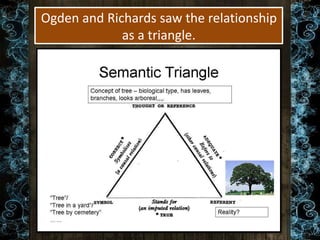
Ogden and Richards saw the relationship
as a triangle.
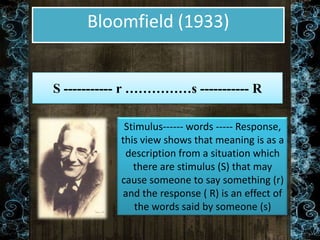
Bloomfield (1933)
S ----------- r ……………s ----------- R
Stimulus------ words ----- Response,
this view shows that meaning is as a
description from a situation which
there are stimulus (S) that may
cause someone to say something (r)
and the response ( R) is an effect of
the words said by someone (s)
The definition of sense:
Sense is abstract and de-
contextualized, and it refers to the
inherent meaning of the linguistic
form.
Sense is concerned only with intra-
linguistic relations.
It is the collection of all the semantic
features of the linguistic form.
The definition of reference:
Reference is what a linguistic
form points to in the real world.
It deals with the relationship
between the linguistic element
and the metalinguistic world of
experience.
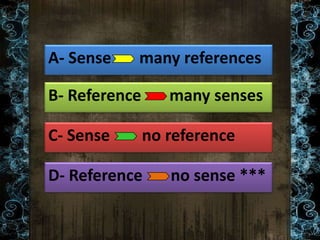
A- Sense many references
B- Reference many senses
C- Sense no reference
D- Reference no sense ***
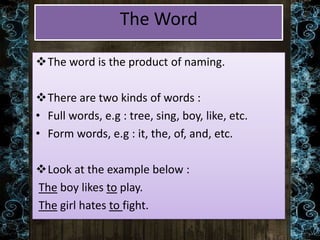
The Word
The word is the product of naming.
There are two kinds of words :
• Full words, e.g : tree, sing, boy, like, etc.
• Form words, e.g : it, the, of, and, etc.
Look at the example below :
The boy likes to play.
The girl hates to fight.
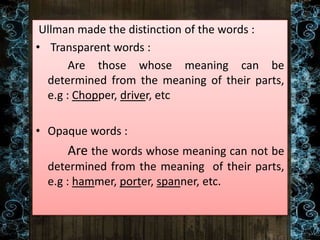
Ullman made the distinction of the words :
• Transparent words :
Are those whose meaning can be
determined from the meaning of their parts,
e.g : Chopper, driver, etc
• Opaque words :
Are the words whose meaning can not be
determined from the meaning of their parts,
e.g : hammer, porter, spanner, etc.
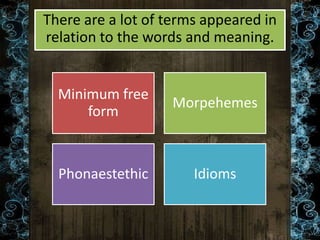
There are a lot of terms appeared in
relation to the words and meaning.
Minimum free
form
Morpehemes
Phonaestethic Idioms
The Sentence
The sentence is the expression of a complete
thought.
English sentence will minimally have a subject
noun phrase and the verb phrase. E.g : birds fly.
There are two possible meanings in the
sentence :
• Meaningful sentence
• Ambiguous sentence
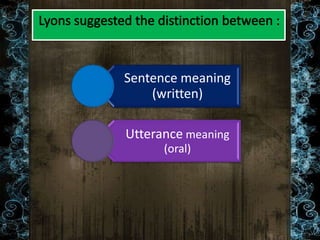
Sentence meaning
(written)
Utterance meaning
(oral)
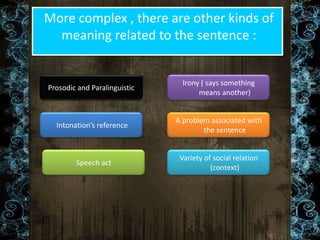
More complex , there are other kinds of
meaning related to the sentence :
Prosodic and Paralinguistic
Irony ( says something
means another)
Intonation’s reference
A problem associated with
the sentence
Variety of social relation
(context)
Speech act

the scope of semantics

  • 1.
    The Scope OfSemantics Class : 5B Ayi Yulianty 112122058 Alifya Nurul Fauziah 112122076 Rizki Aryanti 112122079
  • 2.
    Naming • Language mightbe thought of as a communication system with on the one hand “the signifier”, and on the other “the signified”. • Signifier ----------- Signified • a word the object in • in the language the world that it • stands for/ refers to/ • denotes
  • 3.
    • Problems withthis view:  Words, then, are „names‟ or „labels‟ for things.  It seems to apply only to nouns; therefore, it seems impossible to extend the theory of naming to include the other parts of speech.  Adjectives : beautiful, handsome, difficult, etc  Verbs : run, think, swim, etc  Others: prepositions, conjunctions, pronouns
  • 4.
    • Abstract Nouns??? – e.g. love, hate, inspiration, nonsense That is to say: Words are not just names of things Words are not simply names of the objects of our experience. • Even where there are identifiable physical objects, the meaning is not necessarily the same as its denotation.
  • 5.
    Scientific vs Commonknowledge • e.g. tomato vs apple? One possible way working out the problem: • Some words actually denote objects That children learn some of them as labels. The reminder are used in some way derived from the more basic use.
  • 6.
    • Bertrand Russell: object word • Learned ostensibly, by pointing at objects dictionary word • To be defined in terms of the object words.
  • 7.
    CONCEPTS • According tode Saussure, as we have seen, the linguistic sign consists of a signifier and a signified, these are, however, more strictly a sound image and a concept, both linked by a psychological 'associative' bond.
  • 8.
    Ogden and Richardssaw the relationship as a triangle.
  • 9.
    Bloomfield (1933) S -----------r ……………s ----------- R Stimulus------ words ----- Response, this view shows that meaning is as a description from a situation which there are stimulus (S) that may cause someone to say something (r) and the response ( R) is an effect of the words said by someone (s)
  • 10.
    The definition ofsense: Sense is abstract and de- contextualized, and it refers to the inherent meaning of the linguistic form. Sense is concerned only with intra- linguistic relations. It is the collection of all the semantic features of the linguistic form.
  • 11.
    The definition ofreference: Reference is what a linguistic form points to in the real world. It deals with the relationship between the linguistic element and the metalinguistic world of experience.
  • 12.
    A- Sense manyreferences B- Reference many senses C- Sense no reference D- Reference no sense ***
  • 13.
    The Word The wordis the product of naming. There are two kinds of words : • Full words, e.g : tree, sing, boy, like, etc. • Form words, e.g : it, the, of, and, etc. Look at the example below : The boy likes to play. The girl hates to fight.
  • 14.
    Ullman made thedistinction of the words : • Transparent words : Are those whose meaning can be determined from the meaning of their parts, e.g : Chopper, driver, etc • Opaque words : Are the words whose meaning can not be determined from the meaning of their parts, e.g : hammer, porter, spanner, etc.
  • 15.
    There are alot of terms appeared in relation to the words and meaning. Minimum free form Morpehemes Phonaestethic Idioms
  • 16.
    The Sentence The sentenceis the expression of a complete thought. English sentence will minimally have a subject noun phrase and the verb phrase. E.g : birds fly. There are two possible meanings in the sentence : • Meaningful sentence • Ambiguous sentence
  • 17.
  • 18.
    More complex ,there are other kinds of meaning related to the sentence : Prosodic and Paralinguistic Irony ( says something means another) Intonation’s reference A problem associated with the sentence Variety of social relation (context) Speech act