ENGLISH
GRAMMATICAL
  THEORY I

RELEVANCE THEORY

            Academic Year: 08-09
                   Blanca Pineda
                      Flory Inglés
              Alejandro González
INTRODUCTION:
TWO BASIC PRINCIPLES


          1)   Cognitive Principle
               (Human Cognition)

          2)   Communicative Principle
               (What utterances create)
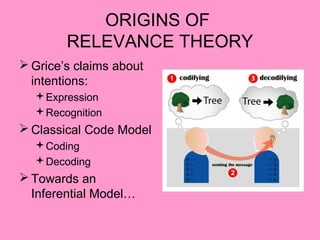
ORIGINS OF
        RELEVANCE THEORY
 Grice’s claims about
  intentions:
  Expression
  Recognition
 Classical Code Model
  Coding
  Decoding
 Towards an
  Inferential Model…
UTTERANCE: What is it?

            • DEFINITION:
              – “A linguistic coded
                piece of evidence”
                (Sperber & Wilson,
                2002)
            • Utterances
              automatically create
              expectations which
              gear the hearer.
RELEVANCE & COGNITION
•   Relevance can be considered from
    two points of view:
     – Intuitively
     – In relevance-theoretic terms
•   As a consequence:
    – The search for relevance is a basic
      feature of human cognition
    – Utterances raising expectations of
      relevance are not so because they are
      expected to obey a Cooperative
      Principle and maxims of any
      communicative convention.
About INPUTS:
• Relevance of inputs is measured by
  POSITIVE COGNITIVE EFFECTS.
  – Intuitively, ANY input might be relevant.
  – In relevance-theoretic terms, IF and ONLY IF those
    inputs draw true conclusions.
Cognitive Effects

• Contextual:
  – Source must be, altogether:
     1) the input itself
     2) the context
• Other types:
  – Revision of assumptions
The proportional
            relevance of inputs
• a) “The greater the
  positive cognitive
  effects – the greater
  the relevance would
  be.”
• b) “The greater the
  processing effort – the
  lower the relevance
  would be.”
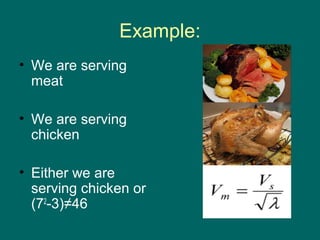
Example:
• We are serving
  meat

• We are serving
  chicken

• Either we are
  serving chicken or
  (72-3)≠46
• APPROACHES TO THE
  PROCESSING OF HUMAN
  COGNITION:
 – COMPARATIVE vs. QUANTITATIVE
   • “from the inside”
   • “from the outside”
Cognitive Principle

• This principle states that human cognition
  tends to be geared to the maximization of
  relevance.
  – potentially relevant stimuli
  – retrieval mechanisms
  – inferential mechanisms
RELEVANCE &
           COMMUNICATION

• Universal tendencies
  – ON THE SIDE OF THE
    HEARER:
    • TO CHOOSE THE MOST RELEVANT
      STIMULI
  – ON THE SIDE OF THE
    SPEAKER:
    • ATTRACT ATTENTION
    • PROMPT CONTEXTUAL ASSUMPTIONS
    • POINT US TOWARDS AN INTENDED
      CONCLUSION
TYPES OF STIMULI
• THEY CAN ACT:
   – COVERTLY
   – OVERTLY
• According to Grice, inferential communication is a matter
  of getting someone to recognize our intentions.
• It involves:
   – An informative intention
   – A communicative intention
• Thus, to achieve understanding, the informative
  intention must be recognized but not necessarily
  fulfilled
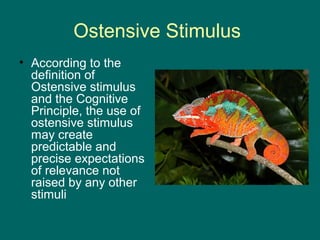
Ostensive Stimulus
• According to the
  definition of
  Ostensive stimulus
  and the Cognitive
  Principle, the use of
  ostensive stimulus
  may create
  predictable and
  precise expectations
  of relevance not
  raised by any other
  stimuli
Communicative Principle


“Every ostensive stimulus conveys and
creates a presumption of its own optimal
relevance”
Optimal Relevance

•   “Any ostensive stimulus is optimally
    relevant when:
    a) It is relevant enough to be worth the
       audience’s processing effort
    b) It is the most relevant one compatible with
       communicator’s abilities and preferences.
What if…
• … a communicator withholds relevant
  information?
  – This represents a problem for Grice’s Maxim of
    Quantity.

• For instance, when we get a silence as an
  answer, this silence could be or not an ostensive
  stimulus:
  – If it is not we would take it as an indication that the
    addressee is unable or unwilling to answer.
  – If he is willing to answer one must conclude that he is
    unable.
  – If he is able to answer one must conclude that he is
    unwilling
Achievements
• Relevance Theory, through the
  Communicative Principle and the definition
  of Optimal Relevance, suggests a
  practical procedure for performing these
  subtasks and constructing a hypothesis
  about the speaker’s meaning.
  – Follow a path of least effort
  – Complement it until the resulting interpretation
    meets your expectations of relevance
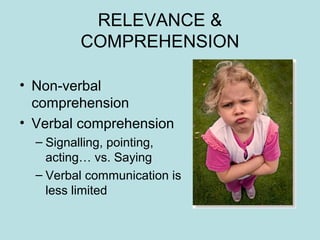
RELEVANCE &
         COMPREHENSION

• Non-verbal
  comprehension
• Verbal comprehension
  – Signalling, pointing,
    acting… vs. Saying
  – Verbal communication is
    less limited
Explicit Content

         • Since Grice,
           pragmatists have
           been continually
           disregarding the
           explicit contents of
           utterances in favour
           of the recovery of
           implicatures
The Comprehension Procedure
•   Relevance Theory, however, considers explicit
    content equally inferential, and equally ruled by
    the Communicative Principle.
•   It states a series of sub-tasks in the process of
    comprehension:
    a) Construct hypotheses about EXPLICATURES
       (v. ‘explicit content’)
    b) Construct hypotheses about IMPLICATED
       PREMISES
    c) Construct hypotheses about IMPLICATED
       CONCLUSIONS
How does this process work?

• It is not a sequential type of process.
• It is an all-at-once sort of mechanism.
• Hypotheses (of the three kinds) develop
  themselves against a background of
  EXPECTATIONS or ANTICIPATORY
  HYPOTHESES which might be revised
  during the very process.
EXAMPLE
   – Peter: Has John paid back the money he owes you?
   – Mary: No. He forgot to go to the bank.

Basic assumption: Mary’s answer WILL BE optimally relevant.
Anticipatory hypothesis: Her answer will give him the information
                          he is requesting
Hypothesis #1: [‘bank’ = financial institution] + [‘He’ = John]
Hypothesis #2: Forgetting to go to the bank could be a plausible
               cause for not repaying.
               OUR IMPLICATED PREMISE
Hypothesis #3: John was unable to repay Mary BECAUSE he
               forgot to go to the bank.
               OUR IMPLICATED CONCLUSION
In-depth analysis of the example
•    Consider the explicature: “No. He forgot (…)”
    1. Precise expectation produced by the ‘no’ utterance.
       Without it, the implicated conclusion could have
       been another.
    2. Resolution of reference: [HE] is referring to John…
       Not to his father, for instance.
    3. Disambiguation: [BANK1] as a financial institution,
       not as a river bank [BANK2], nor as a flight
       manoeuvre in which aircraft tips laterally about its
       longitudinal axis [BANK6]
In-depth analysis of the example (2)

• Communicative Principle accounts for Optimal Relevance.
   – Expectation is raised by Mary’s ostensive behaviour.
• Construction of the first implicated premise.
   – Assumption that forgetting to go to the bank is a cause
     for not having money
• Complementation of the explicature, combined with the
  implicated premise, produces an IMPLICATED CONCLUSION
   – Which, in turn, satisfies the expectation of optimal
     relevance.
Explicature & Implicature

• Considering the example, the conclusion
  is that there exists a process of “mutual
  parallel adjustment” between both.
• But we have not paid complete attention to
  the actual creation of the explicature
  through a series of lexical-pragmatic
  processes.
LEXICAL NARROWING
• LEXICAL UNIT: [BANK]
    • Its denotation MUST be that of a specific type of
      financial institutions, one that deals with private
      individuals.
    • If we change its denotation, we may not reach the
      same conclusions.
• [JOHN]
• [GO TO THE BANK]
Conclusions on Lexical Narrowing
• Relevance Theory differs from classic
  approaches in that it does not describe
  lexical narrowing simply as a sort of
  conversational implicature.
• In other words, ‘default interpretations’ do
  not apply in this model.
• Lexical narrowing is also part of the
  unstoppable search for relevance.
AD HOC Lexical Narrowing
• Most of the times, our lexical items are
  constructed ad hoc, in the very situation.
• “Bank”, in our example, could be referring
  to “cash-dispenser”. This is an even
  NARROWER interpretation.
• Consider cases like: Kleenex, Fairy or
  Post-it. These are LOOSE USES of the
  lexicon.
LOOSE USES OF LANGUAGE
• They present a problem for Grice, and his
  maxim of truthfulness, together with
  tropes:
  – Metaphors
  – Hyperboles
  – Irony
• Daily metaphors and hyperboles pass
  undetected, but according to Grice, they
  should not.
Relevance-theoretic explanation
• Loose talk, metaphor and hyperbole ARE
  NOT violations of any maxim.
• They are “alternative routes to achieving
  optimal relevance”.
     • E.g. – What do you think of this presentation?
            – It’s putting me to sleep
• Most literal interpretations are not even
  tested before looking for figurative
  interpretations
Strong & Weak Implicatures
• Strong implicatures are ESSENTIAL to recover
  the interpretation that best satisfies the
  expectation of relevance.
  – This is typical of Instruction Manuals, for instance.
• Weak implicatures help in the construction of a
  relevant interpretation, but it is not unique,
  because the utterance suggests a range of
  similar possible implicatures.
  – This is usually called Poetic Language
IRONY
• For Grice, it is an overt violation of the
  maxim of truthfulness.
• It is, then, parallel to metaphors and
  hyperboles.
• They differ in the implications they convey
  – Metaphors imply similes based on what was said
  – Hyperboles imply a weakening of what was said
  – Irony implies the opposite of what was said
Criticism on Grice’s study of Irony
• Verbal irony is
  universal,
  spontaneous, untaught
  and unlearnt.
• How can we, then,
  rationally mean to say
  the opposite of what
  we say with
  meanings?
Alternative explanation
• Irony involves a special form of Interpretive use of
  language (as in reported speech)
   – ECHOIC USE: An utterance which achieves its
     relevance by expressing the speaker’s attitude to
     words or views tacitly attributed to someone else
E.g.: - That was a fantastic party
      - [happily] Fantastic.
      - [puzzled] Fantastic??
      - [irritated] Fantastic!!
• Therefore, irony involves the expression of a TACITLY
  DISSOCIATIVE ATTITUDE.
METAREPRESENTATION
• ILLOCUTIONARY ACTS:
  – Peter: Will you pay the money by Tuesday?
  – Mary: I will pay it by then.
• Higher-Level Explicatures:
  – Peter is asking Mary if she promises to pay by
    Tuesday.
• In other words, by asking, we do not make
  anything explicit. We do not say. We do the
  asking.
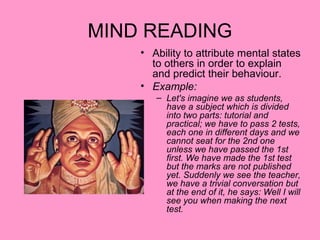
MIND READING
    • Ability to attribute mental states
      to others in order to explain
      and predict their behaviour.
    • Example:
       – Let's imagine we as students,
         have a subject which is divided
         into two parts: tutorial and
         practical; we have to pass 2 tests,
         each one in different days and we
         cannot seat for the 2nd one
         unless we have passed the 1st
         first. We have made the 1st test
         but the marks are not published
         yet. Suddenly we see the teacher,
         we have a trivial conversation but
         at the end of it, he says: Well I will
         see you when making the next
         test.
Regularity to the
          communicative domain
•    Only acts of ostensive
     communication create true
     presumptions of relevance
    1) Naively Optimistic interpreter – Acceptance
       without considering plausibility.
    2) Cautious Optimistic - Capability to deal with
       mistakes but not deliberate deception.
    3) Sophisticated Understander – Capability to deal
       with mistakes and deliberate deception.
CONCLUSION: AN EXPERIMENTALLY
            TESTABLE THEORY
• Relevance theory is a cognitive psychological theory.
• The Cognitive Principle of Relevance
• The Communicative Principle of Relevance
• Relevance theory does not provide an absolute measure
  of mental effort or cognitive effect and does not assume
  such a measure is available to spontaneous workings of
  the mind.
• Cognitive resources can be allocated by comparing
  relevance of inputs.
• The main obstacle to experimental comparisons of
  relevance theory is that in general the testable
  consequences of other pragmatic theories have not been
  made explicit.

Relevance Theory

  • 1.
    ENGLISH GRAMMATICAL THEORYI RELEVANCE THEORY Academic Year: 08-09 Blanca Pineda Flory Inglés Alejandro González
  • 2.
    INTRODUCTION: TWO BASIC PRINCIPLES 1) Cognitive Principle (Human Cognition) 2) Communicative Principle (What utterances create)
  • 3.
    ORIGINS OF RELEVANCE THEORY  Grice’s claims about intentions: Expression Recognition  Classical Code Model Coding Decoding  Towards an Inferential Model…
  • 4.
    UTTERANCE: What isit? • DEFINITION: – “A linguistic coded piece of evidence” (Sperber & Wilson, 2002) • Utterances automatically create expectations which gear the hearer.
  • 5.
    RELEVANCE & COGNITION • Relevance can be considered from two points of view: – Intuitively – In relevance-theoretic terms • As a consequence: – The search for relevance is a basic feature of human cognition – Utterances raising expectations of relevance are not so because they are expected to obey a Cooperative Principle and maxims of any communicative convention.
  • 6.
    About INPUTS: • Relevanceof inputs is measured by POSITIVE COGNITIVE EFFECTS. – Intuitively, ANY input might be relevant. – In relevance-theoretic terms, IF and ONLY IF those inputs draw true conclusions.
  • 7.
    Cognitive Effects • Contextual: – Source must be, altogether: 1) the input itself 2) the context • Other types: – Revision of assumptions
  • 8.
    The proportional relevance of inputs • a) “The greater the positive cognitive effects – the greater the relevance would be.” • b) “The greater the processing effort – the lower the relevance would be.”
  • 9.
    Example: • We areserving meat • We are serving chicken • Either we are serving chicken or (72-3)≠46
  • 10.
    • APPROACHES TOTHE PROCESSING OF HUMAN COGNITION: – COMPARATIVE vs. QUANTITATIVE • “from the inside” • “from the outside”
  • 11.
    Cognitive Principle • Thisprinciple states that human cognition tends to be geared to the maximization of relevance. – potentially relevant stimuli – retrieval mechanisms – inferential mechanisms
  • 12.
    RELEVANCE & COMMUNICATION • Universal tendencies – ON THE SIDE OF THE HEARER: • TO CHOOSE THE MOST RELEVANT STIMULI – ON THE SIDE OF THE SPEAKER: • ATTRACT ATTENTION • PROMPT CONTEXTUAL ASSUMPTIONS • POINT US TOWARDS AN INTENDED CONCLUSION
  • 13.
    TYPES OF STIMULI •THEY CAN ACT: – COVERTLY – OVERTLY • According to Grice, inferential communication is a matter of getting someone to recognize our intentions. • It involves: – An informative intention – A communicative intention • Thus, to achieve understanding, the informative intention must be recognized but not necessarily fulfilled
  • 14.
    Ostensive Stimulus • Accordingto the definition of Ostensive stimulus and the Cognitive Principle, the use of ostensive stimulus may create predictable and precise expectations of relevance not raised by any other stimuli
  • 15.
    Communicative Principle “Every ostensivestimulus conveys and creates a presumption of its own optimal relevance”
  • 16.
    Optimal Relevance • “Any ostensive stimulus is optimally relevant when: a) It is relevant enough to be worth the audience’s processing effort b) It is the most relevant one compatible with communicator’s abilities and preferences.
  • 17.
    What if… • …a communicator withholds relevant information? – This represents a problem for Grice’s Maxim of Quantity. • For instance, when we get a silence as an answer, this silence could be or not an ostensive stimulus: – If it is not we would take it as an indication that the addressee is unable or unwilling to answer. – If he is willing to answer one must conclude that he is unable. – If he is able to answer one must conclude that he is unwilling
  • 18.
    Achievements • Relevance Theory,through the Communicative Principle and the definition of Optimal Relevance, suggests a practical procedure for performing these subtasks and constructing a hypothesis about the speaker’s meaning. – Follow a path of least effort – Complement it until the resulting interpretation meets your expectations of relevance
  • 19.
    RELEVANCE & COMPREHENSION • Non-verbal comprehension • Verbal comprehension – Signalling, pointing, acting… vs. Saying – Verbal communication is less limited
  • 20.
    Explicit Content • Since Grice, pragmatists have been continually disregarding the explicit contents of utterances in favour of the recovery of implicatures
  • 21.
    The Comprehension Procedure • Relevance Theory, however, considers explicit content equally inferential, and equally ruled by the Communicative Principle. • It states a series of sub-tasks in the process of comprehension: a) Construct hypotheses about EXPLICATURES (v. ‘explicit content’) b) Construct hypotheses about IMPLICATED PREMISES c) Construct hypotheses about IMPLICATED CONCLUSIONS
  • 22.
    How does thisprocess work? • It is not a sequential type of process. • It is an all-at-once sort of mechanism. • Hypotheses (of the three kinds) develop themselves against a background of EXPECTATIONS or ANTICIPATORY HYPOTHESES which might be revised during the very process.
  • 23.
    EXAMPLE – Peter: Has John paid back the money he owes you? – Mary: No. He forgot to go to the bank. Basic assumption: Mary’s answer WILL BE optimally relevant. Anticipatory hypothesis: Her answer will give him the information he is requesting Hypothesis #1: [‘bank’ = financial institution] + [‘He’ = John] Hypothesis #2: Forgetting to go to the bank could be a plausible cause for not repaying. OUR IMPLICATED PREMISE Hypothesis #3: John was unable to repay Mary BECAUSE he forgot to go to the bank. OUR IMPLICATED CONCLUSION
  • 24.
    In-depth analysis ofthe example • Consider the explicature: “No. He forgot (…)” 1. Precise expectation produced by the ‘no’ utterance. Without it, the implicated conclusion could have been another. 2. Resolution of reference: [HE] is referring to John… Not to his father, for instance. 3. Disambiguation: [BANK1] as a financial institution, not as a river bank [BANK2], nor as a flight manoeuvre in which aircraft tips laterally about its longitudinal axis [BANK6]
  • 25.
    In-depth analysis ofthe example (2) • Communicative Principle accounts for Optimal Relevance. – Expectation is raised by Mary’s ostensive behaviour. • Construction of the first implicated premise. – Assumption that forgetting to go to the bank is a cause for not having money • Complementation of the explicature, combined with the implicated premise, produces an IMPLICATED CONCLUSION – Which, in turn, satisfies the expectation of optimal relevance.
  • 26.
    Explicature & Implicature •Considering the example, the conclusion is that there exists a process of “mutual parallel adjustment” between both. • But we have not paid complete attention to the actual creation of the explicature through a series of lexical-pragmatic processes.
  • 27.
    LEXICAL NARROWING • LEXICALUNIT: [BANK] • Its denotation MUST be that of a specific type of financial institutions, one that deals with private individuals. • If we change its denotation, we may not reach the same conclusions. • [JOHN] • [GO TO THE BANK]
  • 28.
    Conclusions on LexicalNarrowing • Relevance Theory differs from classic approaches in that it does not describe lexical narrowing simply as a sort of conversational implicature. • In other words, ‘default interpretations’ do not apply in this model. • Lexical narrowing is also part of the unstoppable search for relevance.
  • 29.
    AD HOC LexicalNarrowing • Most of the times, our lexical items are constructed ad hoc, in the very situation. • “Bank”, in our example, could be referring to “cash-dispenser”. This is an even NARROWER interpretation. • Consider cases like: Kleenex, Fairy or Post-it. These are LOOSE USES of the lexicon.
  • 30.
    LOOSE USES OFLANGUAGE • They present a problem for Grice, and his maxim of truthfulness, together with tropes: – Metaphors – Hyperboles – Irony • Daily metaphors and hyperboles pass undetected, but according to Grice, they should not.
  • 31.
    Relevance-theoretic explanation • Loosetalk, metaphor and hyperbole ARE NOT violations of any maxim. • They are “alternative routes to achieving optimal relevance”. • E.g. – What do you think of this presentation? – It’s putting me to sleep • Most literal interpretations are not even tested before looking for figurative interpretations
  • 32.
    Strong & WeakImplicatures • Strong implicatures are ESSENTIAL to recover the interpretation that best satisfies the expectation of relevance. – This is typical of Instruction Manuals, for instance. • Weak implicatures help in the construction of a relevant interpretation, but it is not unique, because the utterance suggests a range of similar possible implicatures. – This is usually called Poetic Language
  • 33.
    IRONY • For Grice,it is an overt violation of the maxim of truthfulness. • It is, then, parallel to metaphors and hyperboles. • They differ in the implications they convey – Metaphors imply similes based on what was said – Hyperboles imply a weakening of what was said – Irony implies the opposite of what was said
  • 34.
    Criticism on Grice’sstudy of Irony • Verbal irony is universal, spontaneous, untaught and unlearnt. • How can we, then, rationally mean to say the opposite of what we say with meanings?
  • 35.
    Alternative explanation • Ironyinvolves a special form of Interpretive use of language (as in reported speech) – ECHOIC USE: An utterance which achieves its relevance by expressing the speaker’s attitude to words or views tacitly attributed to someone else E.g.: - That was a fantastic party - [happily] Fantastic. - [puzzled] Fantastic?? - [irritated] Fantastic!! • Therefore, irony involves the expression of a TACITLY DISSOCIATIVE ATTITUDE.
  • 36.
    METAREPRESENTATION • ILLOCUTIONARY ACTS: – Peter: Will you pay the money by Tuesday? – Mary: I will pay it by then. • Higher-Level Explicatures: – Peter is asking Mary if she promises to pay by Tuesday. • In other words, by asking, we do not make anything explicit. We do not say. We do the asking.
  • 37.
    MIND READING • Ability to attribute mental states to others in order to explain and predict their behaviour. • Example: – Let's imagine we as students, have a subject which is divided into two parts: tutorial and practical; we have to pass 2 tests, each one in different days and we cannot seat for the 2nd one unless we have passed the 1st first. We have made the 1st test but the marks are not published yet. Suddenly we see the teacher, we have a trivial conversation but at the end of it, he says: Well I will see you when making the next test.
  • 38.
    Regularity to the communicative domain • Only acts of ostensive communication create true presumptions of relevance 1) Naively Optimistic interpreter – Acceptance without considering plausibility. 2) Cautious Optimistic - Capability to deal with mistakes but not deliberate deception. 3) Sophisticated Understander – Capability to deal with mistakes and deliberate deception.
  • 39.
    CONCLUSION: AN EXPERIMENTALLY TESTABLE THEORY • Relevance theory is a cognitive psychological theory. • The Cognitive Principle of Relevance • The Communicative Principle of Relevance • Relevance theory does not provide an absolute measure of mental effort or cognitive effect and does not assume such a measure is available to spontaneous workings of the mind. • Cognitive resources can be allocated by comparing relevance of inputs. • The main obstacle to experimental comparisons of relevance theory is that in general the testable consequences of other pragmatic theories have not been made explicit.