Semantics
Semantics
Problem Set 4due 5/20
Problem Set 5 due 5/29
Exercises for Chapter 6: 1, 2, 3, 12, 18 due 5/22
Goals for Semantics chapter
Not responsible for Section 3.4 (interpretation of pronouns)
You should know how to do the following:
Identify the relation among words and sentences
Understand the different theories of meaning
Structural versus lexical ambiguity
Thematic roles
Pragmatics - Especially 4.4 Conversational Maxims
Questions? Comments?
2.
Semantics
Semantics
Semantics
Semantics is thestudy of the meaning in human language.
Have you ever said in frustration, “Well that’s not what I
meant!” - what happened?
Semantics
Slide
1
3.
Semantics
Semantics
Semantic relations thatexist among words
Synonymy (words that are synonyms) - words that have the same meaning
in some or all contexts
Antonymy (words that are antonyms) - words that have the opposite
meaning of each other (with regard to some component of their meaning)
Polysemy - when a word has 2 or more related meanings
Homophony - when 2 words (same pronunciation) has 2 or more entirely
distinct meanings (sound the same but don’t have to have same spelling)
LEXICAL AMBIGUITY = when a single form has 2 or more
meanings (polysemy and homophony)
Semantics
Semantics
Slide
2
4.
Semantics
Semantics
Semantics
Semantic relations thatexist among phrases and sentences
Paraphrase (like synonyms) - 2 sentences that can have the same meaning
a. The cat chased the squirrel.
b. The squirrel was chased by the cat.
The relationship between the above sentences is that if one is true, then the other
must be true as well. They are said to have the same truth condition
When the truth of one sentence guarantees the truth of another, we say that there
is a relation of entailment - the above example is mutual in that either sentence
entails the other
Relation can be asymmetrical:
a. The cat killed the squirrel.
b. The squirrel is dead
If a is true, then b must be true, but not vice versa
Semantics
Slide
3
5.
Semantics
Semantics
Semantics
Contradiction - ifone sentence is true, than the other must be false
a. Jeff is an only child.
b. Jeff has an older sister.
Both sentences cannot both be true, then one contradicts the other
Semantics
Slide
4
6.
Semantics
Semantics
Semantics Practice
steal (torob)
steel (metal)
I saw Craig at the party.
It was Craig I saw at the party.
grass (cows eat)
grass (marijuana)
Jeff is an only child.
Jeff’s sister is Julie.
The cat killed the mouse.
The mouse is dead.
homophones
entailment
paraphrase
polysemes
contradiction
5
Semantics
Practice
Exercises 1, 2, 3
7.
Semantics
Semantics
Semantics
What exactly ismeaning?
As native speakers of a language, we all know the meaning of a great
many words in our language. If we don’t know the meaning, we look it
up in the dictionary. But to understand the definition, we have to know
the meaning of those words...
It is easier to determine the semantic relation between words than the
precise meaning of a word. There are attempts at some theories of
meaning...
Semantics
Slide
6
8.
Semantics
Semantics
Semantics
What exactly ismeaning? Theories of meaning
Connotation - according to this theory, a word’s meaning is simply the set
of associations that the word evokes - desert evokes hot, dry, sandy
Denotation - according to this theory, a word’s meaning is not the set of
associations it evokes, but rather the entity to which it refers = its denotation
or referent in the real world - desert would refer to that set of regions in the
world characterized by barrenness and lack of rain
Problems with these theories? A desert with no sand, unicorn, the President
of the United States AND the leader of the free world OR Michelle Obama’s
husband
Semantics
Slide
7
9.
Semantics
Semantics
Semantics
What exactly ismeaning?
Extension/Intensions - combines denotation and connotation - extension
refers to the referents in the real world and intension is the associations that a
word evokes. desert = extension = a barren, dry region in the world such as
the Gobi or Sahara. intension = having to do with barrenness and dryness, not
a specific region
Extension is the referent while intension is the mental image - in this
case, unicorn or ogre have no extension, only intension - but what about
Shrek?
Semantics
Slide
8
10.
Semantics
Semantics
Semantics
What exactly ismeaning? Theories of meaning
Componential Analysis - this theory is based on the idea that meaning can
be decomposed into smaller semantic units (like features in phonology).
[+living, +human, -adult] gives us the category child
Semantics
Slide
9
11.
Semantics
Semantics
Semantics
What exactly ismeaning? Problems with the theories
Connotation - different people have different associations for words, and
associations do not necessarily get at meaning
Denotation - it cannot account for entities that exist in an imaginary realm
Extension/Intension - can account for entities in imagination, but still
don’t get at what meaning actually is
Componential analysis - works relatively well, but it is difficult to specify
all the features that would be needed. Also, it is difficult to determine smaller
units of meaning for some words (blue versus yellow or orange)
Semantics
Slide
10
12.
Semantics
Semantics
Semantics Practice
Describe theintensions and extensions of each of theses phrases.
Semantics
Practice
a) the president of the US
b) the queen of England
c) the capital of Indiana
d) women who have walked on the
moon
e) my linguistics professor
Extension Intension
Barak Obama US head of state
Elizabeth II British monarch (or the wife of British
monarch)
Indianapolis city containing the state legislature
none set of females who have walked on the
lunar surface
Jeff the person charged with teaching the
ling course in which I am enrolled
11
13.
Semantics
Semantics
Semantics
Concepts -the system we use to identify, classify and organize all elements
of our experiences. Our conceptual system reveals how meaning is expressed
through language.
Fuzzy Concepts - concepts that can differ from person to person - no clear-
cut boundaries - expensive or even smart, beautiful, ugly
Semantics
Slide
12
14.
Semantics
Semantics
Semantics
Graded Membership -members of a concept can be graded according to
how typical they are within that concept - most typical is prototype - other
members are arranged around the prototype - members having more in
common with the prototype occur closer to the prototype, and less in common,
further away
What is meaning of vegetable? What is a prototypical vegetable?
Semantics
Slide
13
15.
Semantics
Semantics
Semantics
Metaphor -the concepts expressed by language do not exist in isolation,
but are interconnected and associated. Metaphor = the understanding of one
concept in terms of another can be used to make these connections.
emotions connected to up and down
Semantics
Slide
14
16.
Semantics
Semantics
Semantics
Lexicalization - processwhereby concepts are encoded into the words of a
language and is language specific. Some English words contain both the
concept of motion and the manner of motion (roll, crawl, slither). Spanish
does not and both concepts need to be lexicalized (2 different words - 1 for
motion and 1 for manner). Spanish has verbs (native English words do not)
that show motion and direction go up = subir; go down = bajar (Eskimo
words for snow/NW word for rain)
By studying what concepts are lexicalized we can find out if there are common
or universal concepts that are or are not lexicalized in any given language
See Figure 6.3 for example
Semantics
Slide
15
17.
Semantics
Semantics
Semantics
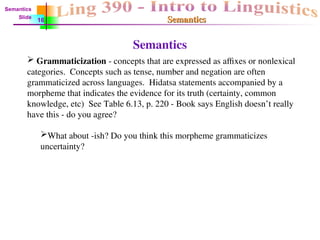
Grammaticization -concepts that are expressed as affixes or nonlexical
categories. Concepts such as tense, number and negation are often
grammaticized across languages. Hidatsa statements accompanied by a
morpheme that indicates the evidence for its truth (certainty, common
knowledge, etc) See Table 6.13, p. 220 - Book says English doesn’t really
have this - do you agree?
What about -ish? Do you think this morpheme grammaticizes
uncertainty?
Semantics
Slide
16
18.
Semantics
Semantics
Semantics
What about wanna,kinda, sorta, like? How do express future tense in Englsih?
will/gonna? going to gonna grammaticized only for future, not for any combination
of going + to.
Semantics
Slide
17
19.
Semantics
Semantics
Semantics Practice
In English,are these concepts fuzzy, graded or have been grammaticized?
the comparative or superlative
cats
mountains
time
vegetables
grammaticized
graded
graded
graded,
fuzzy
grammaticized
fuzzy
18
Semantics
Practice
20.
Semantics
Semantics
Semantics
Principle ofCompositionality - The meaning of a sentence is determined
by the meaning of its component parts and the manner in which they are
arranged in syntactic structure.
How is syntactic structure relevant for meaning?
Constructional meaning - the meaning of a sentence defined by the
construction
The caused motion construction
X causes Y to go somewhere: Jeff mashed the book into the backpack.
NP VP NP PP
The ditransitive construction
X causes Y to have Z: The bartender blended George a margarita.
NP VP NP NP
Semantics
Slide
19
21.
Semantics
Semantics
Semantics
Ambiguity
Structural Ambiguity -2 sentences with the same word order but with
different meanings due to the structural relationship that the sentences
have (e.g., I met the woman standing by the water cooler.)
wealthy men and women
Semantics
Slide
20
Semantics
Semantics
Semantics
Thematic Roles(theta roles) - used to categorize the relation between a
sentence’s parts and the event it describes.
Agent (actor) = the entity that performs the action
Theme = the entity undergoing an action of movement
Source = the starting point for a movement
Goal = the end point for a movement
Location = the place where an action takes place
Semantics
Slide
22
24.
Semantics
Semantics
Semantics Practice
Identify thethematic roles in the following examples
and determine which verb/preposition assigned the role
Sara drove the bus from Seattle to Portland.
The children ate their ice cream in the kitchen.
Which shoes did Jake buy at the store?
agent theme source goal
agent theme location
theme agent location
23
Semantics
Practice
Thematic Roles (theta roles) - used to categorize the relation between a
sentence’s parts and the event it describes.
Agent (actor) = the entity that performs the action
Theme = the entity undergoing an action of movement
Source = the starting point for a movement
Goal = the end point for a movement
Location = the place where an action takes place
25.
Semantics
Semantics
Semantics
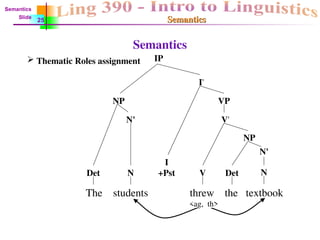
Thematic Rolesassignment - Thematic roles are assigned to NPs based on
their position within the sentence. Typically, verbs and prepositions assign
thematic roles.
VERBS: Assign the agent role to its subject NP; Assign the theme role to its
complement NP (Both are optional)
PREPOSITIONS: Assign a thematic role (the specific one depends on the
preposition) to its complement NP
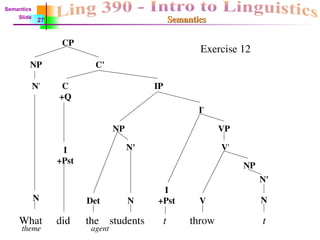
Thematic roles are assigned at deep structure. What did the students throw?
has the deep structure The students threw what - The verb threw assigns the
agent role to the students and the theme role to what. What retains this role
even after Move changes its position in the structure.
Semantics
Slide
24
Semantics
Semantics
What did thestudents t throw t
N
N'
NP
V
Det N
V'
VP
I'
+Pst
I
IP
N'
NP
C'
CP
NP
N'
N
C
+Q
+Pst
I
Semantics
Slide
27
Exercise 12
theme agent
29.
Semantics
Semantics
Pragmatics
Pragmatics -the study of meaning as it relates to speaker’s and addressee’s
background attitudes and beliefs, their understanding of the context in which a
sentence is uttered, and their knowledge of how language can be used to
inform, persuade, mislead, etc.
Focuses on utterances - sentences that are spoken within a given context
(the same sentence spoken 2 different times is 2 different utterances - why?)
Semantics
Slide
28
30.
Semantics
Semantics
Pragmatics
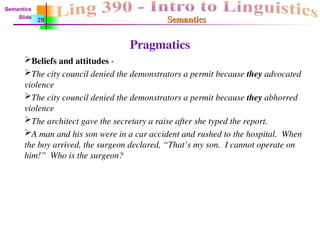
Beliefs and attitudes-
The city council denied the demonstrators a permit because they advocated
violence
The city council denied the demonstrators a permit because they abhorred
violence
The architect gave the secretary a raise after she typed the report.
A man and his son were in a car accident and rushed to the hospital. When
the boy arrived, the surgeon declared, “That’s my son. I cannot operate on
him!” Who is the surgeon?
Semantics
Slide
29
31.
Semantics
Semantics
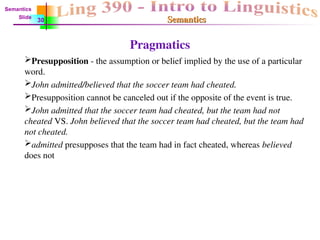
Pragmatics
Presupposition - theassumption or belief implied by the use of a particular
word.
John admitted/believed that the soccer team had cheated.
Presupposition cannot be canceled out if the opposite of the event is true.
John admitted that the soccer team had cheated, but the team had not
cheated VS. John believed that the soccer team had cheated, but the team had
not cheated.
admitted presupposes that the team had in fact cheated, whereas believed
does not
Semantics
Slide
30
32.
Semantics
Semantics
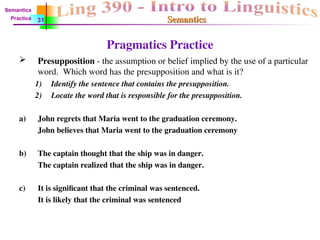
Pragmatics Practice
Presupposition- the assumption or belief implied by the use of a particular
word. Which word has the presupposition and what is it?
1) Identify the sentence that contains the presupposition.
2) Locate the word that is responsible for the presupposition.
a) John regrets that Maria went to the graduation ceremony.
John believes that Maria went to the graduation ceremony
b) The captain thought that the ship was in danger.
The captain realized that the ship was in danger.
c) It is significant that the criminal was sentenced.
It is likely that the criminal was sentenced
31
Semantics
Practice
33.
Semantics
Semantics
Pragmatics
Setting/Deictics - theform and interpretation of some words depend on the
location of the speaker and listener within a particular setting. These words are
called deictics.
here/there - this/that - these ones/those ones - can only have meaning from
their use
Semantics
Slide
32
34.
Semantics
Semantics
Pragmatics
Discourse - theterm used to describe the connected speech of utterances that are
produced during a conversation, lecture, story, or other kind of speech act.
Using pronouns in a story to refer back to already introduced nouns. Meaning
depends on the entire discourse.
Topic - old versus new information - differences in the use of a or the in English
Discourse words like anyways to start an utterance - what does this mean to you?
Semantics
Slide
33
35.
Semantics
Semantics
Pragmatics
How do weinterpret the following sentences and how does the choice of words
influence that interpretation?
1. Karen was killed/murdered in a car accident.
2. Kevin declared/acknowledged that the accusation was false.
3. a. A priest was at the hospital.
b. The priest was at a hospital.
4. When I come/go back to China, I’ll climb the Great Wall.
Semantics
Slide
34
36.
Semantics
Semantics
Pragmatics
Speech Acts:
Sometimes weactually do more than communicate thoughts during speech.
Things we do during speech (acts):
Apologize, compliment, make requests, etc.
The meaning of these speech acts often is from conventionalized forms - more than the words
themselves, but we have gotten used to requests in certain forms.
Can you hand me that book? What is the meaning of this question? What is the speech act?
Semantics
Slide
35
37.
Semantics
Semantics
Pragmatics
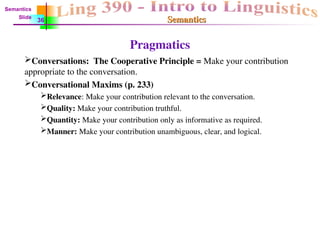
Conversations: The CooperativePrinciple = Make your contribution
appropriate to the conversation.
Conversational Maxims (p. 233)
Relevance: Make your contribution relevant to the conversation.
Quality: Make your contribution truthful.
Quantity: Make your contribution only as informative as required.
Manner: Make your contribution unambiguous, clear, and logical.
Semantics
Slide
36
38.
Semantics
Semantics
Pragmatics
Conversational Maxims (p.233)
Conversational Implicature: During the course of the conversation, we are
often able to make inferences about what is meant but was not actually said.
Implying a meaning in a given conversation by flouting the above maxims. (Not
lying)
EXAMPLES?
Semantics
Slide
37
39.
Semantics
Semantics
Pragmatics
Can you passthe salt?
Parent to child with injured arm vs. Parent to child at dinner.
What are the differences in what is implied/implicated?
Letter of rec for computer IT job that says: The employee always speaks
quietly and dresses well. Also, they don’t eat fish at lunch....
What maxim is being violated? What is the implicature of the letter?
38
Semantics
Slide
Exercise 18




![Semantics
Semantics
Semantics
What exactly is meaning? Theories of meaning
Componential Analysis - this theory is based on the idea that meaning can
be decomposed into smaller semantic units (like features in phonology).
[+living, +human, -adult] gives us the category child
Semantics
Slide
9](https://image.slidesharecdn.com/semantics-250923010111-0ed0e608/85/Semantics-used-in-different-contexts-ppt-10-320.jpg)










![Semantics [Report in Language Study]](https://cdn.slidesharecdn.com/ss_thumbnails/realreportinsemantics-151202145909-lva1-app6891-thumbnail.jpg?width=640&height=640&fit=bounds)


