LexicalChangePresented by:CaecilliaDevy
Whydoes a languageacquire new words?
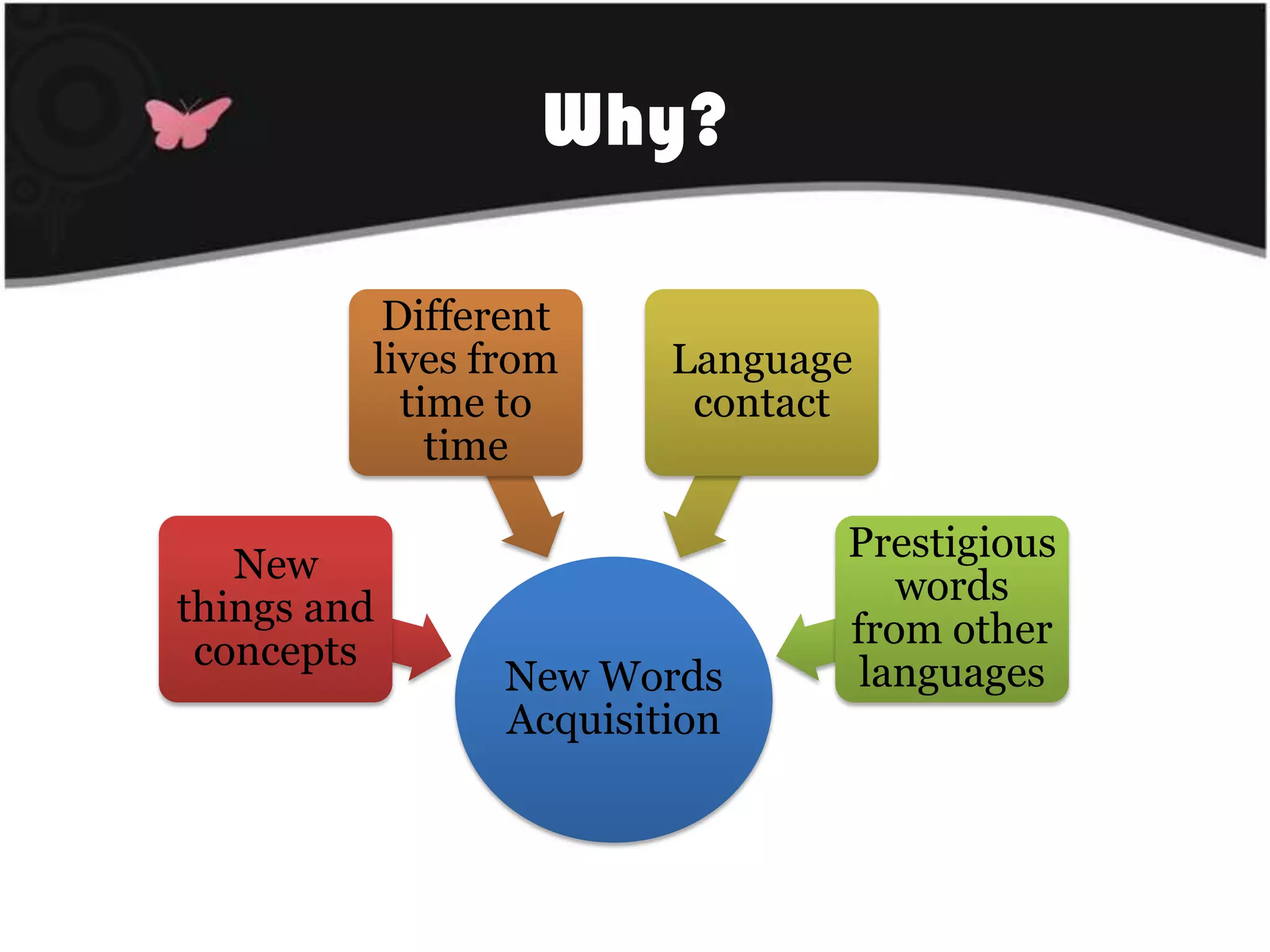
Why?
How?Adding new words to a language to use the existinginventory of lexical items.Creating new ones by meas of a regularword-formation process.Resultingtwo alternatives:The oldwordmaydisappear
Twowordsmaycoexsistexpressingroughly the same concept but differentmeaning or connotationsOld English-the Germanic Basis of English
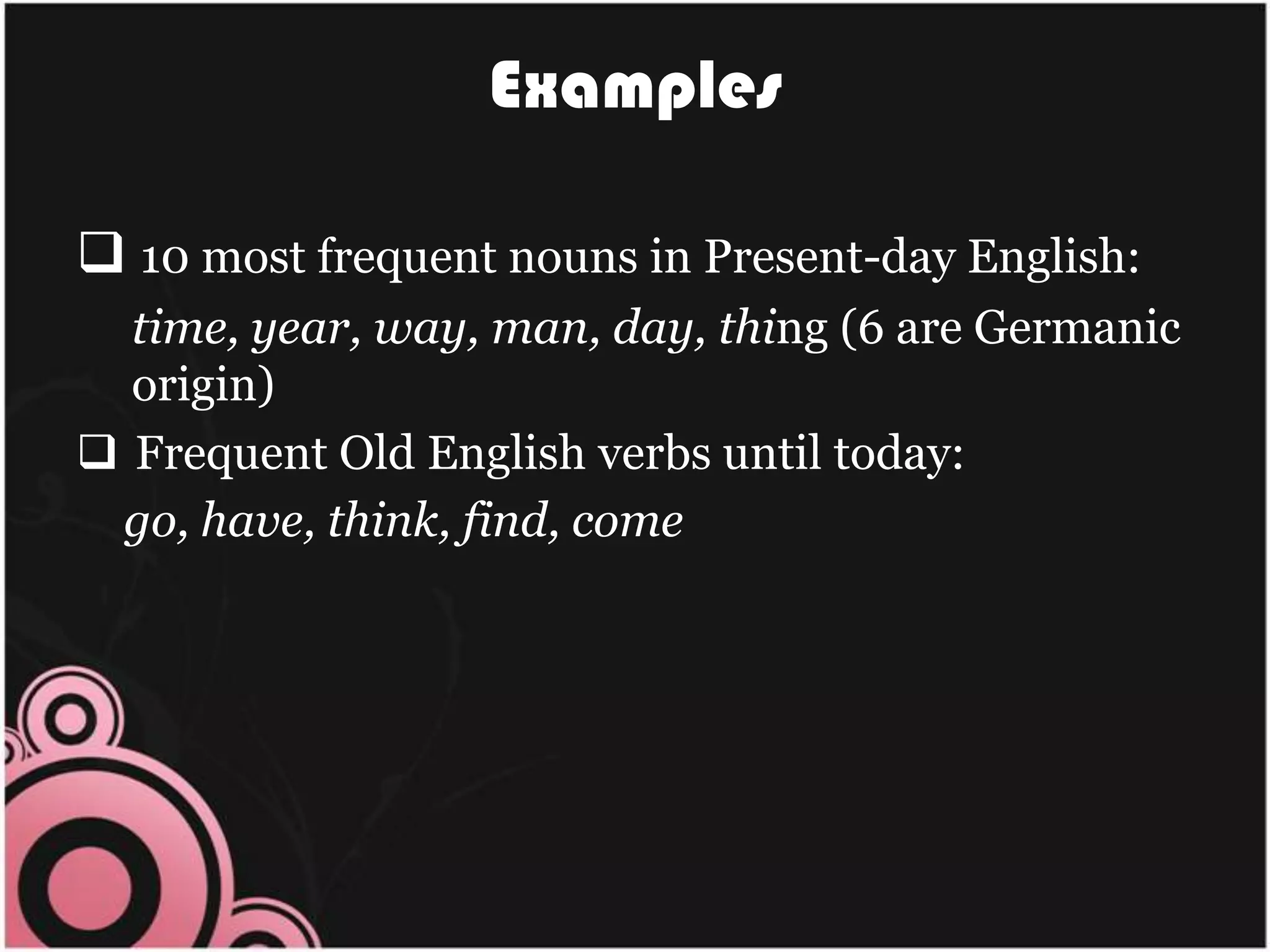
Examples10 mostfrequentnouns in Present-day English: time, year, way, man, day, thing (6 are Germanicorigin)FrequentOld English verbsuntiltoday:go, have, think, find, come
Borrowing I: Early Influences on English
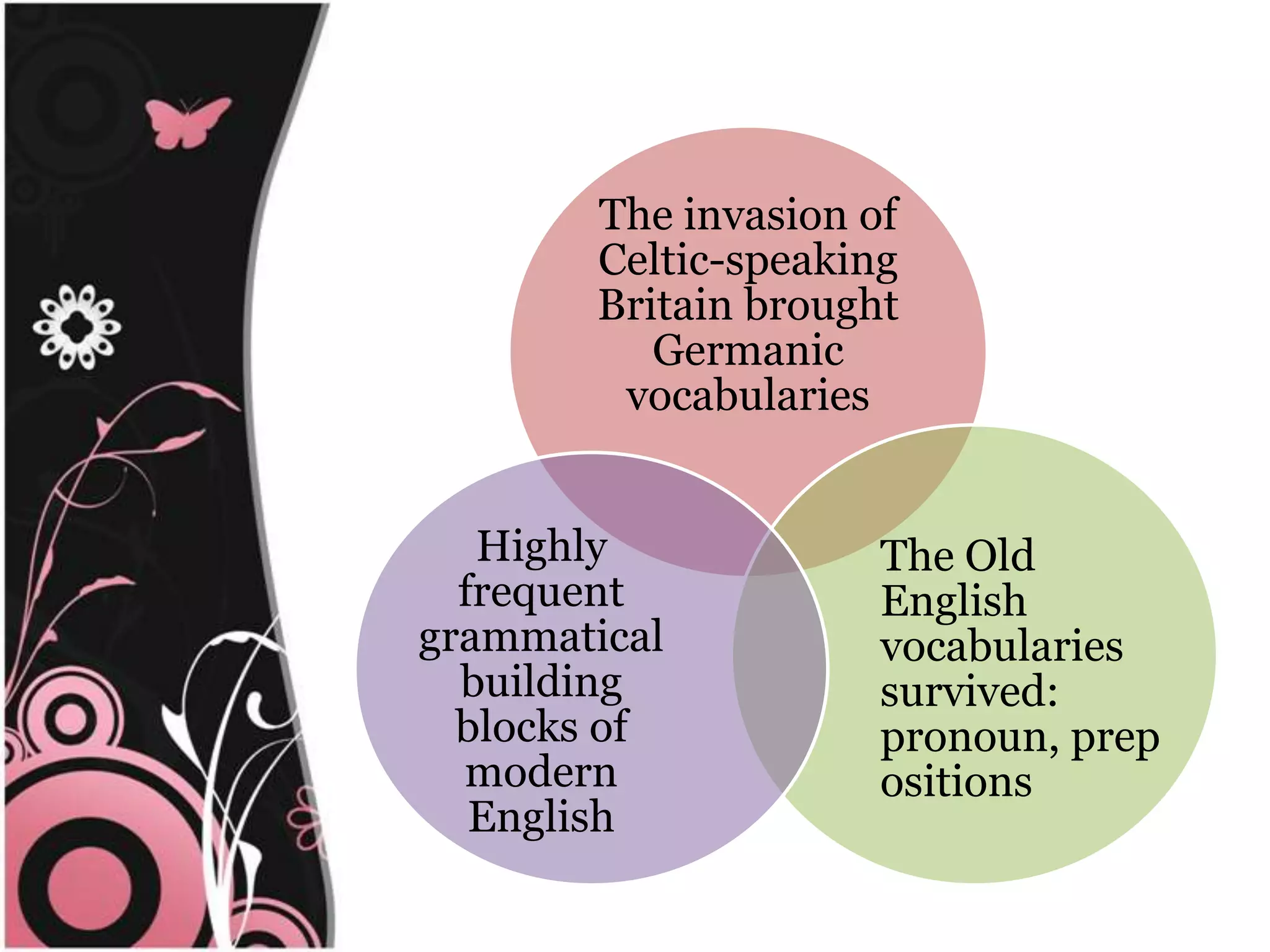
By the end of 7th century The Christianityconvertion influence Latin wordsblendwitheveryday English language.The new words: angel, altar, nun, monastery, priest, temple (religion context); and school, chest, sock, plant, fennel, fever(education, household and medicinecontext)	Contact with speakers of anotherlanguagebrings about the integration of words for new concepts.
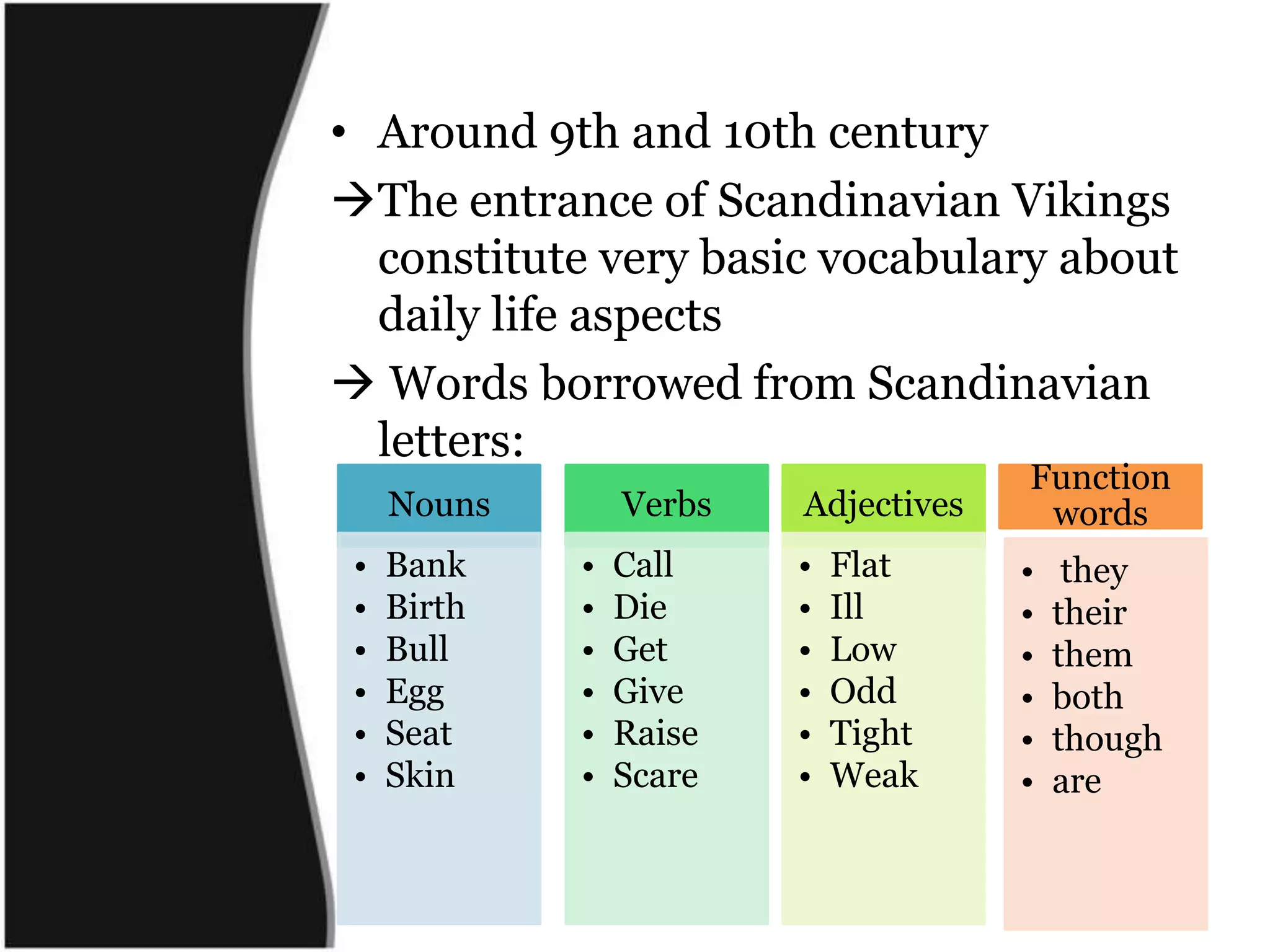
Around 9th and 10th centuryThe entrance of Scandinavian Vikings constitutevery basic vocabulary about daily life aspects
WordsborrowedfromScandinavianletters:The lexical items of the conquerer’slanguagewould have been adopted by the speakers.More prestigiouslanguagewins out in the bilingualismbringing the drop of the ancestor’slanguage.Prestige plays an important role in lexical change.  the dialectspoken in Danelawspread to all part of country not for quitesome time
Borrowing II: French Influence on English Vocabulary
England’s 3 spoken language used by different people with different purpose:English for the native English
French for the new ruling elite
Latin for the religious, science and learningNew words to express the new concepts as French rule changed the society  borrowing French wordsnew ways of governing the country, new laws, new food, new fashionsPrestigiousnamesneeded to do withadministarion, warfare, and arts.Latin continued to be an influentiallanguage and to be a source for new English words.The contact withwrittenlanguagebrought the borrowingwordsenteringEnglish.The words are more formal and stylisticallyelevatedthanFrench borrowings.
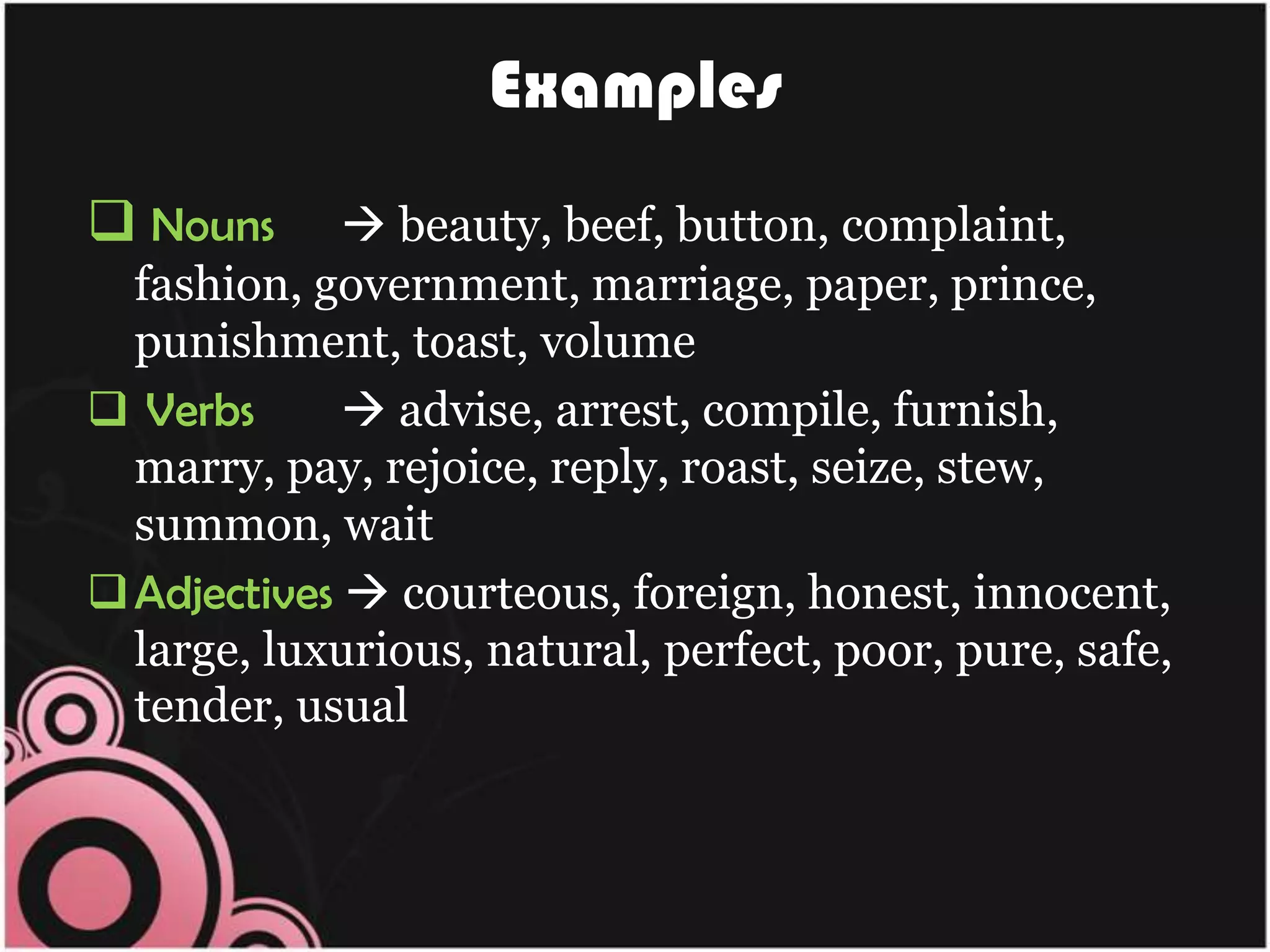
ExamplesNouns beauty, beef, button, complaint, fashion, government, marriage, paper, prince, punishment, toast, volume
Verbs advise, arrest, compile, furnish, marry, pay, rejoice, reply, roast, seize, stew, summon, wait
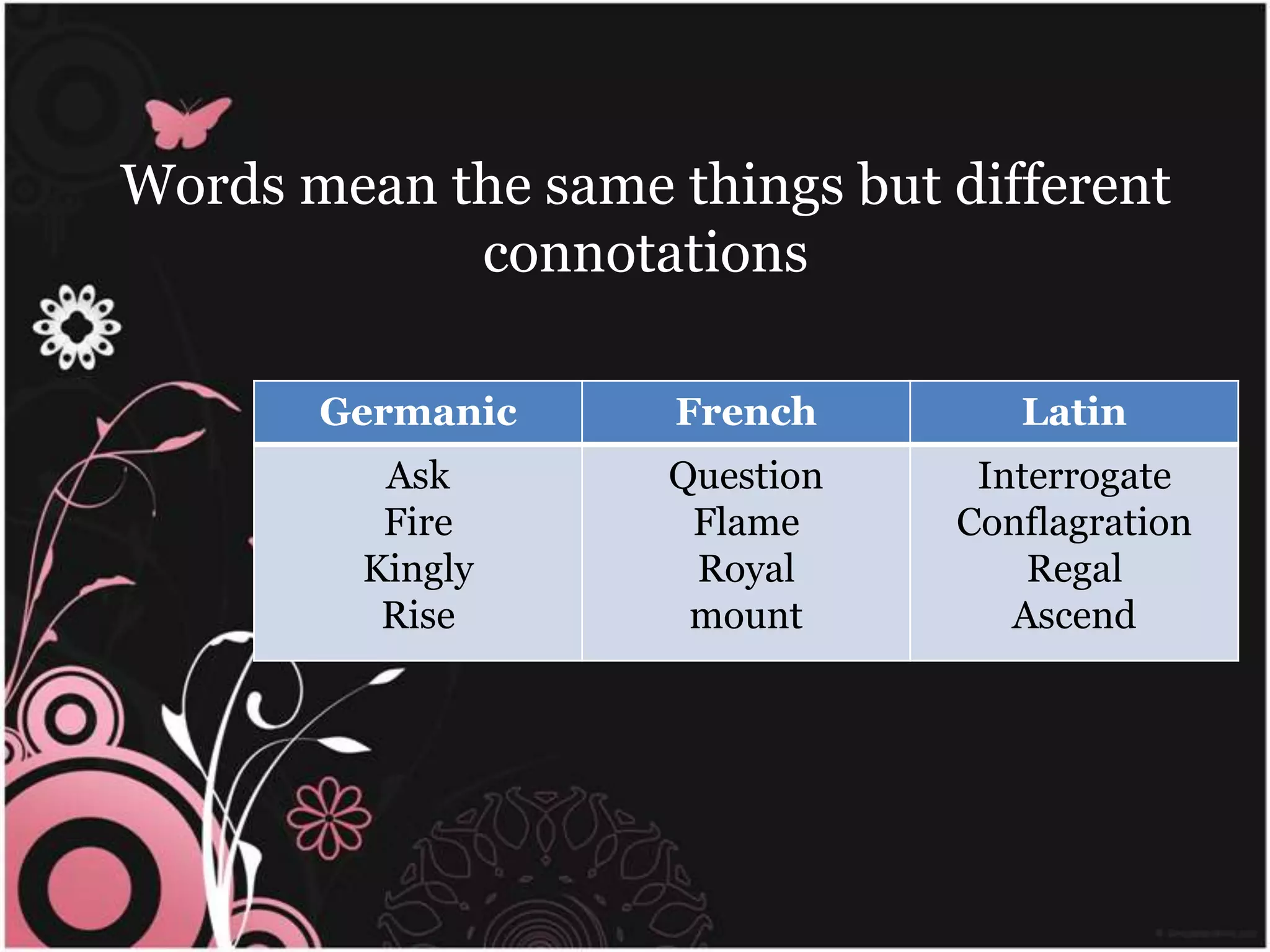
Adjectives courteous, foreign, honest, innocent, large, luxurious, natural, perfect, poor, pure, safe, tender, usualWordsmean the samethings but different connotations
Borrowing III: fromEarly Modern to Present-Day English
 In 17th century: the decline of latin-enormousincrese in specialistknowledge in the science
Inadequatelanguage ‘enrichment’  of language
Turning to Latin and alsoGreek to expand English vocabulary
The expression of ‘inkhornterm’ 	 useless and artificialadditions of the massive influx of borrowing	 disappearedwords:  adminiculation ‘aid’, accersited ‘summoned, sent for’, deruncinate ‘to weed’
The remained and form an essential part of the English lexicontoday:	Nouns: atmosphere, dexterity, disrespect, expectation	 Adjectives: conscipicious, habitual, malignant	 Verbs: assassinate, excavate, extinguish, meditateLatin and French borrowings: more elevated and formal style.Otherlanguageswereadded to the inventory of English written sources, direct contact withother cultures
Internal Lexical Change

Lexical change

  • 1.
  • 2.
  • 3.
  • 4.
    How?Adding new wordsto a language to use the existinginventory of lexical items.Creating new ones by meas of a regularword-formation process.Resultingtwo alternatives:The oldwordmaydisappear
  • 5.
    Twowordsmaycoexsistexpressingroughly the sameconcept but differentmeaning or connotationsOld English-the Germanic Basis of English
  • 7.
    Examples10 mostfrequentnouns inPresent-day English: time, year, way, man, day, thing (6 are Germanicorigin)FrequentOld English verbsuntiltoday:go, have, think, find, come
  • 8.
    Borrowing I: EarlyInfluences on English
  • 9.
    By the endof 7th century The Christianityconvertion influence Latin wordsblendwitheveryday English language.The new words: angel, altar, nun, monastery, priest, temple (religion context); and school, chest, sock, plant, fennel, fever(education, household and medicinecontext) Contact with speakers of anotherlanguagebrings about the integration of words for new concepts.
  • 10.
    Around 9th and10th centuryThe entrance of Scandinavian Vikings constitutevery basic vocabulary about daily life aspects
  • 11.
    WordsborrowedfromScandinavianletters:The lexical itemsof the conquerer’slanguagewould have been adopted by the speakers.More prestigiouslanguagewins out in the bilingualismbringing the drop of the ancestor’slanguage.Prestige plays an important role in lexical change.  the dialectspoken in Danelawspread to all part of country not for quitesome time
  • 12.
    Borrowing II: FrenchInfluence on English Vocabulary
  • 13.
    England’s 3 spokenlanguage used by different people with different purpose:English for the native English
  • 14.
    French for thenew ruling elite
  • 15.
    Latin for thereligious, science and learningNew words to express the new concepts as French rule changed the society  borrowing French wordsnew ways of governing the country, new laws, new food, new fashionsPrestigiousnamesneeded to do withadministarion, warfare, and arts.Latin continued to be an influentiallanguage and to be a source for new English words.The contact withwrittenlanguagebrought the borrowingwordsenteringEnglish.The words are more formal and stylisticallyelevatedthanFrench borrowings.
  • 16.
    ExamplesNouns beauty, beef,button, complaint, fashion, government, marriage, paper, prince, punishment, toast, volume
  • 17.
    Verbs advise, arrest,compile, furnish, marry, pay, rejoice, reply, roast, seize, stew, summon, wait
  • 18.
    Adjectives courteous, foreign,honest, innocent, large, luxurious, natural, perfect, poor, pure, safe, tender, usualWordsmean the samethings but different connotations
  • 19.
    Borrowing III: fromEarlyModern to Present-Day English
  • 20.
    In 17thcentury: the decline of latin-enormousincrese in specialistknowledge in the science
  • 21.
  • 22.
    Turning to Latinand alsoGreek to expand English vocabulary
  • 23.
    The expression of‘inkhornterm’  useless and artificialadditions of the massive influx of borrowing  disappearedwords: adminiculation ‘aid’, accersited ‘summoned, sent for’, deruncinate ‘to weed’
  • 24.
    The remained andform an essential part of the English lexicontoday: Nouns: atmosphere, dexterity, disrespect, expectation  Adjectives: conscipicious, habitual, malignant  Verbs: assassinate, excavate, extinguish, meditateLatin and French borrowings: more elevated and formal style.Otherlanguageswereadded to the inventory of English written sources, direct contact withother cultures
  • 25.
  • 26.
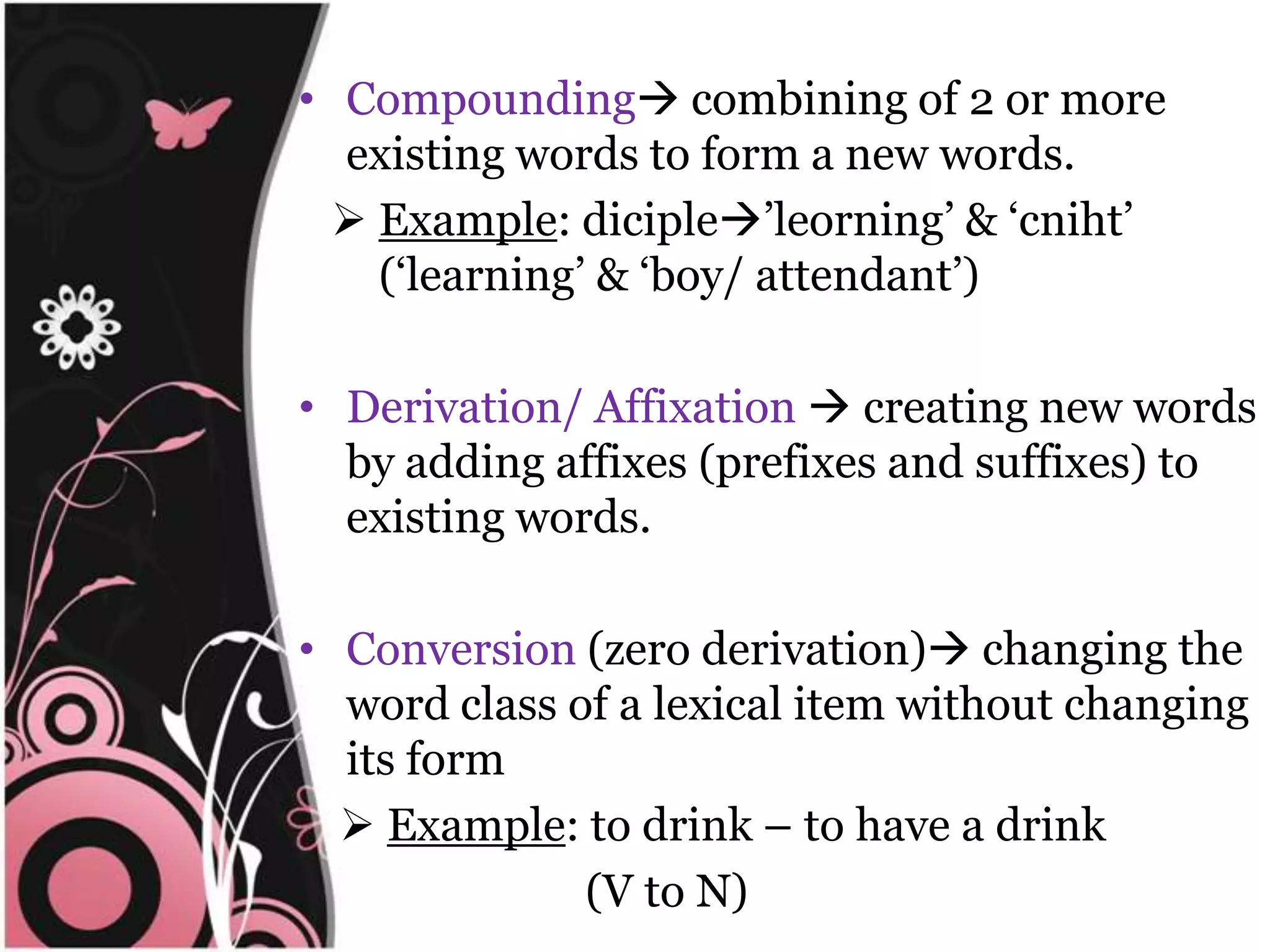
    Compounding combining of2 or more existing words to form a new words.Example: diciple’leorning’ & ‘cniht’ (‘learning’ & ‘boy/ attendant’) Derivation/ Affixation  creating new words by adding affixes (prefixes and suffixes) to existing words.Conversion (zero derivation) changing the word class of a lexical item without changing its form Example: to drink – to have a drink (V to N)
  • 27.
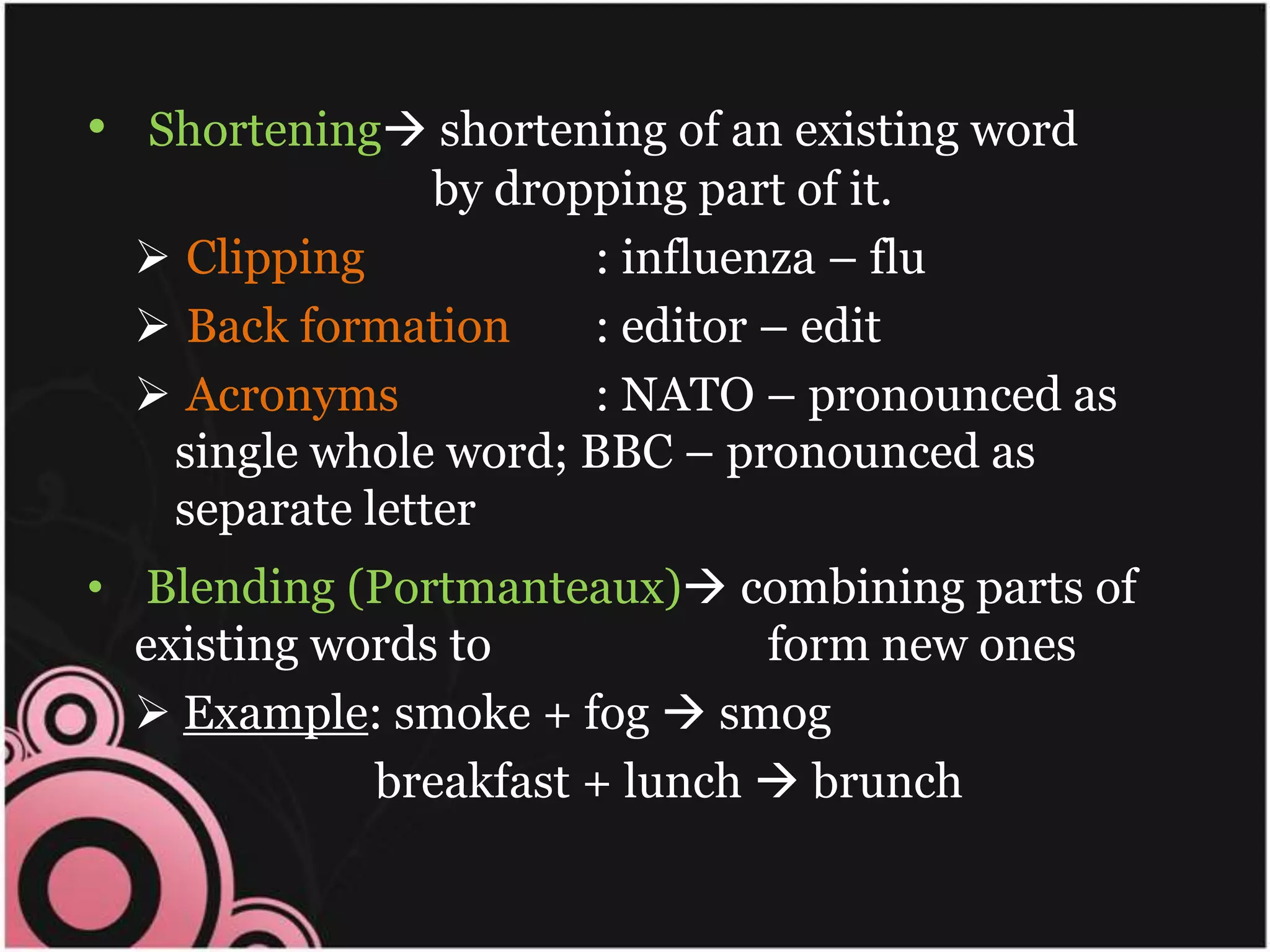
    Shortening shortening ofan existingwordby dropping part of it.
  • 28.
  • 29.
  • 30.
    Acronyms: NATO –pronounced as single wholeword; BBC – pronounced as separateletter
  • 31.
    Blending (Portmanteaux) combiningparts of existingwords to form new ones
  • 32.
    Example: smoke +fog  smog breakfast + lunch  brunch
  • 33.
    VeryrecentLecixal ChangeThe enormousexpansion of the internet has revolutionized the communication patterns in number of ways.Writingdoesn’tinvolverigideditingprocess.Speech-like production of writtenlanguage.The new creations do not mean the new words but othersspread and makeitintogeneral usage.Researchthatlanguageis not onlychangingfast and in interstingways but alsocharting the changes more easilyconducted.
  • 34.
    Driving the changingoffers the basis for establishing a thorough linguistic description of what is going on. Example on page 298: the very recent borrowing.Although uber- has become a productive prefix, it is infrequent prefix.