Semantics
How do you do semantics?
• Generalization –. It occurs when one specific experience
represents a whole class of experiences
– organizing concepts by kind
• Aggregation
– Aggregating complexes into simpler concepts
• Common Properties
– Relationships (connecting properties)
– Attributes (flat properties)
• Naming Conventions
– Terms / Phrases
– Language
What else do semantics
provide?
• Contextual Meaning
• Inferred Relationships
• Causality (Casual Relations between words)
• Granularity - Breaking down an event into
smaller parts
The Problem of Semantic
Ambiguity
context=food context=hardware
Did you say you were looking for
mixed nuts?
People use context to derive the correct
meaning.
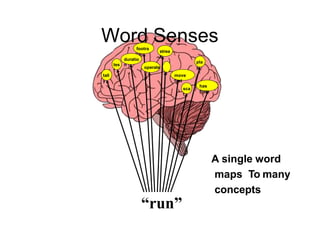
Word Senses
“run”
tall
y
tes
t
footra
ce
strea
k
pla
y
move
fast
sca
t
operate
g
o
has
form
duratio
n
A single word
maps To many
concepts
Definition
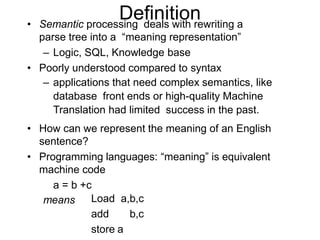
• Semantic processing deals with rewriting a
parse tree into a “meaning representation”
– Logic, SQL, Knowledge base
• Poorly understood compared to syntax
– applications that need complex semantics, like
database front ends or high-quality Machine
Translation had limited success in the past.
• How can we represent the meaning of an English
sentence?
• Programming languages: “meaning” is equivalent
machine code
a = b +c
means Load a,b,c
add b,c
store a
• Lexemes - basic unit of meaning in the lexicon
• Examples:
– Red, n: the color of blood or a ruby
– Blood, n: the red liquid that circulates in the heart,
arteries and veins of animals
– Right, adj: located nearer the right hand esp. being on
the right when facing the same direction as the
observer
• Do dictionaries gives us definitions??
Meanings of words
Three Perspectives on Meaning
1. Lexical Semantics
• The meanings of individual words
2. Formal Semantics (or Compositional Semantics or Sentential
Semantics)
• How those meanings combine to make meanings for
individual sentences or utterances (manner of speaking; power
of speaking)
3. Discourse or Pragmatics
– How those meanings combine with each other and with other
facts about various kinds of context to make meanings for a
text or discourse
– Dialog or Conversation is often lumped together with
Discourse
Relations among words
• Homonymy (Words with identical forms but
different meanings)
– Instead, a bank can hold the investments in a
custodial account in the client’s name.
– But as agriculture burgeons on the east bank, the
river will shrink even more.
• Other examples: be/bee?, wood/would?
• Homophones (Sum, Some) (Son, Sun)
• Homographs (lead - to go first with followers
behind/a type of metal)
• Applications: spelling correction, speech
recognition, text-to-speech
Relationships between word
meanings
• Homonymy
• Polysemy - word having several meanings.
• Synonymy
• Antonymy
• Hypernomy - A word with a broad meaning constituting a
category into which words with more specific meanings. For
example, colour is a hypernym of red.
• Hyponomy - Relationship between more general term Ex:
Red is hyponym of colour, car is a hyponym of vehicle
• Meronomy - A meronym refers to a part of a whole. Engines
have parts: carburetor, Headlights …
finger' is a meronym of 'hand
Homonymy
• Homonymy:
– Lexemes that share a form
• Phonological, orthographic or both
– But have unrelated, distinct meanings
– Can be homophones, homographs, or both:
• Homophones:
– Write and right
– Piece and peace
Homonymy causes problems for
NLP applications
• Text-to-Speech
– Same orthographic form but different phonological form
• bass vs bass
• Bass, when pronounced as base, means the lowest pitch, an
adult male who sings in the lowest pitch, any number of
instruments that play the lowest pitch.
• Information retrieval
– Different meanings same orthographic form
• QUERY: bat care
• Basic bat care. Any bat that is found on the ground, or in an
exposed area, especially during the day, is likely to need help.
• Machine Translation
• Speech recognition
Polysemy
• Polysemy is the property of a word having several meanings.
• The bank is constructed from red brick
I withdrew the money from the bank
• Are those the same sense?
• Or consider the following example
– While some banks furnish blood only to serious patients, others are
less restrictive
– Which sense of bank is this?
• Is it distinct from (homonymous with) the river bank sense?
• How about the savings bank sense?
• He left the bank five minutes ago.
• He caught a fish at the bank.
Polysemy
• A single lexeme with multiple related meanings
(bank the building, bank the financial institution)
• Most non-rare words have multiple meanings
– The number of meanings is related to its frequency
– Verbs tend more to polysemy
– Distinguishing polysemy from homonymy isn’t always
easy (or necessary)
Polysemy
• They rarely serve red meat, preferring to
prepare seafood, poultry, or game birds.
• He served as U.S. ambassador to Norway in
1976 and 1977.
• He might have served his time, come out and
led an upstanding life.
• Homonymy: distinct and unrelated meanings,
possibly with different etymology (multiple
lexemes).
• Polysemy: single lexeme with two meanings.
• Example: an “idea bank”
Metaphor and Metonymy
• Metaphor and metonymy are similar in various
aspects but the major difference is that if a metaphor
substitutes a concept with another, a metonymy
selects a related term. So, if metaphor is for
substitution, metonymy is for association.
• For example, the sentence ‘he is a tiger in class’ is a
metaphor. Here the word tiger is used in substitution
for displaying an attribute of character of the person.
• The sentence ‘the tiger called his students to the
meeting room’ is a metonymy. Here there is no
substitution; instead the person is associated with a
tiger for his nature.
Metaphor and Metonymy
• Metaphor and Metonymy are specific Types of
Polysemy.
• Metaphor:(A metaphor is a figure of speech
containing an implied comparison. With metaphors,
words or phrases that are ordinarily applied to one
thing are applied to something you wouldn't
necessarily pair it with. Here's a metaphor example:
“The curtain of night fell upon us.”
• Her eyes were like diamonds
Metaphor and Metonymy
(Contd)
• Metonymy (Metonymy is a figure of speech that
replaces the name of a thing with the name of
something else with which it is closely associated).
A famous example is, "The pen is mightier than
the sword," from Edward Bulwer Lytton's play
Richelieu.
This sentence has two metonyms:
"Pen" stands for "the written word."
"Sword" stands for "military aggression."
Synonyms
• Words that have the same meaning in some or all contexts.
– Look / see
– Happy / Joyful
– big / large
– automobile / car
– Beautiful / Pretty/Attractive
– Water / H20
• Two lexemes are synonyms if they can be successfully substituted
for each other in all situations
– If so they have the same propositional meaning
Synonyms
• But there are few (or no) examples of
perfect synonymy.
– Why should that be?
– Even if many aspects of meaning are identical
– Still may not preserve the acceptability based
on notions of politeness, slang, register,
genre, etc.
• Example:
– Water and H20
Synonymy
• Principle of substitutability
• How big is this plane?
• Would I be flying on a large or small plane?
• Miss Nelson, for instance, became a kind of
big sister to Mrs. Van Tassel’s son, Benjamin.
• ?? Miss Nelson, for instance, became a kind
of large sister to Mrs. Van Tassel’s son,
Benjamin.
Synonymy is a relation between
senses rather than words
• Consider the words big and large
• Are they synonyms?
– How big is that plane?
– Would I be flying on a large or small plane?
• How about here:
– Miss Nelson, for instance, became a kind of big sister to Benjamin.
– ?Miss Nelson, for instance, became a kind of large sister to Benjamin.
• Why?
– big has a sense that means being older, or grown up
– large lacks this sense
Antonyms
• Senses that are opposites with respect to
one feature of their meaning
• Otherwise, they are very similar!
– dark / light
– short / long
– hot / cold
– up / down
– in / out
• More formally: antonyms can
– define a binary opposition or at opposite ends
Hyponymy
• A term that denotes a subcategory of a more general class:
“Chair” and “table” are hyponyms of “furniture.”
• One sense is a hyponym of another if the first sense is
more specific, denoting a subclass of the other
– car is a hyponym of vehicle
– dog is a hyponym of animal
– mango is a hyponym of fruit
• Conversely
– vehicle is a hypernym/superordinate of car
– animal is a hypernym of dog
– fruit is a hypernym of mango
superordinate vehicle fruit furniture mammal
hyponym car mango chair dog
Hypernymy more formally
• A hypernym describes a more broad term
• Extensional:
– The class denoted by the superordinate
– extensionally includes the class denoted by
the hyponym
• Entailment:
– A sense A is a hyponym of sense B if being
an A entails being a B
• Hyponymy is usually transitive
– (A hypo B and B hypo C entails A hypo C)
EXAMPLE OF HYPONYMS
AND HYPERONYMS
Semantic ambiguity
• A sentence may have a single syntactic
structure, but multiple semantic structures
– Every boy loves a dog
• Vagueness – some senses are more
specific than others
– “Person” is more vague than “woman”
– Quantifiers: Many people saw the accident
Semantics
Mary untangled a library.
• What’s wrong with this sentence?
• It is syntactically correct, but semantically weird
• Since Untangled stands for free from a tangled
or twisted state.
Pragmatics
• The context disambiguates the
meaning.
• This is a complicated cognitive feat!
Mary was hired as the new library director.
She had a hard job because the library was a mess.
Mary untangled a library.
Discourse
• The prior discourse provides references for
the pronouns.
• In general, temporal sequences require
discourse knowledge to be understood.
Mary was hired as the new library director.
Mary had a hard job because the library was a mess.
She untangled it.
World Knowledge
• World knowledge allows you to understand
what this conversation is about.
• It includes knowledge about jobs, office
politics, the structure of argument, and more.
Speaker A:
Mary was hired as the new library director.
She had a hard job because the library was a mess.
Mary untangled a library.
Speaker B:
It doesn’t matter.
She’s still fired.
Semantic Analysis
Semantic Analysis
To Understand the meaning of a sentence, there are
three types of semantic analysis that we can use
1. We can determine the Semantic Feature of key words in the
sentence
2. We can analyze the Lexical Relation of these words in the
sentence
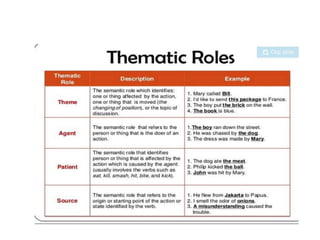
3. We can analyze the Semantic Roles (Thematic Role / Theta
Role) of key words in the sentence(i.e. the roles they fulfill in
the situation described in the sentence.
List of Basic Thematic Roles
• AGENT: the initiator of some action, capable of acting with volition.
– Jack ate the beans.
• PATIENT: the entity undergoing the effect of some action, often
undergoing some change of state.
– Sue mowed the lawn.
• THEME: the entity which is moved by an action, or whose location is
described.
– Fred threw the rock.
• EXPERIENCER: the entity which is aware of the action or state
described by the predicate but which is not in control of the action or
state.
– Kim saw the deer.
• BENEFICIARY: the entity for whose benefit the
action was performed.
– Mary studied hard for her mother.
• INSTRUMENT: the means by which an action is
performed or something comes about.
– Fred opened the lock with a paper clip.
• LOCATION: the place in which something is situated
or takes place.
– The picture hangs above the fireplace.
• GOAL: the entity towards which something moves,
either literally or metaphorically.
– Lee walked to school.
• SOURCE: the entity from which something moves,
either literally or metaphorically.
– Sue ran from the policeman.
ACTOR: the entity which performs, effects,
instigates, or controls the situation denoted by the
predicate (supertype of AGENT):
– The bus hit a pedestrian.
• RECIPIENT: a subtype of GOAL involved in actions
describing changes of possession.
– Bill sold the car to Mary
• PERCEPT/STIMULUS: the entity which is perceived
or experienced.
– Mary fears thunder.
Semantic Analysis Natural Language Processing

Semantic Analysis Natural Language Processing

  • 1.
  • 3.
    How do youdo semantics? • Generalization –. It occurs when one specific experience represents a whole class of experiences – organizing concepts by kind • Aggregation – Aggregating complexes into simpler concepts • Common Properties – Relationships (connecting properties) – Attributes (flat properties) • Naming Conventions – Terms / Phrases – Language
  • 4.
    What else dosemantics provide? • Contextual Meaning • Inferred Relationships • Causality (Casual Relations between words) • Granularity - Breaking down an event into smaller parts
  • 5.
    The Problem ofSemantic Ambiguity context=food context=hardware Did you say you were looking for mixed nuts? People use context to derive the correct meaning.
  • 6.
  • 7.
    Definition • Semantic processingdeals with rewriting a parse tree into a “meaning representation” – Logic, SQL, Knowledge base • Poorly understood compared to syntax – applications that need complex semantics, like database front ends or high-quality Machine Translation had limited success in the past. • How can we represent the meaning of an English sentence? • Programming languages: “meaning” is equivalent machine code a = b +c means Load a,b,c add b,c store a
  • 8.
    • Lexemes -basic unit of meaning in the lexicon • Examples: – Red, n: the color of blood or a ruby – Blood, n: the red liquid that circulates in the heart, arteries and veins of animals – Right, adj: located nearer the right hand esp. being on the right when facing the same direction as the observer • Do dictionaries gives us definitions?? Meanings of words
  • 9.
    Three Perspectives onMeaning 1. Lexical Semantics • The meanings of individual words 2. Formal Semantics (or Compositional Semantics or Sentential Semantics) • How those meanings combine to make meanings for individual sentences or utterances (manner of speaking; power of speaking) 3. Discourse or Pragmatics – How those meanings combine with each other and with other facts about various kinds of context to make meanings for a text or discourse – Dialog or Conversation is often lumped together with Discourse
  • 10.
    Relations among words •Homonymy (Words with identical forms but different meanings) – Instead, a bank can hold the investments in a custodial account in the client’s name. – But as agriculture burgeons on the east bank, the river will shrink even more. • Other examples: be/bee?, wood/would? • Homophones (Sum, Some) (Son, Sun) • Homographs (lead - to go first with followers behind/a type of metal) • Applications: spelling correction, speech recognition, text-to-speech
  • 11.
    Relationships between word meanings •Homonymy • Polysemy - word having several meanings. • Synonymy • Antonymy • Hypernomy - A word with a broad meaning constituting a category into which words with more specific meanings. For example, colour is a hypernym of red. • Hyponomy - Relationship between more general term Ex: Red is hyponym of colour, car is a hyponym of vehicle • Meronomy - A meronym refers to a part of a whole. Engines have parts: carburetor, Headlights … finger' is a meronym of 'hand
  • 12.
    Homonymy • Homonymy: – Lexemesthat share a form • Phonological, orthographic or both – But have unrelated, distinct meanings – Can be homophones, homographs, or both: • Homophones: – Write and right – Piece and peace
  • 13.
    Homonymy causes problemsfor NLP applications • Text-to-Speech – Same orthographic form but different phonological form • bass vs bass • Bass, when pronounced as base, means the lowest pitch, an adult male who sings in the lowest pitch, any number of instruments that play the lowest pitch. • Information retrieval – Different meanings same orthographic form • QUERY: bat care • Basic bat care. Any bat that is found on the ground, or in an exposed area, especially during the day, is likely to need help. • Machine Translation • Speech recognition
  • 14.
    Polysemy • Polysemy isthe property of a word having several meanings. • The bank is constructed from red brick I withdrew the money from the bank • Are those the same sense? • Or consider the following example – While some banks furnish blood only to serious patients, others are less restrictive – Which sense of bank is this? • Is it distinct from (homonymous with) the river bank sense? • How about the savings bank sense? • He left the bank five minutes ago. • He caught a fish at the bank.
  • 15.
    Polysemy • A singlelexeme with multiple related meanings (bank the building, bank the financial institution) • Most non-rare words have multiple meanings – The number of meanings is related to its frequency – Verbs tend more to polysemy – Distinguishing polysemy from homonymy isn’t always easy (or necessary)
  • 16.
    Polysemy • They rarelyserve red meat, preferring to prepare seafood, poultry, or game birds. • He served as U.S. ambassador to Norway in 1976 and 1977. • He might have served his time, come out and led an upstanding life. • Homonymy: distinct and unrelated meanings, possibly with different etymology (multiple lexemes). • Polysemy: single lexeme with two meanings. • Example: an “idea bank”
  • 17.
    Metaphor and Metonymy •Metaphor and metonymy are similar in various aspects but the major difference is that if a metaphor substitutes a concept with another, a metonymy selects a related term. So, if metaphor is for substitution, metonymy is for association. • For example, the sentence ‘he is a tiger in class’ is a metaphor. Here the word tiger is used in substitution for displaying an attribute of character of the person. • The sentence ‘the tiger called his students to the meeting room’ is a metonymy. Here there is no substitution; instead the person is associated with a tiger for his nature.
  • 18.
    Metaphor and Metonymy •Metaphor and Metonymy are specific Types of Polysemy. • Metaphor:(A metaphor is a figure of speech containing an implied comparison. With metaphors, words or phrases that are ordinarily applied to one thing are applied to something you wouldn't necessarily pair it with. Here's a metaphor example: “The curtain of night fell upon us.” • Her eyes were like diamonds
  • 19.
    Metaphor and Metonymy (Contd) •Metonymy (Metonymy is a figure of speech that replaces the name of a thing with the name of something else with which it is closely associated). A famous example is, "The pen is mightier than the sword," from Edward Bulwer Lytton's play Richelieu. This sentence has two metonyms: "Pen" stands for "the written word." "Sword" stands for "military aggression."
  • 20.
    Synonyms • Words thathave the same meaning in some or all contexts. – Look / see – Happy / Joyful – big / large – automobile / car – Beautiful / Pretty/Attractive – Water / H20 • Two lexemes are synonyms if they can be successfully substituted for each other in all situations – If so they have the same propositional meaning
  • 21.
    Synonyms • But thereare few (or no) examples of perfect synonymy. – Why should that be? – Even if many aspects of meaning are identical – Still may not preserve the acceptability based on notions of politeness, slang, register, genre, etc. • Example: – Water and H20
  • 22.
    Synonymy • Principle ofsubstitutability • How big is this plane? • Would I be flying on a large or small plane? • Miss Nelson, for instance, became a kind of big sister to Mrs. Van Tassel’s son, Benjamin. • ?? Miss Nelson, for instance, became a kind of large sister to Mrs. Van Tassel’s son, Benjamin.
  • 23.
    Synonymy is arelation between senses rather than words • Consider the words big and large • Are they synonyms? – How big is that plane? – Would I be flying on a large or small plane? • How about here: – Miss Nelson, for instance, became a kind of big sister to Benjamin. – ?Miss Nelson, for instance, became a kind of large sister to Benjamin. • Why? – big has a sense that means being older, or grown up – large lacks this sense
  • 24.
    Antonyms • Senses thatare opposites with respect to one feature of their meaning • Otherwise, they are very similar! – dark / light – short / long – hot / cold – up / down – in / out • More formally: antonyms can – define a binary opposition or at opposite ends
  • 25.
    Hyponymy • A termthat denotes a subcategory of a more general class: “Chair” and “table” are hyponyms of “furniture.” • One sense is a hyponym of another if the first sense is more specific, denoting a subclass of the other – car is a hyponym of vehicle – dog is a hyponym of animal – mango is a hyponym of fruit • Conversely – vehicle is a hypernym/superordinate of car – animal is a hypernym of dog – fruit is a hypernym of mango superordinate vehicle fruit furniture mammal hyponym car mango chair dog
  • 26.
    Hypernymy more formally •A hypernym describes a more broad term • Extensional: – The class denoted by the superordinate – extensionally includes the class denoted by the hyponym • Entailment: – A sense A is a hyponym of sense B if being an A entails being a B • Hyponymy is usually transitive – (A hypo B and B hypo C entails A hypo C)
  • 27.
  • 28.
    Semantic ambiguity • Asentence may have a single syntactic structure, but multiple semantic structures – Every boy loves a dog • Vagueness – some senses are more specific than others – “Person” is more vague than “woman” – Quantifiers: Many people saw the accident
  • 29.
    Semantics Mary untangled alibrary. • What’s wrong with this sentence? • It is syntactically correct, but semantically weird • Since Untangled stands for free from a tangled or twisted state.
  • 30.
    Pragmatics • The contextdisambiguates the meaning. • This is a complicated cognitive feat! Mary was hired as the new library director. She had a hard job because the library was a mess. Mary untangled a library.
  • 31.
    Discourse • The priordiscourse provides references for the pronouns. • In general, temporal sequences require discourse knowledge to be understood. Mary was hired as the new library director. Mary had a hard job because the library was a mess. She untangled it.
  • 32.
    World Knowledge • Worldknowledge allows you to understand what this conversation is about. • It includes knowledge about jobs, office politics, the structure of argument, and more. Speaker A: Mary was hired as the new library director. She had a hard job because the library was a mess. Mary untangled a library. Speaker B: It doesn’t matter. She’s still fired.
  • 33.
  • 34.
    Semantic Analysis To Understandthe meaning of a sentence, there are three types of semantic analysis that we can use 1. We can determine the Semantic Feature of key words in the sentence 2. We can analyze the Lexical Relation of these words in the sentence 3. We can analyze the Semantic Roles (Thematic Role / Theta Role) of key words in the sentence(i.e. the roles they fulfill in the situation described in the sentence.
  • 38.
    List of BasicThematic Roles • AGENT: the initiator of some action, capable of acting with volition. – Jack ate the beans. • PATIENT: the entity undergoing the effect of some action, often undergoing some change of state. – Sue mowed the lawn. • THEME: the entity which is moved by an action, or whose location is described. – Fred threw the rock. • EXPERIENCER: the entity which is aware of the action or state described by the predicate but which is not in control of the action or state. – Kim saw the deer.
  • 39.
    • BENEFICIARY: theentity for whose benefit the action was performed. – Mary studied hard for her mother. • INSTRUMENT: the means by which an action is performed or something comes about. – Fred opened the lock with a paper clip. • LOCATION: the place in which something is situated or takes place. – The picture hangs above the fireplace. • GOAL: the entity towards which something moves, either literally or metaphorically. – Lee walked to school. • SOURCE: the entity from which something moves, either literally or metaphorically. – Sue ran from the policeman.
  • 40.
    ACTOR: the entitywhich performs, effects, instigates, or controls the situation denoted by the predicate (supertype of AGENT): – The bus hit a pedestrian. • RECIPIENT: a subtype of GOAL involved in actions describing changes of possession. – Bill sold the car to Mary • PERCEPT/STIMULUS: the entity which is perceived or experienced. – Mary fears thunder.