University of Aden
Faculty of Languages
Master Programme in Translation Studies
Syntax (Lecture No. 2)
Sentence Structure: Constituents
Prof. Dr. Gamal M A Abdullah
E-mail: gamal133@yahoo.com
Oct. 2018
1
Introduction
The last lecture (1) is an introductory
one, it started by discussing the
language aspect that is the most closed
one to syntax (grammar). Then, the
other aspects which are more closed to
syntax too, were covered in brief as
phonology: A science concerns with
study of sound structure i.e. phonemes
which can combine altogether to form a
.wordmeaningful
2
In return, the word is the main concern
of morphology. It is worthy to pinpoint
that, morphology starts from where
phonology ends. It concerns with the
study of word structure and explains
what is hidden in the structure of a
word and comprehend the deep
meaning that can be combined with
meanings of other words leading to
create a piece of language in a form of
which issentenceandclause,phrase
the main concern of syntax. 3
Syntax starts from where morphology
ends, it concerns with the study of the
structure of phrase, clause and
sentence.
In short, the previous lecture (1)
proceeded the process of ‘from more
specific to more general’. But in the
current lecture (2), We will start the
discussion by defining and explaining
the words of the main heading
(sentence, structure and constituent),
we will proceed the system of ‘from
more general to more specific’. 4
Sentence
Terminologically, the word ‘sentence’
derived from Latin ‘sententia’ meaning
feeling, opinion or thought. ‘Sententia’ itself
derived from the Latin verb ‘sentire’ meaning
to feel, think or view.
5
Grammatically, sentence is a string of words
put in a well-grammatical structure, it
contains a subject and verb(s) and expresses a
complete thought ending in a full stop or
period (.) (affirmative), asks questions ending
in a question mark (?) (interrogative), giving
a command and ending in a period(.)
(imperative) or expressing exclamation
ending in an exclamatory mark (!).
6
Any English sentence must contain at
least one main clause. It can be deduced
that any sentence contains a clause, but
not any clause contains a sentence .
(Abdullah, 2018)
7
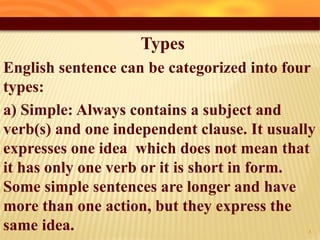
Types
English sentence can be categorized into four
types:
a) Simple: Always contains a subject and
verb(s) and one independent clause. It usually
expresses one idea which does not mean that
it has only one verb or it is short in form.
Some simple sentences are longer and have
more than one action, but they express the
same idea. 8
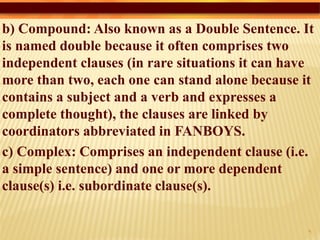
b) Compound: Also known as a Double Sentence. It
is named double because it often comprises two
independent clauses (in rare situations it can have
more than two, each one can stand alone because it
contains a subject and a verb and expresses a
complete thought), the clauses are linked by
coordinators abbreviated in FANBOYS.
c) Complex: Comprises an independent clause (i.e.
a simple sentence) and one or more dependent
clause(s) i.e. subordinate clause(s).
9
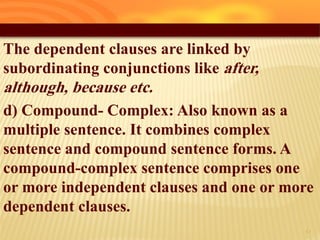
The dependent clauses are linked by
subordinating conjunctions like after,
although, because etc.
d) Compound- Complex: Also known as a
multiple sentence. It combines complex
sentence and compound sentence forms. A
compound-complex sentence comprises one
or more independent clauses and one or more
dependent clauses.
10
Structure
Terminologically, the term ‘structure’
comes from Latinate noun ‘structura’
meaning act of building from the verb
‘struere’ meaning to build something
(Longman Advanced American
Dictionary, 2007).
11
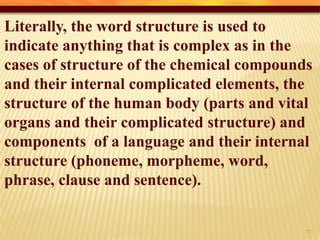
Literally, the word structure is used to
indicate anything that is complex as in the
cases of structure of the chemical compounds
and their internal complicated elements, the
structure of the human body (parts and vital
organs and their complicated structure) and
components of a language and their internal
structure (phoneme, morpheme, word,
phrase, clause and sentence).
12
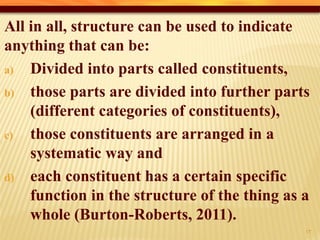
All in all, structure can be used to indicate
anything that can be:
a) Divided into parts called constituents,
b) those parts are divided into further parts
(different categories of constituents),
c) those constituents are arranged in a
systematic way and
d) each constituent has a certain specific
function in the structure of the thing as a
whole (Burton-Roberts, 2011).
13
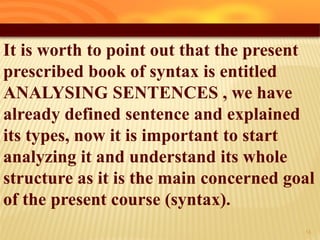
It is worth to point out that the present
prescribed book of syntax is entitled
ANALYSING SENTENCES , we have
already defined sentence and explained
its types, now it is important to start
analyzing it and understand its whole
structure as it is the main concerned goal
of the present course (syntax).
14
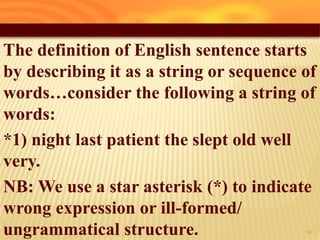
The definition of English sentence starts
by describing it as a string or sequence of
words…consider the following a string of
words:
*1) night last patient the slept old well
very.
NB: We use a star asterisk (*) to indicate
wrong expression or ill-formed/
ungrammatical structure. 15
Is the previous sequence of words a
sentence?
The answer definitely is negative.. Why?
Because sentences of language are not
put in an arbitrary way, language is a
system of systems.
It can be concluded that any sentence is a
sequence of words, but not any sequence
of words is a sentence. 16
Consider the following :
2) The very old patient slept well last night.
Sentence (2) is a well-formed grammatical
structure …Why?
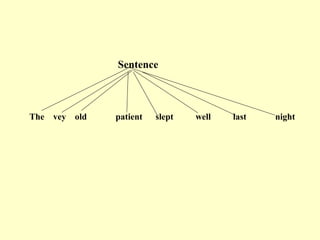
In order to understand why is it true? we
need to analyze it in the form of a tree-
diagram that means the sentence dominates
the sequence of words by nodes. Consider the
following tree-diagram (3):
17
Sentence
The vey old patient slept well last night
Does the diagram provide any informative
analyses?
No, it is the same as sentence No. 1. just sequence of
words.
The informative diagram should analyze the
sentence according to its immediate parts
(constituents), identify syntactic/grammatical class
(category) and determine the
syntactic/grammatical role (function). Those
syntactic expressions will be shown clearly in the
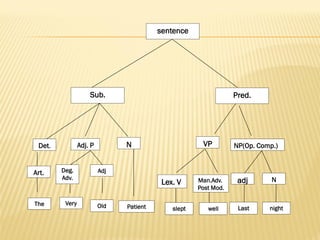
following informative tree-diagram (4): 19
adj NMan.Adv.
Post Mod.
Lex. V
nightLastwellslept
sentence
Pred.Sub.
NP(Op. Comp.)VPNAdj. PDet.
Patient
AdjDeg.
Adv.
Art.
The OldVery
The first immediate parts (large
constituents/higher level) ‘The very old
patient’ and ‘slept well last night’ are
functioning (syntactic function) as subject
and predicate in the structure of the English
sentence (2) respectively. They can be
described as sisters (nodes) dominated by
a mother (sentence).
What is meant by syntactic function?
21
Syntactic Function:
Also known as grammatical relation/role/ or
function, it is used to refer to functional
relations between constituents in a sentence.
The standard examples of syntactic functions
are subject, predicate, objects (direct &
indirect) and complements.
22
The immediate parts (subject and predicate)
consist of sub-parts (intermediate constituents) that
means the subject so called noun phrase NP is
subdivided into further parts (the determiner Det.
‘the’, adjective phrase Adj.P includes degree
adverb Deg. Adv. ‘very’ and Adj. ‘old’ and a noun
N ‘patient’). When the immediate parts are divided
into sub-parts and those sub-parts are divided into
further parts such process in syntax is known as
Hierarchical Structure.
What is meant by it?
23
Hierarchical Structure:
Also known as Hierarchy or Morpho-syntactic
Hierarchy, it refers to any ordering of units
(constituents) or level on scale of size (large units
i.e. immediate constituents), heads (the most
important word in the constituent like ‘patient’ in
the first part (subject/NP) of sentence (2) and
‘slept’ in the second part (predicate/VP) and
subordinations i.e. ultimate constituents which are
used as pre or post modifiers that means to add or
give more information about the head words 24
like ‘the very old’ is used as a pre-modifier of the head
word ‘man’ in the structure of an NP (subject) and ‘well’ is
used as a post-modifier of the head word ‘slept’ in the
structure of a VP (predicate). The head words always are
OBLGATORY that means the sentence cannot be well-
formed without the presence of the head word, but most of
the modifiers are OPTIONAL if we drop them, the
sentence will remain a well-formed, consider the following:
5)* The very old well last night.
6) The patient slept well.
25
In sentence (5) we omitted the words ‘ patient and
slept), it becomes ill-formed because it lost the
obligatory words (head), but sentence (6) is still
well-grammatical despite that it lost a pre-modifier
(very old) and a post modifier (last night), because
they are optional.
It can be estimated that the head words can stand
on their own right without the presence of
modifiers, but modifiers cannot stand on their
respect, they depend on the presence of head
words.
26
Constituent: Terminologically, the word
‘constituent’ derived from the verb ‘constitute’,
originally it comes from Latinate past participle of
‘constituere’ means to set up . As a noun,
constituent means being one of the parts that
makes a whole.
In syntax, a constituent is a word or a group of
words that can form a unit build around the head it
can be a word, a group of words or even entire
clause.
27
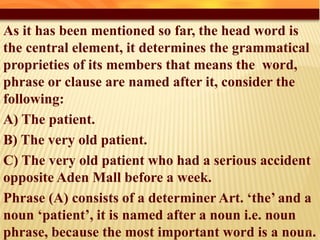
As it has been mentioned so far, the head word is
the central element, it determines the grammatical
proprieties of its members that means the word,
phrase or clause are named after it, consider the
following:
A) The patient.
B) The very old patient.
C) The very old patient who had a serious accident
opposite Aden Mall before a week.
Phrase (A) consists of a determiner Art. ‘the’ and a
noun ‘patient’, it is named after a noun i.e. noun
phrase, because the most important word is a noun.28
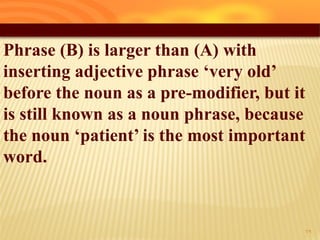
Phrase (B) is larger than (A) with
inserting adjective phrase ‘very old’
before the noun as a pre-modifier, but it
is still known as a noun phrase, because
the noun ‘patient’ is the most important
word.
29
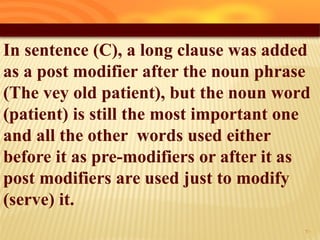
In sentence (C), a long clause was added
as a post modifier after the noun phrase
(The vey old patient), but the noun word
(patient) is still the most important one
and all the other words used either
before it as pre-modifiers or after it as
post modifiers are used just to modify
(serve) it.
30
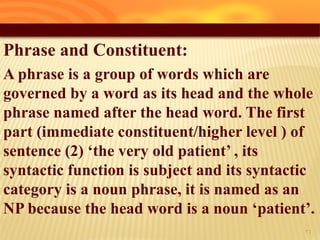
Phrase and Constituent:
A phrase is a group of words which are
governed by a word as its head and the whole
phrase named after the head word. The first
part (immediate constituent/higher level ) of
sentence (2) ‘the very old patient’ , its
syntactic function is subject and its syntactic
category is a noun phrase, it is named as an
NP because the head word is a noun ‘patient’.
31
Types:
The phrase is divided into the following
types:
Noun phrase.
Verb phrase.
Adjective phrase.
Adverb(ial) phrase.
Determiner phrase (appeared recently in
some syntax books). 32
A constituent can be a word or a group of
words, fore example the second part of
sentence (2) ‘slept well last night’ is the
predicate/ VP, also it is known as an
immediate constituent (larger constituent or
higher level), it involves other constituents
inside it, known as intermediate constituents
like Adv. ‘well’ and NP ‘last night’. In return,
the intermediate constituents can be sub-
divided into further constituents known as
ultimate i.e. single words. 33
In short, a constituent can be defined as a
linearized string of interrelated words that
function as a single unit in structure and
meaning , this is known as syntactic and
semantic relation. (Shormani, 2013)
By syntactic and semantic relation, it means
that relation which determines what goes
with what to form a well-formed structure to
convey a clear meaning.
34
Types:
As it has been seen in the previous discussion,
constituent can be divided and subdivided
into different types as follows:
Immediate (higher level).
Intermediate (middle level).
Ultimate (lower level).
Null/ Empty (O Level).
35
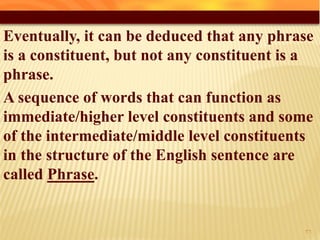
Eventually, it can be deduced that any phrase
is a constituent, but not any constituent is a
phrase.
A sequence of words that can function as
immediate/higher level constituents and some
of the intermediate/middle level constituents
in the structure of the English sentence are
called Phrase.
36
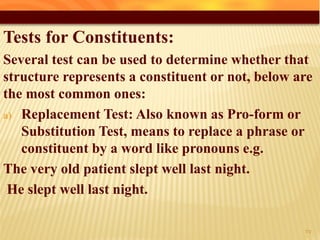
Tests for Constituents:
Several test can be used to determine whether that
structure represents a constituent or not, below are
the most common ones:
a) Replacement Test: Also known as Pro-form or
Substitution Test, means to replace a phrase or
constituent by a word like pronouns e.g.
The very old patient slept well last night.
He slept well last night.
37
b) Omission Test: Also known as Elision Test or
Ellipsis Test, means when omitting a part of a
sentence without affecting the structure of the
whole sentence ( the remaining units stand well-
grammatical structure like omitting the last part
(last night) as in:
The very old patient slept well .
c) Movement Test: Also known as Substitution Test,
means moving part of a sentence from last to the
beginning or vice versa e.g.
Last night, the very old patient slept well.
38
d) Question Test: Using wh-questions (who, where,
when etc.) as in:
Who slept well last night?
e) Sense Test: Also known as Semantic Test, means
asking about meaning as in :
What is meant by slept/well?
39
Conclusion
Several results have been emanated from
the rest of lecture (2):
- A sentence is a sequence of words, but
not any sequence of words is a
sentence.
- Any sentence contains a clause, but not
any clause contains a sentence.
40
- In the structure of English sentence, the
head words are obligatory and they can
stand on their own right without the
presence of modifiers, but some modifiers
are optional and they cannot stand on their
respect, they depend on the presence of
head words.
- Any phrase is a constituent, but not any
constituent is a phrase.
41
- Any sequence of words that can function as
immediate/higher level and some
intermediate/middle level constituents in
the structure of the English sentence are
called Phrase.
42
43
Abdullah, G. M. A. (2018). A Course of Grammar for Medicine and
Health Sciences. Aden University Printing and Publishing House.
Burten-Roberts, N. (2011). Analysing Sentence: An Introduction to
English Syntax. UK: Pearson Education Limited.
Longman Advanced American Dictionary (2007). USA: Pearson
education limited.
Shormani, N. Q. (2013). An Introduction to English Syntax. Yemen:
Aden Printers &Publishers.
44
Ended
45
May Allah Lead All Of You
To Success

Lecture 2 sentence structure constituents

  • 1.
    University of Aden Facultyof Languages Master Programme in Translation Studies Syntax (Lecture No. 2) Sentence Structure: Constituents Prof. Dr. Gamal M A Abdullah E-mail: gamal133@yahoo.com Oct. 2018 1
  • 2.
    Introduction The last lecture(1) is an introductory one, it started by discussing the language aspect that is the most closed one to syntax (grammar). Then, the other aspects which are more closed to syntax too, were covered in brief as phonology: A science concerns with study of sound structure i.e. phonemes which can combine altogether to form a .wordmeaningful 2
  • 3.
    In return, theword is the main concern of morphology. It is worthy to pinpoint that, morphology starts from where phonology ends. It concerns with the study of word structure and explains what is hidden in the structure of a word and comprehend the deep meaning that can be combined with meanings of other words leading to create a piece of language in a form of which issentenceandclause,phrase the main concern of syntax. 3
  • 4.
    Syntax starts fromwhere morphology ends, it concerns with the study of the structure of phrase, clause and sentence. In short, the previous lecture (1) proceeded the process of ‘from more specific to more general’. But in the current lecture (2), We will start the discussion by defining and explaining the words of the main heading (sentence, structure and constituent), we will proceed the system of ‘from more general to more specific’. 4
  • 5.
    Sentence Terminologically, the word‘sentence’ derived from Latin ‘sententia’ meaning feeling, opinion or thought. ‘Sententia’ itself derived from the Latin verb ‘sentire’ meaning to feel, think or view. 5
  • 6.
    Grammatically, sentence isa string of words put in a well-grammatical structure, it contains a subject and verb(s) and expresses a complete thought ending in a full stop or period (.) (affirmative), asks questions ending in a question mark (?) (interrogative), giving a command and ending in a period(.) (imperative) or expressing exclamation ending in an exclamatory mark (!). 6
  • 7.
    Any English sentencemust contain at least one main clause. It can be deduced that any sentence contains a clause, but not any clause contains a sentence . (Abdullah, 2018) 7
  • 8.
    Types English sentence canbe categorized into four types: a) Simple: Always contains a subject and verb(s) and one independent clause. It usually expresses one idea which does not mean that it has only one verb or it is short in form. Some simple sentences are longer and have more than one action, but they express the same idea. 8
  • 9.
    b) Compound: Alsoknown as a Double Sentence. It is named double because it often comprises two independent clauses (in rare situations it can have more than two, each one can stand alone because it contains a subject and a verb and expresses a complete thought), the clauses are linked by coordinators abbreviated in FANBOYS. c) Complex: Comprises an independent clause (i.e. a simple sentence) and one or more dependent clause(s) i.e. subordinate clause(s). 9
  • 10.
    The dependent clausesare linked by subordinating conjunctions like after, although, because etc. d) Compound- Complex: Also known as a multiple sentence. It combines complex sentence and compound sentence forms. A compound-complex sentence comprises one or more independent clauses and one or more dependent clauses. 10
  • 11.
    Structure Terminologically, the term‘structure’ comes from Latinate noun ‘structura’ meaning act of building from the verb ‘struere’ meaning to build something (Longman Advanced American Dictionary, 2007). 11
  • 12.
    Literally, the wordstructure is used to indicate anything that is complex as in the cases of structure of the chemical compounds and their internal complicated elements, the structure of the human body (parts and vital organs and their complicated structure) and components of a language and their internal structure (phoneme, morpheme, word, phrase, clause and sentence). 12
  • 13.
    All in all,structure can be used to indicate anything that can be: a) Divided into parts called constituents, b) those parts are divided into further parts (different categories of constituents), c) those constituents are arranged in a systematic way and d) each constituent has a certain specific function in the structure of the thing as a whole (Burton-Roberts, 2011). 13
  • 14.
    It is worthto point out that the present prescribed book of syntax is entitled ANALYSING SENTENCES , we have already defined sentence and explained its types, now it is important to start analyzing it and understand its whole structure as it is the main concerned goal of the present course (syntax). 14
  • 15.
    The definition ofEnglish sentence starts by describing it as a string or sequence of words…consider the following a string of words: *1) night last patient the slept old well very. NB: We use a star asterisk (*) to indicate wrong expression or ill-formed/ ungrammatical structure. 15
  • 16.
    Is the previoussequence of words a sentence? The answer definitely is negative.. Why? Because sentences of language are not put in an arbitrary way, language is a system of systems. It can be concluded that any sentence is a sequence of words, but not any sequence of words is a sentence. 16
  • 17.
    Consider the following: 2) The very old patient slept well last night. Sentence (2) is a well-formed grammatical structure …Why? In order to understand why is it true? we need to analyze it in the form of a tree- diagram that means the sentence dominates the sequence of words by nodes. Consider the following tree-diagram (3): 17
  • 18.
    Sentence The vey oldpatient slept well last night
  • 19.
    Does the diagramprovide any informative analyses? No, it is the same as sentence No. 1. just sequence of words. The informative diagram should analyze the sentence according to its immediate parts (constituents), identify syntactic/grammatical class (category) and determine the syntactic/grammatical role (function). Those syntactic expressions will be shown clearly in the following informative tree-diagram (4): 19
  • 20.
    adj NMan.Adv. Post Mod. Lex.V nightLastwellslept sentence Pred.Sub. NP(Op. Comp.)VPNAdj. PDet. Patient AdjDeg. Adv. Art. The OldVery
  • 21.
    The first immediateparts (large constituents/higher level) ‘The very old patient’ and ‘slept well last night’ are functioning (syntactic function) as subject and predicate in the structure of the English sentence (2) respectively. They can be described as sisters (nodes) dominated by a mother (sentence). What is meant by syntactic function? 21
  • 22.
    Syntactic Function: Also knownas grammatical relation/role/ or function, it is used to refer to functional relations between constituents in a sentence. The standard examples of syntactic functions are subject, predicate, objects (direct & indirect) and complements. 22
  • 23.
    The immediate parts(subject and predicate) consist of sub-parts (intermediate constituents) that means the subject so called noun phrase NP is subdivided into further parts (the determiner Det. ‘the’, adjective phrase Adj.P includes degree adverb Deg. Adv. ‘very’ and Adj. ‘old’ and a noun N ‘patient’). When the immediate parts are divided into sub-parts and those sub-parts are divided into further parts such process in syntax is known as Hierarchical Structure. What is meant by it? 23
  • 24.
    Hierarchical Structure: Also knownas Hierarchy or Morpho-syntactic Hierarchy, it refers to any ordering of units (constituents) or level on scale of size (large units i.e. immediate constituents), heads (the most important word in the constituent like ‘patient’ in the first part (subject/NP) of sentence (2) and ‘slept’ in the second part (predicate/VP) and subordinations i.e. ultimate constituents which are used as pre or post modifiers that means to add or give more information about the head words 24
  • 25.
    like ‘the veryold’ is used as a pre-modifier of the head word ‘man’ in the structure of an NP (subject) and ‘well’ is used as a post-modifier of the head word ‘slept’ in the structure of a VP (predicate). The head words always are OBLGATORY that means the sentence cannot be well- formed without the presence of the head word, but most of the modifiers are OPTIONAL if we drop them, the sentence will remain a well-formed, consider the following: 5)* The very old well last night. 6) The patient slept well. 25
  • 26.
    In sentence (5)we omitted the words ‘ patient and slept), it becomes ill-formed because it lost the obligatory words (head), but sentence (6) is still well-grammatical despite that it lost a pre-modifier (very old) and a post modifier (last night), because they are optional. It can be estimated that the head words can stand on their own right without the presence of modifiers, but modifiers cannot stand on their respect, they depend on the presence of head words. 26
  • 27.
    Constituent: Terminologically, theword ‘constituent’ derived from the verb ‘constitute’, originally it comes from Latinate past participle of ‘constituere’ means to set up . As a noun, constituent means being one of the parts that makes a whole. In syntax, a constituent is a word or a group of words that can form a unit build around the head it can be a word, a group of words or even entire clause. 27
  • 28.
    As it hasbeen mentioned so far, the head word is the central element, it determines the grammatical proprieties of its members that means the word, phrase or clause are named after it, consider the following: A) The patient. B) The very old patient. C) The very old patient who had a serious accident opposite Aden Mall before a week. Phrase (A) consists of a determiner Art. ‘the’ and a noun ‘patient’, it is named after a noun i.e. noun phrase, because the most important word is a noun.28
  • 29.
    Phrase (B) islarger than (A) with inserting adjective phrase ‘very old’ before the noun as a pre-modifier, but it is still known as a noun phrase, because the noun ‘patient’ is the most important word. 29
  • 30.
    In sentence (C),a long clause was added as a post modifier after the noun phrase (The vey old patient), but the noun word (patient) is still the most important one and all the other words used either before it as pre-modifiers or after it as post modifiers are used just to modify (serve) it. 30
  • 31.
    Phrase and Constituent: Aphrase is a group of words which are governed by a word as its head and the whole phrase named after the head word. The first part (immediate constituent/higher level ) of sentence (2) ‘the very old patient’ , its syntactic function is subject and its syntactic category is a noun phrase, it is named as an NP because the head word is a noun ‘patient’. 31
  • 32.
    Types: The phrase isdivided into the following types: Noun phrase. Verb phrase. Adjective phrase. Adverb(ial) phrase. Determiner phrase (appeared recently in some syntax books). 32
  • 33.
    A constituent canbe a word or a group of words, fore example the second part of sentence (2) ‘slept well last night’ is the predicate/ VP, also it is known as an immediate constituent (larger constituent or higher level), it involves other constituents inside it, known as intermediate constituents like Adv. ‘well’ and NP ‘last night’. In return, the intermediate constituents can be sub- divided into further constituents known as ultimate i.e. single words. 33
  • 34.
    In short, aconstituent can be defined as a linearized string of interrelated words that function as a single unit in structure and meaning , this is known as syntactic and semantic relation. (Shormani, 2013) By syntactic and semantic relation, it means that relation which determines what goes with what to form a well-formed structure to convey a clear meaning. 34
  • 35.
    Types: As it hasbeen seen in the previous discussion, constituent can be divided and subdivided into different types as follows: Immediate (higher level). Intermediate (middle level). Ultimate (lower level). Null/ Empty (O Level). 35
  • 36.
    Eventually, it canbe deduced that any phrase is a constituent, but not any constituent is a phrase. A sequence of words that can function as immediate/higher level constituents and some of the intermediate/middle level constituents in the structure of the English sentence are called Phrase. 36
  • 37.
    Tests for Constituents: Severaltest can be used to determine whether that structure represents a constituent or not, below are the most common ones: a) Replacement Test: Also known as Pro-form or Substitution Test, means to replace a phrase or constituent by a word like pronouns e.g. The very old patient slept well last night. He slept well last night. 37
  • 38.
    b) Omission Test:Also known as Elision Test or Ellipsis Test, means when omitting a part of a sentence without affecting the structure of the whole sentence ( the remaining units stand well- grammatical structure like omitting the last part (last night) as in: The very old patient slept well . c) Movement Test: Also known as Substitution Test, means moving part of a sentence from last to the beginning or vice versa e.g. Last night, the very old patient slept well. 38
  • 39.
    d) Question Test:Using wh-questions (who, where, when etc.) as in: Who slept well last night? e) Sense Test: Also known as Semantic Test, means asking about meaning as in : What is meant by slept/well? 39
  • 40.
    Conclusion Several results havebeen emanated from the rest of lecture (2): - A sentence is a sequence of words, but not any sequence of words is a sentence. - Any sentence contains a clause, but not any clause contains a sentence. 40
  • 41.
    - In thestructure of English sentence, the head words are obligatory and they can stand on their own right without the presence of modifiers, but some modifiers are optional and they cannot stand on their respect, they depend on the presence of head words. - Any phrase is a constituent, but not any constituent is a phrase. 41
  • 42.
    - Any sequenceof words that can function as immediate/higher level and some intermediate/middle level constituents in the structure of the English sentence are called Phrase. 42
  • 43.
    43 Abdullah, G. M.A. (2018). A Course of Grammar for Medicine and Health Sciences. Aden University Printing and Publishing House. Burten-Roberts, N. (2011). Analysing Sentence: An Introduction to English Syntax. UK: Pearson Education Limited. Longman Advanced American Dictionary (2007). USA: Pearson education limited. Shormani, N. Q. (2013). An Introduction to English Syntax. Yemen: Aden Printers &Publishers.
  • 44.
  • 45.
    45 May Allah LeadAll Of You To Success