INTRODUCTION TO LINGUISTICS
syntax
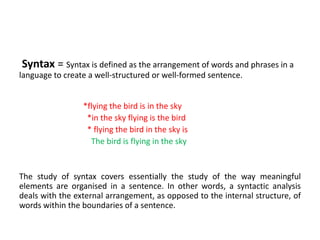
Syntax = Syntax is defined as the arrangement of words and phrases in a
language to create a well-structured or well-formed sentence.
*flying the bird is in the sky
*in the sky flying is the bird
* flying the bird in the sky is
The bird is flying in the sky
The study of syntax covers essentially the study of the way meaningful
elements are organised in a sentence. In other words, a syntactic analysis
deals with the external arrangement, as opposed to the internal structure, of
words within the boundaries of a sentence.
• Properties of syntactic knowledge
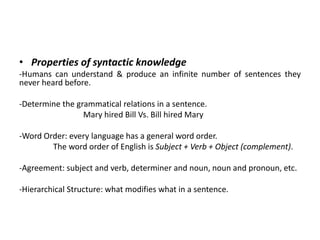
-Humans can understand & produce an infinite number of sentences they
never heard before.
-Determine the grammatical relations in a sentence.
Mary hired Bill Vs. Bill hired Mary
-Word Order: every language has a general word order.
The word order of English is Subject + Verb + Object (complement).
-Agreement: subject and verb, determiner and noun, noun and pronoun, etc.
-Hierarchical Structure: what modifies what in a sentence.
EXAMPLES
Colorless green ideas sleep comfortably.
A verb crumpled the milk.
I gave the question an angry egg.
* Comfortably sleep ideas green colorless.
* Milk the crumpled verb a.
* the question I an gave egg angry.
Syntactic categories:
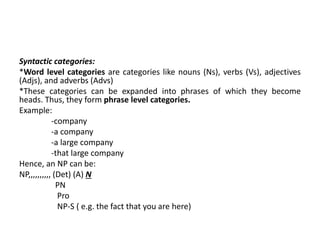
*Word level categories are categories like nouns (Ns), verbs (Vs), adjectives
(Adjs), and adverbs (Advs)
*These categories can be expanded into phrases of which they become
heads. Thus, they form phrase level categories.
Example:
-company
-a company
-a large company
-that large company
Hence, an NP can be:
NP,,,,,,,,,, (Det) (A) N
PN
Pro
NP-S ( e.g. the fact that you are here)
A VP should contain at least its head V. This verb may optionally be followed
by an NP, an AP, an AdvP, a PP or an S.
John slept (VP,,,,,,,,,,,,,,,,V)
John wrote an article (VP,,,,,,,,,,,,,,,,,,,V NP)
John wrote an article about Corona Virus. (VP,,,,,,,,,,,V NP PP)
A significant aspect of these categories is their universality; it seems that
languages tend to have all these categories which actually allows the
formulation of syntactic rules and the representation of the hierarchical
structure of sentences.
• PHRASE STRUCTURE RULES
• Rules that determine……what goes into a phrase (‘constituents’)
• …how the constituents are ordered
• Constituent: a word or group of words that function as a unit and can
make up larger grammatical units
• General schema: X Y Z “X consists of Y followed by Z”
Example
a little boy in a bubble
• Phrase structure rule for NPs: (Det) (Adj) N (PP) N
• As an illustration that phrase structure rules are capable of generating
syntactically correct but semantically incorrect sentences. Phrase structure
rules break sentences down into their constituent parts. These
constituents are often represented as tree structures.
• Syntax trees are a neat graphic tool to chart sentence structure and make
sense of word order.
•
Phrase structure rules have the following functions:
*They reflect the kind of syntactic knowledge that native
speakers of a language possess.
*They show that sentences are rule-governed, hierachically
structured
*They are extremely powerful in the sense that they allow the
generation of an unlimited number of sentencesin a language.
• But Chomsky’s distinction between competence
and performance has a psychological orientation
in the sense that competence refers to the
unconscious knowledge of language that native
speakers store in their brains during early
childhood, in addition to the fact that the
distinction draws on the assumption that
language reflects the activity of the mind.
Chomsky regards linguistics as part of cognitive
psychology and thinks that the description and
explanation of the brain (mental ability) is one
of the essential goals of linguistics.
• Chomsky states that there are two types of
competence : ‘pragmatic competence’ which is
the ability to use the native language
appropriately (in the right context) to satisfy
certain needs, and ‘grammatical competence’
which includes our syntactic, semantic, and
phonological abilities. Syntactic abilities include
the ability to combine words into grammatical
sentences, and the ability to distinguish
grammatical sentences from ungrammatical
ones.
• Phrase structure rules generate structures. In
order to turn this structure into recognizable
English, we also need lexical rules.
• PN {Mary, George} V {followed, helped, saw} N
{girl, dog, boy} Adj {small, crazy} Art {a, the} prep
{near, with} Pro {it, you} Adv {recently, yesterday}
• We can rely on these rules to generate the
grammatical sentences 17, but not the
ungrammatical sentences 8-10
• Phrase/Constituent
• Intuitively, a constituent (phrase) is a group of words which
“belong together” in a sentence. They are usually coherent
by themselves (i.e., when taken out of the context of the
sentence) and make a coherent contribution to the
meaning of the sentence as a whole.
• (12) a. The dog ate the bone. b. The president of the
company likes to see big profits. c. My stupid kid brother
told my mom about my F in algebra.
• Always relative to a given sentence. What is a constituent in
one sentence is not necessarily a constituent in another
sentence.
• Characteristics of Phrase Structure Rules
• A simple grammar:
• (22) a. S → NP V (NP) (PP) d. N → {dog, boy, ...}, P → {on, in, ...}, ... b. NP →
(Det) (A) N (PP) c. PP → P NP
• This grammar describes a simple language (similar to English). It has
several characteristics, which it shares with grammars of real languages:
• • Generativity: It does not list the sentences of the language, it describes
the way how to build them. This is important, since languages contain
infinite number of sentences.
• • Ambiguity: Some sentences can be build in more than one way (starting
with the S rule and ending with the words in the sentence) These
sentences have more than one syntactic structure – they are syntactically
ambiguous (for example the telescope sentence). This also shows that
sentences are more than just simple strings of words.
• • Infinite Recursion: The grammar is recursive and thus allows to produce
an infinite number of sentences using a finite (very small) number of rules.
Introduction to linguistics syntax

Introduction to linguistics syntax

  • 1.
  • 2.
    Syntax = Syntaxis defined as the arrangement of words and phrases in a language to create a well-structured or well-formed sentence. *flying the bird is in the sky *in the sky flying is the bird * flying the bird in the sky is The bird is flying in the sky The study of syntax covers essentially the study of the way meaningful elements are organised in a sentence. In other words, a syntactic analysis deals with the external arrangement, as opposed to the internal structure, of words within the boundaries of a sentence.
  • 3.
    • Properties ofsyntactic knowledge -Humans can understand & produce an infinite number of sentences they never heard before. -Determine the grammatical relations in a sentence. Mary hired Bill Vs. Bill hired Mary -Word Order: every language has a general word order. The word order of English is Subject + Verb + Object (complement). -Agreement: subject and verb, determiner and noun, noun and pronoun, etc. -Hierarchical Structure: what modifies what in a sentence.
  • 4.
    EXAMPLES Colorless green ideassleep comfortably. A verb crumpled the milk. I gave the question an angry egg. * Comfortably sleep ideas green colorless. * Milk the crumpled verb a. * the question I an gave egg angry.
  • 5.
    Syntactic categories: *Word levelcategories are categories like nouns (Ns), verbs (Vs), adjectives (Adjs), and adverbs (Advs) *These categories can be expanded into phrases of which they become heads. Thus, they form phrase level categories. Example: -company -a company -a large company -that large company Hence, an NP can be: NP,,,,,,,,,, (Det) (A) N PN Pro NP-S ( e.g. the fact that you are here)
  • 6.
    A VP shouldcontain at least its head V. This verb may optionally be followed by an NP, an AP, an AdvP, a PP or an S. John slept (VP,,,,,,,,,,,,,,,,V) John wrote an article (VP,,,,,,,,,,,,,,,,,,,V NP) John wrote an article about Corona Virus. (VP,,,,,,,,,,,V NP PP) A significant aspect of these categories is their universality; it seems that languages tend to have all these categories which actually allows the formulation of syntactic rules and the representation of the hierarchical structure of sentences.
  • 7.
    • PHRASE STRUCTURERULES • Rules that determine……what goes into a phrase (‘constituents’) • …how the constituents are ordered • Constituent: a word or group of words that function as a unit and can make up larger grammatical units • General schema: X Y Z “X consists of Y followed by Z” Example a little boy in a bubble • Phrase structure rule for NPs: (Det) (Adj) N (PP) N • As an illustration that phrase structure rules are capable of generating syntactically correct but semantically incorrect sentences. Phrase structure rules break sentences down into their constituent parts. These constituents are often represented as tree structures. • Syntax trees are a neat graphic tool to chart sentence structure and make sense of word order. •
  • 8.
    Phrase structure ruleshave the following functions: *They reflect the kind of syntactic knowledge that native speakers of a language possess. *They show that sentences are rule-governed, hierachically structured *They are extremely powerful in the sense that they allow the generation of an unlimited number of sentencesin a language.
  • 10.
    • But Chomsky’sdistinction between competence and performance has a psychological orientation in the sense that competence refers to the unconscious knowledge of language that native speakers store in their brains during early childhood, in addition to the fact that the distinction draws on the assumption that language reflects the activity of the mind. Chomsky regards linguistics as part of cognitive psychology and thinks that the description and explanation of the brain (mental ability) is one of the essential goals of linguistics.
  • 11.
    • Chomsky statesthat there are two types of competence : ‘pragmatic competence’ which is the ability to use the native language appropriately (in the right context) to satisfy certain needs, and ‘grammatical competence’ which includes our syntactic, semantic, and phonological abilities. Syntactic abilities include the ability to combine words into grammatical sentences, and the ability to distinguish grammatical sentences from ungrammatical ones.
  • 12.
    • Phrase structurerules generate structures. In order to turn this structure into recognizable English, we also need lexical rules. • PN {Mary, George} V {followed, helped, saw} N {girl, dog, boy} Adj {small, crazy} Art {a, the} prep {near, with} Pro {it, you} Adv {recently, yesterday} • We can rely on these rules to generate the grammatical sentences 17, but not the ungrammatical sentences 8-10
  • 13.
    • Phrase/Constituent • Intuitively,a constituent (phrase) is a group of words which “belong together” in a sentence. They are usually coherent by themselves (i.e., when taken out of the context of the sentence) and make a coherent contribution to the meaning of the sentence as a whole. • (12) a. The dog ate the bone. b. The president of the company likes to see big profits. c. My stupid kid brother told my mom about my F in algebra. • Always relative to a given sentence. What is a constituent in one sentence is not necessarily a constituent in another sentence.
  • 14.
    • Characteristics ofPhrase Structure Rules • A simple grammar: • (22) a. S → NP V (NP) (PP) d. N → {dog, boy, ...}, P → {on, in, ...}, ... b. NP → (Det) (A) N (PP) c. PP → P NP • This grammar describes a simple language (similar to English). It has several characteristics, which it shares with grammars of real languages: • • Generativity: It does not list the sentences of the language, it describes the way how to build them. This is important, since languages contain infinite number of sentences. • • Ambiguity: Some sentences can be build in more than one way (starting with the S rule and ending with the words in the sentence) These sentences have more than one syntactic structure – they are syntactically ambiguous (for example the telescope sentence). This also shows that sentences are more than just simple strings of words. • • Infinite Recursion: The grammar is recursive and thus allows to produce an infinite number of sentences using a finite (very small) number of rules.