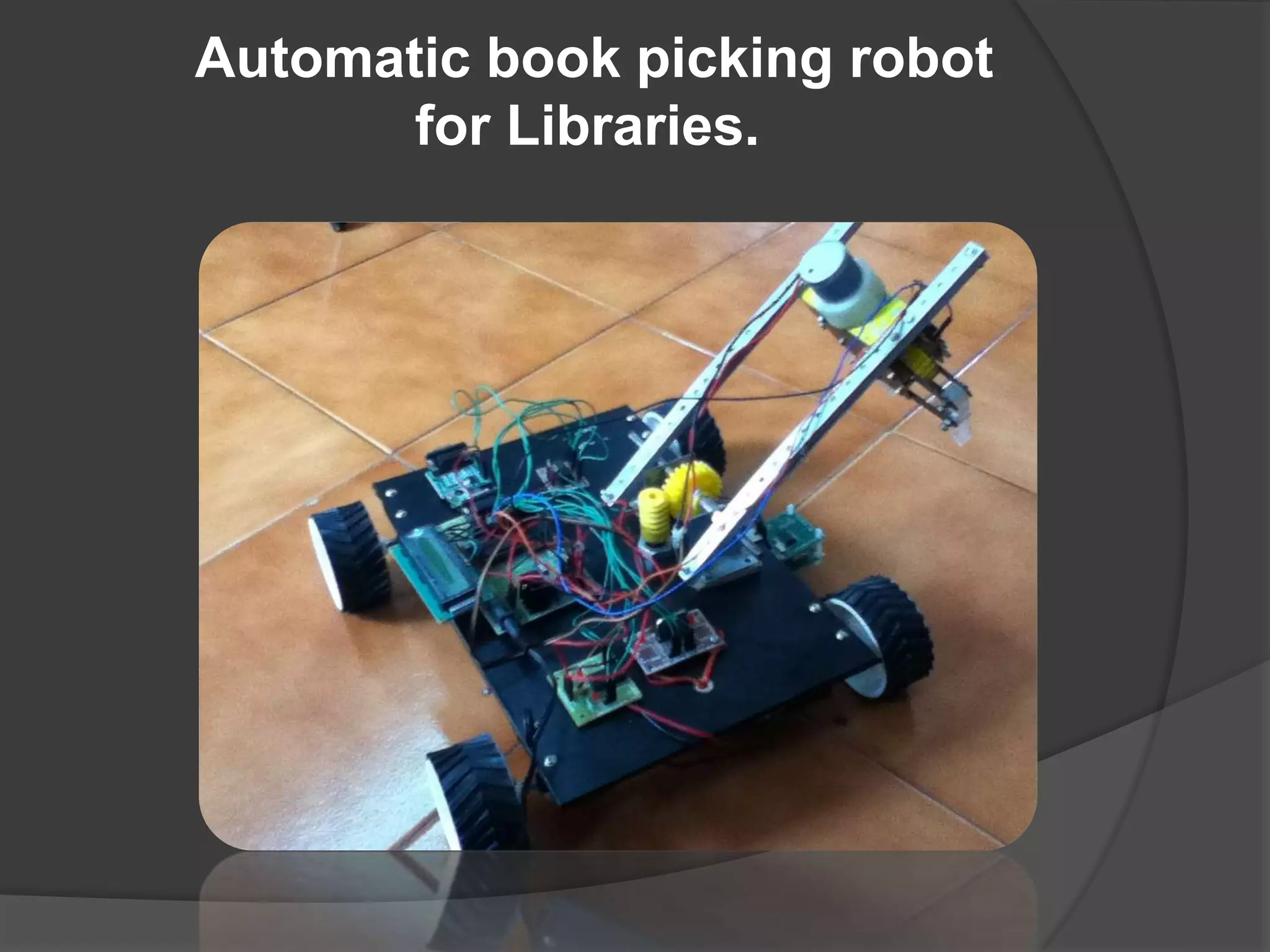
Automatic book picking robot
for Libraries.
Introduction
To automate the process of book finding and
picking we suggest a robot with an arm with
some degrees of freedom which will be able to
find out the book with the required tag and
then pick it and place it on the table.
DESCRIPTION
Here we will be placing the books in a rack and all the
books will be tagged by RFID tags and an RFID reader
will be used to detect the books .The IR obstacle sensor
placed over the arm detects the book and then the
gripper will close the jaws to get an hold of the book
and then the robotic arm is lifted after which the robot
moves in the reverse direction to the place it started
from and places the book.
Features:
This projects contains 3 main parts:
 Moveable base.
 The base shaft.
 Gripping mechanism.
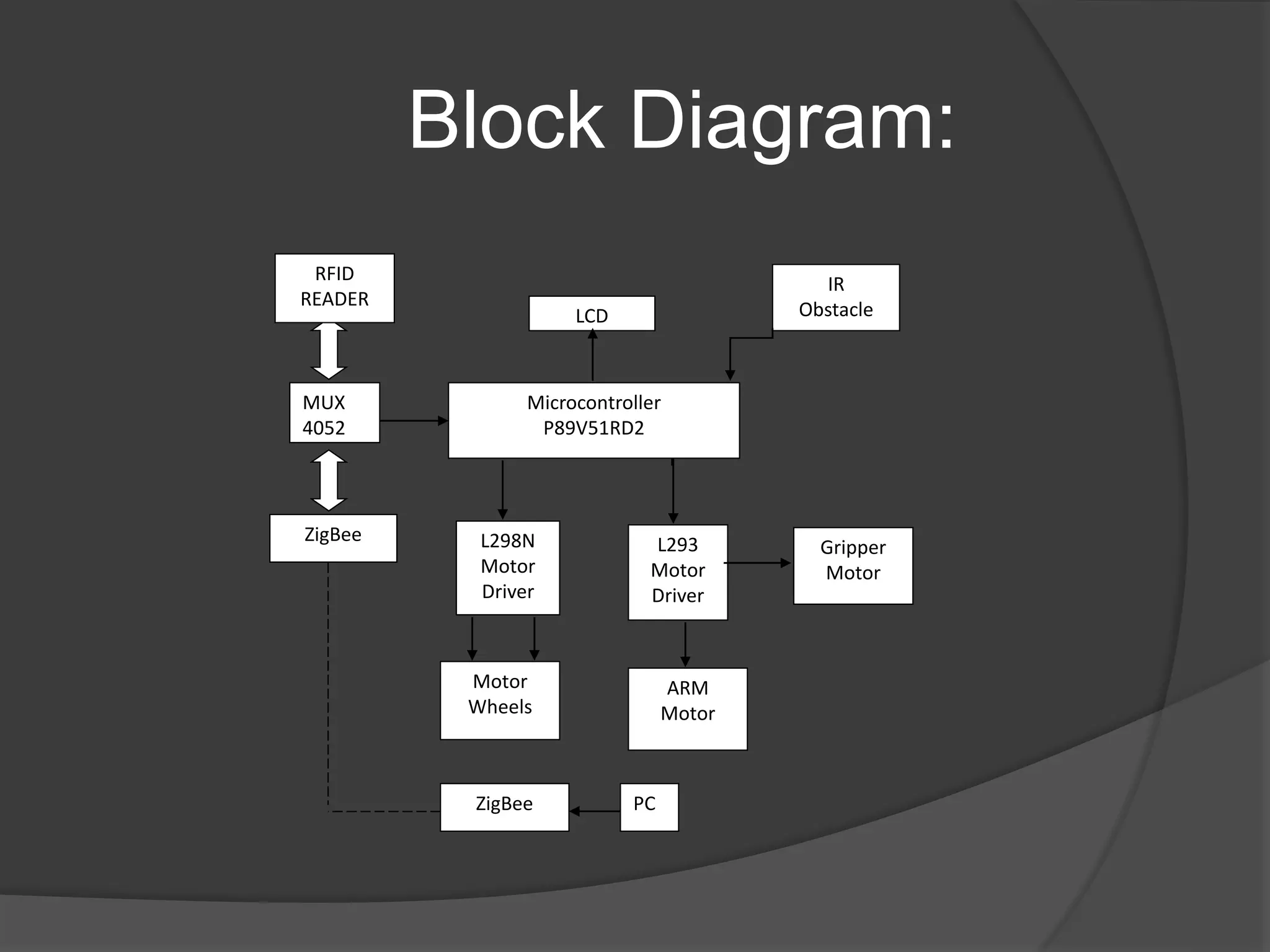
Block Diagram:
Microcontroller
P89V51RD2
LCD
IR
Obstacle
ZigBee L298N
Motor
Driver
L293
Motor
Driver
Motor
Wheels
ARM
Motor
ZigBee PC
Gripper
Motor
MUX
4052
RFID
READER
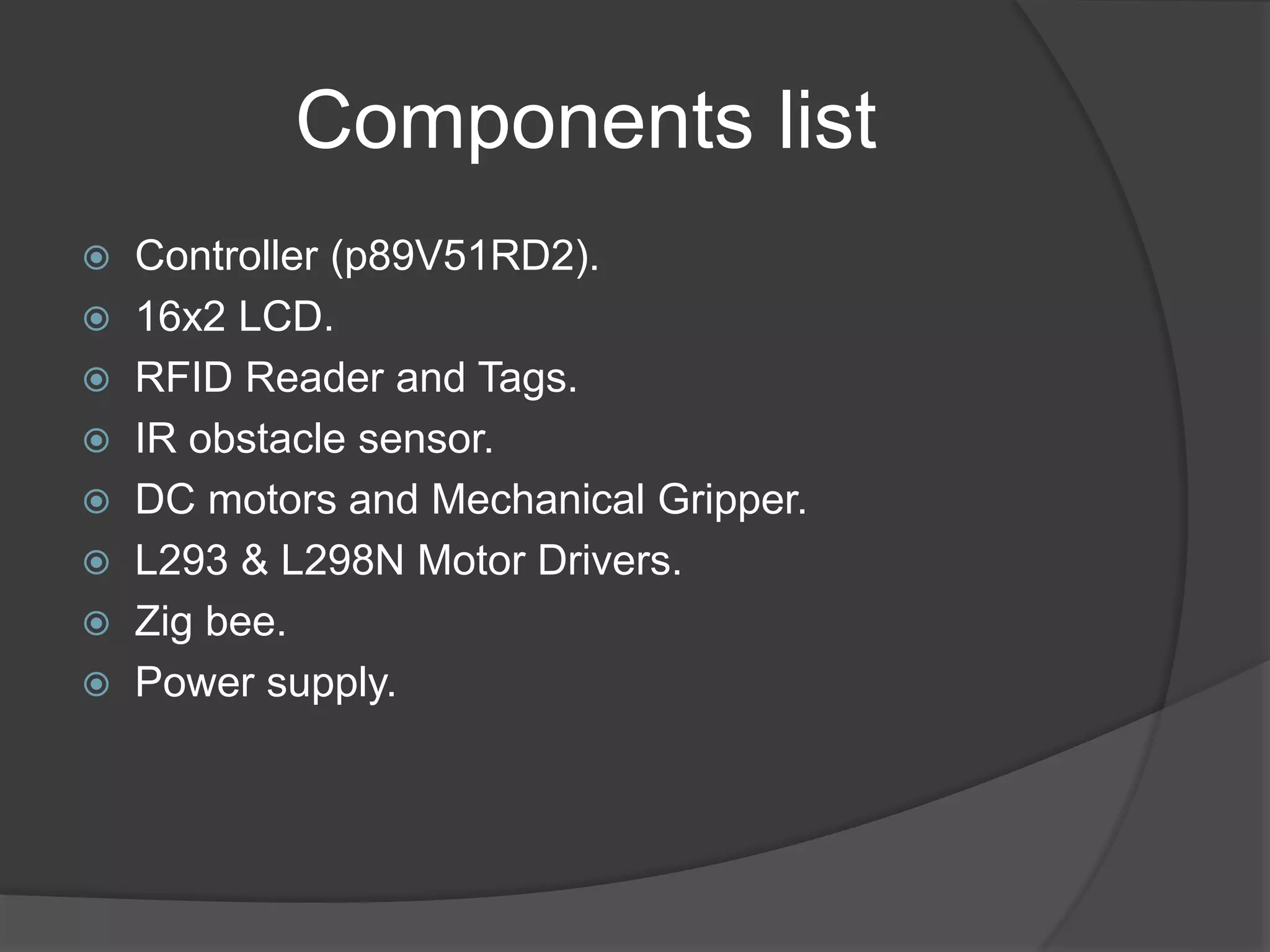
Components list
 Controller (p89V51RD2).
 16x2 LCD.
 RFID Reader and Tags.
 IR obstacle sensor.
 DC motors and Mechanical Gripper.
 L293 & L298N Motor Drivers.
 Zig bee.
 Power supply.
Block Diagram Description
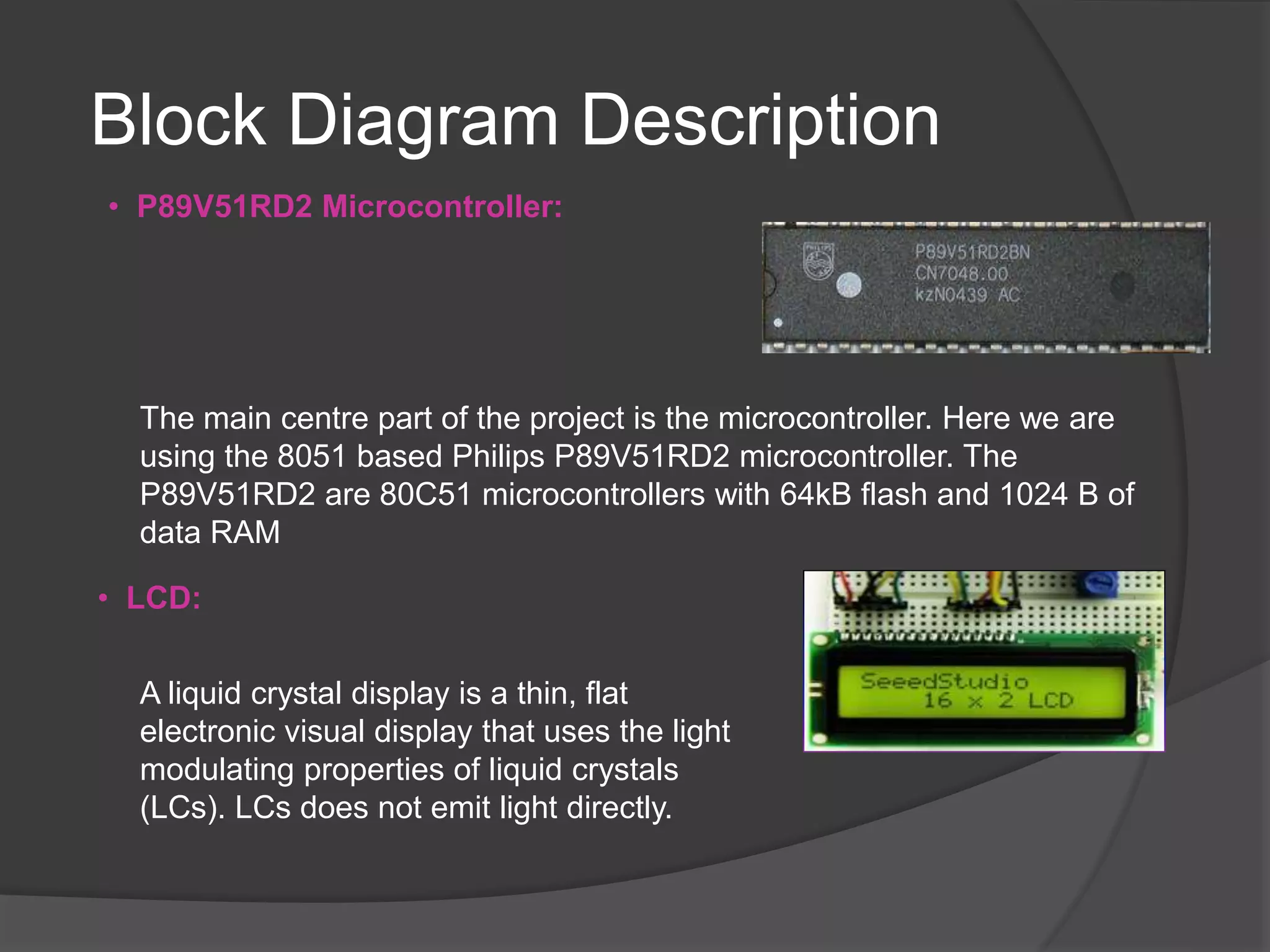
The main centre part of the project is the microcontroller. Here we are
using the 8051 based Philips P89V51RD2 microcontroller. The
P89V51RD2 are 80C51 microcontrollers with 64kB flash and 1024 B of
data RAM
• LCD:
A liquid crystal display is a thin, flat
electronic visual display that uses the light
modulating properties of liquid crystals
(LCs). LCs does not emit light directly.
• P89V51RD2 Microcontroller:
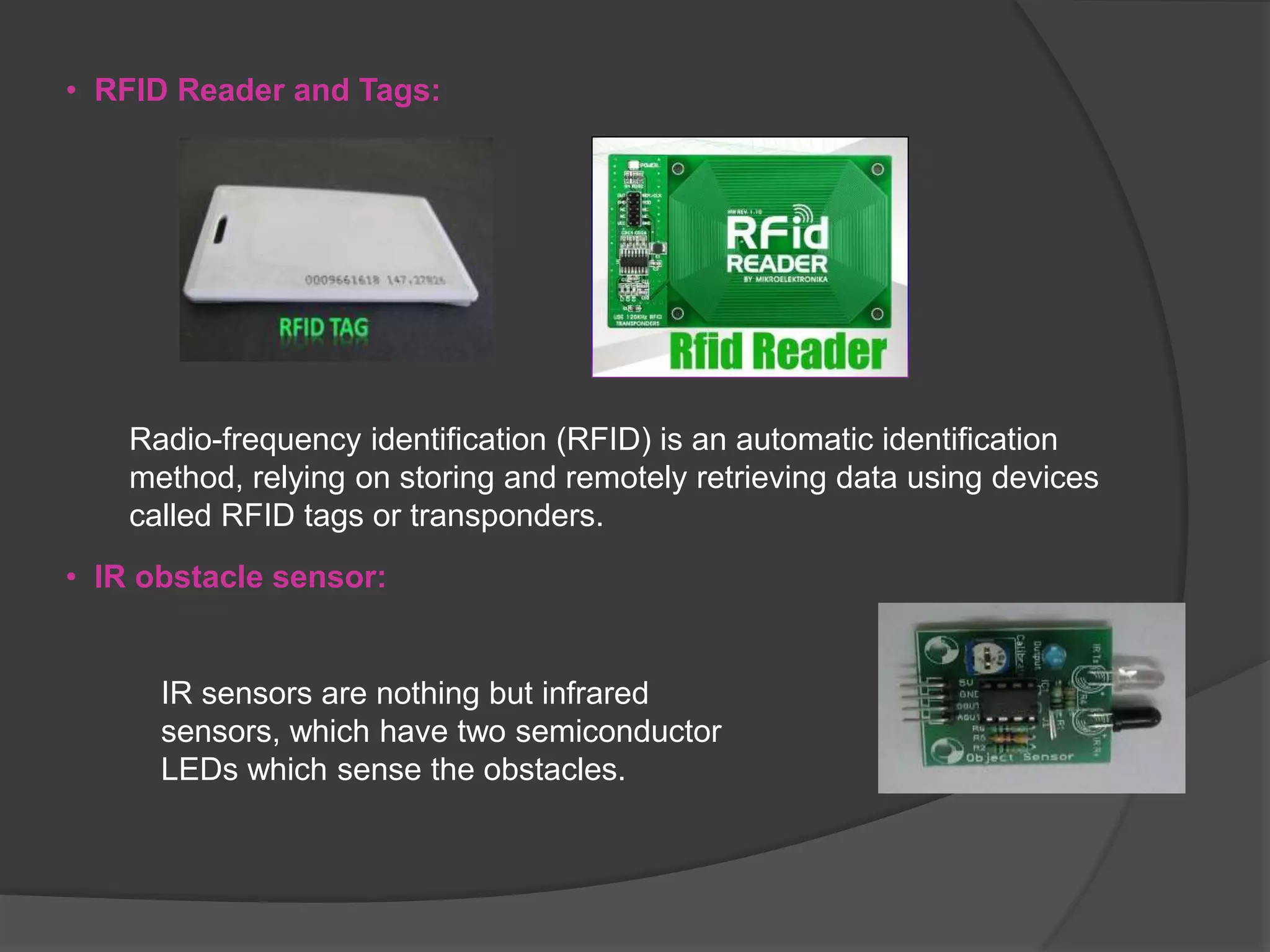
• RFID Reader and Tags:
Radio-frequency identification (RFID) is an automatic identification
method, relying on storing and remotely retrieving data using devices
called RFID tags or transponders.
IR sensors are nothing but infrared
sensors, which have two semiconductor
LEDs which sense the obstacles.
• IR obstacle sensor:
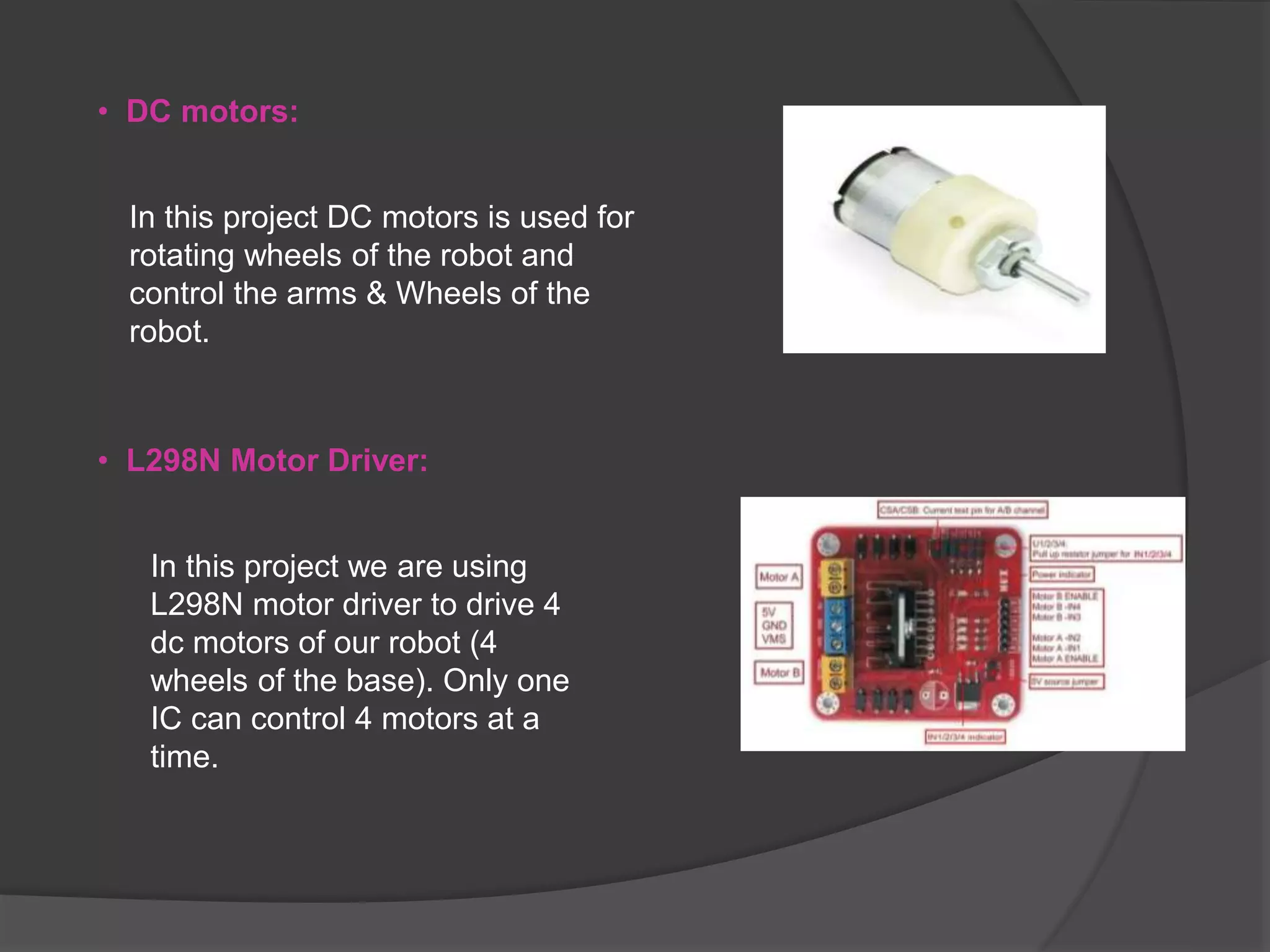
• DC motors:
In this project DC motors is used for
rotating wheels of the robot and
control the arms & Wheels of the
robot.
• L298N Motor Driver:
In this project we are using
L298N motor driver to drive 4
dc motors of our robot (4
wheels of the base). Only one
IC can control 4 motors at a
time.
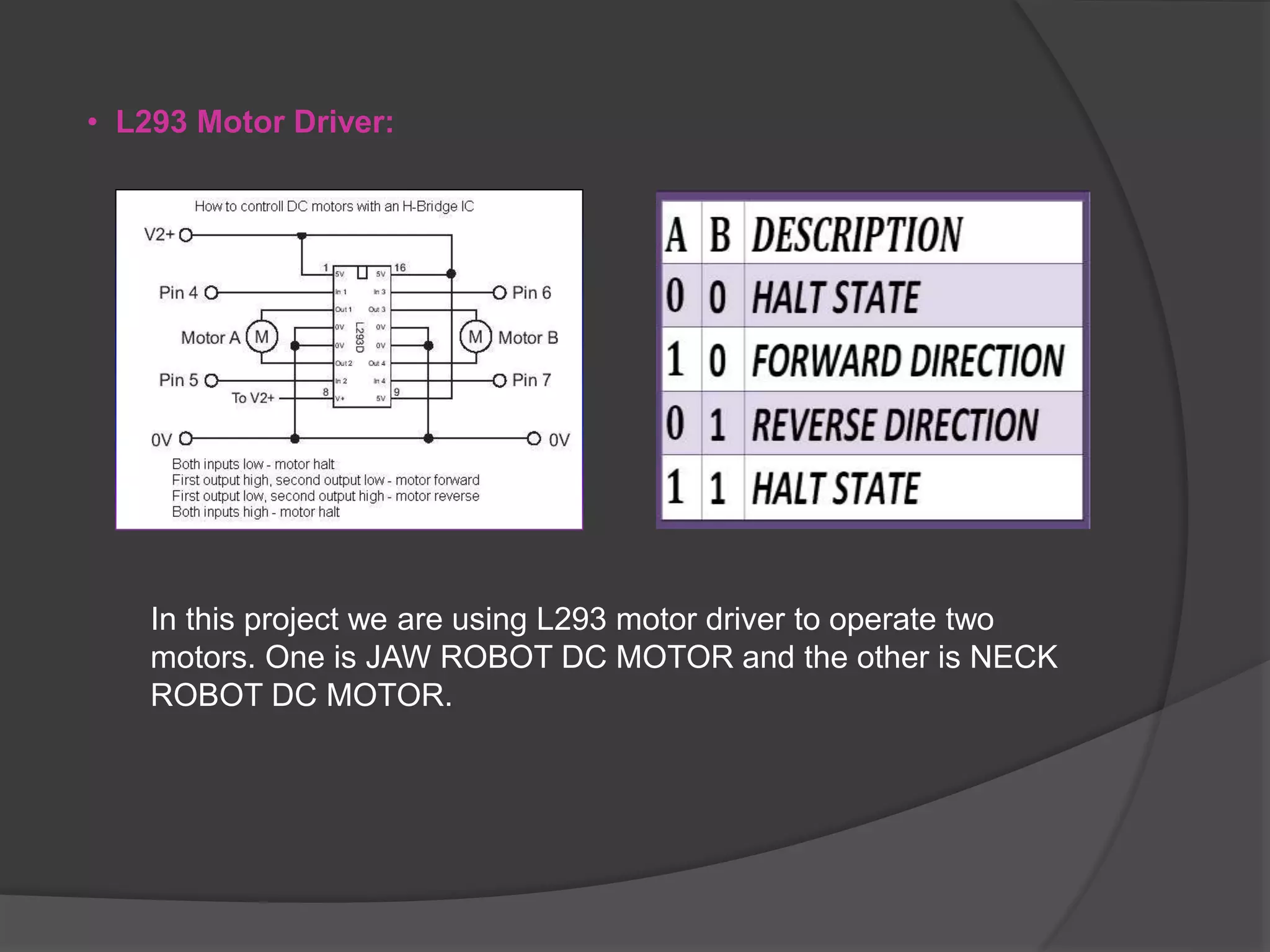
• L293 Motor Driver:
In this project we are using L293 motor driver to operate two
motors. One is JAW ROBOT DC MOTOR and the other is NECK
ROBOT DC MOTOR.
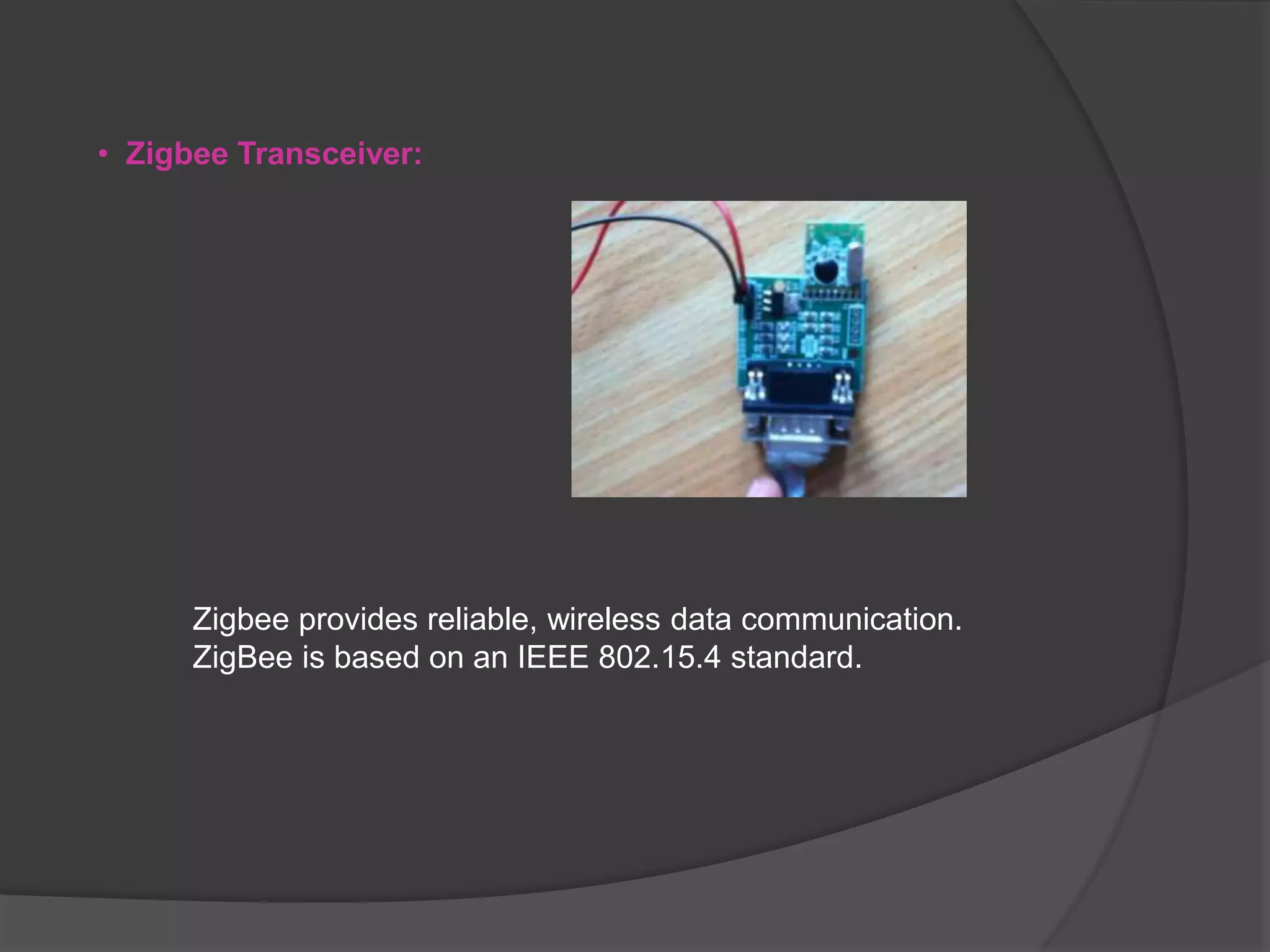
• Zigbee Transceiver:
Zigbee provides reliable, wireless data communication.
ZigBee is based on an IEEE 802.15.4 standard.
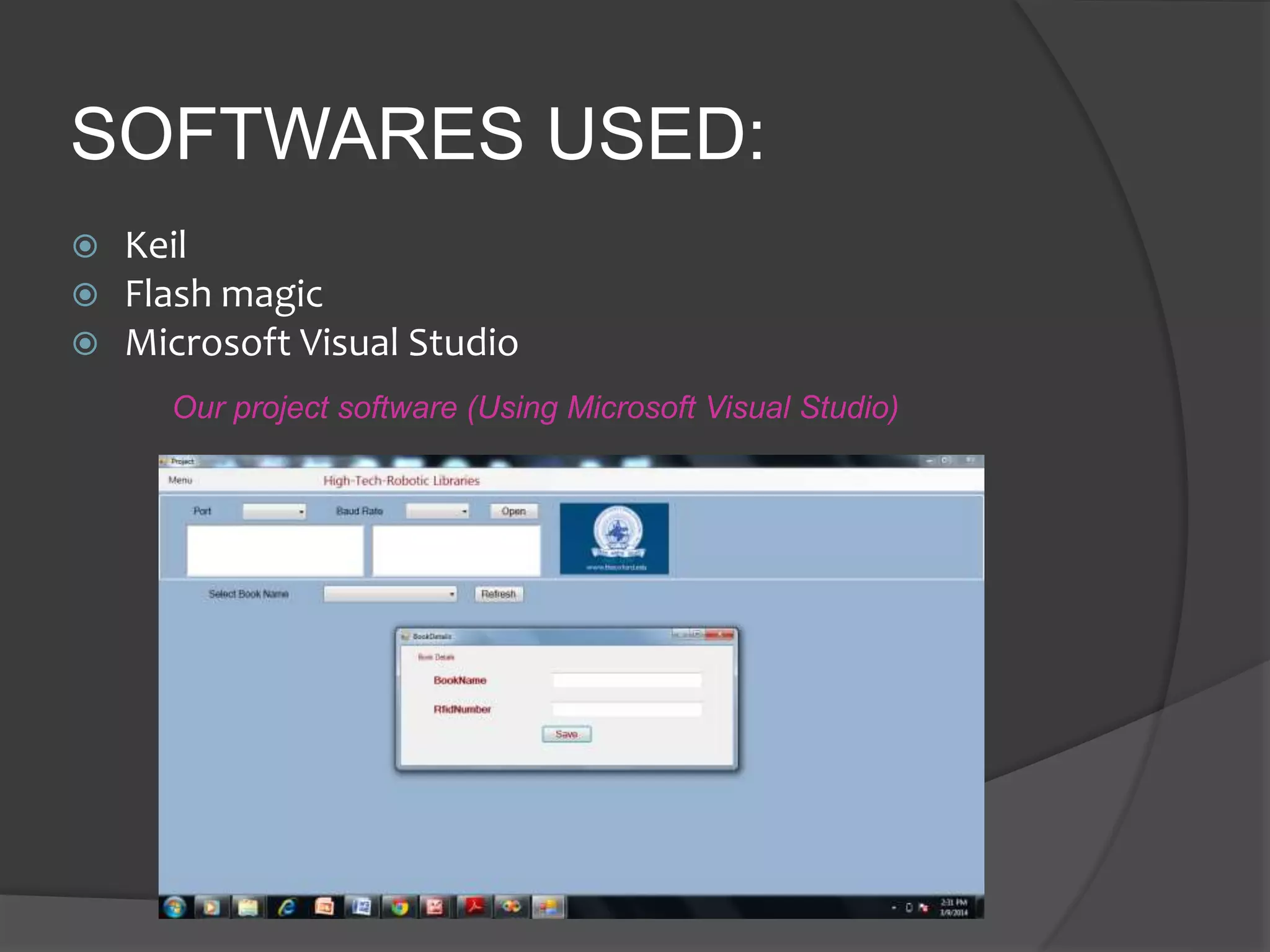
SOFTWARES USED:
 Keil
 Flash magic
 Microsoft Visual Studio
Our project software (Using Microsoft Visual Studio)
Advantages:
 Reduces human effort
 Reduces human error
 Makes the management of the library, easier than
ever.
 Saves time.
Disadvantages:
• Problems of mechanical functioning may occur
• Capability of lifting a book has limitation.
Applications:
• It is used in libraries of school, colleges.
• In big book stalls in malls.
• News Paper printing press for picking
bundles of papers.
• It may be used in paper mills.
• Book exhibition & sales.
• Central Libraries etc.
Conclusion:
• In this Project, the proposed robot will make the
life of the librarian a lot simpler
• To automate the process of book finding and
picking we suggest a robot with an arm with some
degrees of freedom which will be able to find out
the book with the required tag and then pick it and
place it on the table.
• The same principal can be used in the
supermarkets to make an automated item
collector.
• Hence we use this system to avoid human errors,
to save time & Money.
Bibliography:
 en.wikipedia.org
 www.alldatasheet.com
 www.robosoftsystems.co.in
 www.robotplatform.com
 electronics.howstuffworks.com
 https://www.digi.com/technology
 www.8051projects.net
 www.engineersgarage.com
For more Information contact:
Shaik.nayeem8@gmail.com
Automatic Book Picking Robot For Libraries

Automatic Book Picking Robot For Libraries

  • 1.
    Automatic book pickingrobot for Libraries.
  • 2.
    Introduction To automate theprocess of book finding and picking we suggest a robot with an arm with some degrees of freedom which will be able to find out the book with the required tag and then pick it and place it on the table.
  • 3.
    DESCRIPTION Here we willbe placing the books in a rack and all the books will be tagged by RFID tags and an RFID reader will be used to detect the books .The IR obstacle sensor placed over the arm detects the book and then the gripper will close the jaws to get an hold of the book and then the robotic arm is lifted after which the robot moves in the reverse direction to the place it started from and places the book.
  • 4.
    Features: This projects contains3 main parts:  Moveable base.  The base shaft.  Gripping mechanism.
  • 5.
  • 6.
    Components list  Controller(p89V51RD2).  16x2 LCD.  RFID Reader and Tags.  IR obstacle sensor.  DC motors and Mechanical Gripper.  L293 & L298N Motor Drivers.  Zig bee.  Power supply.
  • 7.
    Block Diagram Description Themain centre part of the project is the microcontroller. Here we are using the 8051 based Philips P89V51RD2 microcontroller. The P89V51RD2 are 80C51 microcontrollers with 64kB flash and 1024 B of data RAM • LCD: A liquid crystal display is a thin, flat electronic visual display that uses the light modulating properties of liquid crystals (LCs). LCs does not emit light directly. • P89V51RD2 Microcontroller:
  • 8.
    • RFID Readerand Tags: Radio-frequency identification (RFID) is an automatic identification method, relying on storing and remotely retrieving data using devices called RFID tags or transponders. IR sensors are nothing but infrared sensors, which have two semiconductor LEDs which sense the obstacles. • IR obstacle sensor:
  • 9.
    • DC motors: Inthis project DC motors is used for rotating wheels of the robot and control the arms & Wheels of the robot. • L298N Motor Driver: In this project we are using L298N motor driver to drive 4 dc motors of our robot (4 wheels of the base). Only one IC can control 4 motors at a time.
  • 10.
    • L293 MotorDriver: In this project we are using L293 motor driver to operate two motors. One is JAW ROBOT DC MOTOR and the other is NECK ROBOT DC MOTOR.
  • 11.
    • Zigbee Transceiver: Zigbeeprovides reliable, wireless data communication. ZigBee is based on an IEEE 802.15.4 standard.
  • 12.
    SOFTWARES USED:  Keil Flash magic  Microsoft Visual Studio Our project software (Using Microsoft Visual Studio)
  • 13.
    Advantages:  Reduces humaneffort  Reduces human error  Makes the management of the library, easier than ever.  Saves time. Disadvantages: • Problems of mechanical functioning may occur • Capability of lifting a book has limitation.
  • 14.
    Applications: • It isused in libraries of school, colleges. • In big book stalls in malls. • News Paper printing press for picking bundles of papers. • It may be used in paper mills. • Book exhibition & sales. • Central Libraries etc.
  • 15.
    Conclusion: • In thisProject, the proposed robot will make the life of the librarian a lot simpler • To automate the process of book finding and picking we suggest a robot with an arm with some degrees of freedom which will be able to find out the book with the required tag and then pick it and place it on the table. • The same principal can be used in the supermarkets to make an automated item collector. • Hence we use this system to avoid human errors, to save time & Money.
  • 16.
    Bibliography:  en.wikipedia.org  www.alldatasheet.com www.robosoftsystems.co.in  www.robotplatform.com  electronics.howstuffworks.com  https://www.digi.com/technology  www.8051projects.net  www.engineersgarage.com
  • 17.
    For more Informationcontact: Shaik.nayeem8@gmail.com