This document defines and describes robots. It begins by defining a robot as a programmable, self-controlled automatic device that functions like a living agent. It then discusses ideal robot tasks such as dangerous, boring, repetitive, or high-precision work. The document differentiates between automation and robots, describing types of robots based on mobility. It details characteristics like pick and place movements, continuous path control, and use of sensors. Performance measures, controls, and examples of industrial, military, and personal robots are provided. In conclusion, the document discusses advantages and limitations of robots as well as potential future applications using artificial intelligence.
INDEX
Definition
IdealTasks
Automation VS. Robots
Types of Robots based on mobility
Characteristics of robots
Pick and place
Continuous path control
Sensory
Measures of performance
Controls
Types of robot
Conclusion
Reference
3.
INTRODUCTION
What isa Robot?
“A robot can be defined as a programmable, self-
controlled, automatic device consisting of electronic,
electrical, or mechanical units. More generally, it is a
machine that functions in place of a living agent.”
4.
IDEAL TASKS
Tasks whichare:
Dangerous
Space exploration
chemical spill cleanup
disarming bombs
disaster cleanup
Boring and/or repetitive
Welding car frames
part pick and place
manufacturing parts.
High precision or high speed
Electronics testing
Surgery
precision machining.
5.
AUTOMATION VS. ROBOTS
Automation –Machinery designed to carry out a specific
task
Bottling machine
Dishwasher
Paint sprayer
Robots – Machinery designed
to carry out a variety of tasks
Pick and place arms
Mobile robots
Computer Numerical Control
machines
(These are always better
than robots, because they
can be optimally designed
for a particular task).
CHARACTERISTICS OF ROBOTS
Pick and place
Moves items between points
Continuous path control
Moves along a programmable path
Sensory
Employs sensors for feedback
A SCARA robot (Selective Compliant
Articulated Robot Arm): A pick-and-
place robot with angular
x-y-z positioning (Adept Technology)
A six-axis industrial robot ($60K)(Fanuc
Robotics), but an additional $200K is often
spent for tooling and programming.
8.
PICK AND PLACE
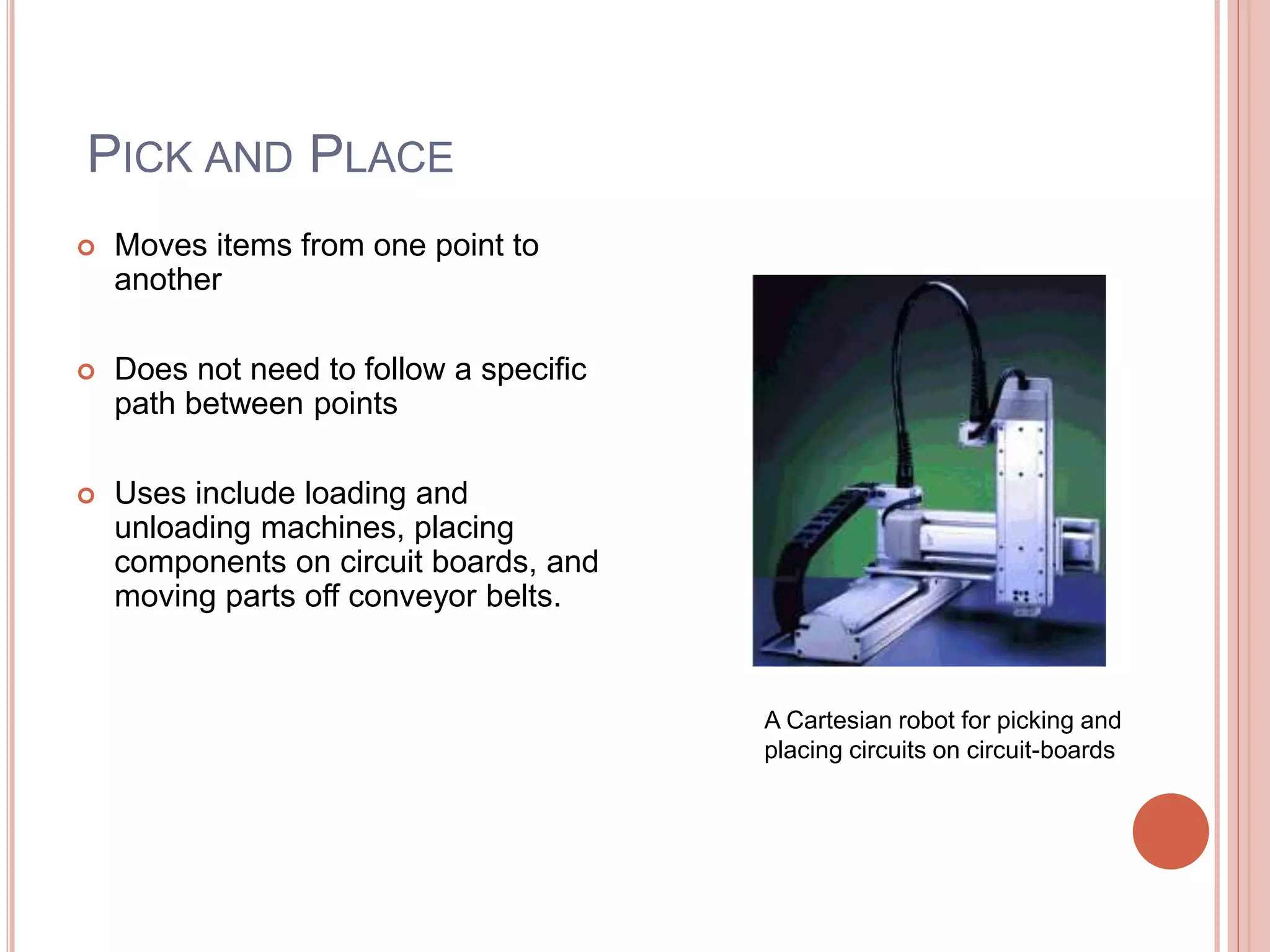
Moves items from one point to
another
Does not need to follow a specific
path between points
Uses include loading and
unloading machines, placing
components on circuit boards, and
moving parts off conveyor belts.
A Cartesian robot for picking and
placing circuits on circuit-boards
9.
CONTINUOUS PATH CONTROL
Moves along a specific path
Uses include welding,
cutting, machining parts.
Robotic seam welding
10.
SENSORY
Uses sensorsfor feedback.
Closed-loop robots use sensors
in conjunction with actuators to
gain higher accuracy – servo
motors.
Uses include mobile robotics,
telepresence, search and
rescue, pick and place with
machine vision.
11.
MEASURES OF PERFORMANCE
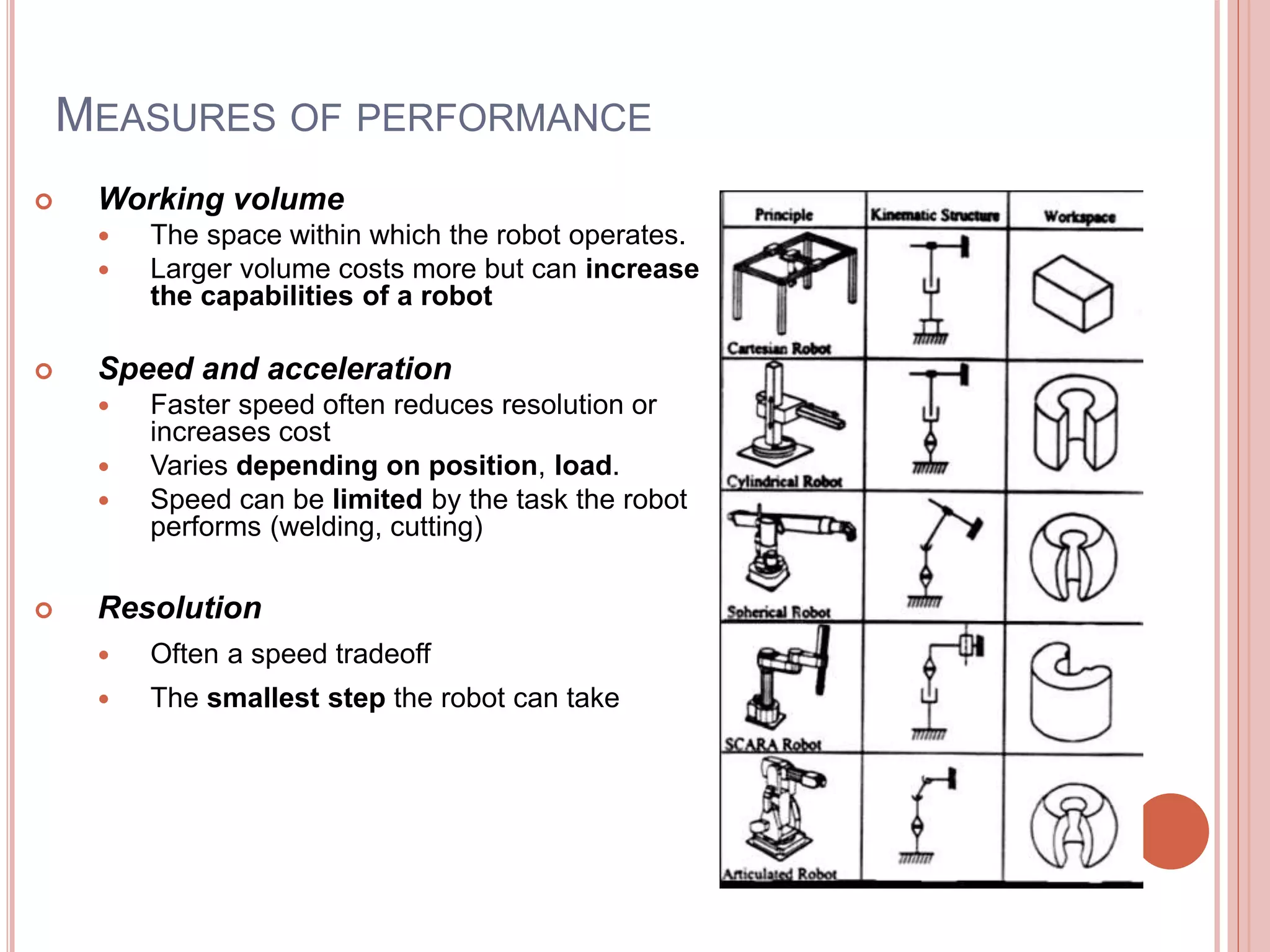
Working volume
The space within which the robot operates.
Larger volume costs more but can increase
the capabilities of a robot
Speed and acceleration
Faster speed often reduces resolution or
increases cost
Varies depending on position, load.
Speed can be limited by the task the robot
performs (welding, cutting)
Resolution
Often a speed tradeoff
The smallest step the robot can take
12.
• Accuracy
The differencebetween the
actual position of the robot and
the programmed position
• Repeatability
Will the robot always return to the
same point under the same
control conditions?
• Increased cost
• Varies depending on
position, load
Performance (cont.)
13.
CONTROLS
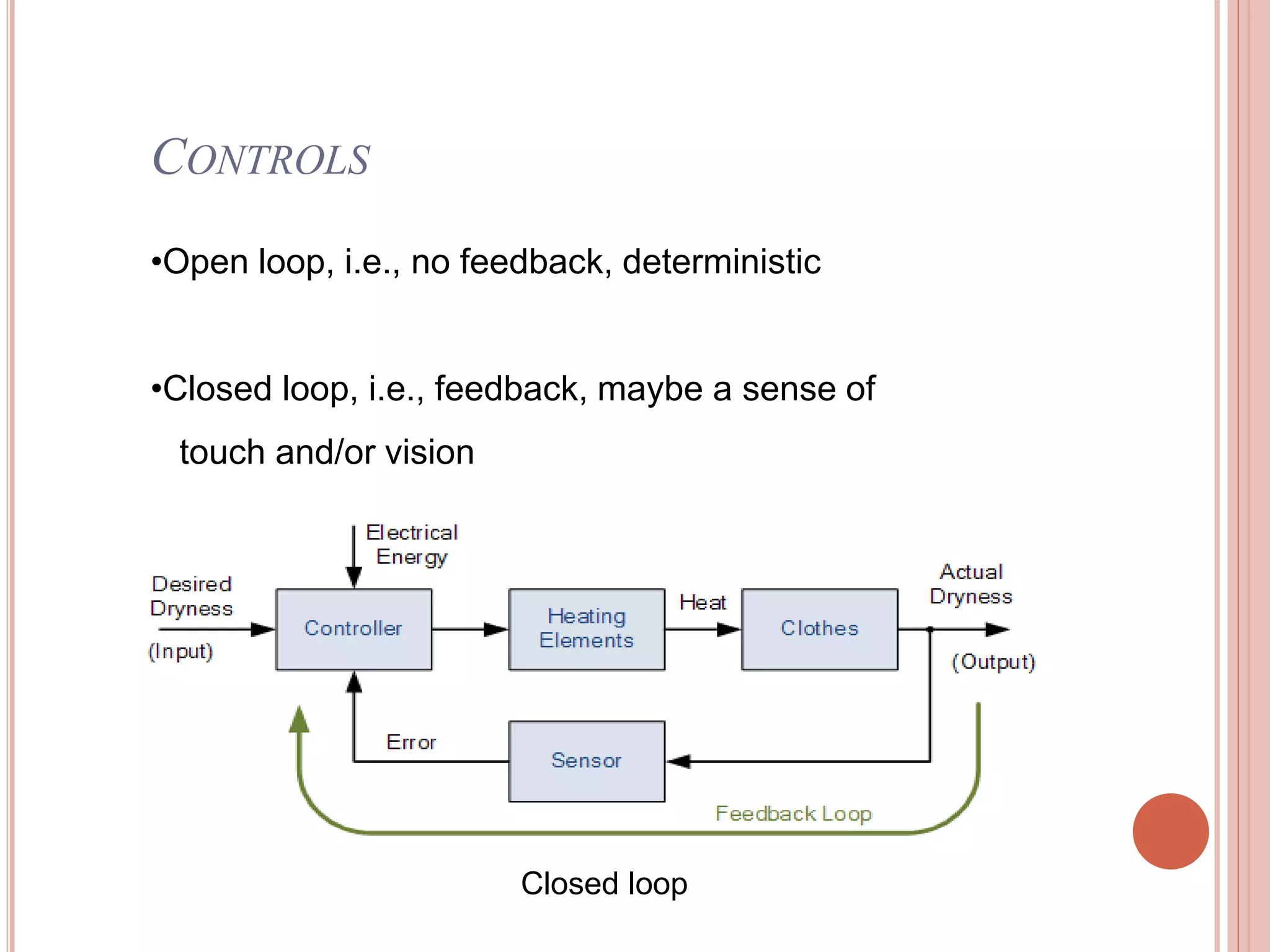
•Open loop, i.e.,no feedback, deterministic
•Closed loop, i.e., feedback, maybe a sense of
touch and/or vision
Closed loop
14.
CONTROLS (CONT.)
Mostindustrial robots have at least the following
parts:
Locomotive parts
Power Supply
Actuator
Sensors
Signal Processing Parts
Control Parts
INDUSTRIAL ROBOTS :
An industrial robot is an automatically controlled,
reprogrammable, multipurpose manipulator,
programmable in three or more axes.
Typical applications of robots include welding,
painting, assembly, pick and place, product
inspection, and testing;
19.
MILITARY ROBOTS :
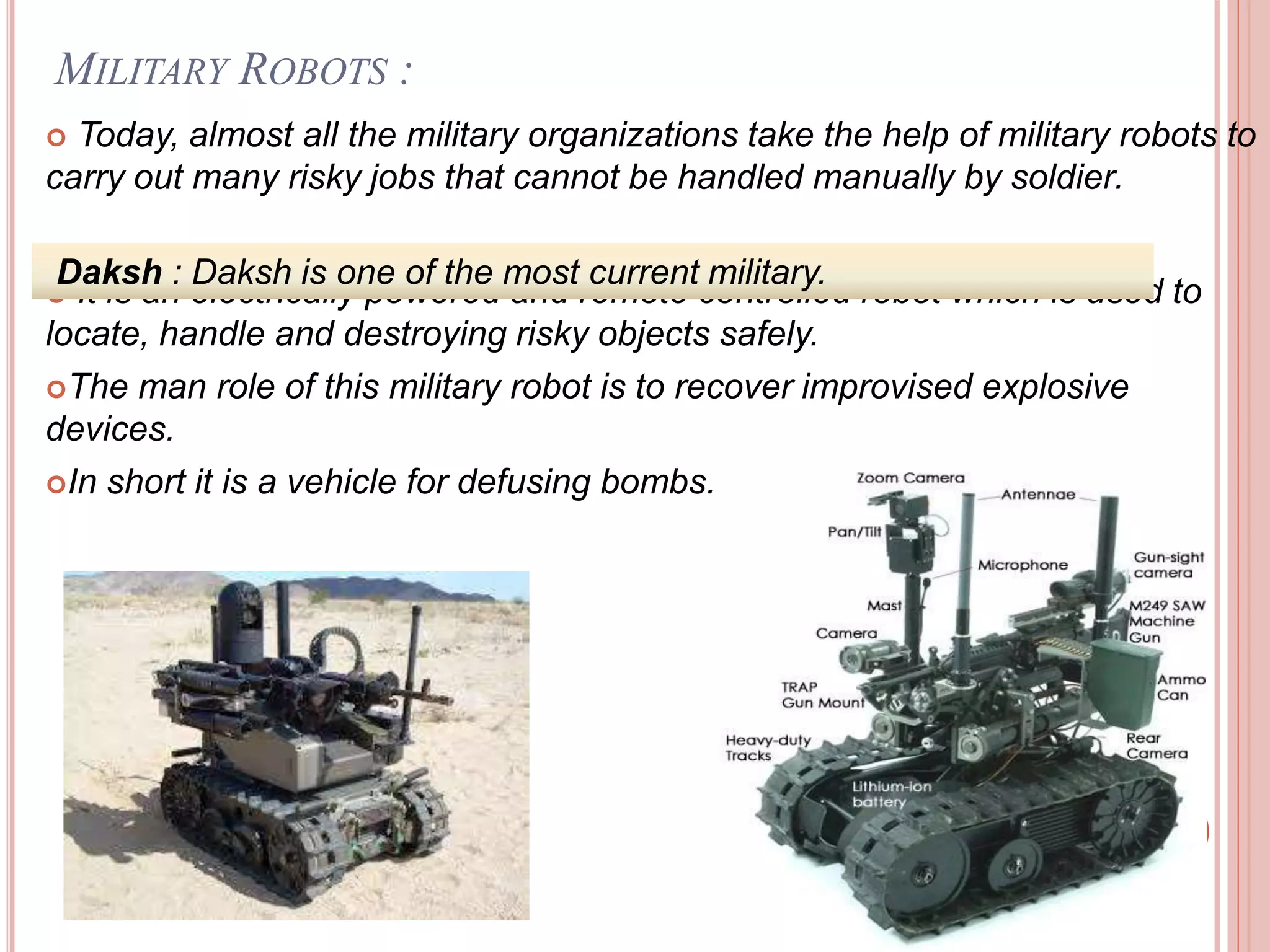
Today, almost all the military organizations take the help of military robots to
carry out many risky jobs that cannot be handled manually by soldier.
It is an electrically powered and remote controlled robot which is used to
locate, handle and destroying risky objects safely.
The man role of this military robot is to recover improvised explosive
devices.
In short it is a vehicle for defusing bombs.
Daksh : Daksh is one of the most current military.
20.
A personalrobot is one whose human interface and design
make it useful for individuals.
PERSONAL ROBOTS :
21.
ADVANTAGES:
Goingfar down into the unknown waters where humans would be
crushed.
Working at places 24 for 7 without any salary and food. Plus they don't get
bored.
They can perform tasks faster than humans and much more consistently
and accurately.
Industrial automated robots have the capacity to improve product
quality.
Robots increase workplace safety.
LIMITATIONS:
People can lose jobs in factories.
The initial investment to integrated automated robotics is high.
They have limited duties as they will only do what is programmed and
cannot think for themselves.
Lack of Emotions.
22.
With theintroduction of Artificial Intelligence and Powerful
sensors technology, future factory will be a digital factory.
In future in place of solders, robots may fight with
enemies. Human may just monitor these robots.
There are some robots, using artificial intelligence
technology, which can represent his boss in his absence.
There is a lot scope in this field for research.
CONCLUSIONS