Lesson 1
Fundamentals of Robot
   A robot is a mechanical agent resembling a human
    being guided by a computer program with electronic
    circuitry and capable of performing all sorts of
    industrial actions in an automated way. A robot may
    convey a sense of intelligence or thought of its own. The
    branch of technology that deals with robots is called
    robotics.
   Robot anatomy usually has 3 physical configurations:-
   Body
   Arm
   Wrist
   In many industries the robots are usually stationary mounted on
    a base. The body is attached to the base, arm is attached to the
    body and wrist is attached to the arm. Relative motion is
    achieved by movements of body, arm and wrist.
   The wrist is the important component bearing the tool or work. It
    is usually called as end effectors. The relative movements can be
    rotating or sliding or the combination of both according to the
    need.
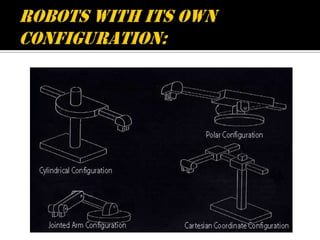
   The robots used in the industry have various sizes,
    shapes and configurations. The common co-ordinate
    systems in robots are:-
   Polar co-ordinate system
   Cylindrical co-ordinate system
   Cartesian co-ordinate system
   Jointed arm co-ordinate system
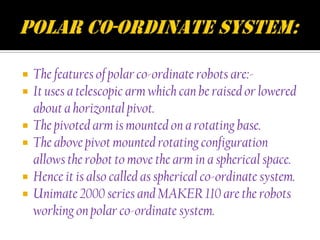
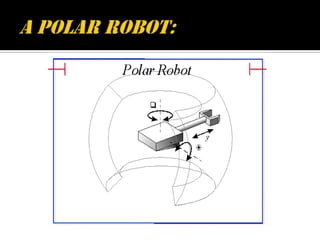
   The features of polar co-ordinate robots are:-
   It uses a telescopic arm which can be raised or lowered
    about a horizontal pivot.
   The pivoted arm is mounted on a rotating base.
   The above pivot mounted rotating configuration
    allows the robot to move the arm in a spherical space.
   Hence it is also called as spherical co-ordinate system.
   Unimate 2000 series and MAKER 110 are the robots
    working on polar co-ordinate system.
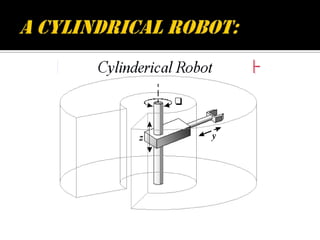
   It has a vertical column that can slide up and down
    along the column.
   The robot arm is attached to the vertical column.
   The robotic arm can rotate radially with respect to the
    column.
   The robot work space resembles a cylinder and hence
    called as cylindrically co-ordinate robot.
   GMF model robots are cylindrical co-ordinate type.
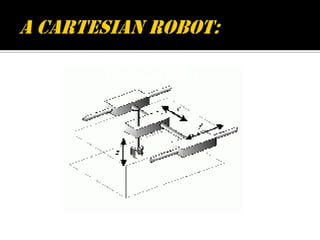
   This uses the mutually perpendicular axes (x, y and z
    respectively).
   The arm is mounted in a vertical column such that it
    can make any kind of motion with the permissible
    limits of x, y, and z axes.
   Hence this robot is also called as xyz robot or
    rectilinear robot.
   By moving the arm it can surround a work area which
    resembles a rectangular envelope.
   IBM RS-1 robots are this type.
 The configurations are:-
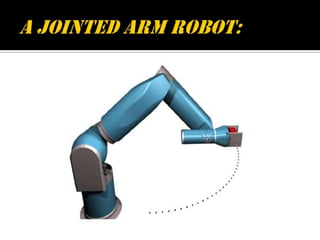
 This kind of robot resembles a human arm.
 It has two components corresponding to human forearm
  and upper arm.
 The fore arm is connected to upper arm by an elbow joint.
 The upper arm is connected to the body by a shoulder joint.
 A wrist is connected to the forearm to perform operations.
 SCARA model type of robots is jointed arm type.
   It is the space within which the robot can manipulate its
    wrist end. The work volume is defined by the following
    characteristics:
   Robots physical configuration
   Sizes of arm, body and wrist components
   Limits of the joints
   The polar configured robot has the work envelope of
    sphere, the cylindrical type has cylinder envelope,
    Cartesian co-ordinate has a rectangular and the jointed
    arm has spherical envelope. The dimensions of the work
    envelope are defined by dimensions of the links and type of
    joints.
   The broad classifications of robots are based on the
    following methods:
   Configuration (same as above)
   Shape of workspace (same as above)
   Type of power-drive (electric, pneumatic and
    hydraulic)
   Type of technology( low-level, medium level and high
    level)
   Type of motion (linear, rotational, extensional,
    twisting)
   The movements of the body, arm and the wrist of the
    robots are determined by the power drive system. It
    also determines the speed, strength and performance of
    robots. Even drive system varies according the
    applications. The drive systems are:-
   Hydraulic
   Electric
   Pneumatic
   The robots working on hydraulic power have some
    common features:
   They are usually large type (unimate series).
   The essential advantage is greater speed and strength.
   The disadvantage is the requirement of more floor
    space, leakage etc.
   They usually actuate rotary and linear movements.
   Rotary vane pump is employed for rotary motion and
    hydraulic pistons for linear movement.
 Common specifications of electrical drive robots are:-
 Do not provide as much speed and power compared to
  hydraulic system.
 Accuracy and repeatability are far better.
 Requires less floor space and suitable for precise
  applications.
 MAKER 110 is of this type.
 They employ stepper and servo motors for rotary
  movements and telescopic arms for linear movements.
 The cost of the electric robot is very much proportional too
  its size.
   The pneumatic robots have the following features:
   Smaller robots with fewer degrees of freedom (2-4).
   Often has application in pick and place operations.
   More suitable for linear and sliding motions.
   It can also be used in rotary applications.
   From the time of discovery of robotic technology
    various advancements have been made till now and the
    developments in technology is going on. Based on
    technology, the robots are classified as
   Low level
   Medium level
   High level
   Mostly used for material handling.
   Could carry out loading-unloading and simple
    assembly operations.
   Fewer degrees of freedom with movements at (2-4
    axes).
   Have a payload of 25 pounds.
   Mostly used for pick and place applications.
   Carry out loading-unloading and common assembly
    operations.
   Degrees of freedom is limited from (4-6) axes.
   Has the payload up to 300 pounds.
   Finds application in industrial manufacturing tasks.
   Degrees of freedom is limited from (6-9) axes.
   Has the payload from 300 pounds.
   Robots are specified by the following terms:
   Pitch
   Yaw
   Roll
   Joint notation
   Speed of motion
   Payload.
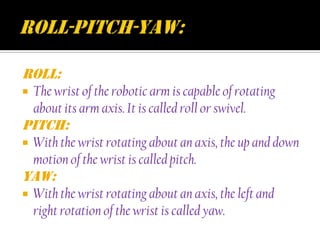
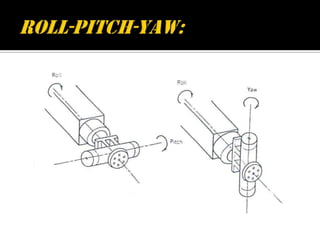
Roll:
   The wrist of the robotic arm is capable of rotating
    about its arm axis. It is called roll or swivel.
Pitch:
   With the wrist rotating about an axis, the up and down
    motion of the wrist is called pitch.
Yaw:
   With the wrist rotating about an axis, the left and
    right rotation of the wrist is called yaw.
   The configuration of the robot can be represented by
    notations or symbols. (L, R, T, V)
   L- Linear
   R- Rotation
   T- Twisting
   V- Revolving
   A polar configured robot is of type TRL while a
    cylindrical robot can be of type TLL, LTL, LVL.
   The speed of the robot is essentially measured by a
    robot extending its arm to a maximum distance from
    the vertical axis and the speed is measure at the end of
    the wrist.
   The maximum speed of the industrial robots is about
    1.7m/s.
   It determines how quickly a job can be accomplished.
   It minimizes the cycle time for a given task.
 Speed depends upon 3 factors;
 Accuracy
 Accuracy has inverse relationship with speed. At higher
  speeds, the robot could not locate the position accurately.
 Weight of the object
 Weight of an object also has inverse relation on speed.
  When heavy objects are moved due to inertia, it lacks its
  stability.
 Distance to be moved
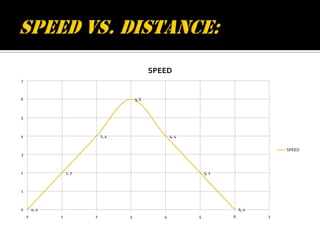
 Distance is directly proportional to speed. When the robot
  has to travel a greater distance, it can reach its maximum
  possible speed.
SPEED
7


6                                        3, 6


5


4                             2, 4                     4, 4


                                                                                        SPEED
3


2                  1, 2                                           5, 2


1


0       0, 0                                                                 6, 0
    0          1          2          3             4          5          6          7
   The weight carrying capacity of the robot determined
    by its weakest position is called payload. It depends
    upon size, configuration, drive system etc. if the rated
    load capacity of the robot is 5 kg and the end effectors
    load is 2kg then the pay load is 3kg.

Industrial robotics

  • 1.
  • 2.
    A robot is a mechanical agent resembling a human being guided by a computer program with electronic circuitry and capable of performing all sorts of industrial actions in an automated way. A robot may convey a sense of intelligence or thought of its own. The branch of technology that deals with robots is called robotics.
  • 3.
    Robot anatomy usually has 3 physical configurations:-  Body  Arm  Wrist  In many industries the robots are usually stationary mounted on a base. The body is attached to the base, arm is attached to the body and wrist is attached to the arm. Relative motion is achieved by movements of body, arm and wrist.  The wrist is the important component bearing the tool or work. It is usually called as end effectors. The relative movements can be rotating or sliding or the combination of both according to the need.
  • 4.
    The robots used in the industry have various sizes, shapes and configurations. The common co-ordinate systems in robots are:-  Polar co-ordinate system  Cylindrical co-ordinate system  Cartesian co-ordinate system  Jointed arm co-ordinate system
  • 6.
    The features of polar co-ordinate robots are:-  It uses a telescopic arm which can be raised or lowered about a horizontal pivot.  The pivoted arm is mounted on a rotating base.  The above pivot mounted rotating configuration allows the robot to move the arm in a spherical space.  Hence it is also called as spherical co-ordinate system.  Unimate 2000 series and MAKER 110 are the robots working on polar co-ordinate system.
  • 8.
    It has a vertical column that can slide up and down along the column.  The robot arm is attached to the vertical column.  The robotic arm can rotate radially with respect to the column.  The robot work space resembles a cylinder and hence called as cylindrically co-ordinate robot.  GMF model robots are cylindrical co-ordinate type.
  • 10.
    This uses the mutually perpendicular axes (x, y and z respectively).  The arm is mounted in a vertical column such that it can make any kind of motion with the permissible limits of x, y, and z axes.  Hence this robot is also called as xyz robot or rectilinear robot.  By moving the arm it can surround a work area which resembles a rectangular envelope.  IBM RS-1 robots are this type.
  • 12.
     The configurationsare:-  This kind of robot resembles a human arm.  It has two components corresponding to human forearm and upper arm.  The fore arm is connected to upper arm by an elbow joint.  The upper arm is connected to the body by a shoulder joint.  A wrist is connected to the forearm to perform operations.  SCARA model type of robots is jointed arm type.
  • 14.
    It is the space within which the robot can manipulate its wrist end. The work volume is defined by the following characteristics:  Robots physical configuration  Sizes of arm, body and wrist components  Limits of the joints  The polar configured robot has the work envelope of sphere, the cylindrical type has cylinder envelope, Cartesian co-ordinate has a rectangular and the jointed arm has spherical envelope. The dimensions of the work envelope are defined by dimensions of the links and type of joints.
  • 15.
    The broad classifications of robots are based on the following methods:  Configuration (same as above)  Shape of workspace (same as above)  Type of power-drive (electric, pneumatic and hydraulic)  Type of technology( low-level, medium level and high level)  Type of motion (linear, rotational, extensional, twisting)
  • 16.
    The movements of the body, arm and the wrist of the robots are determined by the power drive system. It also determines the speed, strength and performance of robots. Even drive system varies according the applications. The drive systems are:-  Hydraulic  Electric  Pneumatic
  • 17.
    The robots working on hydraulic power have some common features:  They are usually large type (unimate series).  The essential advantage is greater speed and strength.  The disadvantage is the requirement of more floor space, leakage etc.  They usually actuate rotary and linear movements.  Rotary vane pump is employed for rotary motion and hydraulic pistons for linear movement.
  • 18.
     Common specificationsof electrical drive robots are:-  Do not provide as much speed and power compared to hydraulic system.  Accuracy and repeatability are far better.  Requires less floor space and suitable for precise applications.  MAKER 110 is of this type.  They employ stepper and servo motors for rotary movements and telescopic arms for linear movements.  The cost of the electric robot is very much proportional too its size.
  • 19.
    The pneumatic robots have the following features:  Smaller robots with fewer degrees of freedom (2-4).  Often has application in pick and place operations.  More suitable for linear and sliding motions.  It can also be used in rotary applications.
  • 20.
    From the time of discovery of robotic technology various advancements have been made till now and the developments in technology is going on. Based on technology, the robots are classified as  Low level  Medium level  High level
  • 21.
    Mostly used for material handling.  Could carry out loading-unloading and simple assembly operations.  Fewer degrees of freedom with movements at (2-4 axes).  Have a payload of 25 pounds.
  • 22.
    Mostly used for pick and place applications.  Carry out loading-unloading and common assembly operations.  Degrees of freedom is limited from (4-6) axes.  Has the payload up to 300 pounds.
  • 23.
    Finds application in industrial manufacturing tasks.  Degrees of freedom is limited from (6-9) axes.  Has the payload from 300 pounds.
  • 24.
    Robots are specified by the following terms:  Pitch  Yaw  Roll  Joint notation  Speed of motion  Payload.
  • 25.
    Roll:  The wrist of the robotic arm is capable of rotating about its arm axis. It is called roll or swivel. Pitch:  With the wrist rotating about an axis, the up and down motion of the wrist is called pitch. Yaw:  With the wrist rotating about an axis, the left and right rotation of the wrist is called yaw.
  • 27.
    The configuration of the robot can be represented by notations or symbols. (L, R, T, V)  L- Linear  R- Rotation  T- Twisting  V- Revolving  A polar configured robot is of type TRL while a cylindrical robot can be of type TLL, LTL, LVL.
  • 28.
    The speed of the robot is essentially measured by a robot extending its arm to a maximum distance from the vertical axis and the speed is measure at the end of the wrist.  The maximum speed of the industrial robots is about 1.7m/s.  It determines how quickly a job can be accomplished.  It minimizes the cycle time for a given task.
  • 29.
     Speed dependsupon 3 factors;  Accuracy  Accuracy has inverse relationship with speed. At higher speeds, the robot could not locate the position accurately.  Weight of the object  Weight of an object also has inverse relation on speed. When heavy objects are moved due to inertia, it lacks its stability.  Distance to be moved  Distance is directly proportional to speed. When the robot has to travel a greater distance, it can reach its maximum possible speed.
  • 30.
    SPEED 7 6 3, 6 5 4 2, 4 4, 4 SPEED 3 2 1, 2 5, 2 1 0 0, 0 6, 0 0 1 2 3 4 5 6 7
  • 31.
    The weight carrying capacity of the robot determined by its weakest position is called payload. It depends upon size, configuration, drive system etc. if the rated load capacity of the robot is 5 kg and the end effectors load is 2kg then the pay load is 3kg.