SECURITY AND PROTECTION IN OPERATING SYSTEM
Presented By :
MUSKAAN
MCA/25020/18
Introduction
 Interference in resource utilization is a
very serious threat in an OS
 The nature of the threat depends on the
nature of a resource and the manner in
which it is used.
Protection and Security
 OS use two sets of techniques to
counter threats to information namely:
 Protection
 Security
Protection
It involves guarding a user’s data and
programs against interference by other
authorized users of the system.
Security
It involves guarding of a user’s data
and programs against interference by
external entities, e.g. unauthorized
persons.
Facets to protection of information
 There are two facets to protection of
information
 Secrecy: Implies that only authorized users
should be able to access information.
 Privacy: Implies that information should be
used only for the purpose(s) for which it is
intended and shared.
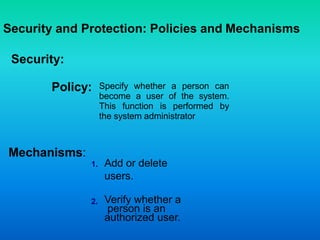
Security and Protection: Policies and Mechanisms
Security:
Specify whether a person can
become a user of the system.
This function is performed by
the system administrator
Add or delete
users.
Verify whether a
person is an
authorized user.
Mechanisms:
Policy:
1.
2.
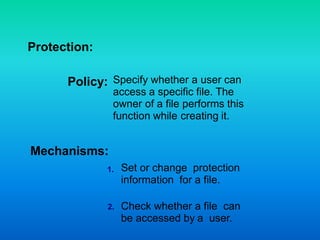
Protection:
Policy:
Mechanisms:
Specify whether a user can
access a specific file. The
owner of a file performs this
function while creating it.
Set or change protection
information for a file.
Check whether a file can
be accessed by a user.
2.
1.
Security Threats
 Direct: This is any direct attack on your
specific systems, whether from outside
hackers or from disgruntled insiders.
 Indirect: This is general random attack,
most commonly computer viruses,
computer worms or Trojan horses.
Reasons for taking Security measures
 To prevent loss of data
 To prevent corruption of data
 To prevent compromise of data
 TO prevent theft of data
 To prevent sabotage
GOALS OF SECURITY AND PROTECTION
Secrecy: Only authorized user should be able to access
information.
Privacy: Information should be used only for the purpose for
which it was intended and shared.
Authenticity: It should be possible to verify the source or
sender of the information and also verify the information has been
preserved in the form in which it was created or sent.
Integrity: It should not be possible to destroy or corrupt the
information .
AUTHENTICATION
Goal of Authentication: Reasonable assurance
that anyone who attempts to access a system
or a network is a legitimate user.
 2 Mechanisms:
Password
Biometric measure
Authentication using Biometrics
Use basic body properties to prove identity.
Examples include:
Fingerprints
voice
Hand size
Retina patterns
Facial features
Thank You

Security & Protection in Operating System

  • 1.
    SECURITY AND PROTECTIONIN OPERATING SYSTEM Presented By : MUSKAAN MCA/25020/18
  • 2.
    Introduction  Interference inresource utilization is a very serious threat in an OS  The nature of the threat depends on the nature of a resource and the manner in which it is used.
  • 3.
    Protection and Security OS use two sets of techniques to counter threats to information namely:  Protection  Security
  • 4.
    Protection It involves guardinga user’s data and programs against interference by other authorized users of the system.
  • 5.
    Security It involves guardingof a user’s data and programs against interference by external entities, e.g. unauthorized persons.
  • 6.
    Facets to protectionof information  There are two facets to protection of information  Secrecy: Implies that only authorized users should be able to access information.  Privacy: Implies that information should be used only for the purpose(s) for which it is intended and shared.
  • 7.
    Security and Protection:Policies and Mechanisms Security: Specify whether a person can become a user of the system. This function is performed by the system administrator Add or delete users. Verify whether a person is an authorized user. Mechanisms: Policy: 1. 2.
  • 8.
    Protection: Policy: Mechanisms: Specify whether auser can access a specific file. The owner of a file performs this function while creating it. Set or change protection information for a file. Check whether a file can be accessed by a user. 2. 1.
  • 9.
    Security Threats  Direct:This is any direct attack on your specific systems, whether from outside hackers or from disgruntled insiders.  Indirect: This is general random attack, most commonly computer viruses, computer worms or Trojan horses.
  • 10.
    Reasons for takingSecurity measures  To prevent loss of data  To prevent corruption of data  To prevent compromise of data  TO prevent theft of data  To prevent sabotage
  • 11.
    GOALS OF SECURITYAND PROTECTION Secrecy: Only authorized user should be able to access information. Privacy: Information should be used only for the purpose for which it was intended and shared. Authenticity: It should be possible to verify the source or sender of the information and also verify the information has been preserved in the form in which it was created or sent. Integrity: It should not be possible to destroy or corrupt the information .
  • 12.
    AUTHENTICATION Goal of Authentication:Reasonable assurance that anyone who attempts to access a system or a network is a legitimate user.  2 Mechanisms: Password Biometric measure
  • 13.
    Authentication using Biometrics Usebasic body properties to prove identity. Examples include: Fingerprints voice Hand size Retina patterns Facial features
  • 14.