Outline:
Protection.
Goals of Protection.
Principles of protection.
Domain of protection.
Domain Structure.
Access Matrix.
Access control.
Compatibility-based System.
 Hydra
 Cambridge CAP system
Language Based Protection.
Protection:
Protection refers to a mechanism for controlling the
access of programs, processes, or users to the
resources defined by a computer system.
Protection ensures that the resources of the
computer are used in a consistent way.
It ensure that each object accessed correctly and
only by those processes that are allowed to do so.
Goals of Protection:
As computer systems have become more sophisticated
and pervasive in their applications, the need to protect
their integrity has also grown.
We need to provide protection for several reasons. The
most obvious is the need to prevent the mischievous,
intentional violation of an access restriction by user.
 An unprotected resource cannot defend against use (or
misuse) by an unauthorized or incompetent user. A
protection-oriented system provides means to distinguish
between authorized and unauthorized usage.
Cont…
The role of protection in a computer system is to
provide a mechanism for the enforcement of the
policies governing resource use. These policies can be
established in a variety of ways. Some are fixed in the
design of the system, while others are formulated by
the management of a system. Still others are defined
by the individual users to protect their own files and
programs. A protection system must have the
flexibility to enforce a variety of policies.
Principles of Protection:
The time-tested guiding principle for protection is the
Principle of least privilege.It dictates that programs,
users, and even systems be given just enough privileges
to perform their tasks.
Consider the analogy of a security guard with a passkey.
If this key allows the guard into just the public areas
that she guards, then misuse of the key will result in
minimal damage. If, however, the passkey allows
access to all areas, then damage from its being lost,
stolen, misused, copied, or otherwise compromised will
be much greater.
Cont…
An operating system following the principle of least
privilege implements its features, programs, system calls,
and data structures so that failure or compromise of a
component does the minimum damage and allows the
minimum damage to be done.
The principle of least privilege can help produce a more
secure computing environment.
Domain of Protection:
A computer system is a collection of processes and
objects. By objects, we mean both hardware objects
(such as the CPU, printer) and software objects(such as
files, programs).
Each object has a unique name that differentiates it from
all other objects in the system, and each can be accessed
only through well-defined and meaningful operations.
Cont…
A process should be allowed to access only those
resources for which it has authorization
Furthermore, at any time, a process should be able
to access only those resources that it currently
requires to complete its task.
Domain Structures.
 A process operates within a Protection Domain
that specifies the resources that the process may
access.
 Each domain defines a set of objects and the types
of operations that may be invoked on each object.
 The ability to execute an operation on an object is
an access right.
Cont…
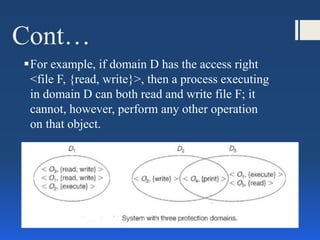
For example, if domain D has the access right
<file F, {read, write}>, then a process executing
in domain D can both read and write file F; it
cannot, however, perform any other operation
on that object.
Cont…
A domain can be realized in a variety of ways:
Each user may be a domain. In this case, the set
of objects that can be accessed depends on the
identity of the user.
Each process may be a domain. In this case, the
set of objects that can be accessed depends on
the identity of the process.
Example of Unix:
In the UNIX operating system, a domain is
associated with the user
In Unix operating system user ID’s use for
identify the domain.
Example of MULTICS:
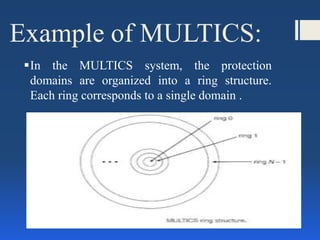
In the MULTICS system, the protection
domains are organized into a ring structure.
Each ring corresponds to a single domain .
Access Matrix:
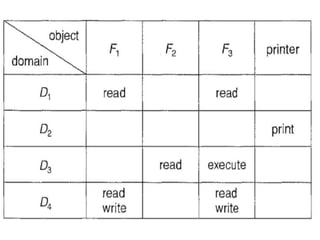
Our model of protection can be viewed
abstractly as a matrix, called an Access Matrix.
The rows of the access matrix represent
domains, and the columns represent objects.
Each entry in the matrix consists of a set of
access rights.
Access Matrix:
Access Control:
The basic problem of computer protection is to
control which objects a given program can
access, and in what ways. Objects are things
like files, sound cards, other programs, the
network, your modem etc. Access means what
kind of operations can be done on these objects.
Examples include reading a file, writing to a file
and creating or deleting objects.
Cont…
When we talk about ``controlling access,'' we
are really talking about four kinds of things:
Preventing access.
Limiting access.
Granting access .
Revoking access.
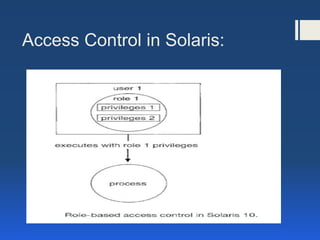
A good example of this is found in Solaris 10.
Solaris uses Role-based access control(RBAC)
to adding the principle.
Cont...
Role-based access control (RBAC) is a security
feature for controlling user access to tasks that
would normally be restricted to the root user.
 In conventional UNIX systems, the root user,
also referred to as superuser. The root user has
the ability to read and write to any file, run all
programs, and send kill signals to any process.
Access Control in Solaris:
Capability-based Systems:
In a capability-based computer system, all access to
objects is done through capabilities, and capabilities
provide the only means of accessing objects. In such a
system, every program holds a set of capabilities.
If program A holds a capability to talk to program B,
then the two programs can grant capabilities to each
other.
In most capability-based systems, a program can hold
an infinite number of capabilities. Such systems have
tended to be slow.
Cont...
A better design allows each program to hold a
fixed (and small -- like 16 or 32) number of
capabilities, and provides a means for storing
additional capabilities if they are needed.
Here two example are discuss
Cambridge CAP System.
Hydra
Cambridge CAP System:
The Cambridge CAP computer was the first
successful experimental computer that demonstrated
the use of security capabilities, both in hardware and
software .It was developed at the University of
Cambridge Computer Laboratory in the 1970s
The CAP system was designed such that any access to
a memory segment or hardware required that the
current process held the necessary capabilities.
CAP has two kinds of capabilities.
Data Capability.
Software Capability.
Cont…
Data Capability:
It can be used to provide access to objects, but the
only rights provided are the standard read, write, and
execute of the individual storage segments associated
with the object.
Software Capability:
It is a protected procedure, which may be written by
an application programmer as part of a subsystem. A
particular kind of rights amplification is associated with a
protected procedure. When executing the code,a process
temporarily acquires the right to read or write the contents
of a software capability itself.
Hydra:
Hydra is a capability-based protection system
that provides considerable flexibility. The
system implements a fixed set of possible
access rights.
 In addition, a user can declare other rights. The
interpretation of user-defined rights is
performed by the user's program, but the system
provides access protection for the use of these
rights.
Language Based Protection:
As operating systems have become more complex,
and particularly as they have attempted to provide
higher-level user interfaces, the goals of protection
have become much more refined. The designers of
protection systems have drawn heavily on ideas that
originated in programming languages and especially
on the concepts of abstract data types and objects.
There must be a protection policy to control the
access of user defined programs.
Cont…
 Protection systems are now concerned not only with the
identity of a resource to which access is attempted but
also with the functional nature of that access.
It is usually achieved through an operating-system
kernel, which acts as a security agent to inspect and
validate each attempt to access a protected resource.

System protection in Operating System

  • 4.
    Outline: Protection. Goals of Protection. Principlesof protection. Domain of protection. Domain Structure. Access Matrix. Access control. Compatibility-based System.  Hydra  Cambridge CAP system Language Based Protection.
  • 5.
    Protection: Protection refers toa mechanism for controlling the access of programs, processes, or users to the resources defined by a computer system. Protection ensures that the resources of the computer are used in a consistent way. It ensure that each object accessed correctly and only by those processes that are allowed to do so.
  • 6.
    Goals of Protection: Ascomputer systems have become more sophisticated and pervasive in their applications, the need to protect their integrity has also grown. We need to provide protection for several reasons. The most obvious is the need to prevent the mischievous, intentional violation of an access restriction by user.  An unprotected resource cannot defend against use (or misuse) by an unauthorized or incompetent user. A protection-oriented system provides means to distinguish between authorized and unauthorized usage.
  • 7.
    Cont… The role ofprotection in a computer system is to provide a mechanism for the enforcement of the policies governing resource use. These policies can be established in a variety of ways. Some are fixed in the design of the system, while others are formulated by the management of a system. Still others are defined by the individual users to protect their own files and programs. A protection system must have the flexibility to enforce a variety of policies.
  • 8.
    Principles of Protection: Thetime-tested guiding principle for protection is the Principle of least privilege.It dictates that programs, users, and even systems be given just enough privileges to perform their tasks. Consider the analogy of a security guard with a passkey. If this key allows the guard into just the public areas that she guards, then misuse of the key will result in minimal damage. If, however, the passkey allows access to all areas, then damage from its being lost, stolen, misused, copied, or otherwise compromised will be much greater.
  • 9.
    Cont… An operating systemfollowing the principle of least privilege implements its features, programs, system calls, and data structures so that failure or compromise of a component does the minimum damage and allows the minimum damage to be done. The principle of least privilege can help produce a more secure computing environment.
  • 10.
    Domain of Protection: Acomputer system is a collection of processes and objects. By objects, we mean both hardware objects (such as the CPU, printer) and software objects(such as files, programs). Each object has a unique name that differentiates it from all other objects in the system, and each can be accessed only through well-defined and meaningful operations.
  • 11.
    Cont… A process shouldbe allowed to access only those resources for which it has authorization Furthermore, at any time, a process should be able to access only those resources that it currently requires to complete its task.
  • 13.
    Domain Structures.  Aprocess operates within a Protection Domain that specifies the resources that the process may access.  Each domain defines a set of objects and the types of operations that may be invoked on each object.  The ability to execute an operation on an object is an access right.
  • 14.
    Cont… For example, ifdomain D has the access right <file F, {read, write}>, then a process executing in domain D can both read and write file F; it cannot, however, perform any other operation on that object.
  • 15.
    Cont… A domain canbe realized in a variety of ways: Each user may be a domain. In this case, the set of objects that can be accessed depends on the identity of the user. Each process may be a domain. In this case, the set of objects that can be accessed depends on the identity of the process.
  • 16.
    Example of Unix: Inthe UNIX operating system, a domain is associated with the user In Unix operating system user ID’s use for identify the domain.
  • 17.
    Example of MULTICS: Inthe MULTICS system, the protection domains are organized into a ring structure. Each ring corresponds to a single domain .
  • 18.
    Access Matrix: Our modelof protection can be viewed abstractly as a matrix, called an Access Matrix. The rows of the access matrix represent domains, and the columns represent objects. Each entry in the matrix consists of a set of access rights.
  • 19.
  • 21.
    Access Control: The basicproblem of computer protection is to control which objects a given program can access, and in what ways. Objects are things like files, sound cards, other programs, the network, your modem etc. Access means what kind of operations can be done on these objects. Examples include reading a file, writing to a file and creating or deleting objects.
  • 22.
    Cont… When we talkabout ``controlling access,'' we are really talking about four kinds of things: Preventing access. Limiting access. Granting access . Revoking access. A good example of this is found in Solaris 10. Solaris uses Role-based access control(RBAC) to adding the principle.
  • 23.
    Cont... Role-based access control(RBAC) is a security feature for controlling user access to tasks that would normally be restricted to the root user.  In conventional UNIX systems, the root user, also referred to as superuser. The root user has the ability to read and write to any file, run all programs, and send kill signals to any process.
  • 24.
  • 25.
    Capability-based Systems: In acapability-based computer system, all access to objects is done through capabilities, and capabilities provide the only means of accessing objects. In such a system, every program holds a set of capabilities. If program A holds a capability to talk to program B, then the two programs can grant capabilities to each other. In most capability-based systems, a program can hold an infinite number of capabilities. Such systems have tended to be slow.
  • 26.
    Cont... A better designallows each program to hold a fixed (and small -- like 16 or 32) number of capabilities, and provides a means for storing additional capabilities if they are needed. Here two example are discuss Cambridge CAP System. Hydra
  • 27.
    Cambridge CAP System: TheCambridge CAP computer was the first successful experimental computer that demonstrated the use of security capabilities, both in hardware and software .It was developed at the University of Cambridge Computer Laboratory in the 1970s The CAP system was designed such that any access to a memory segment or hardware required that the current process held the necessary capabilities. CAP has two kinds of capabilities. Data Capability. Software Capability.
  • 28.
    Cont… Data Capability: It canbe used to provide access to objects, but the only rights provided are the standard read, write, and execute of the individual storage segments associated with the object. Software Capability: It is a protected procedure, which may be written by an application programmer as part of a subsystem. A particular kind of rights amplification is associated with a protected procedure. When executing the code,a process temporarily acquires the right to read or write the contents of a software capability itself.
  • 29.
    Hydra: Hydra is acapability-based protection system that provides considerable flexibility. The system implements a fixed set of possible access rights.  In addition, a user can declare other rights. The interpretation of user-defined rights is performed by the user's program, but the system provides access protection for the use of these rights.
  • 30.
    Language Based Protection: Asoperating systems have become more complex, and particularly as they have attempted to provide higher-level user interfaces, the goals of protection have become much more refined. The designers of protection systems have drawn heavily on ideas that originated in programming languages and especially on the concepts of abstract data types and objects. There must be a protection policy to control the access of user defined programs.
  • 31.
    Cont…  Protection systemsare now concerned not only with the identity of a resource to which access is attempted but also with the functional nature of that access. It is usually achieved through an operating-system kernel, which acts as a security agent to inspect and validate each attempt to access a protected resource.