Chapter 13:  I/O Systems
Chapter 13:  I/O Systems I/O Hardware Application I/O Interface Kernel I/O Subsystem Transforming I/O Requests to Hardware Operations Streams Performance
Objectives Explore the structure of an operating system’s I/O subsystem Discuss the principles of I/O hardware and its complexity Provide details of the performance aspects of I/O hardware and software
I/O Hardware Incredible variety of I/O devices Common concepts Port   Bus  ( daisy chain  or shared direct access) Controller  ( host adapter ) I/O instructions control devices Devices have addresses, used by  Direct I/O instructions Memory-mapped  I/O
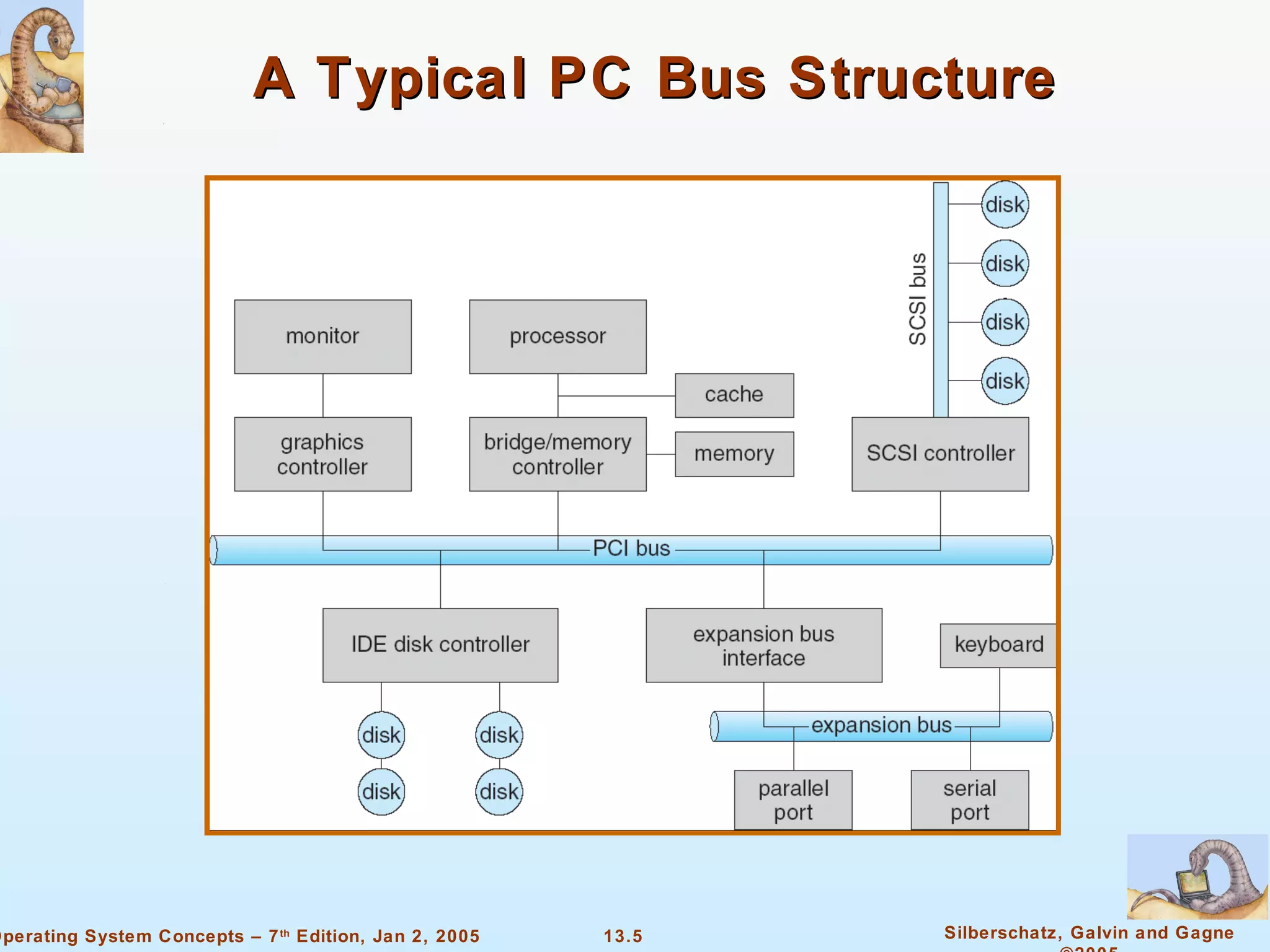
A Typical PC Bus Structure
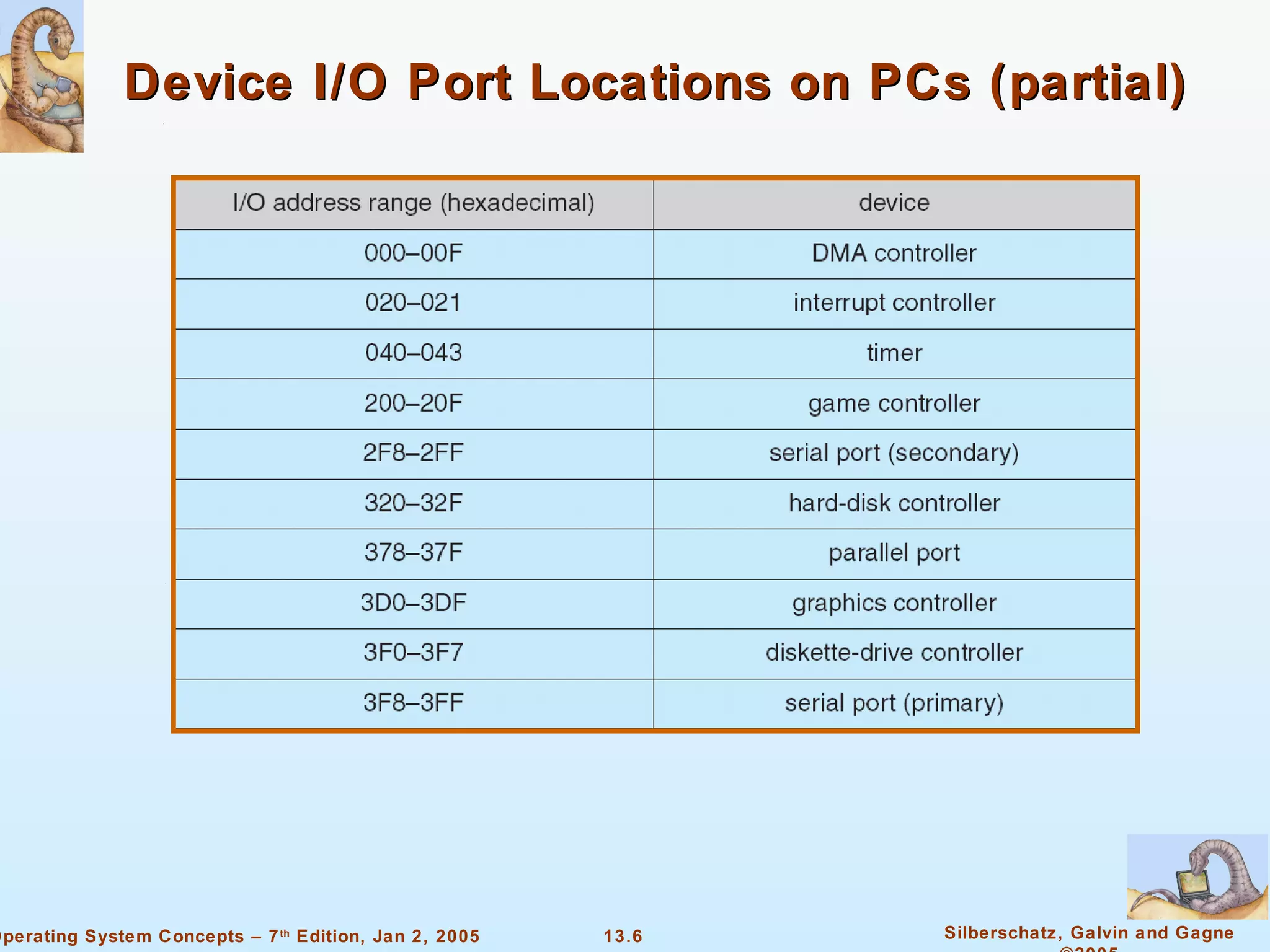
Device I/O Port Locations on PCs (partial)
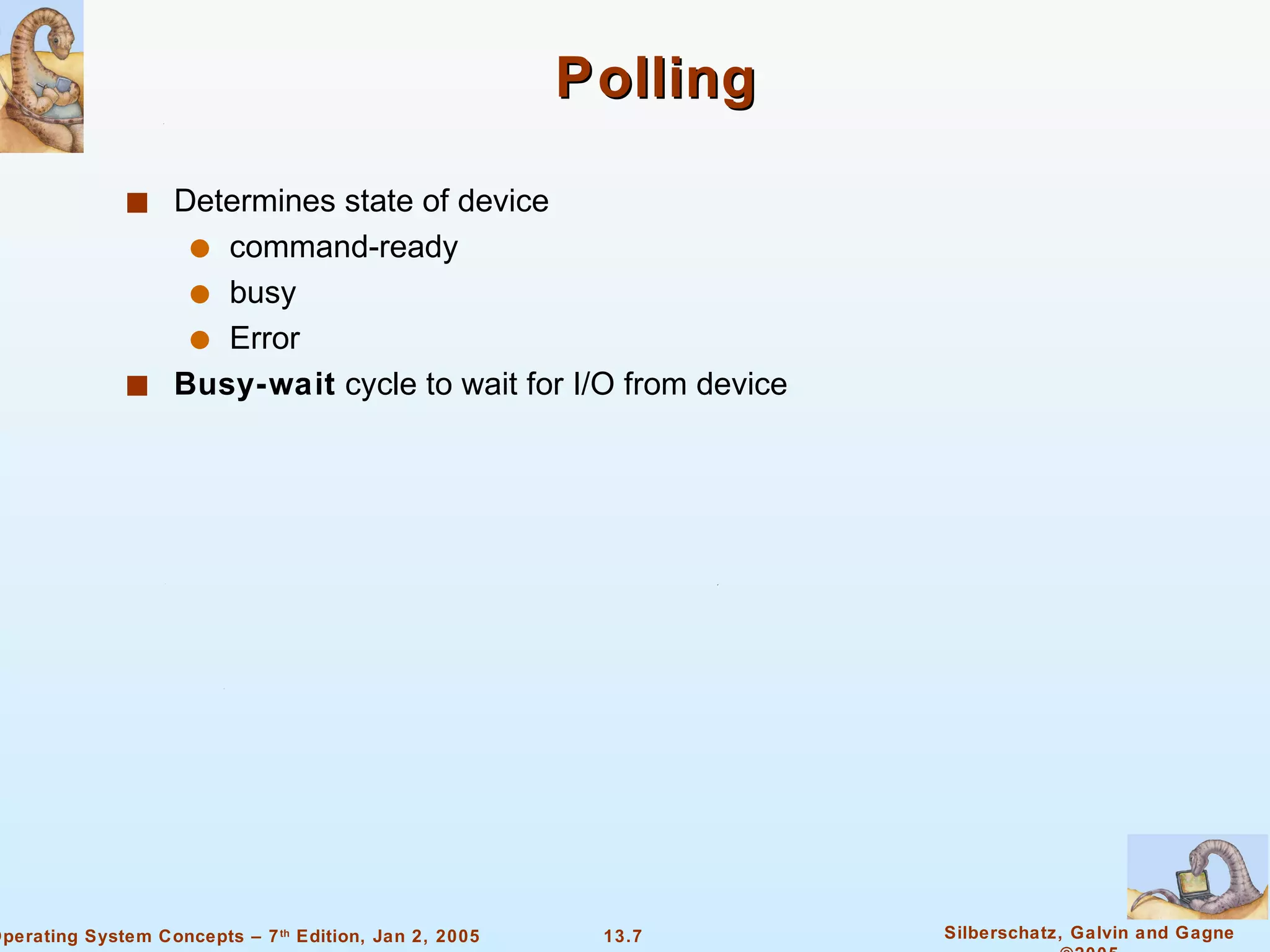
Polling Determines state of device  command-ready busy Error Busy-wait  cycle to wait for I/O from device
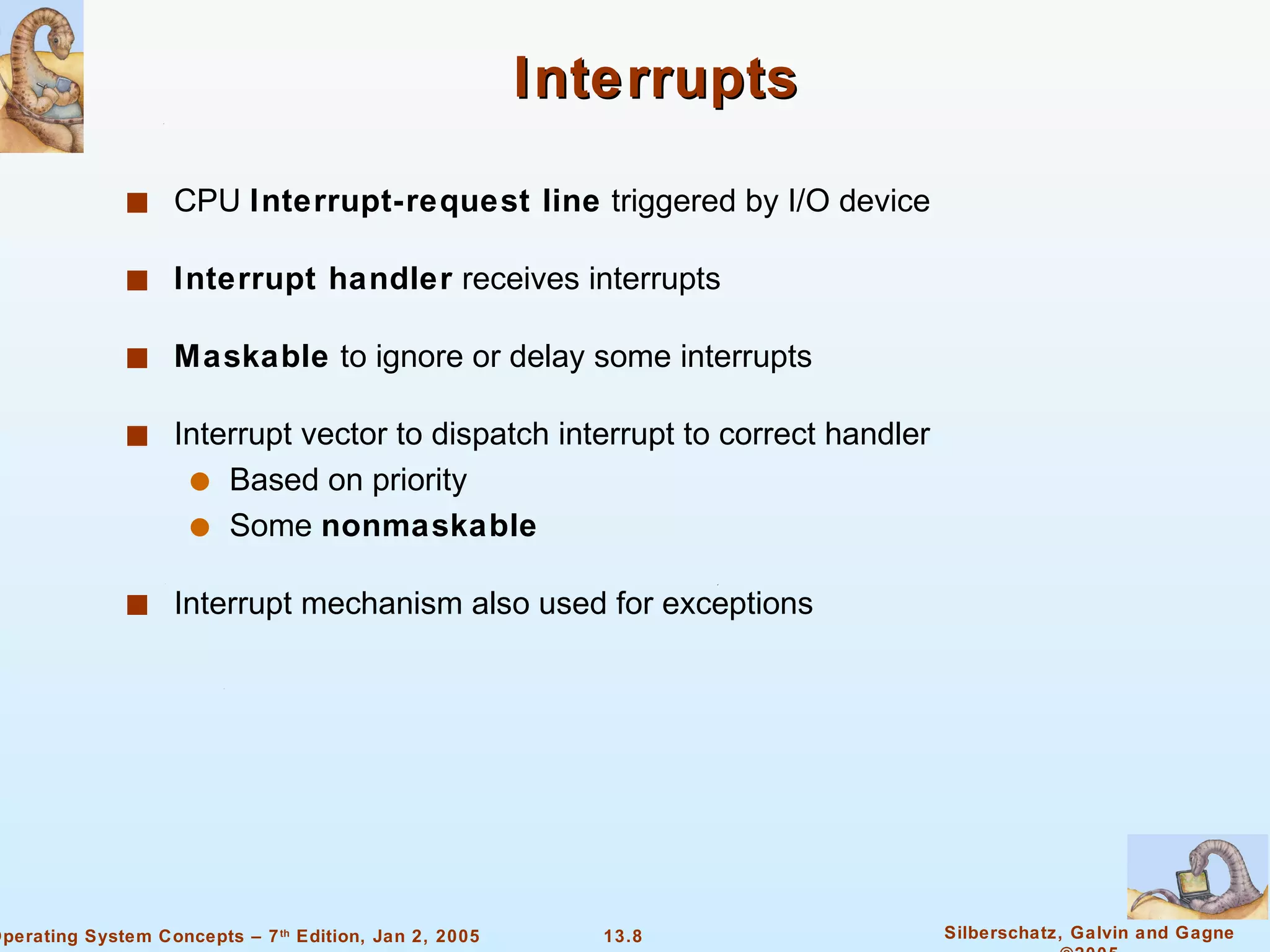
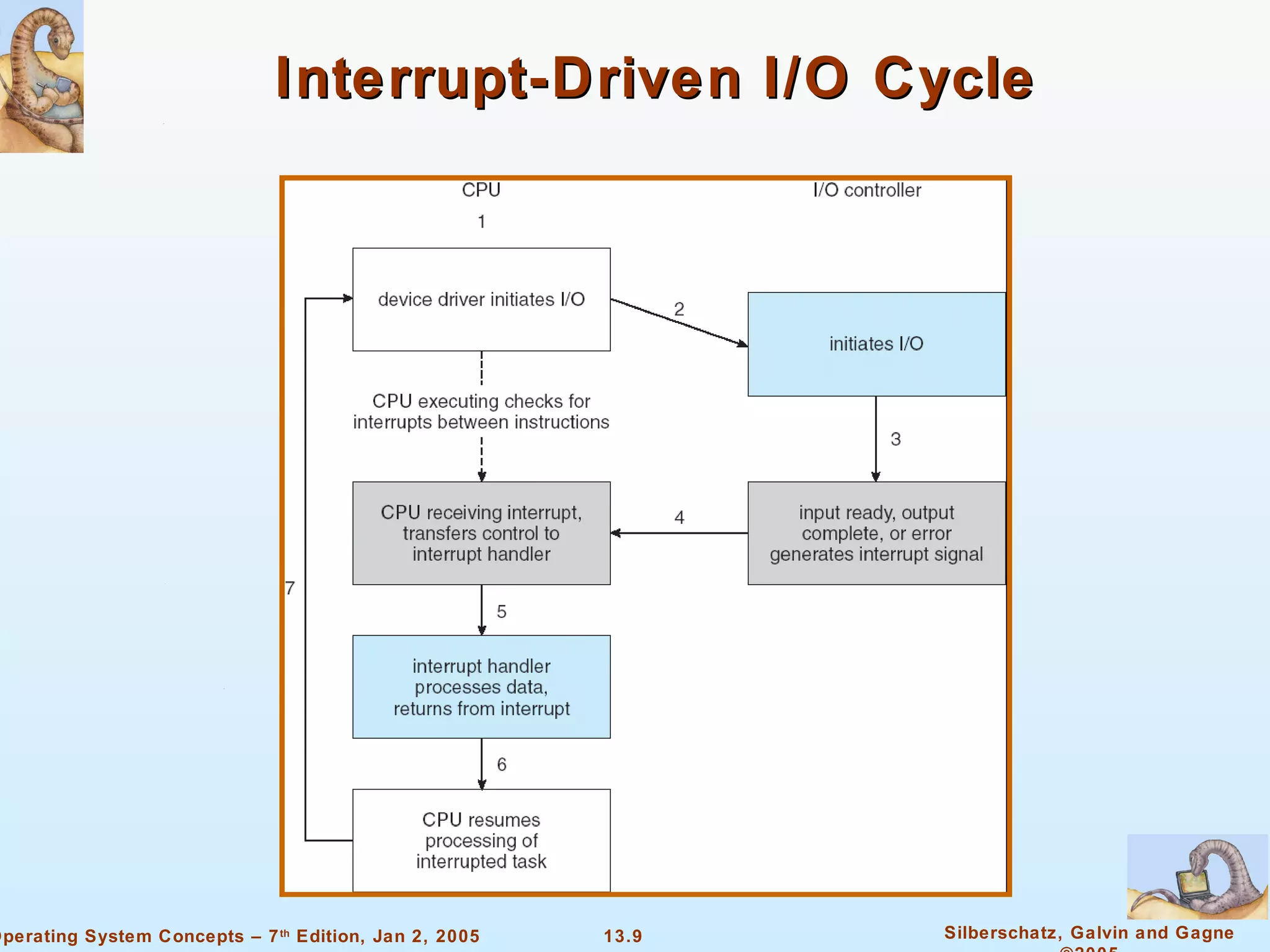
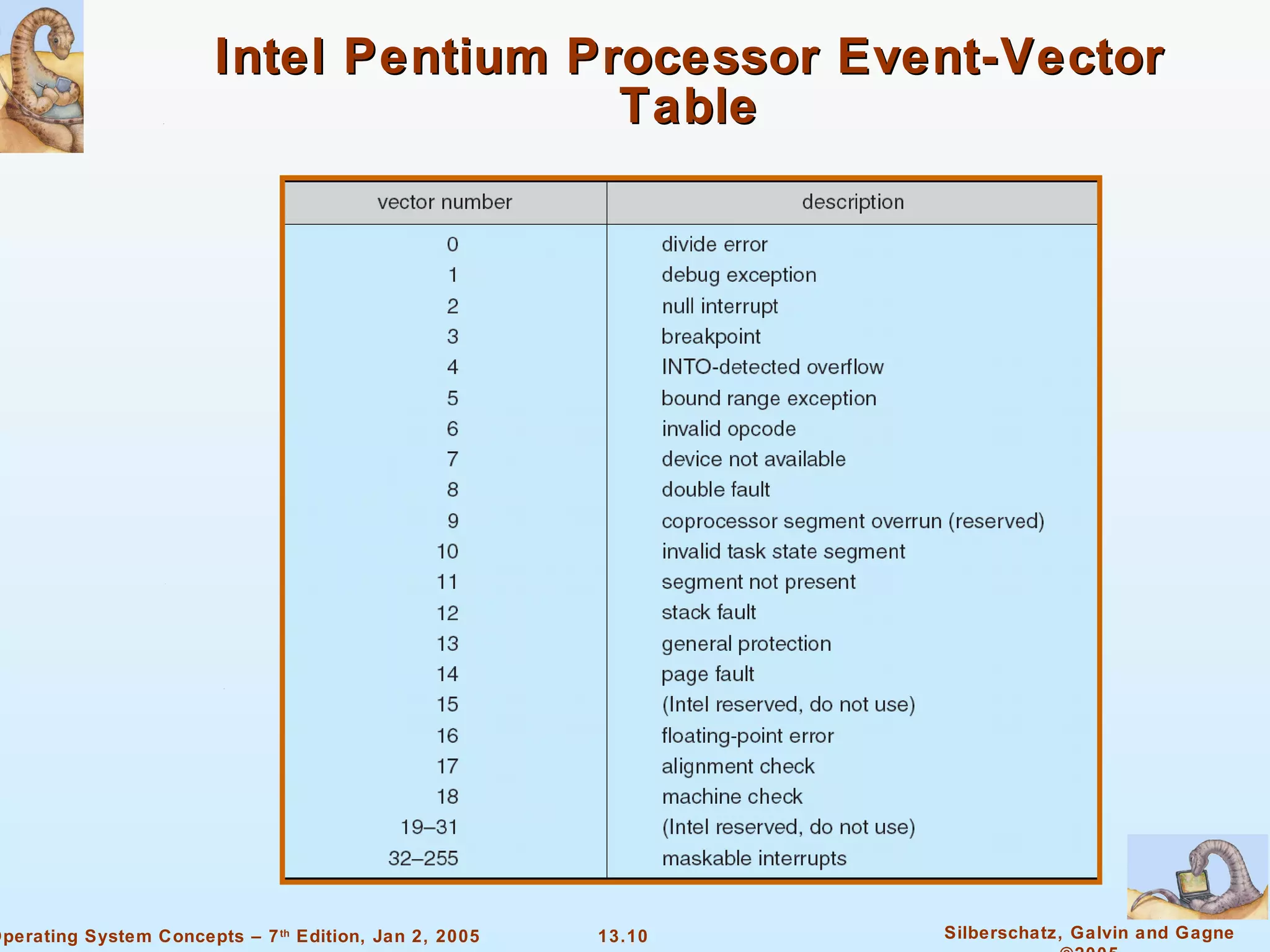
Interrupts CPU  Interrupt-request line  triggered by I/O device Interrupt handler  receives interrupts Maskable  to ignore or delay some interrupts Interrupt vector to dispatch interrupt to correct handler Based on priority Some  nonmaskable Interrupt mechanism also used for exceptions
Interrupt-Driven I/O Cycle
Intel Pentium Processor Event-Vector Table
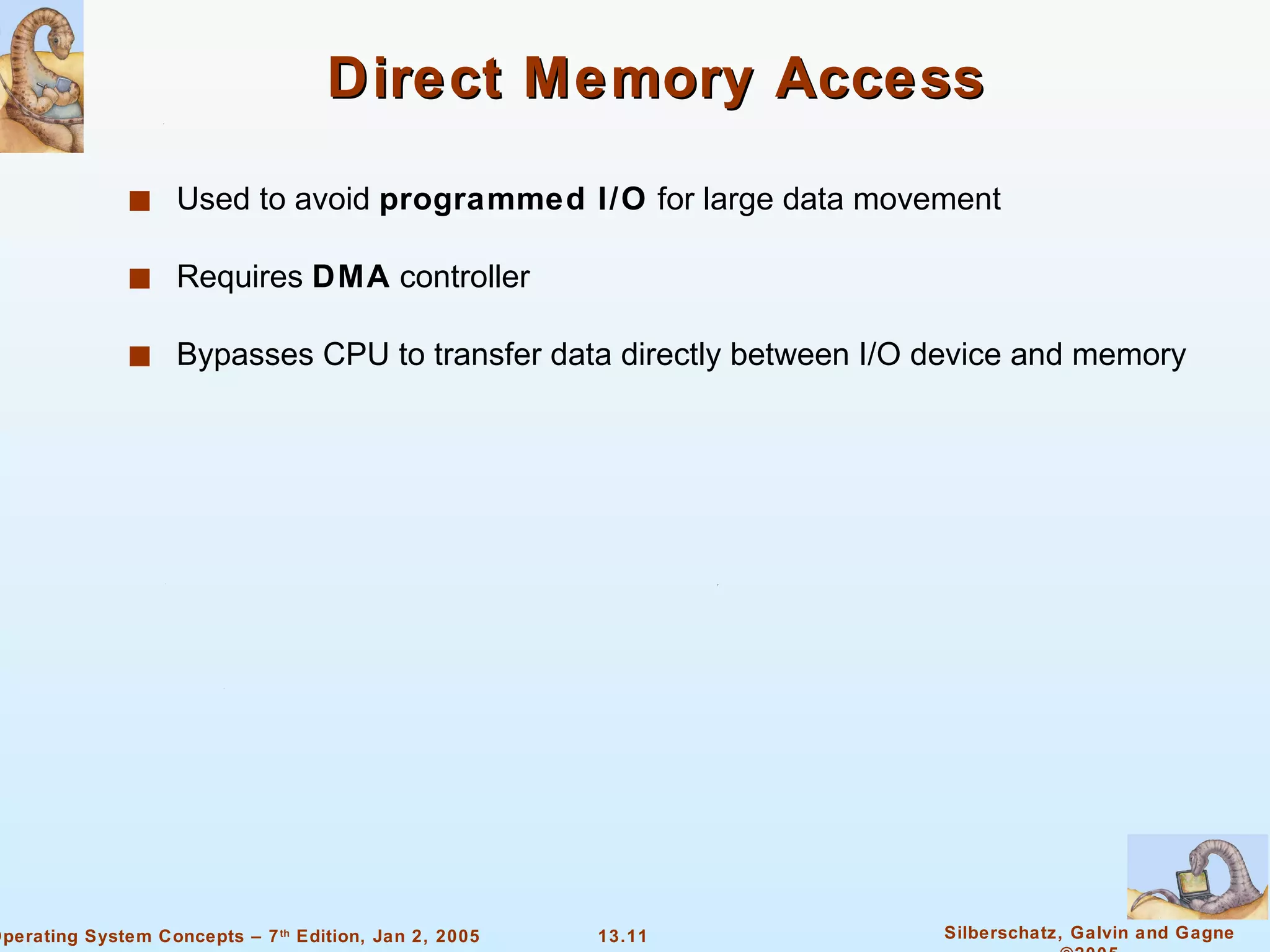
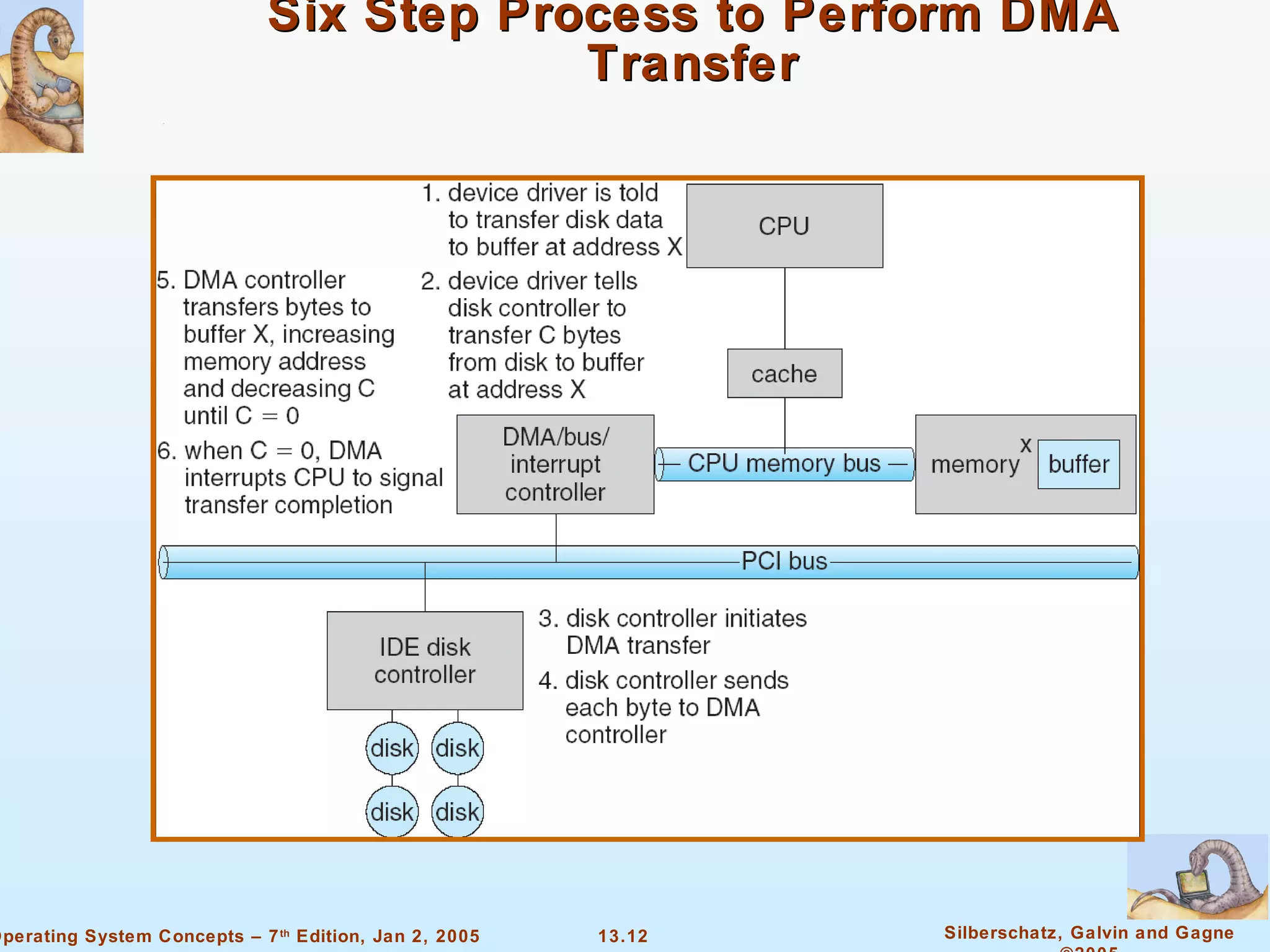
Direct Memory Access Used to avoid  programmed I/O  for large data movement  Requires  DMA  controller Bypasses CPU to transfer data directly between I/O device and memory
Six Step Process to Perform DMA Transfer
Application I/O Interface I/O system calls encapsulate device behaviors in generic classes Device-driver layer hides differences among I/O controllers from kernel Devices vary in many dimensions Character-stream  or  block Sequential or random-access Sharable or dedicated Speed of operation read-write, read only,  or  write only
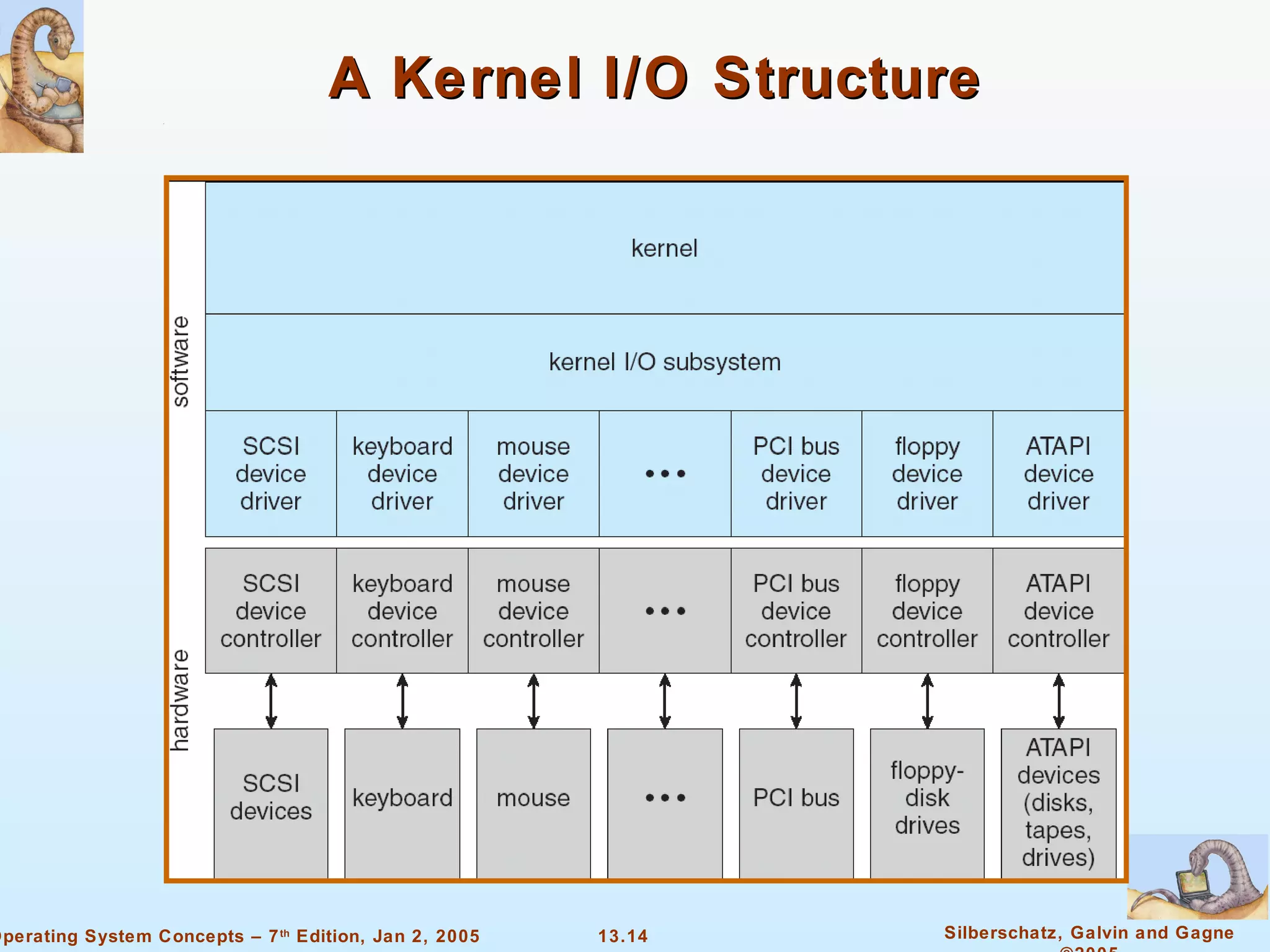
A Kernel I/O Structure
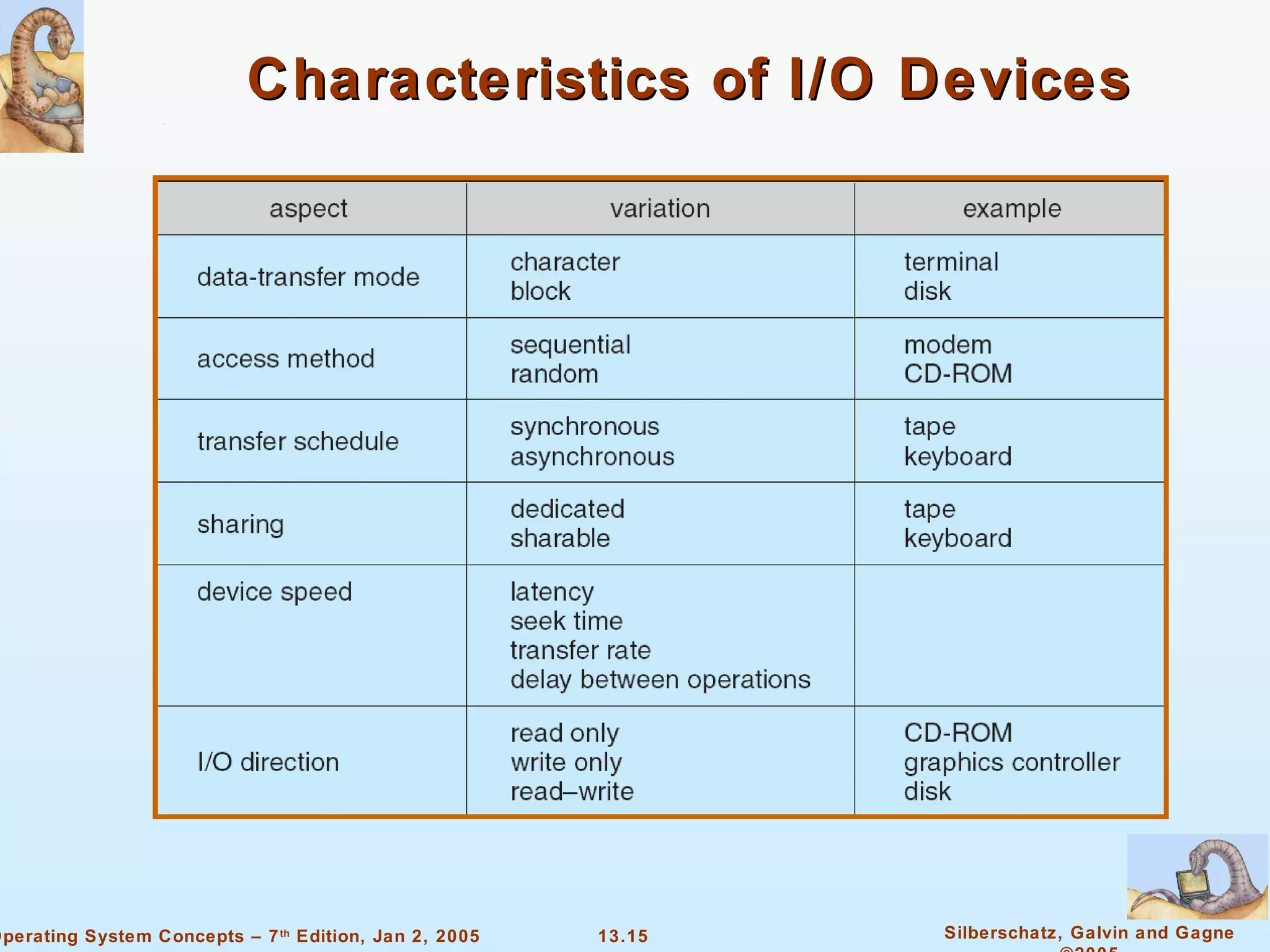
Characteristics of I/O Devices
Block and Character Devices Block devices include disk drives Commands include read, write, seek  Raw I/O or file-system access Memory-mapped file access possible Character devices include keyboards, mice, serial ports Commands include  get, put Libraries layered on top allow line editing
Network Devices Varying enough from block and character to have own interface Unix and Windows NT/9 x /2000 include socket interface Separates network protocol from network operation Includes  select  functionality Approaches vary widely (pipes, FIFOs, streams, queues, mailboxes)
Clocks and Timers Provide current time, elapsed time, timer Programmable interval timer  used for timings, periodic interrupts ioctl  (on UNIX) covers odd aspects of I/O such as clocks and timers
Blocking and Nonblocking I/O Blocking  - process suspended until I/O completed Easy to use and understand Insufficient for some needs Nonblocking  - I/O call returns as much as available User interface, data copy (buffered I/O) Implemented via multi-threading Returns quickly with count of bytes read or written Asynchronous  - process runs while I/O executes Difficult to use I/O subsystem signals process when I/O completed
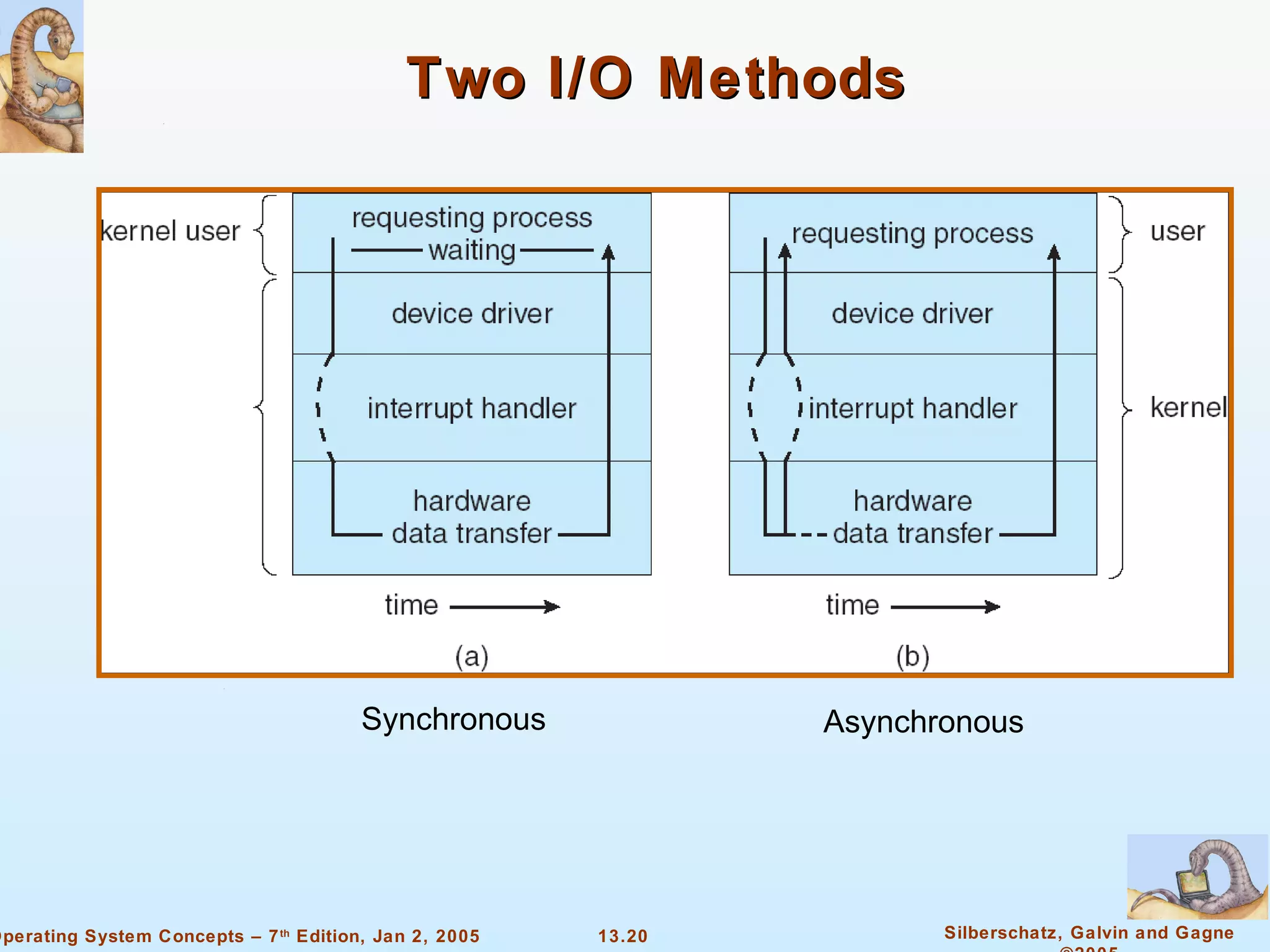
Two I/O Methods Synchronous Asynchronous
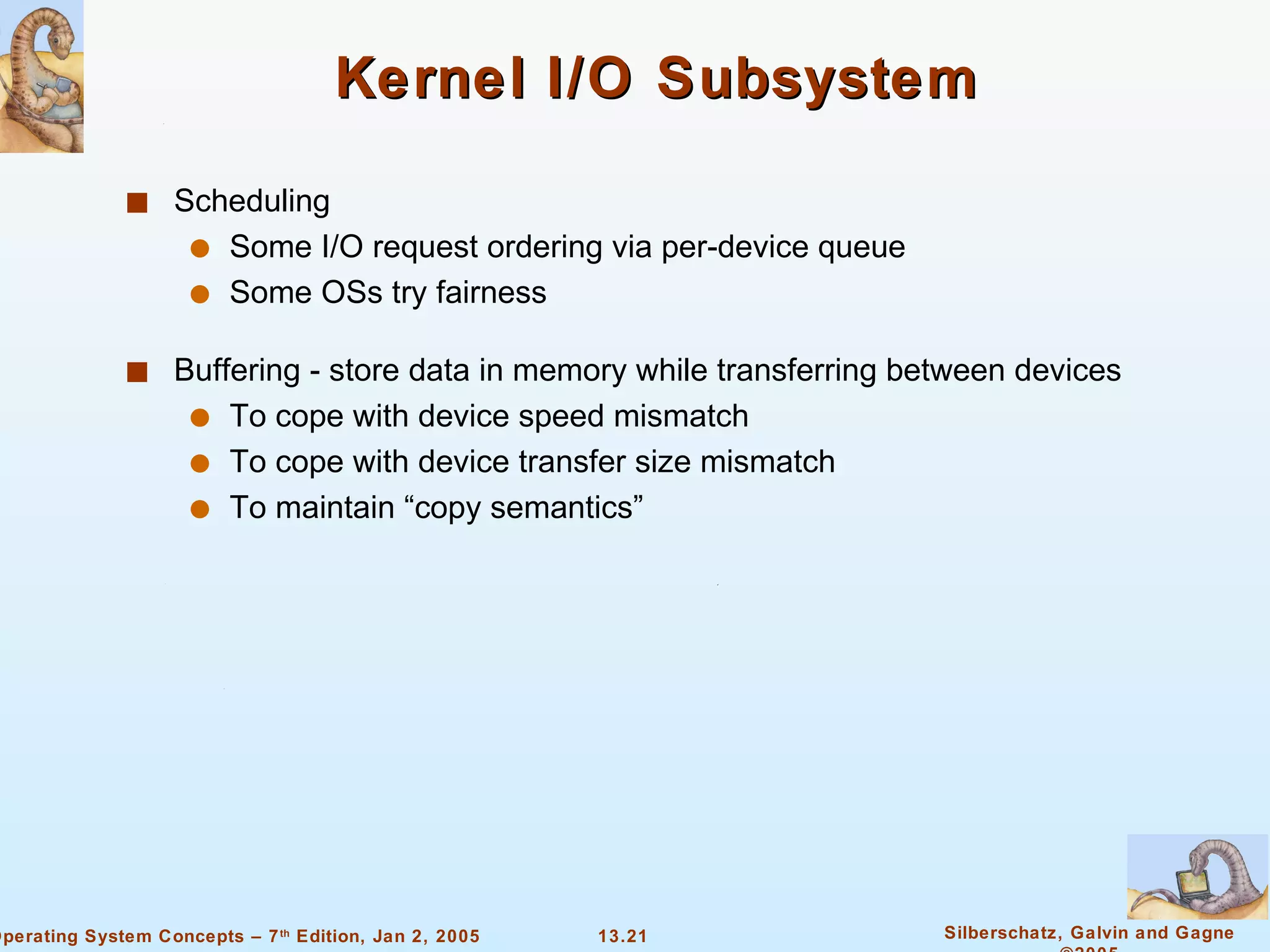
Kernel I/O Subsystem Scheduling Some I/O request ordering via per-device queue Some OSs try fairness Buffering - store data in memory while transferring between devices To cope with device speed mismatch To cope with device transfer size mismatch To maintain “copy semantics”
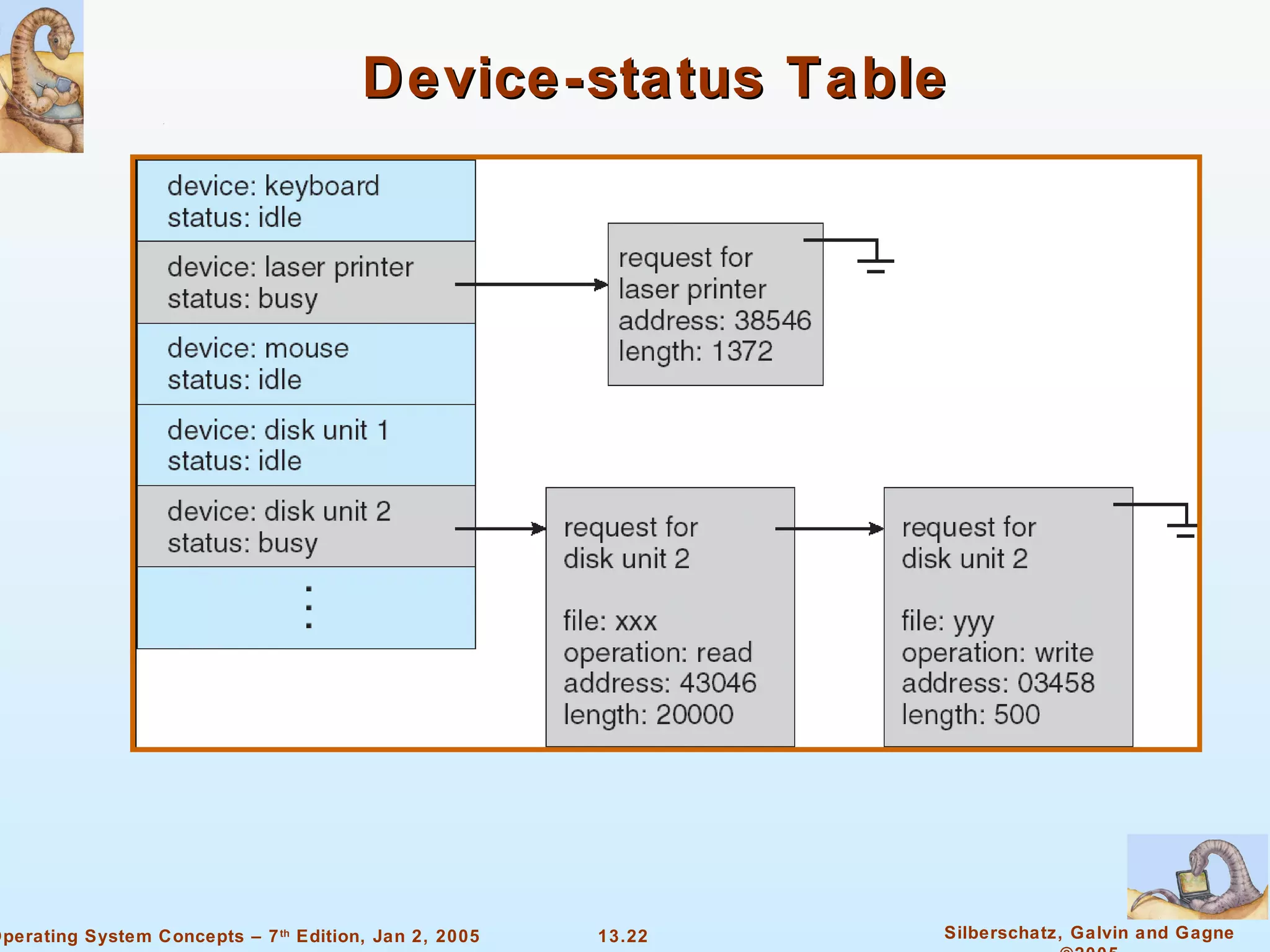
Device-status Table
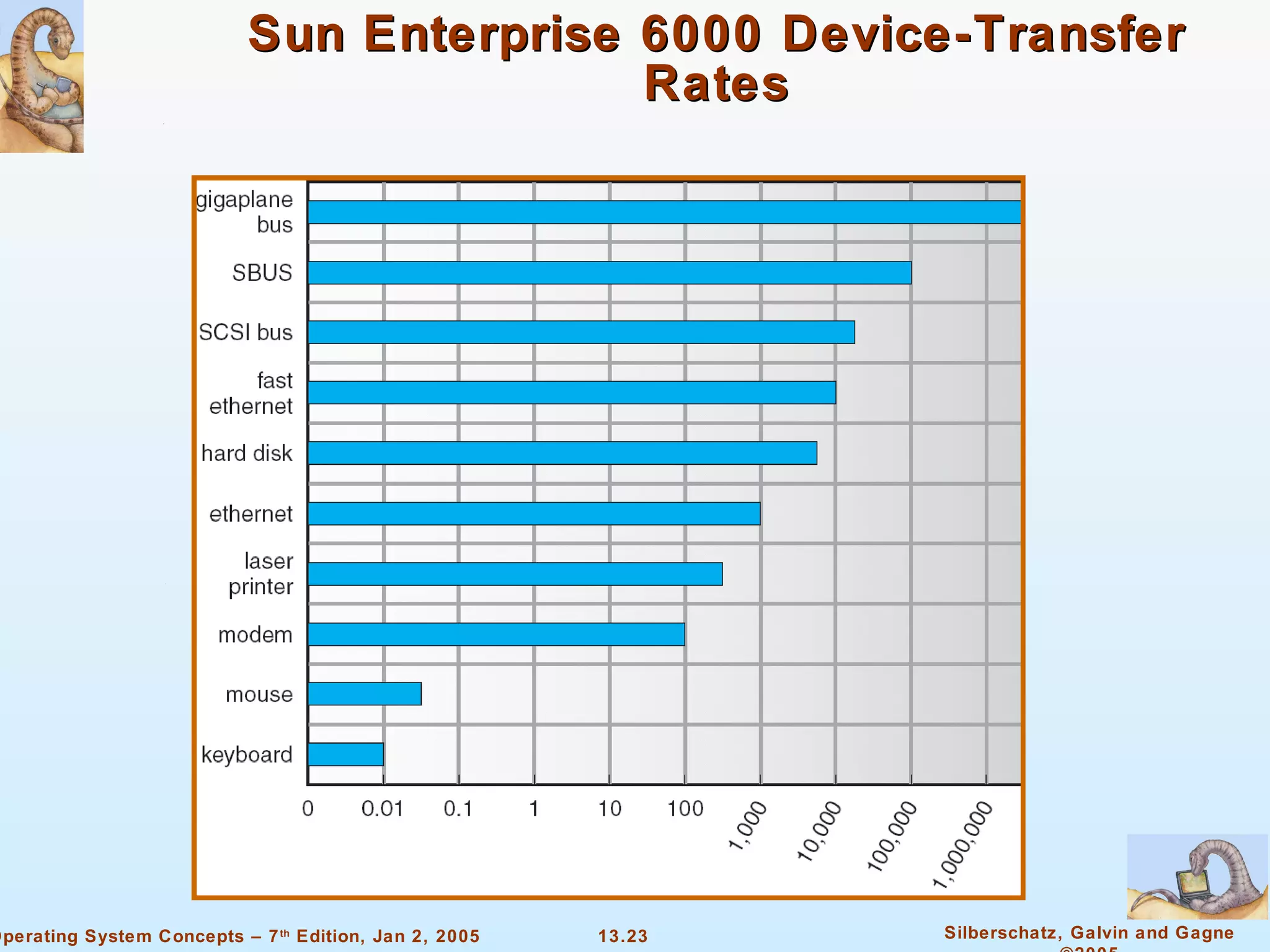
Sun Enterprise 6000 Device-Transfer Rates
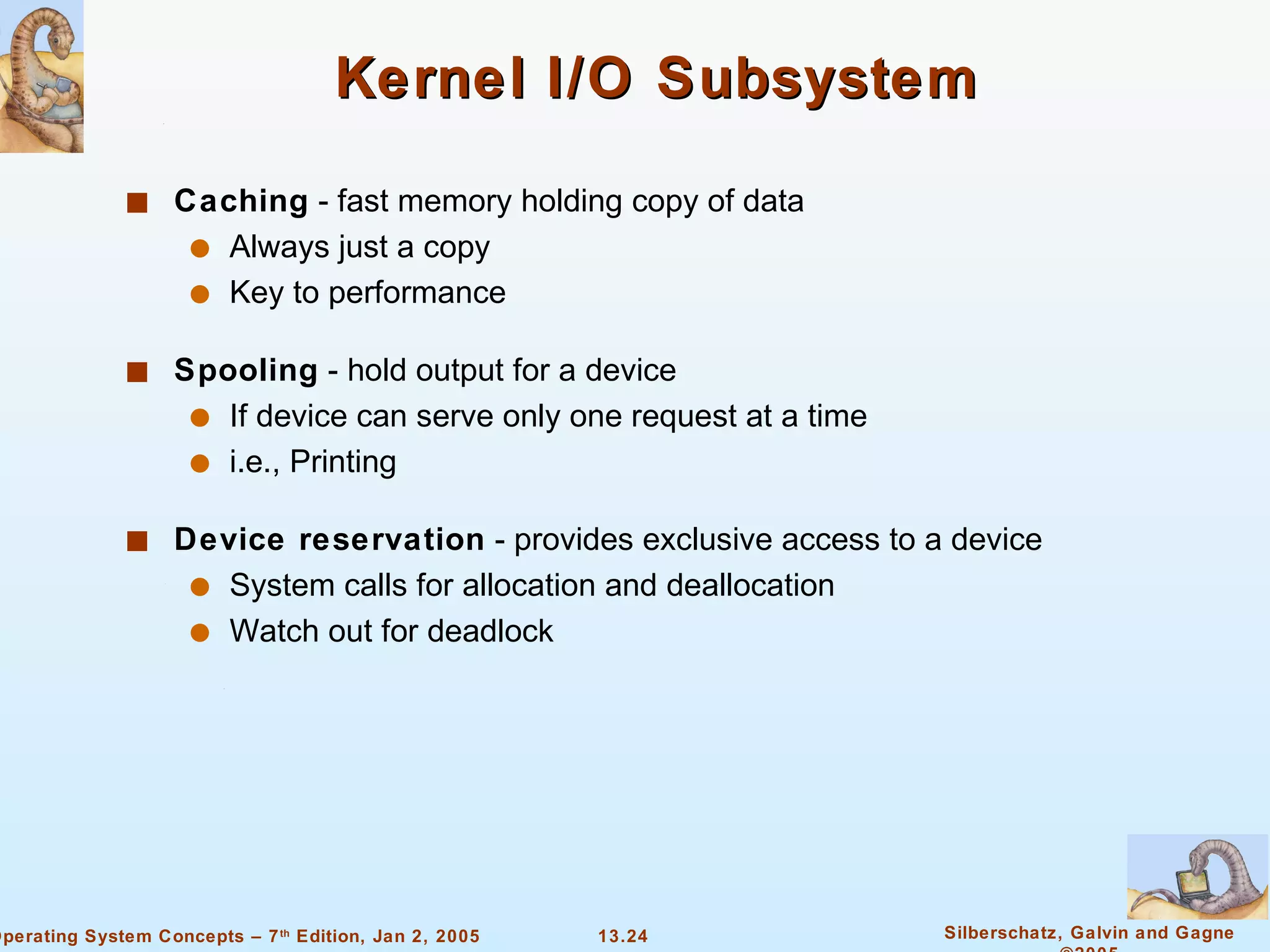
Kernel I/O Subsystem Caching  - fast memory holding copy of data Always just a copy Key to performance Spooling  - hold output for a device If device can serve only one request at a time  i.e., Printing Device reservation  - provides exclusive access to a device System calls for allocation and deallocation Watch out for deadlock
Error Handling OS can recover from disk read, device unavailable, transient write failures Most return an error number or code when I/O request fails  System error logs hold problem reports
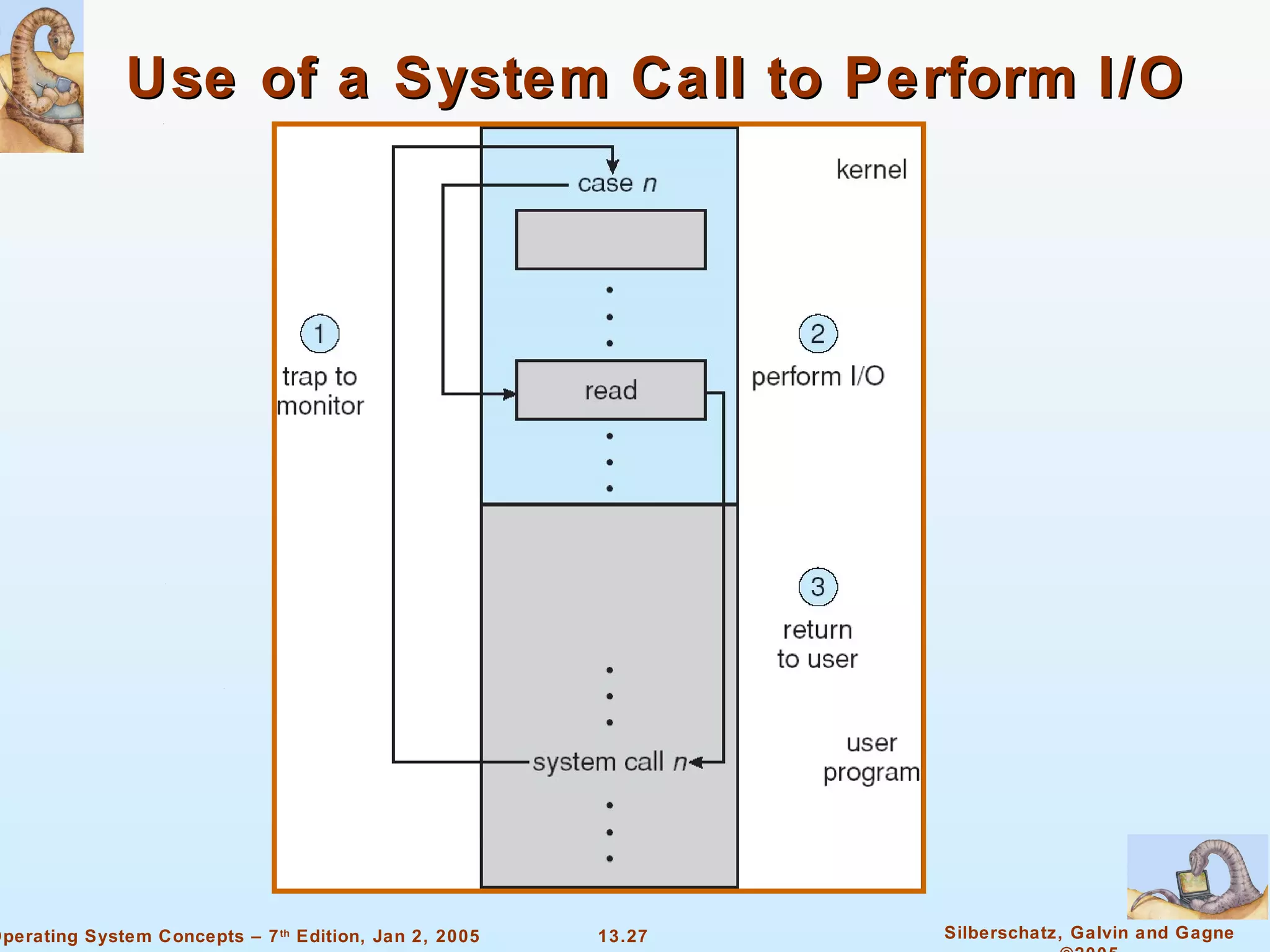
I/O Protection User process may accidentally or purposefully attempt to disrupt normal operation via illegal I/O instructions All I/O instructions defined to be privileged I/O must be performed via system calls Memory-mapped and I/O port memory locations must be protected too
Use of a System Call to Perform I/O
Kernel Data Structures Kernel keeps state info for I/O components, including open file tables, network connections, character device state Many, many complex data structures to track buffers, memory allocation, “dirty” blocks Some use object-oriented methods and message passing to implement I/O
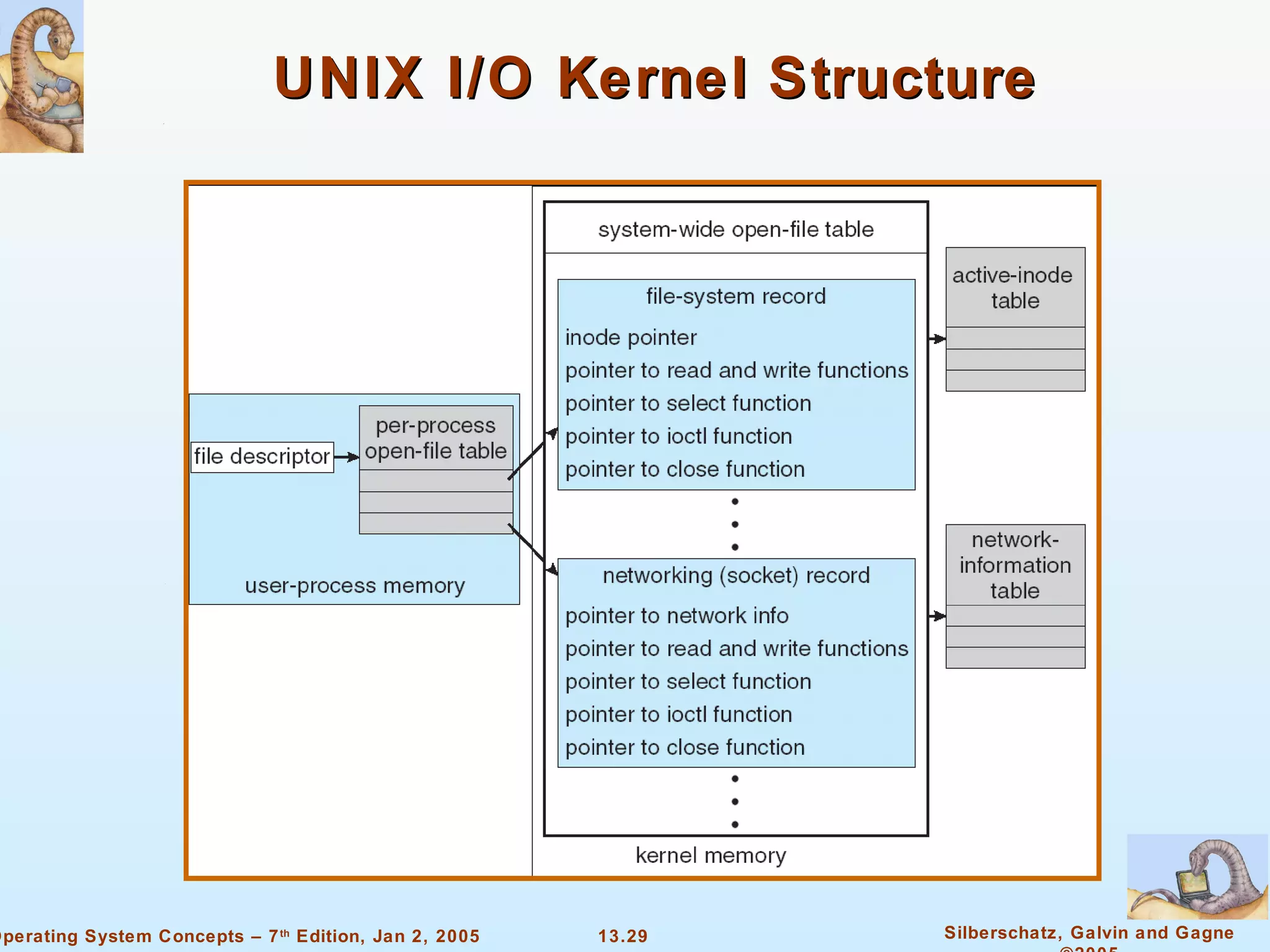
UNIX I/O Kernel Structure
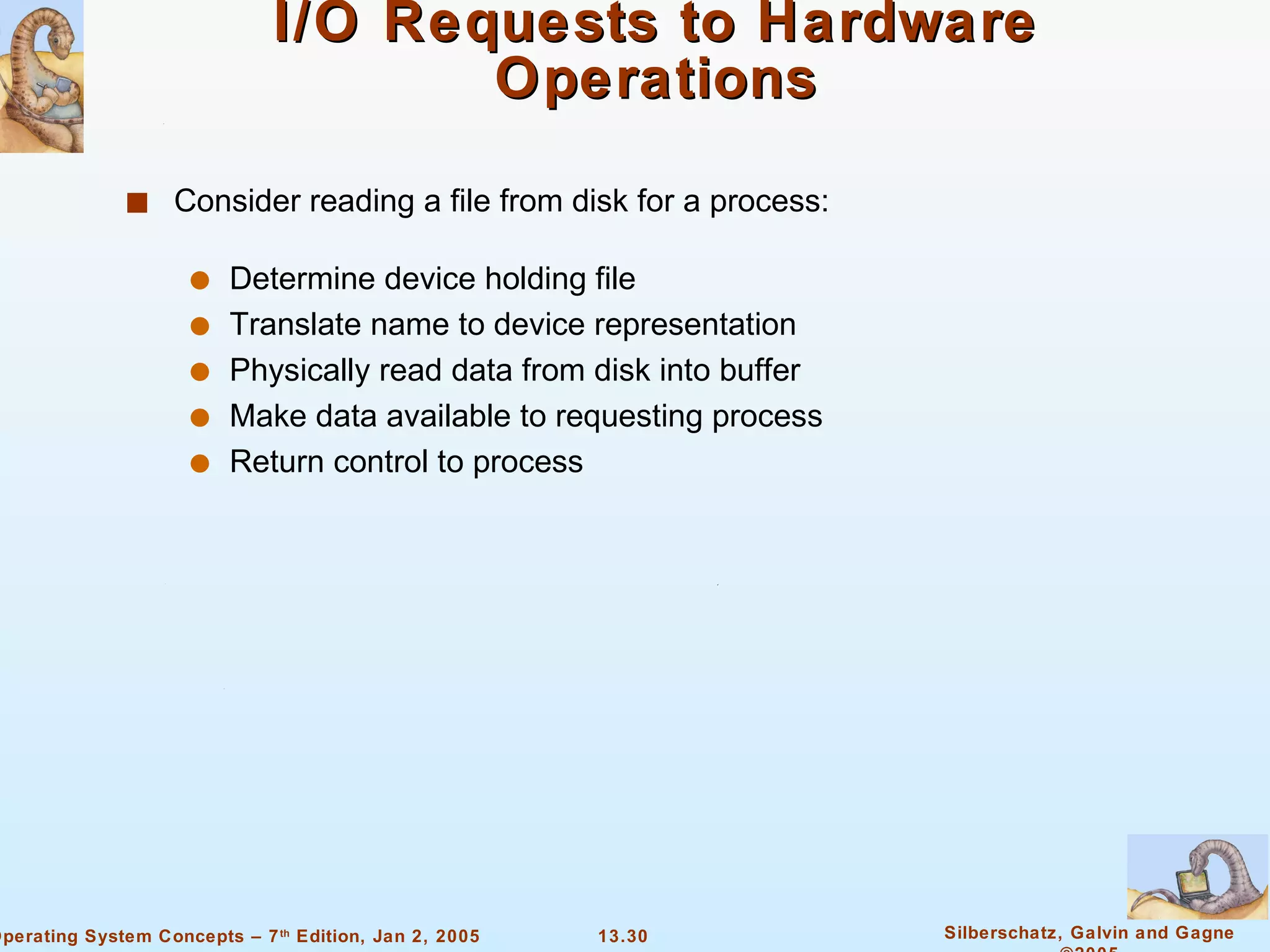
I/O Requests to Hardware Operations Consider reading a file from disk for a process:   Determine device holding file  Translate name to device representation Physically read data from disk into buffer Make data available to requesting process Return control to process
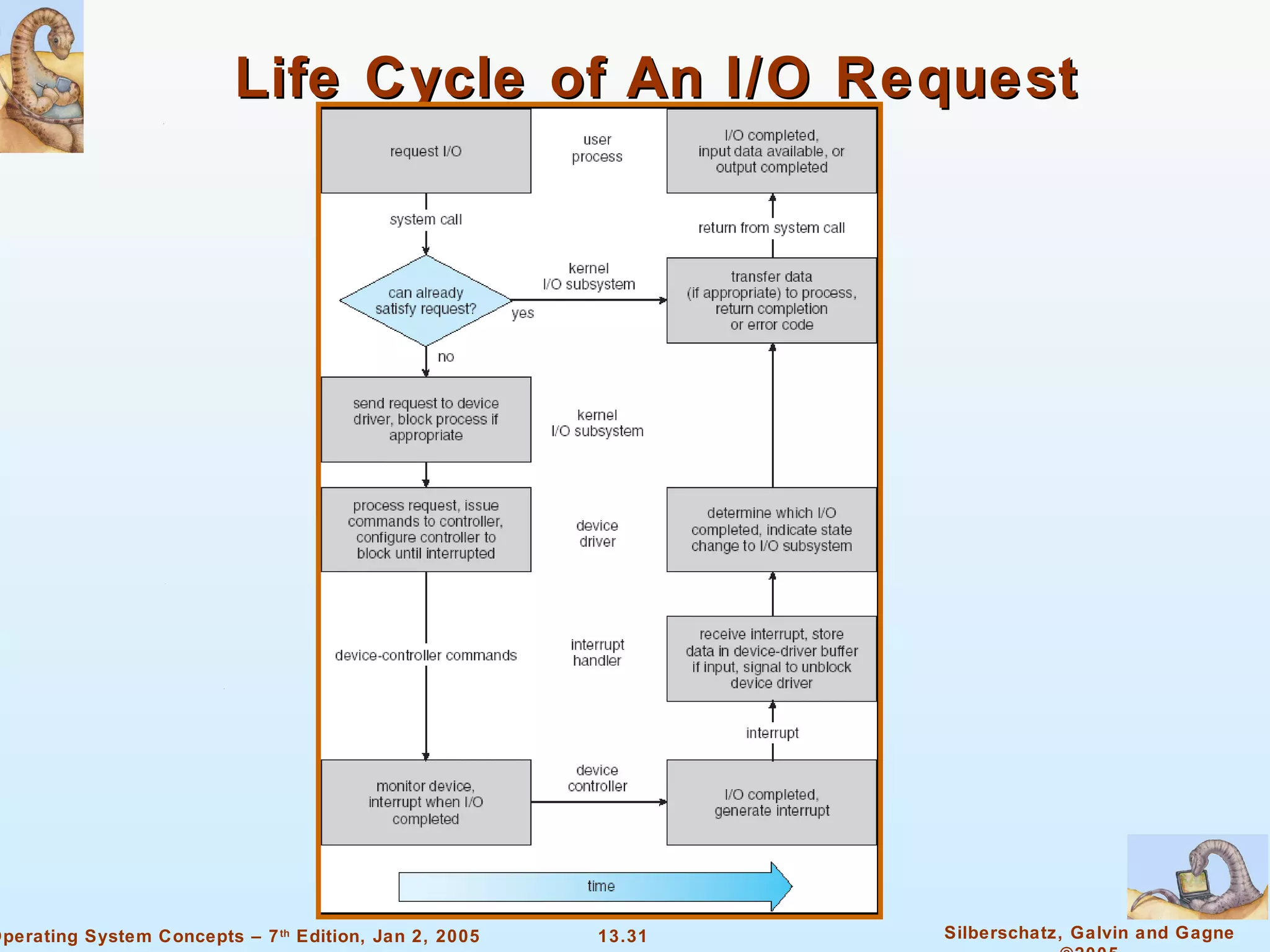
Life Cycle of An I/O Request
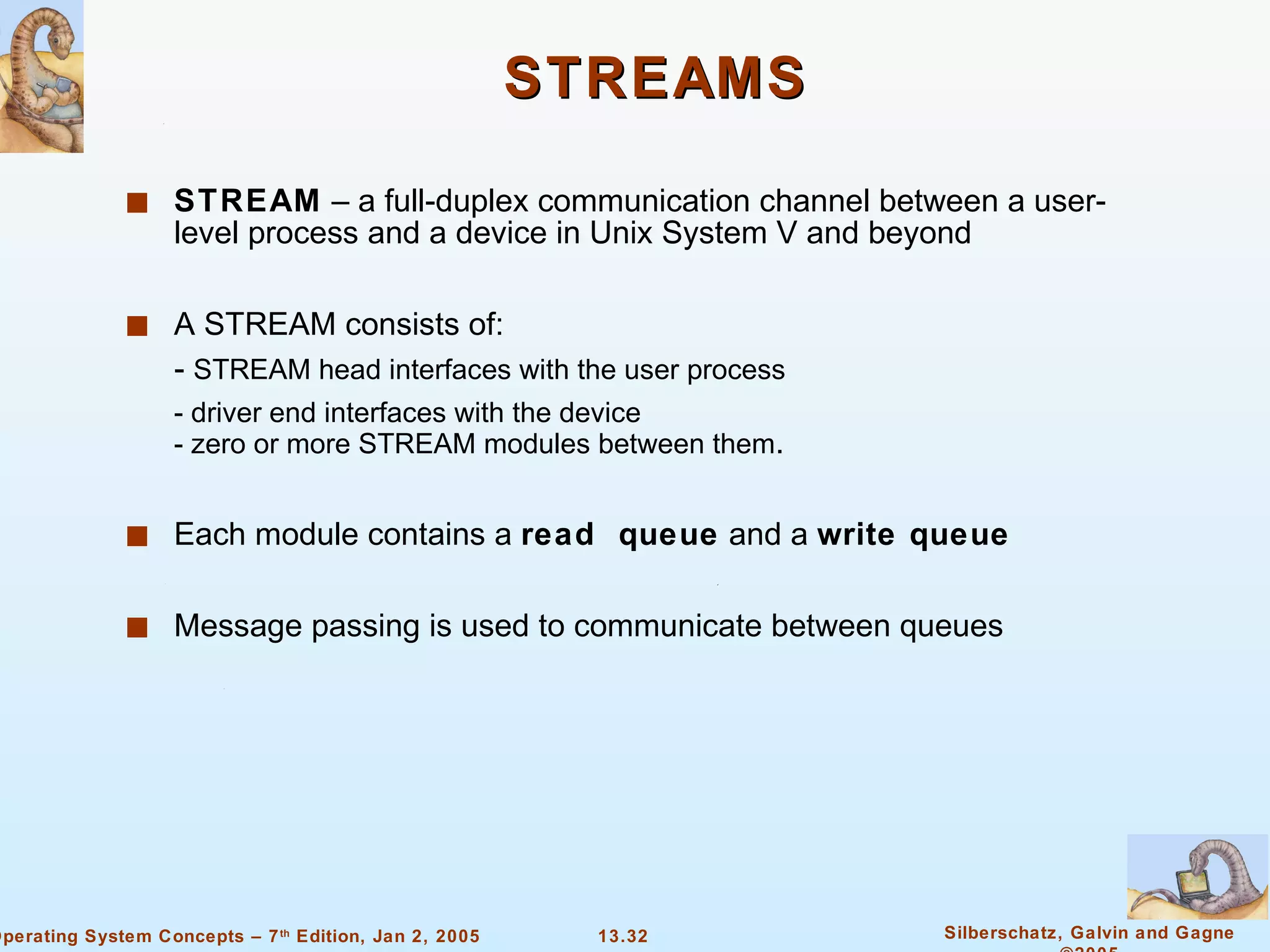
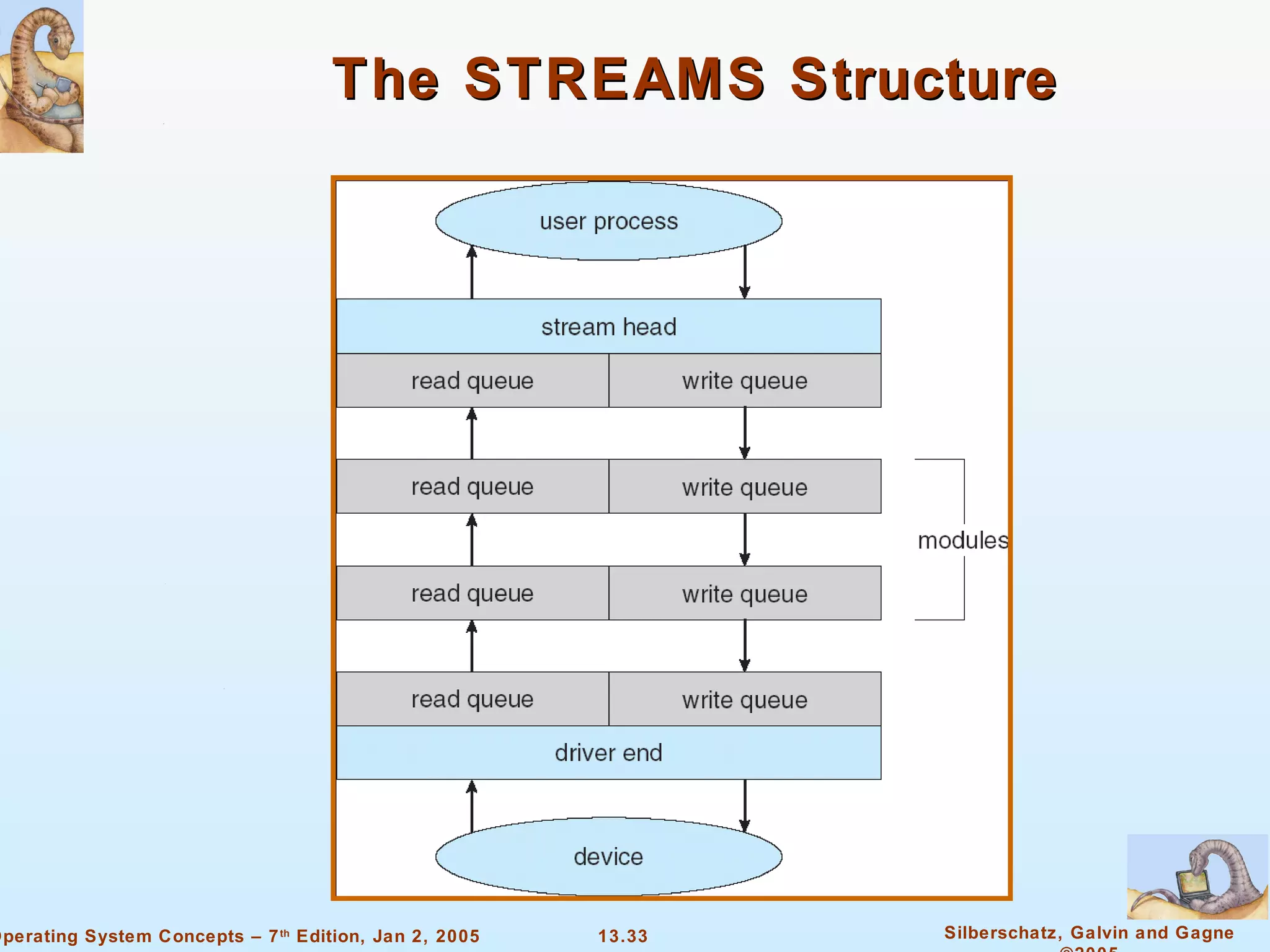
STREAMS STREAM  – a full-duplex communication channel between a user-level process and a device in Unix System V and beyond A STREAM consists of: -  STREAM head interfaces with the user process - driver end interfaces with the device - zero or more STREAM modules between them . Each module contains a  read  queue  and a  write queue Message passing is used to communicate between queues
The STREAMS Structure
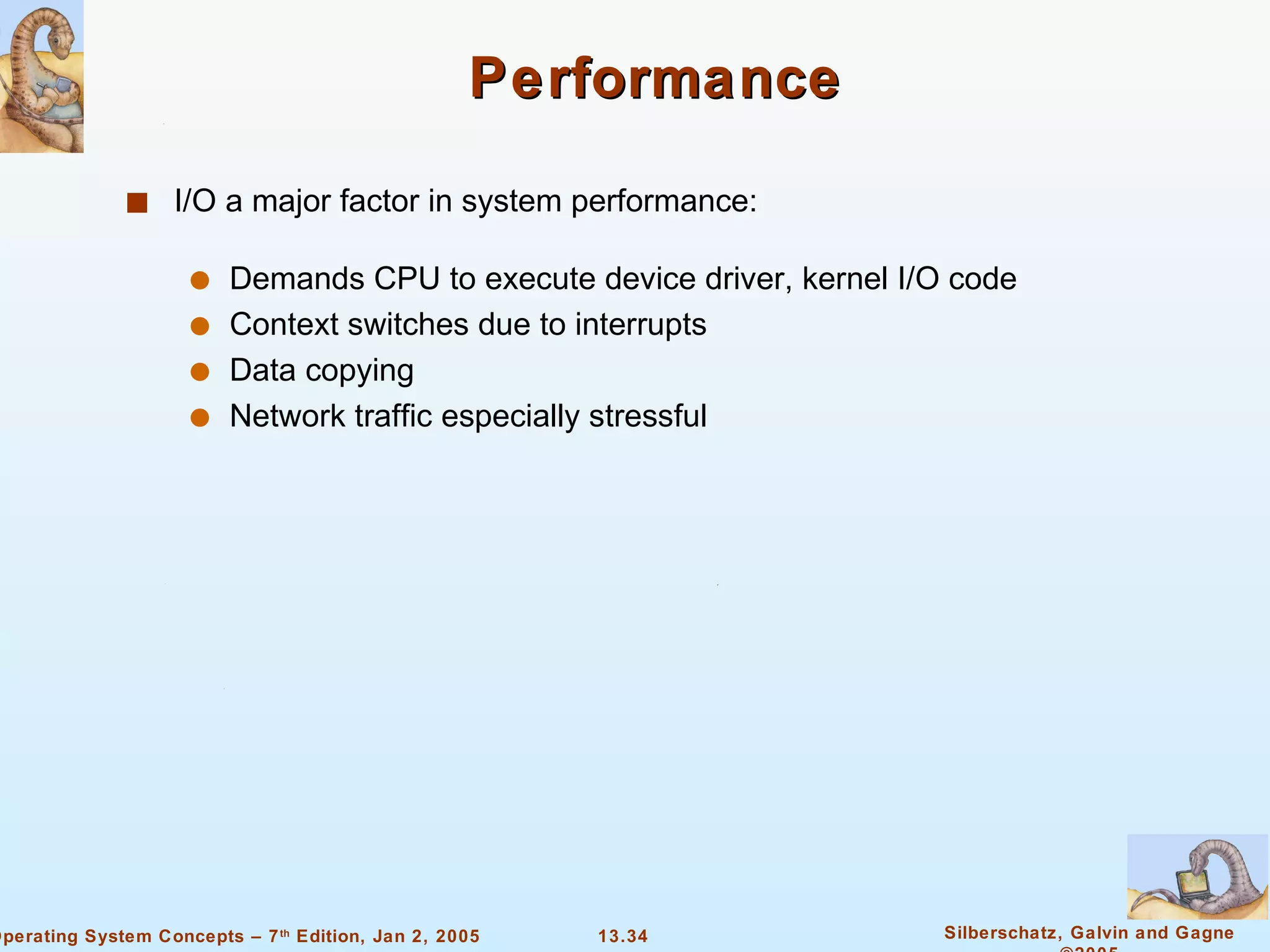
Performance I/O a major factor in system performance: Demands CPU to execute device driver, kernel I/O code Context switches due to interrupts Data copying Network traffic especially stressful
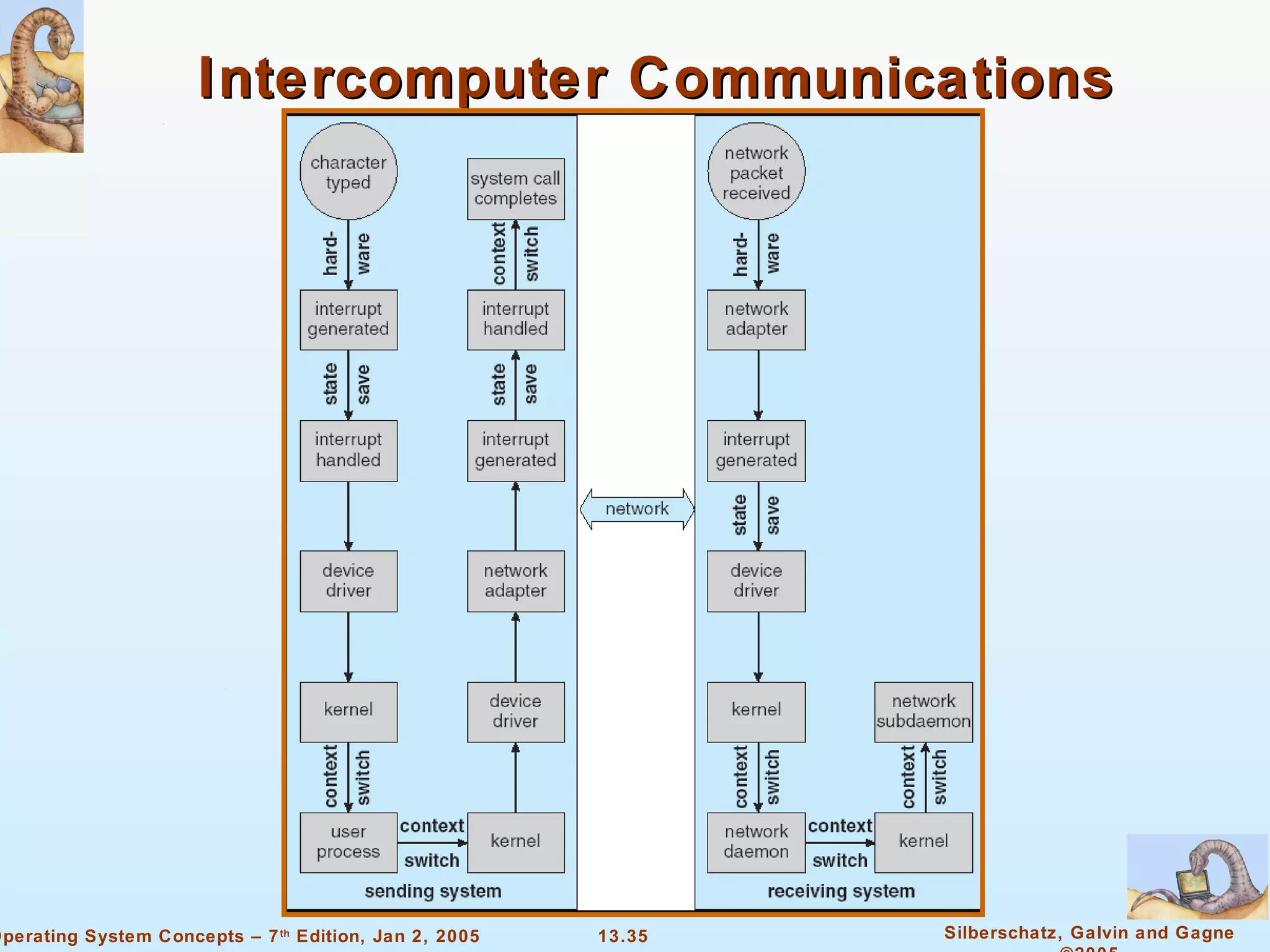
Intercomputer Communications
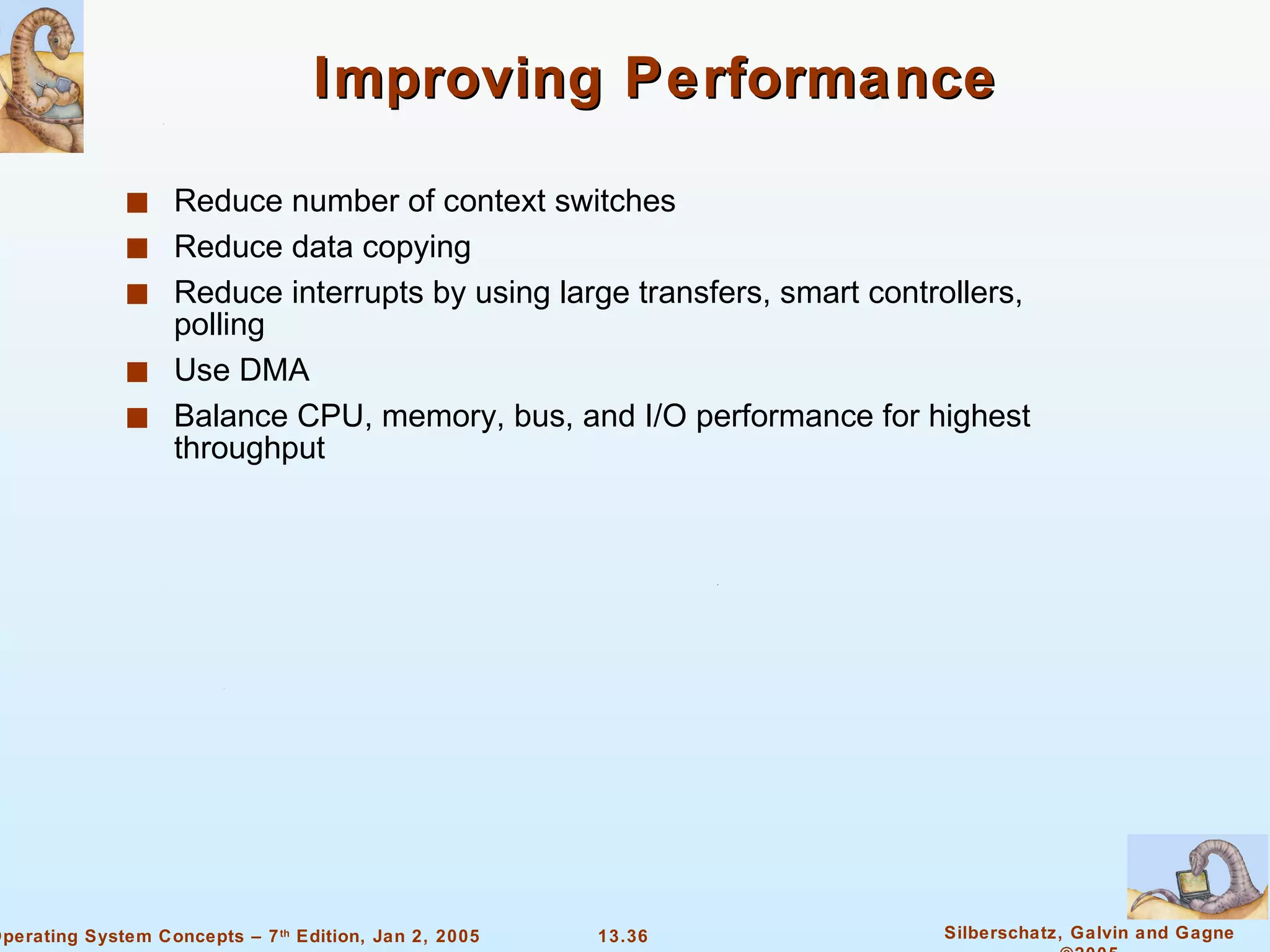
Improving Performance Reduce number of context switches Reduce data copying  Reduce interrupts by using large transfers, smart controllers, polling  Use DMA Balance CPU, memory, bus, and I/O performance for highest throughput
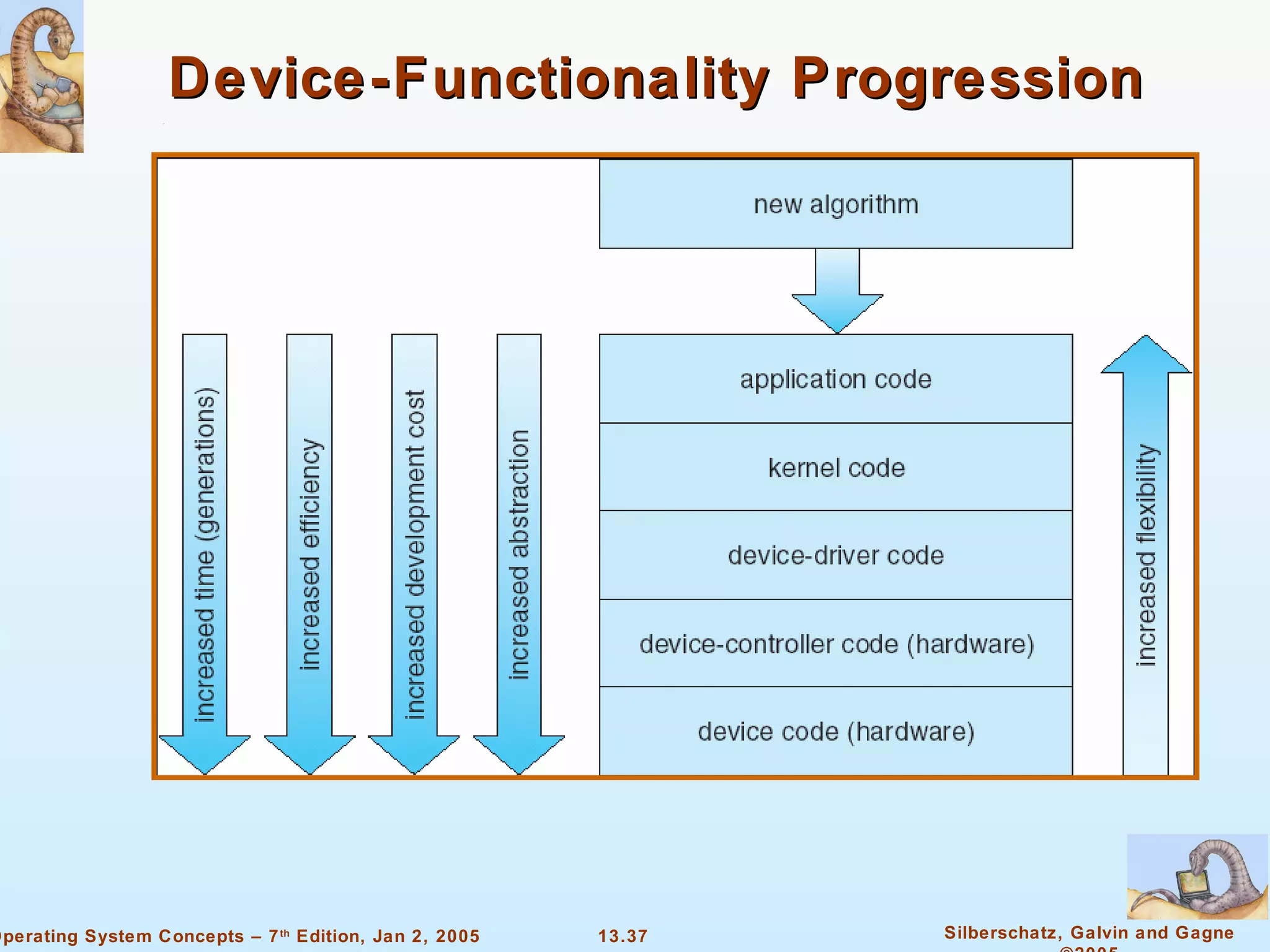
Device-Functionality Progression
End of Chapter 13

Chapter 13 - I/O Systems

  • 1.
    Chapter 13: I/O Systems
  • 2.
    Chapter 13: I/O Systems I/O Hardware Application I/O Interface Kernel I/O Subsystem Transforming I/O Requests to Hardware Operations Streams Performance
  • 3.
    Objectives Explore thestructure of an operating system’s I/O subsystem Discuss the principles of I/O hardware and its complexity Provide details of the performance aspects of I/O hardware and software
  • 4.
    I/O Hardware Incrediblevariety of I/O devices Common concepts Port Bus ( daisy chain or shared direct access) Controller ( host adapter ) I/O instructions control devices Devices have addresses, used by Direct I/O instructions Memory-mapped I/O
  • 5.
    A Typical PCBus Structure
  • 6.
    Device I/O PortLocations on PCs (partial)
  • 7.
    Polling Determines stateof device command-ready busy Error Busy-wait cycle to wait for I/O from device
  • 8.
    Interrupts CPU Interrupt-request line triggered by I/O device Interrupt handler receives interrupts Maskable to ignore or delay some interrupts Interrupt vector to dispatch interrupt to correct handler Based on priority Some nonmaskable Interrupt mechanism also used for exceptions
  • 9.
  • 10.
    Intel Pentium ProcessorEvent-Vector Table
  • 11.
    Direct Memory AccessUsed to avoid programmed I/O for large data movement Requires DMA controller Bypasses CPU to transfer data directly between I/O device and memory
  • 12.
    Six Step Processto Perform DMA Transfer
  • 13.
    Application I/O InterfaceI/O system calls encapsulate device behaviors in generic classes Device-driver layer hides differences among I/O controllers from kernel Devices vary in many dimensions Character-stream or block Sequential or random-access Sharable or dedicated Speed of operation read-write, read only, or write only
  • 14.
    A Kernel I/OStructure
  • 15.
  • 16.
    Block and CharacterDevices Block devices include disk drives Commands include read, write, seek Raw I/O or file-system access Memory-mapped file access possible Character devices include keyboards, mice, serial ports Commands include get, put Libraries layered on top allow line editing
  • 17.
    Network Devices Varyingenough from block and character to have own interface Unix and Windows NT/9 x /2000 include socket interface Separates network protocol from network operation Includes select functionality Approaches vary widely (pipes, FIFOs, streams, queues, mailboxes)
  • 18.
    Clocks and TimersProvide current time, elapsed time, timer Programmable interval timer used for timings, periodic interrupts ioctl (on UNIX) covers odd aspects of I/O such as clocks and timers
  • 19.
    Blocking and NonblockingI/O Blocking - process suspended until I/O completed Easy to use and understand Insufficient for some needs Nonblocking - I/O call returns as much as available User interface, data copy (buffered I/O) Implemented via multi-threading Returns quickly with count of bytes read or written Asynchronous - process runs while I/O executes Difficult to use I/O subsystem signals process when I/O completed
  • 20.
    Two I/O MethodsSynchronous Asynchronous
  • 21.
    Kernel I/O SubsystemScheduling Some I/O request ordering via per-device queue Some OSs try fairness Buffering - store data in memory while transferring between devices To cope with device speed mismatch To cope with device transfer size mismatch To maintain “copy semantics”
  • 22.
  • 23.
    Sun Enterprise 6000Device-Transfer Rates
  • 24.
    Kernel I/O SubsystemCaching - fast memory holding copy of data Always just a copy Key to performance Spooling - hold output for a device If device can serve only one request at a time i.e., Printing Device reservation - provides exclusive access to a device System calls for allocation and deallocation Watch out for deadlock
  • 25.
    Error Handling OScan recover from disk read, device unavailable, transient write failures Most return an error number or code when I/O request fails System error logs hold problem reports
  • 26.
    I/O Protection Userprocess may accidentally or purposefully attempt to disrupt normal operation via illegal I/O instructions All I/O instructions defined to be privileged I/O must be performed via system calls Memory-mapped and I/O port memory locations must be protected too
  • 27.
    Use of aSystem Call to Perform I/O
  • 28.
    Kernel Data StructuresKernel keeps state info for I/O components, including open file tables, network connections, character device state Many, many complex data structures to track buffers, memory allocation, “dirty” blocks Some use object-oriented methods and message passing to implement I/O
  • 29.
    UNIX I/O KernelStructure
  • 30.
    I/O Requests toHardware Operations Consider reading a file from disk for a process: Determine device holding file Translate name to device representation Physically read data from disk into buffer Make data available to requesting process Return control to process
  • 31.
    Life Cycle ofAn I/O Request
  • 32.
    STREAMS STREAM – a full-duplex communication channel between a user-level process and a device in Unix System V and beyond A STREAM consists of: - STREAM head interfaces with the user process - driver end interfaces with the device - zero or more STREAM modules between them . Each module contains a read queue and a write queue Message passing is used to communicate between queues
  • 33.
  • 34.
    Performance I/O amajor factor in system performance: Demands CPU to execute device driver, kernel I/O code Context switches due to interrupts Data copying Network traffic especially stressful
  • 35.
  • 36.
    Improving Performance Reducenumber of context switches Reduce data copying Reduce interrupts by using large transfers, smart controllers, polling Use DMA Balance CPU, memory, bus, and I/O performance for highest throughput
  • 37.
  • 38.