UNIT I INTRODUCTION & NUMBER THEORY
Services, Mechanisms and attacks - the OSI security architecture - Network
security model-Classical Encryption techniques (Symmetric cipher model,
substitution techniques, transposition techniques, steganography). FINITE
FIELDS AND NUMBER THEORY: Groups, Rings, Fields - Modular
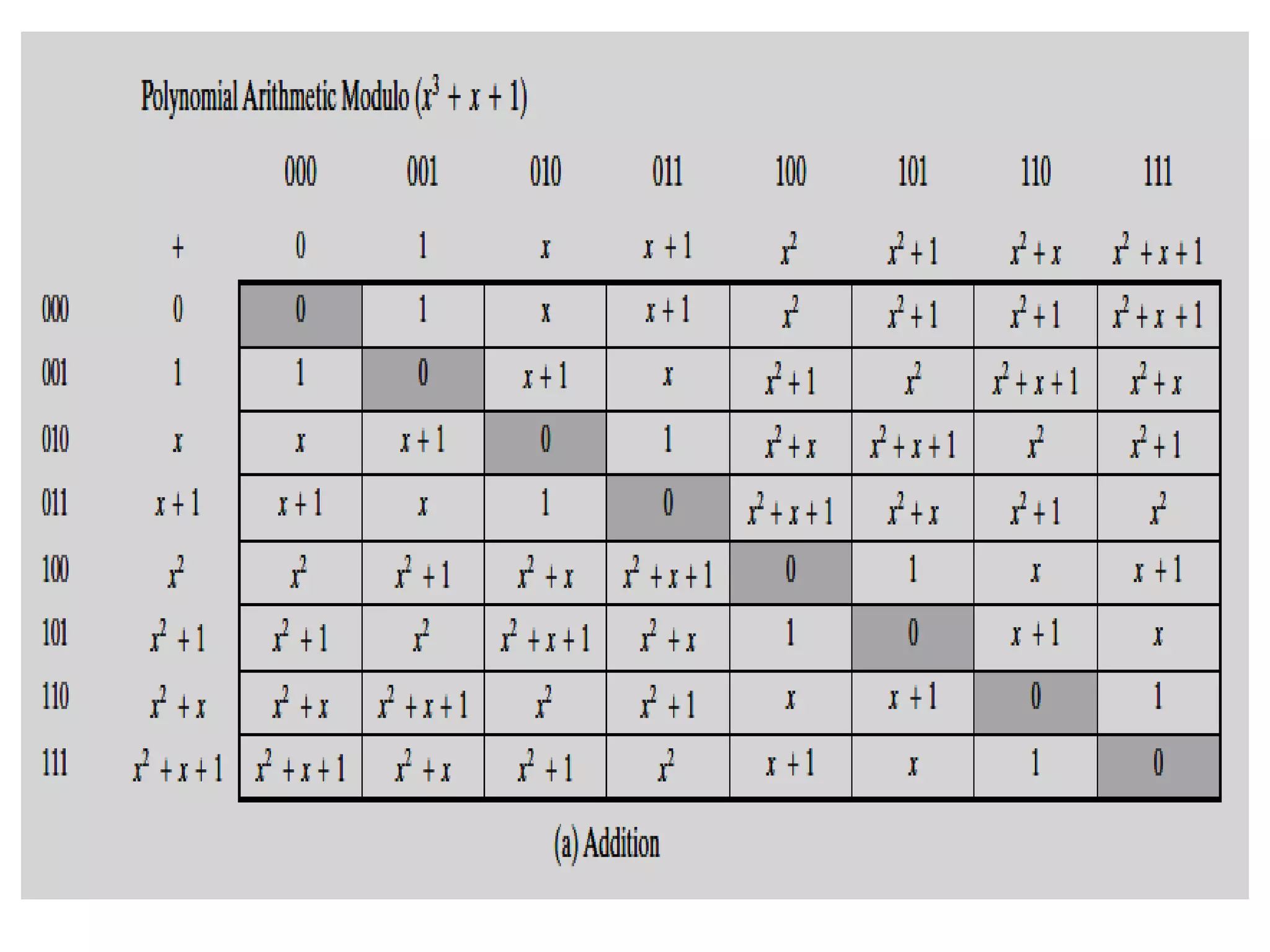
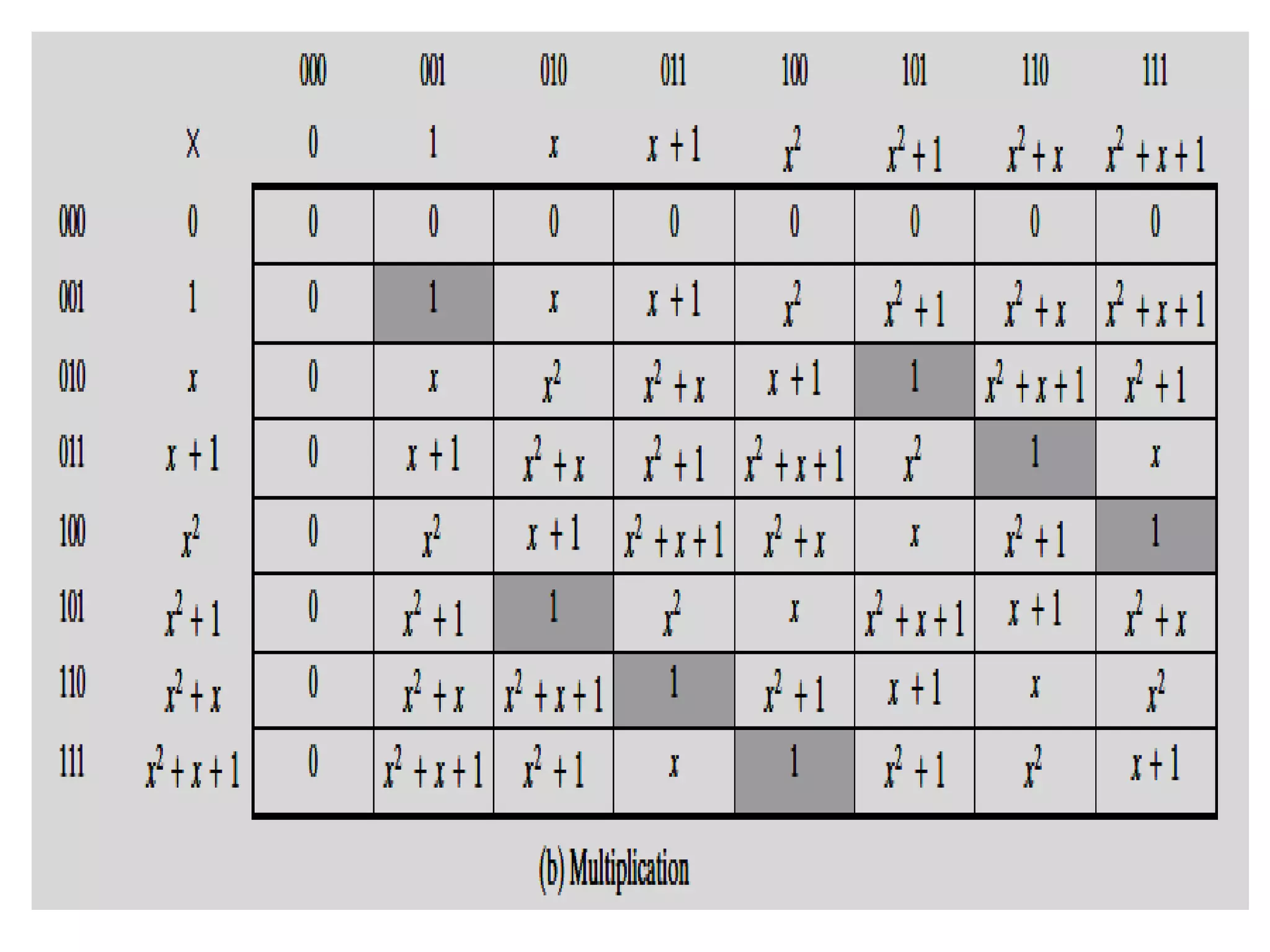
arithmetic- Euclid's algorithm - Finite fields - Polynomial Arithmetic –
Prime numbers - Fermat's and Euler's theorem - Testing for primality -The
Chinese remainder theorem - Discrete logarithms.
OSI SECURITYARCHITECTURE
• The OSI security architecture focuses on security attacks, mechanisms, and
services. These can be defined briefly as follows:
• security attack - any action that compromises the security of information
owned by an organization. Information security is about how to prevent
attacks, or failing that, to detect attacks on information-based systems
• security mechanism - feature designed to detect, prevent, or recover from a
security attack. There is no single mechanism that supports all services
required is available. However, one particular element underlies many of the
security mechanisms in use - cryptographic techniques.
• security service – enhances the security of data processing systems and
information transfers of an organization. Intended to counter security attacks
using one or more security mechanisms.
SECURITY ATTACK
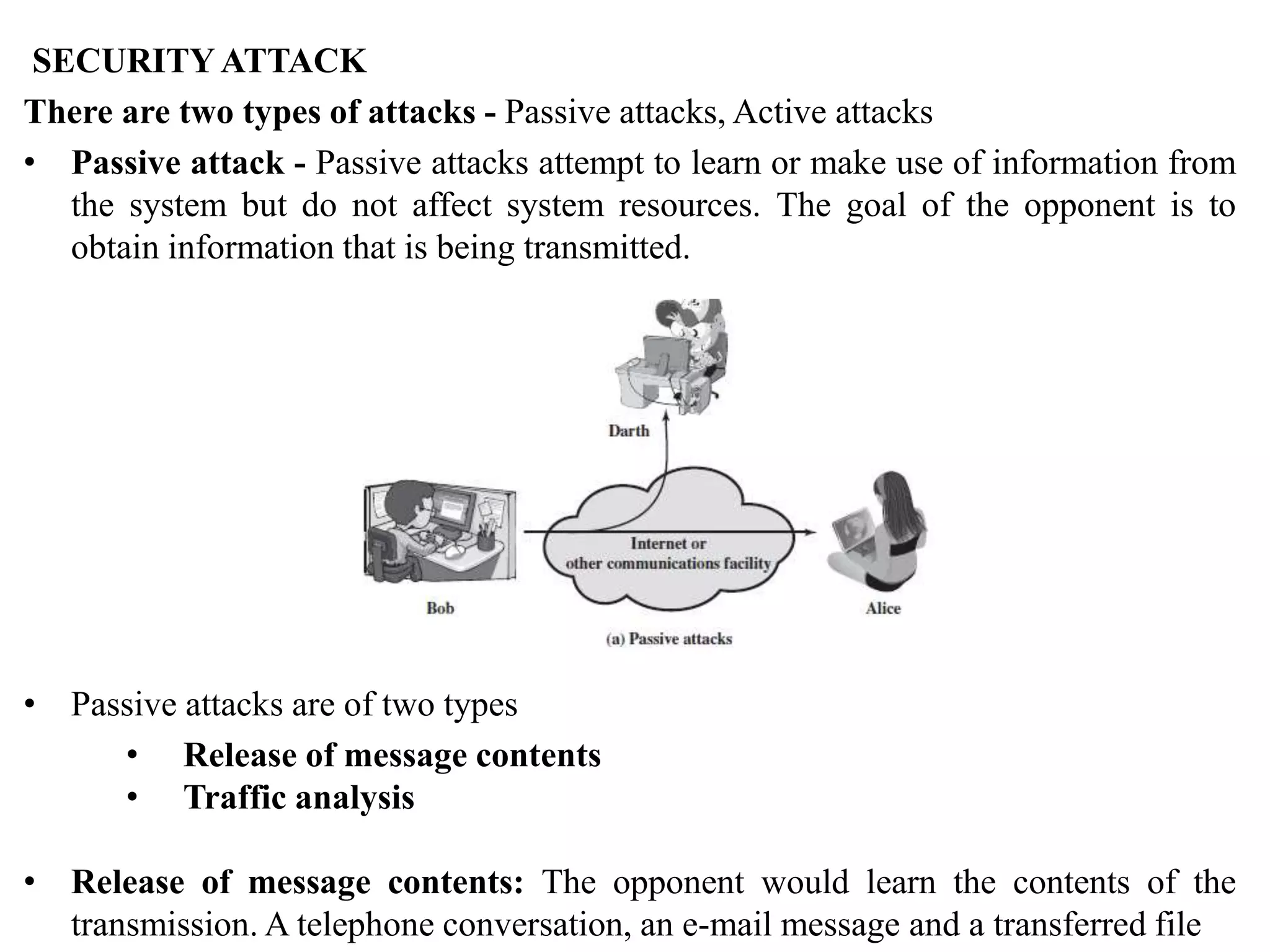
There are two types of attacks - Passive attacks, Active attacks
• Passive attack - Passive attacks attempt to learn or make use of information from
the system but do not affect system resources. The goal of the opponent is to
obtain information that is being transmitted.
• Passive attacks are of two types
• Release of message contents
• Traffic analysis
• Release of message contents: The opponent would learn the contents of the
transmission. A telephone conversation, an e-mail message and a transferred file
may contain sensitive or confidential information. We would like to prevent the
opponent from learning the contents of these transmissions.
• Traffic analysis: The opponent could determine the location and identity of
communicating hosts and could observe the frequency and length of messages
being exchanged. This information might be useful in guessing the nature of the
communication that was taking place.
• Passive attacks are very difficult to detect, because they do not involve any
alteration of the data. However, it is feasible to prevent the success of these
attacks.
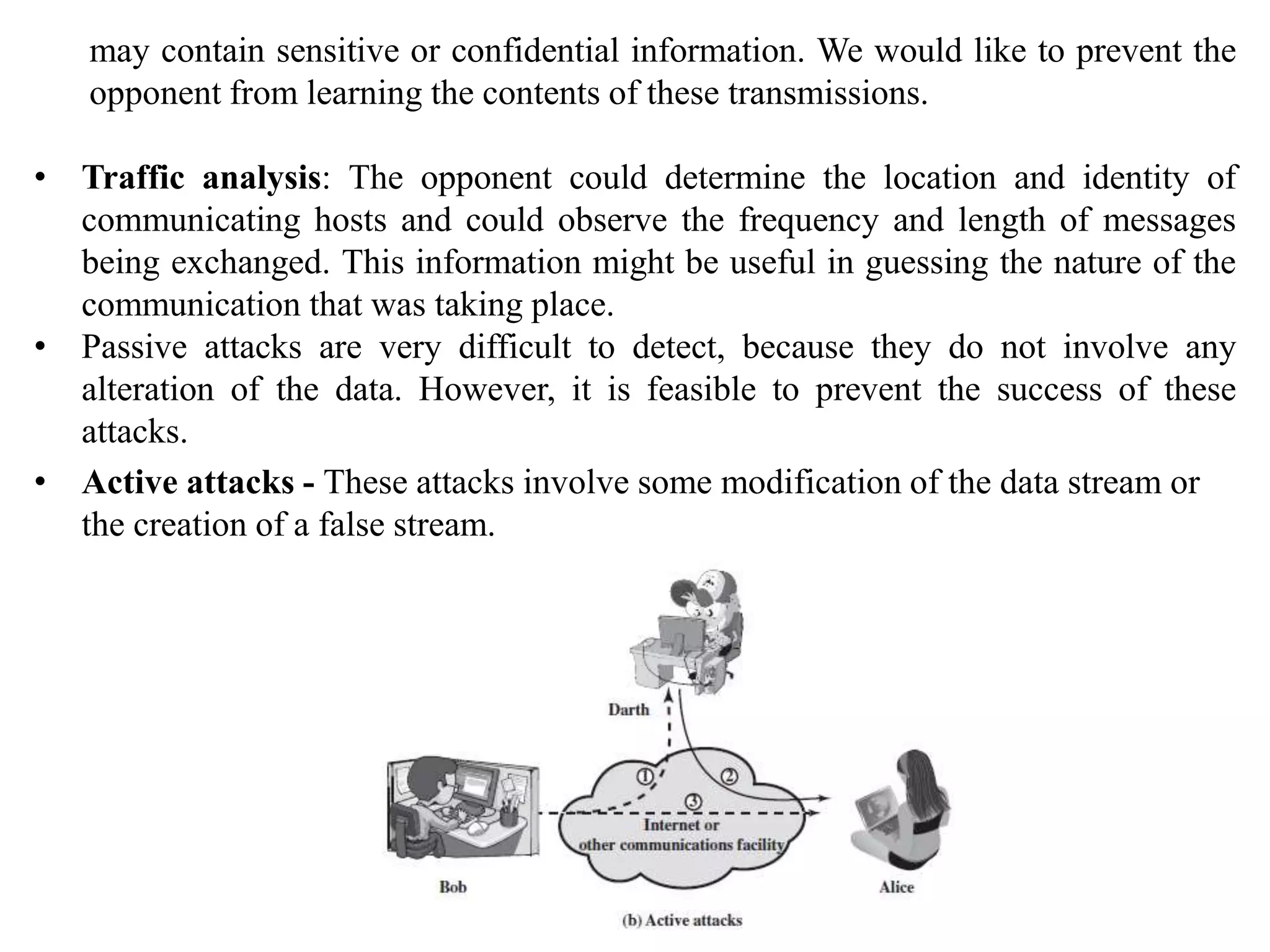
• Active attacks - These attacks involve some modification of the data stream or
the creation of a false stream.
• Active attacks can be classified in to four categories:
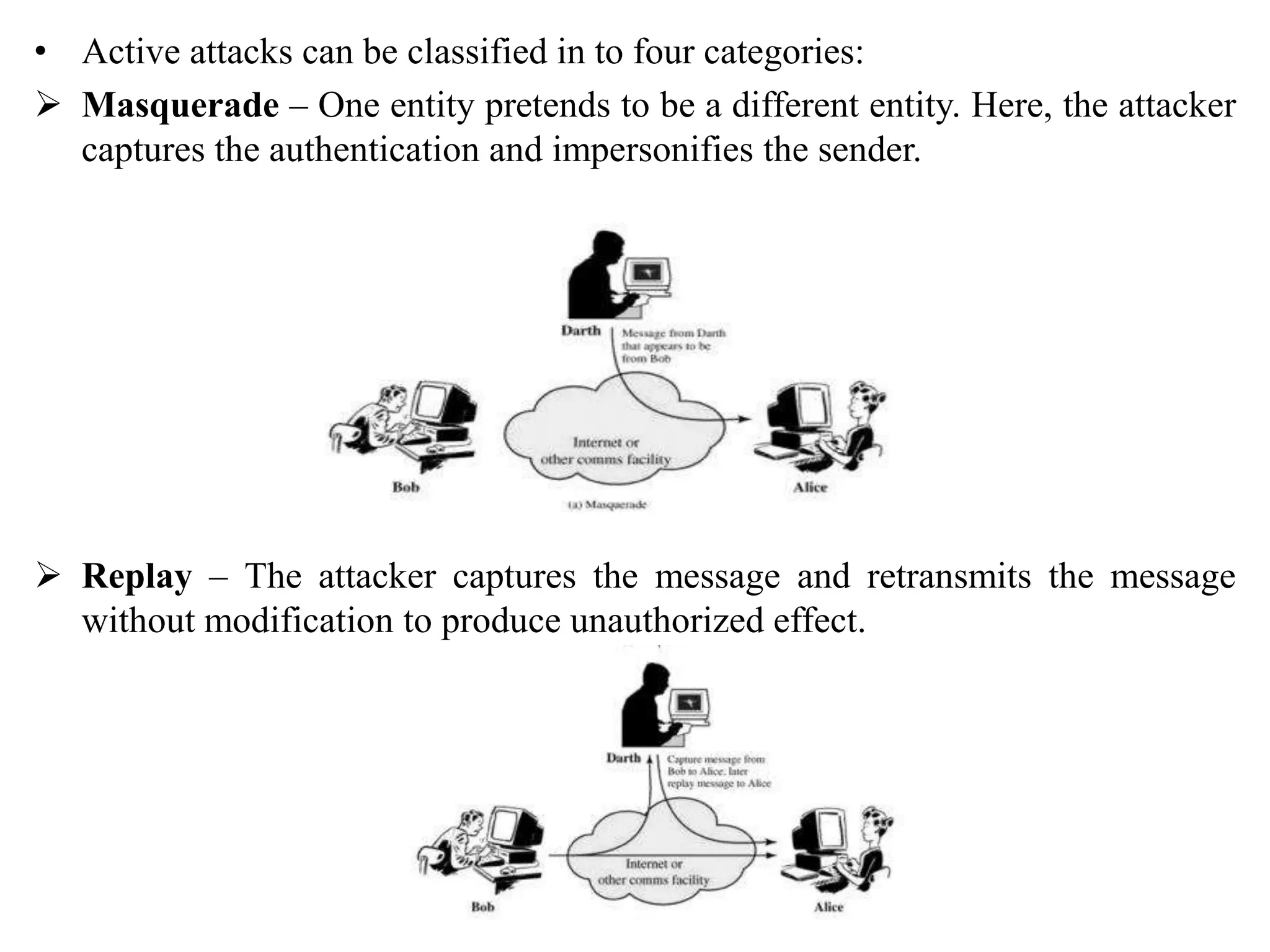
 Masquerade – One entity pretends to be a different entity. Here, the attacker
captures the authentication and impersonifies the sender.
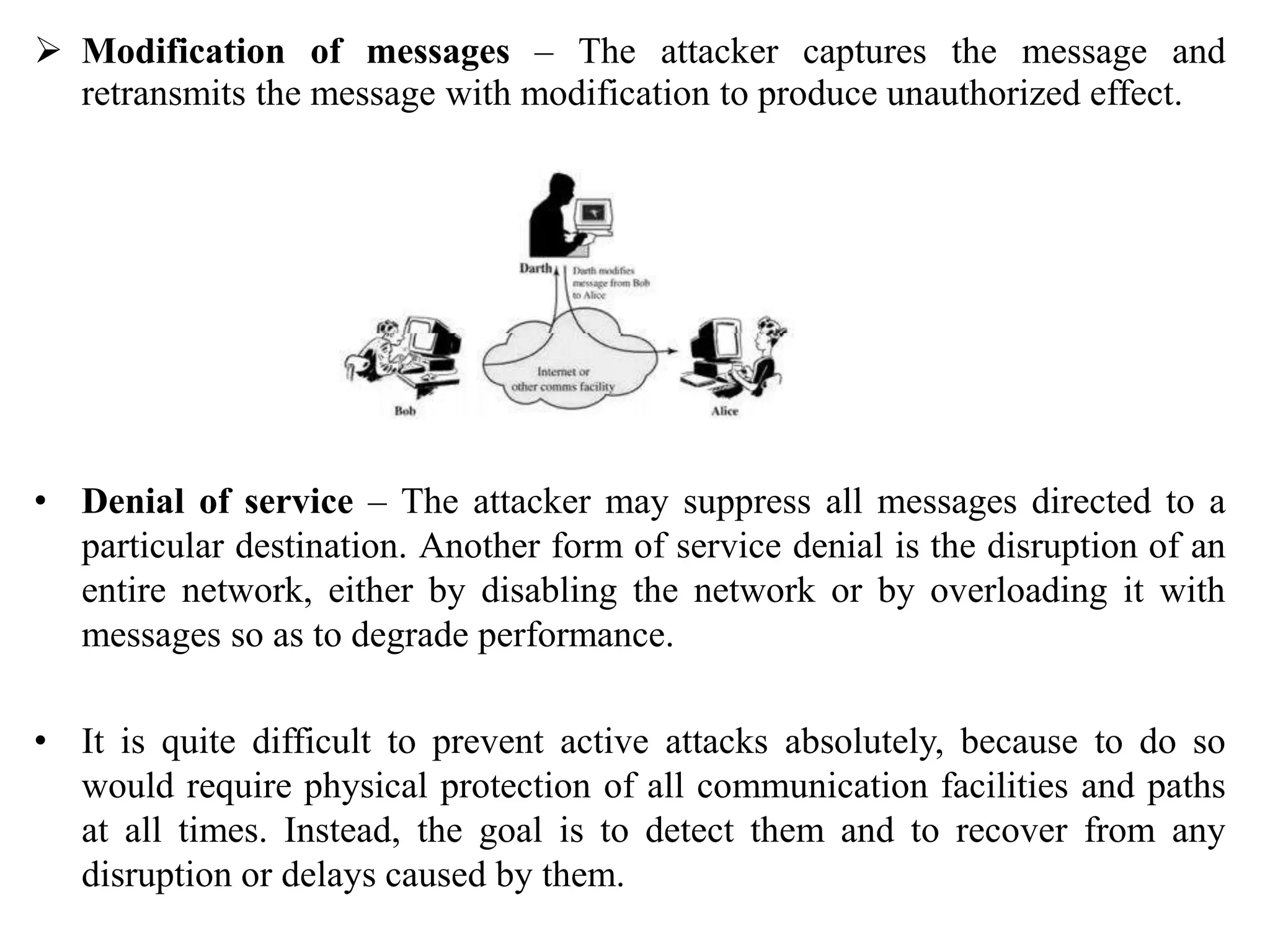
 Replay – The attacker captures the message and retransmits the message
without modification to produce unauthorized effect.
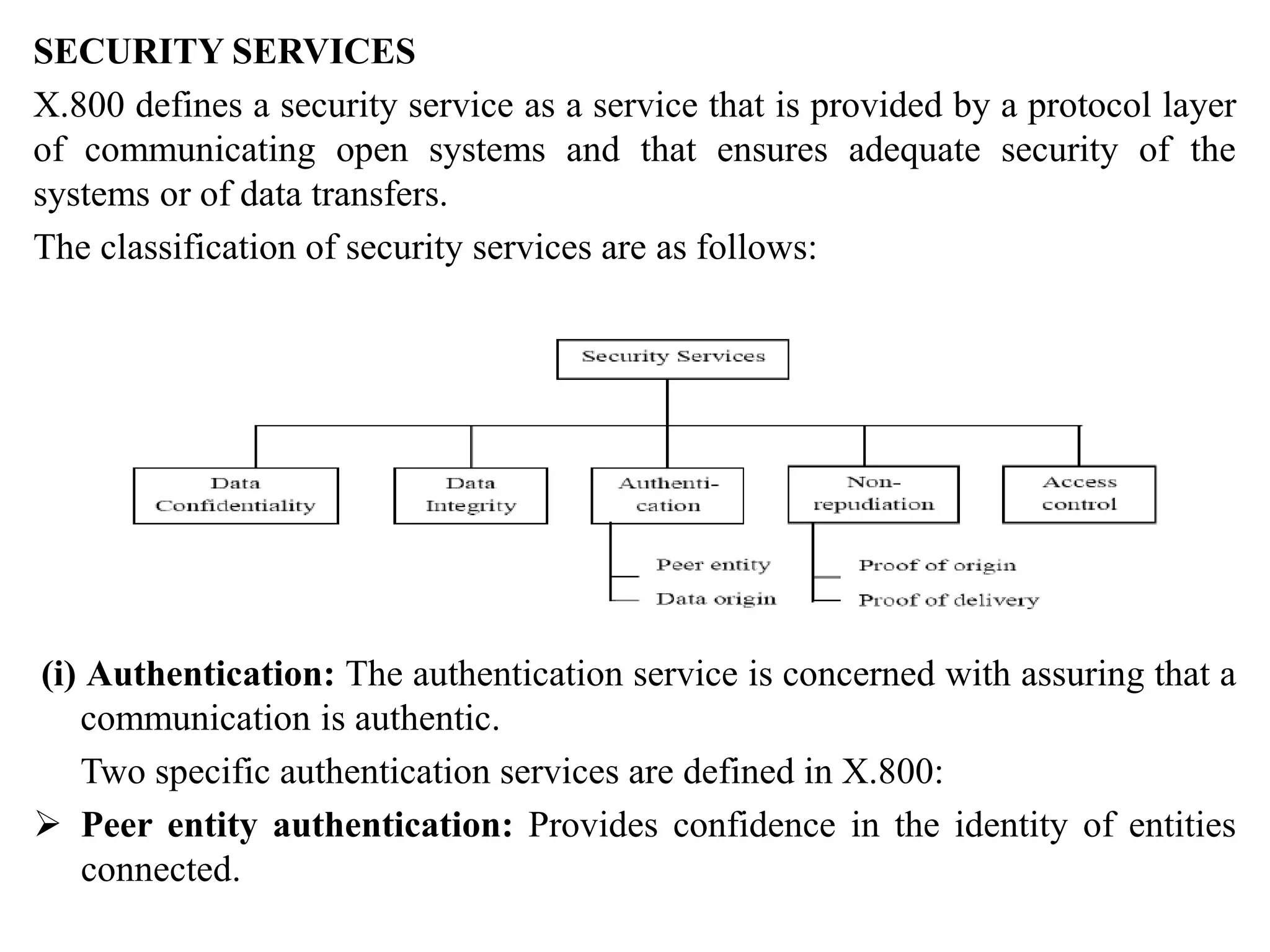
 Modification of messages – The attacker captures the message and
retransmits the message with modification to produce unauthorized effect.
• Denial of service – The attacker may suppress all messages directed to a
particular destination. Another form of service denial is the disruption of an
entire network, either by disabling the network or by overloading it with
messages so as to degrade performance.
• It is quite difficult to prevent active attacks absolutely, because to do so
would require physical protection of all communication facilities and paths
at all times. Instead, the goal is to detect them and to recover from any
disruption or delays caused by them.
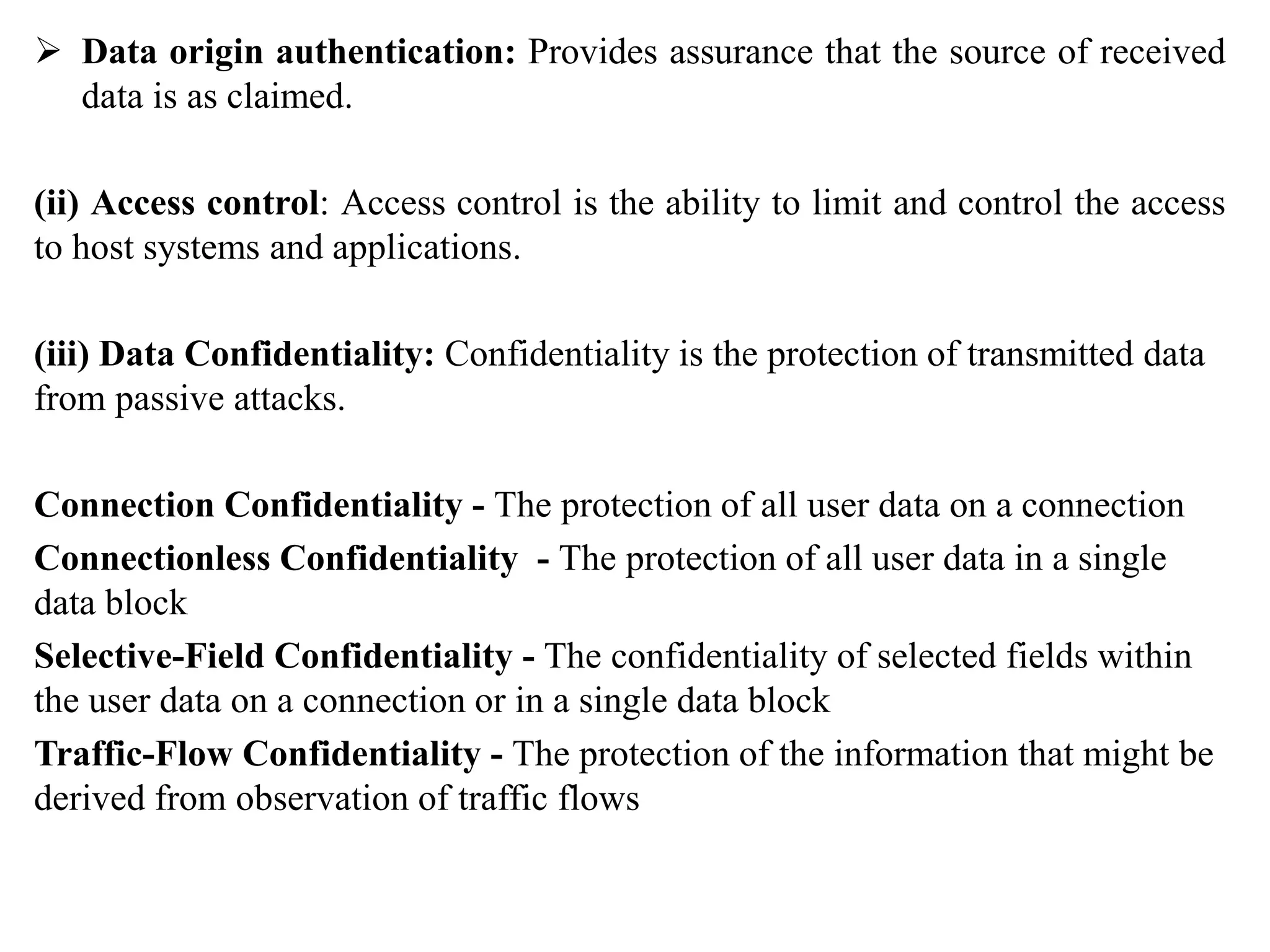
SECURITY SERVICES
X.800 defines a security service as a service that is provided by a protocol layer
of communicating open systems and that ensures adequate security of the
systems or of data transfers.
The classification of security services are as follows:
(i) Authentication: The authentication service is concerned with assuring that a
communication is authentic.
Two specific authentication services are defined in X.800:
 Peer entity authentication: Provides confidence in the identity of entities
connected.
 Data origin authentication: Provides assurance that the source of received
data is as claimed.
(ii) Access control: Access control is the ability to limit and control the access
to host systems and applications.
(iii) Data Confidentiality: Confidentiality is the protection of transmitted data
from passive attacks.
Connection Confidentiality - The protection of all user data on a connection
Connectionless Confidentiality - The protection of all user data in a single
data block
Selective-Field Confidentiality - The confidentiality of selected fields within
the user data on a connection or in a single data block
Traffic-Flow Confidentiality - The protection of the information that might be
derived from observation of traffic flows
(iv)Data Integrity: The assurance that the data received are exactly as sent by an
authorized entity.
 Connection Integrity with Recovery - Provides for the integrity of all user data
on a connection and detects any modification, insertion, deletion, or replay of any
data within an entire data sequence, with recovery attempted.
 Connection Integrity without Recovery - As above, but provides only detection
without recovery.
 Selective-Field Connection Integrity - Provides for the integrity of selected
fields within the user data of a data block transferred over a connection and takes
the form of determination of whether the selected fields have been modified,
inserted, deleted, or replayed.
 Connectionless Integrity - Provides for the integrity of a single connectionless
data block and may take the form of detection of data modification. Additionally,
a limited form of replay detection may be provided.
 Selective-Field Connectionless Integrity - Provides for the integrity of selected
fields within a single connectionless data block; takes the form of determination
of whether the selected fields have been modified.
(v)Non repudiation: Provides protection against denial by one of the entities
involved in a communication of having participated in all or part of the
communication.
 Nonrepudiation, Origin - Proof that the message was sent by the specified party
 Nonrepudiation, Destination - Proof that the message was received by the
specified party
SECURITY MECHANISMS
i. Encipherment: It uses mathematical algorithm to transform data into a form that
is not readily intelligible. It depends upon encryption algorithm and key.
ii. Digital signature: Data appended to or a cryptographic transformation of a data
unit that is to prove integrity of data unit and prevents from forgery.
iii. Access control : A variety of mechanisms that enforce access rights to resources.
iv. Data integrity : A variety of mechanism that are used to ensure integrity of data
unit.
v. Traffic padding: The insertion of bits into gaps in a data stream to frustrate
traffic analysis attempts.
vi. Notarization: The use of a trusted third party to assure certain properties of a
data exchange.
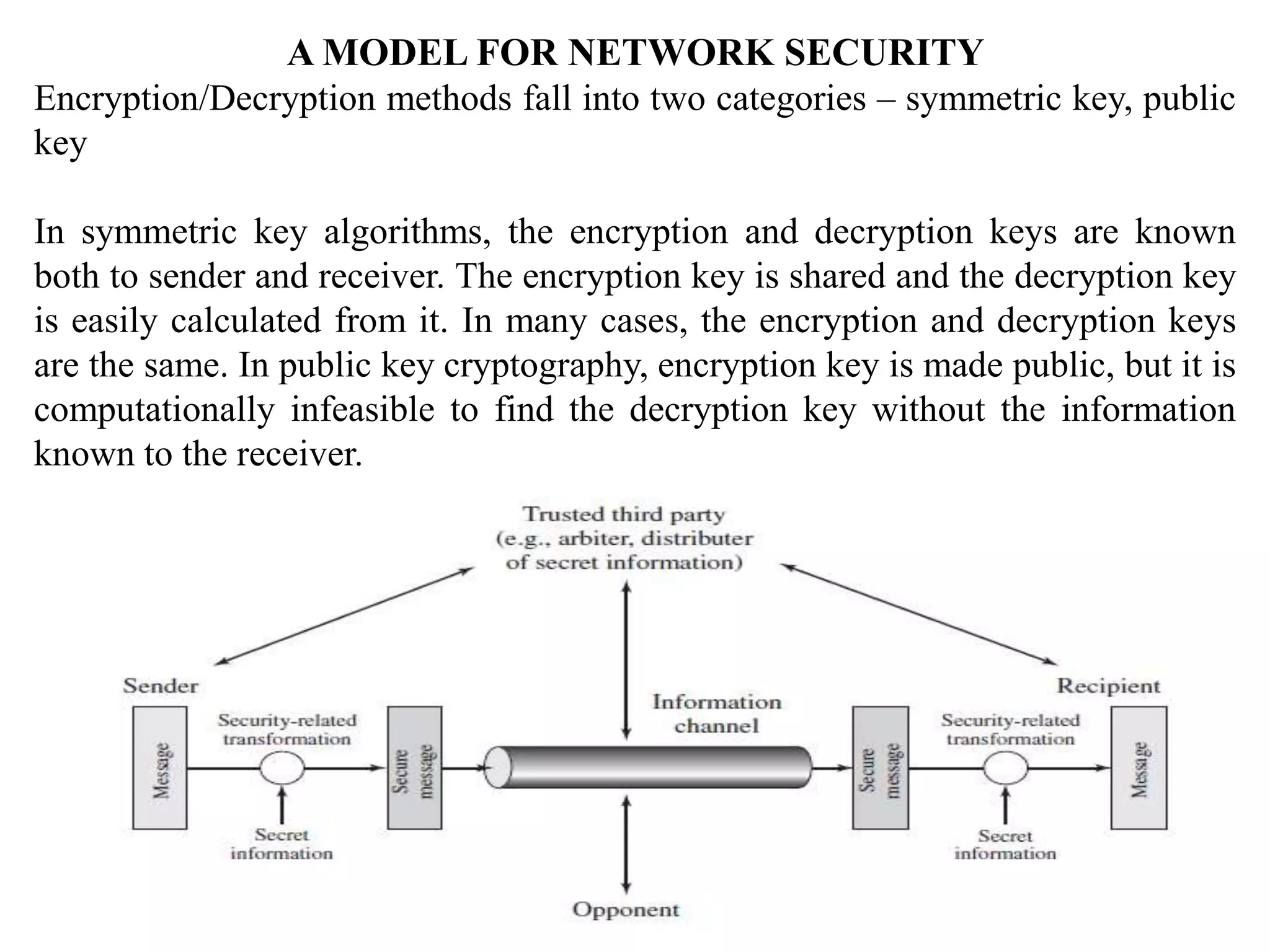
A MODEL FOR NETWORK SECURITY
Encryption/Decryption methods fall into two categories – symmetric key, public
key
In symmetric key algorithms, the encryption and decryption keys are known
both to sender and receiver. The encryption key is shared and the decryption key
is easily calculated from it. In many cases, the encryption and decryption keys
are the same. In public key cryptography, encryption key is made public, but it is
computationally infeasible to find the decryption key without the information
known to the receiver.
• A message is to be transferred from one party to another across some sort of
internet. The two parties, who are the principals in this transaction, must
cooperate for the exchange to take place. A logical information channel is
established by defining a route through the internet from source to
destination and by the cooperative use of communication protocols (e.g.,
TCP/IP) by the two principals.
• All the techniques for providing security have two components:
 A security-related transformation on the information to be sent.
Examples include the encryption of the message, which scrambles the
message so that it is unreadable by the opponent.
 Some secret information shared by the two principals and, it is hoped,
unknown to the opponent. An example is an encryption key used in
conjunction with the transformation to scramble the message before
transmission
• A trusted third party may be needed to achieve secure transmission. For
example, a third party may be responsible for distributing the secret
information to the two principals while keeping it away from any opponent.
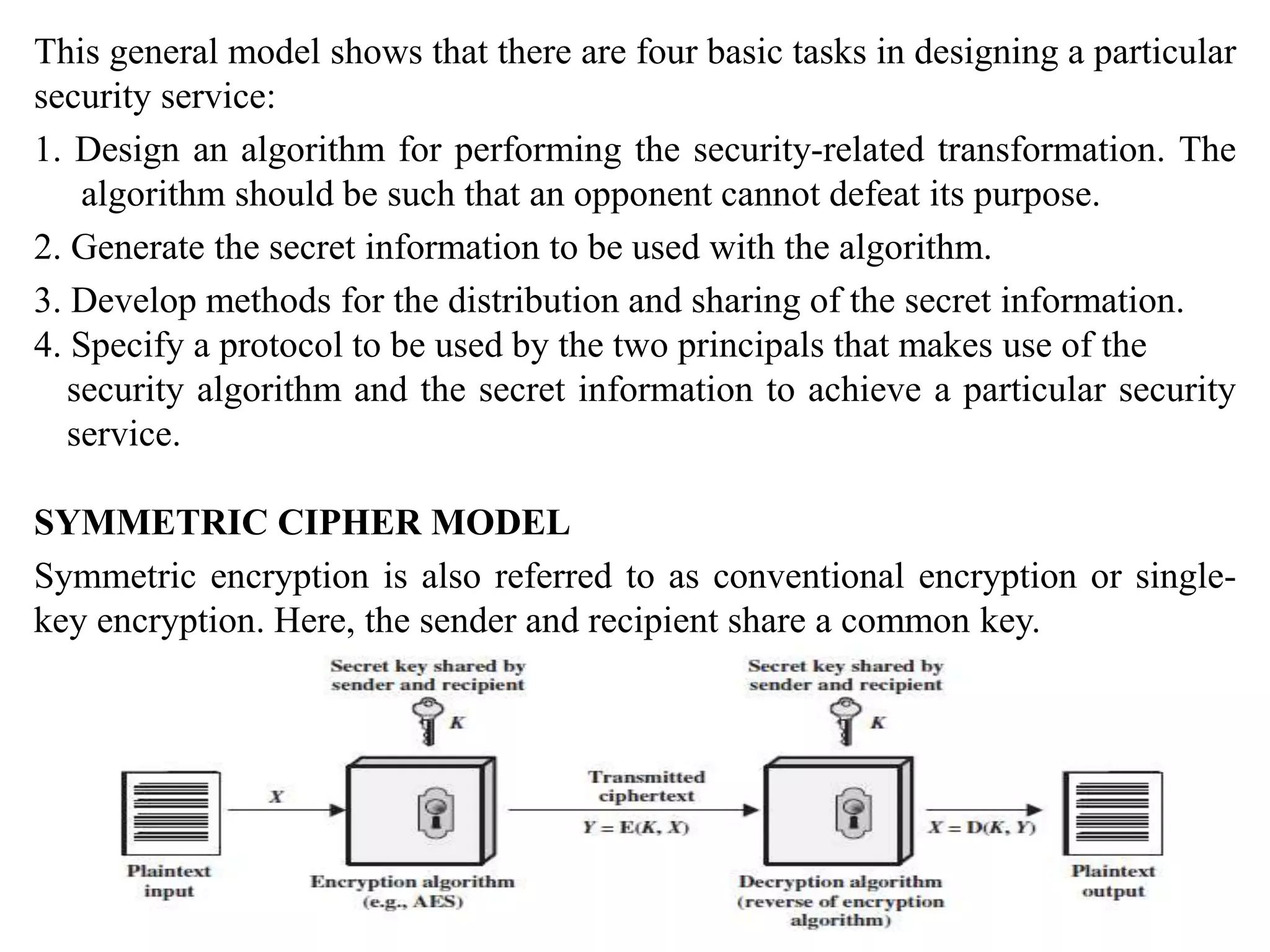
This general model shows that there are four basic tasks in designing a particular
security service:
1. Design an algorithm for performing the security-related transformation. The
algorithm should be such that an opponent cannot defeat its purpose.
2. Generate the secret information to be used with the algorithm.
3. Develop methods for the distribution and sharing of the secret information.
4. Specify a protocol to be used by the two principals that makes use of the
security algorithm and the secret information to achieve a particular security
service.
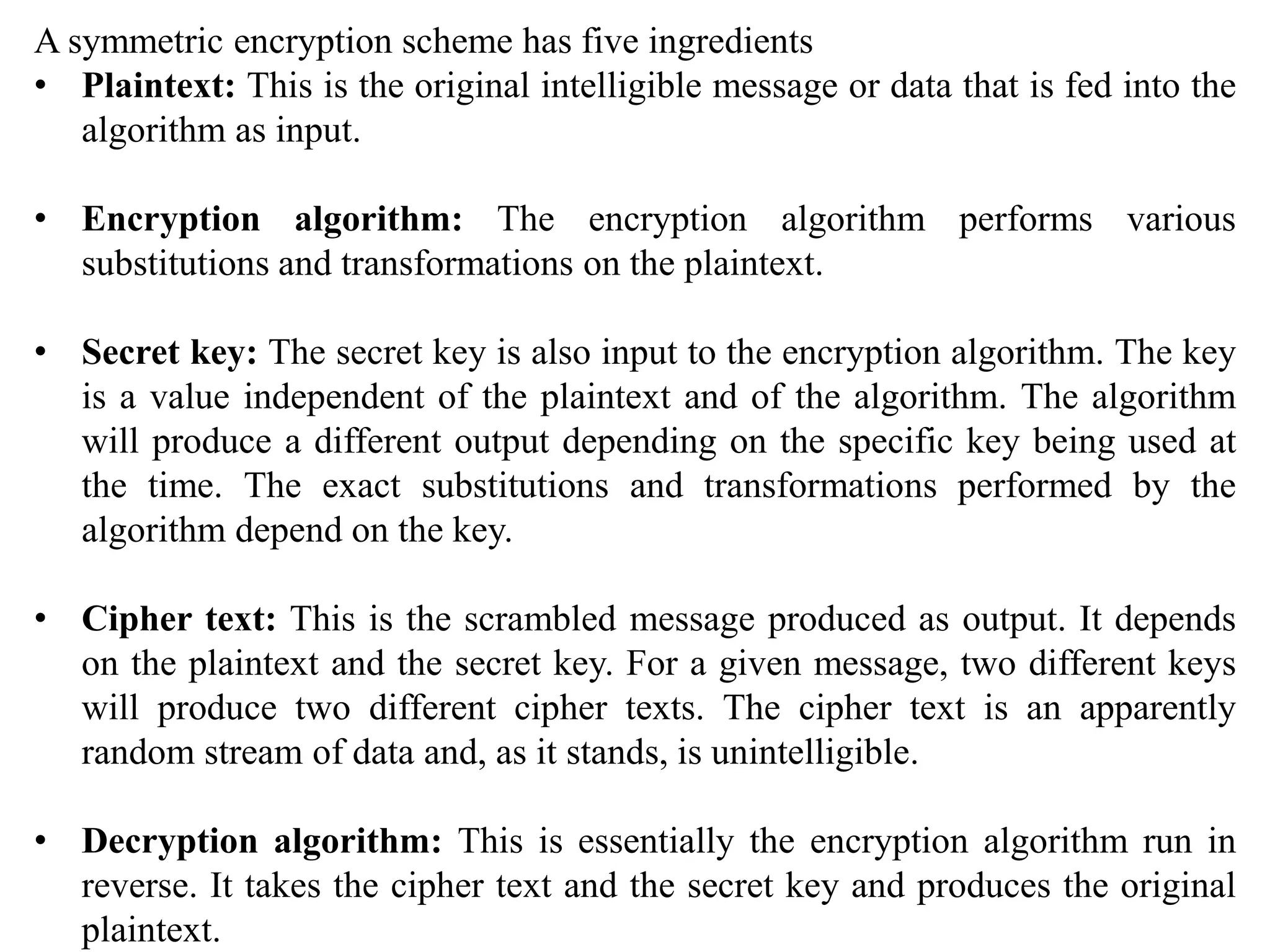
SYMMETRIC CIPHER MODEL
Symmetric encryption is also referred to as conventional encryption or single-
key encryption. Here, the sender and recipient share a common key.
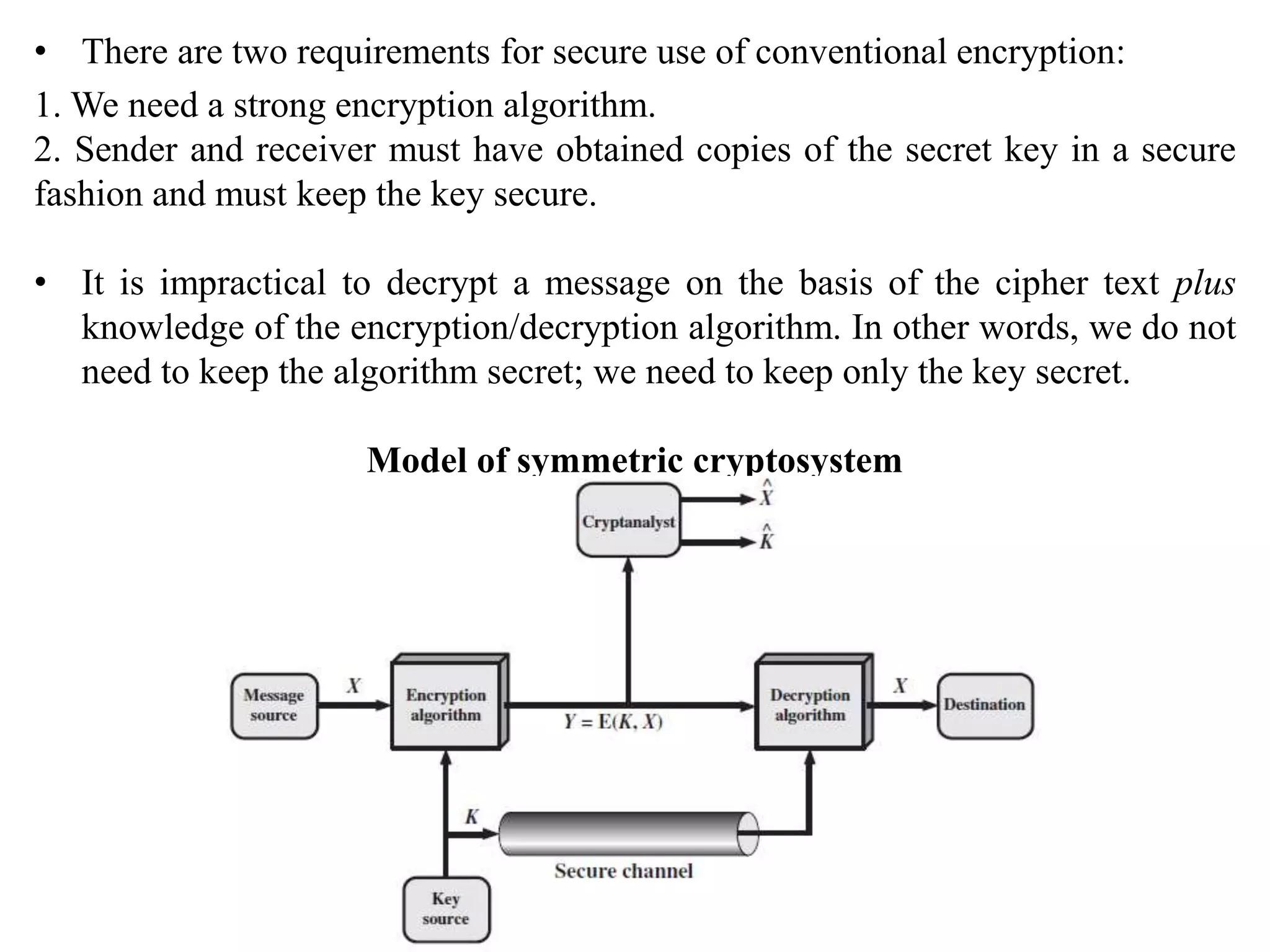
A symmetric encryption scheme has five ingredients
• Plaintext: This is the original intelligible message or data that is fed into the
algorithm as input.
• Encryption algorithm: The encryption algorithm performs various
substitutions and transformations on the plaintext.
• Secret key: The secret key is also input to the encryption algorithm. The key
is a value independent of the plaintext and of the algorithm. The algorithm
will produce a different output depending on the specific key being used at
the time. The exact substitutions and transformations performed by the
algorithm depend on the key.
• Cipher text: This is the scrambled message produced as output. It depends
on the plaintext and the secret key. For a given message, two different keys
will produce two different cipher texts. The cipher text is an apparently
random stream of data and, as it stands, is unintelligible.
• Decryption algorithm: This is essentially the encryption algorithm run in
reverse. It takes the cipher text and the secret key and produces the original
plaintext.
• There are two requirements for secure use of conventional encryption:
1. We need a strong encryption algorithm.
2. Sender and receiver must have obtained copies of the secret key in a secure
fashion and must keep the key secure.
• It is impractical to decrypt a message on the basis of the cipher text plus
knowledge of the encryption/decryption algorithm. In other words, we do not
need to keep the algorithm secret; we need to keep only the key secret.
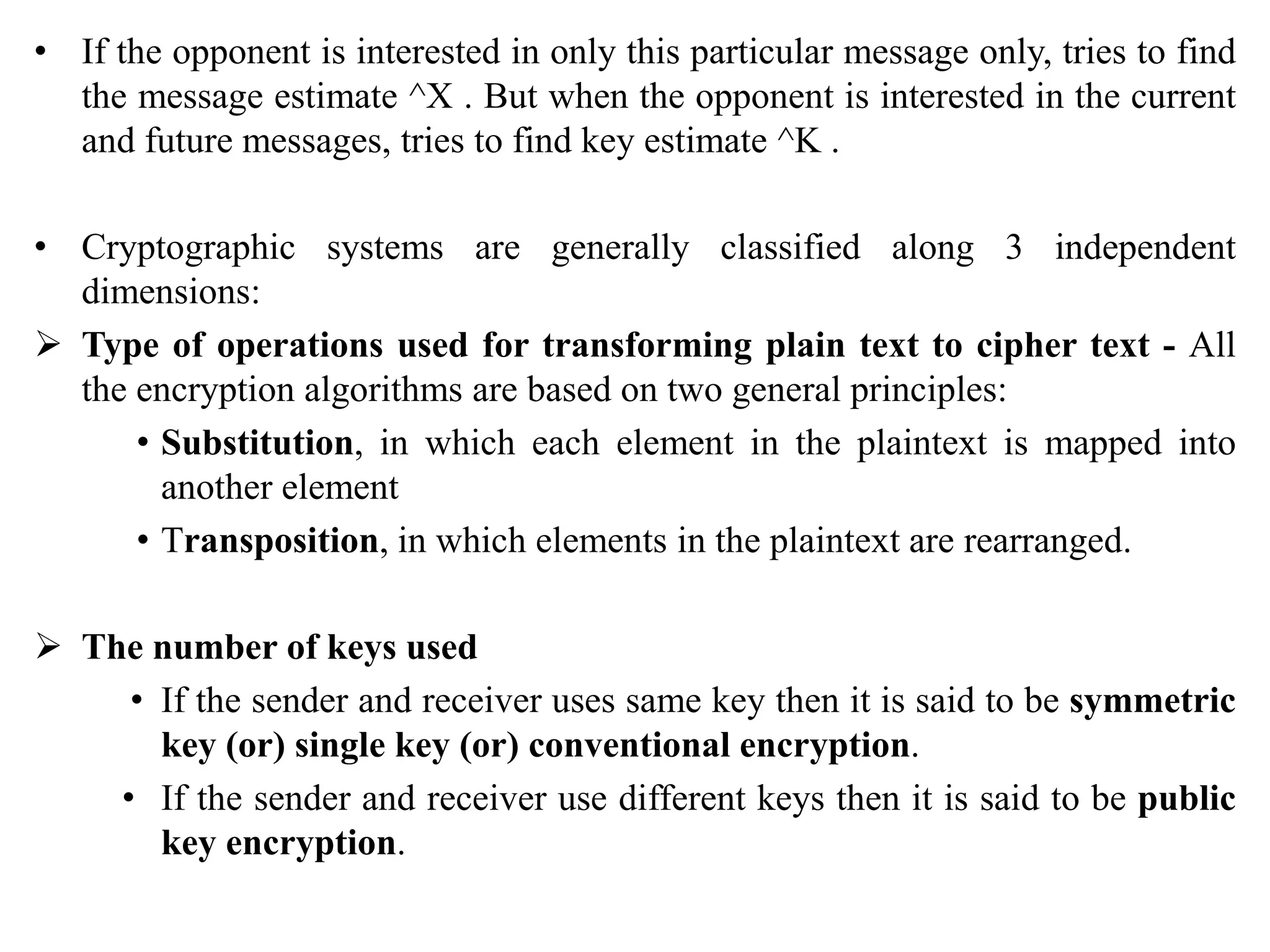
Model of symmetric cryptosystem
• A source produces a message in plaintext
X = [X1, X2,..., XM].
M- elements of X are letters.
• For encryption, a key of the form
K = [K1, K2, …, KJ] is generated.
• If the key is generated at the message source, then it must also be provided to
the destination by means of some secure channel. Alternatively, a third party
could generate the key and securely deliver it to both source and destination.
• With the message X and the encryption key K as input, the encryption
algorithm forms the cipher text
Y = [Y1, Y2,…, YN].
Y = E(K, X)
where Y- cipher text, E- Encryption algorithm, K- Key, X-Plain text
• At the receiver side the transformation is:
X = D(K, Y)
where Y- cipher text, D-Decryption algorithm, K- Key, X-Plain text
• If the opponent is interested in only this particular message only, tries to find
the message estimate ^X . But when the opponent is interested in the current
and future messages, tries to find key estimate ^K .
• Cryptographic systems are generally classified along 3 independent
dimensions:
 Type of operations used for transforming plain text to cipher text - All
the encryption algorithms are based on two general principles:
• Substitution, in which each element in the plaintext is mapped into
another element
• Transposition, in which elements in the plaintext are rearranged.
 The number of keys used
• If the sender and receiver uses same key then it is said to be symmetric
key (or) single key (or) conventional encryption.
• If the sender and receiver use different keys then it is said to be public
key encryption.
 The way in which the plain text is processed
• A block cipher processes the input, one block of elements at a time,
producing an output block for each input block.
• A stream cipher processes the input elements continuously, producing
output, one element at a time, as it goes along.
CRYPTANALYSIS AND BRUTE-FORCE ATTACK
There are two general approaches to attacking a conventional encryption scheme:
• Cryptanalysis: Cryptanalytic attacks rely on the nature of the algorithm and
some knowledge of the general characteristics of the plaintext or even some
sample plaintext–cipher text pairs.
• Brute-force attack: The attacker tries every possible key on a piece of cipher
text until an intelligible translation into plaintext is obtained.
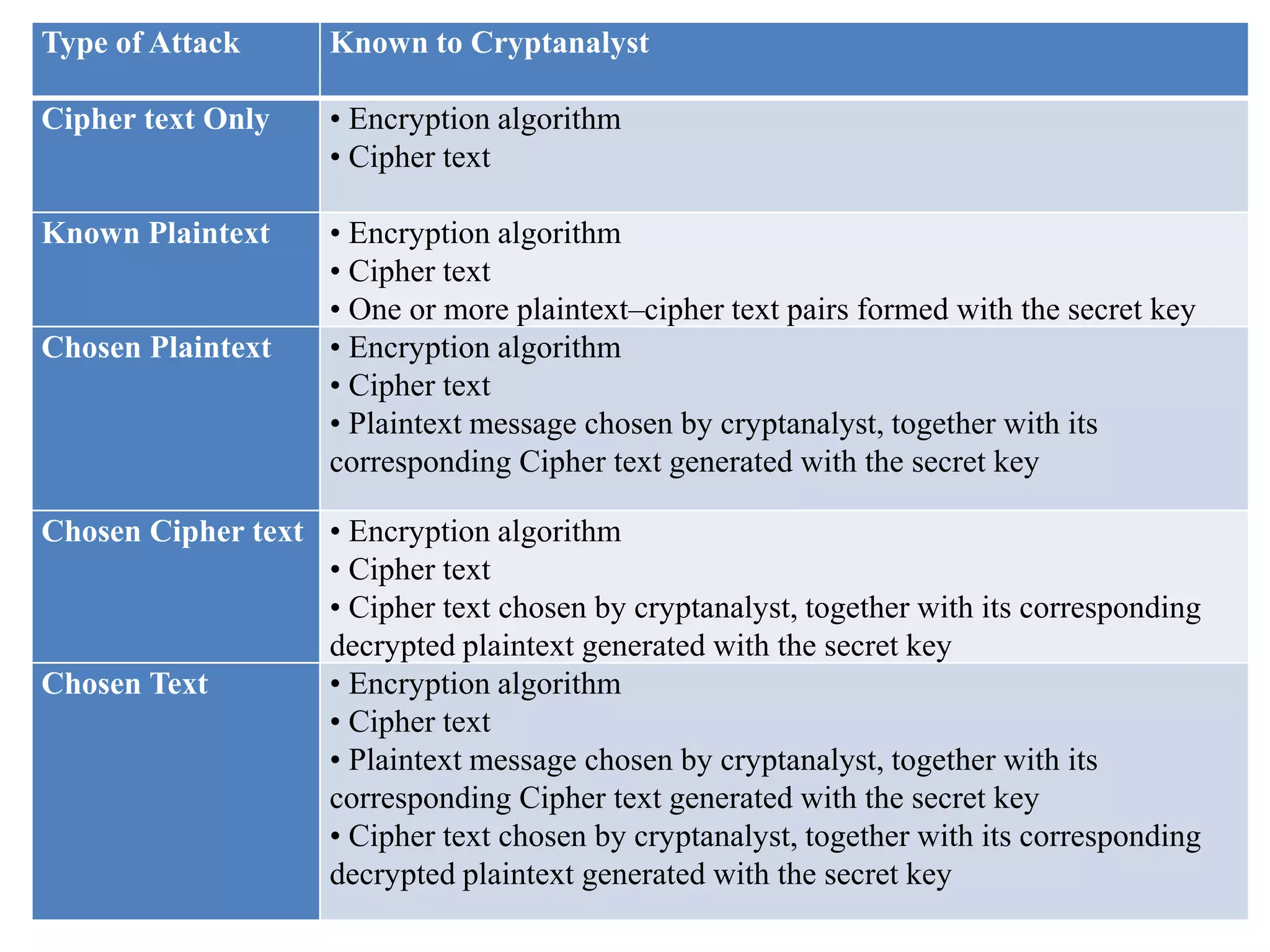
There are various types of cryptanalytic attacks based on the amount of
information known to the cryptanalyst.
Type of Attack Known to Cryptanalyst
Cipher text Only • Encryption algorithm
• Cipher text
Known Plaintext • Encryption algorithm
• Cipher text
• One or more plaintext–cipher text pairs formed with the secret key
Chosen Plaintext • Encryption algorithm
• Cipher text
• Plaintext message chosen by cryptanalyst, together with its
corresponding Cipher text generated with the secret key
Chosen Cipher text • Encryption algorithm
• Cipher text
• Cipher text chosen by cryptanalyst, together with its corresponding
decrypted plaintext generated with the secret key
Chosen Text • Encryption algorithm
• Cipher text
• Plaintext message chosen by cryptanalyst, together with its
corresponding Cipher text generated with the secret key
• Cipher text chosen by cryptanalyst, together with its corresponding
decrypted plaintext generated with the secret key
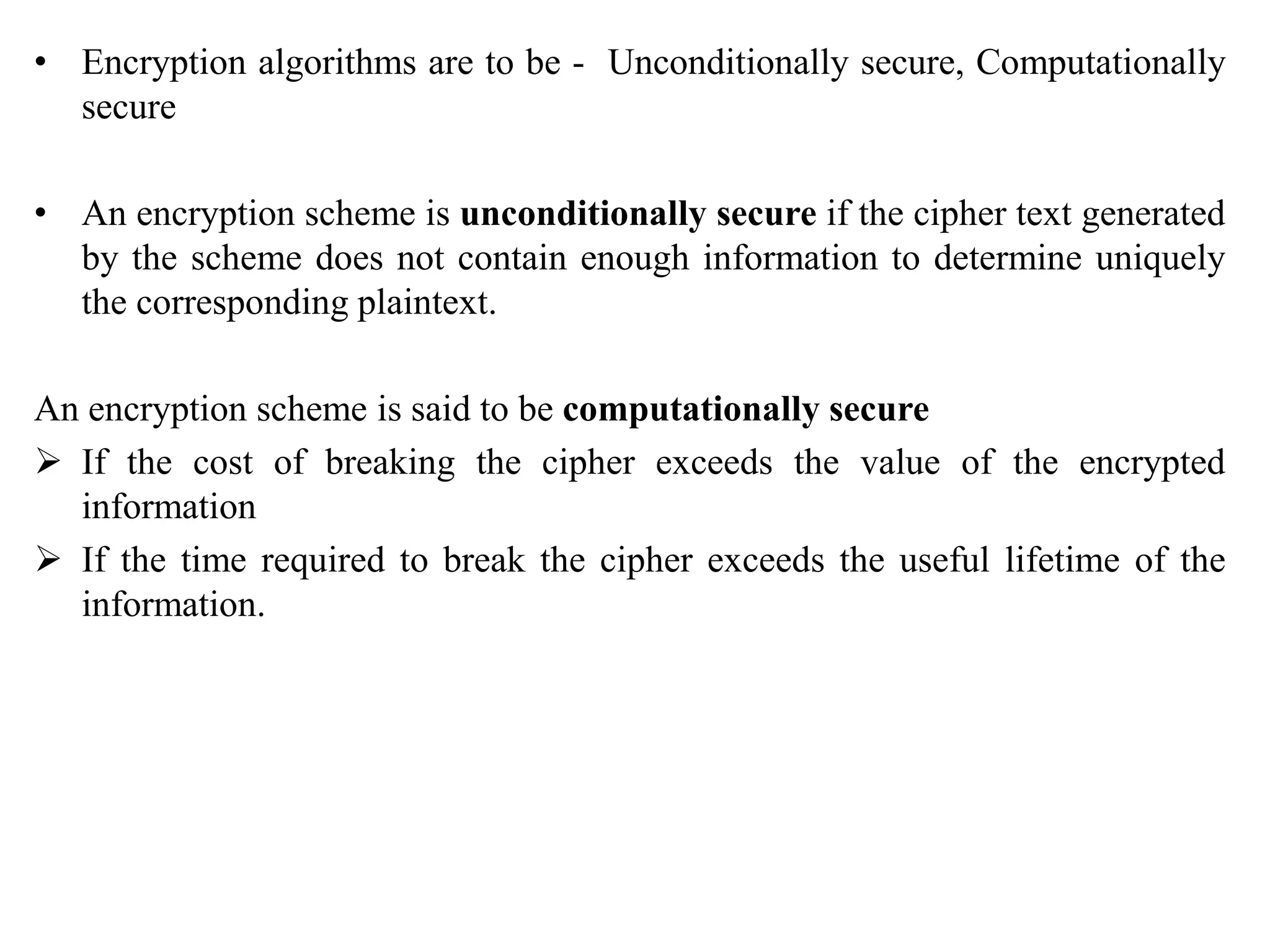
• Encryption algorithms are to be - Unconditionally secure, Computationally
secure
• An encryption scheme is unconditionally secure if the cipher text generated
by the scheme does not contain enough information to determine uniquely
the corresponding plaintext.
An encryption scheme is said to be computationally secure
 If the cost of breaking the cipher exceeds the value of the encrypted
information
 If the time required to break the cipher exceeds the useful lifetime of the
information.
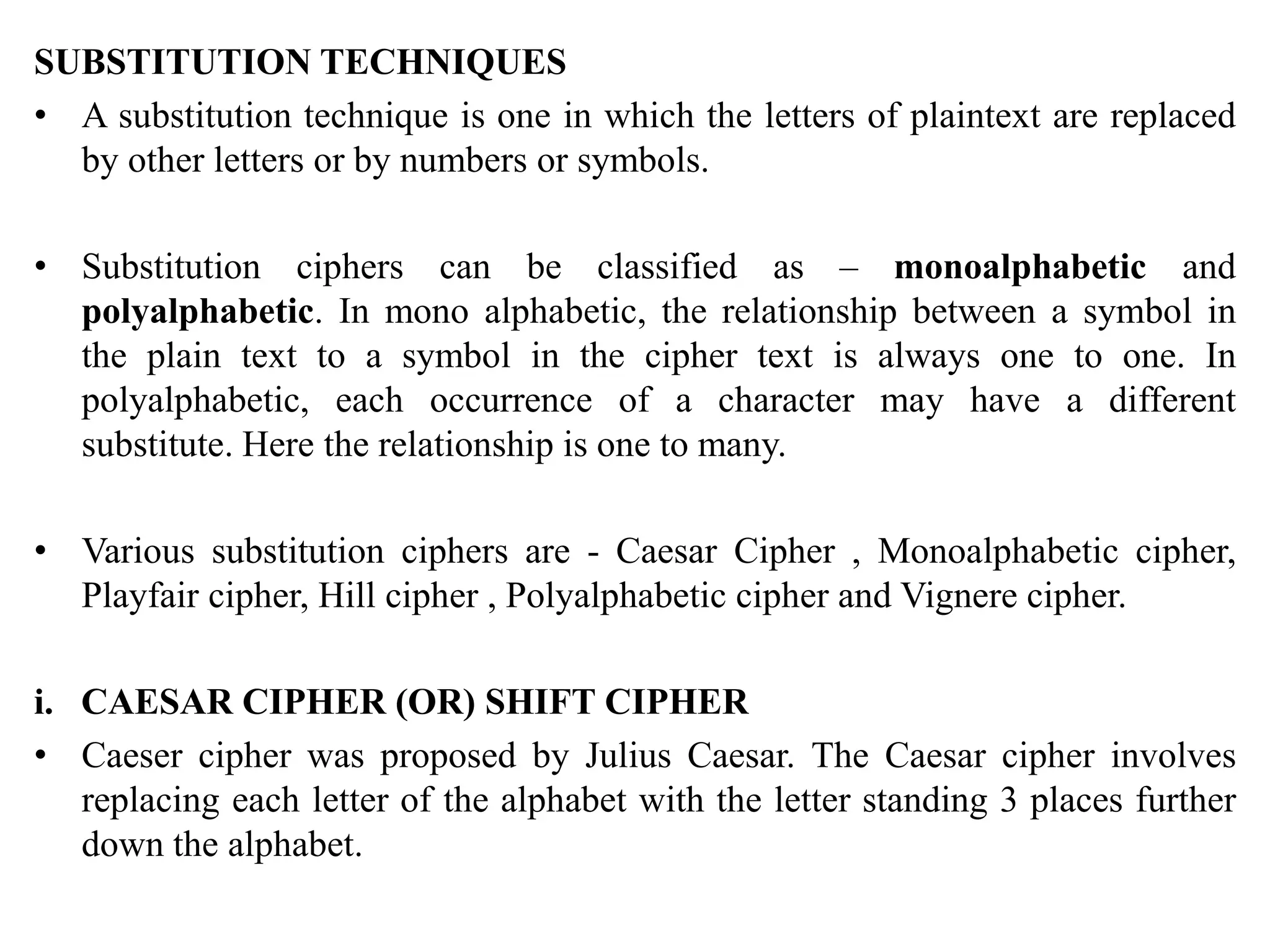
SUBSTITUTION TECHNIQUES
• A substitution technique is one in which the letters of plaintext are replaced
by other letters or by numbers or symbols.
• Substitution ciphers can be classified as – monoalphabetic and
polyalphabetic. In mono alphabetic, the relationship between a symbol in
the plain text to a symbol in the cipher text is always one to one. In
polyalphabetic, each occurrence of a character may have a different
substitute. Here the relationship is one to many.
• Various substitution ciphers are - Caesar Cipher , Monoalphabetic cipher,
Playfair cipher, Hill cipher , Polyalphabetic cipher and Vignere cipher.
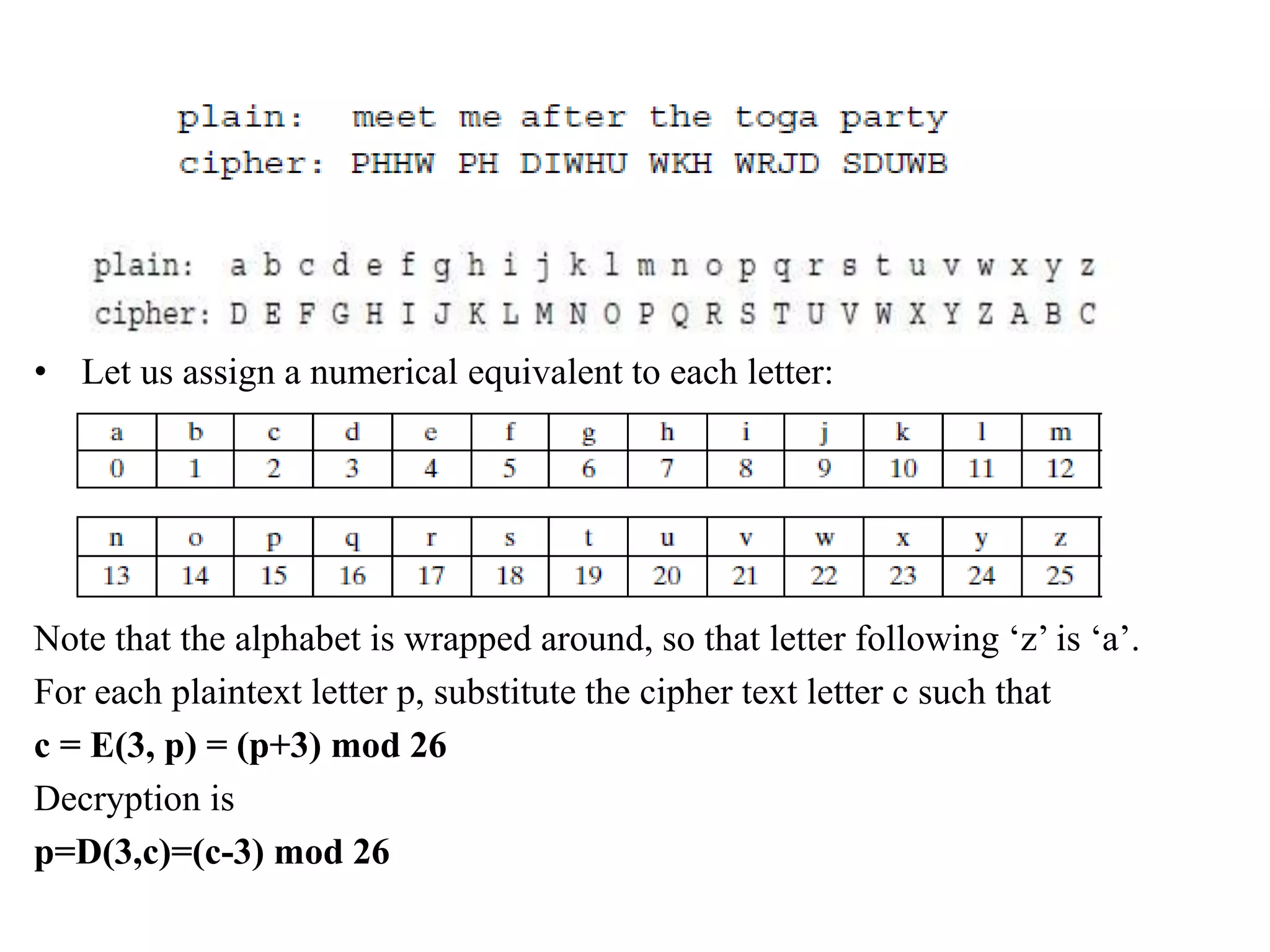
i. CAESAR CIPHER (OR) SHIFT CIPHER
• Caeser cipher was proposed by Julius Caesar. The Caesar cipher involves
replacing each letter of the alphabet with the letter standing 3 places further
down the alphabet.
• Let us assign a numerical equivalent to each letter:
Note that the alphabet is wrapped around, so that letter following ‘z’ is ‘a’.
For each plaintext letter p, substitute the cipher text letter c such that
c = E(3, p) = (p+3) mod 26
Decryption is
p=D(3,c)=(c-3) mod 26
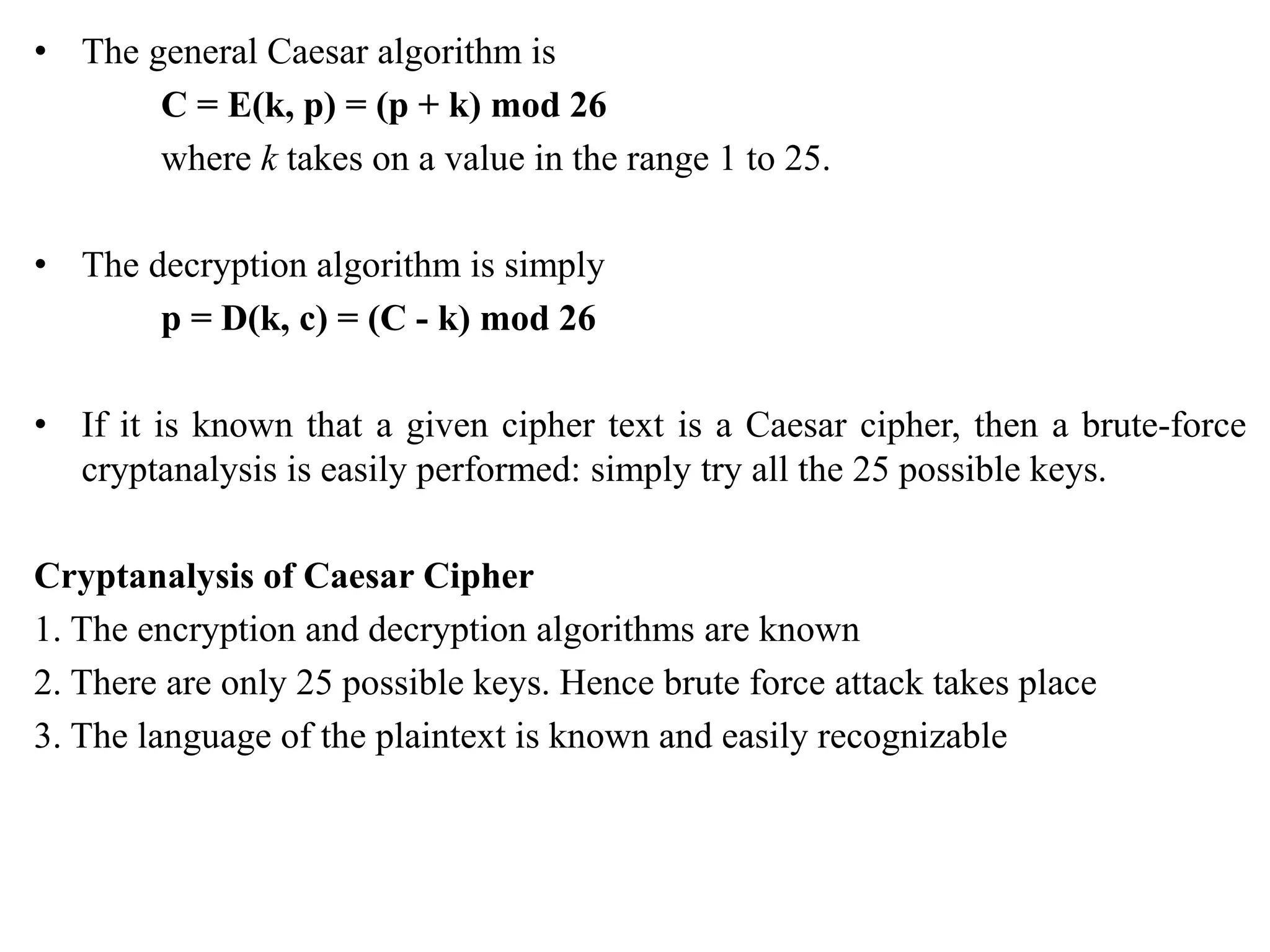
• The general Caesar algorithm is
C = E(k, p) = (p + k) mod 26
where k takes on a value in the range 1 to 25.
• The decryption algorithm is simply
p = D(k, c) = (C - k) mod 26
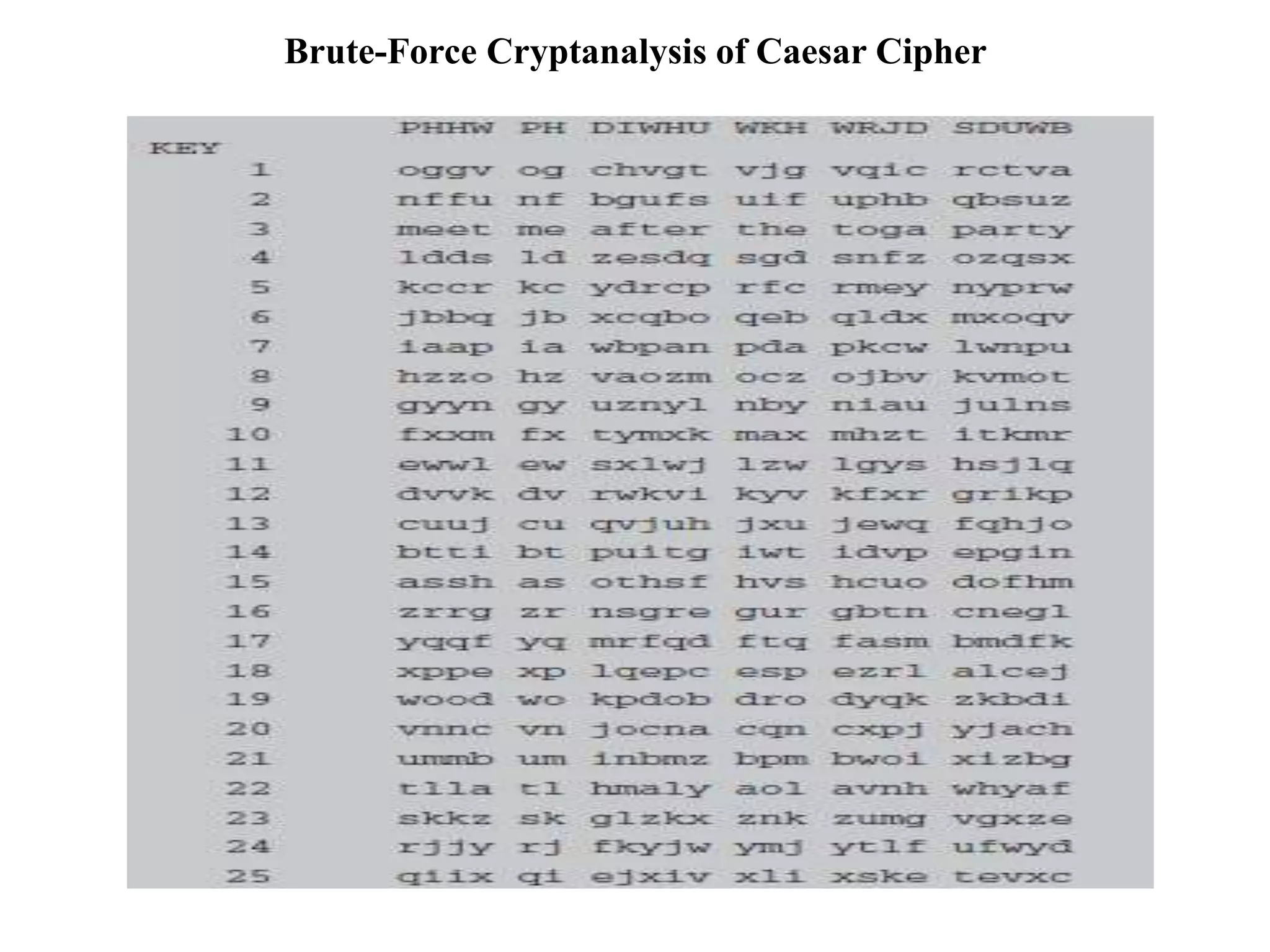
• If it is known that a given cipher text is a Caesar cipher, then a brute-force
cryptanalysis is easily performed: simply try all the 25 possible keys.
Cryptanalysis of Caesar Cipher
1. The encryption and decryption algorithms are known
2. There are only 25 possible keys. Hence brute force attack takes place
3. The language of the plaintext is known and easily recognizable
Brute-Force Cryptanalysis of Caesar Cipher
(ii) MONOALPHABETIC CIPHER
• Each plaintext letter maps to a different random cipher text letter. Here, 26!
Possible keys are used to eliminate brute force attack.
• There is, however, another line of attack. If the cryptanalyst knows the nature
of the plaintext (e.g., non-compressed English text), then the analyst can
exploit the regularities of the language. Consider the ciphertext below:
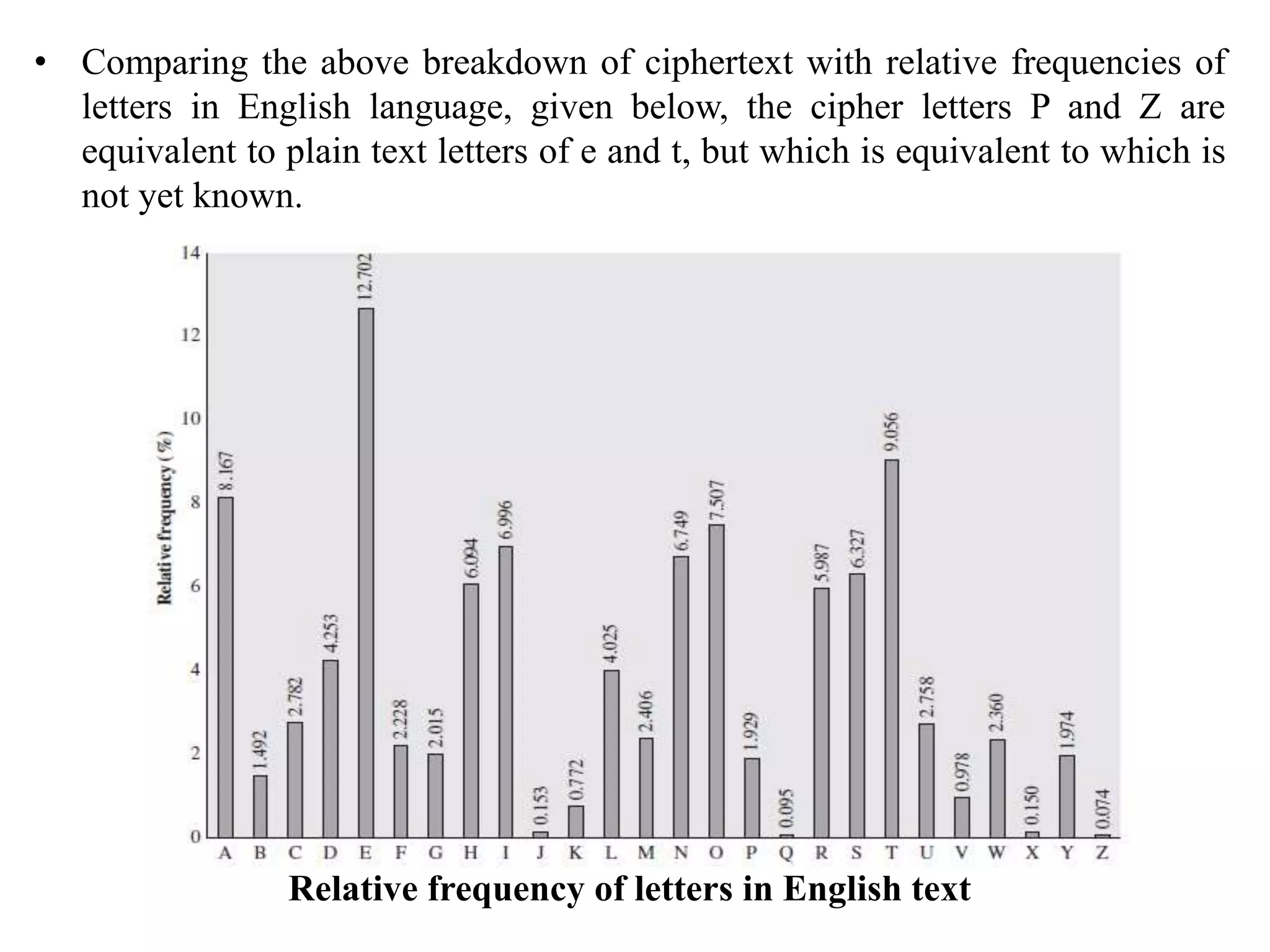
• As a first step, the relative frequency of the letters can be determined and
compared to a standard frequency distribution for English
• Comparing the above breakdown of ciphertext with relative frequencies of
letters in English language, given below, the cipher letters P and Z are
equivalent to plain text letters of e and t, but which is equivalent to which is
not yet known.
Relative frequency of letters in English text
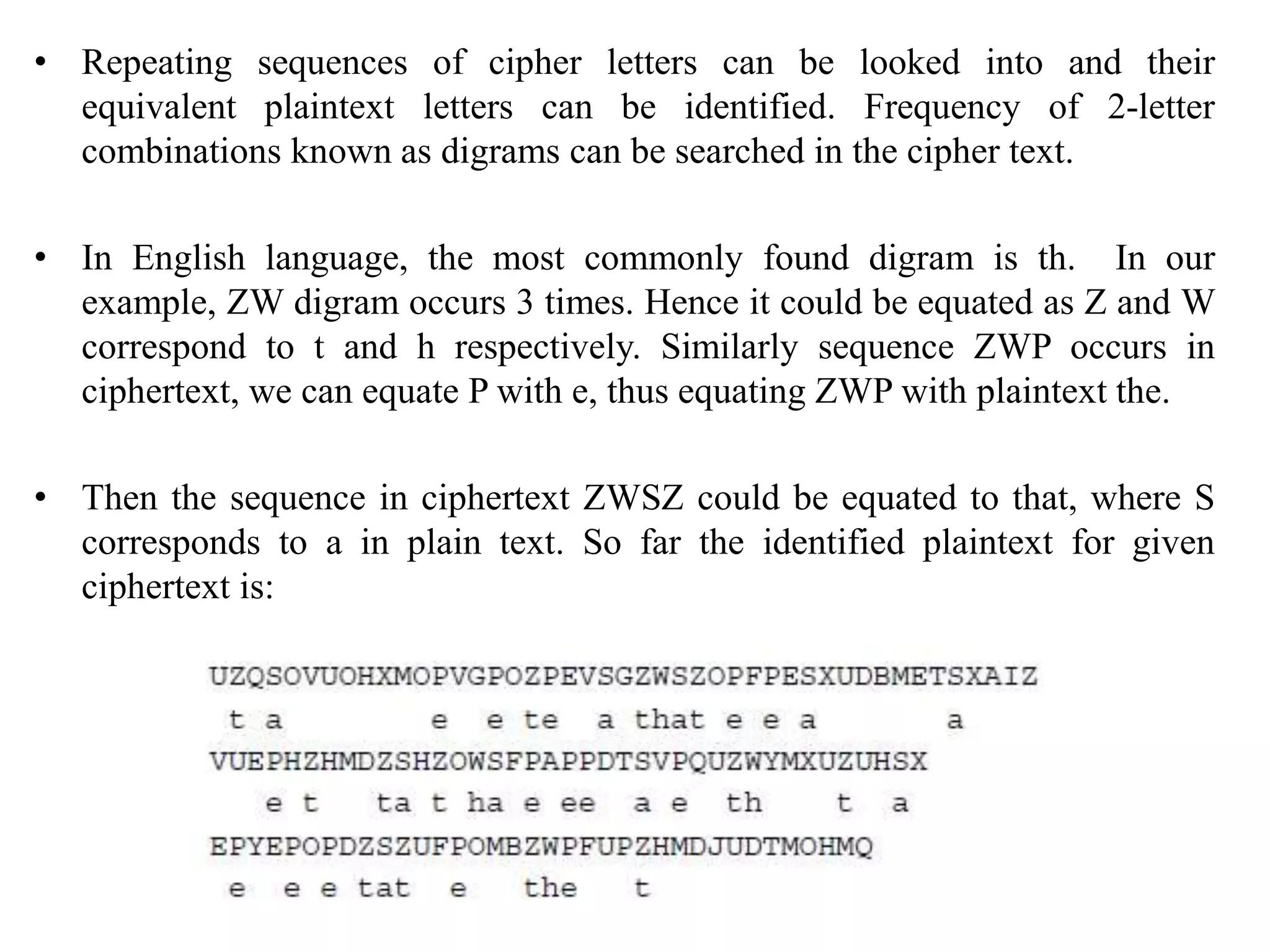
• Repeating sequences of cipher letters can be looked into and their
equivalent plaintext letters can be identified. Frequency of 2-letter
combinations known as digrams can be searched in the cipher text.
• In English language, the most commonly found digram is th. In our
example, ZW digram occurs 3 times. Hence it could be equated as Z and W
correspond to t and h respectively. Similarly sequence ZWP occurs in
ciphertext, we can equate P with e, thus equating ZWP with plaintext the.
• Then the sequence in ciphertext ZWSZ could be equated to that, where S
corresponds to a in plain text. So far the identified plaintext for given
ciphertext is:
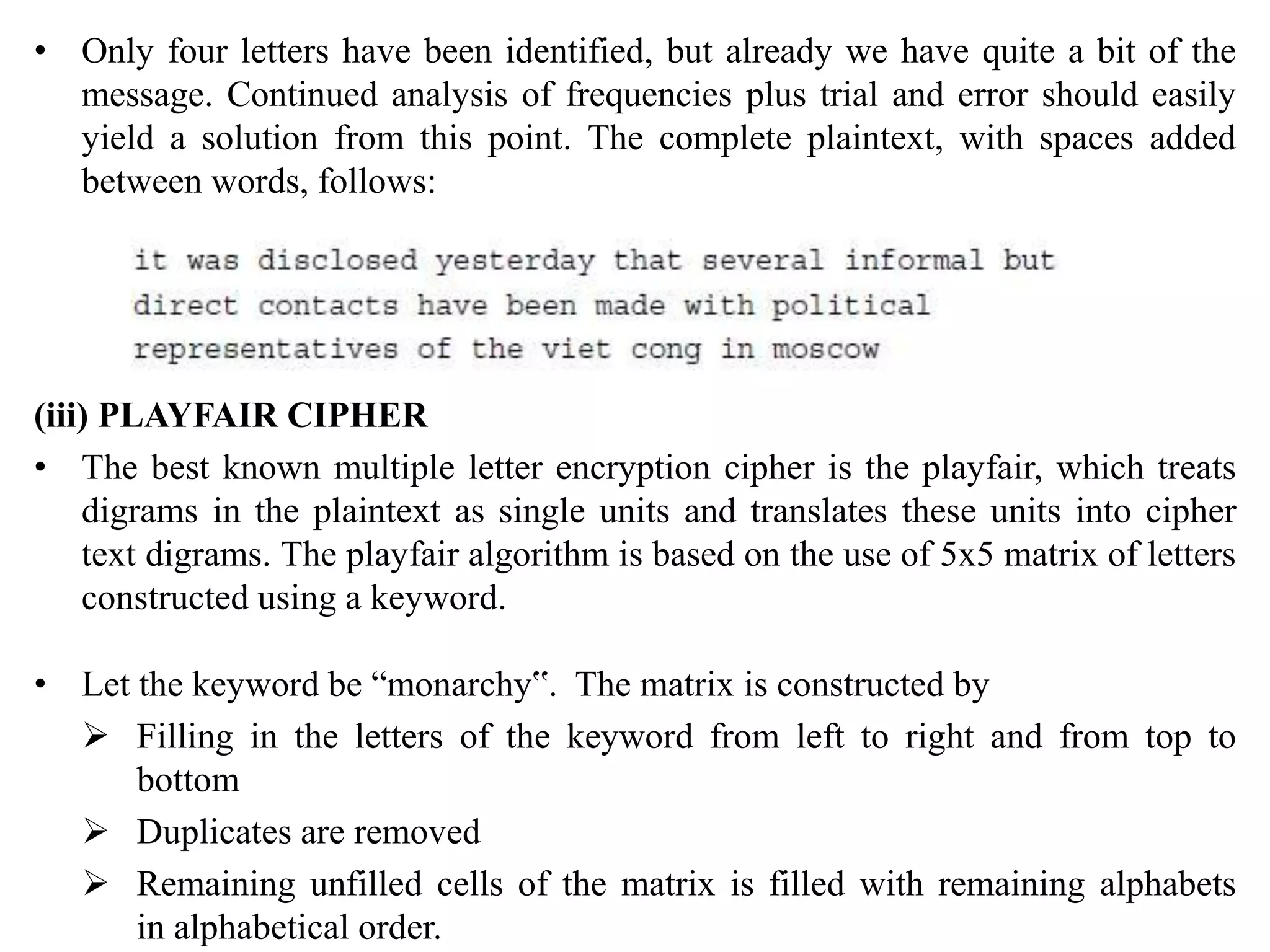
• Only four letters have been identified, but already we have quite a bit of the
message. Continued analysis of frequencies plus trial and error should easily
yield a solution from this point. The complete plaintext, with spaces added
between words, follows:
(iii) PLAYFAIR CIPHER
• The best known multiple letter encryption cipher is the playfair, which treats
digrams in the plaintext as single units and translates these units into cipher
text digrams. The playfair algorithm is based on the use of 5x5 matrix of letters
constructed using a keyword.
• Let the keyword be “monarchy‟. The matrix is constructed by
 Filling in the letters of the keyword from left to right and from top to
bottom
 Duplicates are removed
 Remaining unfilled cells of the matrix is filled with remaining alphabets
in alphabetical order.
• The matrix is 5x5. It can accommodate 25 alphabets. To accommodate the
26th alphabet I and J are counted as one character.
Rules for encryption
• Repeating plaintext letters that would fall in the same pair are separated with
a filler letter such as ‘x’.
• Two plaintext letters that fall in the same row of the matrix are each replaced
by the letter to the right, with the first element of the row circularly following
the last. For example, ar is encrypted as RM.
• Two plaintext letters that fall in the same column are each replaced by the
letter beneath, with the top element of the column circularly following the
last. For example, mu is encrypted as CM.
• Otherwise, each plaintext letter in a pair is replaced by the letter that lies in
its own row and the column occupied by the other plaintext letter. Thus, hs
becomes BP and ea becomes IM (or JM, as the encipherer wishes).
Example:
Plain text: Balloon
Ba ll oo n
Ba lx lo on
Ba I/JB
lx SU
lo PM
on NA
Strength of playfair cipher
• Playfair cipher is a great advance over simple monoalphabetic ciphers.
• Since there are 26 letters, 26 x 26 = 676 digrams are possible, identification
of each individual digram is more difficult.
• Frequency analysis is much more difficult.
Disadvantage
• Easy to break because it has the structure and the resemblance of the plain
text language
(iv) HILL CIPHER
• It is a multi-letter cipher. It is developed by Lester Hill. The encryption
algorithm takes m successive plaintext letters and substitutes for them m
cipher text letters. The substitution is determined by m linear equations in
which each character is assigned numerical value (a=0,b=1…z=25). For m
=3 the system can be described as follows:
• C=KP mod 26
• C and P are column vectors of length 3 representing the cipher and plain text
respectively.
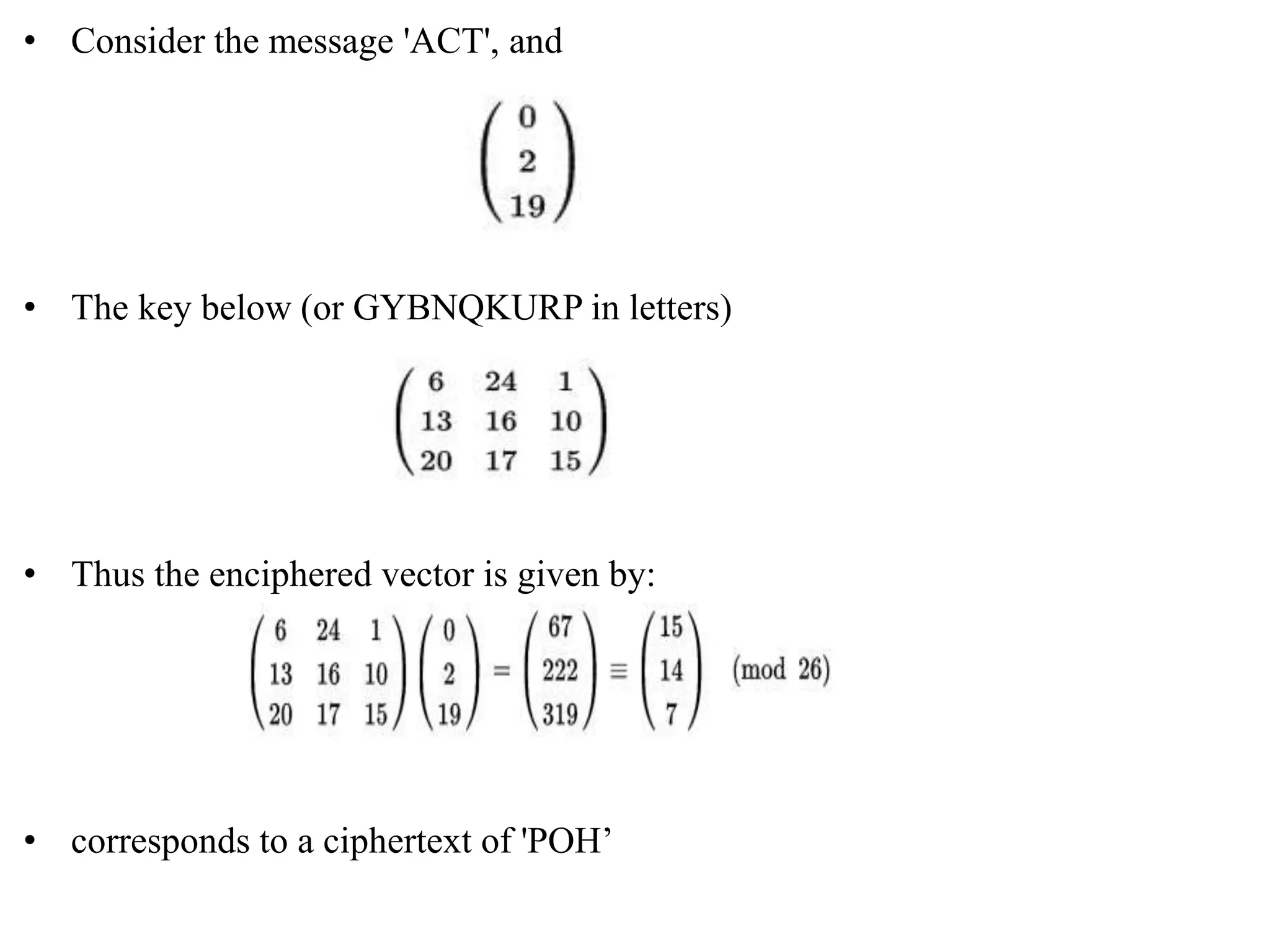
• Consider the message 'ACT', and
• The key below (or GYBNQKURP in letters)
• Thus the enciphered vector is given by:
• corresponds to a ciphertext of 'POH’
Decryption
• Decryption algorithm is done as P=K-1C mod 26
• In order to decrypt, we turn the ciphertext back into a vector, then simply
multiply by the inverse matrix of the key matrix (IFKVIVVMI in letters).
Cipher text of 'POH'
Now gets us back the plain text 'ACT'
Merits and Demerits
 Completely hides single letter and 2 letter frequency information.
 Easily attacked with known plain text attack
(v) POLYALPHABETIC CIPHERS
• Poly alphabetic cipher is a simple technique to improve mono-alphabetic
technique. The features are :
 A set of related monoalphabetic substitution rules are used.
 A key determines which particular rule is chosen for a given
transformation.
Example: Vigenere Cipher
• Each of the 26 ciphers is laid out horizontally, with the key letter for each
cipher to its left. A normal alphabet for the plaintext runs across the top.
• The process of encryption is simple: Given a key letter x and a plaintext
letter y, the cipher text is at the intersection of the row labeled x and the
column labeled y; in this case, the cipher text is V. To encrypt a message, a
key is needed that is as long as the message. Usually, the key is a repeating
keyword.
For example, Key=deceptive
Plain text= we are discovered save yourself
e.g., key = d e c e p t i v e d e c e p t i v e d e c e p t i v e
PT = w e a r e d i s c o v e r e d s a v e y o u r s e l f
CT = ZICVTWQNGRZGVTWAVZHCQYGLMGJ
• Decryption is equally simple. The key letter again identifies the row. The
position of the cipher text letter in that row determines the column, and the
plaintext letter is at the top of that column.
Strength of Vigenere cipher
• There are multiple ciphertext letters for each plaintext letter.
• Letter frequency information is obscured.
(vi) VERNAM CIPHER or ONE-TIME PAD
• It is an unbreakable cryptosystem. It represents the message as a sequence of
0s and 1s. This can be accomplished by writing all numbers in binary, for
example, or by using ASCII. The key is a random sequence of 0’s and 1’s of
same length as the message. Once a key is used, it is discarded and never
used again.
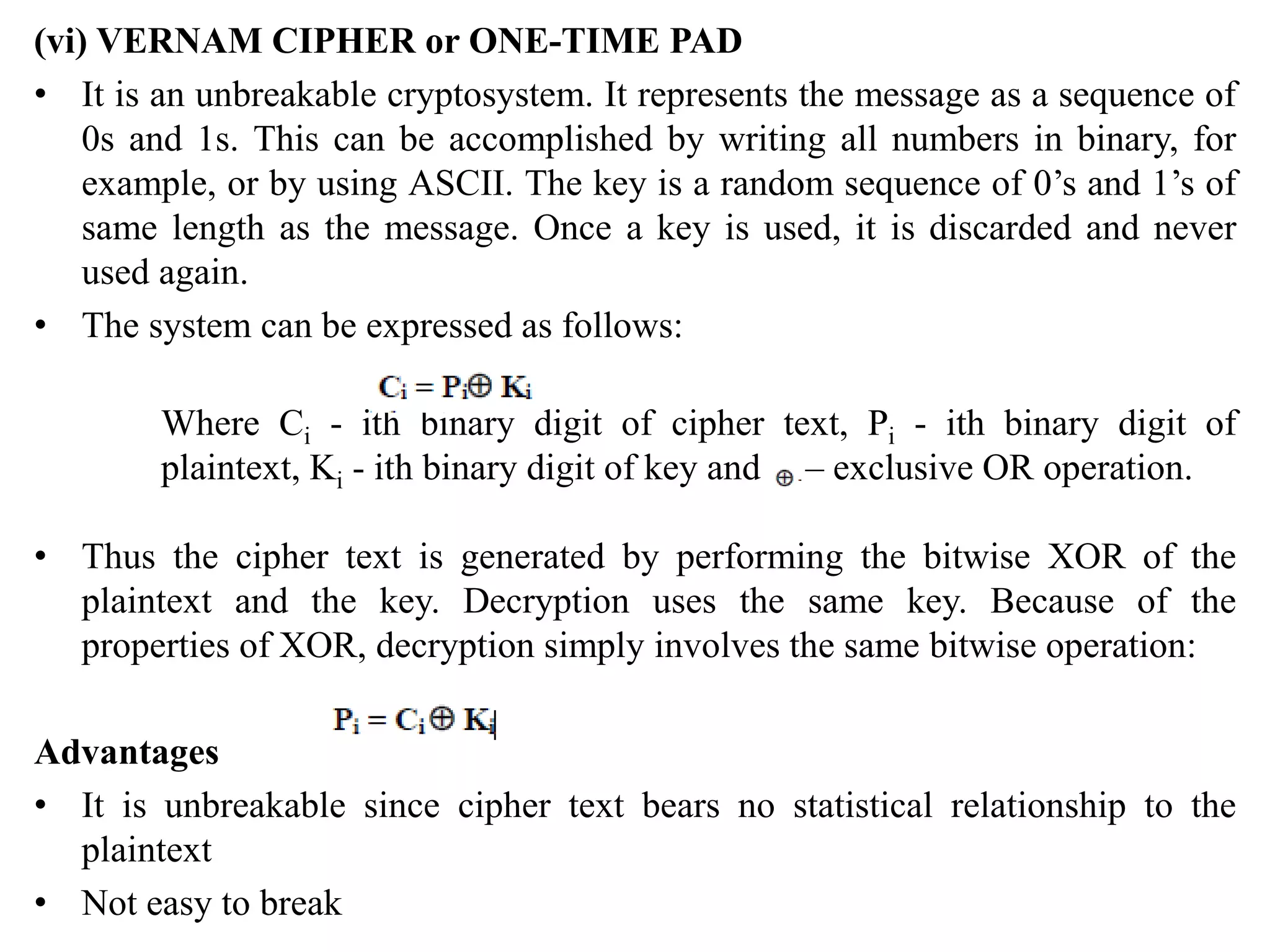
• The system can be expressed as follows:
Where Ci - ith binary digit of cipher text, Pi - ith binary digit of
plaintext, Ki - ith binary digit of key and – exclusive OR operation.
• Thus the cipher text is generated by performing the bitwise XOR of the
plaintext and the key. Decryption uses the same key. Because of the
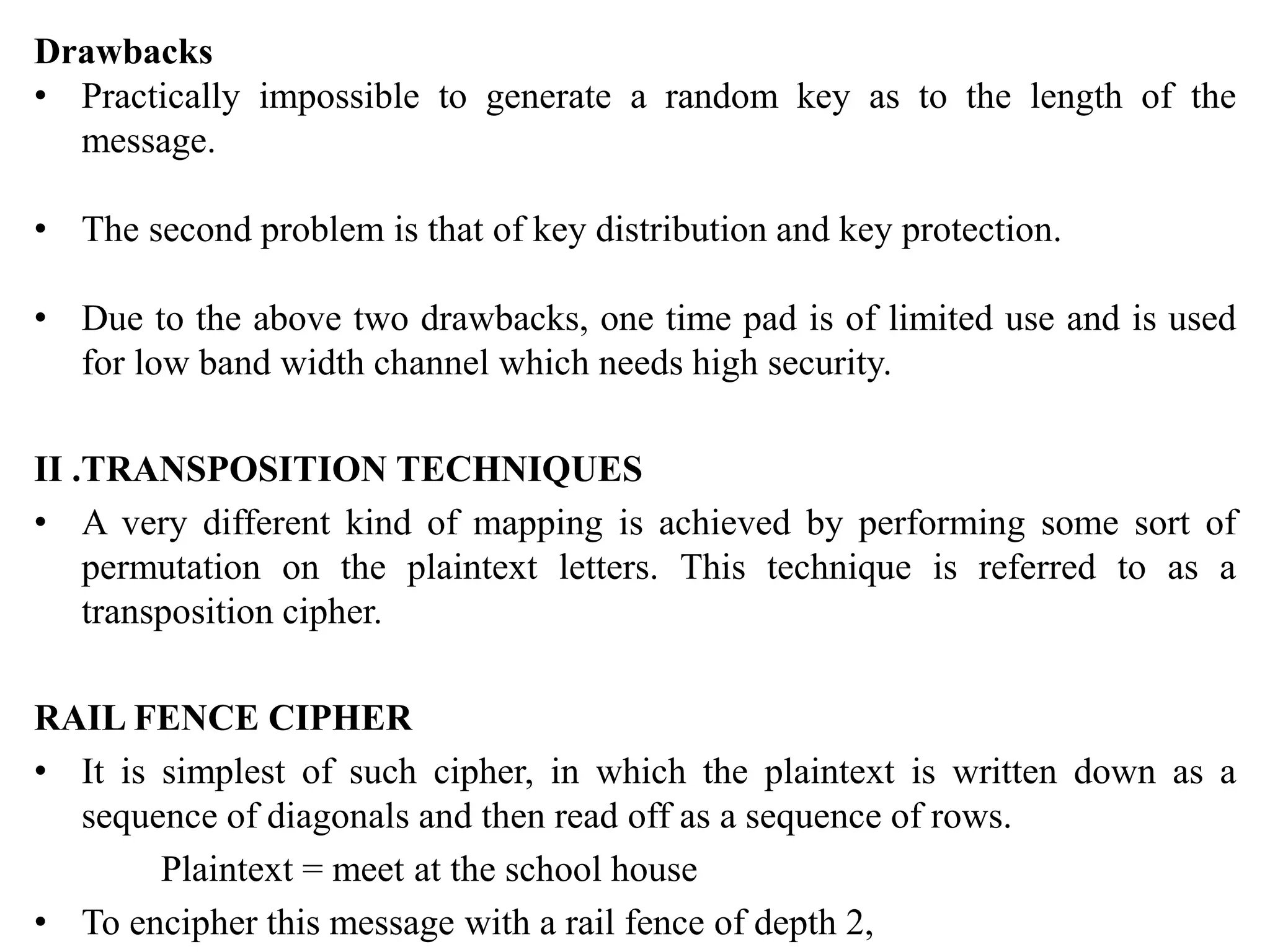
properties of XOR, decryption simply involves the same bitwise operation:
Advantages
• It is unbreakable since cipher text bears no statistical relationship to the
plaintext
• Not easy to break
Drawbacks
• Practically impossible to generate a random key as to the length of the
message.
• The second problem is that of key distribution and key protection.
• Due to the above two drawbacks, one time pad is of limited use and is used
for low band width channel which needs high security.
II .TRANSPOSITION TECHNIQUES
• A very different kind of mapping is achieved by performing some sort of
permutation on the plaintext letters. This technique is referred to as a
transposition cipher.
RAIL FENCE CIPHER
• It is simplest of such cipher, in which the plaintext is written down as a
sequence of diagonals and then read off as a sequence of rows.
Plaintext = meet at the school house
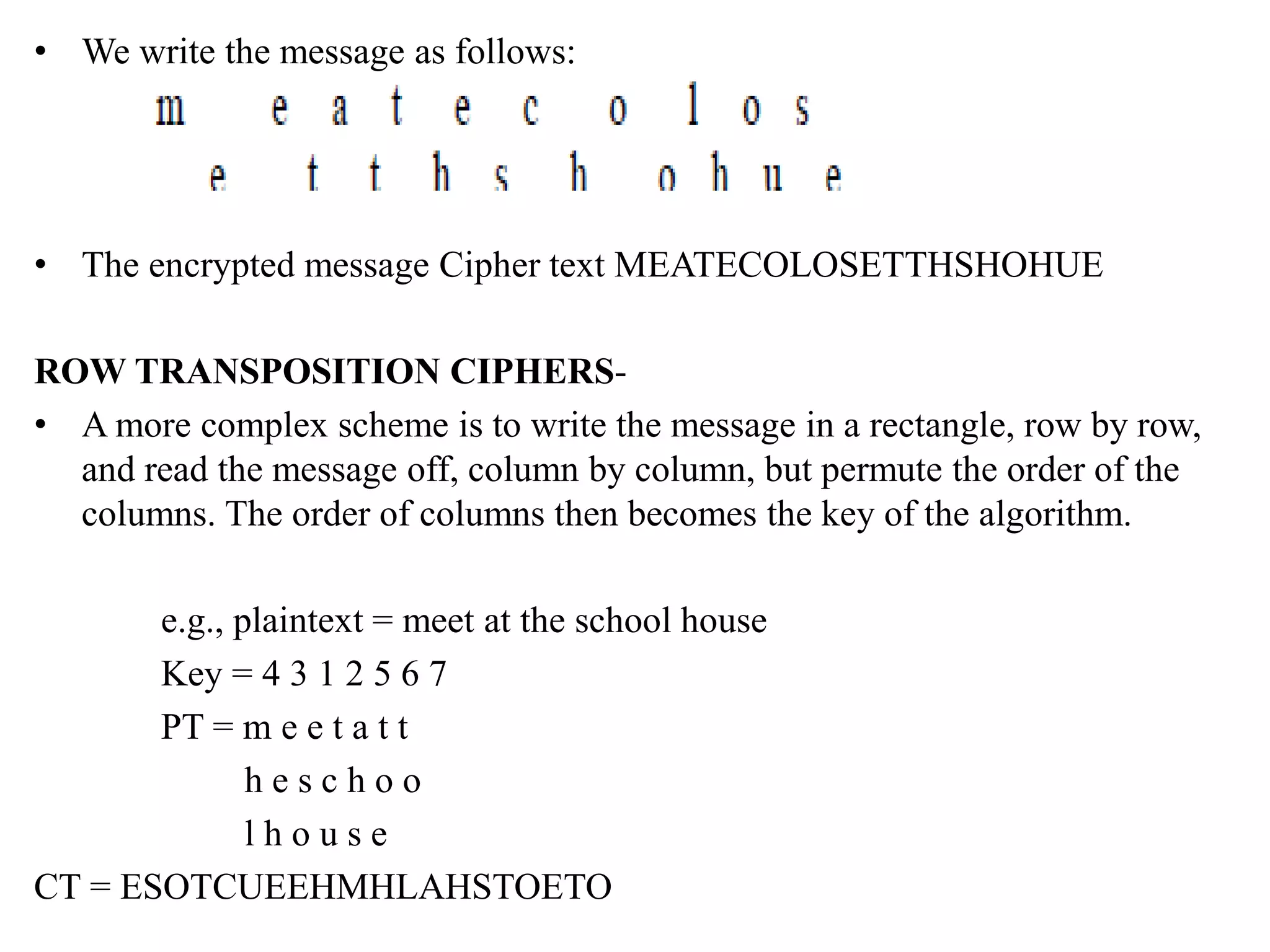
• To encipher this message with a rail fence of depth 2,
• We write the message as follows:
• The encrypted message Cipher text MEATECOLOSETTHSHOHUE
ROW TRANSPOSITION CIPHERS-
• A more complex scheme is to write the message in a rectangle, row by row,
and read the message off, column by column, but permute the order of the
columns. The order of columns then becomes the key of the algorithm.
e.g., plaintext = meet at the school house
Key = 4 3 1 2 5 6 7
PT = m e e t a t t
h e s c h o o
l h o u s e
CT = ESOTCUEEHMHLAHSTOETO
Demerits
• Easily recognized because the frequency is same in both plain text and
cipher text.
• Can be made secure by performing more number of transpositions.
STEGANOGRAPHY
• In Steganography, the plaintext is hidden. The existence of the message is
concealed. For example, the sequence of first letters of each word of the
overall message spells out the hidden message.
• Various other techniques have been used historically; some examples are the
following:
 Character marking: Selected letters of printed or typewritten text are
overwritten in pencil. The marks are ordinarily not visible unless the paper is
held at an angle to bright light.
 Invisible ink: A number of substances can be used for writing but leave no
visible trace until heat or some chemical is applied to the paper.
 Pin punctures: Small pin punctures on selected letters are ordinarily not
visible unless the paper is held up in front of a light.
 Typewriter correction ribbon: Used between lines typed with a black
ribbon, the results of typing with the correction tape are visible only under a
strong light.
Drawback
• It requires a lot of overhead to hide a relatively few bits of information.
• Once the system is discovered, it becomes virtually worthless.
GROUPS, RINGS, AND FIELDS
Groups, rings, and fields are the fundamental elements of a branch of
mathematics known as abstract algebra, or modern algebra.
GROUPS
• A group G, sometimes denoted by {G, •}, is a set of elements with a binary
operation denoted by • that associates to each ordered pair (a, b) of elements
in G an element (a • b) in G, such that the following axioms are obeyed:
 (A1) Closure: If a and b belong to G, then a • b is also in G.
 (A2) Associative: a•(b•c) = (a•b)•c for all a, b, c in G.
 (A3) Identity element: There is an element e in G such that a • e = e • a = a
for all a in G.
 (A4) Inverse element: For each a in G, there is an element a’ in G such that
a • a’ = a’ • a = e.
• If a group has a finite number of elements, it is referred to as a finite group,
and the order of the group is equal to the number of elements in the group.
Otherwise, the group is an infinite group. A group is said to be abelian if it
satisfies the following additional condition:
 (A5) Commutative: a • b = b • a for all a, b in G.
• A group G is cyclic if every element of G is a power ak (k is an integer) of a
fixed element a ε G. The element a is said to generate the group G or to be a
generator of G. A cyclic group is always abelian and may be finite or
infinite.
RINGS
• A ring R, sometimes denoted by {R, +, X}, is a set of elements with two
binary operations, called addition and multiplication, such that for all a, b, c
in R the following axioms are obeyed:
 (A1–A5) R is an abelian group with respect to addition; that is, R satisfies
axioms A1 through A5.
 (M1) Closure under multiplication: If a and b belong to R, then ab is also in
R.
 (M2) Associativity of multiplication: a(bc) = (ab)c for all a, b, c in R.
 (M3) Distributive laws: a(b + c) = ab + ac for all a, b, c in R.
(a + b)c = ac + bc for all a, b, c in R.
• A ring is said to be commutative if it satisfies the following additional
condition:
 (M4) Commutativity of multiplication: ab = ba for all a, b in R.
• An integral domain, which is a commutative ring that obeys the following
axioms:
 (M5) Multiplicative identity: There is an element 1 in R such that a1 = 1a =
a for all a in R.
 (M6) No zero divisors: If a, b in R and ab = 0, then either a = 0 or b = 0.
FIELDS
• A field F, sometimes denoted by {F, +, X}, is a set of elements with two
binary operations, called addition and multiplication, such that for all a, b, c
in F the following axioms are obeyed:
 (A1–M6) F is an integral domain; that is, F satisfies axioms A1 through A5
and M1 through M6.
 (M7) Multiplicative inverse: For each a in F, except 0, there is an element
a-1 in F such that
aa-1 = (a-1)a = 1
MODULAR ARITHMETIC
• If a is an integer and n is a positive integer, we define a mod n to be the
remainder when a is divided by n. The integer n is called the modulus.
Congruent modulo
• Two integers a and b are said to be congruent modulo n if
a (mod n)≡ b (mod n)
a ≡ b (mod n)
For example, 73 ≡ 4 mod 23
• For a positive integer n, two numbers a and b are said to be congruent
modulo n, if their difference a − b is an integer multiple of n (that is, if there
is an integer k such that a − b = kn). This congruence relation is typically
considered when a and b are integers, and is denoted by a ≡ b ( mod n ) .
• The number n is called the modulus of the congruence.
• For example, 38 ≡ 14 ( mod 12 ) because 38 − 14 = 24, which is a multiple
of 12, or, equivalently, because both 38 and 14 have the same remainder 2
when divided by 12.
• The same rule holds for negative values:
2 ≡ − 3 ( mod 5 )
− 3 ≡ − 8 ( mod 5 ) .
• Properties of modulo operator
Congruences have the following properties:
1. a≡ b (mod n) if n|(a-b)
2. a≡ b (mod n) implies b≡ a( mod n)
3. a ≡ b (mod n) and b ≡ c (mod n) imply a ≡ c (mod n).
Modular Arithmetic Operations
• Modular arithmetic exhibits the following properties:
1. [(a mod n) + (b mod n)] mod n = (a + b) mod n
2. [(a mod n) - (b mod n)] mod n = (a - b) mod n
3. [(a mod n) * (b mod n)] mod n = (a * b) mod n
• The proof for the above 3 properties can be explained with an example. For
example consider 11 mod 8 = 3 and 15 mod 8 = 7
1. [(11 mod 8) + (15 mod 8)] mod 8 = 10 mod 8 = 2
(11 + 15) mod 8 = 26 mod 8 = 2.
2. [(11 mod 8) - (15 mod 8)] mod 8 = -4 mod 8 = 4
(11 - 15) mod 8 = -4 mod 8 = 4.
3. [(11 mod 8) * (15 mod 8)] mod 8 = 21 mod 8 = 5
(11 * 15) mod 8 = 165 mod 8 = 5.
Relatively prime
• Two integers are relatively prime, if their only common positive integer
factor is 1. For example,
8 and 15 are relatively prime because
Positive divisors of 8 are 1,2,4,8
Positive divisors of 15 are 1, 3, 5, 15
Therefore, common positive factor=1.
EUCLIDEAN ALGORITHM
• Euclidean algorithm is a simple procedure for determining the greatest
common divisor of two positive integers.
• The positive integer c is said to be the greatest common divisor of a and b if
1. c is a divisor of a and of b.
2. Any divisor of a and b is a divisor of c.
• An equivalent definition is the following:
gcd(a,b)=gcd(|a|,|b|)
gcd(a,0)=|a|
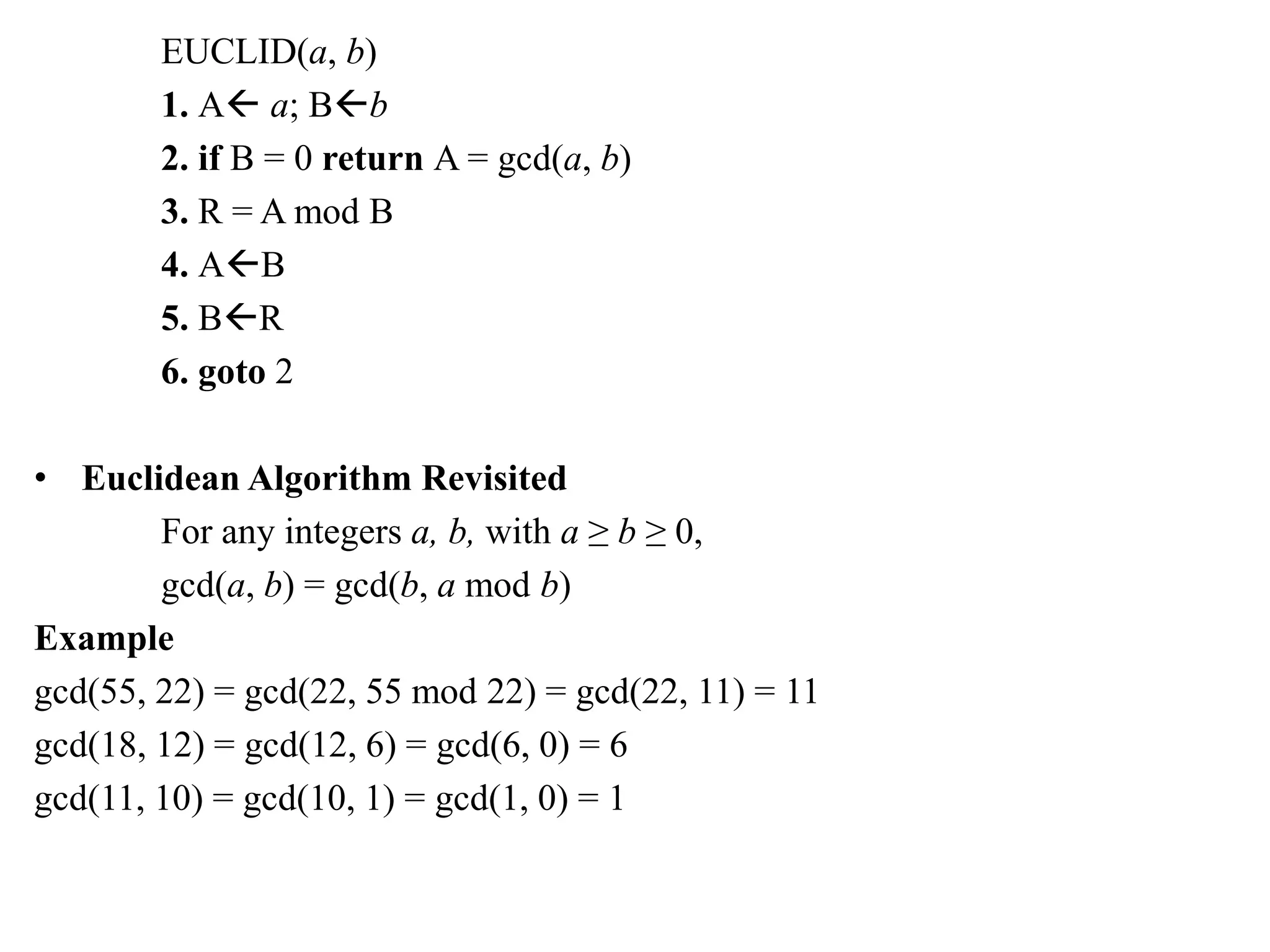
EUCLID(a, b)
1. A a; Bb
2. if B = 0 return A = gcd(a, b)
3. R = A mod B
4. AB
5. BR
6. goto 2
• Euclidean Algorithm Revisited
For any integers a, b, with a ≥ b ≥ 0,
gcd(a, b) = gcd(b, a mod b)
Example
gcd(55, 22) = gcd(22, 55 mod 22) = gcd(22, 11) = 11
gcd(18, 12) = gcd(12, 6) = gcd(6, 0) = 6
gcd(11, 10) = gcd(10, 1) = gcd(1, 0) = 1
The algorithm has the following progression:
A1 = B1 X Q1 + R1
A2 = B2 X Q2 + R2
A3 = B3 X Q3 + R3
A4 = B4 X Q4 + R4
Example: To find gcd (1970, 1066)
1970 = 1066 x 1 + 904 gcd(1066, 904)
1066 = 904 x 1 + 162 gcd(904, 162)
904 = 5 x 162 + 94 gcd(162, 94)
162 = 1 x 94 + 68 gcd(94, 68)
94 = 1 x 68 + 26 gcd(68, 26)
68 = 2 x 26 + 16 gcd(26, 16)
26 = 1 x 16 + 10 gcd(16, 10)
16 = 1 x 10 + 6 gcd(10, 6)
10 = 1 x 6 + 4 gcd(6, 4)
6 = 1 x 4 + 2 gcd(4, 2)
4 = 2 x 2 + 0 gcd(2, 0)  gcd (1970, 1066) = 2
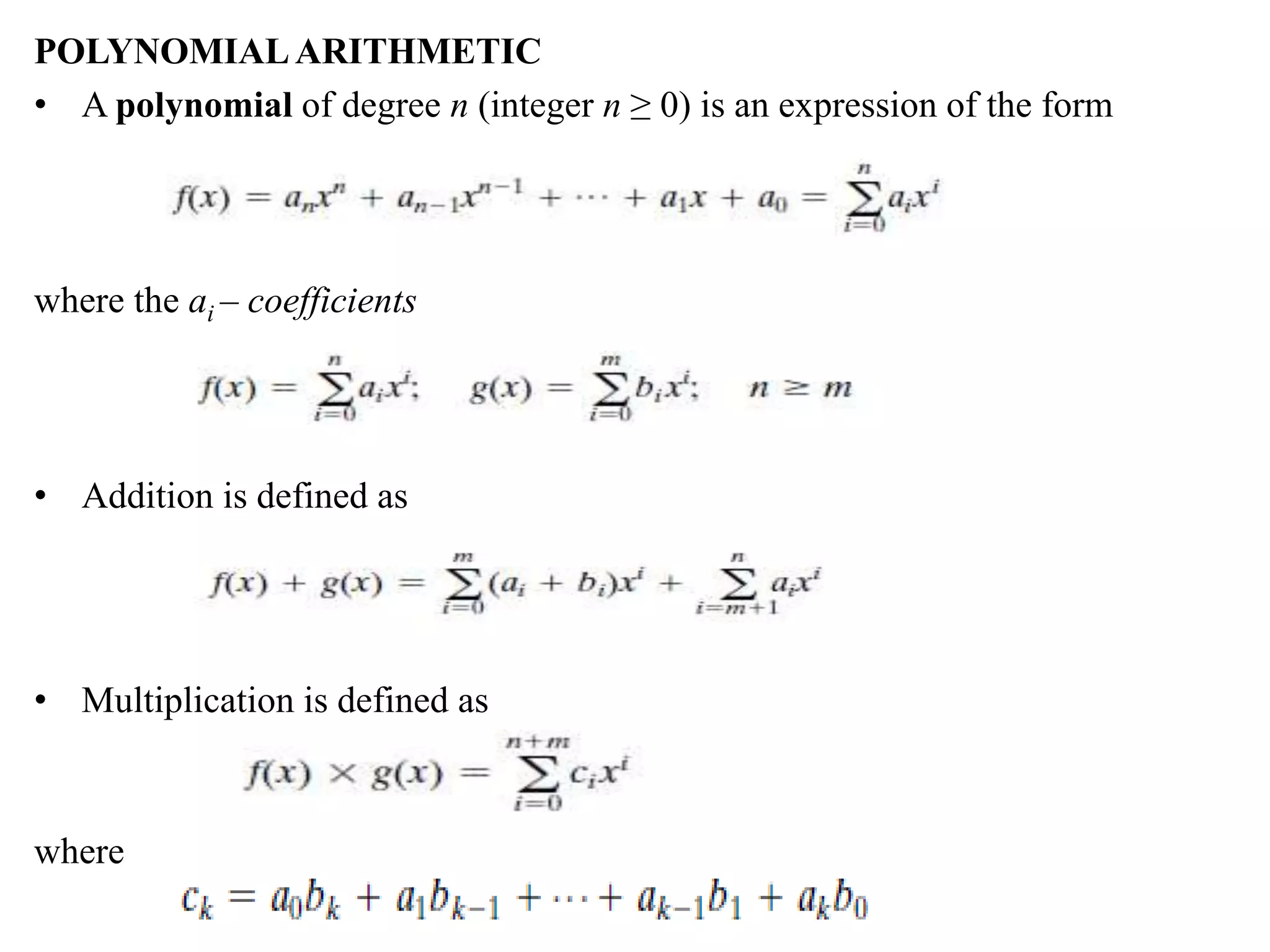
POLYNOMIALARITHMETIC
• A polynomial of degree n (integer n ≥ 0) is an expression of the form
where the ai – coefficients
• Addition is defined as
• Multiplication is defined as
where
• Let f(x) = x3 + x2 + 2 and g(x) = x2 - x + 1, where S is the set of integers. Then
 Addition : f(x) + g(x) = x3 + 2x2 - x + 3
 Subtraction: f(x) - g(x) = x3 + x + 1
 Multiplication: f(x) * g(x) = x5 + 3x2 - 2x + 2
Finding the Greatest Common Divisor
• The polynomial c(x) is said to be the greatest common divisor of a(x) and
b(x) if:
1. c(x) divides both a(x) and b(x).
2. Any divisor of a(x) and b(x) is a divisor of c(x).
• An equivalent definition is the following:
• gcd [a(x), b(x)] is the polynomial of maximum degree that divides both a(x)
and b(x). Euclid’s algorithm can be adapted in the following form:
gcd[a(x), b(x)] = gcd[b(x), a(x) mod b(x)]
• Euclid’s algorithm for polynomials assumes that the degree of a(x) is greater
than the degree of b(x). Then to find gcd[a(x), b(x)],
EUCLID[a(x), b(x)]
1. A(x) = a(x); B(x) = b(x)
2. if B(x) = 0 return A(x) = gcd[a(x), b(x)]
3. R(x) = A(x) mod B(x)
4. A(x) B(x)
5. B(x) R(x)
6. goto 2
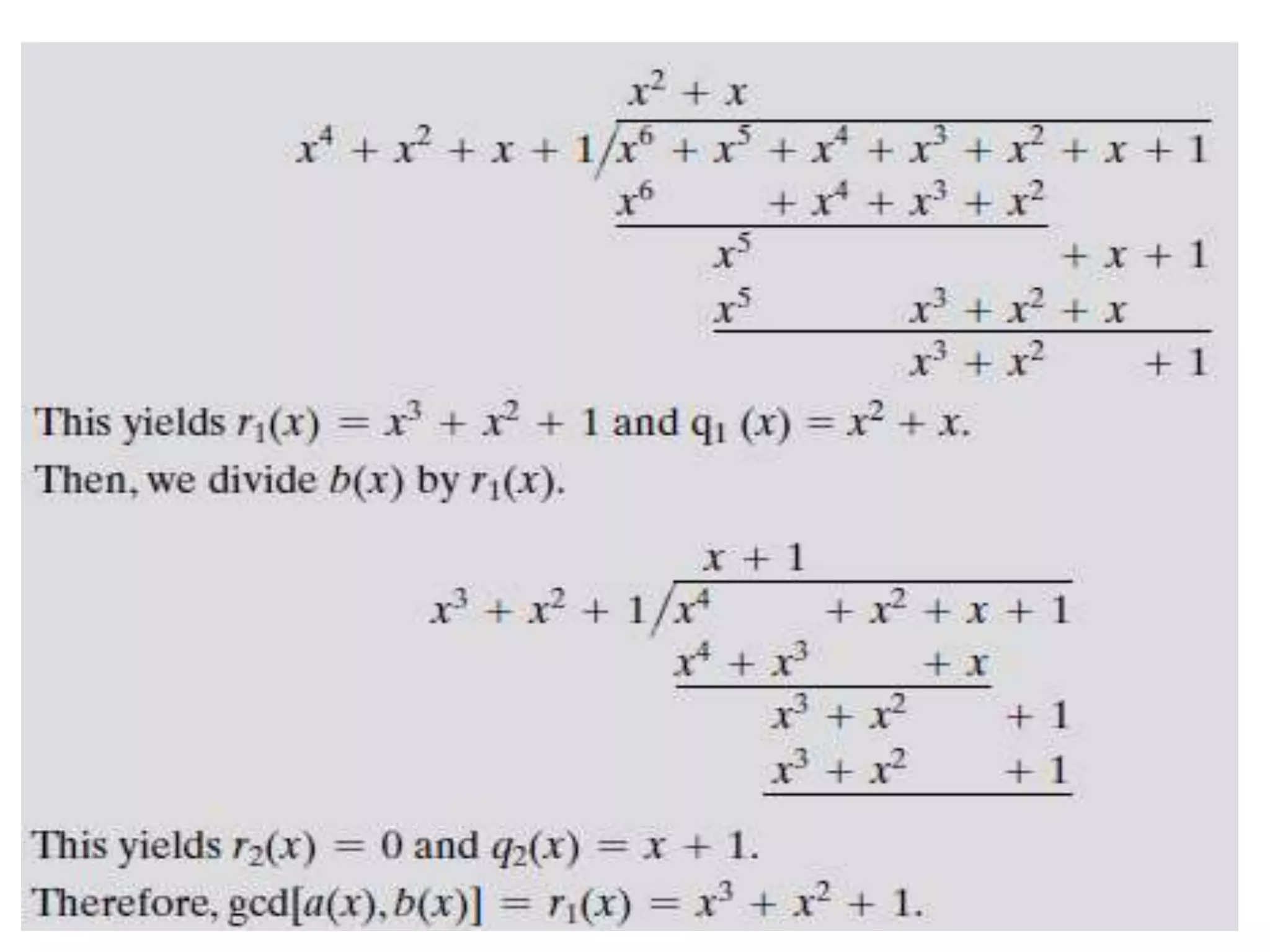
• Find gcd[a(x), b(x)] for a(x) = x6 + x5 + x4 + x3 + x2 + x + 1 and b(x) = x4 + x2
+ x + 1.
• Euclidean algorithm to compute the greatest common divisor of two
polynomials
gcd[a(x), b(x)] = gcd[b(x), a(x) mod b(x)]
= gcd(b(x),r1(x))
= gcd[r1(x),b(x) mod r1(x)]
Finite fields of the form GF(p)
• The order of a finite field (no. of elements in the field) must be a power of a
prime pn, where n is a positive integer. A prime number is an integer, whose
only positive integer factors are itself and 1.
• The finite field of the order pn is generally written as GF(pn). GF stands for
Galois field. For n = 1, we have the finite field GF(pn), which has a different
structure than that for finite fields with n > 1.
Finite fields of order P
For a given prime p, the finite field of order p, GF(p) is defined as the set Zp of
integers {0,1,…..p-1} together with arithmetic operations modulo p. Any integer
in Zp has a multiplicative inverse if and only if that integer is relatively prime to
p, and satisfies the below rule:
Multiplicative inverse w -1 = For each w  Zp , w ≠ 0, there exists a z  Zp such
that w X z ≡ 1 mod (p).
Multiplicative Inverse
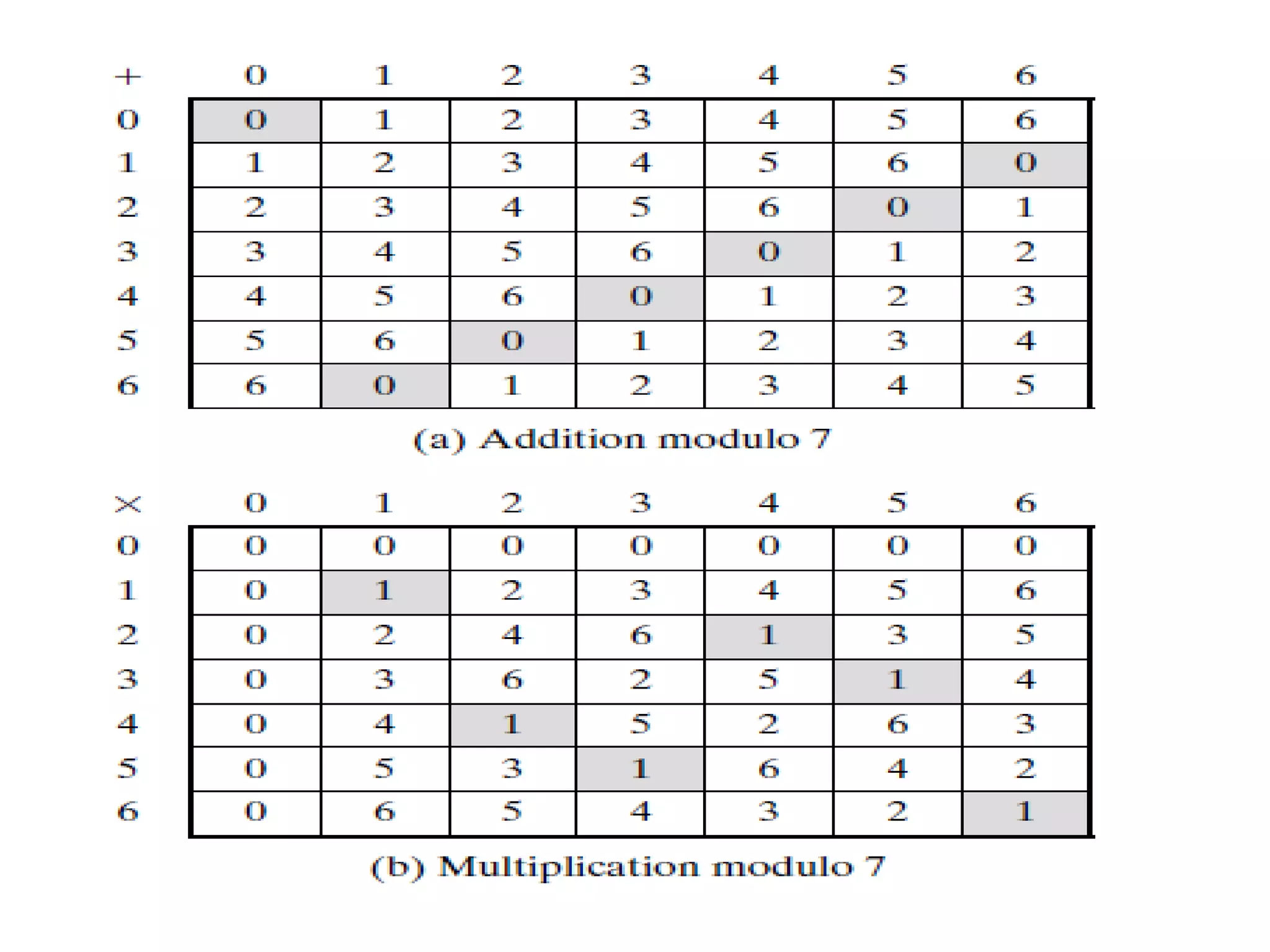
• It is easy to find the multiplicative inverse of an element in GF(p) for small
values of p by constructing a multiplication table. However, for large values
of p, this approach is not practical.
• If a and b are relatively prime, then b has a multiplicative inverse modulo a.
That is, if gcd(a, b) = 1, then b has a multiplicative inverse modulo a. That is,
for positive integer b < a, there exists a b-1 < a such that
bb-1 = 1 mod a.
• If a is a prime number and b < a, then clearly a and b are relatively prime and
have a greatest common divisor of 1. We can easily compute b-1 using the
extended Euclidean algorithm.
EXTENDED EUCLID (m, b)
1. (A1, A2, A3) = (1, 0, m);
(B1, B2, B3) = (0, 1, b)
2. if B3 = 0
return A3 = gcd(m, b); no inverse
3. if B3 = 1
return B3 = gcd(m, b); B2 = b–1 mod m
4. Q = A3 div B3
5. (T1, T2, T3) = (A1 – Q B1, A2 – Q B2, A3 – Q B3)
6. (A1, A2, A3) = (B1, B2, B3)
7. (B1, B2, B3) = (T1, T2, T3)
8. goto 2
Inverse of 550 in GF(1759):
355 (Value of B2, when B3 is 1)
Finding the Multiplicative Inverse of a polynomial
• The extended Euclidean algorithm can be adapted to find the multiplicative
inverse of a polynomial. Specifically, the algorithm will find the
multiplicative inverse of b(x) modulo m(x) if the degree of b(x) is less than
the degree of m(x) and gcd[m(x), b(x)] = 1.
• If m(x) is an irreducible polynomial, then it has no factor other than itself or
1, so that gcd[m(x), b(x)] = 1. The algorithm is as follows:
EXTENDED EUCLID [m(x), b(x)]
1. [A1(x), A2(x), A3(x)][1, 0, m(x)]; [B1(x), B2(x),B3(x)] [0, 1, b(x)]
2. if B3(x) = 0 return A3(x) = gcd[m(x), b(x)]; no inverse
3. if B3(x) = 1 return B3(x) = gcd[m(x), b(x)]; B2(x) = b(x)-1 mod m(x)
4. Q(x) = quotient of A3(x) / B3(x)
5. [T1(x), T2(x), T3(x)] [A1(x)-Q(x)B1(x),A2(x)-Q(x)B2(x),A3(x)-Q(x)B3(x)]
6. [A1(x), A2(x), A3(x)] [B1(x), B2(x), B3(x)]
7. [B1(x), B2(x), B3(x)] [T1(x), T2(x), T3(x)]
8. goto 2
Calculate the multiplicative inverse of (x7 + x + 1) mod (x8 + x4 +x3 + x +
1).
Since B3 = 1, B2 is the Multiplicative Inverse i.e., x7
PRIME NUMBER
• An integer p > 1 is a prime number if and only if its only divisors are ±1 and
±p. Any integer a> 1 can be factored in a unique way as
where p1 <p2 <…< pt are prime numbers and where each ai is a positive integer.
91 = 7 * 13
3600 = 24 * 32 * 52
11011 = 7 * 112 * 13
• If P is the set of all prime numbers, then any positive integer a can be written
uniquely in the following form:
• It is easy to determine the greatest common divisor of two positive integers if
we express each integer as the product of primes.
300 = 22 * 31 * 52
18 = 21 * 32
gcd(18, 300) = 21 * 31 * 50 = 6
• The following relationship always holds:
If k = gcd(a, b), then kp = min(ap, bp) for all p.
FERMAT’S THEOREMS
• Fermat’s theorem states the following: if p is a prime and a is a positive
integer not divisible by p, then
ap-1 ≡ 1(mod p)
• Consider the set of positive integers less than p:{1,2,3..p-1}. Multiply each
element by a, modulo p, to get the set X ={ a mod p,2a mod p….(p-1)amod
p}. Also a X 0 ≡ 0 mod p. Therefore the numbers in set X are just the
numbers {1,2,…(p-1)} in some order.
• None of the elements of X is equal to zero because p does not divide a. No
two integers in X are equal i.e., (p-1) elements of X are all positive integers
with no two elements being equal. Multiplying the numbers in both sets
{a,2a,3a..(p-1)a} and {1,2,….(p-1)} and taking the result mod p yields.
a * 2a *…*(p-1)a ≡ [(1*2*…*(p-1)](mod p)
{1 * 2 *…*(p-1)} ap-1 ≡ [(1*2*…*(p-1)](mod p)
(p-1)! ap-1≡ (p-1)!(mod p)
ap-1 ≡ 1(mod p)
Example
a = 7, p = 19
72 = 49≡ 11 (mod 19)
74 = 121 ≡ 7 (mod 19)
78 ≡ 49 ≡ 11 (mod 19)
716 ≡ 121 ≡ 7 (mod 19)
ap-1 = 718 = 716 * 72 ≡ 7 * 11 ≡ 1 (mod 19).
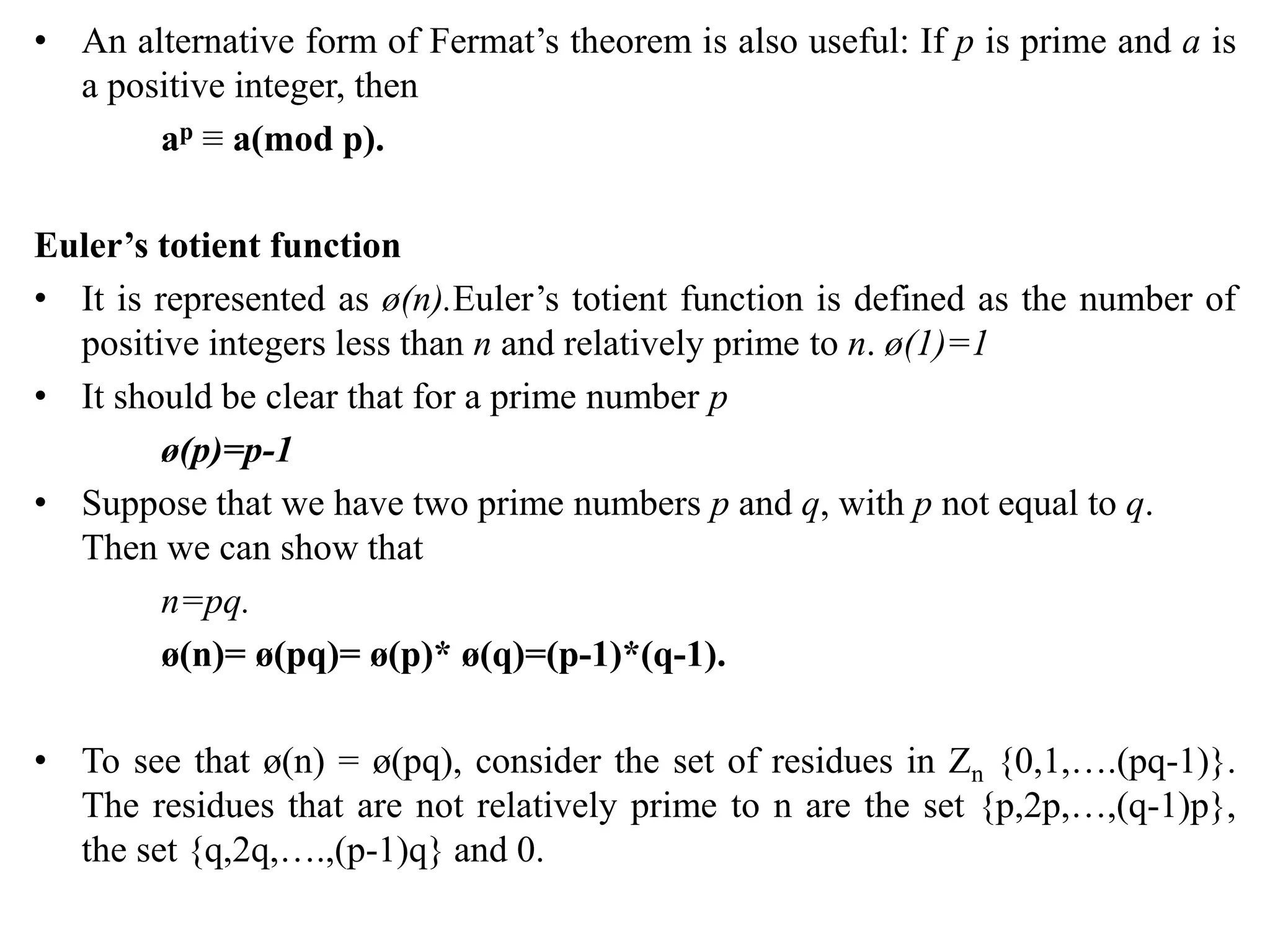
• An alternative form of Fermat’s theorem is also useful: If p is prime and a is
a positive integer, then
ap ≡ a(mod p).
Euler’s totient function
• It is represented as ø(n).Euler’s totient function is defined as the number of
positive integers less than n and relatively prime to n. ø(1)=1
• It should be clear that for a prime number p
ø(p)=p-1
• Suppose that we have two prime numbers p and q, with p not equal to q.
Then we can show that
n=pq.
ø(n)= ø(pq)= ø(p)* ø(q)=(p-1)*(q-1).
• To see that ø(n) = ø(pq), consider the set of residues in Zn {0,1,….(pq-1)}.
The residues that are not relatively prime to n are the set {p,2p,…,(q-1)p},
the set {q,2q,….,(p-1)q} and 0.
ø(n) = (pq-1) - [(q-1)+(p-1)]
= pq - (p+q)+1
= (p-1) * (q-1)
= ø(p) * ø(q).
• To determine f(35), we list all of the positive integers less than 35 that are
relatively prime to it:
1, 2, 3, 4, 6, 8, 9, 11, 12, 13, 16, 17, 18, 19, 22, 23, 24, 26, 27, 29, 31, 32,
33, 34
There are 24 numbers on the list, so f(35) = 24.
f(21) = f(3) * f(7) = (3 - 1) * (7 - 1) = 2 * 6 = 12.
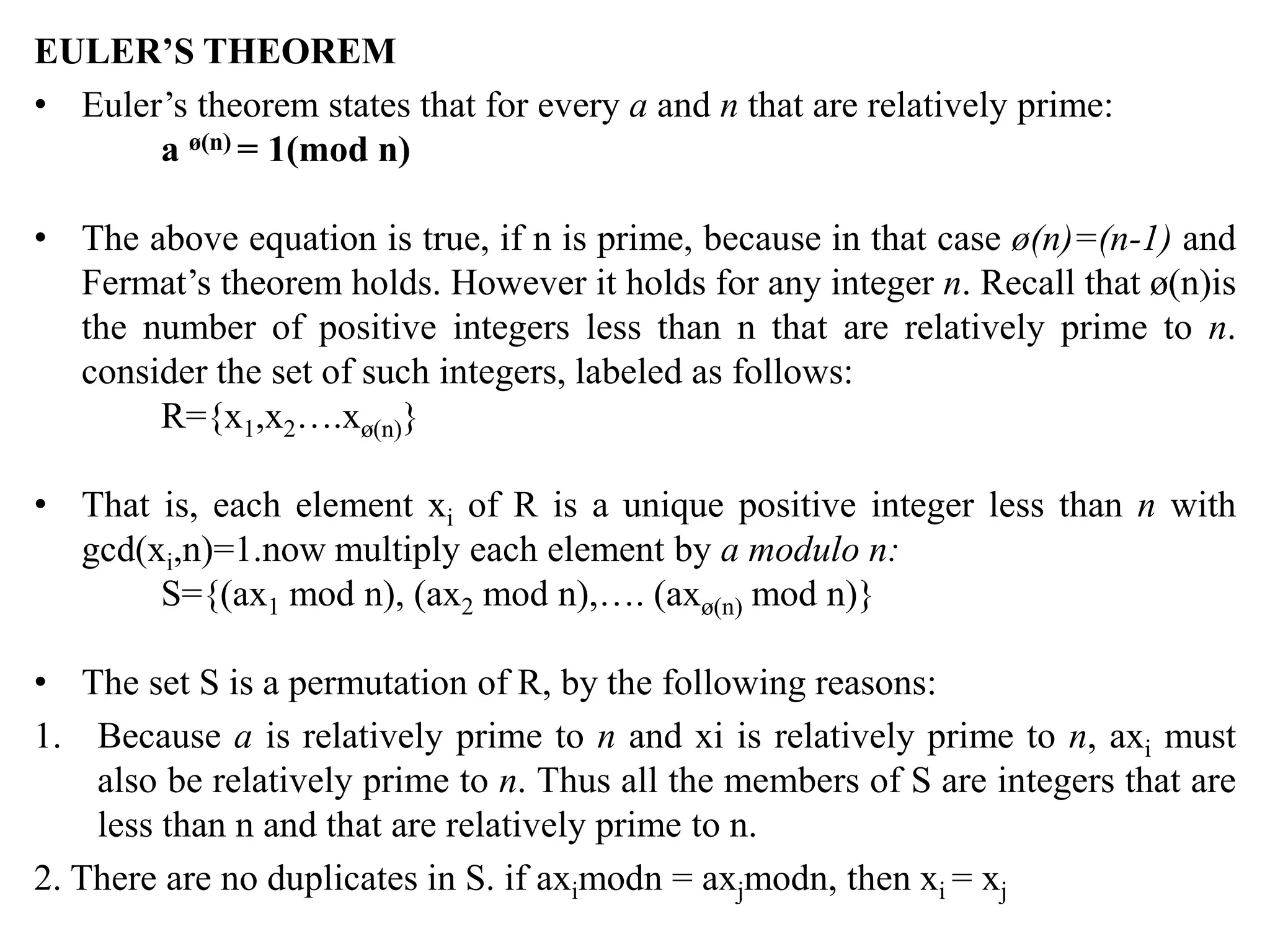
EULER’S THEOREM
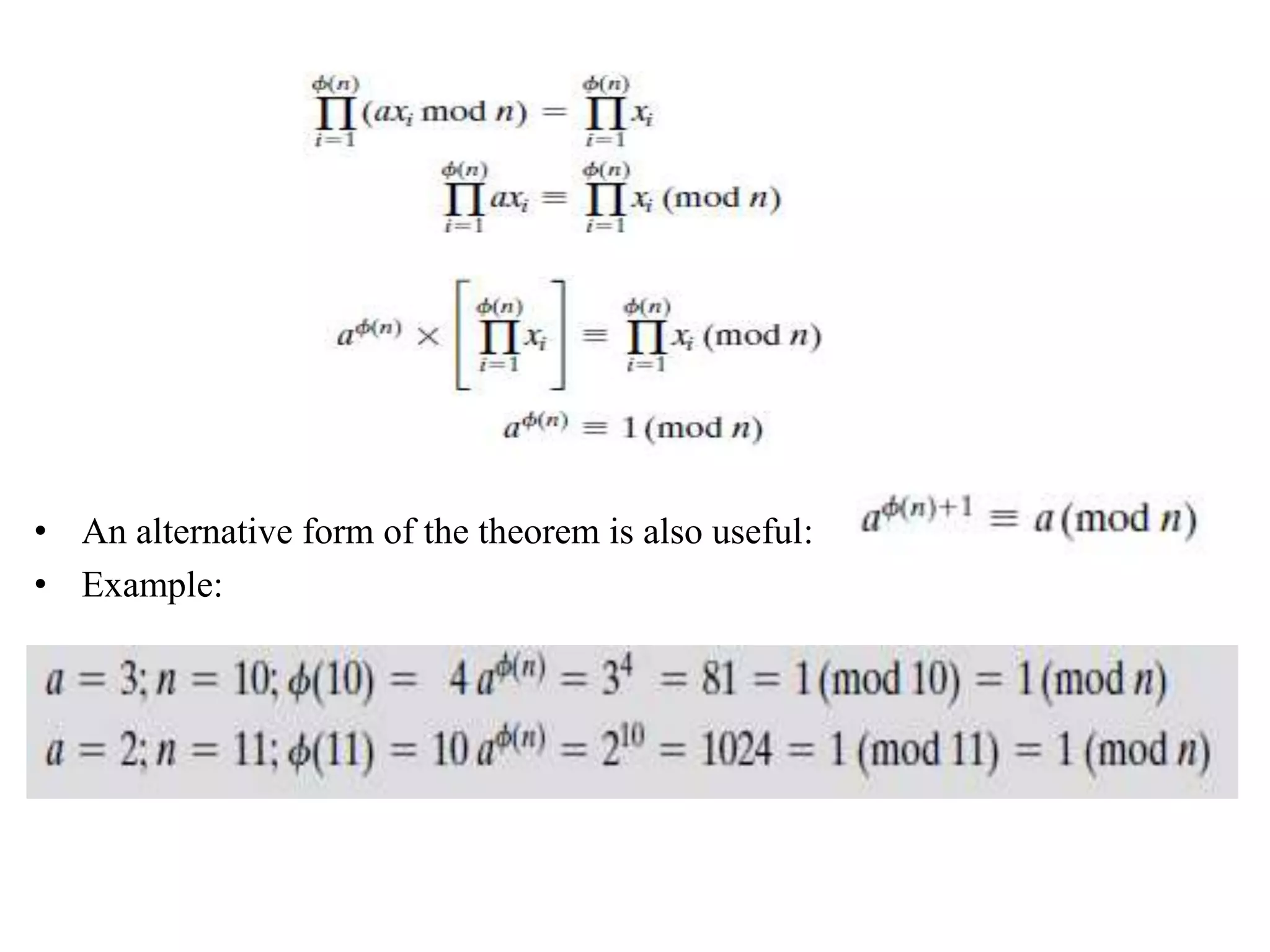
• Euler’s theorem states that for every a and n that are relatively prime:
a ø(n) = 1(mod n)
• The above equation is true, if n is prime, because in that case ø(n)=(n-1) and
Fermat’s theorem holds. However it holds for any integer n. Recall that ø(n)is
the number of positive integers less than n that are relatively prime to n.
consider the set of such integers, labeled as follows:
R={x1,x2….xø(n)}
• That is, each element xi of R is a unique positive integer less than n with
gcd(xi,n)=1.now multiply each element by a modulo n:
S={(ax1 mod n), (ax2 mod n),…. (axø(n) mod n)}
• The set S is a permutation of R, by the following reasons:
1. Because a is relatively prime to n and xi is relatively prime to n, axi must
also be relatively prime to n. Thus all the members of S are integers that are
less than n and that are relatively prime to n.
2. There are no duplicates in S. if aximodn = axjmodn, then xi = xj
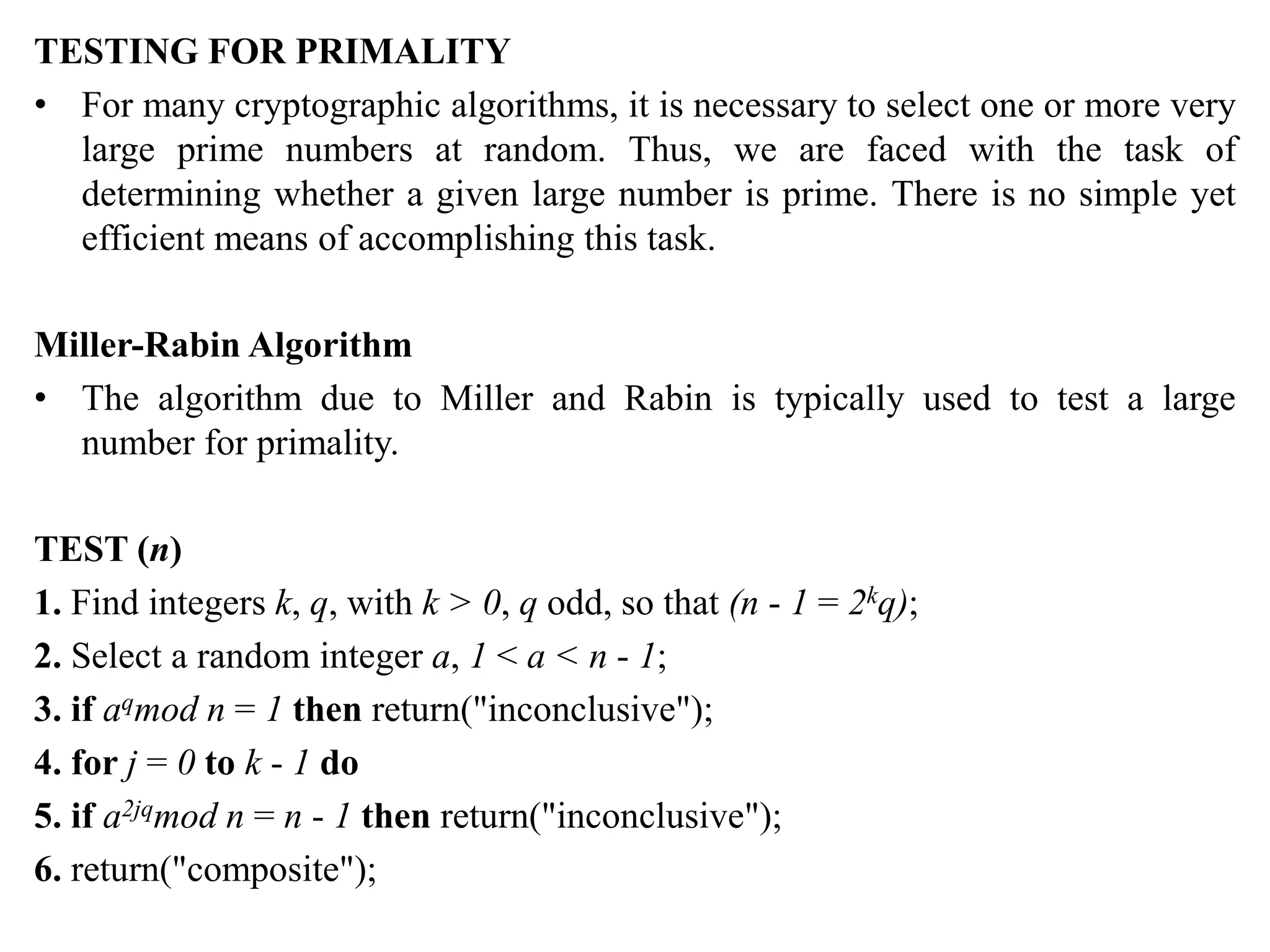
• An alternative form of the theorem is also useful:
• Example:
TESTING FOR PRIMALITY
• For many cryptographic algorithms, it is necessary to select one or more very
large prime numbers at random. Thus, we are faced with the task of
determining whether a given large number is prime. There is no simple yet
efficient means of accomplishing this task.
Miller-Rabin Algorithm
• The algorithm due to Miller and Rabin is typically used to test a large
number for primality.
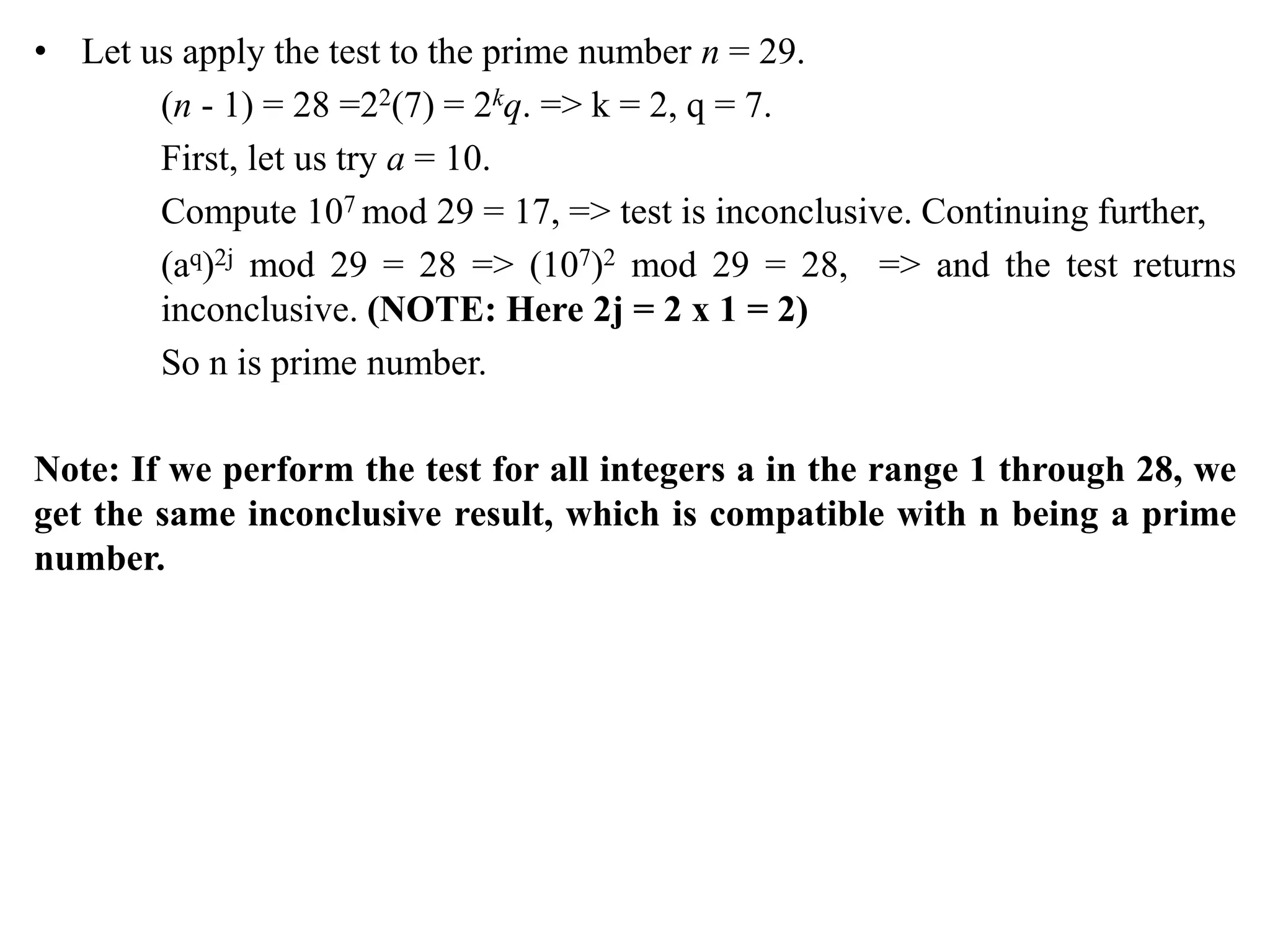
TEST (n)
1. Find integers k, q, with k > 0, q odd, so that (n - 1 = 2kq);
2. Select a random integer a, 1 < a < n - 1;
3. if aqmod n = 1 then return("inconclusive");
4. for j = 0 to k - 1 do
5. if a2jqmod n = n - 1 then return("inconclusive");
6. return("composite");
• Let us apply the test to the prime number n = 29.
(n - 1) = 28 =22(7) = 2kq. => k = 2, q = 7.
First, let us try a = 10.
Compute 107 mod 29 = 17, => test is inconclusive. Continuing further,
(aq)2j mod 29 = 28 => (107)2 mod 29 = 28, => and the test returns
inconclusive. (NOTE: Here 2j = 2 x 1 = 2)
So n is prime number.
Note: If we perform the test for all integers a in the range 1 through 28, we
get the same inconclusive result, which is compatible with n being a prime
number.
THE CHINESE REMAINDER THEOREM
• The Chinese Remainder Theorem states that it is possible to reconstruct
integers in certain range from their residues modulo a set of pair wise
relatively prime moduli.
x ≡ a1 mod n1, x ≡ a2 mod n2, x ≡ ak mod nk
• If n1,n2,..,nk are positive integers that are pairwise co-prime and a1,a2,…,ak
are any integers, then CRT is used to find the values of x that solves the
following congruence simultaneously.
Value of x = (a1m1y1+a2m2y2+…+akmkyk) mod M
Where M = n1n2n3..nk
mi = M / ni
miyi = 1 mod ni
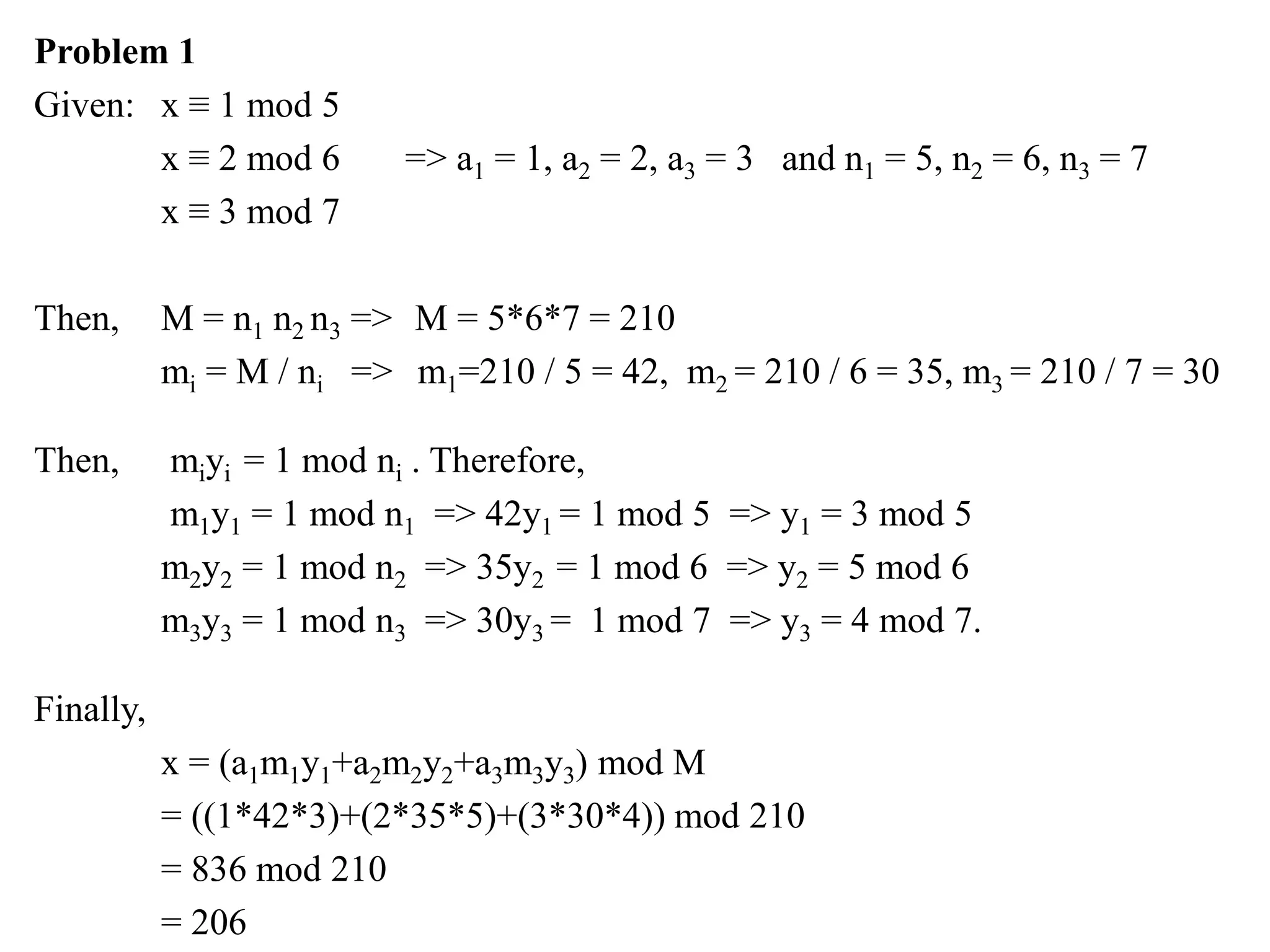
Problem 1
Given: x ≡ 1 mod 5
x ≡ 2 mod 6 => a1 = 1, a2 = 2, a3 = 3 and n1 = 5, n2 = 6, n3 = 7
x ≡ 3 mod 7
Then, M = n1 n2 n3 => M = 5*6*7 = 210
mi = M / ni => m1=210 / 5 = 42, m2 = 210 / 6 = 35, m3 = 210 / 7 = 30
Then, miyi = 1 mod ni . Therefore,
m1y1 = 1 mod n1 => 42y1 = 1 mod 5 => y1 = 3 mod 5
m2y2 = 1 mod n2 => 35y2 = 1 mod 6 => y2 = 5 mod 6
m3y3 = 1 mod n3 => 30y3 = 1 mod 7 => y3 = 4 mod 7.
Finally,
x = (a1m1y1+a2m2y2+a3m3y3) mod M
= ((1*42*3)+(2*35*5)+(3*30*4)) mod 210
= 836 mod 210
= 206
Problem 2
A bag has contained number of pens if you take out 3 pens at a time 2 pens are
left. If you take out 4 pens at a time 1 pen is left and if you take out 5 pens at a
time 3 pens are left in the bag. What is the number of pens in the bag.
x ≡ 2 mod 3
x ≡ 1 mod 4 => a1 = 2, a2 = 1, a3 = 3 and n1 = 3, n2 = 4, n3 = 5
x ≡ 3 mod 5
Then, M = n1 n2 n3 => M = 3*4*5 = 60
mi = M / ni => m1= 60 / 3 = 20, m2 = 60 / 4 = 15, m3 = 60 / 5 = 12
Then, miyi = 1 mod ni . Therefore,
m1y1 = 1 mod n1 => 20y1 = 1 mod 3 => y1 = 2 mod 3
m2y2 = 1 mod n2 => 15y2 = 1 mod 4 => y2 = 3 mod 4
m3y3 = 1 mod n3 => 12y3 = 1 mod 5 => y3 = 3 mod 5.
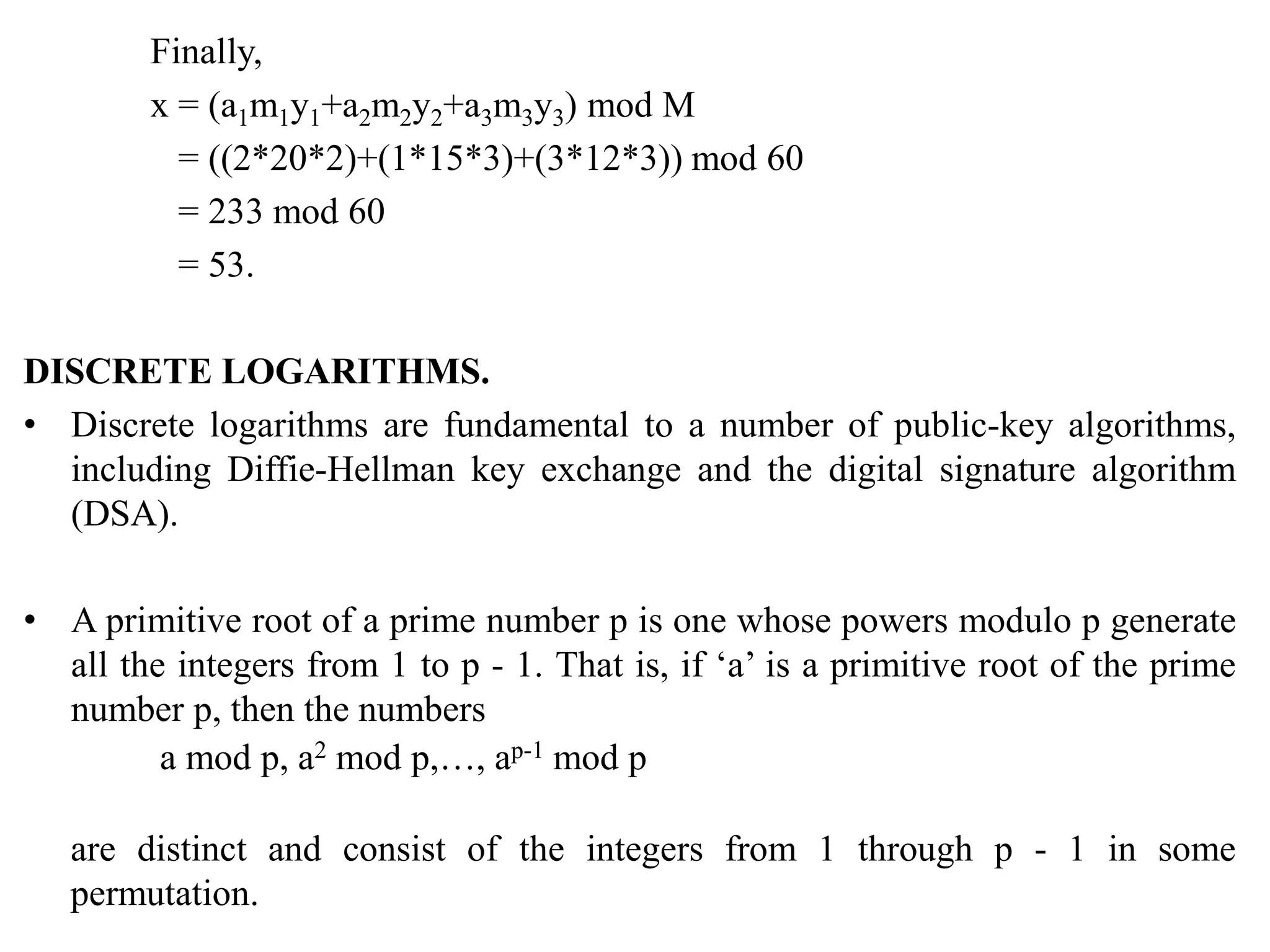
Finally,
x = (a1m1y1+a2m2y2+a3m3y3) mod M
= ((2*20*2)+(1*15*3)+(3*12*3)) mod 60
= 233 mod 60
= 53.
DISCRETE LOGARITHMS.
• Discrete logarithms are fundamental to a number of public-key algorithms,
including Diffie-Hellman key exchange and the digital signature algorithm
(DSA).
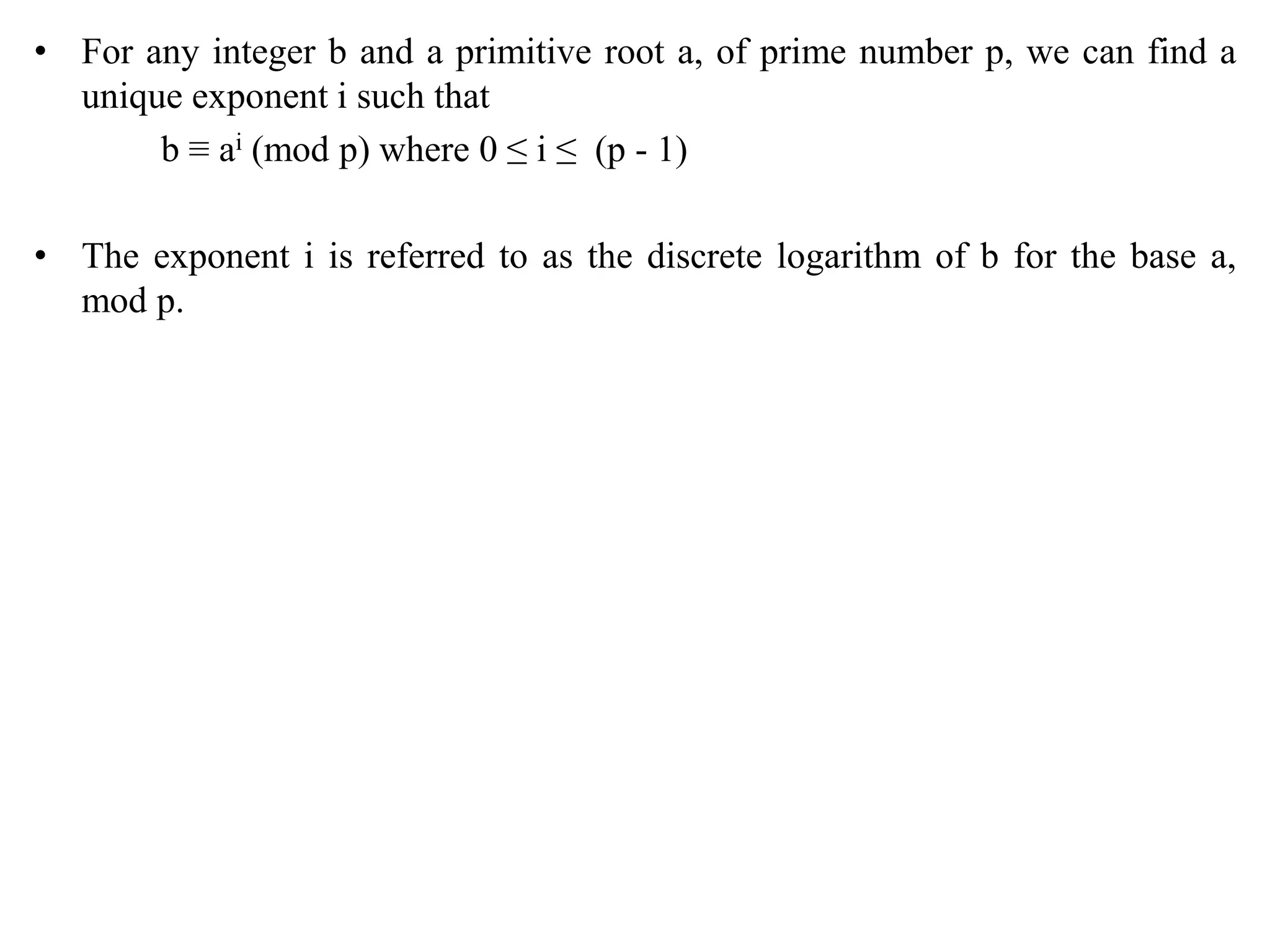
• A primitive root of a prime number p is one whose powers modulo p generate
all the integers from 1 to p - 1. That is, if ‘a’ is a primitive root of the prime
number p, then the numbers
a mod p, a2 mod p,…, ap-1 mod p
are distinct and consist of the integers from 1 through p - 1 in some
permutation.
• For any integer b and a primitive root a, of prime number p, we can find a
unique exponent i such that
b ≡ ai (mod p) where 0 ≤ i ≤ (p - 1)
• The exponent i is referred to as the discrete logarithm of b for the base a,
mod p.
Important Questions
1. Explain Fermat’s theorem in detail.
2. Explain Euler’s theorem in detail.
3. Example problems from Fermat’s and Euler’s theorem.
4. Explain Chinese remainder theorem.
5. Explain OSI security architecture with neat diagram.
6. Describe various security mechanisms.
7. Explain the properties to be satisfied by groups, rings and fields.
8. Explain playfair cipher, Hill cipher, Vigenere cipher , rail fence cipher with
examples.

Unit-1.pptx

  • 1.
    UNIT I INTRODUCTION& NUMBER THEORY Services, Mechanisms and attacks - the OSI security architecture - Network security model-Classical Encryption techniques (Symmetric cipher model, substitution techniques, transposition techniques, steganography). FINITE FIELDS AND NUMBER THEORY: Groups, Rings, Fields - Modular arithmetic- Euclid's algorithm - Finite fields - Polynomial Arithmetic – Prime numbers - Fermat's and Euler's theorem - Testing for primality -The Chinese remainder theorem - Discrete logarithms.
  • 2.
    OSI SECURITYARCHITECTURE • TheOSI security architecture focuses on security attacks, mechanisms, and services. These can be defined briefly as follows: • security attack - any action that compromises the security of information owned by an organization. Information security is about how to prevent attacks, or failing that, to detect attacks on information-based systems • security mechanism - feature designed to detect, prevent, or recover from a security attack. There is no single mechanism that supports all services required is available. However, one particular element underlies many of the security mechanisms in use - cryptographic techniques. • security service – enhances the security of data processing systems and information transfers of an organization. Intended to counter security attacks using one or more security mechanisms.
  • 3.
    SECURITY ATTACK There aretwo types of attacks - Passive attacks, Active attacks • Passive attack - Passive attacks attempt to learn or make use of information from the system but do not affect system resources. The goal of the opponent is to obtain information that is being transmitted. • Passive attacks are of two types • Release of message contents • Traffic analysis • Release of message contents: The opponent would learn the contents of the transmission. A telephone conversation, an e-mail message and a transferred file
  • 4.
    may contain sensitiveor confidential information. We would like to prevent the opponent from learning the contents of these transmissions. • Traffic analysis: The opponent could determine the location and identity of communicating hosts and could observe the frequency and length of messages being exchanged. This information might be useful in guessing the nature of the communication that was taking place. • Passive attacks are very difficult to detect, because they do not involve any alteration of the data. However, it is feasible to prevent the success of these attacks. • Active attacks - These attacks involve some modification of the data stream or the creation of a false stream.
  • 5.
    • Active attackscan be classified in to four categories:  Masquerade – One entity pretends to be a different entity. Here, the attacker captures the authentication and impersonifies the sender.  Replay – The attacker captures the message and retransmits the message without modification to produce unauthorized effect.
  • 6.
     Modification ofmessages – The attacker captures the message and retransmits the message with modification to produce unauthorized effect. • Denial of service – The attacker may suppress all messages directed to a particular destination. Another form of service denial is the disruption of an entire network, either by disabling the network or by overloading it with messages so as to degrade performance. • It is quite difficult to prevent active attacks absolutely, because to do so would require physical protection of all communication facilities and paths at all times. Instead, the goal is to detect them and to recover from any disruption or delays caused by them.
  • 7.
    SECURITY SERVICES X.800 definesa security service as a service that is provided by a protocol layer of communicating open systems and that ensures adequate security of the systems or of data transfers. The classification of security services are as follows: (i) Authentication: The authentication service is concerned with assuring that a communication is authentic. Two specific authentication services are defined in X.800:  Peer entity authentication: Provides confidence in the identity of entities connected.
  • 8.
     Data originauthentication: Provides assurance that the source of received data is as claimed. (ii) Access control: Access control is the ability to limit and control the access to host systems and applications. (iii) Data Confidentiality: Confidentiality is the protection of transmitted data from passive attacks. Connection Confidentiality - The protection of all user data on a connection Connectionless Confidentiality - The protection of all user data in a single data block Selective-Field Confidentiality - The confidentiality of selected fields within the user data on a connection or in a single data block Traffic-Flow Confidentiality - The protection of the information that might be derived from observation of traffic flows
  • 9.
    (iv)Data Integrity: Theassurance that the data received are exactly as sent by an authorized entity.  Connection Integrity with Recovery - Provides for the integrity of all user data on a connection and detects any modification, insertion, deletion, or replay of any data within an entire data sequence, with recovery attempted.  Connection Integrity without Recovery - As above, but provides only detection without recovery.  Selective-Field Connection Integrity - Provides for the integrity of selected fields within the user data of a data block transferred over a connection and takes the form of determination of whether the selected fields have been modified, inserted, deleted, or replayed.  Connectionless Integrity - Provides for the integrity of a single connectionless data block and may take the form of detection of data modification. Additionally, a limited form of replay detection may be provided.  Selective-Field Connectionless Integrity - Provides for the integrity of selected fields within a single connectionless data block; takes the form of determination of whether the selected fields have been modified.
  • 10.
    (v)Non repudiation: Providesprotection against denial by one of the entities involved in a communication of having participated in all or part of the communication.  Nonrepudiation, Origin - Proof that the message was sent by the specified party  Nonrepudiation, Destination - Proof that the message was received by the specified party SECURITY MECHANISMS i. Encipherment: It uses mathematical algorithm to transform data into a form that is not readily intelligible. It depends upon encryption algorithm and key. ii. Digital signature: Data appended to or a cryptographic transformation of a data unit that is to prove integrity of data unit and prevents from forgery. iii. Access control : A variety of mechanisms that enforce access rights to resources. iv. Data integrity : A variety of mechanism that are used to ensure integrity of data unit. v. Traffic padding: The insertion of bits into gaps in a data stream to frustrate traffic analysis attempts. vi. Notarization: The use of a trusted third party to assure certain properties of a data exchange.
  • 11.
    A MODEL FORNETWORK SECURITY Encryption/Decryption methods fall into two categories – symmetric key, public key In symmetric key algorithms, the encryption and decryption keys are known both to sender and receiver. The encryption key is shared and the decryption key is easily calculated from it. In many cases, the encryption and decryption keys are the same. In public key cryptography, encryption key is made public, but it is computationally infeasible to find the decryption key without the information known to the receiver.
  • 12.
    • A messageis to be transferred from one party to another across some sort of internet. The two parties, who are the principals in this transaction, must cooperate for the exchange to take place. A logical information channel is established by defining a route through the internet from source to destination and by the cooperative use of communication protocols (e.g., TCP/IP) by the two principals. • All the techniques for providing security have two components:  A security-related transformation on the information to be sent. Examples include the encryption of the message, which scrambles the message so that it is unreadable by the opponent.  Some secret information shared by the two principals and, it is hoped, unknown to the opponent. An example is an encryption key used in conjunction with the transformation to scramble the message before transmission • A trusted third party may be needed to achieve secure transmission. For example, a third party may be responsible for distributing the secret information to the two principals while keeping it away from any opponent.
  • 13.
    This general modelshows that there are four basic tasks in designing a particular security service: 1. Design an algorithm for performing the security-related transformation. The algorithm should be such that an opponent cannot defeat its purpose. 2. Generate the secret information to be used with the algorithm. 3. Develop methods for the distribution and sharing of the secret information. 4. Specify a protocol to be used by the two principals that makes use of the security algorithm and the secret information to achieve a particular security service. SYMMETRIC CIPHER MODEL Symmetric encryption is also referred to as conventional encryption or single- key encryption. Here, the sender and recipient share a common key.
  • 14.
    A symmetric encryptionscheme has five ingredients • Plaintext: This is the original intelligible message or data that is fed into the algorithm as input. • Encryption algorithm: The encryption algorithm performs various substitutions and transformations on the plaintext. • Secret key: The secret key is also input to the encryption algorithm. The key is a value independent of the plaintext and of the algorithm. The algorithm will produce a different output depending on the specific key being used at the time. The exact substitutions and transformations performed by the algorithm depend on the key. • Cipher text: This is the scrambled message produced as output. It depends on the plaintext and the secret key. For a given message, two different keys will produce two different cipher texts. The cipher text is an apparently random stream of data and, as it stands, is unintelligible. • Decryption algorithm: This is essentially the encryption algorithm run in reverse. It takes the cipher text and the secret key and produces the original plaintext.
  • 15.
    • There aretwo requirements for secure use of conventional encryption: 1. We need a strong encryption algorithm. 2. Sender and receiver must have obtained copies of the secret key in a secure fashion and must keep the key secure. • It is impractical to decrypt a message on the basis of the cipher text plus knowledge of the encryption/decryption algorithm. In other words, we do not need to keep the algorithm secret; we need to keep only the key secret. Model of symmetric cryptosystem
  • 16.
    • A sourceproduces a message in plaintext X = [X1, X2,..., XM]. M- elements of X are letters. • For encryption, a key of the form K = [K1, K2, …, KJ] is generated. • If the key is generated at the message source, then it must also be provided to the destination by means of some secure channel. Alternatively, a third party could generate the key and securely deliver it to both source and destination. • With the message X and the encryption key K as input, the encryption algorithm forms the cipher text Y = [Y1, Y2,…, YN]. Y = E(K, X) where Y- cipher text, E- Encryption algorithm, K- Key, X-Plain text • At the receiver side the transformation is: X = D(K, Y) where Y- cipher text, D-Decryption algorithm, K- Key, X-Plain text
  • 17.
    • If theopponent is interested in only this particular message only, tries to find the message estimate ^X . But when the opponent is interested in the current and future messages, tries to find key estimate ^K . • Cryptographic systems are generally classified along 3 independent dimensions:  Type of operations used for transforming plain text to cipher text - All the encryption algorithms are based on two general principles: • Substitution, in which each element in the plaintext is mapped into another element • Transposition, in which elements in the plaintext are rearranged.  The number of keys used • If the sender and receiver uses same key then it is said to be symmetric key (or) single key (or) conventional encryption. • If the sender and receiver use different keys then it is said to be public key encryption.
  • 18.
     The wayin which the plain text is processed • A block cipher processes the input, one block of elements at a time, producing an output block for each input block. • A stream cipher processes the input elements continuously, producing output, one element at a time, as it goes along. CRYPTANALYSIS AND BRUTE-FORCE ATTACK There are two general approaches to attacking a conventional encryption scheme: • Cryptanalysis: Cryptanalytic attacks rely on the nature of the algorithm and some knowledge of the general characteristics of the plaintext or even some sample plaintext–cipher text pairs. • Brute-force attack: The attacker tries every possible key on a piece of cipher text until an intelligible translation into plaintext is obtained. There are various types of cryptanalytic attacks based on the amount of information known to the cryptanalyst.
  • 19.
    Type of AttackKnown to Cryptanalyst Cipher text Only • Encryption algorithm • Cipher text Known Plaintext • Encryption algorithm • Cipher text • One or more plaintext–cipher text pairs formed with the secret key Chosen Plaintext • Encryption algorithm • Cipher text • Plaintext message chosen by cryptanalyst, together with its corresponding Cipher text generated with the secret key Chosen Cipher text • Encryption algorithm • Cipher text • Cipher text chosen by cryptanalyst, together with its corresponding decrypted plaintext generated with the secret key Chosen Text • Encryption algorithm • Cipher text • Plaintext message chosen by cryptanalyst, together with its corresponding Cipher text generated with the secret key • Cipher text chosen by cryptanalyst, together with its corresponding decrypted plaintext generated with the secret key
  • 20.
    • Encryption algorithmsare to be - Unconditionally secure, Computationally secure • An encryption scheme is unconditionally secure if the cipher text generated by the scheme does not contain enough information to determine uniquely the corresponding plaintext. An encryption scheme is said to be computationally secure  If the cost of breaking the cipher exceeds the value of the encrypted information  If the time required to break the cipher exceeds the useful lifetime of the information.
  • 21.
    SUBSTITUTION TECHNIQUES • Asubstitution technique is one in which the letters of plaintext are replaced by other letters or by numbers or symbols. • Substitution ciphers can be classified as – monoalphabetic and polyalphabetic. In mono alphabetic, the relationship between a symbol in the plain text to a symbol in the cipher text is always one to one. In polyalphabetic, each occurrence of a character may have a different substitute. Here the relationship is one to many. • Various substitution ciphers are - Caesar Cipher , Monoalphabetic cipher, Playfair cipher, Hill cipher , Polyalphabetic cipher and Vignere cipher. i. CAESAR CIPHER (OR) SHIFT CIPHER • Caeser cipher was proposed by Julius Caesar. The Caesar cipher involves replacing each letter of the alphabet with the letter standing 3 places further down the alphabet.
  • 22.
    • Let usassign a numerical equivalent to each letter: Note that the alphabet is wrapped around, so that letter following ‘z’ is ‘a’. For each plaintext letter p, substitute the cipher text letter c such that c = E(3, p) = (p+3) mod 26 Decryption is p=D(3,c)=(c-3) mod 26
  • 23.
    • The generalCaesar algorithm is C = E(k, p) = (p + k) mod 26 where k takes on a value in the range 1 to 25. • The decryption algorithm is simply p = D(k, c) = (C - k) mod 26 • If it is known that a given cipher text is a Caesar cipher, then a brute-force cryptanalysis is easily performed: simply try all the 25 possible keys. Cryptanalysis of Caesar Cipher 1. The encryption and decryption algorithms are known 2. There are only 25 possible keys. Hence brute force attack takes place 3. The language of the plaintext is known and easily recognizable
  • 24.
  • 25.
    (ii) MONOALPHABETIC CIPHER •Each plaintext letter maps to a different random cipher text letter. Here, 26! Possible keys are used to eliminate brute force attack. • There is, however, another line of attack. If the cryptanalyst knows the nature of the plaintext (e.g., non-compressed English text), then the analyst can exploit the regularities of the language. Consider the ciphertext below: • As a first step, the relative frequency of the letters can be determined and compared to a standard frequency distribution for English
  • 26.
    • Comparing theabove breakdown of ciphertext with relative frequencies of letters in English language, given below, the cipher letters P and Z are equivalent to plain text letters of e and t, but which is equivalent to which is not yet known. Relative frequency of letters in English text
  • 27.
    • Repeating sequencesof cipher letters can be looked into and their equivalent plaintext letters can be identified. Frequency of 2-letter combinations known as digrams can be searched in the cipher text. • In English language, the most commonly found digram is th. In our example, ZW digram occurs 3 times. Hence it could be equated as Z and W correspond to t and h respectively. Similarly sequence ZWP occurs in ciphertext, we can equate P with e, thus equating ZWP with plaintext the. • Then the sequence in ciphertext ZWSZ could be equated to that, where S corresponds to a in plain text. So far the identified plaintext for given ciphertext is:
  • 28.
    • Only fourletters have been identified, but already we have quite a bit of the message. Continued analysis of frequencies plus trial and error should easily yield a solution from this point. The complete plaintext, with spaces added between words, follows: (iii) PLAYFAIR CIPHER • The best known multiple letter encryption cipher is the playfair, which treats digrams in the plaintext as single units and translates these units into cipher text digrams. The playfair algorithm is based on the use of 5x5 matrix of letters constructed using a keyword. • Let the keyword be “monarchy‟. The matrix is constructed by  Filling in the letters of the keyword from left to right and from top to bottom  Duplicates are removed  Remaining unfilled cells of the matrix is filled with remaining alphabets in alphabetical order.
  • 29.
    • The matrixis 5x5. It can accommodate 25 alphabets. To accommodate the 26th alphabet I and J are counted as one character. Rules for encryption • Repeating plaintext letters that would fall in the same pair are separated with a filler letter such as ‘x’. • Two plaintext letters that fall in the same row of the matrix are each replaced by the letter to the right, with the first element of the row circularly following the last. For example, ar is encrypted as RM. • Two plaintext letters that fall in the same column are each replaced by the letter beneath, with the top element of the column circularly following the last. For example, mu is encrypted as CM. • Otherwise, each plaintext letter in a pair is replaced by the letter that lies in its own row and the column occupied by the other plaintext letter. Thus, hs becomes BP and ea becomes IM (or JM, as the encipherer wishes).
  • 30.
    Example: Plain text: Balloon Ball oo n Ba lx lo on Ba I/JB lx SU lo PM on NA Strength of playfair cipher • Playfair cipher is a great advance over simple monoalphabetic ciphers. • Since there are 26 letters, 26 x 26 = 676 digrams are possible, identification of each individual digram is more difficult. • Frequency analysis is much more difficult. Disadvantage • Easy to break because it has the structure and the resemblance of the plain text language
  • 31.
    (iv) HILL CIPHER •It is a multi-letter cipher. It is developed by Lester Hill. The encryption algorithm takes m successive plaintext letters and substitutes for them m cipher text letters. The substitution is determined by m linear equations in which each character is assigned numerical value (a=0,b=1…z=25). For m =3 the system can be described as follows: • C=KP mod 26 • C and P are column vectors of length 3 representing the cipher and plain text respectively.
  • 32.
    • Consider themessage 'ACT', and • The key below (or GYBNQKURP in letters) • Thus the enciphered vector is given by: • corresponds to a ciphertext of 'POH’
  • 33.
    Decryption • Decryption algorithmis done as P=K-1C mod 26 • In order to decrypt, we turn the ciphertext back into a vector, then simply multiply by the inverse matrix of the key matrix (IFKVIVVMI in letters). Cipher text of 'POH' Now gets us back the plain text 'ACT' Merits and Demerits  Completely hides single letter and 2 letter frequency information.  Easily attacked with known plain text attack
  • 34.
    (v) POLYALPHABETIC CIPHERS •Poly alphabetic cipher is a simple technique to improve mono-alphabetic technique. The features are :  A set of related monoalphabetic substitution rules are used.  A key determines which particular rule is chosen for a given transformation. Example: Vigenere Cipher • Each of the 26 ciphers is laid out horizontally, with the key letter for each cipher to its left. A normal alphabet for the plaintext runs across the top. • The process of encryption is simple: Given a key letter x and a plaintext letter y, the cipher text is at the intersection of the row labeled x and the column labeled y; in this case, the cipher text is V. To encrypt a message, a key is needed that is as long as the message. Usually, the key is a repeating keyword. For example, Key=deceptive Plain text= we are discovered save yourself
  • 35.
    e.g., key =d e c e p t i v e d e c e p t i v e d e c e p t i v e PT = w e a r e d i s c o v e r e d s a v e y o u r s e l f CT = ZICVTWQNGRZGVTWAVZHCQYGLMGJ • Decryption is equally simple. The key letter again identifies the row. The position of the cipher text letter in that row determines the column, and the plaintext letter is at the top of that column. Strength of Vigenere cipher • There are multiple ciphertext letters for each plaintext letter. • Letter frequency information is obscured.
  • 37.
    (vi) VERNAM CIPHERor ONE-TIME PAD • It is an unbreakable cryptosystem. It represents the message as a sequence of 0s and 1s. This can be accomplished by writing all numbers in binary, for example, or by using ASCII. The key is a random sequence of 0’s and 1’s of same length as the message. Once a key is used, it is discarded and never used again. • The system can be expressed as follows: Where Ci - ith binary digit of cipher text, Pi - ith binary digit of plaintext, Ki - ith binary digit of key and – exclusive OR operation. • Thus the cipher text is generated by performing the bitwise XOR of the plaintext and the key. Decryption uses the same key. Because of the properties of XOR, decryption simply involves the same bitwise operation: Advantages • It is unbreakable since cipher text bears no statistical relationship to the plaintext • Not easy to break
  • 38.
    Drawbacks • Practically impossibleto generate a random key as to the length of the message. • The second problem is that of key distribution and key protection. • Due to the above two drawbacks, one time pad is of limited use and is used for low band width channel which needs high security. II .TRANSPOSITION TECHNIQUES • A very different kind of mapping is achieved by performing some sort of permutation on the plaintext letters. This technique is referred to as a transposition cipher. RAIL FENCE CIPHER • It is simplest of such cipher, in which the plaintext is written down as a sequence of diagonals and then read off as a sequence of rows. Plaintext = meet at the school house • To encipher this message with a rail fence of depth 2,
  • 39.
    • We writethe message as follows: • The encrypted message Cipher text MEATECOLOSETTHSHOHUE ROW TRANSPOSITION CIPHERS- • A more complex scheme is to write the message in a rectangle, row by row, and read the message off, column by column, but permute the order of the columns. The order of columns then becomes the key of the algorithm. e.g., plaintext = meet at the school house Key = 4 3 1 2 5 6 7 PT = m e e t a t t h e s c h o o l h o u s e CT = ESOTCUEEHMHLAHSTOETO
  • 40.
    Demerits • Easily recognizedbecause the frequency is same in both plain text and cipher text. • Can be made secure by performing more number of transpositions. STEGANOGRAPHY • In Steganography, the plaintext is hidden. The existence of the message is concealed. For example, the sequence of first letters of each word of the overall message spells out the hidden message. • Various other techniques have been used historically; some examples are the following:  Character marking: Selected letters of printed or typewritten text are overwritten in pencil. The marks are ordinarily not visible unless the paper is held at an angle to bright light.  Invisible ink: A number of substances can be used for writing but leave no visible trace until heat or some chemical is applied to the paper.
  • 41.
     Pin punctures:Small pin punctures on selected letters are ordinarily not visible unless the paper is held up in front of a light.  Typewriter correction ribbon: Used between lines typed with a black ribbon, the results of typing with the correction tape are visible only under a strong light. Drawback • It requires a lot of overhead to hide a relatively few bits of information. • Once the system is discovered, it becomes virtually worthless. GROUPS, RINGS, AND FIELDS Groups, rings, and fields are the fundamental elements of a branch of mathematics known as abstract algebra, or modern algebra. GROUPS • A group G, sometimes denoted by {G, •}, is a set of elements with a binary operation denoted by • that associates to each ordered pair (a, b) of elements in G an element (a • b) in G, such that the following axioms are obeyed:
  • 42.
     (A1) Closure:If a and b belong to G, then a • b is also in G.  (A2) Associative: a•(b•c) = (a•b)•c for all a, b, c in G.  (A3) Identity element: There is an element e in G such that a • e = e • a = a for all a in G.  (A4) Inverse element: For each a in G, there is an element a’ in G such that a • a’ = a’ • a = e. • If a group has a finite number of elements, it is referred to as a finite group, and the order of the group is equal to the number of elements in the group. Otherwise, the group is an infinite group. A group is said to be abelian if it satisfies the following additional condition:  (A5) Commutative: a • b = b • a for all a, b in G. • A group G is cyclic if every element of G is a power ak (k is an integer) of a fixed element a ε G. The element a is said to generate the group G or to be a generator of G. A cyclic group is always abelian and may be finite or infinite.
  • 43.
    RINGS • A ringR, sometimes denoted by {R, +, X}, is a set of elements with two binary operations, called addition and multiplication, such that for all a, b, c in R the following axioms are obeyed:  (A1–A5) R is an abelian group with respect to addition; that is, R satisfies axioms A1 through A5.  (M1) Closure under multiplication: If a and b belong to R, then ab is also in R.  (M2) Associativity of multiplication: a(bc) = (ab)c for all a, b, c in R.  (M3) Distributive laws: a(b + c) = ab + ac for all a, b, c in R. (a + b)c = ac + bc for all a, b, c in R. • A ring is said to be commutative if it satisfies the following additional condition:  (M4) Commutativity of multiplication: ab = ba for all a, b in R.
  • 44.
    • An integraldomain, which is a commutative ring that obeys the following axioms:  (M5) Multiplicative identity: There is an element 1 in R such that a1 = 1a = a for all a in R.  (M6) No zero divisors: If a, b in R and ab = 0, then either a = 0 or b = 0. FIELDS • A field F, sometimes denoted by {F, +, X}, is a set of elements with two binary operations, called addition and multiplication, such that for all a, b, c in F the following axioms are obeyed:  (A1–M6) F is an integral domain; that is, F satisfies axioms A1 through A5 and M1 through M6.  (M7) Multiplicative inverse: For each a in F, except 0, there is an element a-1 in F such that aa-1 = (a-1)a = 1
  • 45.
    MODULAR ARITHMETIC • Ifa is an integer and n is a positive integer, we define a mod n to be the remainder when a is divided by n. The integer n is called the modulus. Congruent modulo • Two integers a and b are said to be congruent modulo n if a (mod n)≡ b (mod n) a ≡ b (mod n) For example, 73 ≡ 4 mod 23 • For a positive integer n, two numbers a and b are said to be congruent modulo n, if their difference a − b is an integer multiple of n (that is, if there is an integer k such that a − b = kn). This congruence relation is typically considered when a and b are integers, and is denoted by a ≡ b ( mod n ) . • The number n is called the modulus of the congruence.
  • 46.
    • For example,38 ≡ 14 ( mod 12 ) because 38 − 14 = 24, which is a multiple of 12, or, equivalently, because both 38 and 14 have the same remainder 2 when divided by 12. • The same rule holds for negative values: 2 ≡ − 3 ( mod 5 ) − 3 ≡ − 8 ( mod 5 ) . • Properties of modulo operator Congruences have the following properties: 1. a≡ b (mod n) if n|(a-b) 2. a≡ b (mod n) implies b≡ a( mod n) 3. a ≡ b (mod n) and b ≡ c (mod n) imply a ≡ c (mod n).
  • 47.
    Modular Arithmetic Operations •Modular arithmetic exhibits the following properties: 1. [(a mod n) + (b mod n)] mod n = (a + b) mod n 2. [(a mod n) - (b mod n)] mod n = (a - b) mod n 3. [(a mod n) * (b mod n)] mod n = (a * b) mod n • The proof for the above 3 properties can be explained with an example. For example consider 11 mod 8 = 3 and 15 mod 8 = 7 1. [(11 mod 8) + (15 mod 8)] mod 8 = 10 mod 8 = 2 (11 + 15) mod 8 = 26 mod 8 = 2. 2. [(11 mod 8) - (15 mod 8)] mod 8 = -4 mod 8 = 4 (11 - 15) mod 8 = -4 mod 8 = 4. 3. [(11 mod 8) * (15 mod 8)] mod 8 = 21 mod 8 = 5 (11 * 15) mod 8 = 165 mod 8 = 5.
  • 48.
    Relatively prime • Twointegers are relatively prime, if their only common positive integer factor is 1. For example, 8 and 15 are relatively prime because Positive divisors of 8 are 1,2,4,8 Positive divisors of 15 are 1, 3, 5, 15 Therefore, common positive factor=1. EUCLIDEAN ALGORITHM • Euclidean algorithm is a simple procedure for determining the greatest common divisor of two positive integers. • The positive integer c is said to be the greatest common divisor of a and b if 1. c is a divisor of a and of b. 2. Any divisor of a and b is a divisor of c. • An equivalent definition is the following: gcd(a,b)=gcd(|a|,|b|) gcd(a,0)=|a|
  • 49.
    EUCLID(a, b) 1. Aa; Bb 2. if B = 0 return A = gcd(a, b) 3. R = A mod B 4. AB 5. BR 6. goto 2 • Euclidean Algorithm Revisited For any integers a, b, with a ≥ b ≥ 0, gcd(a, b) = gcd(b, a mod b) Example gcd(55, 22) = gcd(22, 55 mod 22) = gcd(22, 11) = 11 gcd(18, 12) = gcd(12, 6) = gcd(6, 0) = 6 gcd(11, 10) = gcd(10, 1) = gcd(1, 0) = 1
  • 50.
    The algorithm hasthe following progression: A1 = B1 X Q1 + R1 A2 = B2 X Q2 + R2 A3 = B3 X Q3 + R3 A4 = B4 X Q4 + R4 Example: To find gcd (1970, 1066) 1970 = 1066 x 1 + 904 gcd(1066, 904) 1066 = 904 x 1 + 162 gcd(904, 162) 904 = 5 x 162 + 94 gcd(162, 94) 162 = 1 x 94 + 68 gcd(94, 68) 94 = 1 x 68 + 26 gcd(68, 26) 68 = 2 x 26 + 16 gcd(26, 16) 26 = 1 x 16 + 10 gcd(16, 10) 16 = 1 x 10 + 6 gcd(10, 6) 10 = 1 x 6 + 4 gcd(6, 4) 6 = 1 x 4 + 2 gcd(4, 2) 4 = 2 x 2 + 0 gcd(2, 0)  gcd (1970, 1066) = 2
  • 51.
    POLYNOMIALARITHMETIC • A polynomialof degree n (integer n ≥ 0) is an expression of the form where the ai – coefficients • Addition is defined as • Multiplication is defined as where
  • 52.
    • Let f(x)= x3 + x2 + 2 and g(x) = x2 - x + 1, where S is the set of integers. Then  Addition : f(x) + g(x) = x3 + 2x2 - x + 3  Subtraction: f(x) - g(x) = x3 + x + 1  Multiplication: f(x) * g(x) = x5 + 3x2 - 2x + 2 Finding the Greatest Common Divisor • The polynomial c(x) is said to be the greatest common divisor of a(x) and b(x) if: 1. c(x) divides both a(x) and b(x). 2. Any divisor of a(x) and b(x) is a divisor of c(x). • An equivalent definition is the following: • gcd [a(x), b(x)] is the polynomial of maximum degree that divides both a(x) and b(x). Euclid’s algorithm can be adapted in the following form: gcd[a(x), b(x)] = gcd[b(x), a(x) mod b(x)]
  • 53.
    • Euclid’s algorithmfor polynomials assumes that the degree of a(x) is greater than the degree of b(x). Then to find gcd[a(x), b(x)], EUCLID[a(x), b(x)] 1. A(x) = a(x); B(x) = b(x) 2. if B(x) = 0 return A(x) = gcd[a(x), b(x)] 3. R(x) = A(x) mod B(x) 4. A(x) B(x) 5. B(x) R(x) 6. goto 2 • Find gcd[a(x), b(x)] for a(x) = x6 + x5 + x4 + x3 + x2 + x + 1 and b(x) = x4 + x2 + x + 1. • Euclidean algorithm to compute the greatest common divisor of two polynomials gcd[a(x), b(x)] = gcd[b(x), a(x) mod b(x)] = gcd(b(x),r1(x)) = gcd[r1(x),b(x) mod r1(x)]
  • 55.
    Finite fields ofthe form GF(p) • The order of a finite field (no. of elements in the field) must be a power of a prime pn, where n is a positive integer. A prime number is an integer, whose only positive integer factors are itself and 1. • The finite field of the order pn is generally written as GF(pn). GF stands for Galois field. For n = 1, we have the finite field GF(pn), which has a different structure than that for finite fields with n > 1. Finite fields of order P For a given prime p, the finite field of order p, GF(p) is defined as the set Zp of integers {0,1,…..p-1} together with arithmetic operations modulo p. Any integer in Zp has a multiplicative inverse if and only if that integer is relatively prime to p, and satisfies the below rule: Multiplicative inverse w -1 = For each w  Zp , w ≠ 0, there exists a z  Zp such that w X z ≡ 1 mod (p).
  • 56.
    Multiplicative Inverse • Itis easy to find the multiplicative inverse of an element in GF(p) for small values of p by constructing a multiplication table. However, for large values of p, this approach is not practical.
  • 58.
    • If aand b are relatively prime, then b has a multiplicative inverse modulo a. That is, if gcd(a, b) = 1, then b has a multiplicative inverse modulo a. That is, for positive integer b < a, there exists a b-1 < a such that bb-1 = 1 mod a. • If a is a prime number and b < a, then clearly a and b are relatively prime and have a greatest common divisor of 1. We can easily compute b-1 using the extended Euclidean algorithm.
  • 59.
    EXTENDED EUCLID (m,b) 1. (A1, A2, A3) = (1, 0, m); (B1, B2, B3) = (0, 1, b) 2. if B3 = 0 return A3 = gcd(m, b); no inverse 3. if B3 = 1 return B3 = gcd(m, b); B2 = b–1 mod m 4. Q = A3 div B3 5. (T1, T2, T3) = (A1 – Q B1, A2 – Q B2, A3 – Q B3) 6. (A1, A2, A3) = (B1, B2, B3) 7. (B1, B2, B3) = (T1, T2, T3) 8. goto 2 Inverse of 550 in GF(1759): 355 (Value of B2, when B3 is 1)
  • 60.
    Finding the MultiplicativeInverse of a polynomial • The extended Euclidean algorithm can be adapted to find the multiplicative inverse of a polynomial. Specifically, the algorithm will find the multiplicative inverse of b(x) modulo m(x) if the degree of b(x) is less than the degree of m(x) and gcd[m(x), b(x)] = 1. • If m(x) is an irreducible polynomial, then it has no factor other than itself or 1, so that gcd[m(x), b(x)] = 1. The algorithm is as follows: EXTENDED EUCLID [m(x), b(x)] 1. [A1(x), A2(x), A3(x)][1, 0, m(x)]; [B1(x), B2(x),B3(x)] [0, 1, b(x)] 2. if B3(x) = 0 return A3(x) = gcd[m(x), b(x)]; no inverse 3. if B3(x) = 1 return B3(x) = gcd[m(x), b(x)]; B2(x) = b(x)-1 mod m(x) 4. Q(x) = quotient of A3(x) / B3(x) 5. [T1(x), T2(x), T3(x)] [A1(x)-Q(x)B1(x),A2(x)-Q(x)B2(x),A3(x)-Q(x)B3(x)] 6. [A1(x), A2(x), A3(x)] [B1(x), B2(x), B3(x)] 7. [B1(x), B2(x), B3(x)] [T1(x), T2(x), T3(x)] 8. goto 2
  • 63.
    Calculate the multiplicativeinverse of (x7 + x + 1) mod (x8 + x4 +x3 + x + 1). Since B3 = 1, B2 is the Multiplicative Inverse i.e., x7
  • 64.
    PRIME NUMBER • Aninteger p > 1 is a prime number if and only if its only divisors are ±1 and ±p. Any integer a> 1 can be factored in a unique way as where p1 <p2 <…< pt are prime numbers and where each ai is a positive integer. 91 = 7 * 13 3600 = 24 * 32 * 52 11011 = 7 * 112 * 13 • If P is the set of all prime numbers, then any positive integer a can be written uniquely in the following form:
  • 65.
    • It iseasy to determine the greatest common divisor of two positive integers if we express each integer as the product of primes. 300 = 22 * 31 * 52 18 = 21 * 32 gcd(18, 300) = 21 * 31 * 50 = 6 • The following relationship always holds: If k = gcd(a, b), then kp = min(ap, bp) for all p. FERMAT’S THEOREMS • Fermat’s theorem states the following: if p is a prime and a is a positive integer not divisible by p, then ap-1 ≡ 1(mod p) • Consider the set of positive integers less than p:{1,2,3..p-1}. Multiply each element by a, modulo p, to get the set X ={ a mod p,2a mod p….(p-1)amod p}. Also a X 0 ≡ 0 mod p. Therefore the numbers in set X are just the numbers {1,2,…(p-1)} in some order.
  • 66.
    • None ofthe elements of X is equal to zero because p does not divide a. No two integers in X are equal i.e., (p-1) elements of X are all positive integers with no two elements being equal. Multiplying the numbers in both sets {a,2a,3a..(p-1)a} and {1,2,….(p-1)} and taking the result mod p yields. a * 2a *…*(p-1)a ≡ [(1*2*…*(p-1)](mod p) {1 * 2 *…*(p-1)} ap-1 ≡ [(1*2*…*(p-1)](mod p) (p-1)! ap-1≡ (p-1)!(mod p) ap-1 ≡ 1(mod p) Example a = 7, p = 19 72 = 49≡ 11 (mod 19) 74 = 121 ≡ 7 (mod 19) 78 ≡ 49 ≡ 11 (mod 19) 716 ≡ 121 ≡ 7 (mod 19) ap-1 = 718 = 716 * 72 ≡ 7 * 11 ≡ 1 (mod 19).
  • 67.
    • An alternativeform of Fermat’s theorem is also useful: If p is prime and a is a positive integer, then ap ≡ a(mod p). Euler’s totient function • It is represented as ø(n).Euler’s totient function is defined as the number of positive integers less than n and relatively prime to n. ø(1)=1 • It should be clear that for a prime number p ø(p)=p-1 • Suppose that we have two prime numbers p and q, with p not equal to q. Then we can show that n=pq. ø(n)= ø(pq)= ø(p)* ø(q)=(p-1)*(q-1). • To see that ø(n) = ø(pq), consider the set of residues in Zn {0,1,….(pq-1)}. The residues that are not relatively prime to n are the set {p,2p,…,(q-1)p}, the set {q,2q,….,(p-1)q} and 0.
  • 68.
    ø(n) = (pq-1)- [(q-1)+(p-1)] = pq - (p+q)+1 = (p-1) * (q-1) = ø(p) * ø(q). • To determine f(35), we list all of the positive integers less than 35 that are relatively prime to it: 1, 2, 3, 4, 6, 8, 9, 11, 12, 13, 16, 17, 18, 19, 22, 23, 24, 26, 27, 29, 31, 32, 33, 34 There are 24 numbers on the list, so f(35) = 24. f(21) = f(3) * f(7) = (3 - 1) * (7 - 1) = 2 * 6 = 12.
  • 69.
    EULER’S THEOREM • Euler’stheorem states that for every a and n that are relatively prime: a ø(n) = 1(mod n) • The above equation is true, if n is prime, because in that case ø(n)=(n-1) and Fermat’s theorem holds. However it holds for any integer n. Recall that ø(n)is the number of positive integers less than n that are relatively prime to n. consider the set of such integers, labeled as follows: R={x1,x2….xø(n)} • That is, each element xi of R is a unique positive integer less than n with gcd(xi,n)=1.now multiply each element by a modulo n: S={(ax1 mod n), (ax2 mod n),…. (axø(n) mod n)} • The set S is a permutation of R, by the following reasons: 1. Because a is relatively prime to n and xi is relatively prime to n, axi must also be relatively prime to n. Thus all the members of S are integers that are less than n and that are relatively prime to n. 2. There are no duplicates in S. if aximodn = axjmodn, then xi = xj
  • 70.
    • An alternativeform of the theorem is also useful: • Example:
  • 71.
    TESTING FOR PRIMALITY •For many cryptographic algorithms, it is necessary to select one or more very large prime numbers at random. Thus, we are faced with the task of determining whether a given large number is prime. There is no simple yet efficient means of accomplishing this task. Miller-Rabin Algorithm • The algorithm due to Miller and Rabin is typically used to test a large number for primality. TEST (n) 1. Find integers k, q, with k > 0, q odd, so that (n - 1 = 2kq); 2. Select a random integer a, 1 < a < n - 1; 3. if aqmod n = 1 then return("inconclusive"); 4. for j = 0 to k - 1 do 5. if a2jqmod n = n - 1 then return("inconclusive"); 6. return("composite");
  • 72.
    • Let usapply the test to the prime number n = 29. (n - 1) = 28 =22(7) = 2kq. => k = 2, q = 7. First, let us try a = 10. Compute 107 mod 29 = 17, => test is inconclusive. Continuing further, (aq)2j mod 29 = 28 => (107)2 mod 29 = 28, => and the test returns inconclusive. (NOTE: Here 2j = 2 x 1 = 2) So n is prime number. Note: If we perform the test for all integers a in the range 1 through 28, we get the same inconclusive result, which is compatible with n being a prime number.
  • 73.
    THE CHINESE REMAINDERTHEOREM • The Chinese Remainder Theorem states that it is possible to reconstruct integers in certain range from their residues modulo a set of pair wise relatively prime moduli. x ≡ a1 mod n1, x ≡ a2 mod n2, x ≡ ak mod nk • If n1,n2,..,nk are positive integers that are pairwise co-prime and a1,a2,…,ak are any integers, then CRT is used to find the values of x that solves the following congruence simultaneously. Value of x = (a1m1y1+a2m2y2+…+akmkyk) mod M Where M = n1n2n3..nk mi = M / ni miyi = 1 mod ni
  • 74.
    Problem 1 Given: x≡ 1 mod 5 x ≡ 2 mod 6 => a1 = 1, a2 = 2, a3 = 3 and n1 = 5, n2 = 6, n3 = 7 x ≡ 3 mod 7 Then, M = n1 n2 n3 => M = 5*6*7 = 210 mi = M / ni => m1=210 / 5 = 42, m2 = 210 / 6 = 35, m3 = 210 / 7 = 30 Then, miyi = 1 mod ni . Therefore, m1y1 = 1 mod n1 => 42y1 = 1 mod 5 => y1 = 3 mod 5 m2y2 = 1 mod n2 => 35y2 = 1 mod 6 => y2 = 5 mod 6 m3y3 = 1 mod n3 => 30y3 = 1 mod 7 => y3 = 4 mod 7. Finally, x = (a1m1y1+a2m2y2+a3m3y3) mod M = ((1*42*3)+(2*35*5)+(3*30*4)) mod 210 = 836 mod 210 = 206
  • 75.
    Problem 2 A baghas contained number of pens if you take out 3 pens at a time 2 pens are left. If you take out 4 pens at a time 1 pen is left and if you take out 5 pens at a time 3 pens are left in the bag. What is the number of pens in the bag. x ≡ 2 mod 3 x ≡ 1 mod 4 => a1 = 2, a2 = 1, a3 = 3 and n1 = 3, n2 = 4, n3 = 5 x ≡ 3 mod 5 Then, M = n1 n2 n3 => M = 3*4*5 = 60 mi = M / ni => m1= 60 / 3 = 20, m2 = 60 / 4 = 15, m3 = 60 / 5 = 12 Then, miyi = 1 mod ni . Therefore, m1y1 = 1 mod n1 => 20y1 = 1 mod 3 => y1 = 2 mod 3 m2y2 = 1 mod n2 => 15y2 = 1 mod 4 => y2 = 3 mod 4 m3y3 = 1 mod n3 => 12y3 = 1 mod 5 => y3 = 3 mod 5.
  • 76.
    Finally, x = (a1m1y1+a2m2y2+a3m3y3)mod M = ((2*20*2)+(1*15*3)+(3*12*3)) mod 60 = 233 mod 60 = 53. DISCRETE LOGARITHMS. • Discrete logarithms are fundamental to a number of public-key algorithms, including Diffie-Hellman key exchange and the digital signature algorithm (DSA). • A primitive root of a prime number p is one whose powers modulo p generate all the integers from 1 to p - 1. That is, if ‘a’ is a primitive root of the prime number p, then the numbers a mod p, a2 mod p,…, ap-1 mod p are distinct and consist of the integers from 1 through p - 1 in some permutation.
  • 77.
    • For anyinteger b and a primitive root a, of prime number p, we can find a unique exponent i such that b ≡ ai (mod p) where 0 ≤ i ≤ (p - 1) • The exponent i is referred to as the discrete logarithm of b for the base a, mod p.
  • 78.
    Important Questions 1. ExplainFermat’s theorem in detail. 2. Explain Euler’s theorem in detail. 3. Example problems from Fermat’s and Euler’s theorem. 4. Explain Chinese remainder theorem. 5. Explain OSI security architecture with neat diagram. 6. Describe various security mechanisms. 7. Explain the properties to be satisfied by groups, rings and fields. 8. Explain playfair cipher, Hill cipher, Vigenere cipher , rail fence cipher with examples.