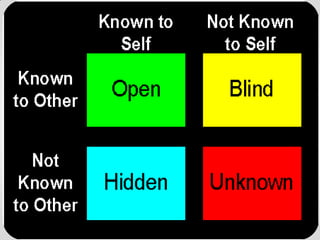
This document provides an overview of the Johari Window model, which is used to illustrate self-awareness and understanding between individuals and groups. It describes the four regions or areas of the model: 1) open/free area known to self and others, 2) blind area known to others but not self, 3) hidden area known to self but not others, and 4) unknown area unknown to self and others. The goal is to increase the open area through feedback and disclosure to improve communication, relationships, and group dynamics. The model was created in 1955 by psychologists Joseph Luft and Harry Ingham to study group interactions.