SUJATA JHA
BSC.NURSING
 OBJECTIVES
I. INTRODUCTION
II. DEFINITION
III. INCIDENCE
IV. ETIOLOGY
V. PATHOPHYSIOLOGY
VI. CLASSIFICATION
VII. CLINICAL MANIFESTATIONS
VIII. DIGNOSTIC EVALUATIONS
IX. NURSING MANAGEMENT IN GERIATRIC
PATIENTS
GLAUCOMA
 Glaucoma is a disease involving the loss of
retinal ganglion cells. At the same time, it
greatly affects the function and condition of
the optic nerve. When left untreated, patients
may end up having visual field loss and
permanent optic nerve damage.
 Glaucoma refers to a group of ocular disorder
characterized by increased intra ocular
pressure, optic nerve atrophy and peripheral
visual field loss that lead to damage to the
optic nerve
 Glaucoma is third leading cause of blindness
• Increased intra-ocular pressure results from inadequate
drainage of aqueous humor from the canal of schlemm,
raised pressure in the episcleral veins or over production of
aqueous humor.
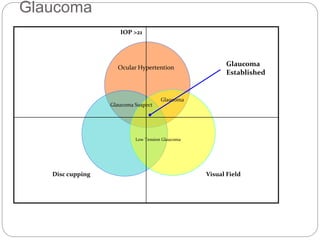
• The pressure of ocular hypertension alone does not
established the diagnosis of glaucoma; two out of following
three criteria usually are required to establish a diagnosis of
glaucoma:
• Elevated IOP (ocular hypertension)
• Visual field loss
• Damage to the optic disc
Ocular Hypertention
Glaucoma Suspect
Low Tension Glaucoma
Glaucoma
Established
Glaucoma
IOP >21
Disc cupping Visual Field
Glaucoma
ETIOLOGY
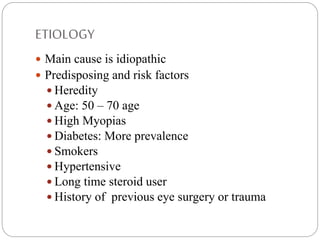
 Main cause is idiopathic
 Predisposing and risk factors
 Heredity
 Age: 50 – 70 age
 High Myopias
 Diabetes: More prevalence
 Smokers
 Hypertensive
 Long time steroid user
 History of previous eye surgery or trauma
PHYSIOLOGYOF GLAUCOMA
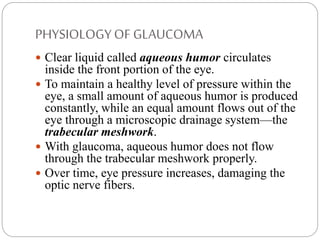
 Clear liquid called aqueous humor circulates
inside the front portion of the eye.
 To maintain a healthy level of pressure within the
eye, a small amount of aqueous humor is produced
constantly, while an equal amount flows out of the
eye through a microscopic drainage system—the
trabecular meshwork.
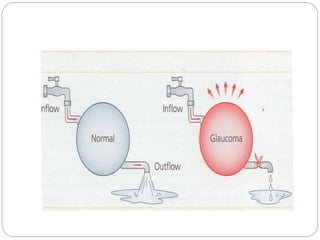
 With glaucoma, aqueous humor does not flow
through the trabecular meshwork properly.
 Over time, eye pressure increases, damaging the
optic nerve fibers.
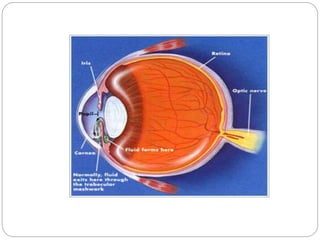
 Intraocular pressure is a function of production of
liquid aqueous humor by the ciliary processes of
the eye and its drainage through the trabecular
meshwork.
 Aqueous humor flows from the ciliary processes
into the posterior chamber, bounded posteriorly by
the lens and the zonules of Zinn and anteriorly by
the iris.
 It then flows through the pupil of the iris into the
anterior chamber, bounded posteriorly by the iris
and anteriorly by the cornea.
 From here the trabecular meshwork drains aqueous
humor via Schlemm's canal into scleral plexuses and
general blood circulation.
 In open angle glaucoma there is reduced flow through
the trabecular meshwork
 In angle closure glaucoma, the iridocorneal angle is
completely closed because of forward displacement of
the final roll and root of the iris against the cornea
resulting in the inability of the aqueous fluid to flow
from the posterior to the anterior chamber and then out
of the trabecular meshwork
CLASSIFICATION
1. According to etiology: primary or
secondary
2. According to anatomy of anterior
chamber: open angle or angle closure
3. According to natural history: acute or
chronic
4. According to age of onset: Congenital or
developmental (adult) glaucoma
 Primary Open-angle glaucoma (POAG): Also called
wide-angle glaucoma, this is the most common type of
glaucoma. The structures of the eye appear normal, but
fluid in the eye does not flow properly or slow through
the drain of the eye, called the trabecular meshwork. It
is a multifactorial disorder that is often genetically
being lost.
 Primary Angle-closure glaucoma (PACG): Also
called acute or chronic angle-closure or narrow-angle
glaucoma, this type of glaucoma is less common, but
can cause a sudden buildup of pressure in the eye.
Drainage may be poor because the angle between the
iris and the cornea (where a drainage channel for the
eye is located) is too narrow. Or, the pupil opens too
wide, narrowing the angle and blocking the flow of the
fluid through that channel.
 Secondary Glaucoma: may occur as a result of
trauma that can disrupt the flow pattern of aqueous
humor. It may be associated with inflammatory
condition, ocular neoplasm and trauma etc
CLINICAL MANIFESTATIONS
 Primary open-angle glaucoma signs and symptoms
include:
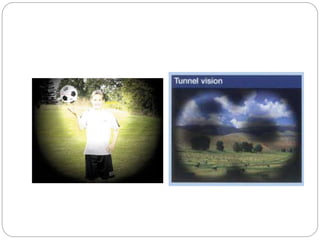
 Gradual loss of peripheral vision, usually in both
eyes
 Tunnel vision in the advanced stages
 Mild discomfort in the eyes
 Halos around lights
 No pain or pressure the patient does not notice the
gradual visual field loss
SYMPTOMS OF ACUTE ANGLE
GLAUCOMA
1. Chronic angle closure glaucoma:
• Hazy or blurred vision
• Sudden slight eye pain including eye brow
• Halos around light, The appearance of rainbow-colored circles
around bright lights
2. Acute angle-closure glaucoma signs and symptoms include:
• Severe eye pain
• Nausea and vomiting (accompanying the severe eye pain)
• Sudden onset of visual disturbance, often in low light
• Blurred vision/cloudy vision
• Halos around lights
• Reddening of the eye
• sudden sight loss
• Progressive loss of central vision
• Vision worsening in the evening with difficulty adjusting to dark
light
• Photophobia, lacrimation
• Frontal headache
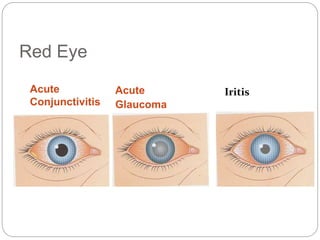
Red Eye
Acute
Conjunctivitis
Acute
Glaucoma
Iritis
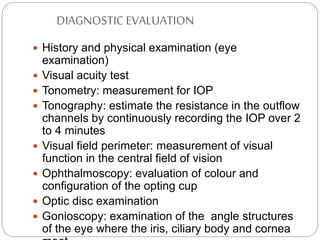
DIAGNOSTIC EVALUATION
 History and physical examination (eye
examination)
 Visual acuity test
 Tonometry: measurement for IOP
 Tonography: estimate the resistance in the outflow
channels by continuously recording the IOP over 2
to 4 minutes
 Visual field perimeter: measurement of visual
function in the central field of vision
 Ophthalmoscopy: evaluation of colour and
configuration of the opting cup
 Optic disc examination
 Gonioscopy: examination of the angle structures
of the eye where the iris, ciliary body and cornea
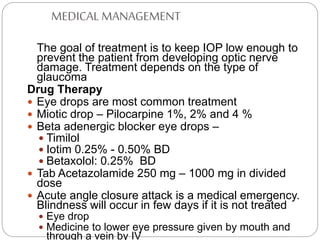
MEDICAL MANAGEMENT
The goal of treatment is to keep IOP low enough to
prevent the patient from developing optic nerve
damage. Treatment depends on the type of
glaucoma
Drug Therapy
 Eye drops are most common treatment
 Miotic drop – Pilocarpine 1%, 2% and 4 %
 Beta adenergic blocker eye drops –
 Timilol
 Iotim 0.25% - 0.50% BD
 Betaxolol: 0.25% BD
 Tab Acetazolamide 250 mg – 1000 mg in divided
dose
 Acute angle closure attack is a medical emergency.
Blindness will occur in few days if it is not treated
 Eye drop
 Medicine to lower eye pressure given by mouth and
through a vein by IV
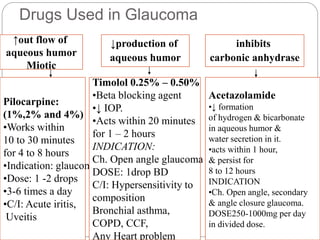
Drugs Used in Glaucoma
↑out flow of
aqueous humor
Miotic
↓production of
aqueous humor
inhibits
carbonic anhydrase
Pilocarpine:
(1%,2% and 4%)
•Works within
10 to 30 minutes
for 4 to 8 hours
•Indication: glaucoma
•Dose: 1 -2 drops
•3-6 times a day
•C/I: Acute iritis,
Uveitis
Timolol 0.25% – 0.50%
•Beta blocking agent
•↓ IOP.
•Acts within 20 minutes
for 1 – 2 hours
INDICATION:
Ch. Open angle glaucoma
DOSE: 1drop BD
C/I: Hypersensitivity to
composition
Bronchial asthma,
COPD, CCF,
Any Heart problem
Acetazolamide
•↓ formation
of hydrogen & bicarbonate
in aqueous humor &
water secretion in it.
•acts within 1 hour,
& persist for
8 to 12 hours
INDICATION
•Ch. Open angle, secondary
& angle closure glaucoma.
DOSE250-1000mg per day
in divided dose.
SURGICAL MANAGEMENT
 Argon Laser Trabeculoplasty is a therapeutic
treatement to lower the IOP when medications
are not successful
 Trabeculoplasty may be done if medical and
laser therapy is not successful
 Iridectomy for angle closure glaucoma
Nursing Management
Nursing Assessment
 History collection and physical examination
 Assess the sign and symptoms of IOP and
glaucoma
Nursing Diagnosis
 Acute pain related to pathophysiology process
and surgical correction
 Disturbed sensory perception related to visual
impairment
 Anxiety related to changes in health status,
presence of pain, possibility of vision loss
 Risk for injury related to visual acuity deficits
 Self care deficits related to visual acuity deficits
 Noncompliance related to the inconvenience and
side effects of glaucoma medications
NURSING MANAGEMENT
• Administer medications as prescribed
• Provide quiet, dark environment
• Apply cold compress in forehead
• Maintain accurate I&O with the use of osmotic agents
• Prepare the client for surgery for indicated
• Provide client teaching:
1. Self administration of eye drops
2. Need to avoid stooping, heavy lifting or pushing, emotional
upsets, excessive fluid intake, constructive clothing
around the neck
3. Need to avoid the use of antihistamines or
sympathomimetic drugs (found in cold preparations) in
closed-angle glaucoma since they cause mydriasis
4. Importance of follow-up care
Glaucoma

Glaucoma

  • 2.
  • 3.
     OBJECTIVES I. INTRODUCTION II.DEFINITION III. INCIDENCE IV. ETIOLOGY V. PATHOPHYSIOLOGY VI. CLASSIFICATION VII. CLINICAL MANIFESTATIONS VIII. DIGNOSTIC EVALUATIONS IX. NURSING MANAGEMENT IN GERIATRIC PATIENTS
  • 4.
    GLAUCOMA  Glaucoma isa disease involving the loss of retinal ganglion cells. At the same time, it greatly affects the function and condition of the optic nerve. When left untreated, patients may end up having visual field loss and permanent optic nerve damage.  Glaucoma refers to a group of ocular disorder characterized by increased intra ocular pressure, optic nerve atrophy and peripheral visual field loss that lead to damage to the optic nerve  Glaucoma is third leading cause of blindness
  • 5.
    • Increased intra-ocularpressure results from inadequate drainage of aqueous humor from the canal of schlemm, raised pressure in the episcleral veins or over production of aqueous humor. • The pressure of ocular hypertension alone does not established the diagnosis of glaucoma; two out of following three criteria usually are required to establish a diagnosis of glaucoma: • Elevated IOP (ocular hypertension) • Visual field loss • Damage to the optic disc
  • 6.
    Ocular Hypertention Glaucoma Suspect LowTension Glaucoma Glaucoma Established Glaucoma IOP >21 Disc cupping Visual Field Glaucoma
  • 7.
    ETIOLOGY  Main causeis idiopathic  Predisposing and risk factors  Heredity  Age: 50 – 70 age  High Myopias  Diabetes: More prevalence  Smokers  Hypertensive  Long time steroid user  History of previous eye surgery or trauma
  • 8.
    PHYSIOLOGYOF GLAUCOMA  Clearliquid called aqueous humor circulates inside the front portion of the eye.  To maintain a healthy level of pressure within the eye, a small amount of aqueous humor is produced constantly, while an equal amount flows out of the eye through a microscopic drainage system—the trabecular meshwork.  With glaucoma, aqueous humor does not flow through the trabecular meshwork properly.  Over time, eye pressure increases, damaging the optic nerve fibers.
  • 10.
     Intraocular pressureis a function of production of liquid aqueous humor by the ciliary processes of the eye and its drainage through the trabecular meshwork.  Aqueous humor flows from the ciliary processes into the posterior chamber, bounded posteriorly by the lens and the zonules of Zinn and anteriorly by the iris.  It then flows through the pupil of the iris into the anterior chamber, bounded posteriorly by the iris and anteriorly by the cornea.
  • 11.
     From herethe trabecular meshwork drains aqueous humor via Schlemm's canal into scleral plexuses and general blood circulation.  In open angle glaucoma there is reduced flow through the trabecular meshwork  In angle closure glaucoma, the iridocorneal angle is completely closed because of forward displacement of the final roll and root of the iris against the cornea resulting in the inability of the aqueous fluid to flow from the posterior to the anterior chamber and then out of the trabecular meshwork
  • 13.
    CLASSIFICATION 1. According toetiology: primary or secondary 2. According to anatomy of anterior chamber: open angle or angle closure 3. According to natural history: acute or chronic 4. According to age of onset: Congenital or developmental (adult) glaucoma
  • 14.
     Primary Open-angleglaucoma (POAG): Also called wide-angle glaucoma, this is the most common type of glaucoma. The structures of the eye appear normal, but fluid in the eye does not flow properly or slow through the drain of the eye, called the trabecular meshwork. It is a multifactorial disorder that is often genetically being lost.  Primary Angle-closure glaucoma (PACG): Also called acute or chronic angle-closure or narrow-angle glaucoma, this type of glaucoma is less common, but can cause a sudden buildup of pressure in the eye. Drainage may be poor because the angle between the iris and the cornea (where a drainage channel for the eye is located) is too narrow. Or, the pupil opens too wide, narrowing the angle and blocking the flow of the fluid through that channel.  Secondary Glaucoma: may occur as a result of trauma that can disrupt the flow pattern of aqueous humor. It may be associated with inflammatory condition, ocular neoplasm and trauma etc
  • 15.
    CLINICAL MANIFESTATIONS  Primaryopen-angle glaucoma signs and symptoms include:  Gradual loss of peripheral vision, usually in both eyes  Tunnel vision in the advanced stages  Mild discomfort in the eyes  Halos around lights  No pain or pressure the patient does not notice the gradual visual field loss
  • 16.
    SYMPTOMS OF ACUTEANGLE GLAUCOMA 1. Chronic angle closure glaucoma: • Hazy or blurred vision • Sudden slight eye pain including eye brow • Halos around light, The appearance of rainbow-colored circles around bright lights 2. Acute angle-closure glaucoma signs and symptoms include: • Severe eye pain • Nausea and vomiting (accompanying the severe eye pain) • Sudden onset of visual disturbance, often in low light • Blurred vision/cloudy vision • Halos around lights • Reddening of the eye • sudden sight loss • Progressive loss of central vision • Vision worsening in the evening with difficulty adjusting to dark light • Photophobia, lacrimation • Frontal headache
  • 17.
  • 19.
    DIAGNOSTIC EVALUATION  Historyand physical examination (eye examination)  Visual acuity test  Tonometry: measurement for IOP  Tonography: estimate the resistance in the outflow channels by continuously recording the IOP over 2 to 4 minutes  Visual field perimeter: measurement of visual function in the central field of vision  Ophthalmoscopy: evaluation of colour and configuration of the opting cup  Optic disc examination  Gonioscopy: examination of the angle structures of the eye where the iris, ciliary body and cornea
  • 20.
    MEDICAL MANAGEMENT The goalof treatment is to keep IOP low enough to prevent the patient from developing optic nerve damage. Treatment depends on the type of glaucoma Drug Therapy  Eye drops are most common treatment  Miotic drop – Pilocarpine 1%, 2% and 4 %  Beta adenergic blocker eye drops –  Timilol  Iotim 0.25% - 0.50% BD  Betaxolol: 0.25% BD  Tab Acetazolamide 250 mg – 1000 mg in divided dose  Acute angle closure attack is a medical emergency. Blindness will occur in few days if it is not treated  Eye drop  Medicine to lower eye pressure given by mouth and through a vein by IV
  • 21.
    Drugs Used inGlaucoma ↑out flow of aqueous humor Miotic ↓production of aqueous humor inhibits carbonic anhydrase Pilocarpine: (1%,2% and 4%) •Works within 10 to 30 minutes for 4 to 8 hours •Indication: glaucoma •Dose: 1 -2 drops •3-6 times a day •C/I: Acute iritis, Uveitis Timolol 0.25% – 0.50% •Beta blocking agent •↓ IOP. •Acts within 20 minutes for 1 – 2 hours INDICATION: Ch. Open angle glaucoma DOSE: 1drop BD C/I: Hypersensitivity to composition Bronchial asthma, COPD, CCF, Any Heart problem Acetazolamide •↓ formation of hydrogen & bicarbonate in aqueous humor & water secretion in it. •acts within 1 hour, & persist for 8 to 12 hours INDICATION •Ch. Open angle, secondary & angle closure glaucoma. DOSE250-1000mg per day in divided dose.
  • 22.
    SURGICAL MANAGEMENT  ArgonLaser Trabeculoplasty is a therapeutic treatement to lower the IOP when medications are not successful  Trabeculoplasty may be done if medical and laser therapy is not successful  Iridectomy for angle closure glaucoma
  • 23.
    Nursing Management Nursing Assessment History collection and physical examination  Assess the sign and symptoms of IOP and glaucoma
  • 24.
    Nursing Diagnosis  Acutepain related to pathophysiology process and surgical correction  Disturbed sensory perception related to visual impairment  Anxiety related to changes in health status, presence of pain, possibility of vision loss  Risk for injury related to visual acuity deficits  Self care deficits related to visual acuity deficits  Noncompliance related to the inconvenience and side effects of glaucoma medications
  • 25.
    NURSING MANAGEMENT • Administermedications as prescribed • Provide quiet, dark environment • Apply cold compress in forehead • Maintain accurate I&O with the use of osmotic agents • Prepare the client for surgery for indicated • Provide client teaching: 1. Self administration of eye drops 2. Need to avoid stooping, heavy lifting or pushing, emotional upsets, excessive fluid intake, constructive clothing around the neck 3. Need to avoid the use of antihistamines or sympathomimetic drugs (found in cold preparations) in closed-angle glaucoma since they cause mydriasis 4. Importance of follow-up care