Searching Basics

   Susan Fowler, MLIS
    Medical Librarian
   Fowler@wustl.edu
     314‐362‐8092
    pg: 314‐360‐1069
Outline
•   Search Strategy
•   Resources
•   PICO
•   Research Methods
•   Boolean
•   Truncation and Wild cards
•   Quotes
•   More help
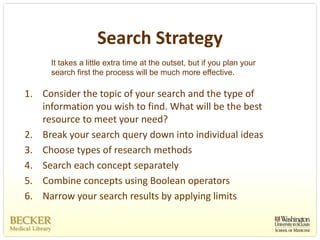
Search Strategy
      It takes a little extra time at the outset, but if you plan your
      search first the process will be much more effective.

1. Consider the topic of your search and the type of 
   information you wish to find. What will be the best 
   resource to meet your need? 
2. Break your search query down into individual ideas
3. Choose types of research methods 
4. Search each concept separately
5. Combine concepts using Boolean operators
6. Narrow your search results by applying limits 
Resources
• Basic Reference Question = Search engine 
  like Google
• Background or Introduction to a topic = 
  textbook
• Research Article = database
PICO
PICO can be used to help break down your question

• Patient or Population ‐ How would I describe a group 
  of patients similar to mine?
• Intervention ‐ Which main intervention, prognostic 
  factor, or exposure am I considering?
• Comparison ‐ What is the main alternative to compare 
  with the intervention?
• Outcome ‐ What can I hope to accomplish, measure, 
  improve or affect?
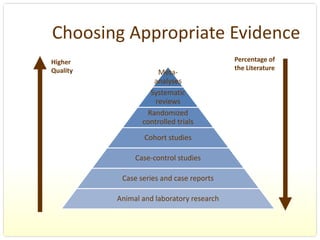
Choosing Appropriate Evidence
Higher                                      Percentage of 
Quality                                     the Literature 
                       Meta‐
                     analyses
                    Systematic 
                      reviews
                   Randomized 
                  controlled trials
                   Cohort studies

                Case‐control studies

            Case series and case reports

           Animal and laboratory research
Research Methods Defined
meta‐analysis: a quantitative approach in which individual study findings 
   addressing a common problem are statistically integrated and analyzed to 
   determine the effectiveness of interventions.
systematic review: a process by which a body of literature is reviewed and 
   assessed using systematic methods which are intended to reduce bias in 
   the review process and improve understandability.
randomized controlled trial: an experiment in which investigators randomly 
   allocate participants into (eg treatment and control) groups to receive or 
   not to receive one or more interventions that are being compared.
cohort study: an observational study in which a cohort is followed over time.
case‐control studies: retrospective research design that compares individuals 
   with a specific condition to those without it.
case report: a detailed report of the symptoms, signs, diagnosis, treatment, 
   and follow‐up of an individual patient. 
case series: a report on a series of patients with an outcome or condition of 
   interest.
Boolean
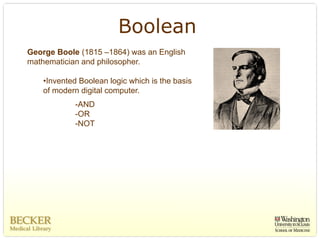
George Boole (1815 –1864) was an English
mathematician and philosopher.

    •Invented Boolean logic which is the basis
    of modern digital computer.
             -AND
             -OR
             -NOT
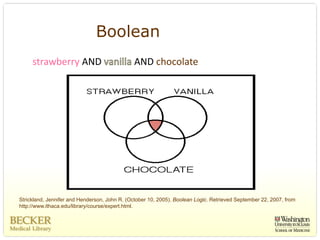
Boolean
     strawberry AND                            AND chocolate


Strickland, Jennifer and Henderson, John R. (October 10, 2005). Boolean Logic. Retrieved September 22, 2007, from
http://www.ithaca.edu/library/course/expert.html.
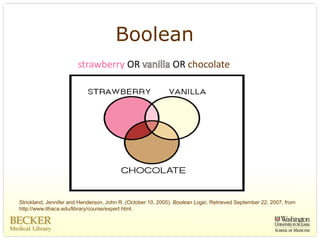
Boolean
                       strawberry OR                          OR chocolate


Strickland, Jennifer and Henderson, John R. (October 10, 2005). Boolean Logic. Retrieved September 22, 2007, from
http://www.ithaca.edu/library/course/expert.html.
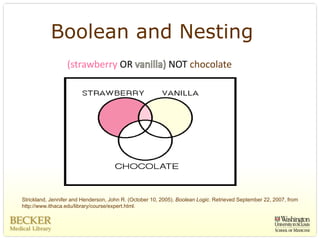
Boolean and Nesting
                  (strawberry OR                           NOT chocolate


Strickland, Jennifer and Henderson, John R. (October 10, 2005). Boolean Logic. Retrieved September 22, 2007, from
http://www.ithaca.edu/library/course/expert.html.
Truncation and Wild Cards
•   Truncation is a searchable shortened form of a word. 
     – adolescen* will include
         • adolescence
         • adolescent
         • adolescents, etc…


•   Wild card characters are useful because of alternate spellings and 
    other quirks in the English language. 
     – behavio?r, will include
         • behaviour
         • behavior 
     – Wom*n, will include
         • women 
         • woman
Quotation Marks
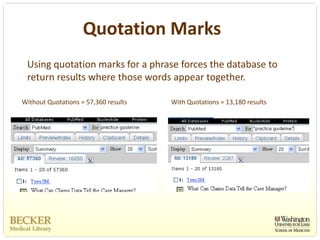
 Using quotation marks for a phrase forces the database to 
 return results where those words appear together. 

Without Quotations = 57,360 results   With Quotations = 13,180 results
20 Minutes
      If 20 minutes have passed and you still have not found what you
      are looking for, stop and ask for help.

• 660 S. Euclid                         • St. Louis Children’s Hospital
   314‐362‐7085                            Lauren Yaeger, 314‐454‐2768
   Susan Fowler, 314‐362‐8092              yaegerl@wustl.edu
   Pg: 314‐360‐1069
   fowler@wustl.edu


• BJ North, Rothschild 
  Medical Library
  Reka Kozak, 314‐454‐7208
  kozakr@wustl.edu

Searching basics

  • 1.
    Searching Basics Susan Fowler, MLIS Medical Librarian Fowler@wustl.edu 314‐362‐8092 pg: 314‐360‐1069
  • 2.
    Outline • Search Strategy • Resources • PICO • Research Methods • Boolean • Truncation and Wild cards • Quotes • More help
  • 3.
    Search Strategy It takes a little extra time at the outset, but if you plan your search first the process will be much more effective. 1. Consider the topic of your search and the type of  information you wish to find. What will be the best  resource to meet your need?  2. Break your search query down into individual ideas 3. Choose types of research methods  4. Search each concept separately 5. Combine concepts using Boolean operators 6. Narrow your search results by applying limits 
  • 4.
    Resources • Basic Reference Question = Search engine  like Google • Background or Introduction to a topic =  textbook • Research Article = database
  • 5.
    PICO PICO can be used to help break down your question • Patient or Population ‐How would I describe a group  of patients similar to mine? • Intervention ‐ Which main intervention, prognostic  factor, or exposure am I considering? • Comparison ‐ What is the main alternative to compare  with the intervention? • Outcome ‐ What can I hope to accomplish, measure,  improve or affect?
  • 6.
    Choosing Appropriate Evidence Higher  Percentage of  Quality  the Literature  Meta‐ analyses Systematic  reviews Randomized  controlled trials Cohort studies Case‐control studies Case series and case reports Animal and laboratory research
  • 7.
    Research Methods Defined meta‐analysis: a quantitative approach in which individual study findings  addressing a common problem are statistically integrated and analyzed to  determine the effectiveness of interventions. systematic review: a process by which a body of literature is reviewed and  assessed using systematic methods which are intended to reduce bias in  the review process and improve understandability. randomized controlled trial: an experiment in which investigators randomly  allocate participants into (eg treatment and control) groups to receive or  not to receive one or more interventions that are being compared. cohort study: an observational study in which a cohort is followed over time. case‐control studies: retrospective research design that compares individuals  with a specific condition to those without it. case report: a detailed report of the symptoms, signs, diagnosis, treatment,  and follow‐up of an individual patient.  case series: a report on a series of patients with an outcome or condition of  interest.
  • 8.
    Boolean George Boole (1815–1864) was an English mathematician and philosopher. •Invented Boolean logic which is the basis of modern digital computer. -AND -OR -NOT
  • 9.
    Boolean strawberry AND  AND chocolate Strickland, Jennifer and Henderson, John R. (October 10, 2005). Boolean Logic. Retrieved September 22, 2007, from http://www.ithaca.edu/library/course/expert.html.
  • 10.
    Boolean strawberry OR  OR chocolate Strickland, Jennifer and Henderson, John R. (October 10, 2005). Boolean Logic. Retrieved September 22, 2007, from http://www.ithaca.edu/library/course/expert.html.
  • 11.
    Boolean and Nesting (strawberry OR  NOT chocolate Strickland, Jennifer and Henderson, John R. (October 10, 2005). Boolean Logic. Retrieved September 22, 2007, from http://www.ithaca.edu/library/course/expert.html.
  • 12.
    Truncation and WildCards • Truncation is a searchable shortened form of a word.  – adolescen* will include • adolescence • adolescent • adolescents, etc… • Wild card characters are useful because of alternate spellings and  other quirks in the English language.  – behavio?r, will include • behaviour • behavior  – Wom*n, will include • women  • woman
  • 13.
  • 14.
    20 Minutes If 20 minutes have passed and you still have not found what you are looking for, stop and ask for help. • 660 S. Euclid • St. Louis Children’s Hospital 314‐362‐7085 Lauren Yaeger, 314‐454‐2768 Susan Fowler, 314‐362‐8092 yaegerl@wustl.edu Pg: 314‐360‐1069 fowler@wustl.edu • BJ North, Rothschild  Medical Library Reka Kozak, 314‐454‐7208 kozakr@wustl.edu