RESEARCH DESIGN
JITHIN K THOMAS
BIMS
WHAT IS RESEARCH DESIGN ?
• Decisions regarding what, where, when,
how much, by what means concerning
an inquiry or a research study constitute
a research design.
Meaning of research design
• A research design is the arrangement of
conditions for collection and analysis of data
in a manner that aims to combine relevance to
the research purpose with economy in
procedure.
Research design have following parts
• Sampling design
• Observational design
• Statistical design
• Operational design
Sampling Designs
• Which deals with the methods of selecting
items to be observed for the study.
Observational design
• Which relates to the condition under which
the observation are to be made.
Statistical Design
• Which concern the question of the of How the
information and data gathered are to be
analyzed ?
Operational design
• Which deals with techniques by which
the procedures satisfied be carried out.
Features Of A Good Research Design
A research design appropriate for a particular research
problem, usually involves the consideration of the
following factors.
• The means of obtaining information.
• The availability and skills of the researcher and his
staff, if any.
• The objective of the problem to be studied.
• The nature of the problem to be studied .
• The availability of time and money for the research
work.
Important Concepts relating to
Research Design
• A concept which can take on different
quantitative values is called a variable.
• A phenomena which can take on different
qualitatively values even in decimal value are
called continues.
Dependent and Independent
Variables:
• If one variable is depend on another variable
it is termed as a dependent variable.
• The variable that is antecedent to the
dependent variable is an independent
variable.
• Ex. Height is dependent on age.
Extraneous Variables
• That are not related to the purpose of the
study but may effect on the dependent
variables are termed as the extraneous
variables.
Example of this
• Suppose a researcher want to test the hypothesis that
there is a relationship between children gains in social
studies achievement and their self concept.
• In this case self-concept = independent variable
• Social studies achievement = dependent variable
• Intelligence may as well affect on the social
achievement.
• But it is not related to the study undertaken by the
researcher so it is a Extraneous variable
Control
• One important characteristic of a good research is to
minimize the influence or effect of extraneous
variables .
• The technical term ‘control’ is used when we design
the study minimizing the effect of extraneous
independent variable
Confounded Relationship
• When the dependent variable is not free from
the influence of extraneous variables the
relationship between the depended and
independent variables is said to be
confounded by an extraneous variable
Research Hypothesis
• When a prediction or a hypothesised relationship is
to be tested by scientific methods, it is termed as a
research hypothesis.
• The Research Hypothesis is a predicative
statement that relates an independent
variable to dependent variable.
Experimental and Non-experimental Hypothesis
Testing
• Research in which the independent variable is
manipulated is termed as Experimental
hypothesis testing research.
• Research in which the independent variable is not
manipulated is termed as non- Experimental
hypothesis testing research.
Experimental and Control Groups
• When a group is exposed to usual conditions,
it is termed as a control group.
• But when the group is exposed to be some
special condition, it is termed as Experimental
group
Treatments
• The different conditions under which
experimental and control groups are put up
usually referred to as treatment.
Experiment
• The process of examining the truth of a statistical
hypothesis, relating to some research problem, is
known as an Experiment.
E.g.:- We can conduct an Experiment to examine the
usefulness of a certain newly developed drug.
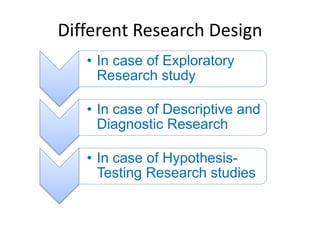
Different Research Design
• In case of Exploratory
Research study
• In case of Descriptive and
Diagnostic Research
• In case of Hypothesis-
Testing Research studies
Exploratory Research Design
Conducted for of gaining better insight into a problem
• Evaluate the feasibility of a research project
• Formulation of a statement
• Provide theoretical basis to a hypothesis
• Provide alternative approaches to a problem
• Establish possibilities for further research
 Used when researcher has only a vague idea about the problems during
the study
 Helps in saving time and money
Ex:- An advertising company got an account for a new coffee containing chicory, the
company started the investigation process with exploratory research in order to identify the
situation. The researchers found that virtually no one had heard about chicory. It wasn’t
being used, and no-one seemed to know how to put it to use. This resulted in the
hypothesis that the advertising could depict the chicory ingredient in whatever way the
customer desired.
The Survey Of Concerning Literature
• This is most simple and fruitful method of
formulating the research problem .
• Hypothesis is taken from earlier workers and
their usefulness is evaluated as a basis for
further Research.
• Review available material for deriving the
reverent hypotheses from it.
The Experience/Expert survey
• The experience survey means the survey of
people who had practical experience .
• The object is to obtain new ideas relating to the
research problem.
• A systematic interviewing format with flexibility is
adopted.
• An expert could provide –
– Source of hypothesis
– Modus operendi of conducting research
– Source of information
– Possible problems in the study
Case Studies
• Also called Inside-Stimulating Examples
• Study of all cases which are prevalent to the
area of study.
• Relatively unformulated problems
• It is also a fruitful method of suggesting the
hypothesis
• Examining existing record
• Unstructured interviewing etc
Descriptive and Diagnostic Research
• Descriptive Research Study's are those studies
which are concerned with describing the
characteristics of a particular Individual , or a
group.
• In diagnostic research study determine the
frequency with which some thing occur or is
associated with something else.
Descriptive and Diagnostic Research
• Formulating the objective of the study.
• Designing the method of data collection.
• Selecting Sample. (Size)
• Collecting the data.( Where and time)
• Processing and analysing the data.
• Reporting the findings.
 A descriptive research design should clearly state the
subject of the study, object of the study, content of
study, time and place of conducting the study and
method adopted to conduct the study.
Descriptive and Diagnostic Research
• Clear definition of problem
• Method of Data Collection
• Preparation of Instruments
• Sampling Design
• Data Collection and Analysis Techniques
Difference between
Formulate vs Descriptive/Diagnostic
• Flexible design
• Judgmental sampling
• No pre-determined
design
• No fixed decision
about the
operational
procedures
• No flexibility
• Random sampling
• Pre-determined design
for analysis
• Advanced decisions
Hypothesis-Testing Research Studies
• Hypothesis-testing research studies known as
experimental studies are those researcher
tests the hypothesis of casual relationship
between variables.
• Cause and effect relationship between
variable under study.
• Researcher attempts to maintain control and
manipulate the variables that affect the study.
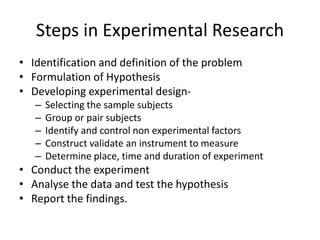
Steps in Experimental Research
• Identification and definition of the problem
• Formulation of Hypothesis
• Developing experimental design-
– Selecting the sample subjects
– Group or pair subjects
– Identify and control non experimental factors
– Construct validate an instrument to measure
– Determine place, time and duration of experiment
• Conduct the experiment
• Analyse the data and test the hypothesis
• Report the findings.
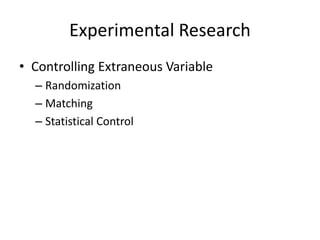
Experimental Research
• Controlling Extraneous Variable
– Randomization
– Matching
– Statistical Control
Principles of Experimental Design
• Principle of Replication
• Principle of Randomization
• Principle of Local Control
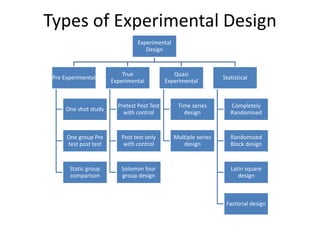
Types of Experimental Design
Experimental
Design
Pre Experimental
One shot study
One group Pre
test post test
Static group
comparison
True
Experimental
Pretest Post Test
with control
Post test only
with control
Solomon four
group design
Quasi
Experimental
Time series
design
Multiple series
design
Statistical
Completely
Randomised
Randomised
Block design
Latin square
design
Factorial design
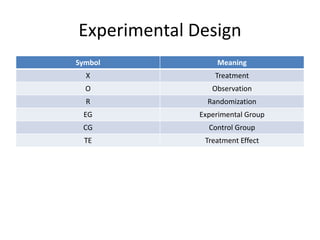
Experimental Design
Symbol Meaning
X Treatment
O Observation
R Randomization
EG Experimental Group
CG Control Group
TE Treatment Effect
Pre Experimental Design
• They follow procedures of Experimental
Design but do not include control group.
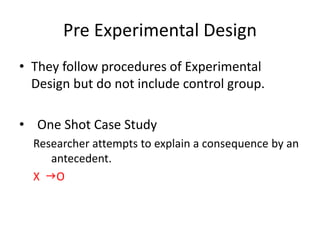
• One Shot Case Study
Researcher attempts to explain a consequence by an
antecedent.
X gO
Pre Experimental Design
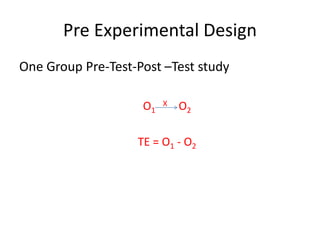
One Group Pre-Test-Post –Test study
O1
X O2
TE = O1 - O2
Pre Experimental Design
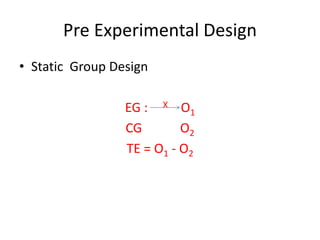
• Static Group Design
EG : X O1
CG O2
TE = O1 - O2
True Experimental Designs
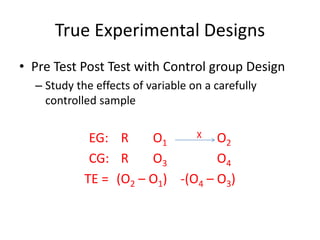
• Pre Test Post Test with Control group Design
– Study the effects of variable on a carefully
controlled sample
EG: R O1
X O2
CG: R O3 O4
TE = (O2 – O1) -(O4 – O3)
True Experimental Designs
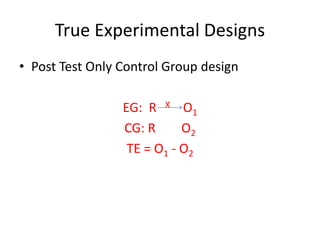
• Post Test Only Control Group design
EG: R X O1
CG: R O2
TE = O1 - O2
True Experimental Designs
• Solomon Four-Group Design
EG: R O1
X O2
CG: R O3 O4
EG: R O5
CG: R O6
• TE = O2 – O1
• TE = O2 – O4
• TE = O5 – O6
• TE = O5 – O3
• TE = [(O2 – O1) – (O4 – O3 )]
Quasi Experimental Designs
• Quicker to use and less expensive
• But do not involve randomization
1. Time Series Design
– Pre-testing and post-testing of subjects
2. Multiple Time Series Design
– Experimental and Control group Pre-testing and
post-testing
Statistical Designs
• Extraneous variable which the research is able
to identify called ‘block factor’ is isolated and
its effects eliminated.
a) Complete Randomized Design
– Used when dependent variable is influenced by
a single independent variable.
– Principles of replication and randomization is
used.
Statistical Designs
• Two Group Simple Randomized Design
• Random Replication Design
• Randomized Block Deign
• Latin Square Design
Statistical Designs
• Factorial Design
– Simple Factorial Design
– Complex Factorial Design
Research design

Research design

  • 1.
  • 2.
    WHAT IS RESEARCHDESIGN ? • Decisions regarding what, where, when, how much, by what means concerning an inquiry or a research study constitute a research design.
  • 3.
    Meaning of researchdesign • A research design is the arrangement of conditions for collection and analysis of data in a manner that aims to combine relevance to the research purpose with economy in procedure.
  • 4.
    Research design havefollowing parts • Sampling design • Observational design • Statistical design • Operational design
  • 5.
    Sampling Designs • Whichdeals with the methods of selecting items to be observed for the study. Observational design • Which relates to the condition under which the observation are to be made.
  • 6.
    Statistical Design • Whichconcern the question of the of How the information and data gathered are to be analyzed ? Operational design • Which deals with techniques by which the procedures satisfied be carried out.
  • 7.
    Features Of AGood Research Design A research design appropriate for a particular research problem, usually involves the consideration of the following factors. • The means of obtaining information. • The availability and skills of the researcher and his staff, if any. • The objective of the problem to be studied. • The nature of the problem to be studied . • The availability of time and money for the research work.
  • 8.
    Important Concepts relatingto Research Design • A concept which can take on different quantitative values is called a variable. • A phenomena which can take on different qualitatively values even in decimal value are called continues.
  • 9.
    Dependent and Independent Variables: •If one variable is depend on another variable it is termed as a dependent variable. • The variable that is antecedent to the dependent variable is an independent variable. • Ex. Height is dependent on age.
  • 10.
    Extraneous Variables • Thatare not related to the purpose of the study but may effect on the dependent variables are termed as the extraneous variables.
  • 11.
    Example of this •Suppose a researcher want to test the hypothesis that there is a relationship between children gains in social studies achievement and their self concept. • In this case self-concept = independent variable • Social studies achievement = dependent variable • Intelligence may as well affect on the social achievement. • But it is not related to the study undertaken by the researcher so it is a Extraneous variable
  • 12.
    Control • One importantcharacteristic of a good research is to minimize the influence or effect of extraneous variables . • The technical term ‘control’ is used when we design the study minimizing the effect of extraneous independent variable
  • 13.
    Confounded Relationship • Whenthe dependent variable is not free from the influence of extraneous variables the relationship between the depended and independent variables is said to be confounded by an extraneous variable
  • 14.
    Research Hypothesis • Whena prediction or a hypothesised relationship is to be tested by scientific methods, it is termed as a research hypothesis. • The Research Hypothesis is a predicative statement that relates an independent variable to dependent variable.
  • 15.
    Experimental and Non-experimentalHypothesis Testing • Research in which the independent variable is manipulated is termed as Experimental hypothesis testing research. • Research in which the independent variable is not manipulated is termed as non- Experimental hypothesis testing research.
  • 16.
    Experimental and ControlGroups • When a group is exposed to usual conditions, it is termed as a control group. • But when the group is exposed to be some special condition, it is termed as Experimental group
  • 17.
    Treatments • The differentconditions under which experimental and control groups are put up usually referred to as treatment.
  • 18.
    Experiment • The processof examining the truth of a statistical hypothesis, relating to some research problem, is known as an Experiment. E.g.:- We can conduct an Experiment to examine the usefulness of a certain newly developed drug.
  • 19.
    Different Research Design •In case of Exploratory Research study • In case of Descriptive and Diagnostic Research • In case of Hypothesis- Testing Research studies
  • 20.
    Exploratory Research Design Conductedfor of gaining better insight into a problem • Evaluate the feasibility of a research project • Formulation of a statement • Provide theoretical basis to a hypothesis • Provide alternative approaches to a problem • Establish possibilities for further research  Used when researcher has only a vague idea about the problems during the study  Helps in saving time and money Ex:- An advertising company got an account for a new coffee containing chicory, the company started the investigation process with exploratory research in order to identify the situation. The researchers found that virtually no one had heard about chicory. It wasn’t being used, and no-one seemed to know how to put it to use. This resulted in the hypothesis that the advertising could depict the chicory ingredient in whatever way the customer desired.
  • 21.
    The Survey OfConcerning Literature • This is most simple and fruitful method of formulating the research problem . • Hypothesis is taken from earlier workers and their usefulness is evaluated as a basis for further Research. • Review available material for deriving the reverent hypotheses from it.
  • 22.
    The Experience/Expert survey •The experience survey means the survey of people who had practical experience . • The object is to obtain new ideas relating to the research problem. • A systematic interviewing format with flexibility is adopted. • An expert could provide – – Source of hypothesis – Modus operendi of conducting research – Source of information – Possible problems in the study
  • 23.
    Case Studies • Alsocalled Inside-Stimulating Examples • Study of all cases which are prevalent to the area of study. • Relatively unformulated problems • It is also a fruitful method of suggesting the hypothesis • Examining existing record • Unstructured interviewing etc
  • 24.
    Descriptive and DiagnosticResearch • Descriptive Research Study's are those studies which are concerned with describing the characteristics of a particular Individual , or a group. • In diagnostic research study determine the frequency with which some thing occur or is associated with something else.
  • 25.
    Descriptive and DiagnosticResearch • Formulating the objective of the study. • Designing the method of data collection. • Selecting Sample. (Size) • Collecting the data.( Where and time) • Processing and analysing the data. • Reporting the findings.  A descriptive research design should clearly state the subject of the study, object of the study, content of study, time and place of conducting the study and method adopted to conduct the study.
  • 26.
    Descriptive and DiagnosticResearch • Clear definition of problem • Method of Data Collection • Preparation of Instruments • Sampling Design • Data Collection and Analysis Techniques
  • 27.
    Difference between Formulate vsDescriptive/Diagnostic • Flexible design • Judgmental sampling • No pre-determined design • No fixed decision about the operational procedures • No flexibility • Random sampling • Pre-determined design for analysis • Advanced decisions
  • 28.
    Hypothesis-Testing Research Studies •Hypothesis-testing research studies known as experimental studies are those researcher tests the hypothesis of casual relationship between variables. • Cause and effect relationship between variable under study. • Researcher attempts to maintain control and manipulate the variables that affect the study.
  • 29.
    Steps in ExperimentalResearch • Identification and definition of the problem • Formulation of Hypothesis • Developing experimental design- – Selecting the sample subjects – Group or pair subjects – Identify and control non experimental factors – Construct validate an instrument to measure – Determine place, time and duration of experiment • Conduct the experiment • Analyse the data and test the hypothesis • Report the findings.
  • 30.
    Experimental Research • ControllingExtraneous Variable – Randomization – Matching – Statistical Control
  • 31.
    Principles of ExperimentalDesign • Principle of Replication • Principle of Randomization • Principle of Local Control
  • 32.
    Types of ExperimentalDesign Experimental Design Pre Experimental One shot study One group Pre test post test Static group comparison True Experimental Pretest Post Test with control Post test only with control Solomon four group design Quasi Experimental Time series design Multiple series design Statistical Completely Randomised Randomised Block design Latin square design Factorial design
  • 33.
    Experimental Design Symbol Meaning XTreatment O Observation R Randomization EG Experimental Group CG Control Group TE Treatment Effect
  • 34.
    Pre Experimental Design •They follow procedures of Experimental Design but do not include control group. • One Shot Case Study Researcher attempts to explain a consequence by an antecedent. X gO
  • 35.
    Pre Experimental Design OneGroup Pre-Test-Post –Test study O1 X O2 TE = O1 - O2
  • 36.
    Pre Experimental Design •Static Group Design EG : X O1 CG O2 TE = O1 - O2
  • 37.
    True Experimental Designs •Pre Test Post Test with Control group Design – Study the effects of variable on a carefully controlled sample EG: R O1 X O2 CG: R O3 O4 TE = (O2 – O1) -(O4 – O3)
  • 38.
    True Experimental Designs •Post Test Only Control Group design EG: R X O1 CG: R O2 TE = O1 - O2
  • 39.
    True Experimental Designs •Solomon Four-Group Design EG: R O1 X O2 CG: R O3 O4 EG: R O5 CG: R O6 • TE = O2 – O1 • TE = O2 – O4 • TE = O5 – O6 • TE = O5 – O3 • TE = [(O2 – O1) – (O4 – O3 )]
  • 40.
    Quasi Experimental Designs •Quicker to use and less expensive • But do not involve randomization 1. Time Series Design – Pre-testing and post-testing of subjects 2. Multiple Time Series Design – Experimental and Control group Pre-testing and post-testing
  • 41.
    Statistical Designs • Extraneousvariable which the research is able to identify called ‘block factor’ is isolated and its effects eliminated. a) Complete Randomized Design – Used when dependent variable is influenced by a single independent variable. – Principles of replication and randomization is used.
  • 42.
    Statistical Designs • TwoGroup Simple Randomized Design • Random Replication Design • Randomized Block Deign • Latin Square Design
  • 43.
    Statistical Designs • FactorialDesign – Simple Factorial Design – Complex Factorial Design