How to searchfor relevant scientific
papers (stepwise manner)
Prepared by :
Dr Marina Hany
Medical education demonstrator
Faculty of medicine ,Damietta university
Drmarinahany@du.edu.eg
ILOS : bythe end of this session the students will be able to
• 1)Explain literature searching
• 2) classify medical literature
• 3) Mention steps of finding relevant scientific paper
• 4) ask the proper research question using PICO
• 5) use keywords,synonyms,MeSH
• 6) compare different databases & choose the appropriate one for you
• 7) develop a research strategy
• 8) use different filter & evaluate results
6.
What is literaturesearching???
• refers to the systematic process of identifying, locating, and
reviewing of the existing published materials relevant to the
particular research topic or question.
• The scientists conduct literature searches to gain knowledge and
help make accurate and relevant research conclusion. Literature
search is an integral component of the scientific investigation
process and it is usually called evidence-based research practice
that is applied to produce the best available proof.
7.
Other purposes toconduct literature search include:
• Identify the existing knowledge.
• Formulate research questions and objectives.
• Build a theoretical framework
• Identify appropriate methodologies and methods.
• Support arguments and evidence.
• Avoid bias and ensure rigor.
8.
Literature review:
reviewing thestudies which have been identified ( narrative review)
Systematic review:
Systematically searching the literature to identify all relevant
published and unpublished data in order to appraise their quality
and summarise the overall findings.
Meta-analysis study
Combining the results of similar subsides into one study to obtain
one final result summarizing all the included studies.
9.
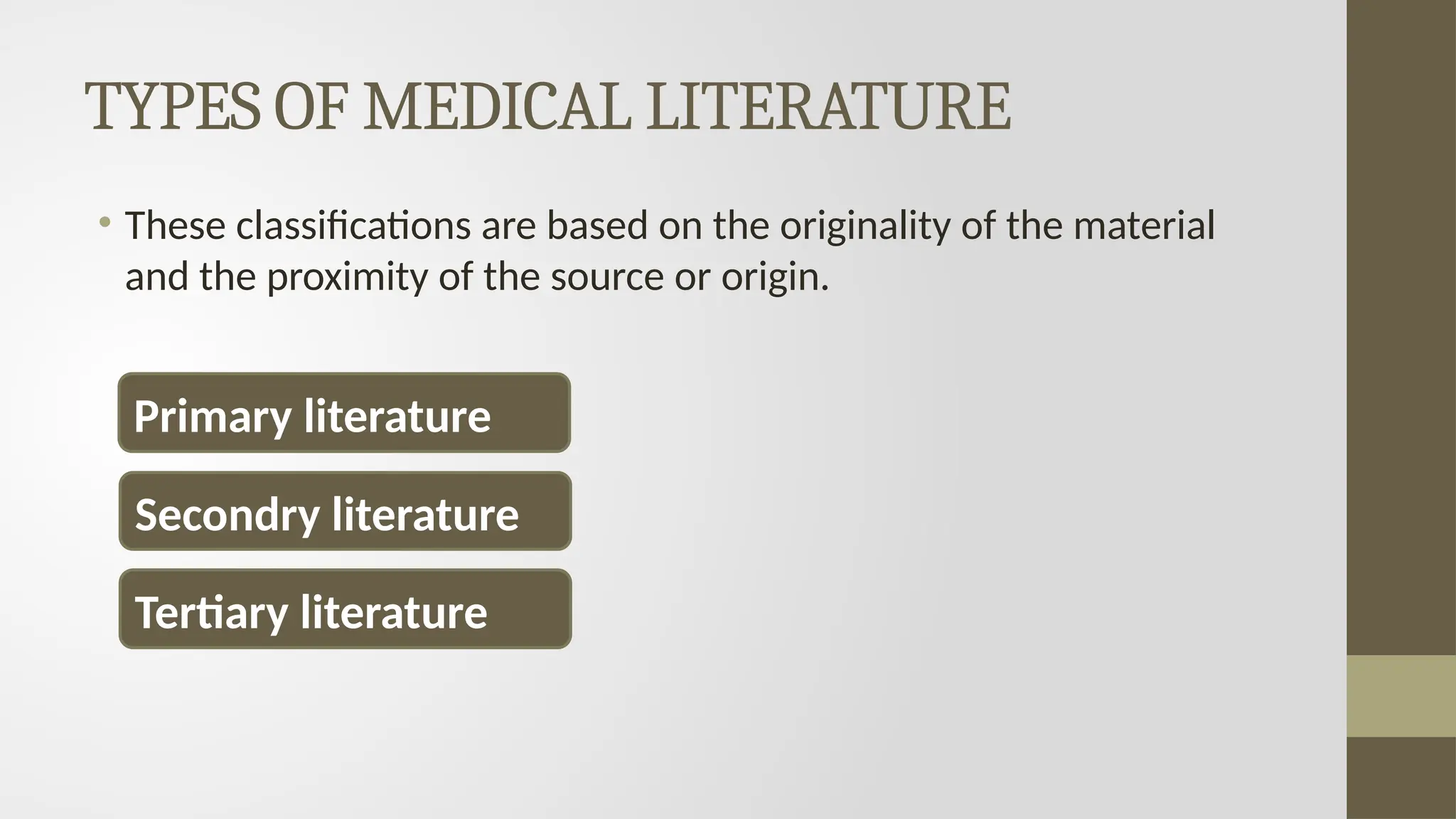
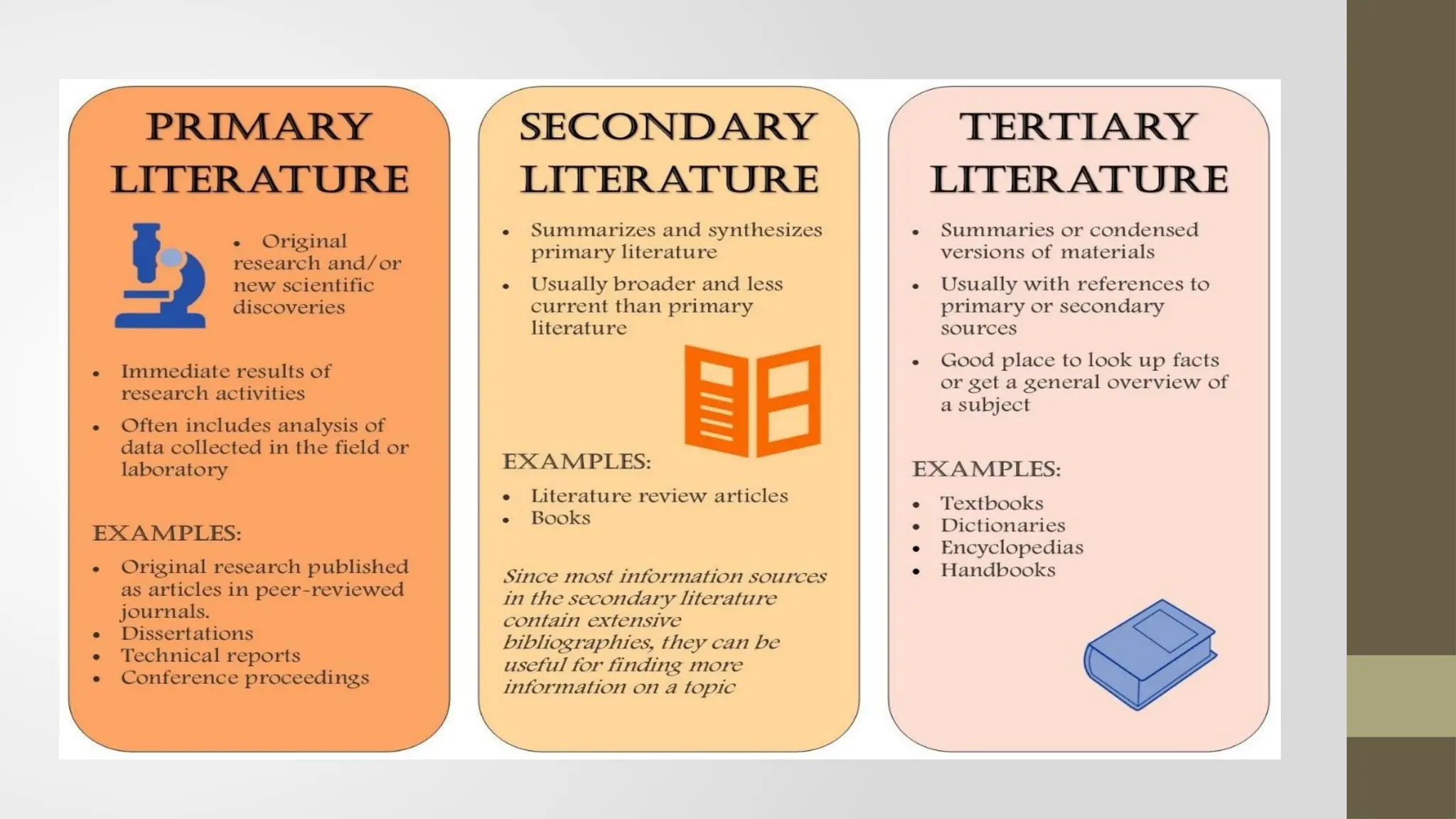
TYPES OF MEDICALLITERATURE
• These classifications are based on the originality of the material
and the proximity of the source or origin.
Primary literature
Secondry literature
Tertiary literature
11.
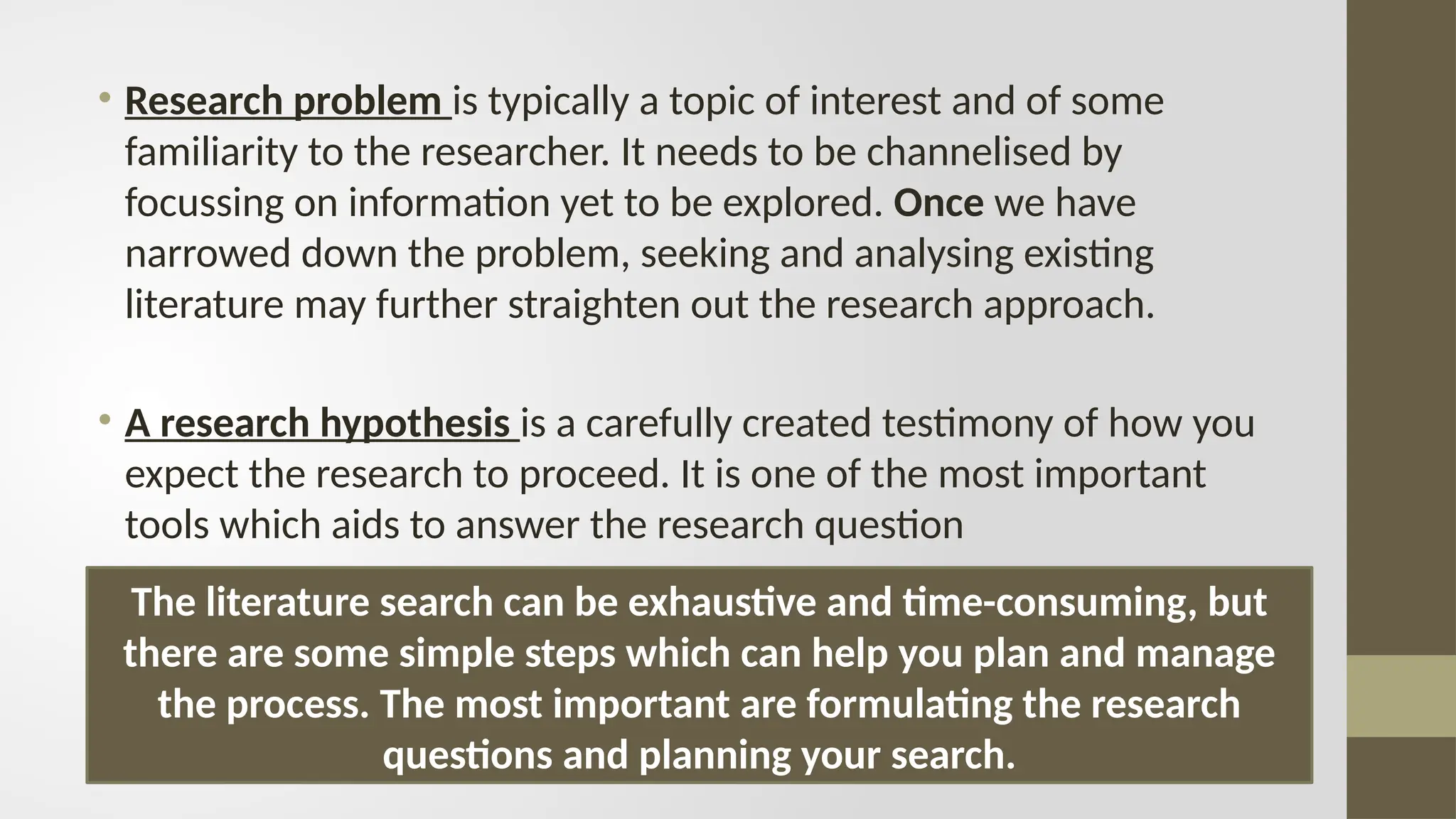
• Research problemis typically a topic of interest and of some
familiarity to the researcher. It needs to be channelised by
focussing on information yet to be explored. Once we have
narrowed down the problem, seeking and analysing existing
literature may further straighten out the research approach.
• A research hypothesis is a carefully created testimony of how you
expect the research to proceed. It is one of the most important
tools which aids to answer the research question
The literature search can be exhaustive and time-consuming, but
there are some simple steps which can help you plan and manage
the process. The most important are formulating the research
questions and planning your search.
13.
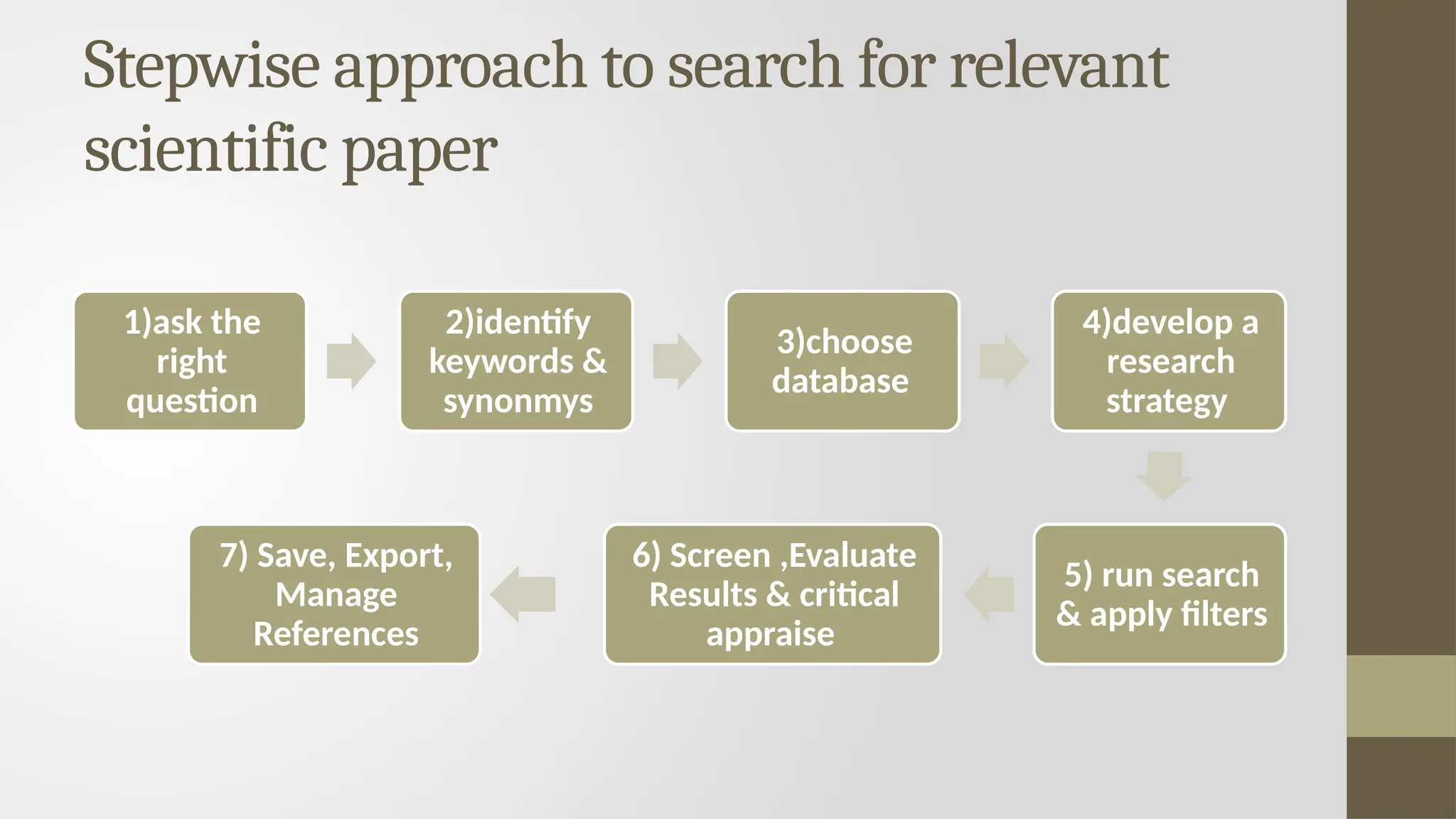
Stepwise approach tosearch for relevant
scientific paper
1)ask the
right
question
2)identify
keywords &
synonmys
3)choose
database
4)develop a
research
strategy
5) run search
& apply filters
6) Screen ,Evaluate
Results & critical
appraise
7) Save, Export,
Manage
References
14.
Step 1 Askthe right question :
If you are not aware of where you
want to go …YOU WILL NEVER
REACH THERE
The same way ,A badly
formulated clinical question will
not yield the information you
need.
15.
Step 1 Askthe right question :
The FIRST step
The HARDEST step
The MOST IMPORTANT step!
→ You should form a search question before you begin.
→ Decide the topic of your search
You should start by deciding the topic of your search. This means
identifying the broad topic, refining it to establish which particular
aspect of the topic interests you, and reframing that topic as a
question.
16.
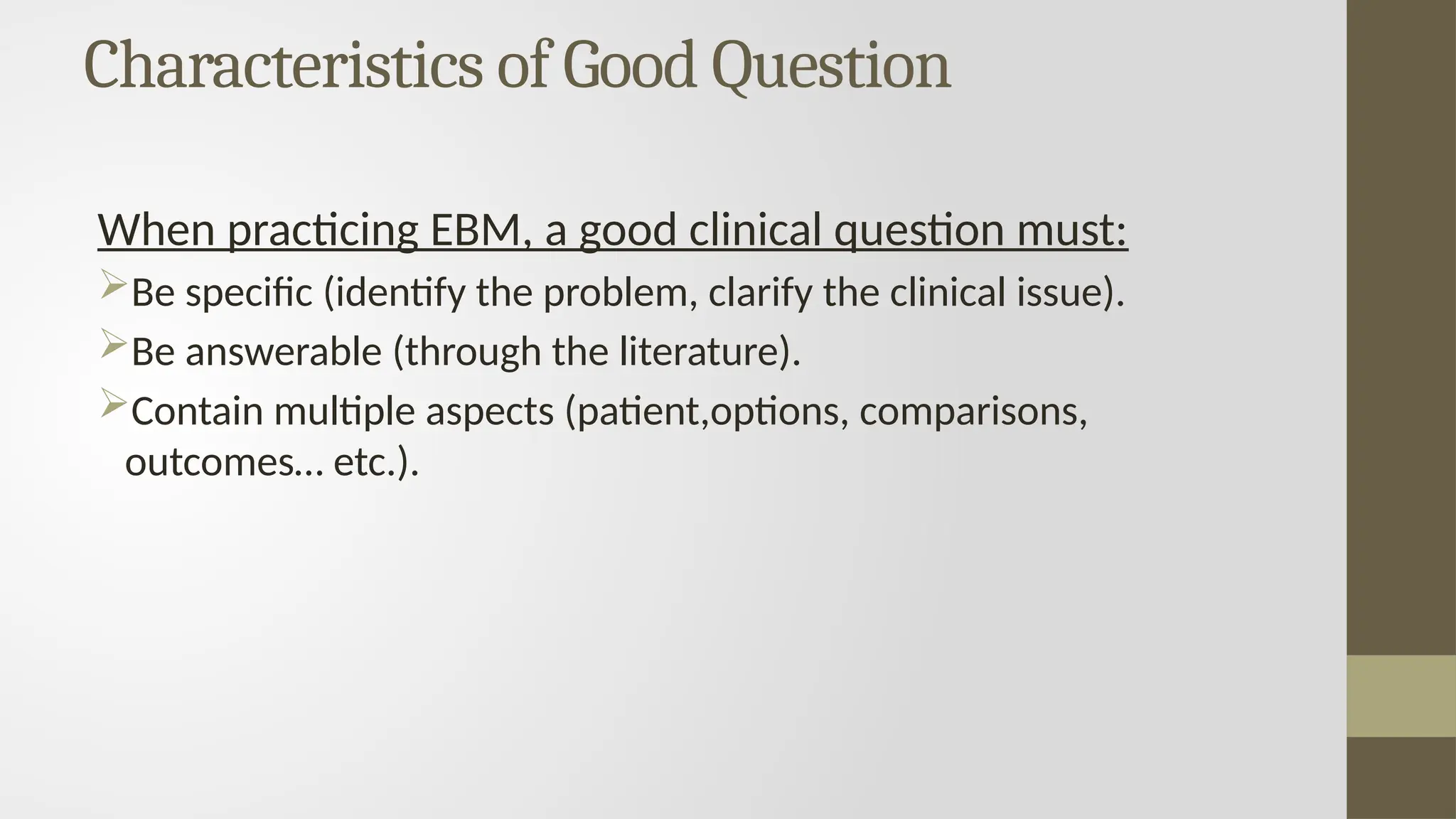
Characteristics of GoodQuestion
When practicing EBM, a good clinical question must:
Be specific (identify the problem, clarify the clinical issue).
Be answerable (through the literature).
Contain multiple aspects (patient,options, comparisons,
outcomes… etc.).
17.
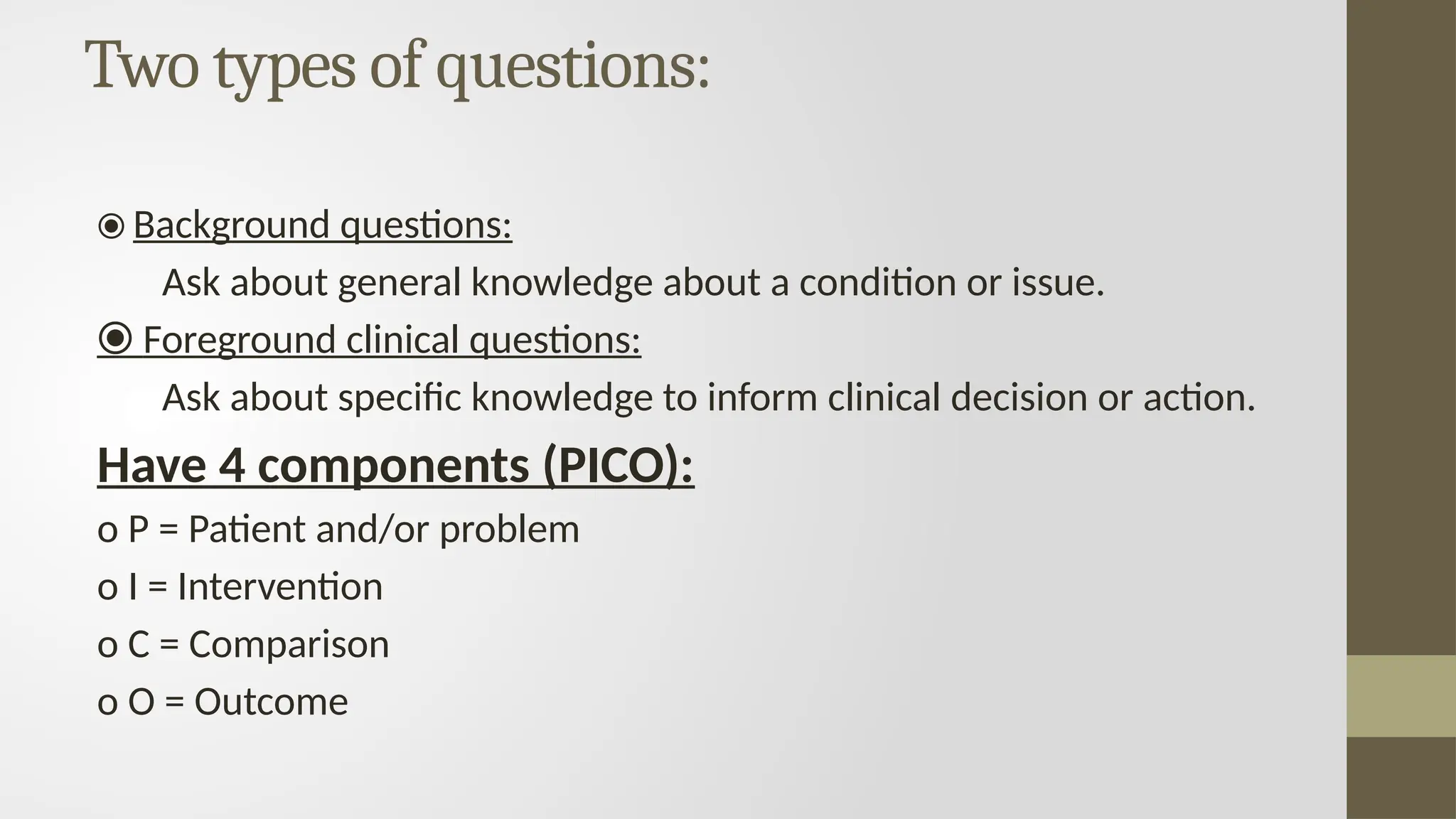
Two types ofquestions:
⦿ Background questions:
Ask about general knowledge about a condition or issue.
⦿ Foreground clinical questions:
Ask about specific knowledge to inform clinical decision or action.
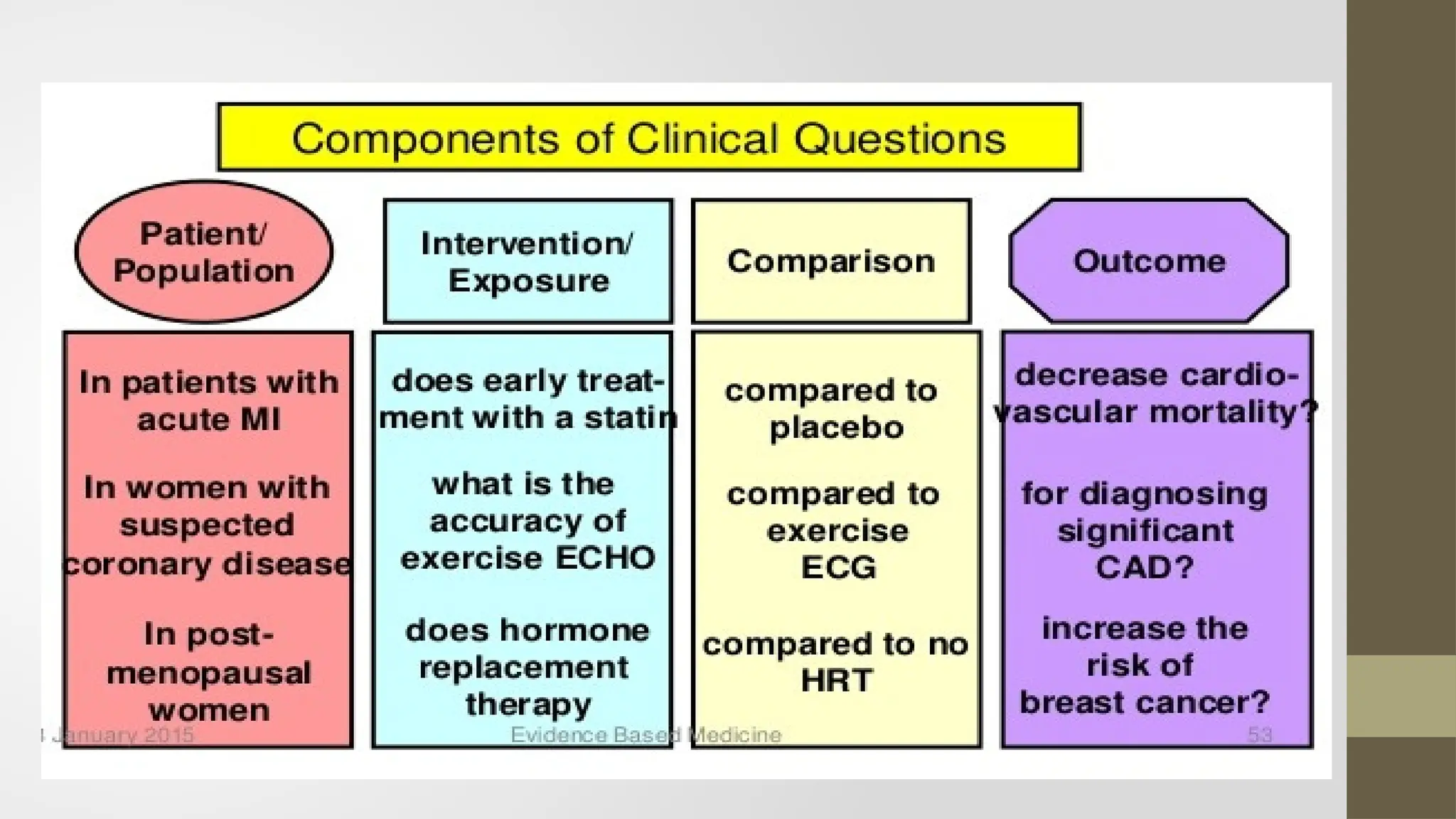
Have 4 components (PICO):
o P = Patient and/or problem
o I = Intervention
o C = Comparison
o O = Outcome
19.
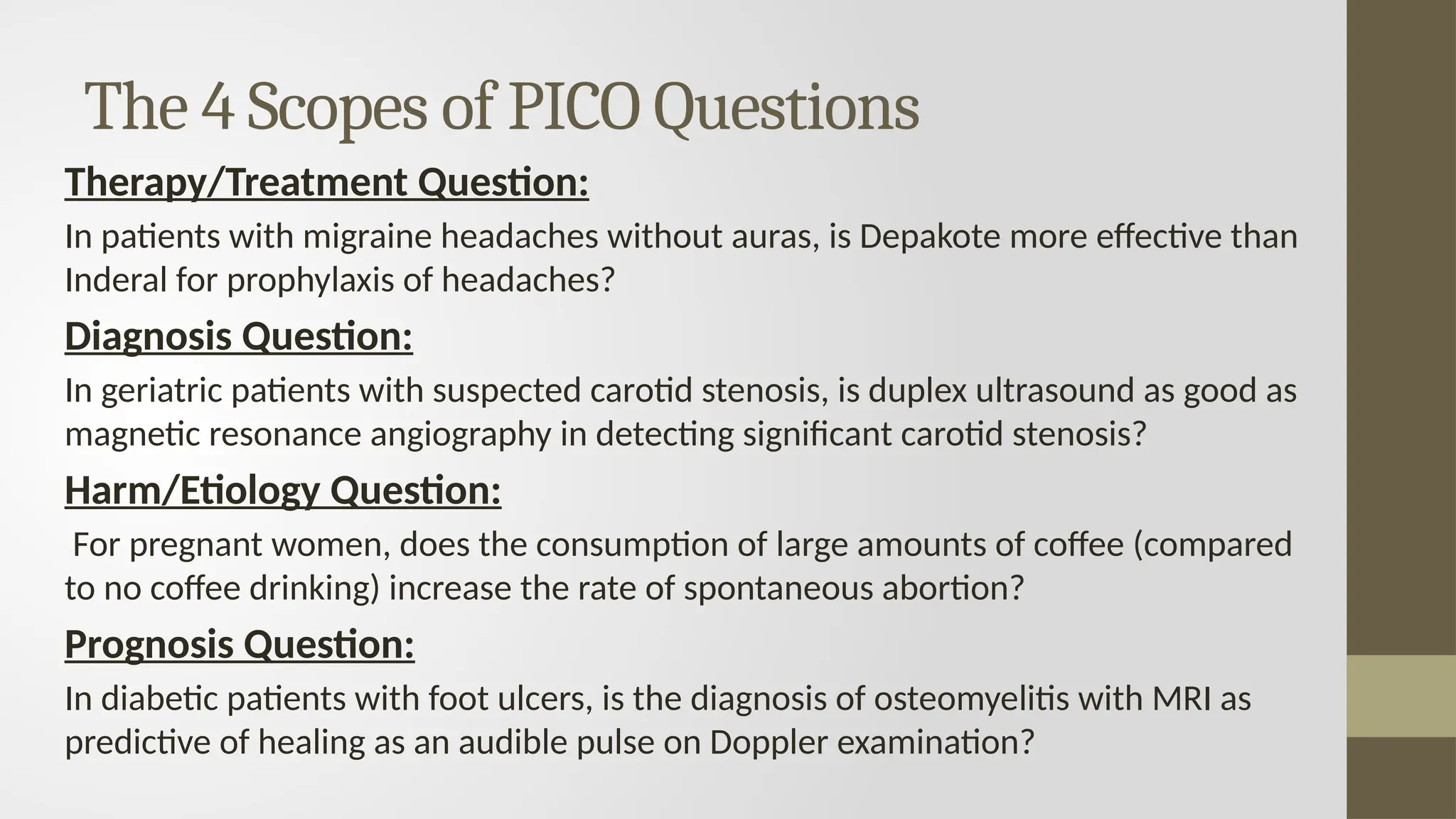
The 4 Scopesof PICO Questions
Therapy/Treatment Question:
In patients with migraine headaches without auras, is Depakote more effective than
Inderal for prophylaxis of headaches?
Diagnosis Question:
In geriatric patients with suspected carotid stenosis, is duplex ultrasound as good as
magnetic resonance angiography in detecting significant carotid stenosis?
Harm/Etiology Question:
For pregnant women, does the consumption of large amounts of coffee (compared
to no coffee drinking) increase the rate of spontaneous abortion?
Prognosis Question:
In diabetic patients with foot ulcers, is the diagnosis of osteomyelitis with MRI as
predictive of healing as an audible pulse on Doppler examination?
20.
Example:Case 1
A patientwho is found to be HCV RNA positive. His liver biopsy
reveals periportal inflammation, some piecemeal necrosis and early
fibrosis. He wants to know whether a combination therapy of
interferon with ribavirin really offer much more chance of viral
clearance than interferon alone.
21.
The clinical question:
Ina patient who is HCV RNA positive, does treatment with
interferon + ribavirin, compared to interferon alone
offer a significant chance of viral clearance?
22.
Step 2 :identify keywords & synonyms
We need to make sure we cover all possible ways the concept could
appear in the literature, so we don’t miss important papers.
1. Extract Core Concepts
Look at your PICO question,Pull out the main ideas (Patient,
Intervention, Comparison, Outcome).
•Example: pneumonia, co-amoxiclav, azithromycin, treatment
failure.
in adults with community-acquired
pneumonia, is co-amoxiclav compared
with azithromycin more effective in
reducing treatment failure?
23.
2. Brainstorm Synonyms,Abbreviations, Variations
Authors may use different words for the same idea.
•To find alternative keywords or phrases for your concepts try the
following:
Use a thesaurus to identify synonyms.https://www.thesaurus.com/
Search for your concepts on a search engine like Google Scholar,
scanning the results for alternative words and phrases.
Example:
Pneumonia → “lung infection”, CAP
Co-amoxiclav → “amoxicillin-clavulanate”, Augmentin
Azithromycin → “macrolide”
Include US/UK spellings: “behavior” vs “behaviour”.
Include abbreviations: “MI” for “Myocardial Infarction”.
24.
• 3. UseTruncation & Wildcards
• Truncation (*) = captures different word endings.(useful for finding
singular and plural forms of words )
• therap* → therapy, therapies, therapist.
• Wildcard (?) = captures spelling variations.( useful for finding
British and American spellings)
• behavio?r → behavior OR behaviour.
• •There are sometimes different symbols to find a variable single
character. For example, in the Medline database, “wom#n” will
find woman and also women.
25.
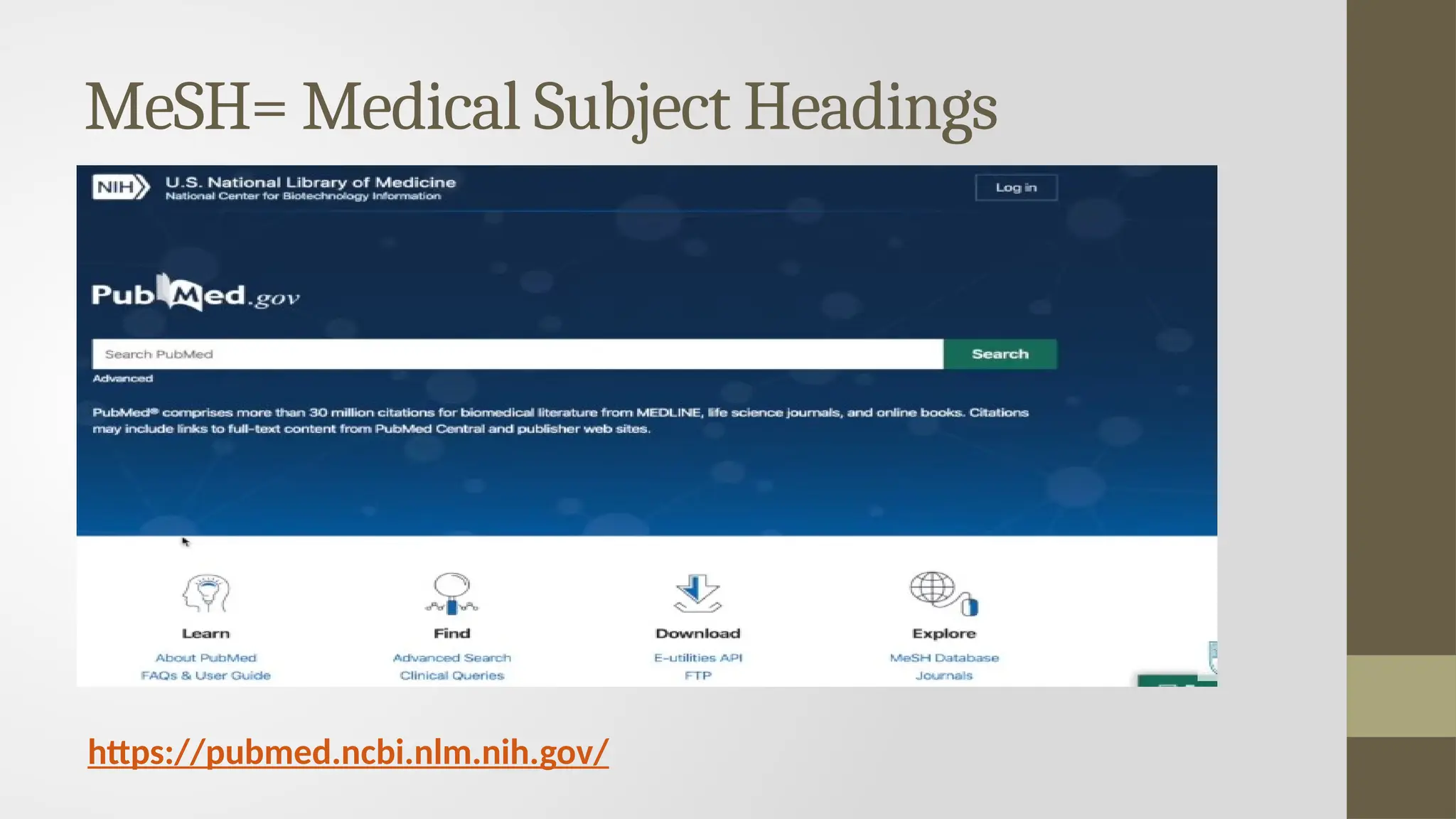
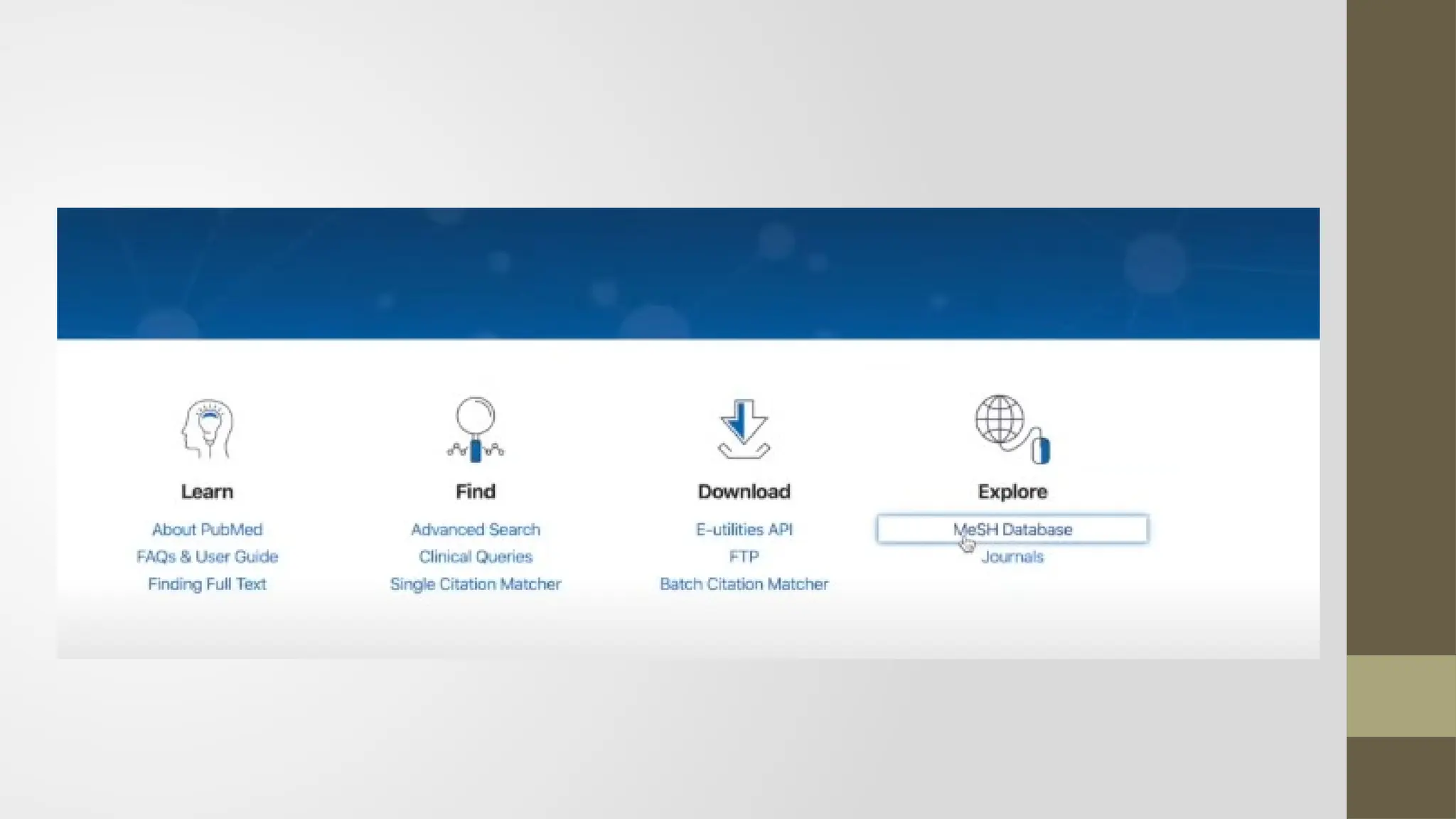
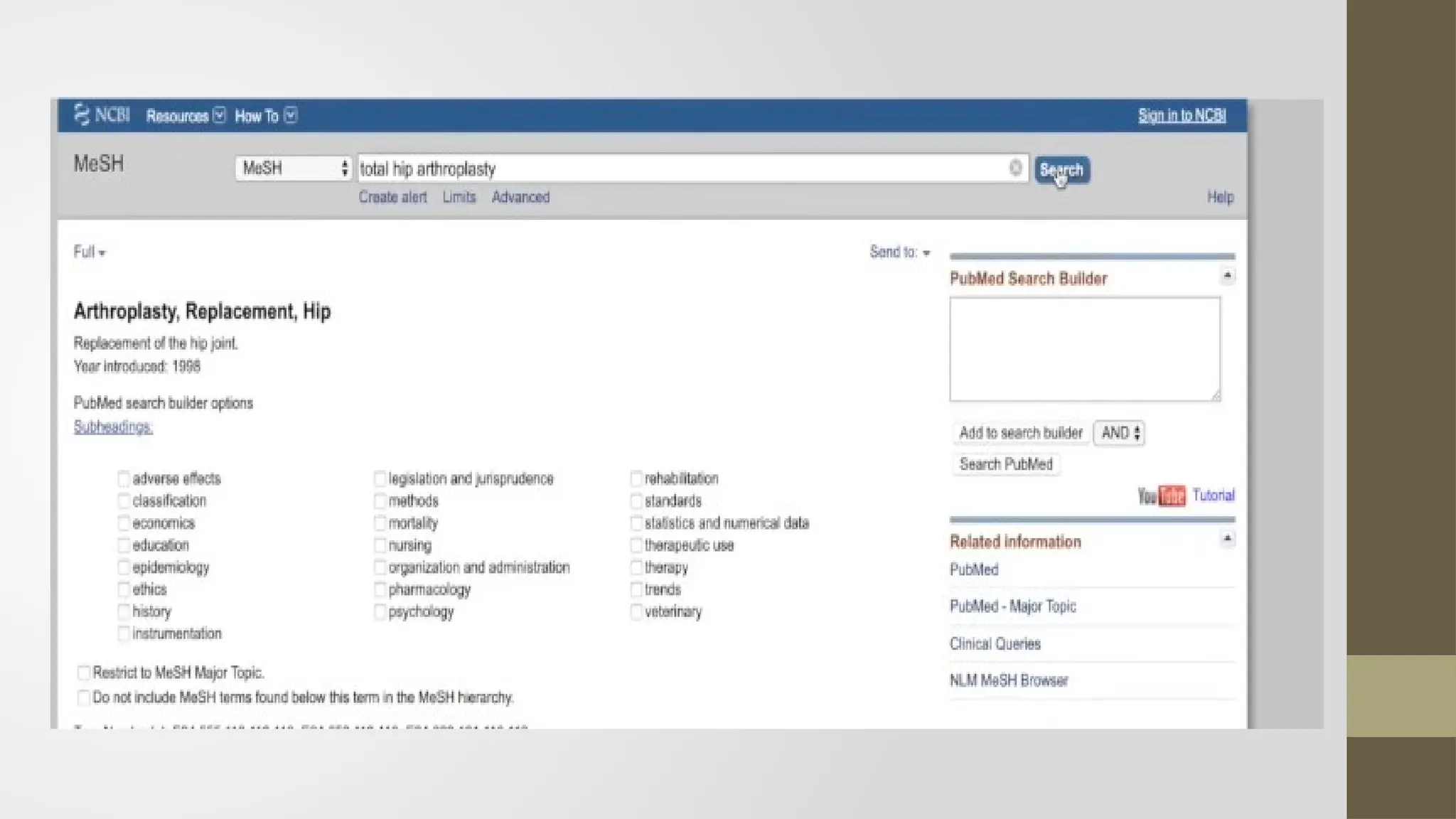
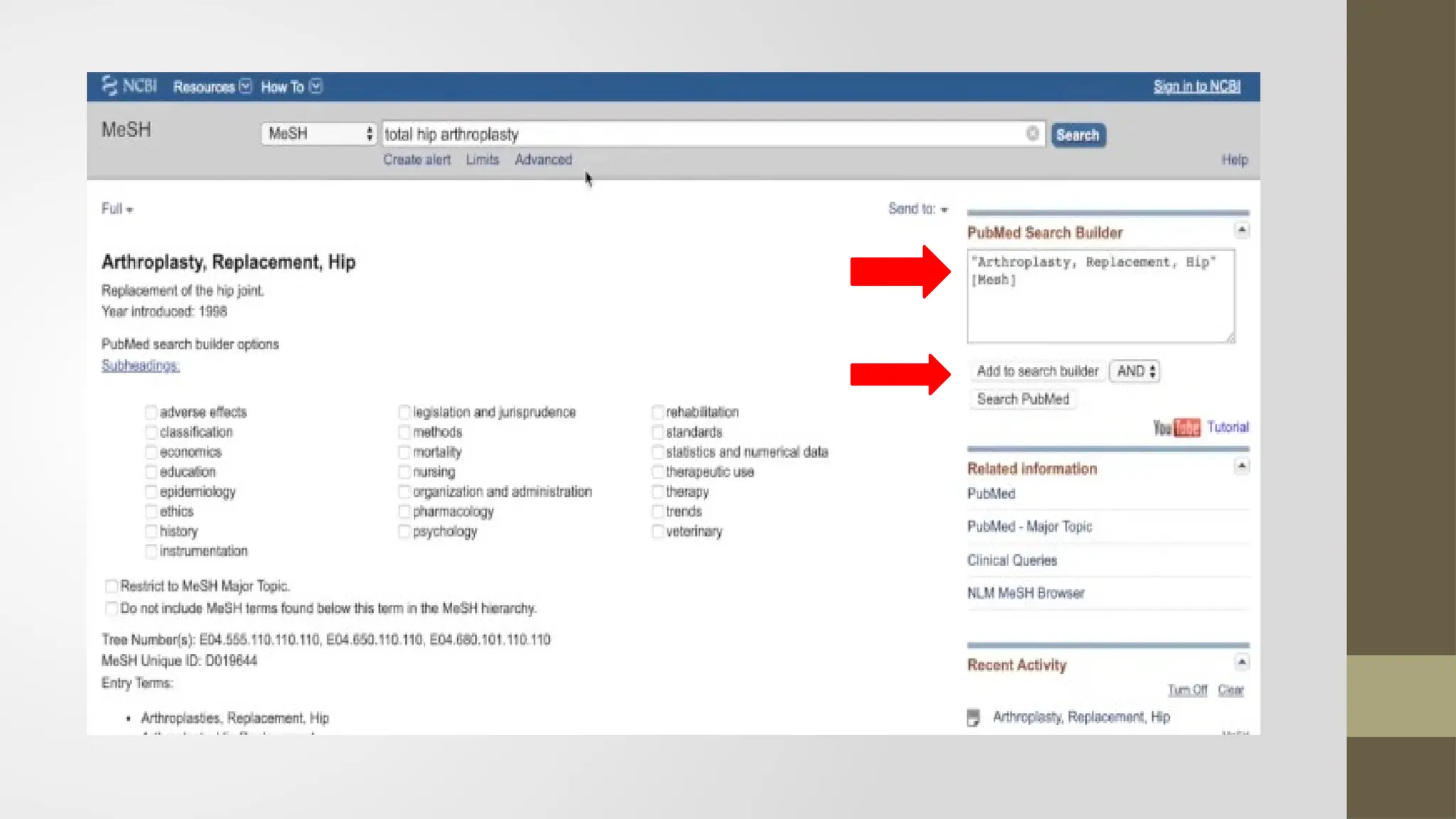
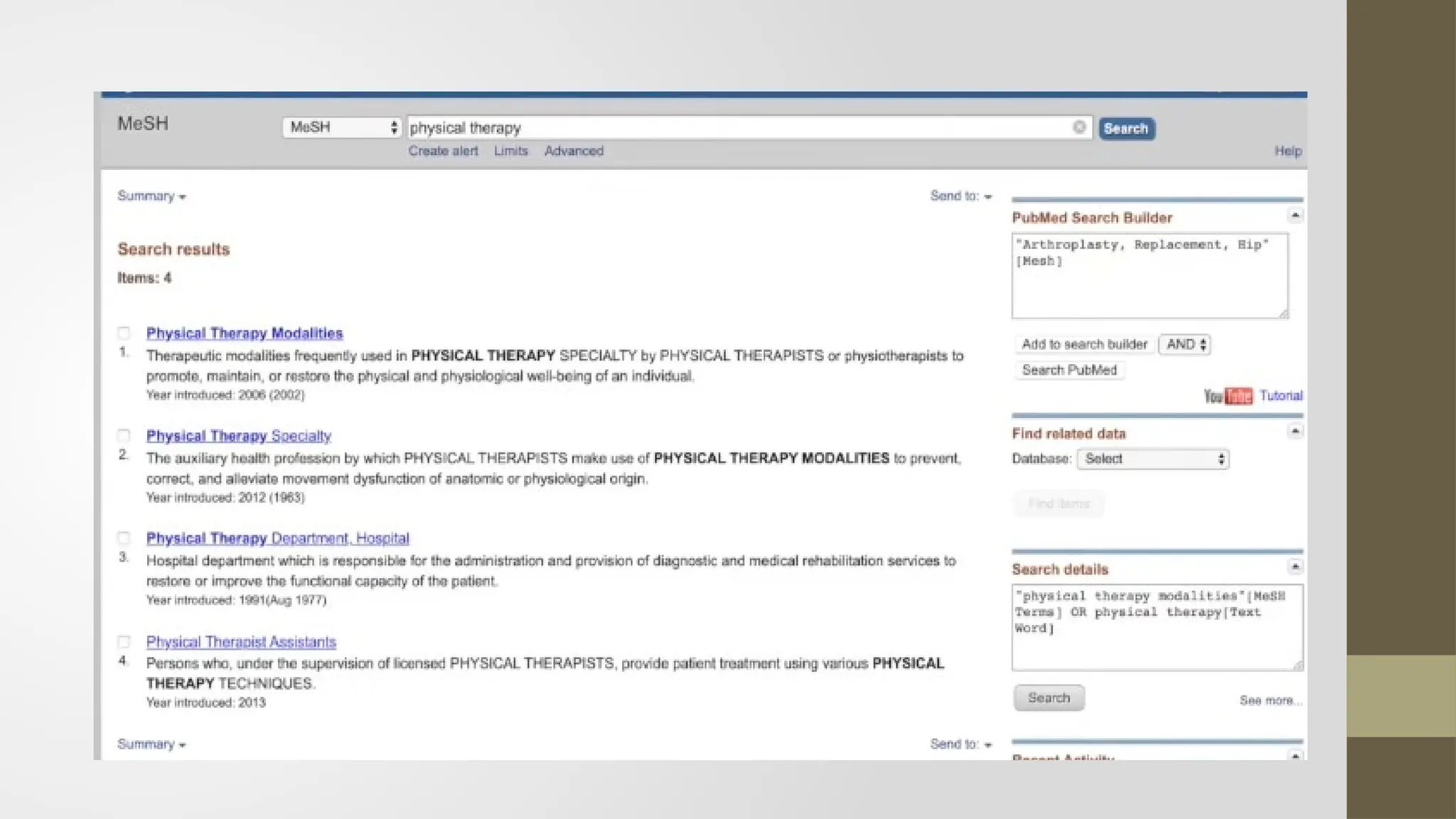
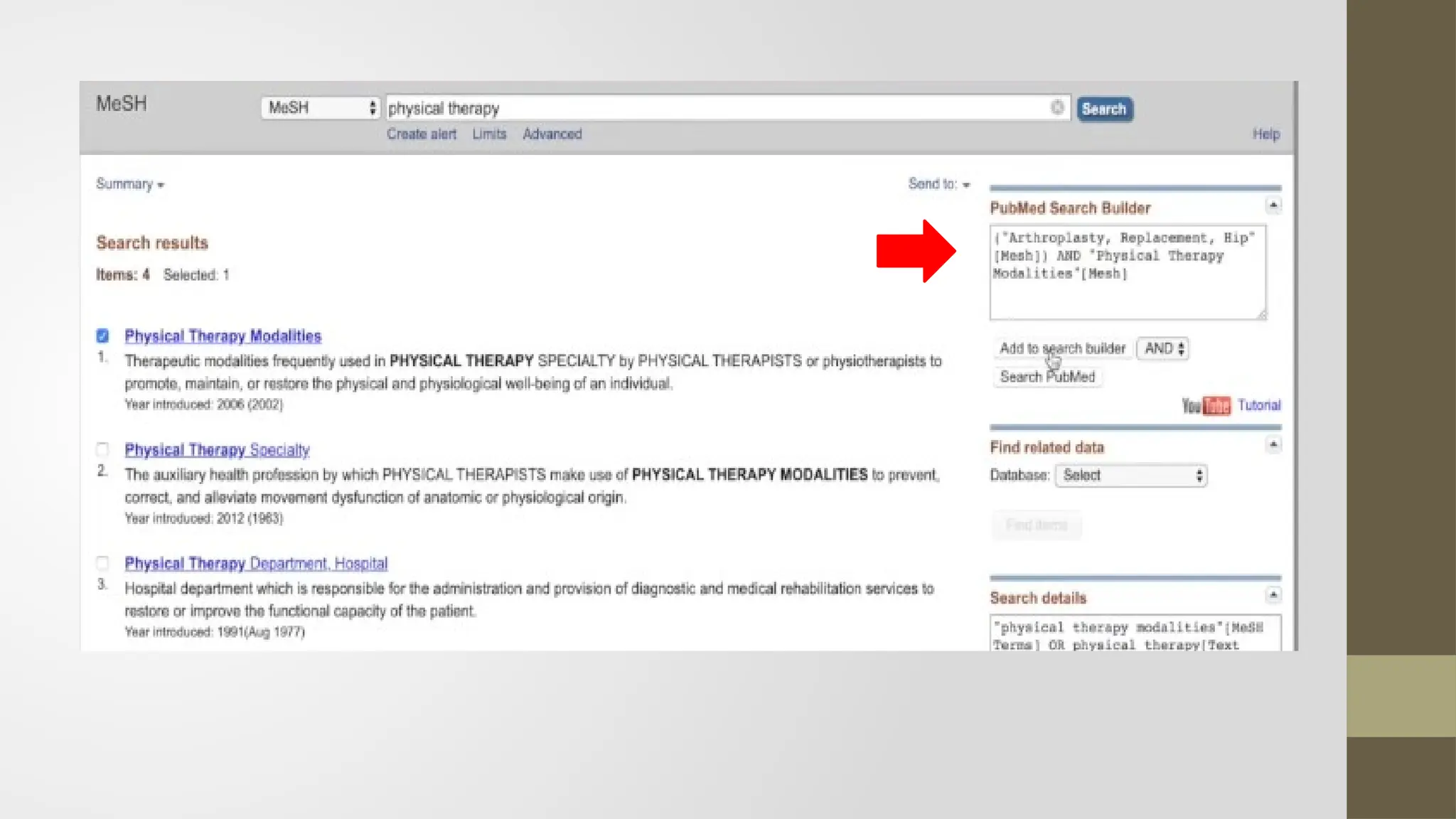
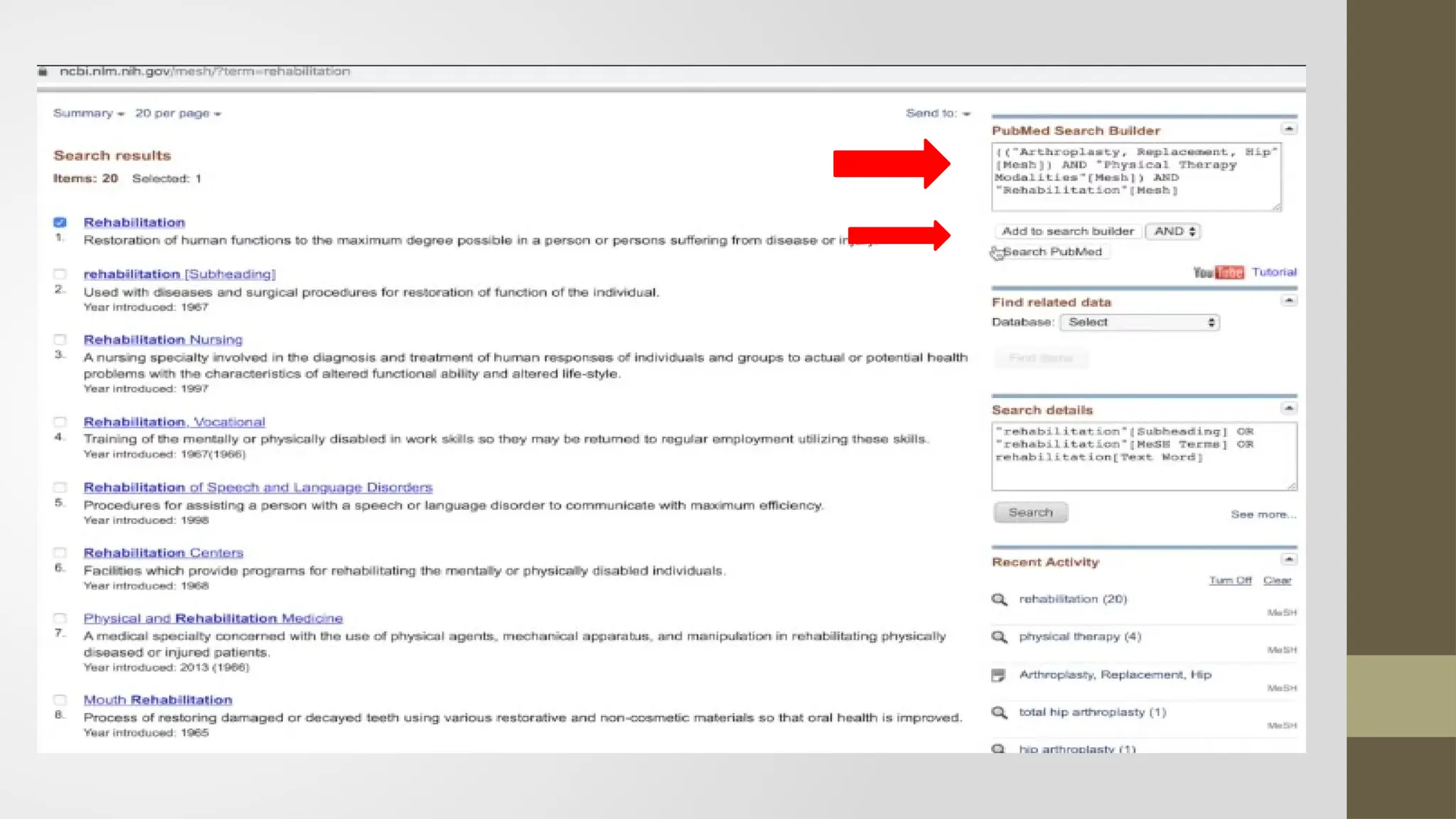
MeSH= Medical SubjectHeadings
•https://www.nlm.nih.gov/mesh/meshhome.html
•It is the National Library of Medicine's controlled hierarchical
vocabulary that is used for indexing articles in PubMed, with more
specific terms organised underneath more general terms. It is
indexed Keywords specific for PubMed articles
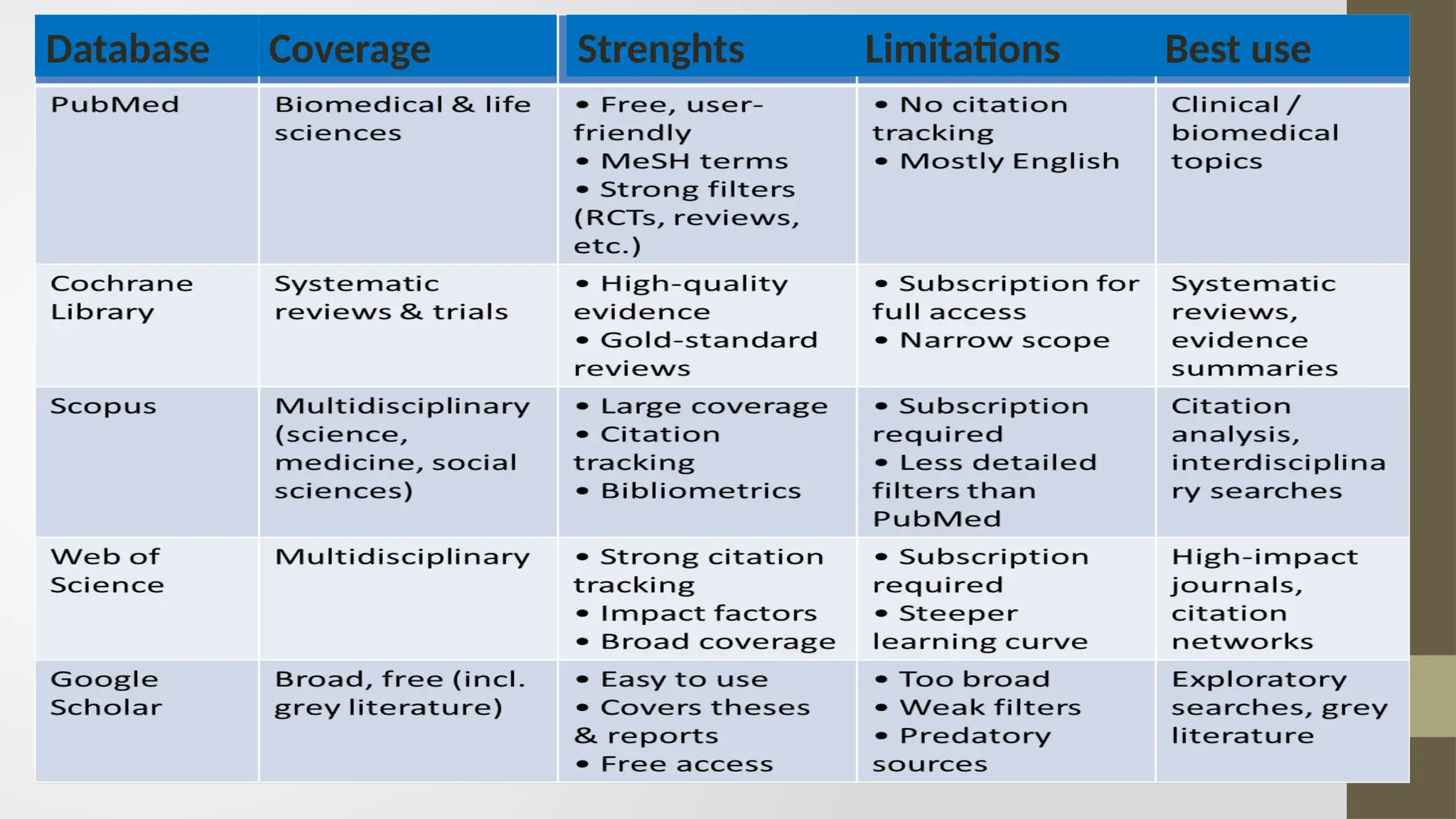
Step 3 :choose database
• There is a wide variety of search platforms and databases available
for public access.
• Depending on the publisher, some literature pieces are open-access,
so you can view and download the original articles without a
subscription,With others you will only be able to view the abstracts
or portions thereof, and you must pay a subscription or library fee for
access to the full text.
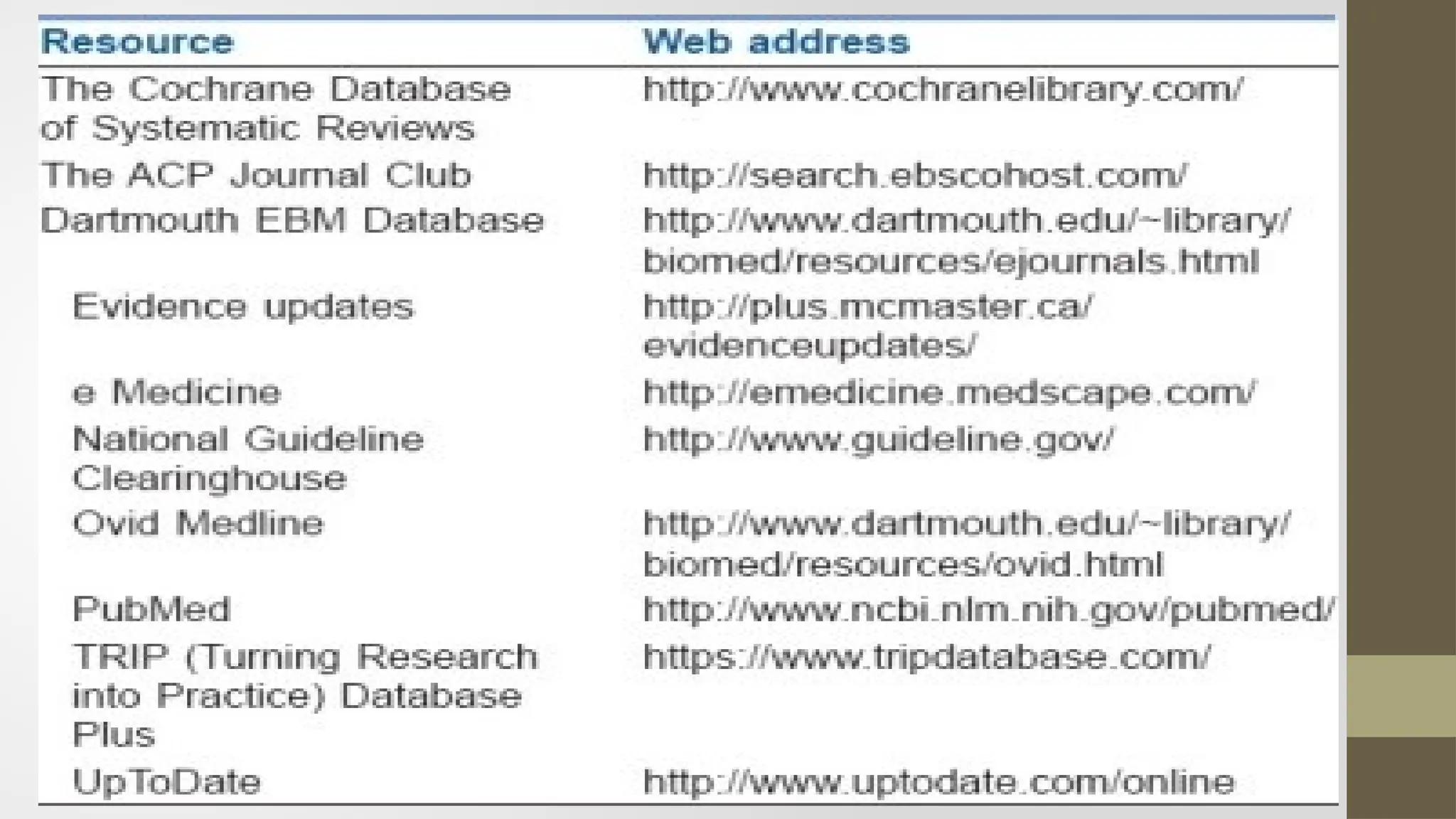
• Example of search platforms and databases
Cochrane Library -Google Scholar –MEDLINE -Ovid EmCare -PubMed
ScienceDirect -Scopus – Web of Science
Step 4 :Developa search strategy (boolen)
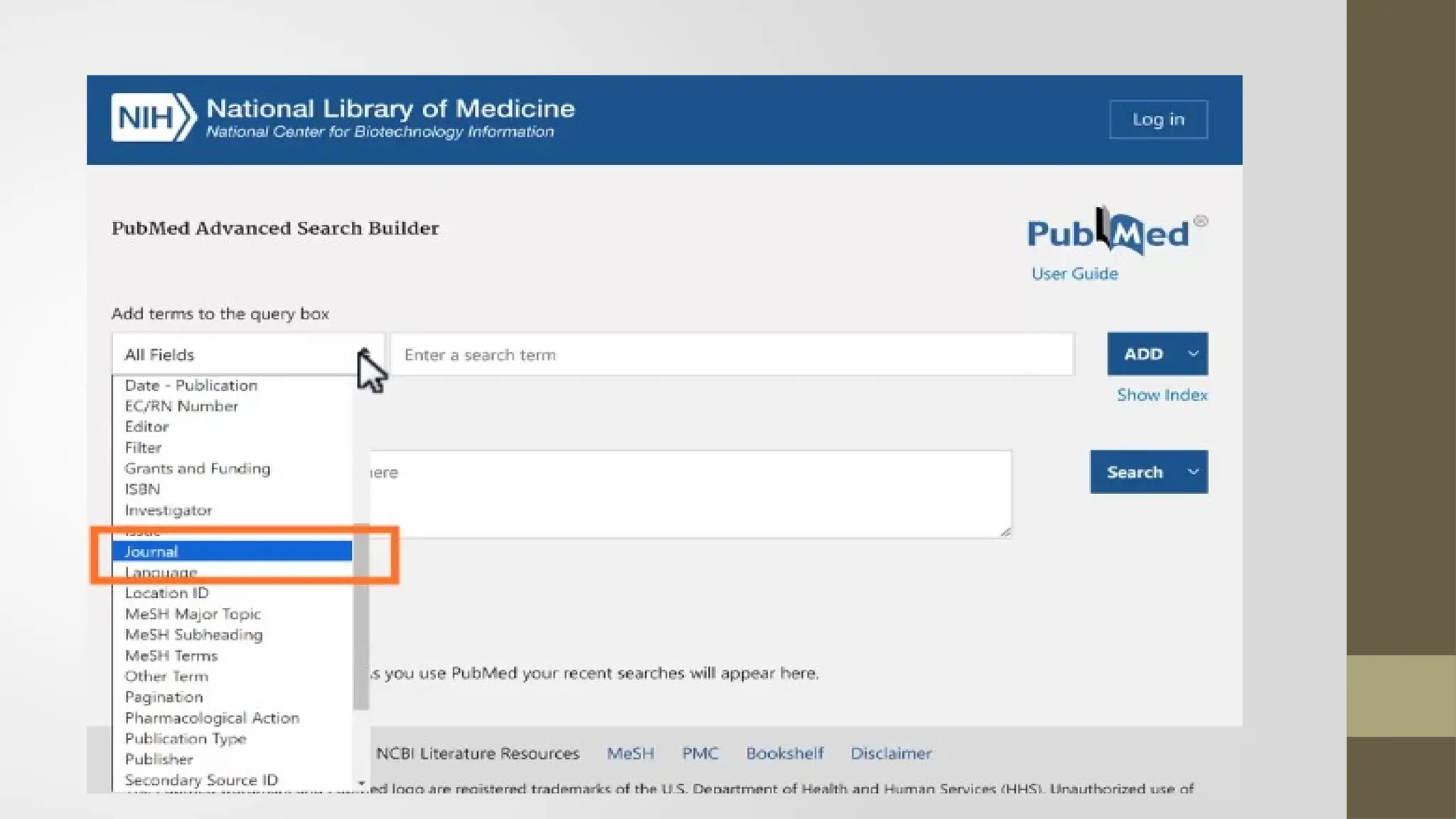
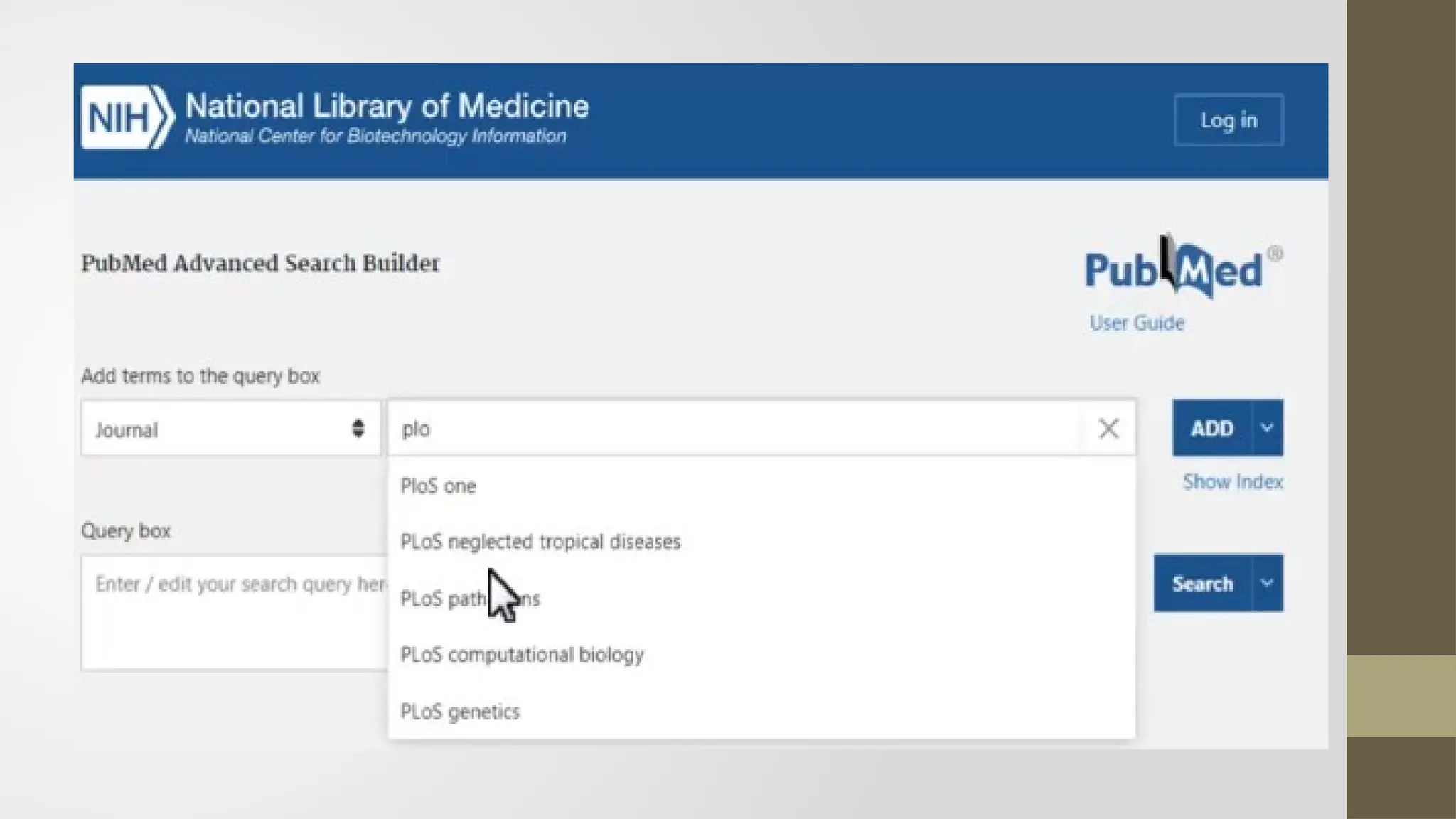
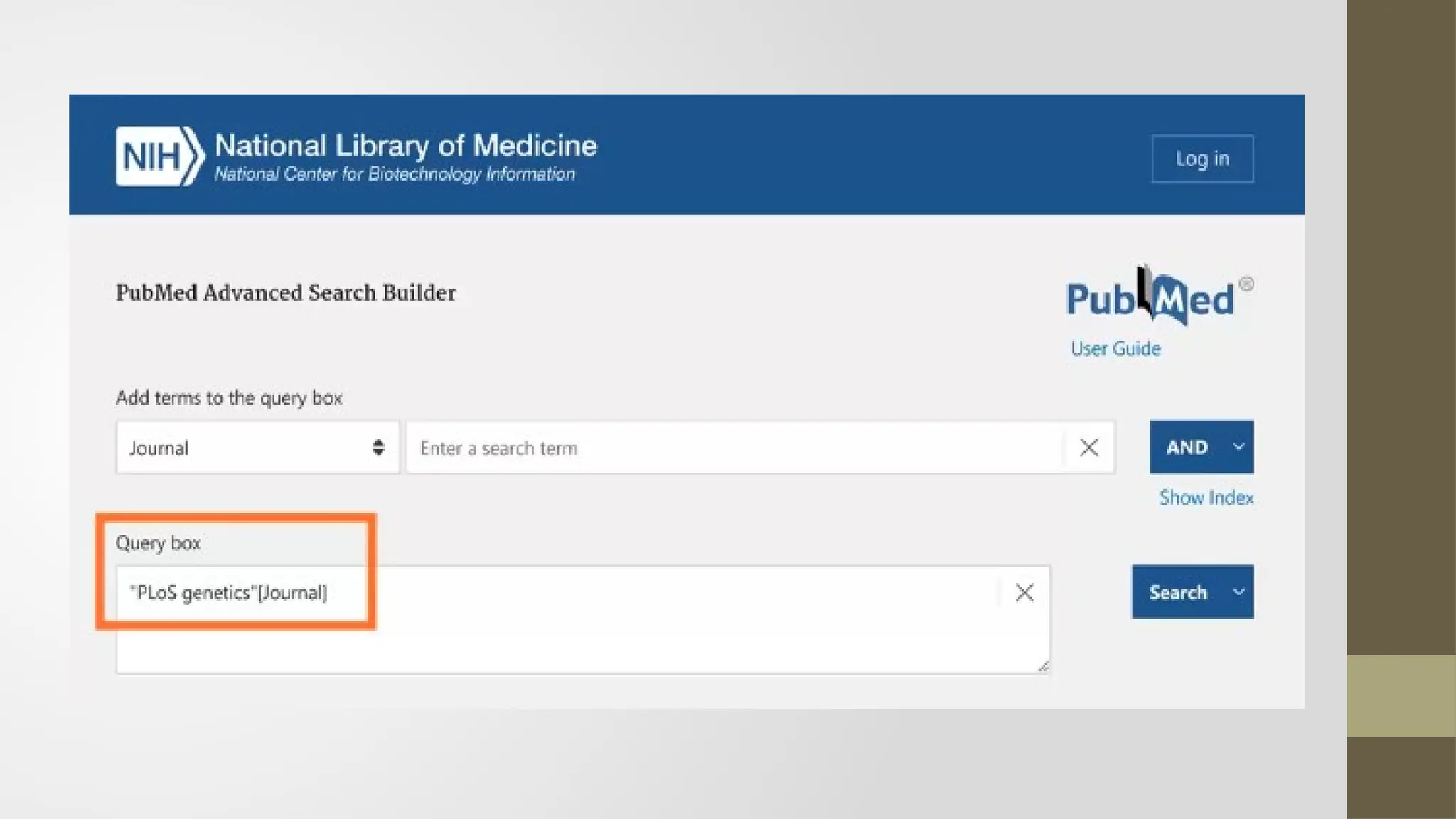
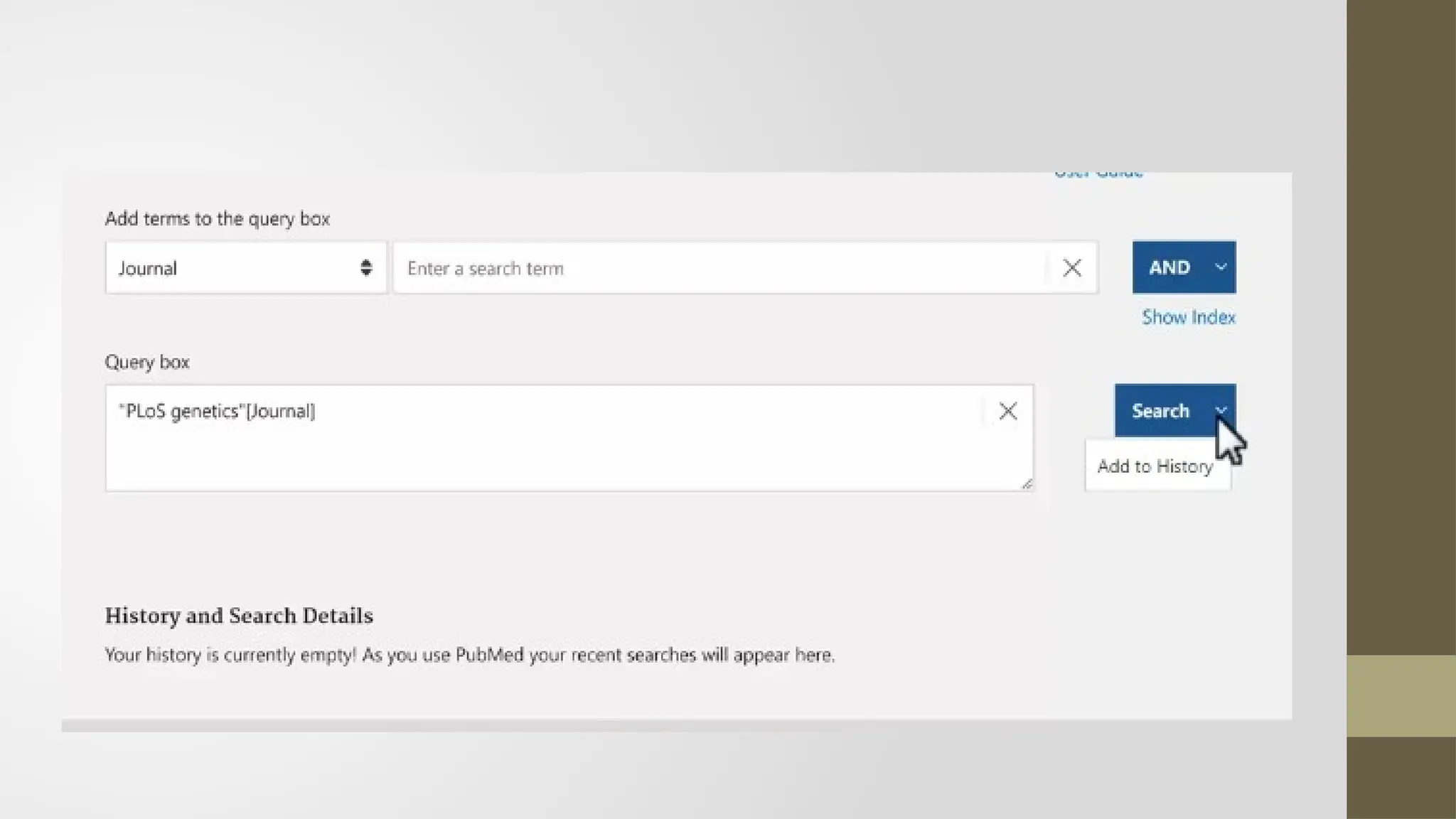
Each database works differently so you need to adapt your search
strategy for each database. You may wish to develop a number of
separate search strategies if your research covers several different areas.
•You can use the following techniques which are used to find scientific
papers.
•Choosing search terms (discussed before)
•Searching with keywords (discussed before)
•Searching for exact phrases
•Using Limiters/Filters(discussed later)
•Using truncated and wildcard searches (discussed before)
•Using Boolean logic
39.
Searching for exactphrases
Use quotation marks (") to bind terms as phrases (words to appear
next to each other in a exact phrase)
Example: “self-esteem”.
Phrase searching decreases the number of results you get and
makes your results more relevant. Most databases allow you to
search for phrases, but check the database guide if you are unsure.
40.
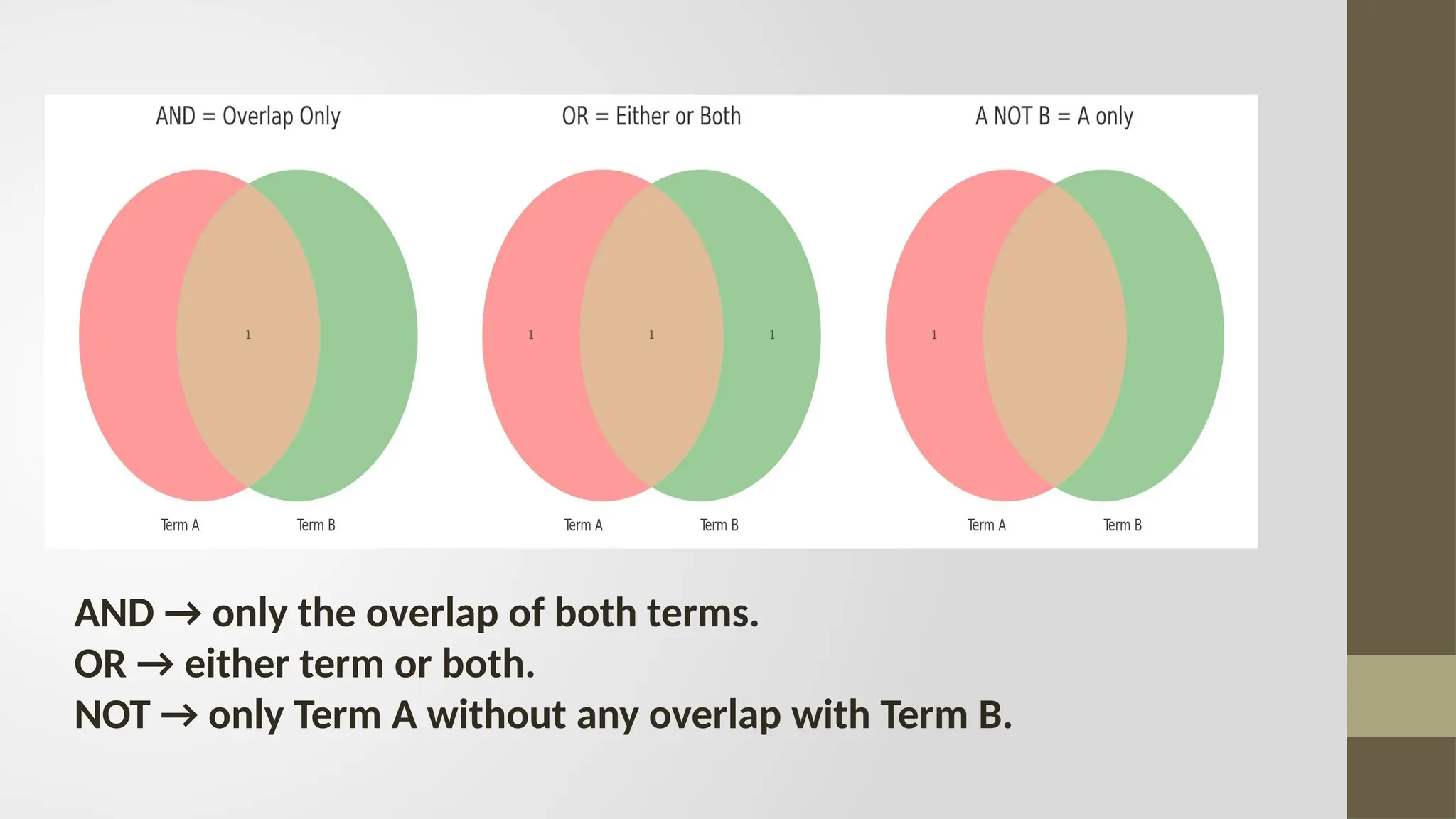
Using Boolean logic
Boolean logic defines logical relationships between terms in a search
Boolean operators (AND, OR and NOT) allow you to try different
combinations of search terms or subject headings.
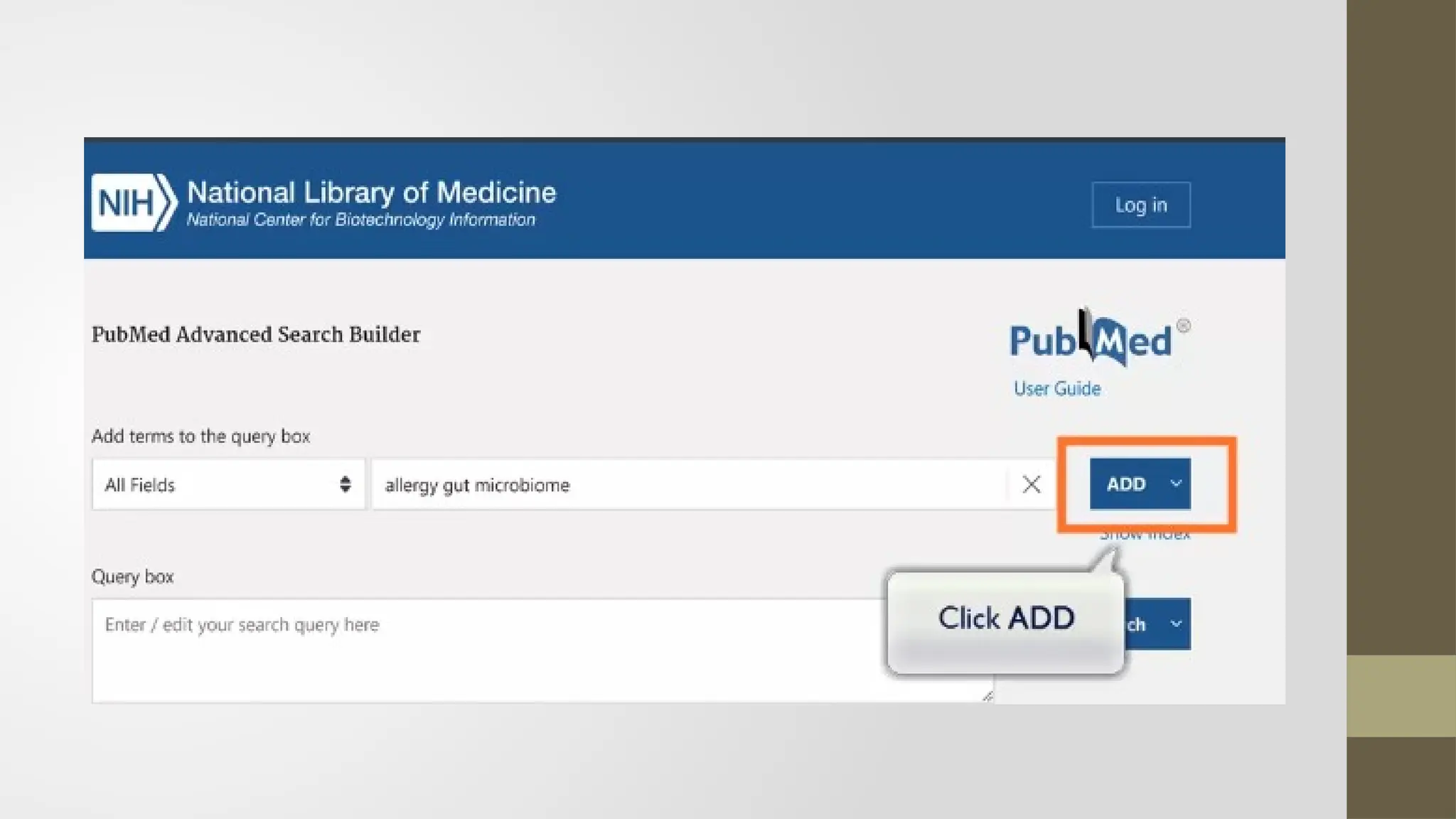
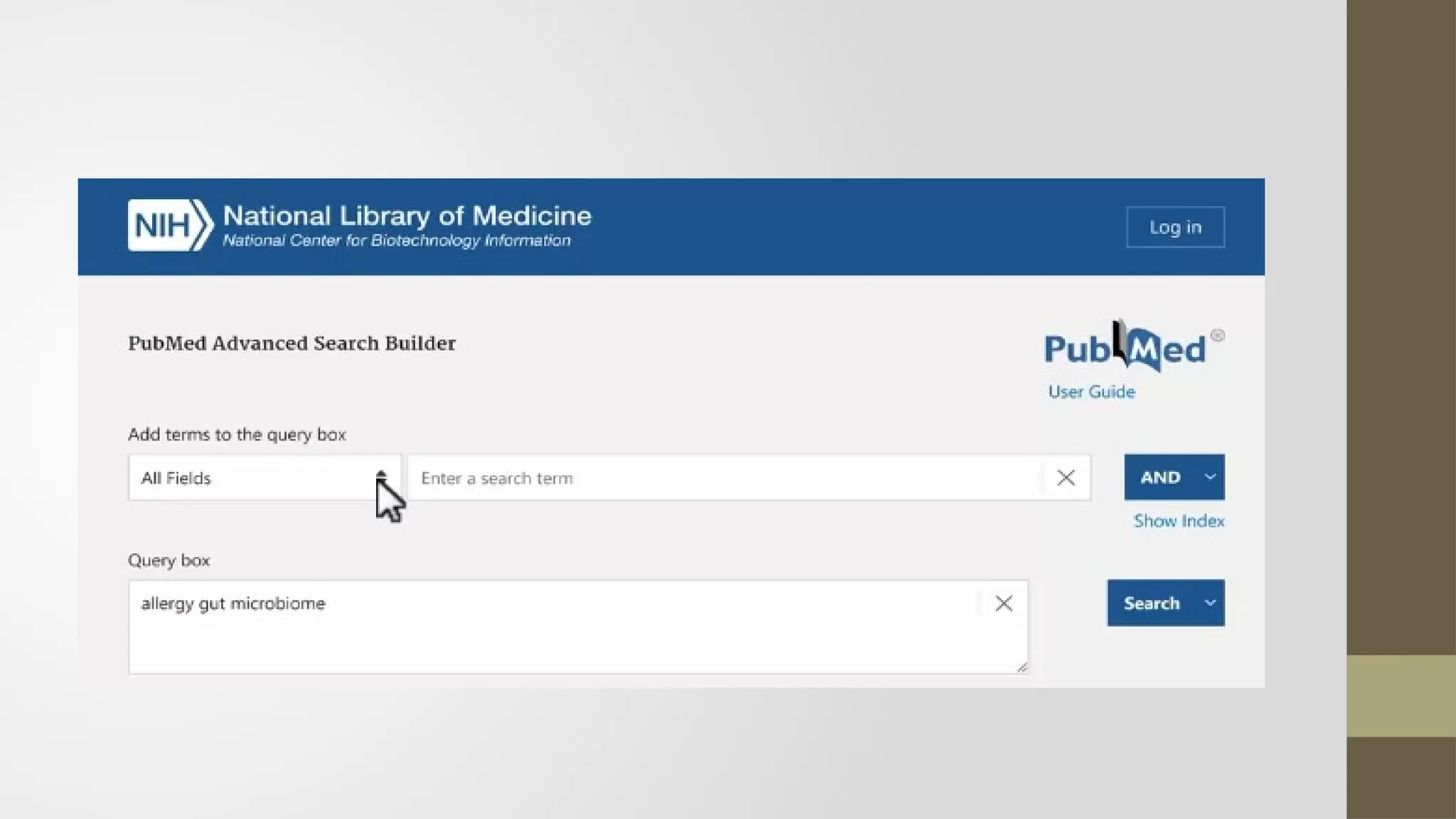
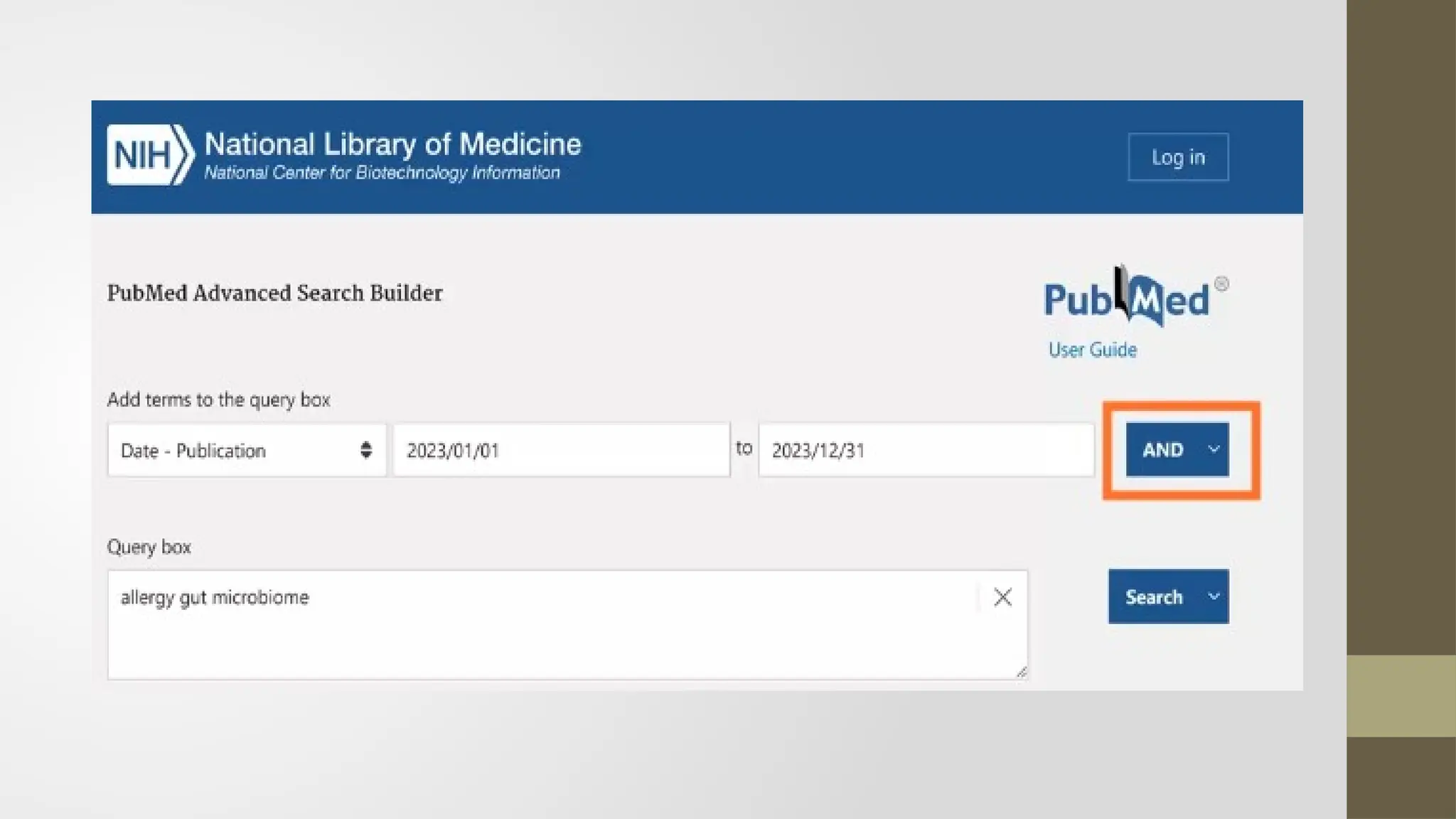
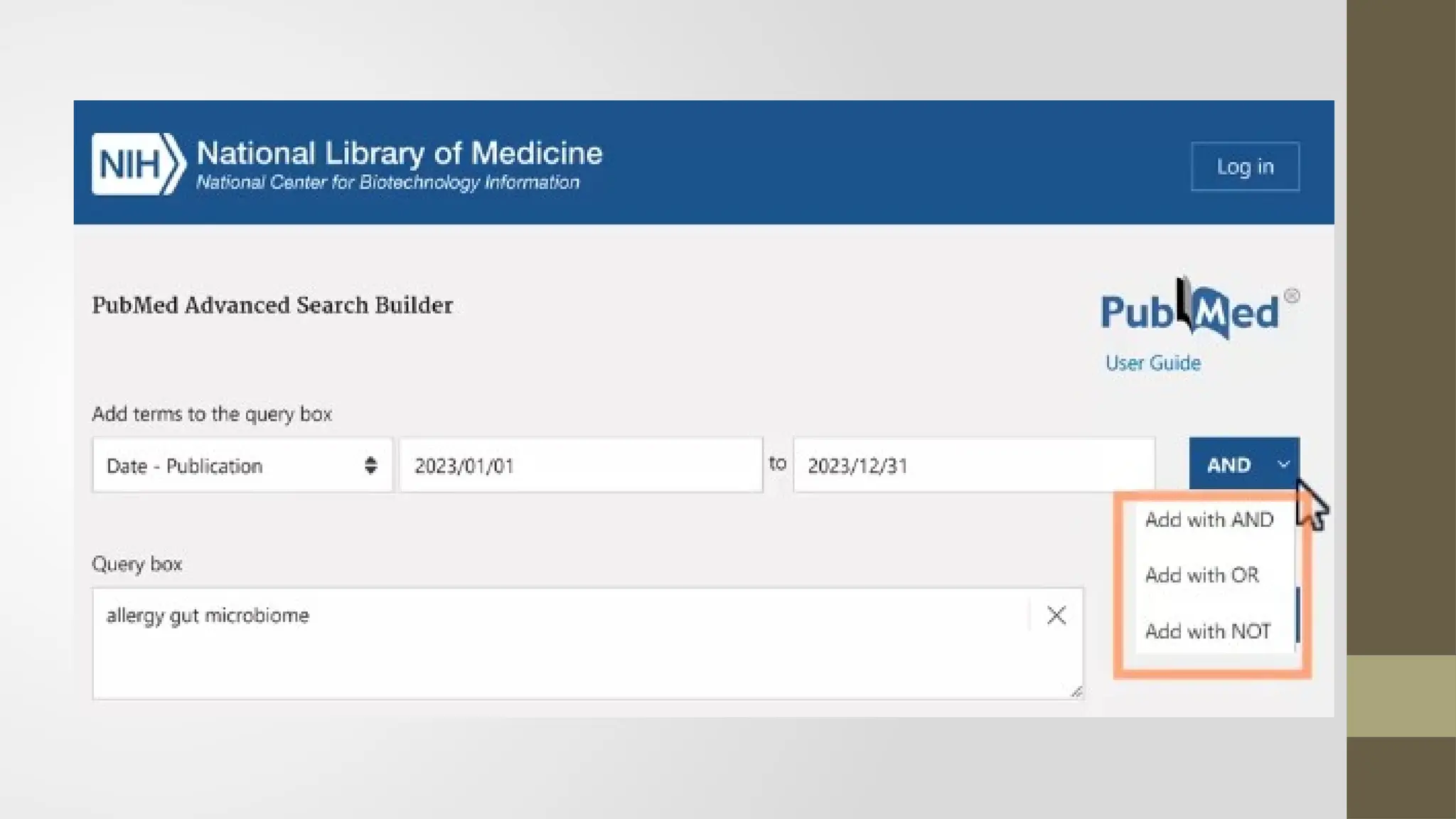
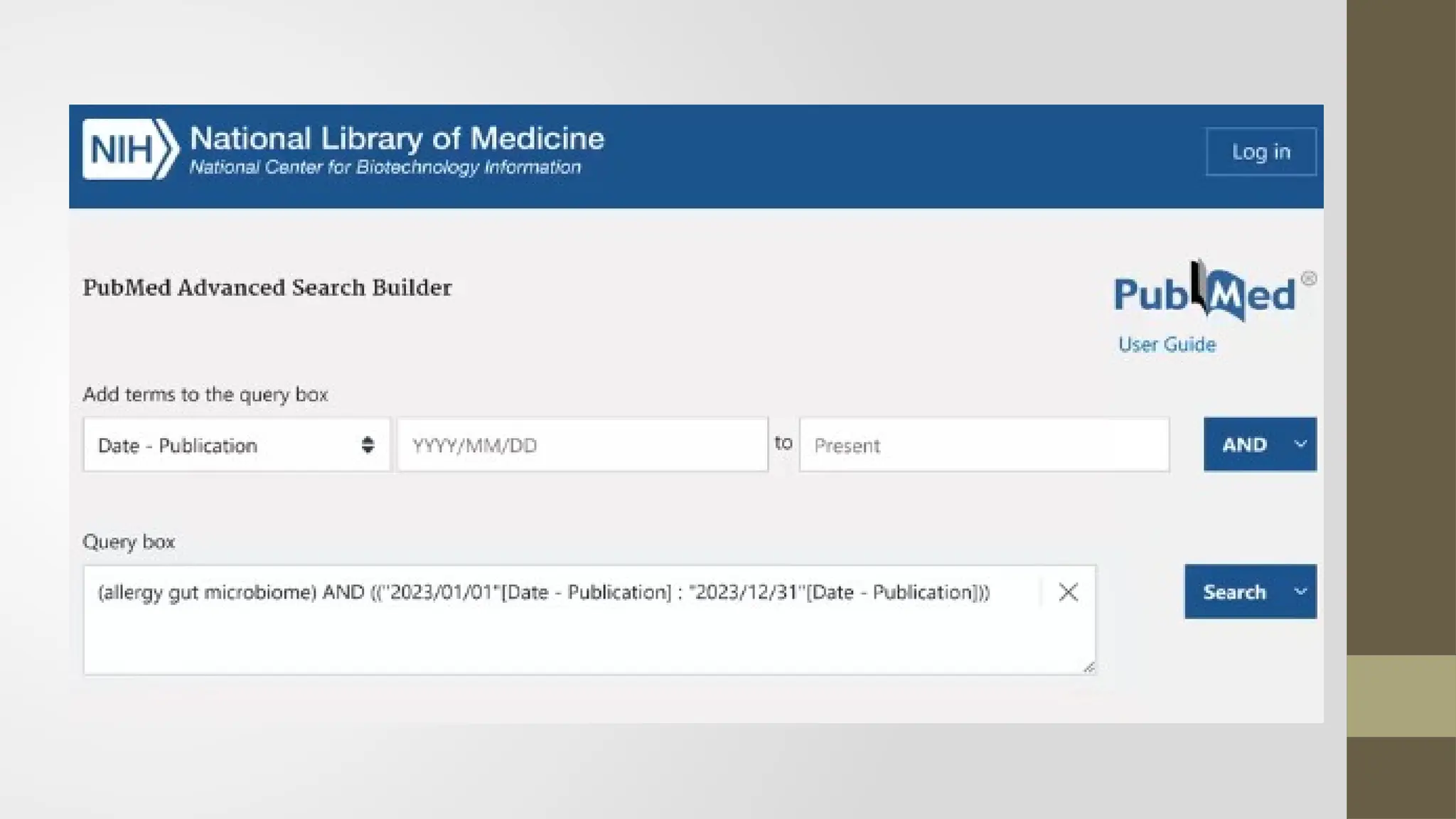
Databases often show Boolean operators as buttons or drop-down
menus that you can click to combine your search terms or results.
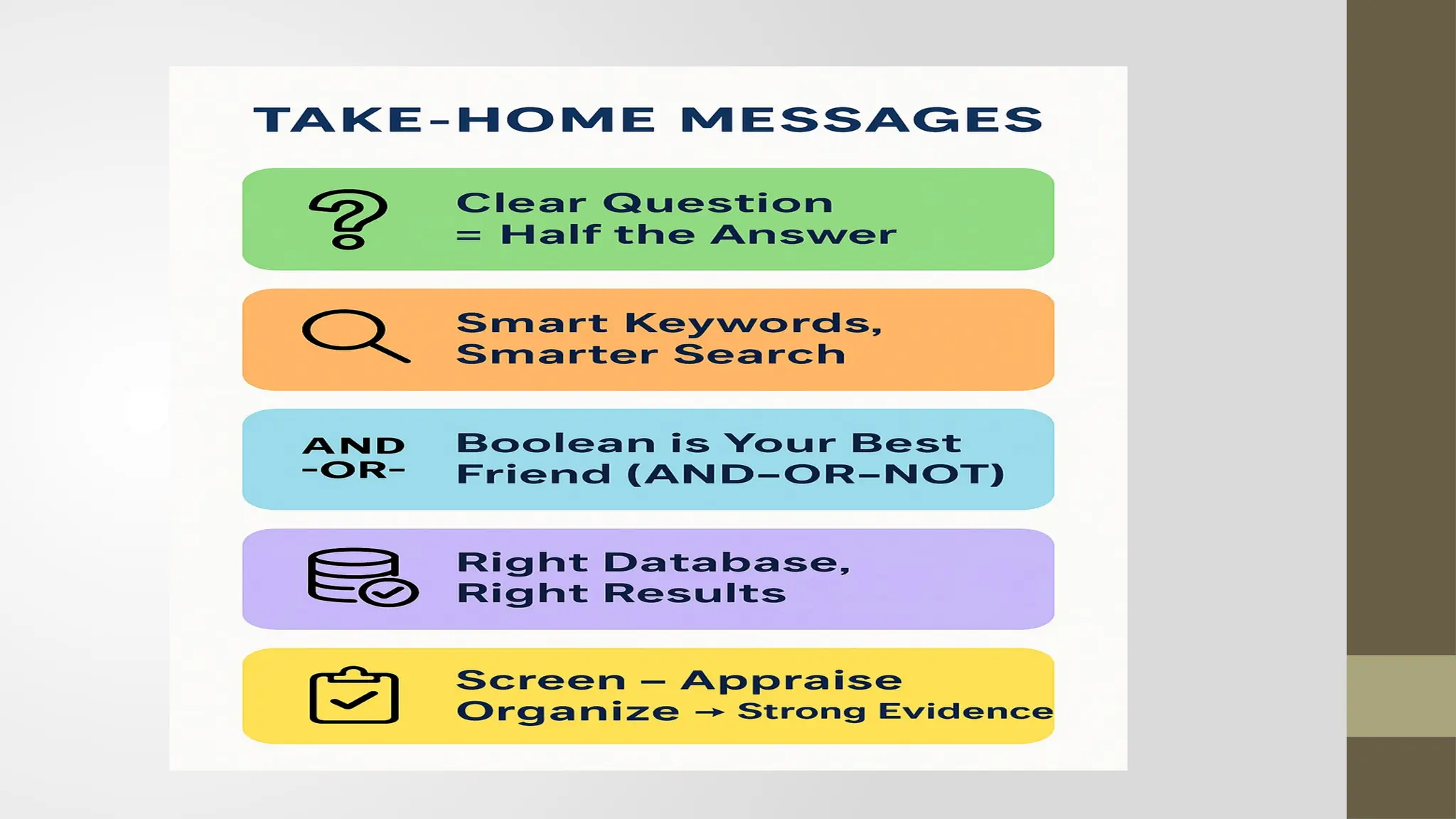
•The main Boolean operators are:OR – AND - NOT
1.AND
•Narrows the search → retrieves results containing all the specified
terms.
Ex, diabetes AND hypertension
→ Finds articles that discuss both diabetes and hypertension.
41.
2.OR
•Broadens the search→ retrieves results containing any of the
specified terms (useful for synonyms).
Ex,adolescent OR teenager OR youth
Finds articles mentioning any of these words.
3.NOT
•Excludes specific terms → useful to filter out irrelevant results
Ex,cancer NOT lung
Finds articles about cancer, but excludes those about lung cancer
So, Boolean operators are essential in research searching because
they help make your results more specific, comprehensive, and
relevant.
42.
AND → onlythe overlap of both terms.
OR → either term or both.
NOT → only Term A without any overlap with Term B.
Step 5 :run search & apply filters :
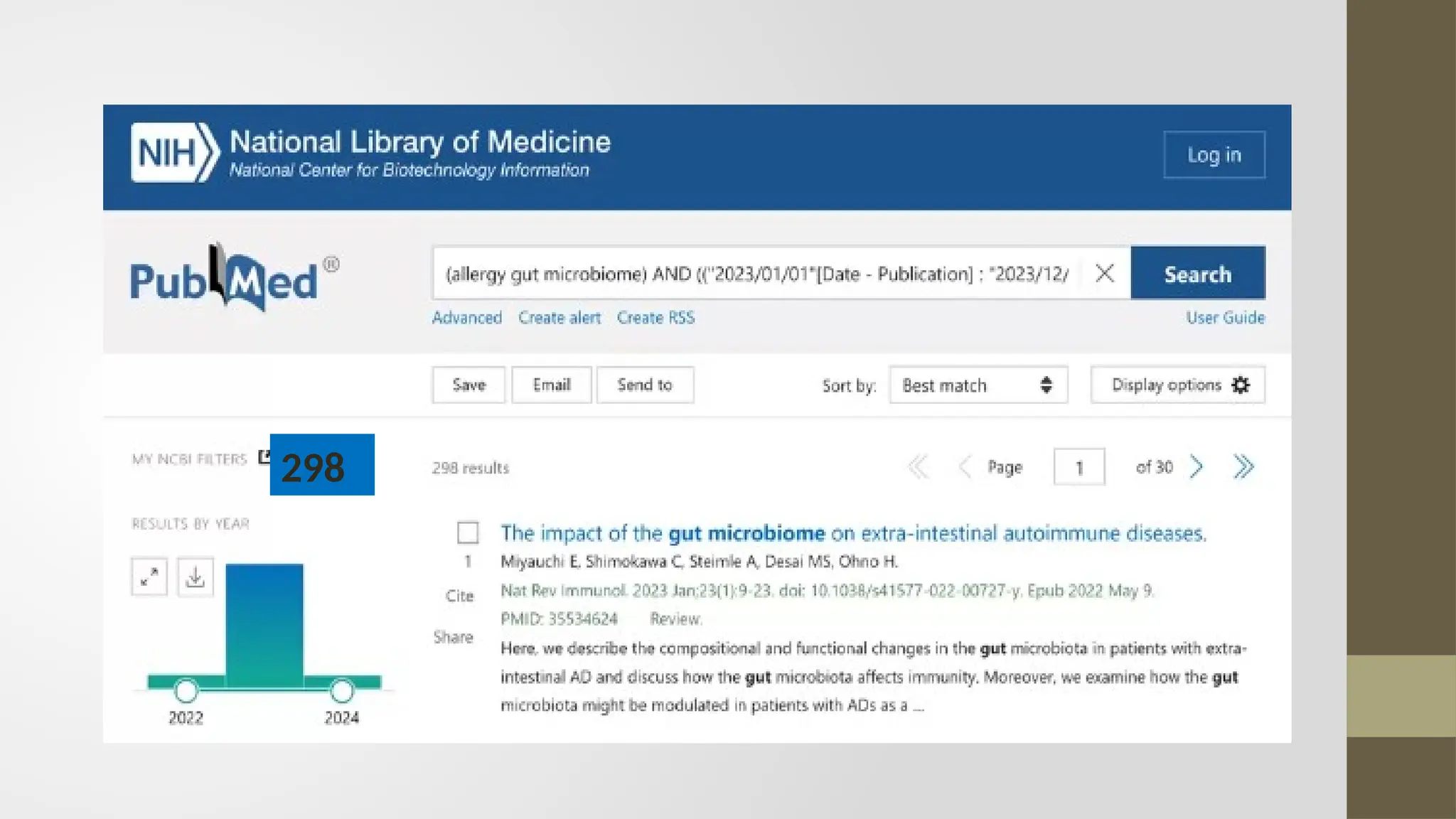
Searches can often produce large numbers of results (papers). This may be an
appropriate number for a systematic review, where you need to ensure your
search is very comprehensive.
However, if your search retrieves several irrelevant results, techniques can be
used make your search more effective
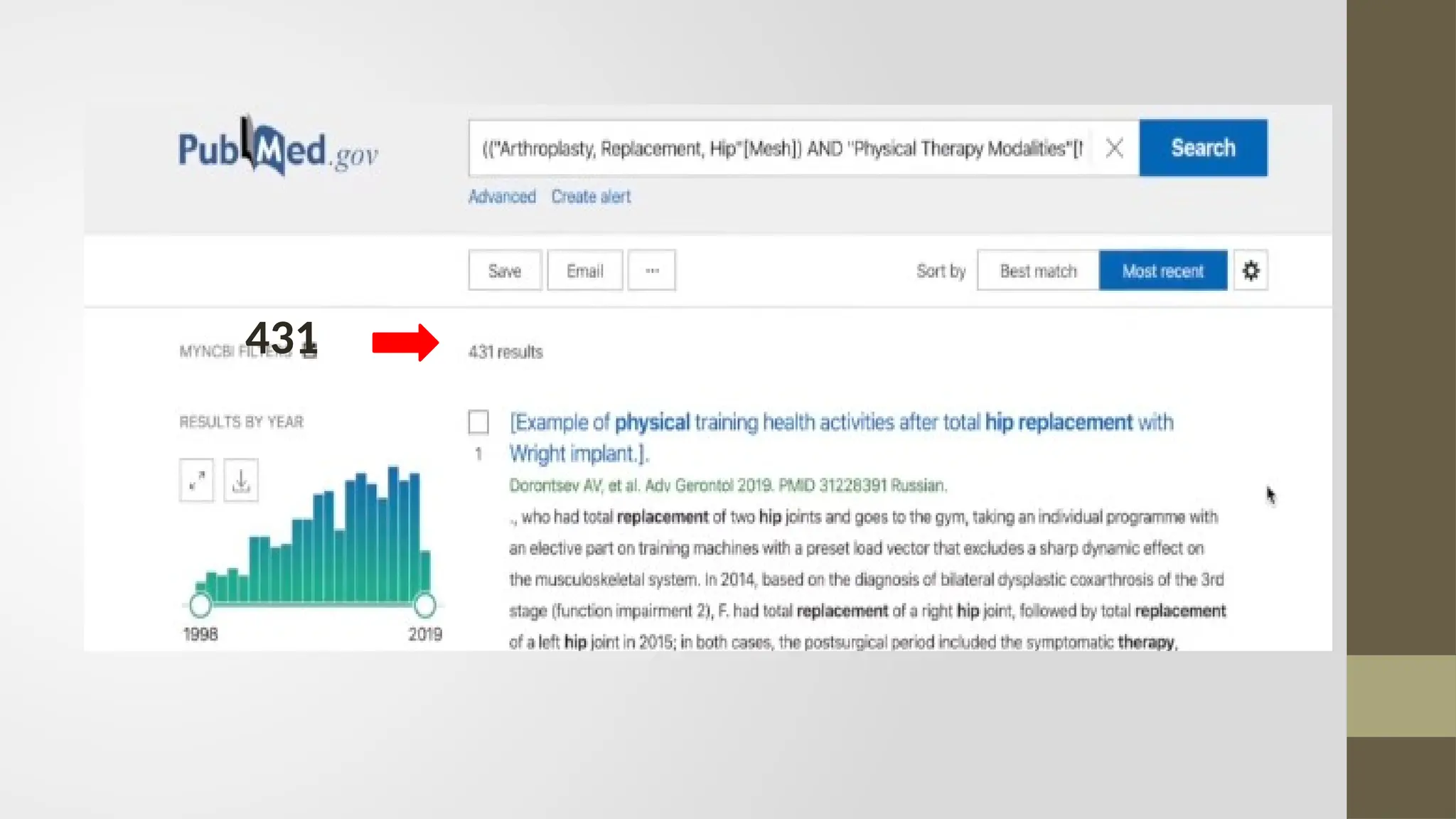
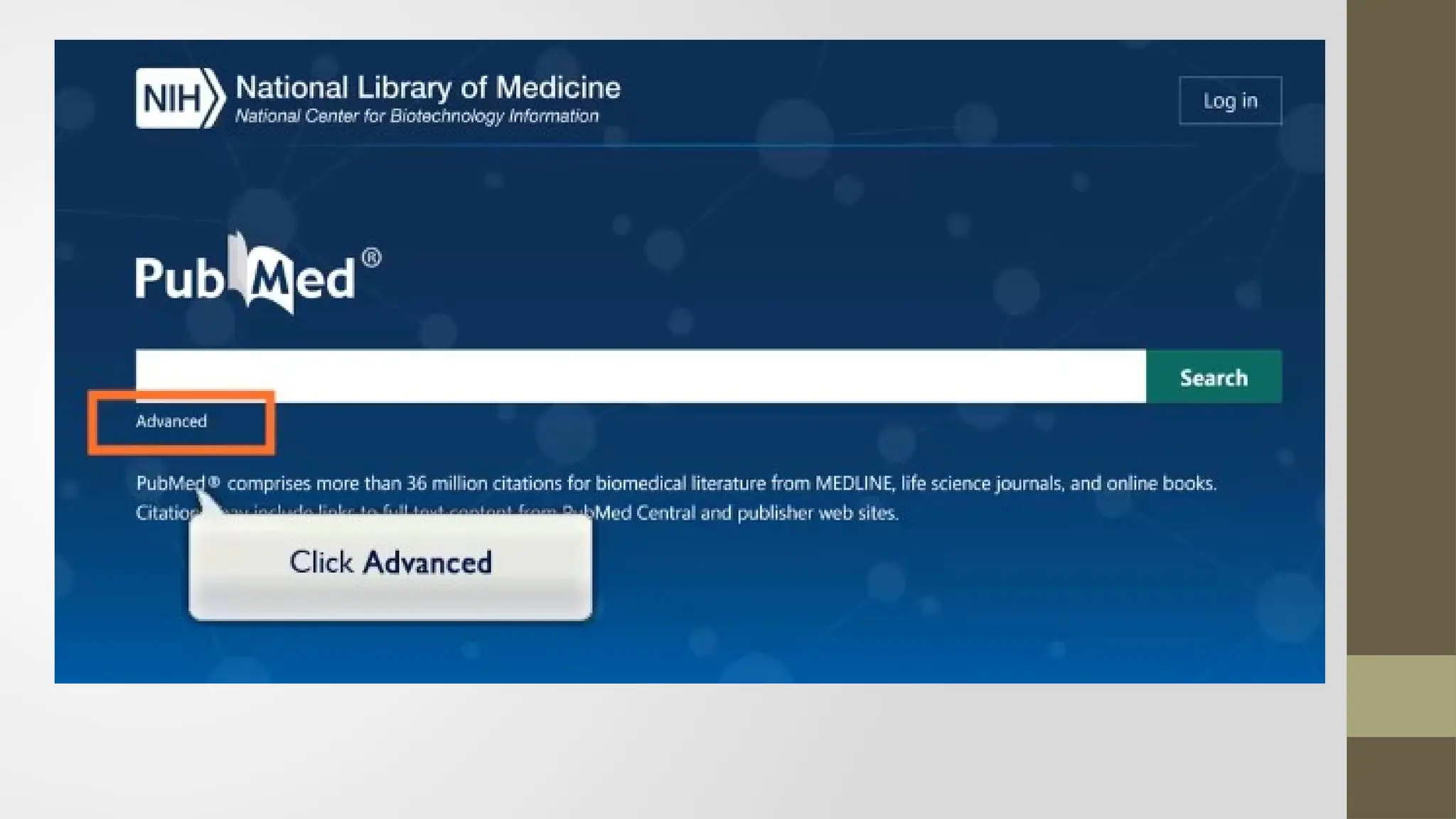
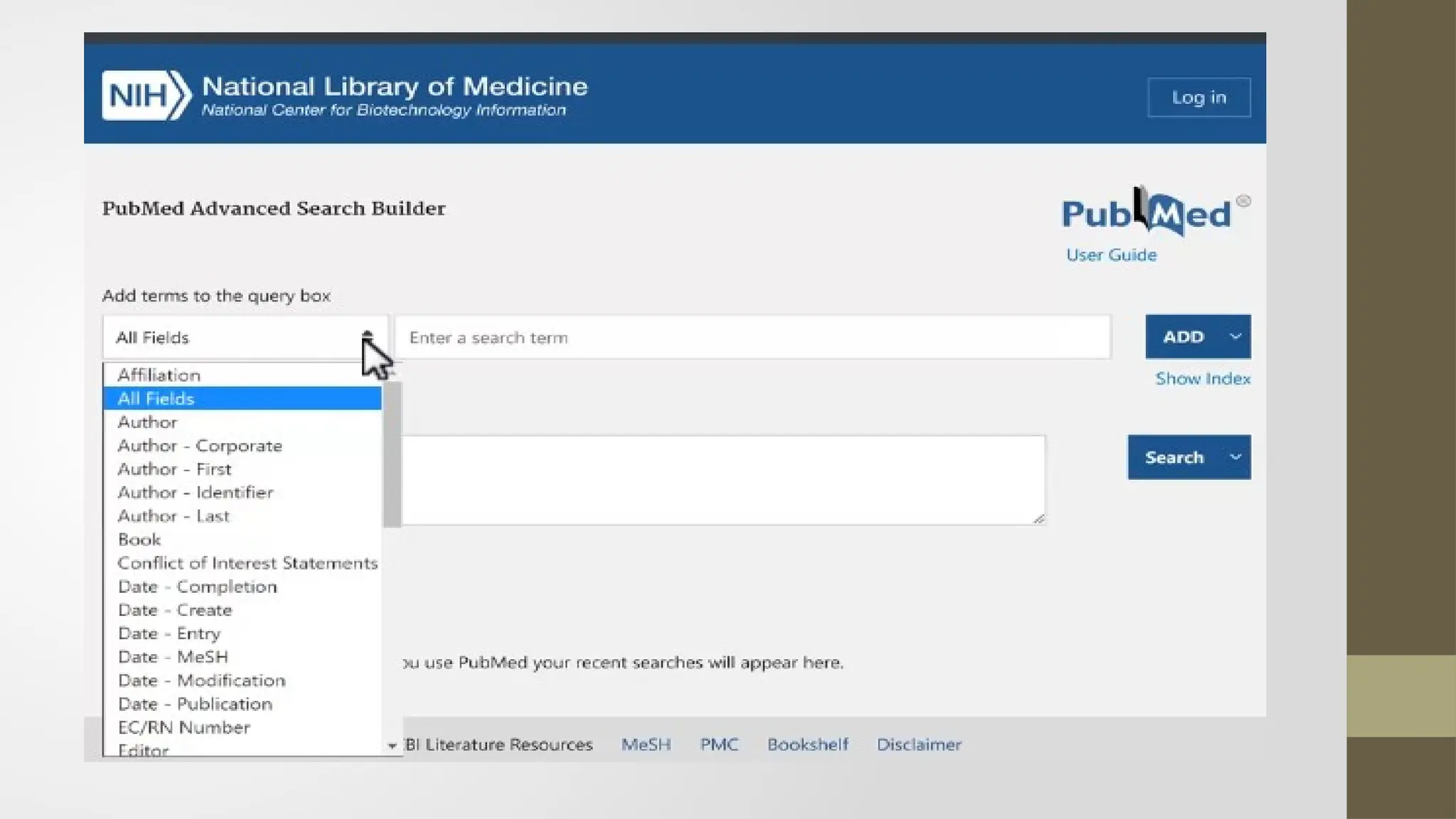
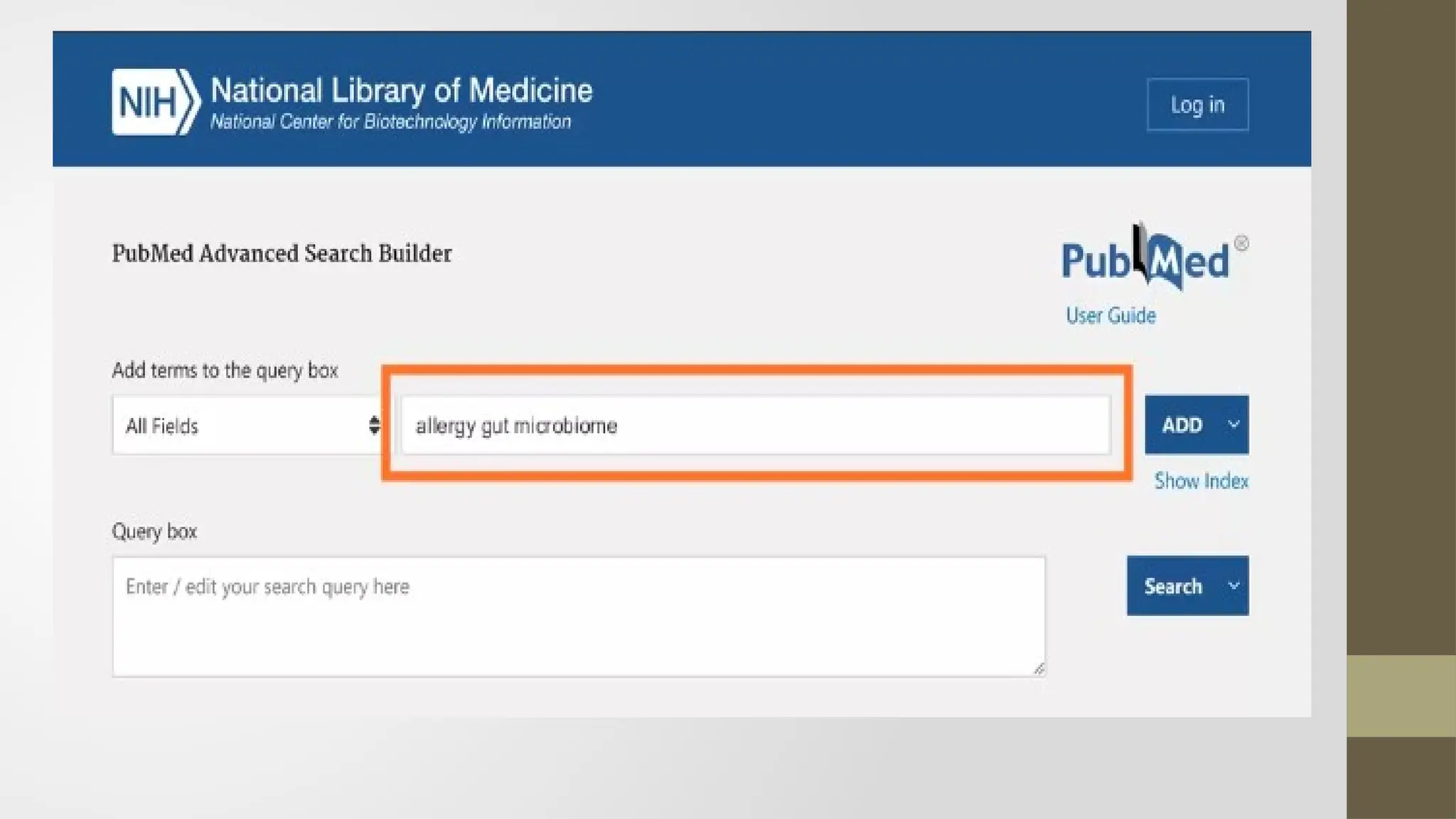
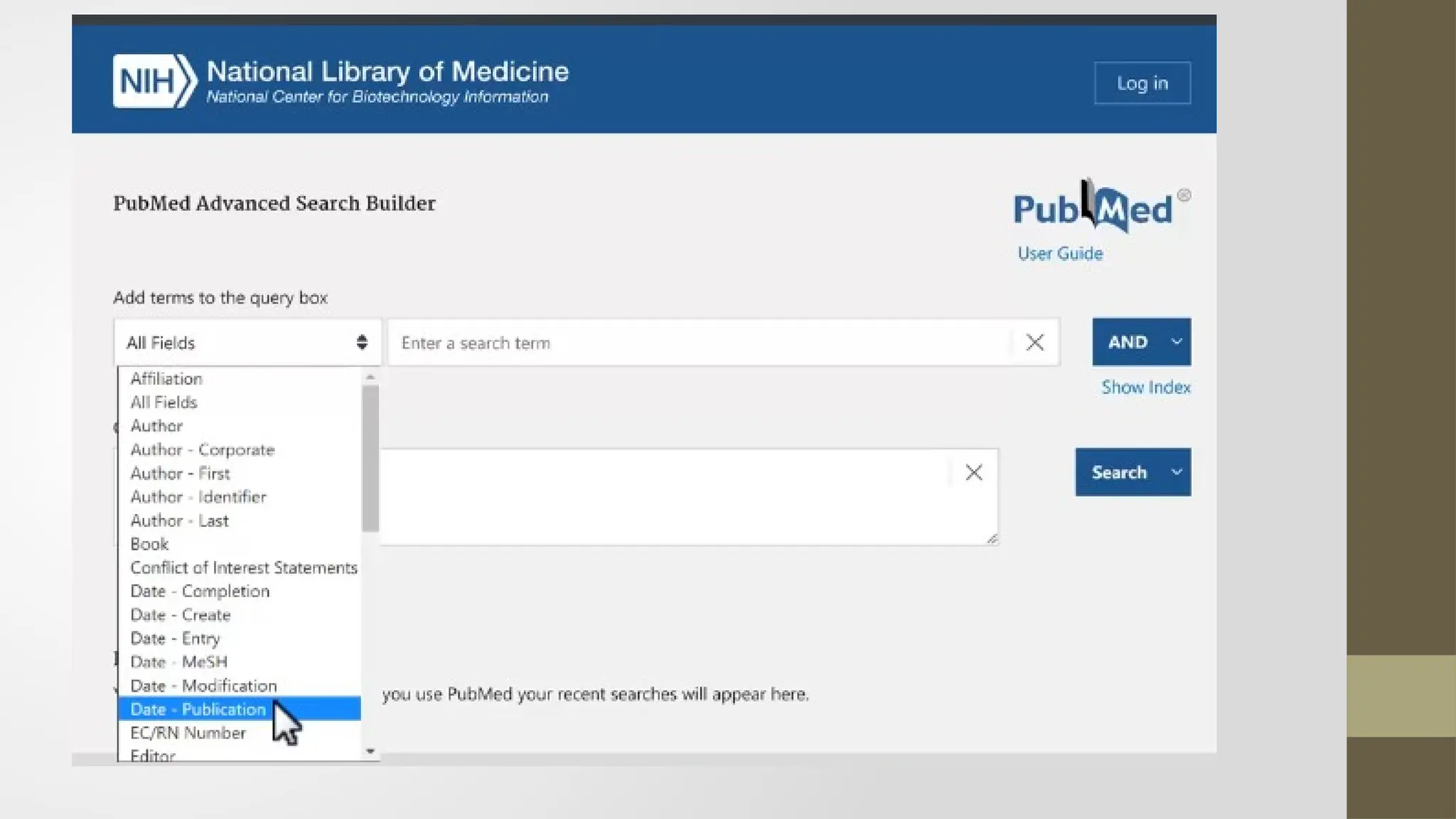
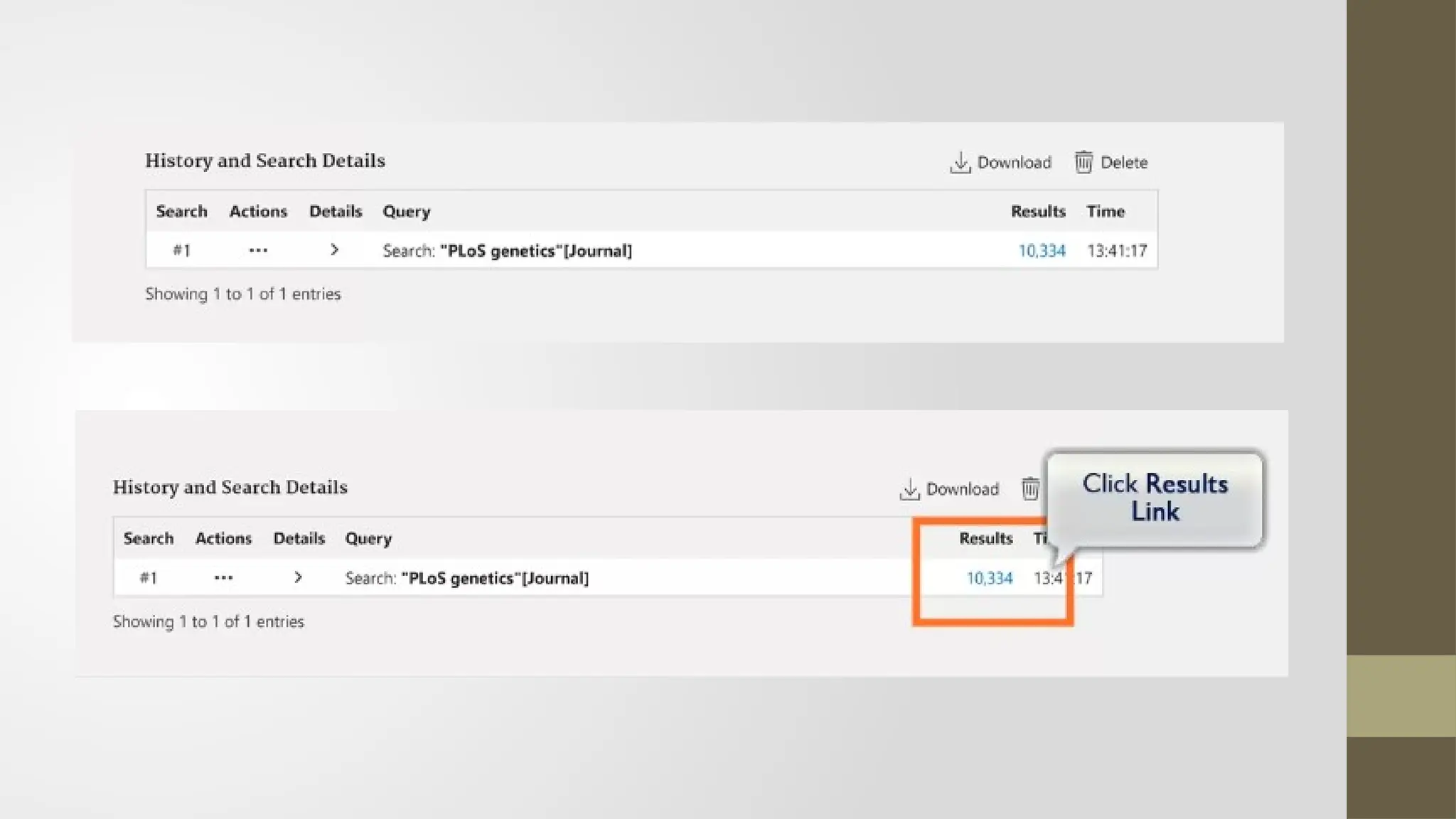
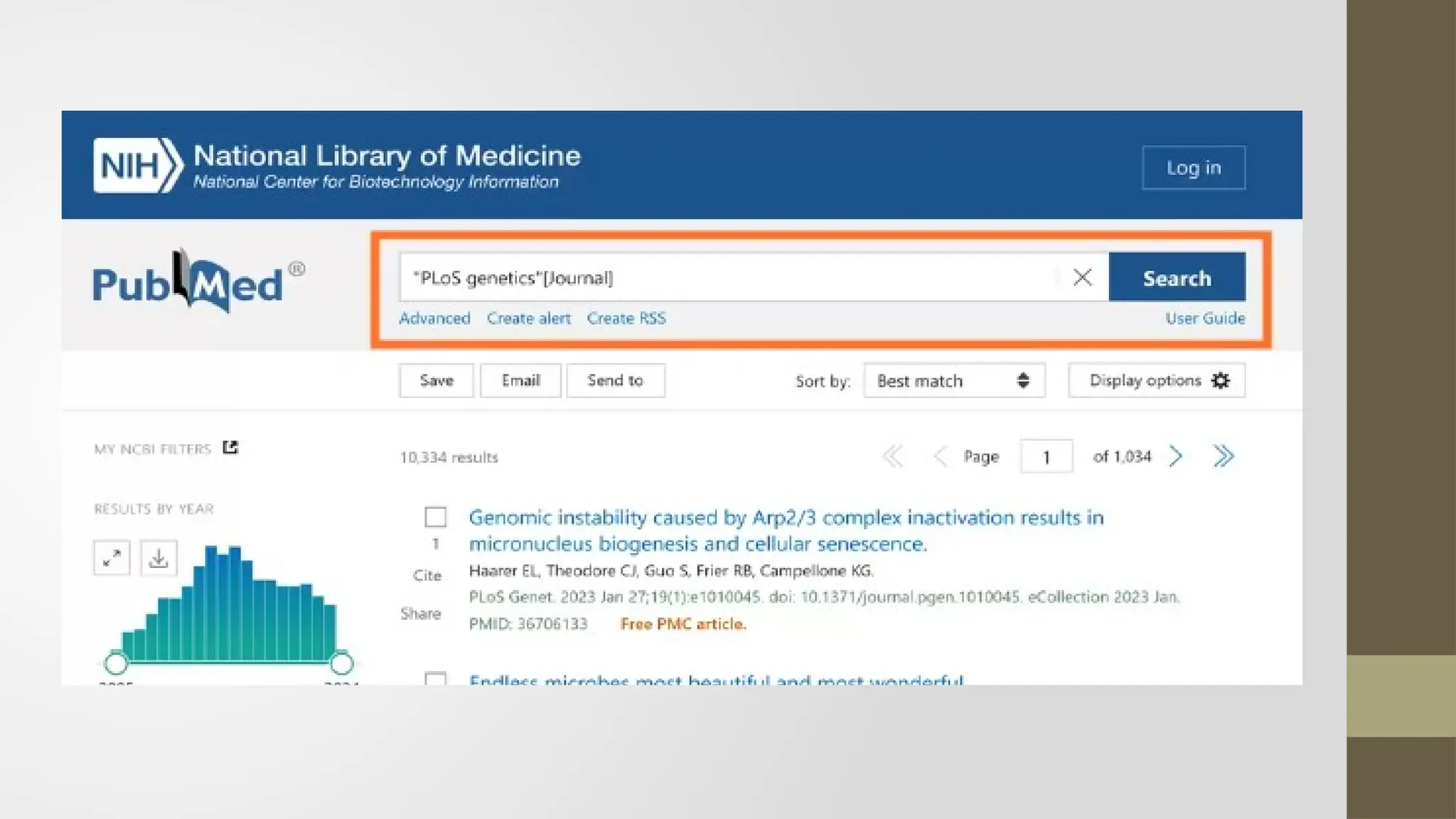
Different types of filters ( example on pubmed)
1. Article type:clinical trial or randomized controlled trial or systematic review
2. Publication date :last 5 to 10years
3. Species :human
4. Language :english
5. Full text - limit results to full text only
6. Material or resource type - journal article, book, video, etc
7. Journal type - limit results scholarly, peer-reviewed, etc.
54.
Step 6 :Screen,Evaluate Results & critical
appraise :
1. Screening Results
“Once you run your search, you’ll probably get hundreds or
even thousands of results. We need a systematic way to screen
them so we don’t waste time.”
• Title & Abstract screening :
Read quickly → Does it match your PICO question?
• Inclusion / Exclusion criteria
Example: Include: RCTs, humans, last 5 years.
Exclude: case reports, animal studies, non-English.
55.
2. Evaluate Results
“Notevery paper that looks relevant is high-quality evidence. We
need to evaluate critically before we accept it.”
• Check source → Is it a peer-reviewed journal?
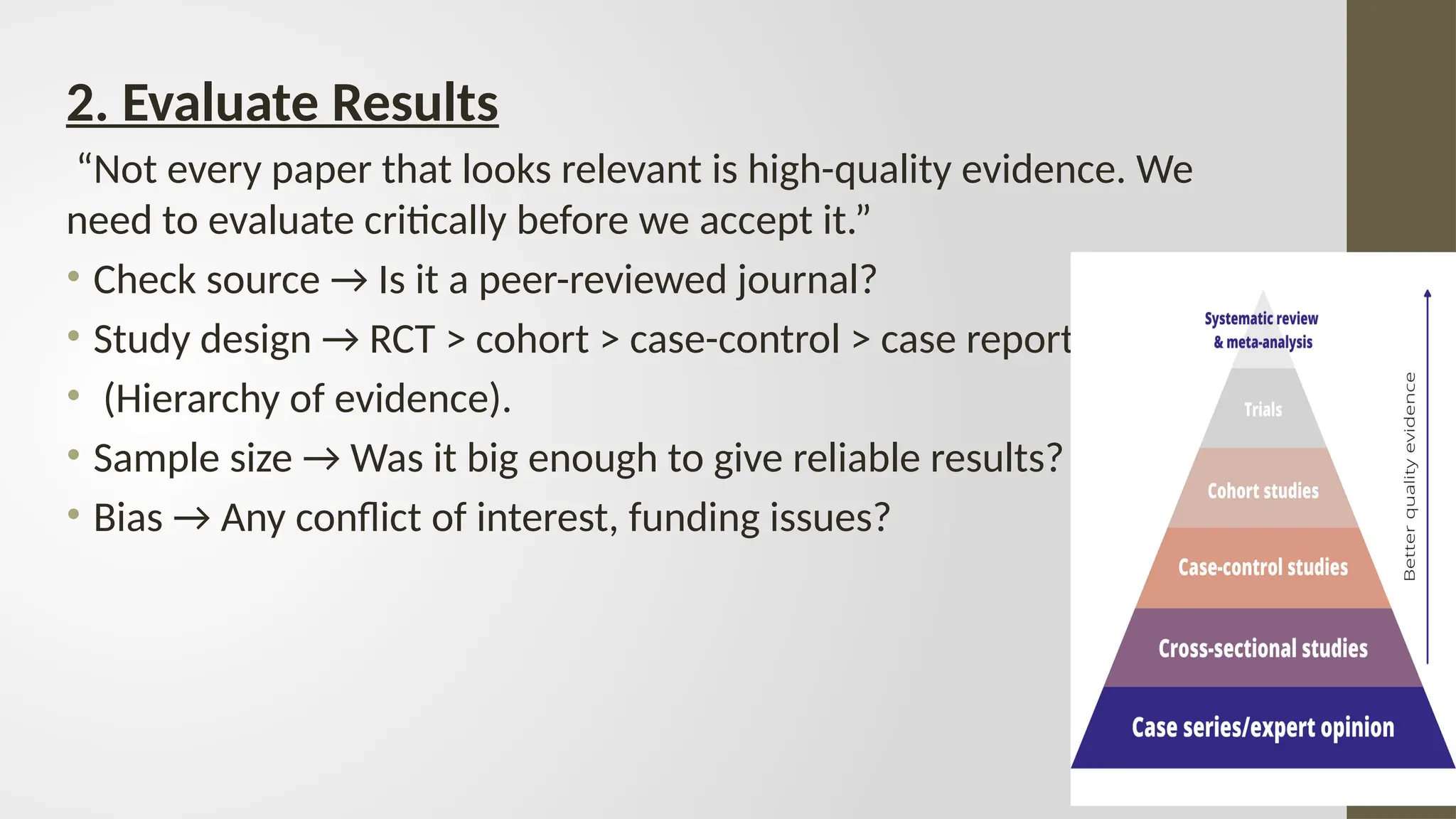
• Study design → RCT > cohort > case-control > case report
• (Hierarchy of evidence).
• Sample size → Was it big enough to give reliable results?
• Bias → Any conflict of interest, funding issues?
56.
3. Critical Appraisal
“Criticalappraisal means judging the reliability, validity, and
applicability of a study.”
Key tools:
CASP checklists (Critical Appraisal Skills Programme) – free, simple
https://casp-uk.net/casp-tools-checklists/
57.
Step 7 :Save,Export,Manage References
Save copies of the useful records you find and where possible save a
copy of your search strategy. This will ensure that you don’t have to
repeat work
Always save or print the useful article records you find. Most databases
give you a few options, such as:
save – usually as a text file or an RIS file,print,email,direct export to
reference software such as EndNote.
Getting full text
Generally you will not be able to download the full text of the documents
directly from the database. In many databases you will have to follow the
"full text" links. If the Library has a subscription, you will be able to
download the article.
references
• C. Heneghan,P. Glasziou. Evidence-based Medicine. Chapter 33. In: John Dent,
Ronald Harden (Eds.). A Practical Guide for Medical Teachers. Churchill Livingstone
Elsevier. 4th edition, 2013
• Paul Glasziou, Chris Del Mar and Janet Salisbury. Evidence-based Medicine
Workbook: Finding and applying the best research evidence to improve patient care.
BMJ Publishing Group. 1st edition, 2003
• https://grunigen.lib.uci.edu/sites/all/docs/gml/ebm-guidebook.pdf