How Scientific and to what Degree 
a Revolution?
Before Scientific 
Revolution the west 
was steeped in 
superstition—science 
hadn’t existed since a 
brief showing under 
the ancient Greeks 
Once Scientific 
Revolution took place, 
superstition and 
religion (seen largely 
as the same thing) 
were out and the west 
became rational and 
orderly
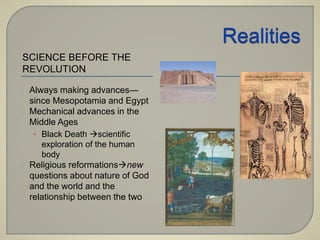
SCIENCE BEFORE THE 
REVOLUTION 
Always making advances— 
since Mesopotamia and Egypt 
Mechanical advances in the 
Middle Ages 
• Black Death scientific 
exploration of the human 
body 
Religious reformationsnew 
questions about nature of God 
and the world and the 
relationship between the two
RELIGIOUS IDEAS AND 
CONNECTIONS PERSIST, 
EVEN AMONG BIG NAMES 
OF SCIENTIFIC 
REVOLUTION 
UNSCIENTIFIC PURSUITS 
FOLLOWED BY KEY 
FIGURES 
Copernicus’ lectures heard 
with interest by Pope 
Clement VII and he 
dedicated De revolutionibus 
orbium coelestium to Pope 
Paul III 
Pope Urban VIII a patron to 
Galileo until 1633 
Pascal a Jansenist 
Newton interested in 
alchemy 
Copernicus, Kepler, Galileo 
and Newton all followed 
Hermeticism and astrology 
and alchemy
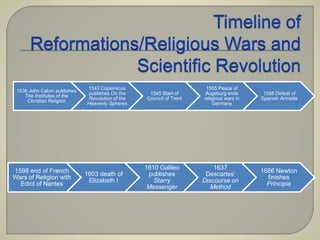
1536 John Calvin publishes 
The Institutes of the 
Christian Religion 
1543 Copernicus 
publishes On the 
Revolution of the 
Heavenly Spheres 
1545 Start of 
Council of Trent 
1555 Peace of 
Augsburg ends 
religious wars in 
Germany 
1588 Defeat of 
Spanish Armada 
1598 end of French 
Wars of Religion with 
Edict of Nantes 
1603 death of 
Elizabeth I 
1610 Galileo 
publishes 
Starry 
Messenger 
1637 
Descartes’ 
Discourse on 
Method 
1686 Newton 
finishes 
Principia
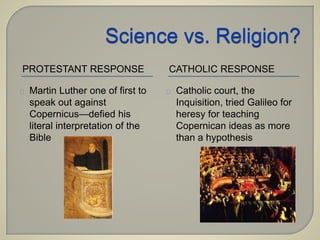
PROTESTANT RESPONSE CATHOLIC RESPONSE 
Martin Luther one of first to 
speak out against 
Copernicus—defied his 
literal interpretation of the 
Bible 
Catholic court, the 
Inquisition, tried Galileo for 
heresy for teaching 
Copernican ideas as more 
than a hypothesis
Popes patrons of scientists, such as 
Copernicus and Galileo 
Royal Societies in England and France 
endorsed by their respective monarchs, 
who were religious leaders
Together with end of religious wars and 
spread of official religious toleration, 
intellectual world questions religious 
assumptions 
• Does not mean religious feeling ends
Long span of time— 
over a century 
• Small increments of 
change 
Women go from being 
seen as created by God 
to serve men (Genesis) 
to being seen as 
biologically inferior to 
men (anatomy and 
physiology) 
Center of the world 
changes from earth at 
the center of the 
universe to sun at the 
center 
Intellectuals go from 
seeking proof of God’s 
existence (St. Anselm’s 
ontological argument) to 
proof of man’s own 
existence (Descartes’ 
cogito ergo sum)
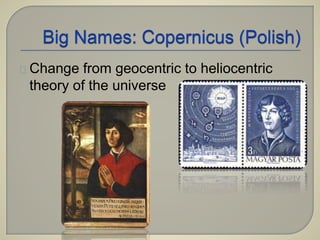
Change from geocentric to heliocentric 
theory of the universe
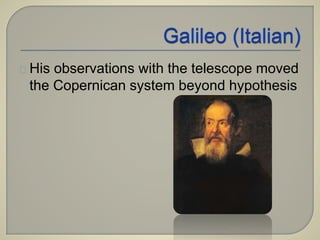
His observations with the telescope moved 
the Copernican system beyond hypothesis
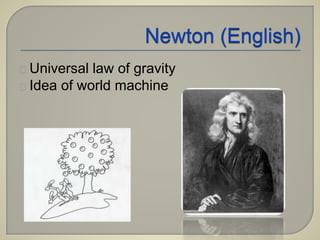
Universal law of gravity 
Idea of world machine
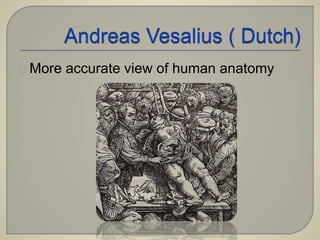
More accurate view of human anatomy
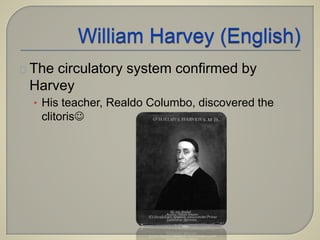
The circulatory system confirmed by 
Harvey 
• His teacher, Realdo Columbo, discovered the 
clitoris
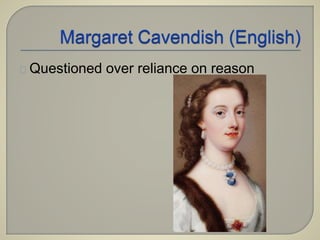
Questioned over reliance on reason
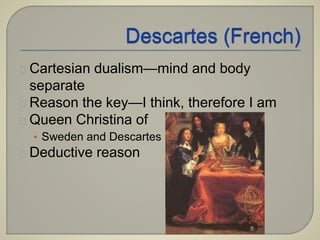
Cartesian dualism—mind and body 
separate 
Reason the key—I think, therefore I am 
Queen Christina of 
• Sweden and Descartes 
Deductive reason
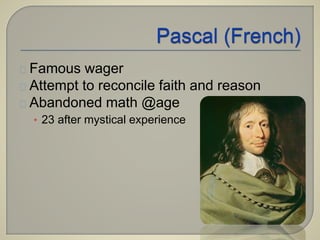
Famous wager 
Attempt to reconcile faith and reason 
Abandoned math @age 
• 23 after mystical experience
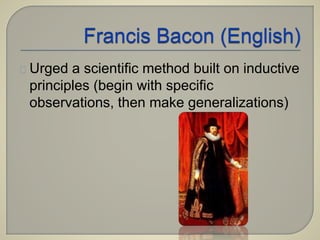
Urged a scientific method built on inductive 
principles (begin with specific 
observations, then make generalizations)
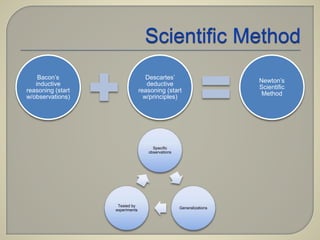
Bacon’s 
inductive 
reasoning (start 
w/observations) 
Descartes’ 
deductive 
reasoning (start 
w/principles) 
Newton’s 
Scientific 
Method 
Specific 
observations 
Generalizations 
Tested by 
experiments
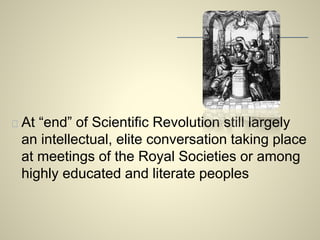
At “end” of Scientific Revolution still largely 
an intellectual, elite conversation taking place 
at meetings of the Royal Societies or among 
highly educated and literate peoples

Scientific Revolution

  • 1.
    How Scientific andto what Degree a Revolution?
  • 2.
    Before Scientific Revolutionthe west was steeped in superstition—science hadn’t existed since a brief showing under the ancient Greeks Once Scientific Revolution took place, superstition and religion (seen largely as the same thing) were out and the west became rational and orderly
  • 3.
    SCIENCE BEFORE THE REVOLUTION Always making advances— since Mesopotamia and Egypt Mechanical advances in the Middle Ages • Black Death scientific exploration of the human body Religious reformationsnew questions about nature of God and the world and the relationship between the two
  • 4.
    RELIGIOUS IDEAS AND CONNECTIONS PERSIST, EVEN AMONG BIG NAMES OF SCIENTIFIC REVOLUTION UNSCIENTIFIC PURSUITS FOLLOWED BY KEY FIGURES Copernicus’ lectures heard with interest by Pope Clement VII and he dedicated De revolutionibus orbium coelestium to Pope Paul III Pope Urban VIII a patron to Galileo until 1633 Pascal a Jansenist Newton interested in alchemy Copernicus, Kepler, Galileo and Newton all followed Hermeticism and astrology and alchemy
  • 5.
    1536 John Calvinpublishes The Institutes of the Christian Religion 1543 Copernicus publishes On the Revolution of the Heavenly Spheres 1545 Start of Council of Trent 1555 Peace of Augsburg ends religious wars in Germany 1588 Defeat of Spanish Armada 1598 end of French Wars of Religion with Edict of Nantes 1603 death of Elizabeth I 1610 Galileo publishes Starry Messenger 1637 Descartes’ Discourse on Method 1686 Newton finishes Principia
  • 6.
    PROTESTANT RESPONSE CATHOLICRESPONSE Martin Luther one of first to speak out against Copernicus—defied his literal interpretation of the Bible Catholic court, the Inquisition, tried Galileo for heresy for teaching Copernican ideas as more than a hypothesis
  • 7.
    Popes patrons ofscientists, such as Copernicus and Galileo Royal Societies in England and France endorsed by their respective monarchs, who were religious leaders
  • 8.
    Together with endof religious wars and spread of official religious toleration, intellectual world questions religious assumptions • Does not mean religious feeling ends
  • 9.
    Long span oftime— over a century • Small increments of change Women go from being seen as created by God to serve men (Genesis) to being seen as biologically inferior to men (anatomy and physiology) Center of the world changes from earth at the center of the universe to sun at the center Intellectuals go from seeking proof of God’s existence (St. Anselm’s ontological argument) to proof of man’s own existence (Descartes’ cogito ergo sum)
  • 10.
    Change from geocentricto heliocentric theory of the universe
  • 11.
    His observations withthe telescope moved the Copernican system beyond hypothesis
  • 12.
    Universal law ofgravity Idea of world machine
  • 13.
    More accurate viewof human anatomy
  • 14.
    The circulatory systemconfirmed by Harvey • His teacher, Realdo Columbo, discovered the clitoris
  • 15.
  • 16.
    Cartesian dualism—mind andbody separate Reason the key—I think, therefore I am Queen Christina of • Sweden and Descartes Deductive reason
  • 17.
    Famous wager Attemptto reconcile faith and reason Abandoned math @age • 23 after mystical experience
  • 18.
    Urged a scientificmethod built on inductive principles (begin with specific observations, then make generalizations)
  • 19.
    Bacon’s inductive reasoning(start w/observations) Descartes’ deductive reasoning (start w/principles) Newton’s Scientific Method Specific observations Generalizations Tested by experiments
  • 20.
    At “end” ofScientific Revolution still largely an intellectual, elite conversation taking place at meetings of the Royal Societies or among highly educated and literate peoples