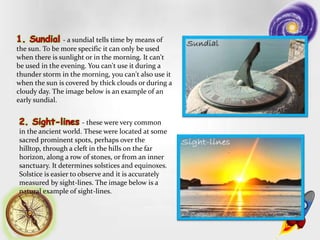
- a sundial tells time by means of
the sun. To be more specific it can only be used
when there is sunlight or in the morning. It can't
be used in the evening. You can't use it during a
thunder storm in the morning, you can't also use it
when the sun is covered by thick clouds or during a
cloudy day. The image below is an example of an
early sundial.
- these were very common
in the ancient world. These were located at some
sacred prominent spots, perhaps over the
hilltop, through a cleft in the hills on the far
horizon, along a row of stones, or from an inner
sanctuary. It determines solstices and equinoxes.
Solstice is easier to observe and it is accurately
measured by sight-lines. The image below is a
natural example of sight-lines.
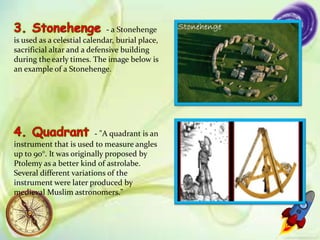
- a Stonehenge
is used as a celestial calendar, burial place,
sacrificial altar and a defensive building
during the early times. The image below is
an example of a Stonehenge.
- "A quadrant is an
instrument that is used to measure angles
up to 90°. It was originally proposed by
Ptolemy as a better kind of astrolabe.
Several different variations of the
instrument were later produced by
medieval Muslim astronomers."
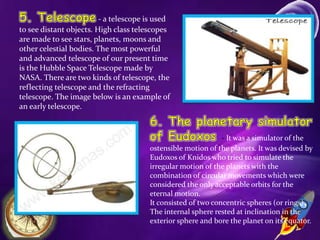
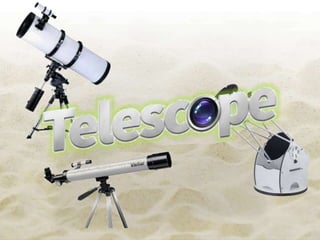
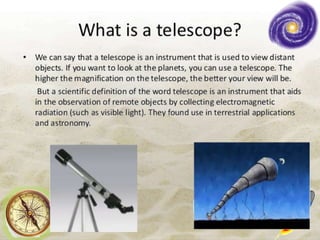
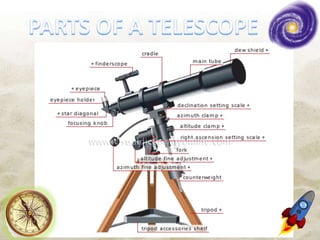
- a telescope is used
to see distant objects. High class telescopes
are made to see stars, planets, moons and
other celestial bodies. The most powerful
and advanced telescope of our present time
is the Hubble Space Telescope made by
NASA. There are two kinds of telescope, the
reflecting telescope and the refracting
telescope. The image below is an example of
an early telescope.
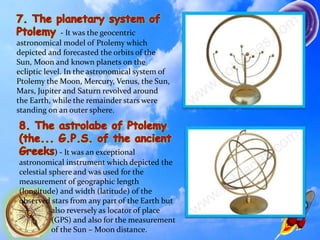
- It was a simulator of the
ostensible motion of the planets. It was devised by
Eudoxos of Knidos who tried to simulate the
irregular motion of the planets with the
combination of circular movements which were
considered the only acceptable orbits for the
eternal motion.
It consisted of two concentric spheres (or rings).
The internal sphere rested at inclination in the
exterior sphere and bore the planet on its equator.
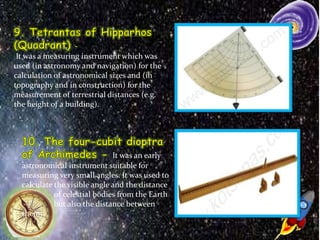
- It was the geocentric
astronomical model of Ptolemy which
depicted and forecasted the orbits of the
Sun, Moon and known planets on the
ecliptic level. In the astronomical system of
Ptolemy the Moon, Mercury, Venus, the Sun,
Mars, Jupiter and Saturn revolved around
the Earth, while the remainder stars were
standing on an outer sphere.
) - It was an exceptional
astronomical instrument which depicted the
celestial sphere and was used for the
measurement of geographic length
(longitude) and width (latitude) of the
observed stars from any part of the Earth but
also reversely as locator of place
(GPS) and also for the measurement
of the Sun – Moon distance.
-
It was a measuring instrument which was
used (in astronomy and navigation) for the
calculation of astronomical sizes and (in
topography and in construction) for the
measurement of terrestrial distances (e.g.
the height of a building).
It was an early
astronomical instrument suitable for
measuring very small angles. It was used to
calculate the visible angle and the distance
of celestial bodies from the Earth
but also the distance between
them.
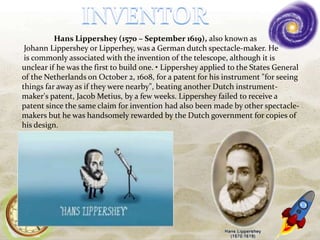
Hans Lippershey (1570 – September 1619), also known as
Johann Lippershey or Lipperhey, was a German dutch spectacle-maker. He
is commonly associated with the invention of the telescope, although it is
unclear if he was the first to build one. • Lippershey applied to the States General
of the Netherlands on October 2, 1608, for a patent for his instrument "for seeing
things far away as if they were nearby", beating another Dutch instrument-
maker's patent, Jacob Metius, by a few weeks. Lippershey failed to receive a
patent since the same claim for invention had also been made by other spectacle-
makers but he was handsomely rewarded by the Dutch government for copies of
his design.
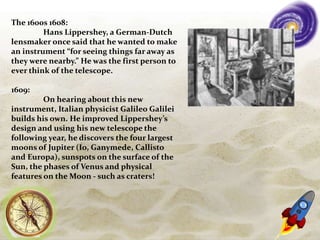
The 1600s 1608:
Hans Lippershey, a German-Dutch
lensmaker once said that he wanted to make
an instrument “for seeing things far away as
they were nearby.” He was the first person to
ever think of the telescope.
1609:
On hearing about this new
instrument, Italian physicist Galileo Galilei
builds his own. He improved Lippershey’s
design and using his new telescope the
following year, he discovers the four largest
moons of Jupiter (Io, Ganymede, Callisto
and Europa), sunspots on the surface of the
Sun, the phases of Venus and physical
features on the Moon - such as craters!
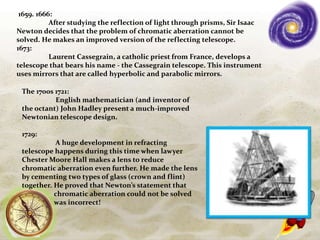
1659. 1666:
After studying the reflection of light through prisms, Sir Isaac
Newton decides that the problem of chromatic aberration cannot be
solved. He makes an improved version of the reflecting telescope.
1673:
Laurent Cassegrain, a catholic priest from France, develops a
telescope that bears his name - the Cassegrain telescope. This instrument
uses mirrors that are called hyperbolic and parabolic mirrors.
The 1700s 1721:
English mathematician (and inventor of
the octant) John Hadley present a much-improved
Newtonian telescope design.
1729:
A huge development in refracting
telescope happens during this time when lawyer
Chester Moore Hall makes a lens to reduce
chromatic aberration even further. He made the lens
by cementing two types of glass (crown and flint)
together. He proved that Newton’s statement that
chromatic aberration could not be solved
was incorrect!
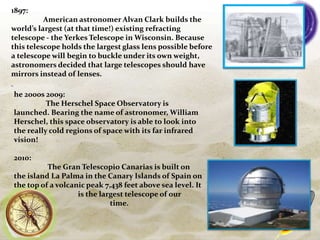
1897:
American astronomer Alvan Clark builds the
world’s largest (at that time!) existing refracting
telescope - the Yerkes Telescope in Wisconsin. Because
this telescope holds the largest glass lens possible before
a telescope will begin to buckle under its own weight,
astronomers decided that large telescopes should have
mirrors instead of lenses.
he 2000s 2009:
The Herschel Space Observatory is
launched. Bearing the name of astronomer, William
Herschel, this space observatory is able to look into
the really cold regions of space with its far infrared
vision!
2010:
The Gran Telescopio Canarias is built on
the island La Palma in the Canary Islands of Spain on
the top of a volcanic peak 7,438 feet above sea level. It
is the largest telescope of our
time.

Early Astronomical Instruments

  • 2.
    - a sundialtells time by means of the sun. To be more specific it can only be used when there is sunlight or in the morning. It can't be used in the evening. You can't use it during a thunder storm in the morning, you can't also use it when the sun is covered by thick clouds or during a cloudy day. The image below is an example of an early sundial. - these were very common in the ancient world. These were located at some sacred prominent spots, perhaps over the hilltop, through a cleft in the hills on the far horizon, along a row of stones, or from an inner sanctuary. It determines solstices and equinoxes. Solstice is easier to observe and it is accurately measured by sight-lines. The image below is a natural example of sight-lines.
  • 3.
    - a Stonehenge isused as a celestial calendar, burial place, sacrificial altar and a defensive building during the early times. The image below is an example of a Stonehenge. - "A quadrant is an instrument that is used to measure angles up to 90°. It was originally proposed by Ptolemy as a better kind of astrolabe. Several different variations of the instrument were later produced by medieval Muslim astronomers."
  • 4.
    - a telescopeis used to see distant objects. High class telescopes are made to see stars, planets, moons and other celestial bodies. The most powerful and advanced telescope of our present time is the Hubble Space Telescope made by NASA. There are two kinds of telescope, the reflecting telescope and the refracting telescope. The image below is an example of an early telescope. - It was a simulator of the ostensible motion of the planets. It was devised by Eudoxos of Knidos who tried to simulate the irregular motion of the planets with the combination of circular movements which were considered the only acceptable orbits for the eternal motion. It consisted of two concentric spheres (or rings). The internal sphere rested at inclination in the exterior sphere and bore the planet on its equator.
  • 5.
    - It wasthe geocentric astronomical model of Ptolemy which depicted and forecasted the orbits of the Sun, Moon and known planets on the ecliptic level. In the astronomical system of Ptolemy the Moon, Mercury, Venus, the Sun, Mars, Jupiter and Saturn revolved around the Earth, while the remainder stars were standing on an outer sphere. ) - It was an exceptional astronomical instrument which depicted the celestial sphere and was used for the measurement of geographic length (longitude) and width (latitude) of the observed stars from any part of the Earth but also reversely as locator of place (GPS) and also for the measurement of the Sun – Moon distance.
  • 6.
    - It was ameasuring instrument which was used (in astronomy and navigation) for the calculation of astronomical sizes and (in topography and in construction) for the measurement of terrestrial distances (e.g. the height of a building). It was an early astronomical instrument suitable for measuring very small angles. It was used to calculate the visible angle and the distance of celestial bodies from the Earth but also the distance between them.
  • 10.
    Hans Lippershey (1570– September 1619), also known as Johann Lippershey or Lipperhey, was a German dutch spectacle-maker. He is commonly associated with the invention of the telescope, although it is unclear if he was the first to build one. • Lippershey applied to the States General of the Netherlands on October 2, 1608, for a patent for his instrument "for seeing things far away as if they were nearby", beating another Dutch instrument- maker's patent, Jacob Metius, by a few weeks. Lippershey failed to receive a patent since the same claim for invention had also been made by other spectacle- makers but he was handsomely rewarded by the Dutch government for copies of his design.
  • 11.
    The 1600s 1608: HansLippershey, a German-Dutch lensmaker once said that he wanted to make an instrument “for seeing things far away as they were nearby.” He was the first person to ever think of the telescope. 1609: On hearing about this new instrument, Italian physicist Galileo Galilei builds his own. He improved Lippershey’s design and using his new telescope the following year, he discovers the four largest moons of Jupiter (Io, Ganymede, Callisto and Europa), sunspots on the surface of the Sun, the phases of Venus and physical features on the Moon - such as craters!
  • 12.
    1659. 1666: After studyingthe reflection of light through prisms, Sir Isaac Newton decides that the problem of chromatic aberration cannot be solved. He makes an improved version of the reflecting telescope. 1673: Laurent Cassegrain, a catholic priest from France, develops a telescope that bears his name - the Cassegrain telescope. This instrument uses mirrors that are called hyperbolic and parabolic mirrors. The 1700s 1721: English mathematician (and inventor of the octant) John Hadley present a much-improved Newtonian telescope design. 1729: A huge development in refracting telescope happens during this time when lawyer Chester Moore Hall makes a lens to reduce chromatic aberration even further. He made the lens by cementing two types of glass (crown and flint) together. He proved that Newton’s statement that chromatic aberration could not be solved was incorrect!
  • 13.
    1897: American astronomer AlvanClark builds the world’s largest (at that time!) existing refracting telescope - the Yerkes Telescope in Wisconsin. Because this telescope holds the largest glass lens possible before a telescope will begin to buckle under its own weight, astronomers decided that large telescopes should have mirrors instead of lenses. he 2000s 2009: The Herschel Space Observatory is launched. Bearing the name of astronomer, William Herschel, this space observatory is able to look into the really cold regions of space with its far infrared vision! 2010: The Gran Telescopio Canarias is built on the island La Palma in the Canary Islands of Spain on the top of a volcanic peak 7,438 feet above sea level. It is the largest telescope of our time.