The Study of Geography
   Understanding the World We Live In
Objectives


• Students will explain how geographers use tools
  to understand the world.
• Students will identify and discuss the
  importance of the five themes of geography.
Vocabulary I
• geography - the study of the earth’s surface and
  the processes that shape it, the connections
  between places and the complex relationships
  between people and their environments
• absolute location - the position on the earth in
  which a place can be found
• relative location - the position of a place in
  relation to another place
Vocabulary II
• hemisphere - a half of the earth; the Equator
  divides the Northern and Southern hemispheres;
  the Prime Meridian divides the Eastern and
  Western hemispheres
• perception - a viewpoint that is influenced by
  one’s own culture and experiences
• character of a place - the physical and human
  characteristics that help to distinguish a place
  from other places
Geographic Tools
• Living in an ever-changing world, humans develop
  tools to better understand those changes
 • Geography is the study that helps us track those
   changes
 • most important is the ability to examine those
   changes from many perspectives
• Use of modern technology helps us track many
  changes
 • SONAR (ocean floor), Landsat (remote sensing),
   GPS, GIS (geographic information systems)
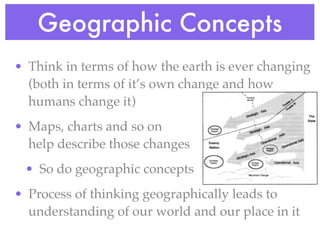
Geographic Concepts
• Think in terms of how the earth is ever changing
  (both in terms of it’s own change and how
  humans change it)
• Maps, charts and so on
  help describe those changes
 • So do geographic concepts
• Process of thinking geographically leads to
  understanding of our world and our place in it
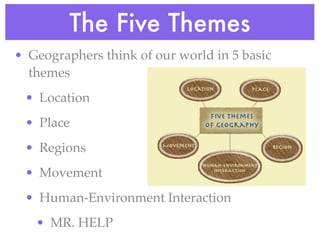
The Five Themes
• Geographers think of our world in 5 basic
  themes
 • Location
 • Place
 • Regions
 • Movement
 • Human-Environment Interaction
   • MR. HELP
Location: Absolute
• Usually the first step to identifying a place -
  finding it’s location
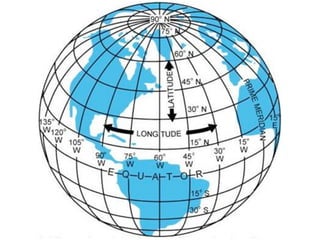
 • Absolute location is it’s position on the globe
• Latitude and longitude
 • Latitude: imaginary lines that run parallel to
   the Equator (line that divides the Earth into
   two hemispheres - north and south)
 • Longitude: imaginary lines that run between
   poles starting at Prime Meridian
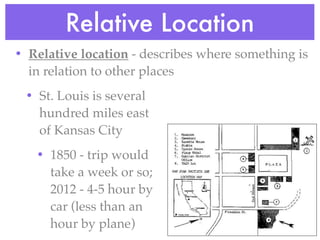
Relative Location
• Relative location - describes where something is
  in relation to other places
 • St. Louis is several
   hundred miles east
   of Kansas City
   • 1850 - trip would
     take a week or so;
     2012 - 4-5 hour by
     car (less than an
     hour by plane)
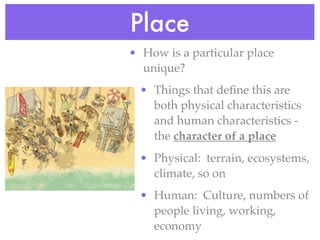
Place
• How is a particular place
  unique?
  • Things that define this are
    both physical characteristics
    and human characteristics -
    the character of a place
  • Physical: terrain, ecosystems,
    climate, so on
  • Human: Culture, numbers of
    people living, working,
    economy
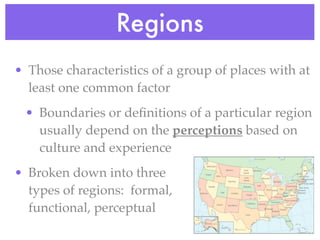
Regions
• Those characteristics of a group of places with at
  least one common factor
 • Boundaries or definitions of a particular region
   usually depend on the perceptions based on
   culture and experience
• Broken down into three
  types of regions: formal,
  functional, perceptual
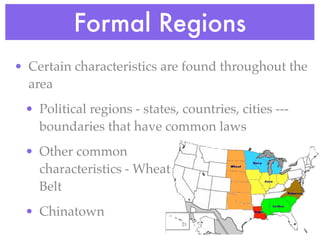
Formal Regions
• Certain characteristics are found throughout the
  area
 • Political regions - states, countries, cities ---
   boundaries that have common laws
 • Other common
   characteristics - Wheat
   Belt
 • Chinatown
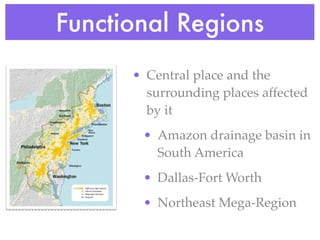
Functional Regions
      • Central place and the
        surrounding places affected
        by it
       • Amazon drainage basin in
         South America
       • Dallas-Fort Worth
       • Northeast Mega-Region
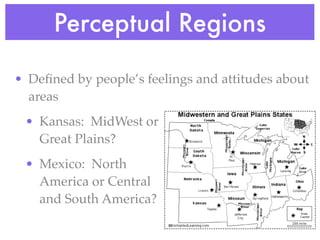
Perceptual Regions

• Defined by people’s feelings and attitudes about
  areas
 • Kansas: MidWest or
   Great Plains?
 • Mexico: North
   America or Central
   and South America?
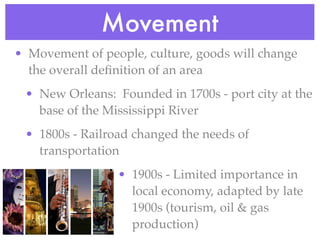
Movement
• Movement of people, culture, goods will change
  the overall definition of an area
 • New Orleans: Founded in 1700s - port city at the
   base of the Mississippi River
 • 1800s - Railroad changed the needs of
   transportation
                 • 1900s - Limited importance in
                   local economy, adapted by late
                   1900s (tourism, oil & gas
                   production)
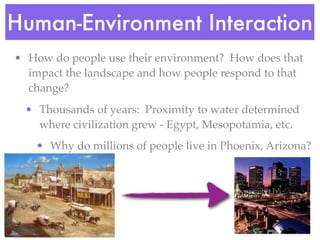
Human-Environment Interaction
• How do people use their environment? How does that
  impact the landscape and how people respond to that
  change?
  • Thousands of years: Proximity to water determined
    where civilization grew - Egypt, Mesopotamia, etc.
    • Why do millions of people live in Phoenix, Arizona?

01 - The Study of Geography

  • 1.
    The Study ofGeography Understanding the World We Live In
  • 2.
    Objectives • Students willexplain how geographers use tools to understand the world. • Students will identify and discuss the importance of the five themes of geography.
  • 3.
    Vocabulary I • geography- the study of the earth’s surface and the processes that shape it, the connections between places and the complex relationships between people and their environments • absolute location - the position on the earth in which a place can be found • relative location - the position of a place in relation to another place
  • 4.
    Vocabulary II • hemisphere- a half of the earth; the Equator divides the Northern and Southern hemispheres; the Prime Meridian divides the Eastern and Western hemispheres • perception - a viewpoint that is influenced by one’s own culture and experiences • character of a place - the physical and human characteristics that help to distinguish a place from other places
  • 5.
    Geographic Tools • Livingin an ever-changing world, humans develop tools to better understand those changes • Geography is the study that helps us track those changes • most important is the ability to examine those changes from many perspectives • Use of modern technology helps us track many changes • SONAR (ocean floor), Landsat (remote sensing), GPS, GIS (geographic information systems)
  • 6.
    Geographic Concepts • Thinkin terms of how the earth is ever changing (both in terms of it’s own change and how humans change it) • Maps, charts and so on help describe those changes • So do geographic concepts • Process of thinking geographically leads to understanding of our world and our place in it
  • 7.
    The Five Themes •Geographers think of our world in 5 basic themes • Location • Place • Regions • Movement • Human-Environment Interaction • MR. HELP
  • 8.
    Location: Absolute • Usuallythe first step to identifying a place - finding it’s location • Absolute location is it’s position on the globe • Latitude and longitude • Latitude: imaginary lines that run parallel to the Equator (line that divides the Earth into two hemispheres - north and south) • Longitude: imaginary lines that run between poles starting at Prime Meridian
  • 10.
    Relative Location • Relativelocation - describes where something is in relation to other places • St. Louis is several hundred miles east of Kansas City • 1850 - trip would take a week or so; 2012 - 4-5 hour by car (less than an hour by plane)
  • 11.
    Place • How isa particular place unique? • Things that define this are both physical characteristics and human characteristics - the character of a place • Physical: terrain, ecosystems, climate, so on • Human: Culture, numbers of people living, working, economy
  • 12.
    Regions • Those characteristicsof a group of places with at least one common factor • Boundaries or definitions of a particular region usually depend on the perceptions based on culture and experience • Broken down into three types of regions: formal, functional, perceptual
  • 13.
    Formal Regions • Certaincharacteristics are found throughout the area • Political regions - states, countries, cities --- boundaries that have common laws • Other common characteristics - Wheat Belt • Chinatown
  • 14.
    Functional Regions • Central place and the surrounding places affected by it • Amazon drainage basin in South America • Dallas-Fort Worth • Northeast Mega-Region
  • 15.
    Perceptual Regions • Definedby people’s feelings and attitudes about areas • Kansas: MidWest or Great Plains? • Mexico: North America or Central and South America?
  • 16.
    Movement • Movement ofpeople, culture, goods will change the overall definition of an area • New Orleans: Founded in 1700s - port city at the base of the Mississippi River • 1800s - Railroad changed the needs of transportation • 1900s - Limited importance in local economy, adapted by late 1900s (tourism, oil & gas production)
  • 17.
    Human-Environment Interaction • Howdo people use their environment? How does that impact the landscape and how people respond to that change? • Thousands of years: Proximity to water determined where civilization grew - Egypt, Mesopotamia, etc. • Why do millions of people live in Phoenix, Arizona?