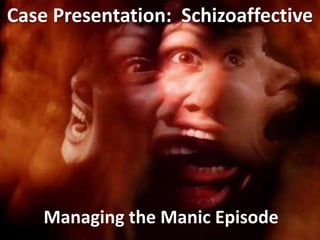
Case Presentation: Schizoaffective


    Managing the Manic Episode
Objectives
• Identify the characteristics of schizoaffective disorder, manic
  episode
• Establish therapeutic rapport with schizoaffective manic patient
• Coordinate discharge planning needs of nursing home patient
Assessment

• Biographical data
   – 50 yr, old African-American
     female

• Psychiatric admission
   – Voluntary admission

• Reason for admission

• Past psychiatric history
Assessment
    • Medical Comorbid Conditions
       – Hypertension

    • Current Medications
       – Clonidine 0.1 mg PO BID
       – HaldolDecanoate 150 mg IM
         monthly
       – Lamictal 25 mg PO BID
       – Invega 3 mg PO daily
Assessment

• Social/Work Data
   – Single, never married, no
     children

   – Before residing at NH
     patient lived with mother
     but is not allowed to
     return

   – Currently unemployed
Assessment
  • Family History
     – Patient denies familial psychiatric
       history

  • Psychological Testing/Psychiatric
    Assessment

  • Labs/Other Tests
     – Toxicology screen unavailable

  • Past Discharge Plans/Continuity of Care
Pathophysiology
Schizoaffective Disorder
Define
Schizoaffective Disorder

• Schizoaffective Disorder is a
  disorder in which a mood
  episode and the active phase
  symptoms of Schizophrenia
  occur together and were
  preceded or are followed by
  at least 2 weeks of delusions
  or hallucinations without
  prominent mood symptoms.

• Frequently used to describe a
  psychotic person with
  significant symptoms of
  depression and/or mania.
Schizoaffective Disorder in the DSM-IV-TR has four
               (4) diagnostic criteria
A. An uninterrupted period of illness during which, at some time, there is
   either a major depressive episode, a manic episode, or a mixed episode
   concurrent with symptoms that meet criterion A for schizophrenia
   (i.e., at least 2 of 5 symptoms (delusions, hallucinations, disorganized
   speech, grossly disorganized or catatonic behavior, negative
   symptoms), each present for a significant portion of time during a 1-
   month period.)

   Symptoms for Schizophrenia fall into three (3) broad categories:
   Positive symptoms, Negative symptoms and Cognitive symptoms.
Positive Symptoms
• Positive symptoms: The term
  positive symptoms is
  confusing, because positive
  symptoms (as the term might
  suggest) aren’t “good” symptoms
  at all. They’re symptoms that add
  to reality, and not in a good way.
  People with schizophrenia hear
  things that don’t exist or see things
  that aren’t there (in what are
  known as hallucinations).

   People with schizophrenia can also
   have delusions (false beliefs that
   defy logic or any culturally specific
   explanation and that cannot be
   change by logic or reason).
Negative Symptoms
 • Negative symptoms:
   These symptoms are a lack
   of something that should
   be present.


   They may be much slower
   to respond than most
   other people, have little to
   say when they do
   speak, and appear as if
   they have no emotions, or
   exhibit emotions that are
   inappropriate to the
   situation.
Cognitive Symptoms
• Cognitive symptoms: Most people with the disorder suffer from
  impairments in memory, learning, concentration, and their ability to
  make sound decisions. These so-called cognitive symptoms interfere
  with an individual’s ability to learn new things, remember things they
  once knew, and use skills they once had.
Schizoaffective Disorder in the DSM-IV-TR has four
               (4) diagnostic criteria
B.   During the same periods of illness, there have been delusions or
     hallucinations for at least 2 weeks in the absence of prominent
     mood symptoms.
Schizoaffective Disorder in the DSM-IV-TR has four
                (4) diagnostic criteria
C.   Symptoms that meet criteria for a mood episode are present for a
     substantial portion of the total duration of the active and residual
     periods of the illness.
     Specify type
     – Bipolar type: If the disturbance includes a manic or a mixed episode
       (or a manic or a mixed episode and major depressive episodes)
     – Depressive type: If the disturbance only includes major depressive
       episodes
Schizoaffective Disorder in the DSM-IV-TR has four
               (4) diagnostic criteria
D. The disturbance is not due to the direct physiologic effects of a
   substance (e.g., a drug of abuse, a medication) or a general
   medication condition.
Associated Features and Disorders
There may be poor occupational
functioning, a restricted range of
social contact, difficulties with
self-care, and increased risk of
suicide associated with
Schizoaffective Disorder.
Residual and negative symptoms
are usually less severe and less
chronic than those seen in
Schizophrenia. Anosognosia
(i.e., poor insight) is also
common in Schizoaffective
Disorder.
Course


The typical age at onset of Schizoaffective Disorder is early
adulthood, although onset can occur anywhere from adolescence to late
in life. The prognosis for Schizoaffective Disorder is somewhat better
than the prognosis for Schizophrenia, but considerably worse than the
prognosis for Mood Disorders.
Prevalence
Detailed information is lacking, but Schizoaffective Disorder appears to
be less common than Schizophrenia.
Hospitalization Goals and Plan


Patient stated goals
1. To experience decrease in
   behavior that is injurious to
   self and others.
2. To decrease
   hallucinations, delusions.
Hospitalization Goals and Plan
              • Interdisciplinary team goals:
                Nursing

                 – Decrease restlessness and
                   irritability

                 – Improve worry and anxiety

                 – Increase self control and
                   medication compliance

                 – Prevent injury to self and
                   others

                 – Decrease
                   hallucinations/delusions

                 – Increase adaptive coping skills
Hospitalization Goals and Plan

• Multidisciplinary team goals:
  Activity Therapy

   – Compliance with
     functional assessment
     group therapy
     participation, increased
     self expression by
     providing structure and
     support, health
     education, and group
     therapy.
Hospitalization Goals and Plan

                 • Multidisciplinary team
                   goals: Social Work

                    – Compliance with
                      psychosocial
                      evaluation, identify
                      placement through
                      family contact, group
                      therapy, reality
                      orientation, and health
                      education.
Interventions
• Nursing

   – Medication treatment
     and education

   – Administer PRN meds

   – Stress management
     techniques

   – Anger management

   – Reality orientation

   – Monitored Q15 mins.
     on assault precautions
Interventions

       • Social Work

          – Milieu therapy etc.

          – Patient family education
Medications

• Medications upon admission
   – Haldol D115 mg IM monthly
   – Clonidine 0.1 mg PO BID
   – Haldol 7.5 mg PO BID
   – Lithium Carbonate 600 mg QHS
     and 300 mg QAM

• Response to medications
Medications
• Patient remained noncompliant with oral Haldol and Lithium.

• They were discontinued and replaced with:
   – Lamotrigine (Lamictal) 25 mg PO BID
       • Mood stabilizer
   – Invega 3 mg PO daily
       • Antipsychotic


• Patient was compliant with Lamictal and Invega.
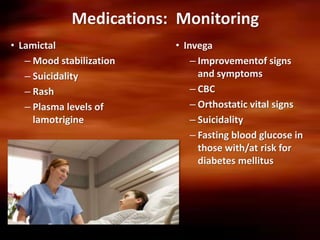
Medications: Monitoring
• Lamictal                • Invega
   – Mood stabilization       – Improvementof signs
   – Suicidality                and symptoms
   – Rash                     – CBC
   – Plasma levels of         – Orthostatic vital signs
     lamotrigine              – Suicidality
                              – Fasting blood glucose in
                                those with/at risk for
                                diabetes mellitus
Medications: Education
• Lamictal                    • Invega
   – May cause                    – May impair heat
     nausea, tremors, dizz          regulation
     iness, fatigue, malais       – May cause EPS
     e                            – Tablet and core
   – Immediately report             components of tablet are
     rash                           insoluble, may appear in
   – Do not discontinue             stool
     suddenly, this may           – Should be swallowed
     induce seizures                whole
                                  – Do not drink alcohol with
                                    this medication
Discharge Summary


• Patient behaviors indicating
  readiness for discharge

• Hospitalization goals met

• Discharge and continuity of
  care plan
Evaluation
• Evaluate effectiveness of goals/plans/interventions

• Course of treatment conditions

• Complications

• Lessons learned (if relevant)
Bibliography

American Psychiatric Association. Diagnostic and Statistical Manual of Mental
Disorders, Edition 4 (text revision), Washington, DC: American Psychiatric
Association

Major M. Pirozzi R, Formicola AM, et al.: Reliability and Validity of DSM-IV
diagnostic category of schizoaffective disorder: preliminary data. S Affect Disord
2000, 57: 95-98.
Behavioral Health Program 15th Floor
Presenting: Schizoaffective Disorder


      Managing The Manic Episode
Date: March __, 2011 - Time: 12pm – 1pm - Place: TBD
                  (CEUsare offered)

Schizoaffective Disorders

  • 1.
    Case Presentation: Schizoaffective Managing the Manic Episode
  • 2.
    Objectives • Identify thecharacteristics of schizoaffective disorder, manic episode • Establish therapeutic rapport with schizoaffective manic patient • Coordinate discharge planning needs of nursing home patient
  • 3.
    Assessment • Biographical data – 50 yr, old African-American female • Psychiatric admission – Voluntary admission • Reason for admission • Past psychiatric history
  • 4.
    Assessment • Medical Comorbid Conditions – Hypertension • Current Medications – Clonidine 0.1 mg PO BID – HaldolDecanoate 150 mg IM monthly – Lamictal 25 mg PO BID – Invega 3 mg PO daily
  • 5.
    Assessment • Social/Work Data – Single, never married, no children – Before residing at NH patient lived with mother but is not allowed to return – Currently unemployed
  • 6.
    Assessment •Family History – Patient denies familial psychiatric history • Psychological Testing/Psychiatric Assessment • Labs/Other Tests – Toxicology screen unavailable • Past Discharge Plans/Continuity of Care
  • 7.
  • 8.
    Define Schizoaffective Disorder • SchizoaffectiveDisorder is a disorder in which a mood episode and the active phase symptoms of Schizophrenia occur together and were preceded or are followed by at least 2 weeks of delusions or hallucinations without prominent mood symptoms. • Frequently used to describe a psychotic person with significant symptoms of depression and/or mania.
  • 9.
    Schizoaffective Disorder inthe DSM-IV-TR has four (4) diagnostic criteria A. An uninterrupted period of illness during which, at some time, there is either a major depressive episode, a manic episode, or a mixed episode concurrent with symptoms that meet criterion A for schizophrenia (i.e., at least 2 of 5 symptoms (delusions, hallucinations, disorganized speech, grossly disorganized or catatonic behavior, negative symptoms), each present for a significant portion of time during a 1- month period.) Symptoms for Schizophrenia fall into three (3) broad categories: Positive symptoms, Negative symptoms and Cognitive symptoms.
  • 10.
    Positive Symptoms • Positivesymptoms: The term positive symptoms is confusing, because positive symptoms (as the term might suggest) aren’t “good” symptoms at all. They’re symptoms that add to reality, and not in a good way. People with schizophrenia hear things that don’t exist or see things that aren’t there (in what are known as hallucinations). People with schizophrenia can also have delusions (false beliefs that defy logic or any culturally specific explanation and that cannot be change by logic or reason).
  • 11.
    Negative Symptoms •Negative symptoms: These symptoms are a lack of something that should be present. They may be much slower to respond than most other people, have little to say when they do speak, and appear as if they have no emotions, or exhibit emotions that are inappropriate to the situation.
  • 12.
    Cognitive Symptoms • Cognitivesymptoms: Most people with the disorder suffer from impairments in memory, learning, concentration, and their ability to make sound decisions. These so-called cognitive symptoms interfere with an individual’s ability to learn new things, remember things they once knew, and use skills they once had.
  • 13.
    Schizoaffective Disorder inthe DSM-IV-TR has four (4) diagnostic criteria B. During the same periods of illness, there have been delusions or hallucinations for at least 2 weeks in the absence of prominent mood symptoms.
  • 14.
    Schizoaffective Disorder inthe DSM-IV-TR has four (4) diagnostic criteria C. Symptoms that meet criteria for a mood episode are present for a substantial portion of the total duration of the active and residual periods of the illness. Specify type – Bipolar type: If the disturbance includes a manic or a mixed episode (or a manic or a mixed episode and major depressive episodes) – Depressive type: If the disturbance only includes major depressive episodes
  • 15.
    Schizoaffective Disorder inthe DSM-IV-TR has four (4) diagnostic criteria D. The disturbance is not due to the direct physiologic effects of a substance (e.g., a drug of abuse, a medication) or a general medication condition.
  • 16.
    Associated Features andDisorders There may be poor occupational functioning, a restricted range of social contact, difficulties with self-care, and increased risk of suicide associated with Schizoaffective Disorder. Residual and negative symptoms are usually less severe and less chronic than those seen in Schizophrenia. Anosognosia (i.e., poor insight) is also common in Schizoaffective Disorder.
  • 17.
    Course The typical ageat onset of Schizoaffective Disorder is early adulthood, although onset can occur anywhere from adolescence to late in life. The prognosis for Schizoaffective Disorder is somewhat better than the prognosis for Schizophrenia, but considerably worse than the prognosis for Mood Disorders.
  • 18.
    Prevalence Detailed information islacking, but Schizoaffective Disorder appears to be less common than Schizophrenia.
  • 19.
    Hospitalization Goals andPlan Patient stated goals 1. To experience decrease in behavior that is injurious to self and others. 2. To decrease hallucinations, delusions.
  • 20.
    Hospitalization Goals andPlan • Interdisciplinary team goals: Nursing – Decrease restlessness and irritability – Improve worry and anxiety – Increase self control and medication compliance – Prevent injury to self and others – Decrease hallucinations/delusions – Increase adaptive coping skills
  • 21.
    Hospitalization Goals andPlan • Multidisciplinary team goals: Activity Therapy – Compliance with functional assessment group therapy participation, increased self expression by providing structure and support, health education, and group therapy.
  • 22.
    Hospitalization Goals andPlan • Multidisciplinary team goals: Social Work – Compliance with psychosocial evaluation, identify placement through family contact, group therapy, reality orientation, and health education.
  • 23.
    Interventions • Nursing – Medication treatment and education – Administer PRN meds – Stress management techniques – Anger management – Reality orientation – Monitored Q15 mins. on assault precautions
  • 24.
    Interventions • Social Work – Milieu therapy etc. – Patient family education
  • 25.
    Medications • Medications uponadmission – Haldol D115 mg IM monthly – Clonidine 0.1 mg PO BID – Haldol 7.5 mg PO BID – Lithium Carbonate 600 mg QHS and 300 mg QAM • Response to medications
  • 26.
    Medications • Patient remainednoncompliant with oral Haldol and Lithium. • They were discontinued and replaced with: – Lamotrigine (Lamictal) 25 mg PO BID • Mood stabilizer – Invega 3 mg PO daily • Antipsychotic • Patient was compliant with Lamictal and Invega.
  • 27.
    Medications: Monitoring • Lamictal • Invega – Mood stabilization – Improvementof signs – Suicidality and symptoms – Rash – CBC – Plasma levels of – Orthostatic vital signs lamotrigine – Suicidality – Fasting blood glucose in those with/at risk for diabetes mellitus
  • 28.
    Medications: Education • Lamictal • Invega – May cause – May impair heat nausea, tremors, dizz regulation iness, fatigue, malais – May cause EPS e – Tablet and core – Immediately report components of tablet are rash insoluble, may appear in – Do not discontinue stool suddenly, this may – Should be swallowed induce seizures whole – Do not drink alcohol with this medication
  • 29.
    Discharge Summary • Patientbehaviors indicating readiness for discharge • Hospitalization goals met • Discharge and continuity of care plan
  • 30.
    Evaluation • Evaluate effectivenessof goals/plans/interventions • Course of treatment conditions • Complications • Lessons learned (if relevant)
  • 31.
    Bibliography American Psychiatric Association.Diagnostic and Statistical Manual of Mental Disorders, Edition 4 (text revision), Washington, DC: American Psychiatric Association Major M. Pirozzi R, Formicola AM, et al.: Reliability and Validity of DSM-IV diagnostic category of schizoaffective disorder: preliminary data. S Affect Disord 2000, 57: 95-98.
  • 32.
    Behavioral Health Program15th Floor Presenting: Schizoaffective Disorder Managing The Manic Episode Date: March __, 2011 - Time: 12pm – 1pm - Place: TBD (CEUsare offered)