Mental Health 101 Cari Guthrie Cho, LCSW-C Chief Operating Officer Threshold Services, Inc.
Common Mental Health Disorders Thought Disorders Schizophrenia Schizoaffective Mood Disorders Major Depression Bipolar Disorder Personality Disorders Borderline Personality Disorder Anxiety Disorders Post Traumatic Stress Disorder Obsessive Compulsive Disorder
WHAT CAUSES MENTAL ILLNESS? Family Inheritance / Genetic Causes: No specific gene has been found Inheritance does not explain all cases Current thinking – genetic vulnerability and environmental damage both needed  Environmental Causes Early brain damage Viruses
Schizophrenia Biological brain disease that effects about 1% of the population worldwide. Cause is not known.  Treatment can improve but not cure this illness. Effects a person’s ability to tell the difference between real and unreal experiences. Effects a person’s ability to remember, think logically and act appropriately in society. Onset usually 18 – 25 years old
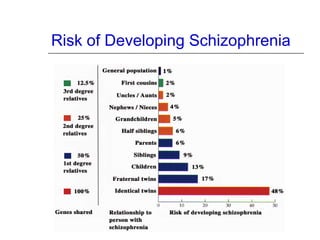
Risk of Developing Schizophrenia
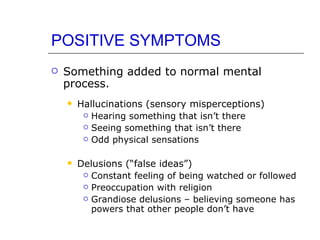
POSITIVE SYMPTOMS Something added to normal mental process.  Hallucinations (sensory misperceptions) Hearing something that isn’t there Seeing something that isn’t there Odd physical sensations Delusions (“false ideas”) Constant feeling of being watched or followed Preoccupation with religion Grandiose delusions – believing someone has powers that other people don’t have
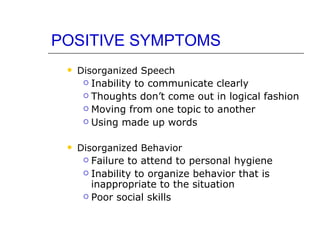
POSITIVE SYMPTOMS Disorganized Speech Inability to communicate clearly Thoughts don’t come out in logical fashion Moving from one topic to another Using made up words Disorganized Behavior Failure to attend to personal hygiene Inability to organize behavior that is inappropriate to the situation Poor social skills
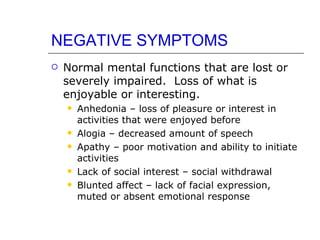
NEGATIVE SYMPTOMS Normal mental functions that are lost or severely impaired.  Loss of what is enjoyable or interesting.  Anhedonia – loss of pleasure or interest in activities that were enjoyed before Alogia – decreased amount of speech Apathy – poor motivation and ability to initiate activities Lack of social interest – social withdrawal Blunted affect – lack of facial expression, muted or absent emotional response
MOST COMMON COURSE Repeated episodes in early adulthood, gradual loss of functional capacity and increasing negative symptoms. Wide variation in outcomes has been seen – some studies show 50% of patients gain functional independence. Most studies show majority of patients have symptoms and some functional impairment throughout their lives.
COGNITIVE IMPAIRMENT EXECUTIVE FUNCTIONS – capacity to organize actins to achieve a goal. ATTENTION – ability to remain focused and not be distracted. SECONDARY MEMORY – remembering what you did a week ago and it’s consequences. WORKING MEMORY – ability to use information that has been learned to solve problems. INFORMATION PROCESSING – ability to use environmental cues accurately and make accurate judgments about the environment.
GOALS OF TREATMENT Treat acute episodes of psychotic symptoms, prevent relapse and support recovery. Prevent future episodes by: Learning early warning signs; Intervene with additional support or medications when warning signs appear; Avoid stressors that lead to relapse.
TREATMENT OF SCHIZOPHRENIA Most important medications are called anti-psychotics Most effective on positive symptoms 50 - 80% of patients show significant improvement Except for clozapine, no one agent has been shown consistently to be more effective than another on average Cognitive Therapy usually not successful Skills training is helpful – helping client learn how to deal with stressors, signs of relapse, personal hygiene, employment skills, etc.
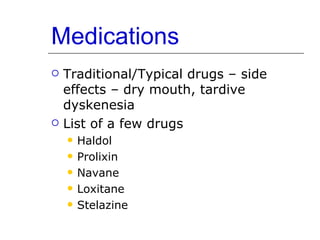
Medications Traditional/Typical drugs – side effects – dry mouth, tardive dyskenesia List of a few drugs Haldol Prolixin Navane Loxitane Stelazine
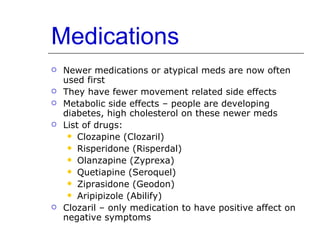
Medications Newer medications or atypical meds are now often used first They have fewer movement related side effects Metabolic side effects – people are developing diabetes, high cholesterol on these newer meds List of drugs: Clozapine (Clozaril) Risperidone (Risperdal) Olanzapine (Zyprexa) Quetiapine (Seroquel) Ziprasidone (Geodon) Aripipizole (Abilify) Clozaril – only medication to have positive affect on negative symptoms
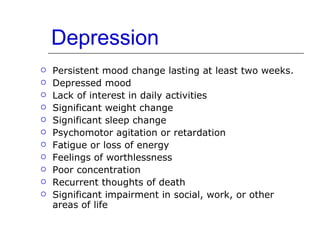
Depression Persistent mood change lasting at least two weeks. Depressed mood Lack of interest in daily activities Significant weight change Significant sleep change Psychomotor agitation or retardation Fatigue or loss of energy Feelings of worthlessness Poor concentration Recurrent thoughts of death Significant impairment in social, work, or other areas of life
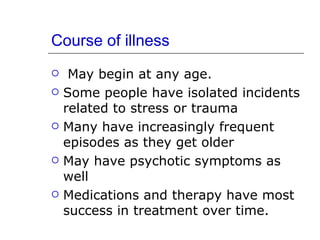
Course of illness May begin at any age. Some people have isolated incidents related to stress or trauma Many have increasingly frequent episodes as they get older May have psychotic symptoms as well Medications and therapy have most success in treatment over time.
Treatment for Major Depression Traditional meds – Anti Depressants SSRI’s – impact different (Serotonin) neurotransmitters in the brain Prozac Elavil Effexor Wellbutrin Therapy – cognitive behaviorial therapy; support groups; skills training are all helpful.
Bipolar Disorder Bipolar I - A combination of one or more Manic episodes as well as one or more Depressed episodes Bipolar II – A combination of one or more depressed episodes as well as one or more hypomanic episodes. Average age of onset is 20 years old. More than 90% have multiple episodes 10 – 15% will complete suicide – usually in depressed episode
Manic Episode  Distinct period of abnormally and persistently elevated, expansive, or irritable mood – for at least one week in duration Inflated self esteem Decreased need for sleep Increased talking Flight of ideas, racing thoughts Distractible Increase in goal directed activity Excessive involvement in pleasurable activities that could have negative consequences – buying sprees, sexual indiscretions, foolish investments Causes significant impairment in social or employment functioning May have psychotic features
Hypomanic Episode Same symptoms as Manic episode except for: Duration at least 4 days Changes are observable by others – uncharacteristic of the person Not severe enough to cause impairment in social or employment functioning
Course of illness May begin at any age. Some people have isolated incidents related to stress or trauma Others have increasingly frequent episodes as they get older May have psychotic symptoms as well Medications and therapy have most success in treatment over time.
Treatment for Bipolar Disorders Mood Stabilizers Depakote Lithium These medications need regular lab work done because of effects on Liver or Kidney functioning Anti depressants Therapy – cognitive behaviorial therapy; support groups; skills training are all helpful.
Schizoaffective Disorder Period of illness with a combination of symptoms for Schizophrenia as well as Major Depressive, Manic, or Mixed episode Delusions or hallucinations present for at least 2 weeks during period of illness Mood episode symptoms are present most of the time during the period of illness
Treatment for Schizoaffective D/O Mood stabilizers Anti psychotics Anti depressants Therapy – skills training most helpful; cognitive therapy may not be as useful due to thought disorder aspect of illness.
Borderline Personality Disorder A pervasive pattern of unstable relationships, self image Marked impulsivity beginning in early adulthood Frantic efforts to avoid “abandonment” Unstable relationships characterized by extremes of idealization and devaluation Identity disturbance
What is Borderline Personality Disorder? Impulsivity that is self damaging Recurrent suicidal behavior, gestures, or self mutilating behavior Intense labile moods Chronic feelings of emptiness Inappropriate, intense anger; inability to control anger Transient, stress related paranoid ideation or dissociation
Treatment for Borderline Personality Disorder For Personality disorders, medications are not useful – you can’t medicate someones personality. Medications may be prescribed for particular symptoms such as depression or anxiety Therapy – particularly Dialectical Behavioral Therapy (DBT) has proven successful.
What Is Recovery? Recovery is possible for people with mental illness.  You must offer HOPE! Recovery is different for each person. Recovery means that you have a successful, high quality of life even though you have a mental illness. Recovery means that you might maintain a job, use supports, have friends, go to school, or have a home.  Recovery may mean that you experience symptoms everyday, but you can manage them and still do the things you want to do. Recovery does not mean that you are cured!
WHAT YOU CAN DO   Have HOPE – people to recover, clients can have more fulfilling lives, if you don’t believe it – they never will either! Don’t take things personally – if a client yells at you or curses at you – it’s probably not about you – it’s about them feeling out of control because of depression, hearing voices, or any other symptom they are having. Be where the client is at – put yourself in their shoes – how would you feel if you were homeless and hearing voices and having a bunch of people telling you what to do?
WHAT YOU CAN DO Have HOPE It’s all about the relationship – you have to build trust before you can effect any change.  Help them with the basics first – food, clothing, shelter, entitlements, etc.  They will see that you care about them and can help them – trust will start to build so that you can talk about other things like symptoms and medications, etc. Revise expectations, at least temporarily – acknowledge symptoms of illness.  If the client does not think they have a mental illness then talking to them about mental illness is just going to piss them off.  Talk to them about other stuff instead – family, work, interests – find something positive, a strength, to focus on – not the negative all the time.
WHAT YOU CAN DO Have HOPE Avoid over-stimulation – groups, lots of noise, loud noise, multiple conversations can be too much.  Someone with depression make breakdown; someone with schizophrenia may become agitated and more delusional  Set limits/boundaries – should be reasonable and flexible if needed.  Allow for the client to have input and choice whenever possible, but be CONSISTENT with each client.  Selectively ignore – give people space.  Do you really need to tell that client to stop pacing?  Who is it hurting?
WHAT YOU CAN DO Have HOPE Keep communications simple and respectful.  Support the patient’s medication regimen – monitor meds; communicate with the doctor and treatment team Learn to recognize signals for help – appropriate crisis intervention – know how to calm a situation not agitate it.
WHAT YOU CAN DO Have a positive attitude – watch your language about clients – don’t use terms like “punishment”, “lazy”, or “resistant” Ask for help whenever you need it –  Supervisor Crisis Center Treatment provider Me Have HOPE!

HOME Conference 2010 - Mental Health 101

  • 1.
    Mental Health 101Cari Guthrie Cho, LCSW-C Chief Operating Officer Threshold Services, Inc.
  • 2.
    Common Mental HealthDisorders Thought Disorders Schizophrenia Schizoaffective Mood Disorders Major Depression Bipolar Disorder Personality Disorders Borderline Personality Disorder Anxiety Disorders Post Traumatic Stress Disorder Obsessive Compulsive Disorder
  • 3.
    WHAT CAUSES MENTALILLNESS? Family Inheritance / Genetic Causes: No specific gene has been found Inheritance does not explain all cases Current thinking – genetic vulnerability and environmental damage both needed Environmental Causes Early brain damage Viruses
  • 4.
    Schizophrenia Biological braindisease that effects about 1% of the population worldwide. Cause is not known. Treatment can improve but not cure this illness. Effects a person’s ability to tell the difference between real and unreal experiences. Effects a person’s ability to remember, think logically and act appropriately in society. Onset usually 18 – 25 years old
  • 5.
    Risk of DevelopingSchizophrenia
  • 6.
    POSITIVE SYMPTOMS Somethingadded to normal mental process. Hallucinations (sensory misperceptions) Hearing something that isn’t there Seeing something that isn’t there Odd physical sensations Delusions (“false ideas”) Constant feeling of being watched or followed Preoccupation with religion Grandiose delusions – believing someone has powers that other people don’t have
  • 7.
    POSITIVE SYMPTOMS DisorganizedSpeech Inability to communicate clearly Thoughts don’t come out in logical fashion Moving from one topic to another Using made up words Disorganized Behavior Failure to attend to personal hygiene Inability to organize behavior that is inappropriate to the situation Poor social skills
  • 8.
    NEGATIVE SYMPTOMS Normalmental functions that are lost or severely impaired. Loss of what is enjoyable or interesting. Anhedonia – loss of pleasure or interest in activities that were enjoyed before Alogia – decreased amount of speech Apathy – poor motivation and ability to initiate activities Lack of social interest – social withdrawal Blunted affect – lack of facial expression, muted or absent emotional response
  • 9.
    MOST COMMON COURSERepeated episodes in early adulthood, gradual loss of functional capacity and increasing negative symptoms. Wide variation in outcomes has been seen – some studies show 50% of patients gain functional independence. Most studies show majority of patients have symptoms and some functional impairment throughout their lives.
  • 10.
    COGNITIVE IMPAIRMENT EXECUTIVEFUNCTIONS – capacity to organize actins to achieve a goal. ATTENTION – ability to remain focused and not be distracted. SECONDARY MEMORY – remembering what you did a week ago and it’s consequences. WORKING MEMORY – ability to use information that has been learned to solve problems. INFORMATION PROCESSING – ability to use environmental cues accurately and make accurate judgments about the environment.
  • 11.
    GOALS OF TREATMENTTreat acute episodes of psychotic symptoms, prevent relapse and support recovery. Prevent future episodes by: Learning early warning signs; Intervene with additional support or medications when warning signs appear; Avoid stressors that lead to relapse.
  • 12.
    TREATMENT OF SCHIZOPHRENIAMost important medications are called anti-psychotics Most effective on positive symptoms 50 - 80% of patients show significant improvement Except for clozapine, no one agent has been shown consistently to be more effective than another on average Cognitive Therapy usually not successful Skills training is helpful – helping client learn how to deal with stressors, signs of relapse, personal hygiene, employment skills, etc.
  • 13.
    Medications Traditional/Typical drugs– side effects – dry mouth, tardive dyskenesia List of a few drugs Haldol Prolixin Navane Loxitane Stelazine
  • 14.
    Medications Newer medicationsor atypical meds are now often used first They have fewer movement related side effects Metabolic side effects – people are developing diabetes, high cholesterol on these newer meds List of drugs: Clozapine (Clozaril) Risperidone (Risperdal) Olanzapine (Zyprexa) Quetiapine (Seroquel) Ziprasidone (Geodon) Aripipizole (Abilify) Clozaril – only medication to have positive affect on negative symptoms
  • 15.
    Depression Persistent moodchange lasting at least two weeks. Depressed mood Lack of interest in daily activities Significant weight change Significant sleep change Psychomotor agitation or retardation Fatigue or loss of energy Feelings of worthlessness Poor concentration Recurrent thoughts of death Significant impairment in social, work, or other areas of life
  • 16.
    Course of illnessMay begin at any age. Some people have isolated incidents related to stress or trauma Many have increasingly frequent episodes as they get older May have psychotic symptoms as well Medications and therapy have most success in treatment over time.
  • 17.
    Treatment for MajorDepression Traditional meds – Anti Depressants SSRI’s – impact different (Serotonin) neurotransmitters in the brain Prozac Elavil Effexor Wellbutrin Therapy – cognitive behaviorial therapy; support groups; skills training are all helpful.
  • 18.
    Bipolar Disorder BipolarI - A combination of one or more Manic episodes as well as one or more Depressed episodes Bipolar II – A combination of one or more depressed episodes as well as one or more hypomanic episodes. Average age of onset is 20 years old. More than 90% have multiple episodes 10 – 15% will complete suicide – usually in depressed episode
  • 19.
    Manic Episode Distinct period of abnormally and persistently elevated, expansive, or irritable mood – for at least one week in duration Inflated self esteem Decreased need for sleep Increased talking Flight of ideas, racing thoughts Distractible Increase in goal directed activity Excessive involvement in pleasurable activities that could have negative consequences – buying sprees, sexual indiscretions, foolish investments Causes significant impairment in social or employment functioning May have psychotic features
  • 20.
    Hypomanic Episode Samesymptoms as Manic episode except for: Duration at least 4 days Changes are observable by others – uncharacteristic of the person Not severe enough to cause impairment in social or employment functioning
  • 21.
    Course of illnessMay begin at any age. Some people have isolated incidents related to stress or trauma Others have increasingly frequent episodes as they get older May have psychotic symptoms as well Medications and therapy have most success in treatment over time.
  • 22.
    Treatment for BipolarDisorders Mood Stabilizers Depakote Lithium These medications need regular lab work done because of effects on Liver or Kidney functioning Anti depressants Therapy – cognitive behaviorial therapy; support groups; skills training are all helpful.
  • 23.
    Schizoaffective Disorder Periodof illness with a combination of symptoms for Schizophrenia as well as Major Depressive, Manic, or Mixed episode Delusions or hallucinations present for at least 2 weeks during period of illness Mood episode symptoms are present most of the time during the period of illness
  • 24.
    Treatment for SchizoaffectiveD/O Mood stabilizers Anti psychotics Anti depressants Therapy – skills training most helpful; cognitive therapy may not be as useful due to thought disorder aspect of illness.
  • 25.
    Borderline Personality DisorderA pervasive pattern of unstable relationships, self image Marked impulsivity beginning in early adulthood Frantic efforts to avoid “abandonment” Unstable relationships characterized by extremes of idealization and devaluation Identity disturbance
  • 26.
    What is BorderlinePersonality Disorder? Impulsivity that is self damaging Recurrent suicidal behavior, gestures, or self mutilating behavior Intense labile moods Chronic feelings of emptiness Inappropriate, intense anger; inability to control anger Transient, stress related paranoid ideation or dissociation
  • 27.
    Treatment for BorderlinePersonality Disorder For Personality disorders, medications are not useful – you can’t medicate someones personality. Medications may be prescribed for particular symptoms such as depression or anxiety Therapy – particularly Dialectical Behavioral Therapy (DBT) has proven successful.
  • 28.
    What Is Recovery?Recovery is possible for people with mental illness. You must offer HOPE! Recovery is different for each person. Recovery means that you have a successful, high quality of life even though you have a mental illness. Recovery means that you might maintain a job, use supports, have friends, go to school, or have a home. Recovery may mean that you experience symptoms everyday, but you can manage them and still do the things you want to do. Recovery does not mean that you are cured!
  • 29.
    WHAT YOU CANDO Have HOPE – people to recover, clients can have more fulfilling lives, if you don’t believe it – they never will either! Don’t take things personally – if a client yells at you or curses at you – it’s probably not about you – it’s about them feeling out of control because of depression, hearing voices, or any other symptom they are having. Be where the client is at – put yourself in their shoes – how would you feel if you were homeless and hearing voices and having a bunch of people telling you what to do?
  • 30.
    WHAT YOU CANDO Have HOPE It’s all about the relationship – you have to build trust before you can effect any change. Help them with the basics first – food, clothing, shelter, entitlements, etc. They will see that you care about them and can help them – trust will start to build so that you can talk about other things like symptoms and medications, etc. Revise expectations, at least temporarily – acknowledge symptoms of illness. If the client does not think they have a mental illness then talking to them about mental illness is just going to piss them off. Talk to them about other stuff instead – family, work, interests – find something positive, a strength, to focus on – not the negative all the time.
  • 31.
    WHAT YOU CANDO Have HOPE Avoid over-stimulation – groups, lots of noise, loud noise, multiple conversations can be too much. Someone with depression make breakdown; someone with schizophrenia may become agitated and more delusional Set limits/boundaries – should be reasonable and flexible if needed. Allow for the client to have input and choice whenever possible, but be CONSISTENT with each client. Selectively ignore – give people space. Do you really need to tell that client to stop pacing? Who is it hurting?
  • 32.
    WHAT YOU CANDO Have HOPE Keep communications simple and respectful. Support the patient’s medication regimen – monitor meds; communicate with the doctor and treatment team Learn to recognize signals for help – appropriate crisis intervention – know how to calm a situation not agitate it.
  • 33.
    WHAT YOU CANDO Have a positive attitude – watch your language about clients – don’t use terms like “punishment”, “lazy”, or “resistant” Ask for help whenever you need it – Supervisor Crisis Center Treatment provider Me Have HOPE!