SPEAKER: AMIT CHOUGULE
ACUTE AND
TRANSIENT
PSYCHOTIC
DISORDER
LAYOUT
1. Introduction
2. History and evolution of ATPD
3. ICD-10 diagnostic criteria
4. Epidemiology of ATPD
5. Course and outcome
6. Treatment of ATPD
7. Issues with nosology
8. Future of ATPD as a diagnostic criteria
9. Conclusion
INTRODUCTION
 Acute and transient Psychotic Disorder (ATPD) as a descriptive entity
was recognized in ICD-10 in 1992
 Included under psychotic disorder (F23) as a three-digit code
 “Nomenclature of these acute disorders is as uncertain as their nosological
status”
 “Psychotic disorder” is used as a term of convenience”
 The fact remains that systematic clinical information that would guide the
classification of acute psychotic states is not yet available”
HISTORY AND EVOLUTION OF ATPD
 1876 German Psychiatist Karl westphal described paranoia acuta
 1890 Meynert repeated the clinical description but named the condition
“amentia”
 Sigmund Freud chose this type of acute delusion with hallucinations for
his psychoanalytic conception of psychosis
 100 Years
 The existence of acute psychoses has been described by almost
all important authors of the Pre-Kraepelinian period
 Meynert in 1889 first described transient amentia (amnesia with
a sad spirit)
 Psychotic confusional state
 Good prognosis
 Emil Kraepelin’s dichotomy of dementia praecox and manic-
depressive insanity
 Kraepelin based this dichotomy mainly on symptomatology,
course and longitudinal outcome
(Kraepelin, 1893, 1896, 1899)
HISTORY OF
ACUTE PSYCHOSIS
KRAEPELIN’S DICHOTOMY
 Kraepelin knew of Brief and Acute Psychoses
 Could not be allocate it either to schizophrenia or to affective
disorder
 Such disorders could cause severe doubts regarding the
reliability of his dichotomy (Kraepelin, 1920)
 Kraepelin allocated them either to manic-depressive insanity or to
dementia praecox
 Majority of Brief and Acute Psychoses were allocated by
Kraepelin to the manic-depressive insanity group
JUGGLE OF ACUTE PSYCHOSIS
GROUP TO SCHIZOPHRENIA
 Kraepelin’s dichotomic system was
reformed by Eugen Bleuler (1911)
 Created the group of schizophrenias
 Problem of the brief, acute, transient and
good prognosis psychoses persisted
 Acute psychosis category was moved
from Kraepelin’s manic-depressive
insanity to Bleuler’s schizophrenia
 A tradition which is still going on
Psychotic Symptoms, Mood Symptoms, Cognitive symptoms,
Aggression, Poor insight, excitement, Decreased self care,
Socio-occupational dysfunction
Acute vs Insidious Onset
Continuous Vs Episodic vs Remitting Course
Good Vs Bad Prognosis
KRAEPELIN’S
DICHOTOMY
Dementia
praecox
Manic-
Depressive
Psychosis
Not schizophrenia
Not an affective disorder
Not a schizoaffective
disorder
Good Prognosis
Eugen
Bleuler
Schizophrenia
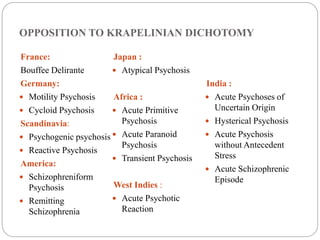
OPPOSITION TO KRAPELINIAN DICHOTOMY
France:
Bouffee Delirante
Germany:
 Motility Psychosis
 Cycloid Psychosis
Scandinavia:
 Psychogenic psychosis
 Reactive Psychosis
America:
 Schizophreniform
Psychosis
 Remitting
Schizophrenia
Japan :
 Atypical Psychosis
Africa :
 Acute Primitive
Psychosis
 Acute Paranoid
Psychosis
 Transient Psychosis
West Indies :
 Acute Psychotic
Reaction
India :
 Acute Psychoses of
Uncertain Origin
 Hysterical Psychosis
 Acute Psychosis
without Antecedent
Stress
 Acute Schizophrenic
Episode
THE CYCLOID PSYCHOSES- GERMANY
 It was created and developed by three Karls’:
1. Carl Wernicke
2. Karl Kleist
3. Karl Leonhard
 Focused mainly on clinical and on genetic findings
 Demanded a separation from Kraepelin’s manic-depressive insanity
 Fish (1964) introduced the concept of cycloid psychosis to English
speaking countries
(Acute and transient psychosis by Andreas Marneros and Frank pillmann,2004)
BOUFFEE DELIRANTE- FRANCE
1. It can be regarded as the French root of ATPD and Brief Psychoses
2. Valentin Magnan (1835–1916)
3. The modern concept of bouffee delirante is based on operational criteria
like:
1. Sudden onset
2. Specific symptomatology
3. Evolution of the disorder
4. Retained the category bouffee delirante as an independent mental
disorder
ACUTE PSYCHOSIS - INDIA
 Wig and Singh extracted psychiatric categories from the APA DSM II
relevant for use in India
 They argued for the category of acute psychosis for brief episodes
precipitated by stress which does not fit into the Kraepelinian
dichotomy
 They sub-classified acute psychosis into:
1. Confusional
2. Paranoid hallucinatory
3. Schizoaffective
4. Hysterical psychosis (K. S. Jacob, 2016)
REACTIVE/PSYCHOGENIC PSYCHOSES
 Basic concept was developed by Karl Jaspers
 Very strong tradition mainly in Scandinavia
 The first monograph was written by August Wimmer
 The concept developed by Wimmer is based on Jaspers General
Psychopathology
(Acute and transient psychosis by Andreas Marneros and Frank pillmann,2004)
TOWARDS A PERMANENT PLACE IN
INTERNATIONAL CLASSIFICATION
 What happened to individual national concepts of acute
psychosis?
 How did they find a permanent place in international
classification?
 Which landmark studies identified them as a separate
category?
INTERNATIONAL PILOT STUDY OF
SCHIZOPHRENIA (IPSS) (1968-70)
 This was a nine-country study on schizophrenia led and
funded by WHO, with the main aims:
1. Whether schizophrenia existed in different parts of the
world?
2. What were the common/differing clinical presentations?
3. What was the course and outcome among different
cultures?
INTERNATIONAL PILOT STUDY OF
SCHIZOPHRENIA (IPSS) (1968-70)
 Agra was the center from India
 The main findings:
1. Course and outcome in developing world was better than
developed countries
2. 25% of people diagnosed to have schizophrenia had only one
episode and good outcome
 IPSS raised questions like whether these subjects with good outcome
had a:
 Separate psychosis?
 Were they part of the schizophrenia group?
Determinants Of Outcome Of Severe Mental Health
Disorders (DOSMED) (1978-80)
 Designed to study:
1. First onset psychosis
2. Incidence of schizophrenia
3. Findings related to acute psychosis
 Chandigarh was the Indian center
 The incidence of “broadly defined schizophrenia” was 10 times higher in
the developing world than in the developed countries as compared to
“narrowly defined schizophrenia”
 These patients also exhibited a benign course at two-year follow-up
 Possibility of psychotic states that were not yet clearly identified
THE CROSS-CULTURAL STUDY OF ACUTE
PSYCHOSIS (CAP) (1980-82)
 The study aimed to:
1. Differentiate ATPD from schizophrenia and manic depressive
psychosis
2. Understand its relationship with psychological and physical stress
 Main findings included:
1. 41.2% of patients had symptoms of schizophrenia
2. 20% had Affective symptoms
3. 35.3% had “other psychoses”
4. 41.7% reported stress at onset
5. Two-thirds of the subjects remained without relapse at one year
follow-up
INDIAN COUNCIL OF MEDICAL RESEARCH’S
MULTICENTRE STUDY OF ACUTE PSYCHOSIS
 Bikaner, Goa, Patiala and Vellore
 It was found that:
1. 35% of were Schizophrenia
2. 25% were MDP
3. 40% as non-organic psychosis as per ICD-9
4. 52% of cases of acute psychosis could not be categorized into any of
the categorical diagnosis
RECOGNITION OF ACUTE PSYCHOSIS
AS A SEPARATE CATEGORY
 These studies provided evidence of a non-affective, non
schizophrenia psychosis with remission and good outcome
 Inclusion of acute and transient Psychosis as a separate
category in ICD-10 in 1992
CLINICAL DESCRIPTION: PSYCHOPATHOLOGY
 The heterogeneous group of acute and transient psychotic disorders
 Characterized by three typical features in the descending order of
priority:
1. An acute onset (within 2 weeks) as the defining feature of the whole
group
2. Presence of typical syndromes
3. Presence of associated acute stress
ACUTE ONSET
 Acute onset is defined as a change from a state without psychotic
features to a clearly abnormal psychotic state, within a period of 2
weeks or less
 There is some evidence that acute onset is associated with a good
outcome
 More abrupt the onset better the outcome
 It is therefore recommended that whenever appropriate, abrupt onset
(within 48 hours or less) be specified
THE TYPICAL SYNDROMES
1. Rapidly changing and variable state called "polymorphic“
2. Typical schizophrenic symptoms
3. Differentiated on the basis of first rank Symptoms of schizophrenia
ASSOCIATED ACUTE STRESS
 Traditional linkage of stress with acute psychosis
 Substantial proportion of acute psychotic disorders arise without
associated stress
 First psychotic symptoms should occur within about 2 weeks of one or
more events that would be regarded as stressful to most people
 Typical events would be bereavement, unexpected loss of partner or
job, marriage or the psychological trauma of combat, terrorism, and
torture
 Long-standing difficulties or problems should not be included
F23.0 Acute polymorphic psychotic disorder
without symptoms of schizophrenia
 The delusional themes are varied and include grandeur, persecution,
influence, possession, body transformation (depersonalization),
derealization or world alteration
 These themes change with time and may combine
 Consciousness fluctuates with the delirious convictions and changes of
emotion
 Karl Jaspers - ‘first delirious experience‘ which is a “dreamlike state”
 The criteria for manic episode, depressive episode or schizophrenia are not
fulfilled
F23.0 Acute polymorphic psychotic disorder
without symptoms of schizophrenia
 Duration of less than a month
 In most cases recovery occurs within a few weeks or months
 If resolution of the symptoms has not occurred after 3 months, the
diagnosis should be changed to persistent delusional disorder (F22) or
non-organic psychotic disorder (F28)
F23.1 Acute polymorphic disorder with symptoms
of schizophrenia
 This diagnostic category combines the symptoms of acute polymorphic
psychotic disorder with some typical symptoms of schizophrenia (F20)
present for most of the time
 It can be a provisional diagnosis, which is changed to schizophrenia if
the criteria of schizophrenia persist more than a month
F23.2 Acute schizophrenia-like psychotic disorder
 This acute psychotic disorder lasts for less than a month and is mostly
schizophrenic
 The polymorphic psychotic symptoms are stable
 The duration criterion is the most important
 This category is a provisional diagnosis
 In ICD-10 if the first episode lasts for more than a month, it has to be
considered as an acute onset of schizophrenia
F23.3 Other acute predominantly delusional
psychotic disorders
 The main clinical features of this category are delusions and
hallucinations
 Do not meet the criteria for schizophrenia
 The duration of this psychotic episode must be less than 3 months
 If the persecutory delusions persist for more than 3 months, the
diagnosis changes to persistent delusional disorders (F22)
 Auditory hallucinations persist for more than 3 months, the diagnosis is
changed to other non-organic psychotic disorders (F28)
 F23.8 Other acute and transient psychotic disorders
1. Any other acute psychotic disorders that are unclassifiable under
any other category in F23
2. States of undifferentiated excitement should also be coded here if
more detailed information about the patient's mental state is not
available
 F23.9 Acute and transient psychotic disorder
unspecified
(brief) reactive psychosis NOS
SYNONYMS FOR ATPD IN ICD 10
1. Acute (Undifferentiated) Schizophrenia
2. Bouff´ee D´elirante
3. Cycloid Psychoses
4. Oneirophrenia
5. Paranoid Reaction
6. Psychogenic Psychosis/ Reactive Psychosis
7. Schizophrenic Reaction
8. Schizophreniform Attack Or Psychosis
9. Remitting Schizophrenia
10. Good Prognosis Schizophrenia
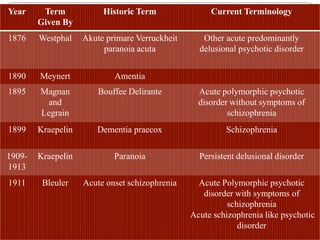
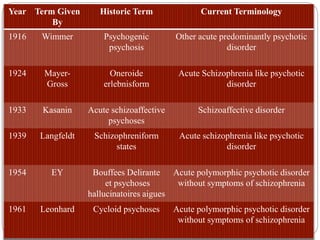
Year Term
Given By
Historic Term Current Terminology
1876 Westphal Akute primare Verruckheit
paranoia acuta
Other acute predominantly
delusional psychotic disorder
1890 Meynert Amentia
1895 Magnan
and
Legrain
Bouffee Delirante Acute polymorphic psychotic
disorder without symptoms of
schizophrenia
1899 Kraepelin Dementia praecox Schizophrenia
1909-
1913
Kraepelin Paranoia Persistent delusional disorder
1911 Bleuler Acute onset schizophrenia Acute Polymorphic psychotic
disorder with symptoms of
schizophrenia
Acute schizophrenia like psychotic
disorder
Year Term Given
By
Historic Term Current Terminology
1916 Wimmer Psychogenic
psychosis
Other acute predominantly psychotic
disorder
1924 Mayer-
Gross
Oneroide
erlebnisform
Acute Schizophrenia like psychotic
disorder
1933 Kasanin Acute schizoaffective
psychoses
Schizoaffective disorder
1939 Langfeldt Schizophreniform
states
Acute schizophrenia like psychotic
disorder
1954 EY Bouffees Delirante
et psychoses
hallucinatoires aigues
Acute polymorphic psychotic disorder
without symptoms of schizophrenia
1961 Leonhard Cycloid psychoses Acute polymorphic psychotic disorder
without symptoms of schizophrenia
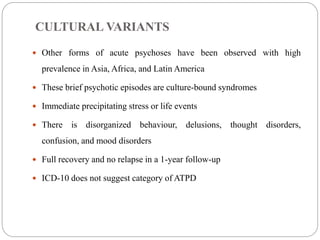
CULTURAL VARIANTS
 Other forms of acute psychoses have been observed with high
prevalence in Asia, Africa, and Latin America
 These brief psychotic episodes are culture-bound syndromes
 Immediate precipitating stress or life events
 There is disorganized behaviour, delusions, thought disorders,
confusion, and mood disorders
 Full recovery and no relapse in a 1-year follow-up
 ICD-10 does not suggest category of ATPD
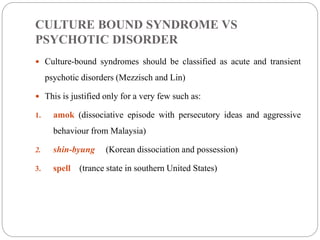
CULTURE BOUND SYNDROME VS
PSYCHOTIC DISORDER
 Culture-bound syndromes should be classified as acute and transient
psychotic disorders (Mezzisch and Lin)
 This is justified only for a very few such as:
1. amok (dissociative episode with persecutory ideas and aggressive
behaviour from Malaysia)
2. shin-byung (Korean dissociation and possession)
3. spell (trance state in southern United States)
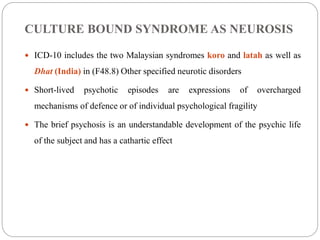
CULTURE BOUND SYNDROME AS NEUROSIS
 ICD-10 includes the two Malaysian syndromes koro and latah as well as
Dhat (India) in (F48.8) Other specified neurotic disorders
 Short-lived psychotic episodes are expressions of overcharged
mechanisms of defence or of individual psychological fragility
 The brief psychosis is an understandable development of the psychic life
of the subject and has a cathartic effect
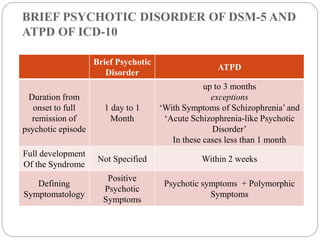
BRIEF PSYCHOTIC DISORDER OF DSM-5 AND
ATPD OF ICD-10
Brief Psychotic
Disorder
ATPD
Duration from
onset to full
remission of
psychotic episode
1 day to 1
Month
up to 3 months
exceptions
‘With Symptoms of Schizophrenia’ and
‘Acute Schizophrenia-like Psychotic
Disorder’
In these cases less than 1 month
Full development
Of the Syndrome
Not Specified Within 2 weeks
Defining
Symptomatology
Positive
Psychotic
Symptoms
Psychotic symptoms + Polymorphic
Symptoms
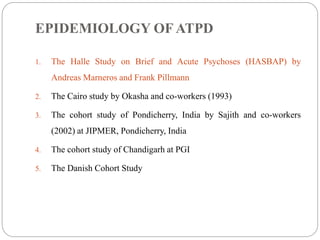
EPIDEMIOLOGY OF ATPD
1. The Halle Study on Brief and Acute Psychoses (HASBAP) by
Andreas Marneros and Frank Pillmann
2. The Cairo study by Okasha and co-workers (1993)
3. The cohort study of Pondicherry, India by Sajith and co-workers
(2002) at JIPMER, Pondicherry, India
4. The cohort study of Chandigarh at PGI
5. The Danish Cohort Study
THE FREQUENCY OF ATPD
 The frequency of Brief and Acute Psychoses is considerably higher in
developing countries
 Frequency of subtypes of ATPD according to ICD-10:
1. Acute Polymorphic Psychoses- 67%
2. Acute Schizophrenia-like Psychoses - 26%
3. Other Acute Predominantly Delusional Psychoses - 2%
4. Other Acute and Transient Psychoses (F23.8) - 5%
 Frequency of Subtypes of Acute Polymorphic:
1. Without Symptoms of Schizophrenia-50%
2. With Symptoms of Schizophrenia-50%
GENDER DISTRIBUTION
 More frequent in women than in men
 This constitutes an important difference to schizophrenia and to
schizoaffective disorders
AGE AT ONSET
 Acute and Transient Psychotic Disorders may occur at any age
 Peak in the mid thirties
 Age at onset is higher than in schizophrenia
MENTAL DISORDERS IN THE FAMILY
 In a major case control study found family history of ATP was three
times greater in first degree relatives(FDRS) of ATP
 History of schizophrenia was seen in FDRs of those ATP patients who
had schizophrenic symptoms
 These findings gave evidence that ATP is genetically distinct from
MDP
 There is genetic overlap between ATP and schizophrenia and
schizophrenic symptoms
PREMORBID PERSONALITY
 Assessment by ‘Big Five’ personality dimensions
 No significant difference between ATPD patients and healthy controls
 Bipolar Schizoaffective Disorder patients differ from mentally healthy
controls on two of five subscales-neuroticism and extraversion
 Schizophrenia patients show pronounced differences from the mentally
healthy controls on three of five subscales: neuroticism, extraversion
and conscientiousness
ONSET AND DURATION OF EPISODE
 Neither abrupt nor acute onset are specific for ATPD
 Schizophrenia can have an acute onset and rarely an abrupt onset
 The duration of the psychotic period as well as the duration of inpatient
treatment is significantly shorter in ATPD
 Insidious onset tends to have a longer duration of the psychotic period
 Tendency for patients with a precipitating life event to show a more
acute onset
PSYCHOPATHOLOGICAL ASPECTS OF
ATPD
 The most crucial differences in phenomenology of ATPD:
1. Rapidly changing delusional topics
2. Rapidly changing mood
3. Anxiety
 Significantly more frequently represented in ATPD
LONGITUDINAL COURSE OF ATPD
 Relapse rates in ATPD are similar to those in controls with
Schizophrenia and BPAD
 After 2.3 years one-half of the ATPD patients will experience a relapse
 Patients with ATPD who experience a relapse usually have ATPD
episodes again
 Affective and schizoaffective episodes during follow-up are also
common
(HALLE STUDY)
COURSE AND DIAGNOSTIC STABILITY
OF ATPD
 Recurrence of psychotic episodes is common
 Not as common as in schizophrenia or bipolar disorder
 Over 15 years of follow-up:
1. 30% of ATPD patients experienced a single episode
2. 50% had an episodic-remitting course
3. 20% had a chronic course
 Four studies in India have evaluated the diagnostic stability of ATPD
for a follow up period from 12-36 months
 63-100% of patients retained their diagnosis of ATPD at follow-up
DIAGNOSTIC STABILITY IN INDIAN STUDIES
 Thangadurai et al. while analyzing the medical records of all patients with
psychotic disorders found:
 13.9% were diagnosed with acute psychosis
 Mean duration of follow-up was 13.2 months
 The diagnosis was revised to:
1. Affective disorder in 9.2%
2. Schizophrenia in 26.4%
3. 11.5% presented with recurrent episodes of acute psychosis
DIAGNOSTIC STABILITY OF ATPD
 A Danish study covering 15 years of register data found a 39% stability
rate of ATPD
 Majority of patients transitioning to diagnoses of schizophrenia or
affective disorders
 60% of the total ATPD sample developing another psychiatric disorder by
their third admission
DIAGNOSTIC STABILITY OF ATPD
 Diagnostic stability differs widely by diagnosis and length of
follow-up
 A small study of first-episode psychotic patients in Iran found that
100% of those diagnosed with ICD-10 ATPD maintained the same
diagnosis over 12 months of follow-up
 In a 15-year follow-up the diagnoses of ATPD, Schizophreniform and
brief psychotic disorder were unstable over time
DIAGNOSTIC STABILITY
DEVELOPING VS DEVELOPED NATIONS
 In industrialized nations like Europe more than 50% of cases with ATPD
tend to change diagnosis into another category
 In a review of 13 follow-up studies of ATPD:
 Castagnini and Berrios noted that studies in developing settings
tend to show higher diagnostic stability and lower rates of relapse
than studies in western settings
PREDICTORS OF DIAGNOSTIC STABILITY
AND FAVOURABLE OUTCOME IN ATPD
1. Sudden onset
2. Female sex
3. Duration less than one month
4. Good premorbid functioning
5. Acute insomnia
DIAGNOSTIC STABILITY OF ATPD
 Syndrome stability of ATPD is found to be located in the middle
between the high stability of schizophrenia and the low stability of
schizoaffective disorder
 After exclusion of the Acute Schizophrenia-like Psychotic Disorders
from the group of ATPD 50% of the ATPD patients have a
‘monosyndromal’ course during the prospective follow-up of five years
OUTCOME
 After 10 years of illness patients with ATPD in comparison to controls
with schizophrenia show:
1. Better global functioning
2. Less social disability
3. Fewer persisting alterations
4. Fewer negative and positive symptoms
5. Higher rates of heterosexual relationships
MANAGEMENT OF ATPD
 Early hospitalization in order to make:
1. Careful clinical evaluation
2. To separate the patient from environment
3. To provide a reassuring setting
4. To prevent any suicidal or aggressive tendencies
 Antipsychotic drugs are indicated
 The choice of antipsychotic drug depends on the clinician's experience
and the clinical features
 Benzodiazepines may be given to potentiate the action of the
neuroleptics
CONTINUATION OF TREATMENT
AND PREVENTION OF RECURRENCE
 The effectiveness of psychopharmacotherapy is usually manifested in the
first 6 weeks
 If mood disorders or cyclic episodes occur treatment with antidepressants
or mood stabilizers is warranted
 Low-dosage pharmacotherapy must be maintained for 1 or 2 years after
recovery
 During this long-term follow-up, periodic assessment and effective
clinical care with social and psychological therapy are essential
ISSUES OF NOSOLOGY
THE BOUNDARIES OF HOMOGENEITY:
 Various sub-classifications of ATPD leads to an inhomogeneous group of
psychotic disorders
 ICD-10 differentiates Acute Polymorphic Psychoses ‘with’ and ‘without”
symptoms of schizophrenia based on first-rank symptoms
 WHO defines ‘Acute Schizophrenia-like Psychotic Disorder” based on:
1. Presence of first-rank symptoms
2. Absence of polymorphic symptomatology
 No significant differences between the Polymorphic Psychotic Disorders
with or without schizophrenic symptoms was found
THE BOUNDARIES OF HOMOGENEITY
 First-rank symptoms cannot distinguish the Acute Polymorphic
Disorders into subgroups
 The polymorphism of the symptomatology has a much more
discriminating power than the presence of first-rank symptoms
 The WHO distinction of ‘Acute Polymorphic Disorder’ into the two
categories ‘with’ and ‘without’ schizophrenic symptoms is unwarranted
and unnecessary
 ICD-10 subtype F23.0 (‘with’ schizophrenic symptoms) and F23.1
(‘without’ schizophrenic symptoms) can be put together
Is the ‘Acute Schizophrenia-like Psychosis’ simply
schizophrenia
 Main difference between Acute Schizophrenia-like Disorders and
schizophrenia concerns is duration (1 month)
 Is this criterion valid enough to combine with ATPD ??
 Patients with Acute Schizophrenia-like Psychoses are more similar to
patients with schizophrenia
 The category ‘ATPD’ can be much more homogeneous if the ‘Acute
Polymorphic Psychotic Disorders’ are not combined with the ‘Acute
Schizophrenia-like Psychotic Disorders
FUTURE OF ATPD IN ICD-11
 Working Group on the Classification of Psychotic Disorders (WGPD)
 Diagnostic focus should be “Polymorphic” clinical presentation:
“”High variability/fluctuation of psychotic and affective symptoms”
 WGPD recommends that:
1. Subcategory F23.0 (Acute polymorphic psychotic disorder without
symptoms of schizophrenia) be retained as the clinical guideline for
ATPD
2. Delusional subtype (F23.3) be incorporated into the revised category
Delusional disorder
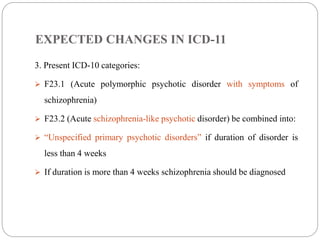
EXPECTED CHANGES IN ICD-11
3. Present ICD-10 categories:
 F23.1 (Acute polymorphic psychotic disorder with symptoms of
schizophrenia)
 F23.2 (Acute schizophrenia-like psychotic disorder) be combined into:
 “Unspecified primary psychotic disorders” if duration of disorder is
less than 4 weeks
 If duration is more than 4 weeks schizophrenia should be diagnosed
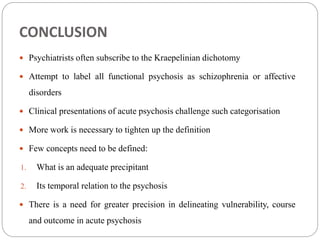
CONCLUSION
 Psychiatrists often subscribe to the Kraepelinian dichotomy
 Attempt to label all functional psychosis as schizophrenia or affective
disorders
 Clinical presentations of acute psychosis challenge such categorisation
 More work is necessary to tighten up the definition
 Few concepts need to be defined:
1. What is an adequate precipitant
2. Its temporal relation to the psychosis
 There is a need for greater precision in delineating vulnerability, course
and outcome in acute psychosis
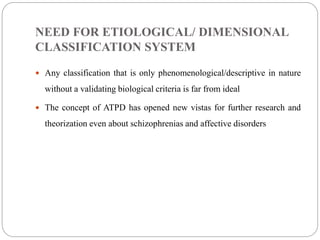
NEED FOR ETIOLOGICAL/ DIMENSIONAL
CLASSIFICATION SYSTEM
 Any classification that is only phenomenological/descriptive in nature
without a validating biological criteria is far from ideal
 The concept of ATPD has opened new vistas for further research and
theorization even about schizophrenias and affective disorders
References
1. Acute and transient psychosis by Andreas Marneros and Frank pillmann,2004
2. K. S. Jacob Indian Psychiatry and classification of psychiatric disorders.Indian
J Psychiatry 52, Supplement, January 2010
3. Savita Malhotra. Acute and transient psychosis: A paradigmatic approach.
Indian J Psychiatry 49(4), Oct-Dec 2007 233
4. M Taylor Madness and Maastricht: a review of reactive psychoses from a
European perspectiveJournal of the Royal Society of Medicine Volume 87
November 1994
5. Aksel Bertelsen Reactive or Psychogenic Psychoses: The Scandinavian
Concept. Revista do Serviço de Psiquiatria do Hospital Fernando Fonseca
6. Ruud van Winkel, Nicholas C. Stefanis, Inez Myin-Germeys Psychosocial
Stress and Psychosis. A Review of the Neurobiological Mechanisms and the
Evidence for Gene-Stress InteractionSchizophrenia Bulletin vol. 34 no. 6 pp.
1095–1105, 2008
7. Wolfgang Gaebel*Status of Psychotic Disorders in ICD-11Schizophrenia
Bulletin vol. 38 no. 5 pp. 895–898, 2012
THANK YOU

Acute and transient Psychotic Disorder

  • 1.
    SPEAKER: AMIT CHOUGULE ACUTEAND TRANSIENT PSYCHOTIC DISORDER
  • 2.
    LAYOUT 1. Introduction 2. Historyand evolution of ATPD 3. ICD-10 diagnostic criteria 4. Epidemiology of ATPD 5. Course and outcome 6. Treatment of ATPD 7. Issues with nosology 8. Future of ATPD as a diagnostic criteria 9. Conclusion
  • 3.
    INTRODUCTION  Acute andtransient Psychotic Disorder (ATPD) as a descriptive entity was recognized in ICD-10 in 1992  Included under psychotic disorder (F23) as a three-digit code  “Nomenclature of these acute disorders is as uncertain as their nosological status”  “Psychotic disorder” is used as a term of convenience”  The fact remains that systematic clinical information that would guide the classification of acute psychotic states is not yet available”
  • 4.
    HISTORY AND EVOLUTIONOF ATPD  1876 German Psychiatist Karl westphal described paranoia acuta  1890 Meynert repeated the clinical description but named the condition “amentia”  Sigmund Freud chose this type of acute delusion with hallucinations for his psychoanalytic conception of psychosis  100 Years
  • 5.
     The existenceof acute psychoses has been described by almost all important authors of the Pre-Kraepelinian period  Meynert in 1889 first described transient amentia (amnesia with a sad spirit)  Psychotic confusional state  Good prognosis  Emil Kraepelin’s dichotomy of dementia praecox and manic- depressive insanity  Kraepelin based this dichotomy mainly on symptomatology, course and longitudinal outcome (Kraepelin, 1893, 1896, 1899) HISTORY OF ACUTE PSYCHOSIS
  • 6.
    KRAEPELIN’S DICHOTOMY  Kraepelinknew of Brief and Acute Psychoses  Could not be allocate it either to schizophrenia or to affective disorder  Such disorders could cause severe doubts regarding the reliability of his dichotomy (Kraepelin, 1920)  Kraepelin allocated them either to manic-depressive insanity or to dementia praecox  Majority of Brief and Acute Psychoses were allocated by Kraepelin to the manic-depressive insanity group
  • 7.
    JUGGLE OF ACUTEPSYCHOSIS GROUP TO SCHIZOPHRENIA  Kraepelin’s dichotomic system was reformed by Eugen Bleuler (1911)  Created the group of schizophrenias  Problem of the brief, acute, transient and good prognosis psychoses persisted  Acute psychosis category was moved from Kraepelin’s manic-depressive insanity to Bleuler’s schizophrenia  A tradition which is still going on
  • 8.
    Psychotic Symptoms, MoodSymptoms, Cognitive symptoms, Aggression, Poor insight, excitement, Decreased self care, Socio-occupational dysfunction Acute vs Insidious Onset Continuous Vs Episodic vs Remitting Course Good Vs Bad Prognosis KRAEPELIN’S DICHOTOMY Dementia praecox Manic- Depressive Psychosis Not schizophrenia Not an affective disorder Not a schizoaffective disorder Good Prognosis Eugen Bleuler Schizophrenia
  • 9.
    OPPOSITION TO KRAPELINIANDICHOTOMY France: Bouffee Delirante Germany:  Motility Psychosis  Cycloid Psychosis Scandinavia:  Psychogenic psychosis  Reactive Psychosis America:  Schizophreniform Psychosis  Remitting Schizophrenia Japan :  Atypical Psychosis Africa :  Acute Primitive Psychosis  Acute Paranoid Psychosis  Transient Psychosis West Indies :  Acute Psychotic Reaction India :  Acute Psychoses of Uncertain Origin  Hysterical Psychosis  Acute Psychosis without Antecedent Stress  Acute Schizophrenic Episode
  • 10.
    THE CYCLOID PSYCHOSES-GERMANY  It was created and developed by three Karls’: 1. Carl Wernicke 2. Karl Kleist 3. Karl Leonhard  Focused mainly on clinical and on genetic findings  Demanded a separation from Kraepelin’s manic-depressive insanity  Fish (1964) introduced the concept of cycloid psychosis to English speaking countries (Acute and transient psychosis by Andreas Marneros and Frank pillmann,2004)
  • 11.
    BOUFFEE DELIRANTE- FRANCE 1.It can be regarded as the French root of ATPD and Brief Psychoses 2. Valentin Magnan (1835–1916) 3. The modern concept of bouffee delirante is based on operational criteria like: 1. Sudden onset 2. Specific symptomatology 3. Evolution of the disorder 4. Retained the category bouffee delirante as an independent mental disorder
  • 12.
    ACUTE PSYCHOSIS -INDIA  Wig and Singh extracted psychiatric categories from the APA DSM II relevant for use in India  They argued for the category of acute psychosis for brief episodes precipitated by stress which does not fit into the Kraepelinian dichotomy  They sub-classified acute psychosis into: 1. Confusional 2. Paranoid hallucinatory 3. Schizoaffective 4. Hysterical psychosis (K. S. Jacob, 2016)
  • 13.
    REACTIVE/PSYCHOGENIC PSYCHOSES  Basicconcept was developed by Karl Jaspers  Very strong tradition mainly in Scandinavia  The first monograph was written by August Wimmer  The concept developed by Wimmer is based on Jaspers General Psychopathology (Acute and transient psychosis by Andreas Marneros and Frank pillmann,2004)
  • 14.
    TOWARDS A PERMANENTPLACE IN INTERNATIONAL CLASSIFICATION  What happened to individual national concepts of acute psychosis?  How did they find a permanent place in international classification?  Which landmark studies identified them as a separate category?
  • 15.
    INTERNATIONAL PILOT STUDYOF SCHIZOPHRENIA (IPSS) (1968-70)  This was a nine-country study on schizophrenia led and funded by WHO, with the main aims: 1. Whether schizophrenia existed in different parts of the world? 2. What were the common/differing clinical presentations? 3. What was the course and outcome among different cultures?
  • 16.
    INTERNATIONAL PILOT STUDYOF SCHIZOPHRENIA (IPSS) (1968-70)  Agra was the center from India  The main findings: 1. Course and outcome in developing world was better than developed countries 2. 25% of people diagnosed to have schizophrenia had only one episode and good outcome  IPSS raised questions like whether these subjects with good outcome had a:  Separate psychosis?  Were they part of the schizophrenia group?
  • 17.
    Determinants Of OutcomeOf Severe Mental Health Disorders (DOSMED) (1978-80)  Designed to study: 1. First onset psychosis 2. Incidence of schizophrenia 3. Findings related to acute psychosis  Chandigarh was the Indian center  The incidence of “broadly defined schizophrenia” was 10 times higher in the developing world than in the developed countries as compared to “narrowly defined schizophrenia”  These patients also exhibited a benign course at two-year follow-up  Possibility of psychotic states that were not yet clearly identified
  • 18.
    THE CROSS-CULTURAL STUDYOF ACUTE PSYCHOSIS (CAP) (1980-82)  The study aimed to: 1. Differentiate ATPD from schizophrenia and manic depressive psychosis 2. Understand its relationship with psychological and physical stress  Main findings included: 1. 41.2% of patients had symptoms of schizophrenia 2. 20% had Affective symptoms 3. 35.3% had “other psychoses” 4. 41.7% reported stress at onset 5. Two-thirds of the subjects remained without relapse at one year follow-up
  • 19.
    INDIAN COUNCIL OFMEDICAL RESEARCH’S MULTICENTRE STUDY OF ACUTE PSYCHOSIS  Bikaner, Goa, Patiala and Vellore  It was found that: 1. 35% of were Schizophrenia 2. 25% were MDP 3. 40% as non-organic psychosis as per ICD-9 4. 52% of cases of acute psychosis could not be categorized into any of the categorical diagnosis
  • 20.
    RECOGNITION OF ACUTEPSYCHOSIS AS A SEPARATE CATEGORY  These studies provided evidence of a non-affective, non schizophrenia psychosis with remission and good outcome  Inclusion of acute and transient Psychosis as a separate category in ICD-10 in 1992
  • 21.
    CLINICAL DESCRIPTION: PSYCHOPATHOLOGY The heterogeneous group of acute and transient psychotic disorders  Characterized by three typical features in the descending order of priority: 1. An acute onset (within 2 weeks) as the defining feature of the whole group 2. Presence of typical syndromes 3. Presence of associated acute stress
  • 22.
    ACUTE ONSET  Acuteonset is defined as a change from a state without psychotic features to a clearly abnormal psychotic state, within a period of 2 weeks or less  There is some evidence that acute onset is associated with a good outcome  More abrupt the onset better the outcome  It is therefore recommended that whenever appropriate, abrupt onset (within 48 hours or less) be specified
  • 23.
    THE TYPICAL SYNDROMES 1.Rapidly changing and variable state called "polymorphic“ 2. Typical schizophrenic symptoms 3. Differentiated on the basis of first rank Symptoms of schizophrenia
  • 24.
    ASSOCIATED ACUTE STRESS Traditional linkage of stress with acute psychosis  Substantial proportion of acute psychotic disorders arise without associated stress  First psychotic symptoms should occur within about 2 weeks of one or more events that would be regarded as stressful to most people  Typical events would be bereavement, unexpected loss of partner or job, marriage or the psychological trauma of combat, terrorism, and torture  Long-standing difficulties or problems should not be included
  • 25.
    F23.0 Acute polymorphicpsychotic disorder without symptoms of schizophrenia  The delusional themes are varied and include grandeur, persecution, influence, possession, body transformation (depersonalization), derealization or world alteration  These themes change with time and may combine  Consciousness fluctuates with the delirious convictions and changes of emotion  Karl Jaspers - ‘first delirious experience‘ which is a “dreamlike state”  The criteria for manic episode, depressive episode or schizophrenia are not fulfilled
  • 26.
    F23.0 Acute polymorphicpsychotic disorder without symptoms of schizophrenia  Duration of less than a month  In most cases recovery occurs within a few weeks or months  If resolution of the symptoms has not occurred after 3 months, the diagnosis should be changed to persistent delusional disorder (F22) or non-organic psychotic disorder (F28)
  • 27.
    F23.1 Acute polymorphicdisorder with symptoms of schizophrenia  This diagnostic category combines the symptoms of acute polymorphic psychotic disorder with some typical symptoms of schizophrenia (F20) present for most of the time  It can be a provisional diagnosis, which is changed to schizophrenia if the criteria of schizophrenia persist more than a month
  • 28.
    F23.2 Acute schizophrenia-likepsychotic disorder  This acute psychotic disorder lasts for less than a month and is mostly schizophrenic  The polymorphic psychotic symptoms are stable  The duration criterion is the most important  This category is a provisional diagnosis  In ICD-10 if the first episode lasts for more than a month, it has to be considered as an acute onset of schizophrenia
  • 29.
    F23.3 Other acutepredominantly delusional psychotic disorders  The main clinical features of this category are delusions and hallucinations  Do not meet the criteria for schizophrenia  The duration of this psychotic episode must be less than 3 months  If the persecutory delusions persist for more than 3 months, the diagnosis changes to persistent delusional disorders (F22)  Auditory hallucinations persist for more than 3 months, the diagnosis is changed to other non-organic psychotic disorders (F28)
  • 30.
     F23.8 Otheracute and transient psychotic disorders 1. Any other acute psychotic disorders that are unclassifiable under any other category in F23 2. States of undifferentiated excitement should also be coded here if more detailed information about the patient's mental state is not available  F23.9 Acute and transient psychotic disorder unspecified (brief) reactive psychosis NOS
  • 31.
    SYNONYMS FOR ATPDIN ICD 10 1. Acute (Undifferentiated) Schizophrenia 2. Bouff´ee D´elirante 3. Cycloid Psychoses 4. Oneirophrenia 5. Paranoid Reaction 6. Psychogenic Psychosis/ Reactive Psychosis 7. Schizophrenic Reaction 8. Schizophreniform Attack Or Psychosis 9. Remitting Schizophrenia 10. Good Prognosis Schizophrenia
  • 32.
    Year Term Given By HistoricTerm Current Terminology 1876 Westphal Akute primare Verruckheit paranoia acuta Other acute predominantly delusional psychotic disorder 1890 Meynert Amentia 1895 Magnan and Legrain Bouffee Delirante Acute polymorphic psychotic disorder without symptoms of schizophrenia 1899 Kraepelin Dementia praecox Schizophrenia 1909- 1913 Kraepelin Paranoia Persistent delusional disorder 1911 Bleuler Acute onset schizophrenia Acute Polymorphic psychotic disorder with symptoms of schizophrenia Acute schizophrenia like psychotic disorder
  • 33.
    Year Term Given By HistoricTerm Current Terminology 1916 Wimmer Psychogenic psychosis Other acute predominantly psychotic disorder 1924 Mayer- Gross Oneroide erlebnisform Acute Schizophrenia like psychotic disorder 1933 Kasanin Acute schizoaffective psychoses Schizoaffective disorder 1939 Langfeldt Schizophreniform states Acute schizophrenia like psychotic disorder 1954 EY Bouffees Delirante et psychoses hallucinatoires aigues Acute polymorphic psychotic disorder without symptoms of schizophrenia 1961 Leonhard Cycloid psychoses Acute polymorphic psychotic disorder without symptoms of schizophrenia
  • 34.
    CULTURAL VARIANTS  Otherforms of acute psychoses have been observed with high prevalence in Asia, Africa, and Latin America  These brief psychotic episodes are culture-bound syndromes  Immediate precipitating stress or life events  There is disorganized behaviour, delusions, thought disorders, confusion, and mood disorders  Full recovery and no relapse in a 1-year follow-up  ICD-10 does not suggest category of ATPD
  • 35.
    CULTURE BOUND SYNDROMEVS PSYCHOTIC DISORDER  Culture-bound syndromes should be classified as acute and transient psychotic disorders (Mezzisch and Lin)  This is justified only for a very few such as: 1. amok (dissociative episode with persecutory ideas and aggressive behaviour from Malaysia) 2. shin-byung (Korean dissociation and possession) 3. spell (trance state in southern United States)
  • 36.
    CULTURE BOUND SYNDROMEAS NEUROSIS  ICD-10 includes the two Malaysian syndromes koro and latah as well as Dhat (India) in (F48.8) Other specified neurotic disorders  Short-lived psychotic episodes are expressions of overcharged mechanisms of defence or of individual psychological fragility  The brief psychosis is an understandable development of the psychic life of the subject and has a cathartic effect
  • 37.
    BRIEF PSYCHOTIC DISORDEROF DSM-5 AND ATPD OF ICD-10 Brief Psychotic Disorder ATPD Duration from onset to full remission of psychotic episode 1 day to 1 Month up to 3 months exceptions ‘With Symptoms of Schizophrenia’ and ‘Acute Schizophrenia-like Psychotic Disorder’ In these cases less than 1 month Full development Of the Syndrome Not Specified Within 2 weeks Defining Symptomatology Positive Psychotic Symptoms Psychotic symptoms + Polymorphic Symptoms
  • 38.
    EPIDEMIOLOGY OF ATPD 1.The Halle Study on Brief and Acute Psychoses (HASBAP) by Andreas Marneros and Frank Pillmann 2. The Cairo study by Okasha and co-workers (1993) 3. The cohort study of Pondicherry, India by Sajith and co-workers (2002) at JIPMER, Pondicherry, India 4. The cohort study of Chandigarh at PGI 5. The Danish Cohort Study
  • 39.
    THE FREQUENCY OFATPD  The frequency of Brief and Acute Psychoses is considerably higher in developing countries  Frequency of subtypes of ATPD according to ICD-10: 1. Acute Polymorphic Psychoses- 67% 2. Acute Schizophrenia-like Psychoses - 26% 3. Other Acute Predominantly Delusional Psychoses - 2% 4. Other Acute and Transient Psychoses (F23.8) - 5%  Frequency of Subtypes of Acute Polymorphic: 1. Without Symptoms of Schizophrenia-50% 2. With Symptoms of Schizophrenia-50%
  • 40.
    GENDER DISTRIBUTION  Morefrequent in women than in men  This constitutes an important difference to schizophrenia and to schizoaffective disorders AGE AT ONSET  Acute and Transient Psychotic Disorders may occur at any age  Peak in the mid thirties  Age at onset is higher than in schizophrenia
  • 41.
    MENTAL DISORDERS INTHE FAMILY  In a major case control study found family history of ATP was three times greater in first degree relatives(FDRS) of ATP  History of schizophrenia was seen in FDRs of those ATP patients who had schizophrenic symptoms  These findings gave evidence that ATP is genetically distinct from MDP  There is genetic overlap between ATP and schizophrenia and schizophrenic symptoms
  • 42.
    PREMORBID PERSONALITY  Assessmentby ‘Big Five’ personality dimensions  No significant difference between ATPD patients and healthy controls  Bipolar Schizoaffective Disorder patients differ from mentally healthy controls on two of five subscales-neuroticism and extraversion  Schizophrenia patients show pronounced differences from the mentally healthy controls on three of five subscales: neuroticism, extraversion and conscientiousness
  • 43.
    ONSET AND DURATIONOF EPISODE  Neither abrupt nor acute onset are specific for ATPD  Schizophrenia can have an acute onset and rarely an abrupt onset  The duration of the psychotic period as well as the duration of inpatient treatment is significantly shorter in ATPD  Insidious onset tends to have a longer duration of the psychotic period  Tendency for patients with a precipitating life event to show a more acute onset
  • 44.
    PSYCHOPATHOLOGICAL ASPECTS OF ATPD The most crucial differences in phenomenology of ATPD: 1. Rapidly changing delusional topics 2. Rapidly changing mood 3. Anxiety  Significantly more frequently represented in ATPD
  • 45.
    LONGITUDINAL COURSE OFATPD  Relapse rates in ATPD are similar to those in controls with Schizophrenia and BPAD  After 2.3 years one-half of the ATPD patients will experience a relapse  Patients with ATPD who experience a relapse usually have ATPD episodes again  Affective and schizoaffective episodes during follow-up are also common (HALLE STUDY)
  • 46.
    COURSE AND DIAGNOSTICSTABILITY OF ATPD  Recurrence of psychotic episodes is common  Not as common as in schizophrenia or bipolar disorder  Over 15 years of follow-up: 1. 30% of ATPD patients experienced a single episode 2. 50% had an episodic-remitting course 3. 20% had a chronic course  Four studies in India have evaluated the diagnostic stability of ATPD for a follow up period from 12-36 months  63-100% of patients retained their diagnosis of ATPD at follow-up
  • 47.
    DIAGNOSTIC STABILITY ININDIAN STUDIES  Thangadurai et al. while analyzing the medical records of all patients with psychotic disorders found:  13.9% were diagnosed with acute psychosis  Mean duration of follow-up was 13.2 months  The diagnosis was revised to: 1. Affective disorder in 9.2% 2. Schizophrenia in 26.4% 3. 11.5% presented with recurrent episodes of acute psychosis
  • 48.
    DIAGNOSTIC STABILITY OFATPD  A Danish study covering 15 years of register data found a 39% stability rate of ATPD  Majority of patients transitioning to diagnoses of schizophrenia or affective disorders  60% of the total ATPD sample developing another psychiatric disorder by their third admission
  • 49.
    DIAGNOSTIC STABILITY OFATPD  Diagnostic stability differs widely by diagnosis and length of follow-up  A small study of first-episode psychotic patients in Iran found that 100% of those diagnosed with ICD-10 ATPD maintained the same diagnosis over 12 months of follow-up  In a 15-year follow-up the diagnoses of ATPD, Schizophreniform and brief psychotic disorder were unstable over time
  • 50.
    DIAGNOSTIC STABILITY DEVELOPING VSDEVELOPED NATIONS  In industrialized nations like Europe more than 50% of cases with ATPD tend to change diagnosis into another category  In a review of 13 follow-up studies of ATPD:  Castagnini and Berrios noted that studies in developing settings tend to show higher diagnostic stability and lower rates of relapse than studies in western settings
  • 51.
    PREDICTORS OF DIAGNOSTICSTABILITY AND FAVOURABLE OUTCOME IN ATPD 1. Sudden onset 2. Female sex 3. Duration less than one month 4. Good premorbid functioning 5. Acute insomnia
  • 52.
    DIAGNOSTIC STABILITY OFATPD  Syndrome stability of ATPD is found to be located in the middle between the high stability of schizophrenia and the low stability of schizoaffective disorder  After exclusion of the Acute Schizophrenia-like Psychotic Disorders from the group of ATPD 50% of the ATPD patients have a ‘monosyndromal’ course during the prospective follow-up of five years
  • 53.
    OUTCOME  After 10years of illness patients with ATPD in comparison to controls with schizophrenia show: 1. Better global functioning 2. Less social disability 3. Fewer persisting alterations 4. Fewer negative and positive symptoms 5. Higher rates of heterosexual relationships
  • 54.
    MANAGEMENT OF ATPD Early hospitalization in order to make: 1. Careful clinical evaluation 2. To separate the patient from environment 3. To provide a reassuring setting 4. To prevent any suicidal or aggressive tendencies  Antipsychotic drugs are indicated  The choice of antipsychotic drug depends on the clinician's experience and the clinical features  Benzodiazepines may be given to potentiate the action of the neuroleptics
  • 55.
    CONTINUATION OF TREATMENT ANDPREVENTION OF RECURRENCE  The effectiveness of psychopharmacotherapy is usually manifested in the first 6 weeks  If mood disorders or cyclic episodes occur treatment with antidepressants or mood stabilizers is warranted  Low-dosage pharmacotherapy must be maintained for 1 or 2 years after recovery  During this long-term follow-up, periodic assessment and effective clinical care with social and psychological therapy are essential
  • 56.
    ISSUES OF NOSOLOGY THEBOUNDARIES OF HOMOGENEITY:  Various sub-classifications of ATPD leads to an inhomogeneous group of psychotic disorders  ICD-10 differentiates Acute Polymorphic Psychoses ‘with’ and ‘without” symptoms of schizophrenia based on first-rank symptoms  WHO defines ‘Acute Schizophrenia-like Psychotic Disorder” based on: 1. Presence of first-rank symptoms 2. Absence of polymorphic symptomatology  No significant differences between the Polymorphic Psychotic Disorders with or without schizophrenic symptoms was found
  • 57.
    THE BOUNDARIES OFHOMOGENEITY  First-rank symptoms cannot distinguish the Acute Polymorphic Disorders into subgroups  The polymorphism of the symptomatology has a much more discriminating power than the presence of first-rank symptoms  The WHO distinction of ‘Acute Polymorphic Disorder’ into the two categories ‘with’ and ‘without’ schizophrenic symptoms is unwarranted and unnecessary  ICD-10 subtype F23.0 (‘with’ schizophrenic symptoms) and F23.1 (‘without’ schizophrenic symptoms) can be put together
  • 58.
    Is the ‘AcuteSchizophrenia-like Psychosis’ simply schizophrenia  Main difference between Acute Schizophrenia-like Disorders and schizophrenia concerns is duration (1 month)  Is this criterion valid enough to combine with ATPD ??  Patients with Acute Schizophrenia-like Psychoses are more similar to patients with schizophrenia  The category ‘ATPD’ can be much more homogeneous if the ‘Acute Polymorphic Psychotic Disorders’ are not combined with the ‘Acute Schizophrenia-like Psychotic Disorders
  • 59.
    FUTURE OF ATPDIN ICD-11  Working Group on the Classification of Psychotic Disorders (WGPD)  Diagnostic focus should be “Polymorphic” clinical presentation: “”High variability/fluctuation of psychotic and affective symptoms”  WGPD recommends that: 1. Subcategory F23.0 (Acute polymorphic psychotic disorder without symptoms of schizophrenia) be retained as the clinical guideline for ATPD 2. Delusional subtype (F23.3) be incorporated into the revised category Delusional disorder
  • 60.
    EXPECTED CHANGES INICD-11 3. Present ICD-10 categories:  F23.1 (Acute polymorphic psychotic disorder with symptoms of schizophrenia)  F23.2 (Acute schizophrenia-like psychotic disorder) be combined into:  “Unspecified primary psychotic disorders” if duration of disorder is less than 4 weeks  If duration is more than 4 weeks schizophrenia should be diagnosed
  • 61.
    CONCLUSION  Psychiatrists oftensubscribe to the Kraepelinian dichotomy  Attempt to label all functional psychosis as schizophrenia or affective disorders  Clinical presentations of acute psychosis challenge such categorisation  More work is necessary to tighten up the definition  Few concepts need to be defined: 1. What is an adequate precipitant 2. Its temporal relation to the psychosis  There is a need for greater precision in delineating vulnerability, course and outcome in acute psychosis
  • 62.
    NEED FOR ETIOLOGICAL/DIMENSIONAL CLASSIFICATION SYSTEM  Any classification that is only phenomenological/descriptive in nature without a validating biological criteria is far from ideal  The concept of ATPD has opened new vistas for further research and theorization even about schizophrenias and affective disorders
  • 63.
    References 1. Acute andtransient psychosis by Andreas Marneros and Frank pillmann,2004 2. K. S. Jacob Indian Psychiatry and classification of psychiatric disorders.Indian J Psychiatry 52, Supplement, January 2010 3. Savita Malhotra. Acute and transient psychosis: A paradigmatic approach. Indian J Psychiatry 49(4), Oct-Dec 2007 233 4. M Taylor Madness and Maastricht: a review of reactive psychoses from a European perspectiveJournal of the Royal Society of Medicine Volume 87 November 1994 5. Aksel Bertelsen Reactive or Psychogenic Psychoses: The Scandinavian Concept. Revista do Serviço de Psiquiatria do Hospital Fernando Fonseca 6. Ruud van Winkel, Nicholas C. Stefanis, Inez Myin-Germeys Psychosocial Stress and Psychosis. A Review of the Neurobiological Mechanisms and the Evidence for Gene-Stress InteractionSchizophrenia Bulletin vol. 34 no. 6 pp. 1095–1105, 2008 7. Wolfgang Gaebel*Status of Psychotic Disorders in ICD-11Schizophrenia Bulletin vol. 38 no. 5 pp. 895–898, 2012
  • 64.

Editor's Notes

  • #9 Kraepelin based this dichotomy mainly on symptomatology, course and longitudinal outcome
  • #15 Although this evidence was highly suggestive, there was need for confirmation using standardized methodology