PRESENTED BY:- MR. SUNIL
KUMAR
M.SC. FINAL YEAR
B.V.C.O.N.PUNE
What is 'dissociation'?
 'Dissociation' means a period when we feel
disconnected from the environment and/or from
ourselves.
 We all have these moments of disconnection from
time to time – daydreaming while driving, or
switching off and missing part of a conversation, for
example. These moments of 'not being with it'
normally pass quickly.
 Someone with a dissociative disorder has
persistent, repeated episodes of dissociation
that are extreme enough to severely affect
everyday life.
 Dissociation is a mental process where a person
disconnects from their thoughts, feelings,
memories or sense of identity. Dissociative
disorders include dissociative amnesia,
dissociative fugue, depersonalisation disorder
and dissociative identity disorder.
 People who experience a traumatic event will often
have some degree of dissociation during the event
itself or in the following hours, days or weeks. For
example, the event seems ‘unreal’ or the person
feels detached from what’s going on around them as
if watching the events on television.
Symptoms and signs of dissociative disorders
depend on the type and severity, but may include:
 Feeling disconnected from yourself
 Problems with handling intense emotions
 Sudden and unexpected shifts in mood – for
example, feeling very sad for no reason
 Depression or anxiety problems, or both
 Feeling as though the world is distorted or not
real (called ‘derealisation’)
 Memory problems that aren’t linked to
physical injury or medical conditions
 Other cognitive (thought-related) problems
such as concentration problems
 Significant memory lapses such as forgetting
important personal information
 Feeling compelled to behave in a certain way
 Identity confusion – for example, behaving in a
way that the person would normally find
offensive or abhorrent.
Mental health professionals recognise four main
types of dissociative disorder, including:
 Dissociative amnesia
 Dissociative fugue
 Depersonalisation disorder
 Dissociative identity disorder.
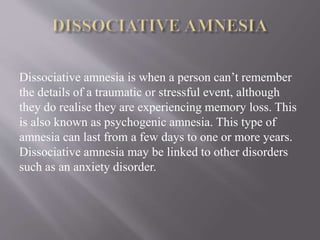
Dissociative amnesia is when a person can’t remember
the details of a traumatic or stressful event, although
they do realise they are experiencing memory loss. This
is also known as psychogenic amnesia. This type of
amnesia can last from a few days to one or more years.
Dissociative amnesia may be linked to other disorders
such as an anxiety disorder.
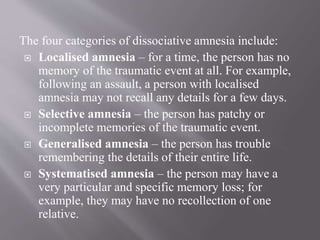
The four categories of dissociative amnesia include:
 Localised amnesia – for a time, the person has no
memory of the traumatic event at all. For example,
following an assault, a person with localised
amnesia may not recall any details for a few days.
 Selective amnesia – the person has patchy or
incomplete memories of the traumatic event.
 Generalised amnesia – the person has trouble
remembering the details of their entire life.
 Systematised amnesia – the person may have a
very particular and specific memory loss; for
example, they may have no recollection of one
relative.
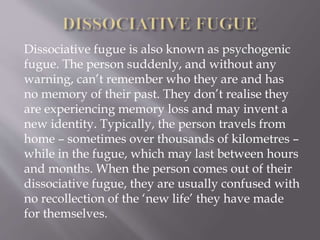
Dissociative fugue is also known as psychogenic
fugue. The person suddenly, and without any
warning, can’t remember who they are and has
no memory of their past. They don’t realise they
are experiencing memory loss and may invent a
new identity. Typically, the person travels from
home – sometimes over thousands of kilometres –
while in the fugue, which may last between hours
and months. When the person comes out of their
dissociative fugue, they are usually confused with
no recollection of the ‘new life’ they have made
for themselves.
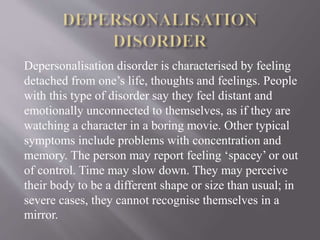
Depersonalisation disorder is characterised by feeling
detached from one’s life, thoughts and feelings. People
with this type of disorder say they feel distant and
emotionally unconnected to themselves, as if they are
watching a character in a boring movie. Other typical
symptoms include problems with concentration and
memory. The person may report feeling ‘spacey’ or out
of control. Time may slow down. They may perceive
their body to be a different shape or size than usual; in
severe cases, they cannot recognise themselves in a
mirror.
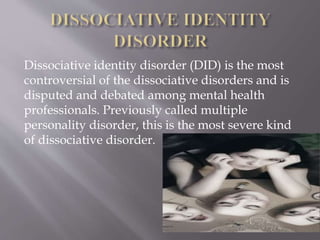
Dissociative identity disorder (DID) is the most
controversial of the dissociative disorders and is
disputed and debated among mental health
professionals. Previously called multiple
personality disorder, this is the most severe kind
of dissociative disorder.
 The condition typically involves the
coexistence of two or more personality states
within the same person. While the different
personality states influence the person’s
behaviour, the person is usually not aware of
these personality states and experiences them
as memory lapses. The other states may have
different body language, voice tone, outlook on
life and memories. The person may switch to
another personality state when under stress. A
person who has dissociative identity disorder
almost always has dissociative amnesia too.
 Most mental health professionals believe that
the underlying cause of dissociative disorders
is chronic trauma in childhood. Examples of
trauma included repeated physical or sexual
abuse, emotional abuse or neglect.
 Unpredictable or frightening family
environments may also cause the child to
‘disconnect’ from reality during times of stress.
 It seems that the severity of the dissociative
disorder in adulthood is directly related to the
severity of the childhood trauma.
 Traumatic events that occur during adulthood
may also cause dissociative disorders. Such
events may include war, torture or going
through a natural disaster.
Without treatment, possible complications for a
person with a dissociative disorder may include:
 Life difficulties such as broken relationships and
job loss
 Sleep problems such as insomnia
 Sexual problems
 Severe depression
 Anxiety disorders
 Eating disorders such as anorexia or bulimia
 Problematic drug use including alcoholism
 Self-harm, including suicide.
 If you are concerned that you or a loved one may
have a dissociative disorder, it is important to seek
professional help. Dissociative disorders always
require professional diagnosis and care.
Diagnosis can be tricky because dissociative
disorders are complex and their symptoms are
common to a number of other conditions. For
example:
 Physical causes (such as head trauma or brain
tumours) can cause amnesia and other
cognitive problems.
 Mental illnesses such as obsessive-compulsive
disorder, panic disorder and post-traumatic
stress disorder may cause similar symptoms to
a dissociative disorder.
 The effects of certain substances, including
some recreational drugs and prescription
medications, can mimic symptoms.
 Diagnosis may be further hampered when a
dissociative disorder coexists with another
mental health problem such as depression.
The effectiveness of treatments for dissociative disorders
has not been studied. Treatment options are based on case
studies, not research. Generally speaking, treatment may
take many years. Options may include:
 A safe environment – doctors will try to get the person
to feel safe and relaxed, which is enough to trigger
memory recall in some people with dissociative
disorders.
 Psychiatric drugs – such as barbiturates.
 Hypnosis – may help to recover repressed memories,
although this form of treatment for dissociative
disorders is considered controversial.
 Psychotherapy – also known as ‘talk therapy’ or
counselling, which is usually needed for the long
term. Examples include cognitive therapy and
psychoanalysis.
 Stress management – since stress can trigger
symptoms.
 Treatment for other disorders – typically, a person
with a dissociative disorder may have other mental
health problems such as depression or anxiety.
Treatment may include antidepressants or anti-
anxiety medications to try to improve the symptoms
of the dissociative disorder.
1. http://www.betterhealth.vic.gov.au/bhcv2/b
hcarticles.nsf/pages/Dissociation_and_dissoci
ative_disorders
2. http://www.nhs.uk/Conditions/dissociative-
disorders/Pages/Introduction.aspx
3. https://en.wikipedia.org/wiki/Dissociative_
disorder
4. http://www.mind.org.uk/information-
support/types-of-mental-health-
problems/dissociative-disorders/
5. http://psychcentral.com/lib/in-depth-
understanding-dissociative-disorders/
6. http://www.nhs.uk/Conditions/dissociative-
disorders/Pages/Introduction.aspx

Dissociative disorder

  • 1.
    PRESENTED BY:- MR.SUNIL KUMAR M.SC. FINAL YEAR B.V.C.O.N.PUNE
  • 2.
    What is 'dissociation'? 'Dissociation' means a period when we feel disconnected from the environment and/or from ourselves.  We all have these moments of disconnection from time to time – daydreaming while driving, or switching off and missing part of a conversation, for example. These moments of 'not being with it' normally pass quickly.
  • 3.
     Someone witha dissociative disorder has persistent, repeated episodes of dissociation that are extreme enough to severely affect everyday life.
  • 4.
     Dissociation isa mental process where a person disconnects from their thoughts, feelings, memories or sense of identity. Dissociative disorders include dissociative amnesia, dissociative fugue, depersonalisation disorder and dissociative identity disorder.
  • 5.
     People whoexperience a traumatic event will often have some degree of dissociation during the event itself or in the following hours, days or weeks. For example, the event seems ‘unreal’ or the person feels detached from what’s going on around them as if watching the events on television.
  • 6.
    Symptoms and signsof dissociative disorders depend on the type and severity, but may include:  Feeling disconnected from yourself  Problems with handling intense emotions  Sudden and unexpected shifts in mood – for example, feeling very sad for no reason  Depression or anxiety problems, or both  Feeling as though the world is distorted or not real (called ‘derealisation’)
  • 7.
     Memory problemsthat aren’t linked to physical injury or medical conditions  Other cognitive (thought-related) problems such as concentration problems  Significant memory lapses such as forgetting important personal information  Feeling compelled to behave in a certain way  Identity confusion – for example, behaving in a way that the person would normally find offensive or abhorrent.
  • 8.
    Mental health professionalsrecognise four main types of dissociative disorder, including:  Dissociative amnesia  Dissociative fugue  Depersonalisation disorder  Dissociative identity disorder.
  • 9.
    Dissociative amnesia iswhen a person can’t remember the details of a traumatic or stressful event, although they do realise they are experiencing memory loss. This is also known as psychogenic amnesia. This type of amnesia can last from a few days to one or more years. Dissociative amnesia may be linked to other disorders such as an anxiety disorder.
  • 10.
    The four categoriesof dissociative amnesia include:  Localised amnesia – for a time, the person has no memory of the traumatic event at all. For example, following an assault, a person with localised amnesia may not recall any details for a few days.  Selective amnesia – the person has patchy or incomplete memories of the traumatic event.  Generalised amnesia – the person has trouble remembering the details of their entire life.  Systematised amnesia – the person may have a very particular and specific memory loss; for example, they may have no recollection of one relative.
  • 11.
    Dissociative fugue isalso known as psychogenic fugue. The person suddenly, and without any warning, can’t remember who they are and has no memory of their past. They don’t realise they are experiencing memory loss and may invent a new identity. Typically, the person travels from home – sometimes over thousands of kilometres – while in the fugue, which may last between hours and months. When the person comes out of their dissociative fugue, they are usually confused with no recollection of the ‘new life’ they have made for themselves.
  • 12.
    Depersonalisation disorder ischaracterised by feeling detached from one’s life, thoughts and feelings. People with this type of disorder say they feel distant and emotionally unconnected to themselves, as if they are watching a character in a boring movie. Other typical symptoms include problems with concentration and memory. The person may report feeling ‘spacey’ or out of control. Time may slow down. They may perceive their body to be a different shape or size than usual; in severe cases, they cannot recognise themselves in a mirror.
  • 13.
    Dissociative identity disorder(DID) is the most controversial of the dissociative disorders and is disputed and debated among mental health professionals. Previously called multiple personality disorder, this is the most severe kind of dissociative disorder.
  • 14.
     The conditiontypically involves the coexistence of two or more personality states within the same person. While the different personality states influence the person’s behaviour, the person is usually not aware of these personality states and experiences them as memory lapses. The other states may have different body language, voice tone, outlook on life and memories. The person may switch to another personality state when under stress. A person who has dissociative identity disorder almost always has dissociative amnesia too.
  • 15.
     Most mentalhealth professionals believe that the underlying cause of dissociative disorders is chronic trauma in childhood. Examples of trauma included repeated physical or sexual abuse, emotional abuse or neglect.  Unpredictable or frightening family environments may also cause the child to ‘disconnect’ from reality during times of stress.
  • 16.
     It seemsthat the severity of the dissociative disorder in adulthood is directly related to the severity of the childhood trauma.  Traumatic events that occur during adulthood may also cause dissociative disorders. Such events may include war, torture or going through a natural disaster.
  • 17.
    Without treatment, possiblecomplications for a person with a dissociative disorder may include:  Life difficulties such as broken relationships and job loss  Sleep problems such as insomnia  Sexual problems  Severe depression  Anxiety disorders  Eating disorders such as anorexia or bulimia  Problematic drug use including alcoholism  Self-harm, including suicide.
  • 18.
     If youare concerned that you or a loved one may have a dissociative disorder, it is important to seek professional help. Dissociative disorders always require professional diagnosis and care. Diagnosis can be tricky because dissociative disorders are complex and their symptoms are common to a number of other conditions. For example:
  • 19.
     Physical causes(such as head trauma or brain tumours) can cause amnesia and other cognitive problems.  Mental illnesses such as obsessive-compulsive disorder, panic disorder and post-traumatic stress disorder may cause similar symptoms to a dissociative disorder.  The effects of certain substances, including some recreational drugs and prescription medications, can mimic symptoms.  Diagnosis may be further hampered when a dissociative disorder coexists with another mental health problem such as depression.
  • 20.
    The effectiveness oftreatments for dissociative disorders has not been studied. Treatment options are based on case studies, not research. Generally speaking, treatment may take many years. Options may include:  A safe environment – doctors will try to get the person to feel safe and relaxed, which is enough to trigger memory recall in some people with dissociative disorders.  Psychiatric drugs – such as barbiturates.  Hypnosis – may help to recover repressed memories, although this form of treatment for dissociative disorders is considered controversial.
  • 21.
     Psychotherapy –also known as ‘talk therapy’ or counselling, which is usually needed for the long term. Examples include cognitive therapy and psychoanalysis.  Stress management – since stress can trigger symptoms.  Treatment for other disorders – typically, a person with a dissociative disorder may have other mental health problems such as depression or anxiety. Treatment may include antidepressants or anti- anxiety medications to try to improve the symptoms of the dissociative disorder.
  • 22.
    1. http://www.betterhealth.vic.gov.au/bhcv2/b hcarticles.nsf/pages/Dissociation_and_dissoci ative_disorders 2. http://www.nhs.uk/Conditions/dissociative- disorders/Pages/Introduction.aspx 3.https://en.wikipedia.org/wiki/Dissociative_ disorder 4. http://www.mind.org.uk/information- support/types-of-mental-health- problems/dissociative-disorders/
  • 23.