DISORDER CONTENT
OF THOUGHT -DELUSION
BY DR.WASIM
UNDER GUIDANCE OF
DR.SANJAY.JAIN
Karl Jaspers was the first to define the three main
criteria for a belief to be considered delusional in his
1913 book General Psychopathology.
These criteria are:
 Certainty (held with absolute conviction)
 Incorrigibility (not changeable by compelling
counterargument or proof to the contrary)
 Impossibility or falsity of content (implausible,
bizarre or patently untrue)
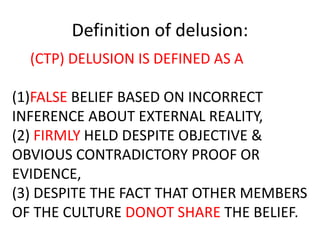
Definition of delusion:
(CTP) DELUSION IS DEFINED AS A
(1)FALSE BELIEF BASED ON INCORRECT
INFERENCE ABOUT EXTERNAL REALITY,
(2) FIRMLY HELD DESPITE OBJECTIVE &
OBVIOUS CONTRADICTORY PROOF OR
EVIDENCE,
(3) DESPITE THE FACT THAT OTHER MEMBERS
OF THE CULTURE DONOT SHARE THE BELIEF.
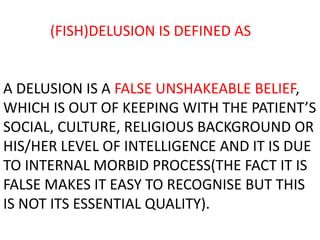
(FISH)DELUSION IS DEFINED AS
A DELUSION IS A FALSE UNSHAKEABLE BELIEF,
WHICH IS OUT OF KEEPING WITH THE PATIENT’S
SOCIAL, CULTURE, RELIGIOUS BACKGROUND OR
HIS/HER LEVEL OF INTELLIGENCE AND IT IS DUE
TO INTERNAL MORBID PROCESS(THE FACT IT IS
FALSE MAKES IT EASY TO RECOGNISE BUT THIS
IS NOT ITS ESSENTIAL QUALITY).
Delusions are categorized into four
different groups
 Bizarre delusion: A delusion that is very strange and completely
implausible; an example of a bizarre delusion would be that aliens
have removed the affected person's brain.
 Non-bizarre delusion: A delusion that, though false, is at least
possible, e.g., the affected person mistakenly believes that he is under
constant police surveillance.
 Mood-congruent delusion: Any delusion with content consistent with
either a depressive or manic state, e.g., a depressed person believes
that news anchors on television highly disapprove of him, or a person
in a manic state might believe he is a powerful deity.
 Mood-neutral delusion: A delusion that does not relate to the
sufferer's emotional state; for example, a belief that an extra limb is
growing out of the back of one's head is neutral to either depression
or manic.
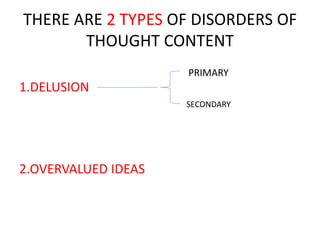
THERE ARE 2 TYPES OF DISORDERS OF
THOUGHT CONTENT
1.DELUSION
2.OVERVALUED IDEAS
PRIMARY
SECONDARY
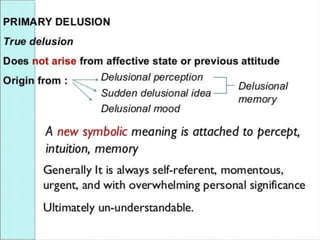
PRIMARY DELUSION - True delusions, result of
primary delusional experience ( due to faulty thinking
and self-monitoring) which cannot be deduced from
any other morbid phenomena(diagnostic of
schizophrenia but may be seen in organic disorders
like epileptic psychoses).
SECONDARY DELUSION - Delusion-like ideas which can
be understandably derived from some other morbid
psychological phenomena;( perceptual
disturbances,intense emotions & personality
disorder).
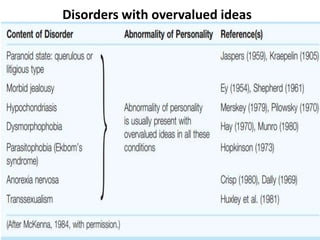
OVERVALUED IDEAS - Refers to a solitary, abnormal
belief that is neither delusional nor obsessional in
nature, but which is preoccupying to the extent of
dominating the sufferer’s life.(McKenna (1984).
It is overvalued in the sense that it causes disturbed
functioning or suffering to the person himself or to
others.
It becomes so dominant that all other ideas are
secondary and relate to it: the patient’s whole life
comes to revolve around this one idea.
Disorders with overvalued ideas
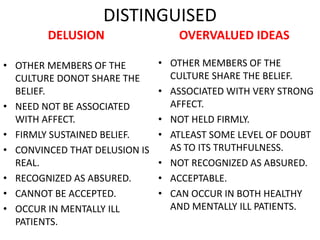
DISTINGUISED
DELUSION
• OTHER MEMBERS OF THE
CULTURE DONOT SHARE THE
BELIEF.
• NEED NOT BE ASSOCIATED
WITH AFFECT.
• FIRMLY SUSTAINED BELIEF.
• CONVINCED THAT DELUSION IS
REAL.
• RECOGNIZED AS ABSURED.
• CANNOT BE ACCEPTED.
• OCCUR IN MENTALLY ILL
PATIENTS.
OVERVALUED IDEAS
• OTHER MEMBERS OF THE
CULTURE SHARE THE BELIEF.
• ASSOCIATED WITH VERY STRONG
AFFECT.
• NOT HELD FIRMLY.
• ATLEAST SOME LEVEL OF DOUBT
AS TO ITS TRUTHFULNESS.
• NOT RECOGNIZED AS ABSURED.
• ACCEPTABLE.
• CAN OCCUR IN BOTH HEALTHY
AND MENTALLY ILL PATIENTS.
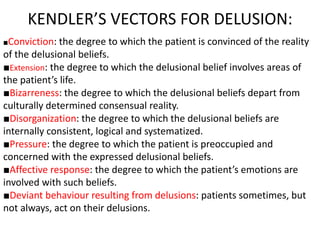
KENDLER’S VECTORS FOR DELUSION:
■Conviction: the degree to which the patient is convinced of the reality
of the delusional beliefs.
■Extension: the degree to which the delusional belief involves areas of
the patient’s life.
■Bizarreness: the degree to which the delusional beliefs depart from
culturally determined consensual reality.
■Disorganization: the degree to which the delusional beliefs are
internally consistent, logical and systematized.
■Pressure: the degree to which the patient is preoccupied and
concerned with the expressed delusional beliefs.
■Affective response: the degree to which the patient’s emotions are
involved with such beliefs.
■Deviant behaviour resulting from delusions: patients sometimes, but
not always, act on their delusions.
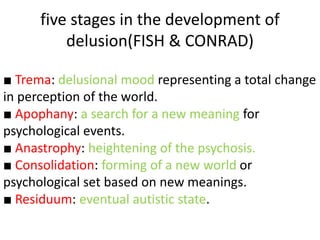
five stages in the development of
delusion(FISH & CONRAD)
■ Trema: delusional mood representing a total change
in perception of the world.
■ Apophany: a search for a new meaning for
psychological events.
■ Anastrophy: heightening of the psychosis.
■ Consolidation: forming of a new world or
psychological set based on new meanings.
■ Residuum: eventual autistic state.
FACTORS CONCERNED WITH
GENERATION OF DELUSIONS
(1) DISORDERS OF BRAIN FUNCTIONING.
(2) BACKGROUND INFLUENCES OF TEMPERAMENT
& PERSONALITY.
(3) MAINTENANCE OF SELF-ESTEEM.
(4) ROLE OF AFFECT.
(5) AS A RESPONSE TO PERCEPTUAL DISTURBANCES.
(6) AS A RESPONSE TO DEPERSONALISATION.
(7) ASSOCIATED WITH COGNITIVE OVERLOAD.
PATHPOPHYSIOLOGY OF DELUSIONS
Uncertain and may differ from one disorder to another.
Dysfunction of prefrontal and temporal lobes(Leposavic et
al,2009) and the basal ganglia(Morrison and murray,2009)has
been suggested.
Dysregulation of Dopamine.
Endocannabinoid and adenosine systems may be involved
(Morrison and murray,2009)
PRIMARY DELUSIONS
1.Autochthonous delusion (delusional intuition)
2.Delusional percept
3.Delusional atmosphere
4.Delusional memory
1.Autochthonous delusion (delusional intuition)-
These are delusions that appear to arise suddenly
‘out of the blue’; they are phenomenologically
indistinguishable from the sudden arrival of a normal
idea.
It suddenly appears fully formed in patient’s mind
but they are not diagnostic of schizophrenia unless
they are BIZARRE, and secondly they can occur in
normal individuals secondary to mood & personality
disorder.
Delusional intuition occurs as a single stage,
unlike delusional perception, which occurs in two
stages: perception and then false interpretation.
Like delusional perceptions, delusional intuitions are
self-referent and usually of momentous import to
the patient.
2.Delusional percept-(APOPHANOUS)- This is present
when the patient receives a normal perception that is
then interpreted with delusional meaning and has
immense personal significance.
It is a first rank symptom of schizophrenia.
Schneider(1949)considered the essence of delusional
perception to be the abnormal significance attached
to a real percept not understandable in rational or
emotional terms; it is self-referent, momentous,
urgent, of overwhelming personal significance and,
of course, false.
EXAMPLE
A woman said, ‘every night blood is being injected out of my
arms [sic]’. When asked for her evidence, she explained that
she had little brown spots on her arms and therefore knew
that she was being injected. The interviewer looked at the
spots on her arms, rolled up his sleeve and showed her spots
identical in appearance on his own arm. He said that they had
been on his arm as long as he could remember and were
called ‘freckles’. She agreed that both sets of spots looked
similar and accepted his explanation of his own spots, but she
still insisted that her freckles proved that she was being
injected in her sleep. This was a delusional percept.
.
3.Delusional atmosphere(DELUSIONAL MOOD)-In this
state patient has the knowledge that there is
something going on around him which concerns him,
but he does not know what it is.
4.Delusional memory-delusional memory is the
delusional interpretation of a normal memory. These
are sometimes called retrospective delusions. An
event that occurred in the past is explained in a
delusional way.
EXAMPLE
A man aged 50 whose mental illness had lasted for about
two years claimed that his health had been permanently
affected since the age of 16, when he had had ‘an operation
to remove his appendix’. He now believed that the operation
had been an excuse to ‘implant a golden convolvulus’ in his
bowels.
SECONDARY DELUSIONS
Can be understood as arising from some other morbid experience-
1) Projection: projection occurs in the non-psychotic some other
explanation is necessary to account for the excessive projection which
occurs in delusions, particularly those of persecution.
2) Latent homosexuality (Freud): the different ways in which this is
denied gave rise to delusions of persecution, erotomania, jealousy and
grandeur.
3) Depressive moods
4) Hallucinations
5) PSYCHOGENIC REACTION : In abnormally suspicious personalities.
6)SENSITIVE PERSONALITIES
SYSTEMATIZATION
DEFINITION:ELABORATION OF DELUSIONS & their
integration into some sort of system(DELUSIONAL
WORK); i.e delusions are built logically on one basic
delusion; they are commonly seen in older
schizophrenics.
SYSTEMATIZATION appears to be related to the
retention of integrity of the personality. When
schizophrenia occurs in young person it has a
devastating effect on the integrity of their
personality therefore young schizophrenics have
nonsystematised delusions.
DELUSIONS ON THE BASIS OF
CONTENT OF DELUSIONS
(1) DELUSIONS OF PERSECUTION
(2) DELUSIONS OF JEALOUSY
(3) DELUSIONS OF LOVE
(4) GRANDIOSE DELUSIONS
(5) DELUSIONS OF ILL HEALTH
(6) DELUSIONS OF GUILT
(7) NIHILISTIC DELUSIONS
(8) DELUSIONS OF POVERTY
(1) DELUSIONS OF PERSECUTION
Harm in any form by an external agency, which may be identified or
just a vague influence.
It may also arise from auditory hallucinations, bodily hallucinations,
passivity.
Delusion of persecution are seen in:
Schizophrenia-The affect associated with the belief of persecution
may vary from an inappropriate indifference and apathy
Delirium tremens-stark terror
Affective psychoses of manic and depressive type
In Manic-persecutory delusions show gross over activity and flight of
ideas in attempting to express and deal with their beliefs.
In depression-take on the characteristic colouring of the dominant
mood state.
Organic states (acute and chronic)
Associated secondary delusions –
Delusions of reference: people talking about him
Delusions of guilt : justification of persecution at times
Delusions of being poisoned/ infected : explanatory nature
Delusions of influence : from passivity feelings
(2) DELUSIONS OF JEALOUSY
‘Delusion of jealousy’ is generally a misnomer as patients tend to have
morbid jealousy with delusions of infidelity rather than delusions of
jealousy (Munro, 1999).
Occur in both organic and functional disorders. Often the patient has
been suspicious, sensitive and mildly jealous before the onset of the
illness.
Delusions of infidelity are seen:
Schizophrenia
Alcohol dependency syndrome
Affective psychosis-morbid exaggeration of a premorbid mildly jealous
attitude.
 Delusions of infidelity may develop gradually.
 As a suspicious or insecure person becomes more and more
convinced of their spouse’s infidelity and finally the idea reaches
delusional intensity.
 The severity of the condition may also fluctuate over the course of
time, and during episodes of marked disturbance, the spouse may be
interrogated unceasingly and may be kept awake for hours at night.
 A jealous husband, for example, may interpret common phenomena
as ‘evidence’ of infidelity;
for example
Suspicious or insecure person may insist that his wife has bags under
her eyes as a result of frequent sexual intercourse with someone else, or
may search his wife’s underclothes for stains and claim that all stains are
due to semen. This behaviour may progress to violence against the
spouse and even to murder. Apart from delusions of infidelity, these
patients tend not to show any other symptoms that would suggest
schizophrenia.
(3) DELUSIONS OF LOVE
This condition has also been described as ‘the fantasy lover syndrome’
and ‘erotomania’(De Clerambault Syndrome).
The patient is convinced that some person is in love with them although
the alleged lover may never have spoken to them (Kelly, 2005).
Delusions of love are seen in:
Abnormal personality state-isolated.
Schizophrenia-begin with a circumscribed delusion of a fantasy lover
and subsequently delusions may become more diffuse and
hallucinations may develop.
They may pester the victim with letters and unwanted attention of all
kinds (Kennedy et al, 2002). If there is no response to their letters, they
may claim that their letters are being intercepted, that others are
maligning them to their lover, and so on.
(4) GRANDIOSE DELUSIONS
Exaggerated Concerns about one’s importance ,power or identity.
Believes that one has special power accomplishing extraordinary
things for good of the community.
Some People believe that that are god, king or rock star whereas some
others believe they are skilled sportsman or great investors.
Delusion of Grandiose are seen in :
Mania-The expansive delusions may be supported by hallucinatory
voices(voices telling the patient that he is important).
The expansive affect of mania can be very clearly seen to render this
delusion understandable.
GRANDIOSITY has to be differentiated from mania(absence of well held
expansive delusion).
Schizophrenia-Primary grandiose delusions occur in schizophrenia. The
patient may believe himself to be a famous celebrity or to have
supernatural powers. He may believe himself to be involved in some
very special and secret mission about which he has not yet been fully
briefed but in anticipation
of which he is waiting with excitement for the dénouement. Beliefs of
this sort are sometimes called delusions of special purpose and are of
the form of delusional intuition.
Fantastic hallucinosis-in which all forms of hallucination occur.
(5) DELUSIONS OF ILL HEALTH
Delusions of ill health may develop on a background of concerns about
health; many people worry about their health and when they become
depressed they naturally may develop delusions or overvalued ideas of
ill health.
Delusion of ill health seen in:
Depression-patients feel that they have an incurable disease.
Schizophrenia-due to a bodily hallucination or a depressed mood.
personality disorder-Chronic Hypochondriasis may be secondary to a
personality disorder
.
Post-partum -Depressive delusions of ill health may involve the patient’s
spouse and children. Thus the depressed mother may believe that she
has infected her children or that she is mad and her children have
inherited incurable insanity.
This may lead her to harm or even kill her children in the mistaken belief
that she is putting them out of their misery. Many depressed puerperal
women fear or believe that the new born child has learning disabilities
of some kind.
(6) DELUSIONS OF GUILT
Mainly seen in DEPRESSIVE ILLNESSES.
MILD DEPRESSION- patient is self-critical & self-reproachful (this
differentiates true depression from reactive depression)
SEVERE DEPRESSION- (delusion of guilt) self-reproach may take the
form of delusions of guilt, when the patient believes that they are a
bad or evil person and have ruined their family. They may claim to
have committed an unpardonable sin and insist that they will rot in
hell for this
VERY SEVERE DEPRESSION-the delusions may even appear to take on
a grandiose character and the patient may assert that they are the
most evil person in the world, the most terrible sinner who ever
existed and that they will never die but will be punished for all eternity
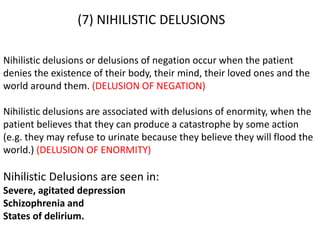
(7) NIHILISTIC DELUSIONS
Nihilistic delusions or delusions of negation occur when the patient
denies the existence of their body, their mind, their loved ones and the
world around them. (DELUSION OF NEGATION)
Nihilistic delusions are associated with delusions of enormity, when the
patient believes that they can produce a catastrophe by some action
(e.g. they may refuse to urinate because they believe they will flood the
world.) (DELUSION OF ENORMITY)
Nihilistic Delusions are seen in:
Severe, agitated depression
Schizophrenia and
States of delirium.
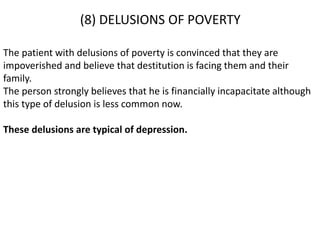
(8) DELUSIONS OF POVERTY
The patient with delusions of poverty is convinced that they are
impoverished and believe that destitution is facing them and their
family.
The person strongly believes that he is financially incapacitate although
this type of delusion is less common now.
These delusions are typical of depression.
THANK YOU

Disorder content

  • 1.
    DISORDER CONTENT OF THOUGHT-DELUSION BY DR.WASIM UNDER GUIDANCE OF DR.SANJAY.JAIN
  • 2.
    Karl Jaspers wasthe first to define the three main criteria for a belief to be considered delusional in his 1913 book General Psychopathology. These criteria are:  Certainty (held with absolute conviction)  Incorrigibility (not changeable by compelling counterargument or proof to the contrary)  Impossibility or falsity of content (implausible, bizarre or patently untrue)
  • 3.
    Definition of delusion: (CTP)DELUSION IS DEFINED AS A (1)FALSE BELIEF BASED ON INCORRECT INFERENCE ABOUT EXTERNAL REALITY, (2) FIRMLY HELD DESPITE OBJECTIVE & OBVIOUS CONTRADICTORY PROOF OR EVIDENCE, (3) DESPITE THE FACT THAT OTHER MEMBERS OF THE CULTURE DONOT SHARE THE BELIEF.
  • 4.
    (FISH)DELUSION IS DEFINEDAS A DELUSION IS A FALSE UNSHAKEABLE BELIEF, WHICH IS OUT OF KEEPING WITH THE PATIENT’S SOCIAL, CULTURE, RELIGIOUS BACKGROUND OR HIS/HER LEVEL OF INTELLIGENCE AND IT IS DUE TO INTERNAL MORBID PROCESS(THE FACT IT IS FALSE MAKES IT EASY TO RECOGNISE BUT THIS IS NOT ITS ESSENTIAL QUALITY).
  • 5.
    Delusions are categorizedinto four different groups  Bizarre delusion: A delusion that is very strange and completely implausible; an example of a bizarre delusion would be that aliens have removed the affected person's brain.  Non-bizarre delusion: A delusion that, though false, is at least possible, e.g., the affected person mistakenly believes that he is under constant police surveillance.  Mood-congruent delusion: Any delusion with content consistent with either a depressive or manic state, e.g., a depressed person believes that news anchors on television highly disapprove of him, or a person in a manic state might believe he is a powerful deity.  Mood-neutral delusion: A delusion that does not relate to the sufferer's emotional state; for example, a belief that an extra limb is growing out of the back of one's head is neutral to either depression or manic.
  • 6.
    THERE ARE 2TYPES OF DISORDERS OF THOUGHT CONTENT 1.DELUSION 2.OVERVALUED IDEAS PRIMARY SECONDARY
  • 7.
    PRIMARY DELUSION -True delusions, result of primary delusional experience ( due to faulty thinking and self-monitoring) which cannot be deduced from any other morbid phenomena(diagnostic of schizophrenia but may be seen in organic disorders like epileptic psychoses). SECONDARY DELUSION - Delusion-like ideas which can be understandably derived from some other morbid psychological phenomena;( perceptual disturbances,intense emotions & personality disorder).
  • 8.
    OVERVALUED IDEAS -Refers to a solitary, abnormal belief that is neither delusional nor obsessional in nature, but which is preoccupying to the extent of dominating the sufferer’s life.(McKenna (1984). It is overvalued in the sense that it causes disturbed functioning or suffering to the person himself or to others. It becomes so dominant that all other ideas are secondary and relate to it: the patient’s whole life comes to revolve around this one idea.
  • 9.
  • 10.
    DISTINGUISED DELUSION • OTHER MEMBERSOF THE CULTURE DONOT SHARE THE BELIEF. • NEED NOT BE ASSOCIATED WITH AFFECT. • FIRMLY SUSTAINED BELIEF. • CONVINCED THAT DELUSION IS REAL. • RECOGNIZED AS ABSURED. • CANNOT BE ACCEPTED. • OCCUR IN MENTALLY ILL PATIENTS. OVERVALUED IDEAS • OTHER MEMBERS OF THE CULTURE SHARE THE BELIEF. • ASSOCIATED WITH VERY STRONG AFFECT. • NOT HELD FIRMLY. • ATLEAST SOME LEVEL OF DOUBT AS TO ITS TRUTHFULNESS. • NOT RECOGNIZED AS ABSURED. • ACCEPTABLE. • CAN OCCUR IN BOTH HEALTHY AND MENTALLY ILL PATIENTS.
  • 11.
    KENDLER’S VECTORS FORDELUSION: ■Conviction: the degree to which the patient is convinced of the reality of the delusional beliefs. ■Extension: the degree to which the delusional belief involves areas of the patient’s life. ■Bizarreness: the degree to which the delusional beliefs depart from culturally determined consensual reality. ■Disorganization: the degree to which the delusional beliefs are internally consistent, logical and systematized. ■Pressure: the degree to which the patient is preoccupied and concerned with the expressed delusional beliefs. ■Affective response: the degree to which the patient’s emotions are involved with such beliefs. ■Deviant behaviour resulting from delusions: patients sometimes, but not always, act on their delusions.
  • 12.
    five stages inthe development of delusion(FISH & CONRAD) ■ Trema: delusional mood representing a total change in perception of the world. ■ Apophany: a search for a new meaning for psychological events. ■ Anastrophy: heightening of the psychosis. ■ Consolidation: forming of a new world or psychological set based on new meanings. ■ Residuum: eventual autistic state.
  • 13.
    FACTORS CONCERNED WITH GENERATIONOF DELUSIONS (1) DISORDERS OF BRAIN FUNCTIONING. (2) BACKGROUND INFLUENCES OF TEMPERAMENT & PERSONALITY. (3) MAINTENANCE OF SELF-ESTEEM. (4) ROLE OF AFFECT. (5) AS A RESPONSE TO PERCEPTUAL DISTURBANCES. (6) AS A RESPONSE TO DEPERSONALISATION. (7) ASSOCIATED WITH COGNITIVE OVERLOAD.
  • 14.
    PATHPOPHYSIOLOGY OF DELUSIONS Uncertainand may differ from one disorder to another. Dysfunction of prefrontal and temporal lobes(Leposavic et al,2009) and the basal ganglia(Morrison and murray,2009)has been suggested. Dysregulation of Dopamine. Endocannabinoid and adenosine systems may be involved (Morrison and murray,2009)
  • 15.
    PRIMARY DELUSIONS 1.Autochthonous delusion(delusional intuition) 2.Delusional percept 3.Delusional atmosphere 4.Delusional memory 1.Autochthonous delusion (delusional intuition)- These are delusions that appear to arise suddenly ‘out of the blue’; they are phenomenologically indistinguishable from the sudden arrival of a normal idea.
  • 16.
    It suddenly appearsfully formed in patient’s mind but they are not diagnostic of schizophrenia unless they are BIZARRE, and secondly they can occur in normal individuals secondary to mood & personality disorder. Delusional intuition occurs as a single stage, unlike delusional perception, which occurs in two stages: perception and then false interpretation. Like delusional perceptions, delusional intuitions are self-referent and usually of momentous import to the patient.
  • 17.
    2.Delusional percept-(APOPHANOUS)- Thisis present when the patient receives a normal perception that is then interpreted with delusional meaning and has immense personal significance. It is a first rank symptom of schizophrenia. Schneider(1949)considered the essence of delusional perception to be the abnormal significance attached to a real percept not understandable in rational or emotional terms; it is self-referent, momentous, urgent, of overwhelming personal significance and, of course, false.
  • 18.
    EXAMPLE A woman said,‘every night blood is being injected out of my arms [sic]’. When asked for her evidence, she explained that she had little brown spots on her arms and therefore knew that she was being injected. The interviewer looked at the spots on her arms, rolled up his sleeve and showed her spots identical in appearance on his own arm. He said that they had been on his arm as long as he could remember and were called ‘freckles’. She agreed that both sets of spots looked similar and accepted his explanation of his own spots, but she still insisted that her freckles proved that she was being injected in her sleep. This was a delusional percept. .
  • 19.
    3.Delusional atmosphere(DELUSIONAL MOOD)-Inthis state patient has the knowledge that there is something going on around him which concerns him, but he does not know what it is. 4.Delusional memory-delusional memory is the delusional interpretation of a normal memory. These are sometimes called retrospective delusions. An event that occurred in the past is explained in a delusional way.
  • 20.
    EXAMPLE A man aged50 whose mental illness had lasted for about two years claimed that his health had been permanently affected since the age of 16, when he had had ‘an operation to remove his appendix’. He now believed that the operation had been an excuse to ‘implant a golden convolvulus’ in his bowels.
  • 22.
    SECONDARY DELUSIONS Can beunderstood as arising from some other morbid experience- 1) Projection: projection occurs in the non-psychotic some other explanation is necessary to account for the excessive projection which occurs in delusions, particularly those of persecution. 2) Latent homosexuality (Freud): the different ways in which this is denied gave rise to delusions of persecution, erotomania, jealousy and grandeur. 3) Depressive moods 4) Hallucinations 5) PSYCHOGENIC REACTION : In abnormally suspicious personalities. 6)SENSITIVE PERSONALITIES
  • 23.
    SYSTEMATIZATION DEFINITION:ELABORATION OF DELUSIONS& their integration into some sort of system(DELUSIONAL WORK); i.e delusions are built logically on one basic delusion; they are commonly seen in older schizophrenics. SYSTEMATIZATION appears to be related to the retention of integrity of the personality. When schizophrenia occurs in young person it has a devastating effect on the integrity of their personality therefore young schizophrenics have nonsystematised delusions.
  • 24.
    DELUSIONS ON THEBASIS OF CONTENT OF DELUSIONS (1) DELUSIONS OF PERSECUTION (2) DELUSIONS OF JEALOUSY (3) DELUSIONS OF LOVE (4) GRANDIOSE DELUSIONS (5) DELUSIONS OF ILL HEALTH (6) DELUSIONS OF GUILT (7) NIHILISTIC DELUSIONS (8) DELUSIONS OF POVERTY
  • 25.
    (1) DELUSIONS OFPERSECUTION Harm in any form by an external agency, which may be identified or just a vague influence. It may also arise from auditory hallucinations, bodily hallucinations, passivity. Delusion of persecution are seen in: Schizophrenia-The affect associated with the belief of persecution may vary from an inappropriate indifference and apathy Delirium tremens-stark terror Affective psychoses of manic and depressive type In Manic-persecutory delusions show gross over activity and flight of ideas in attempting to express and deal with their beliefs. In depression-take on the characteristic colouring of the dominant mood state. Organic states (acute and chronic)
  • 26.
    Associated secondary delusions– Delusions of reference: people talking about him Delusions of guilt : justification of persecution at times Delusions of being poisoned/ infected : explanatory nature Delusions of influence : from passivity feelings
  • 27.
    (2) DELUSIONS OFJEALOUSY ‘Delusion of jealousy’ is generally a misnomer as patients tend to have morbid jealousy with delusions of infidelity rather than delusions of jealousy (Munro, 1999). Occur in both organic and functional disorders. Often the patient has been suspicious, sensitive and mildly jealous before the onset of the illness. Delusions of infidelity are seen: Schizophrenia Alcohol dependency syndrome Affective psychosis-morbid exaggeration of a premorbid mildly jealous attitude.
  • 28.
     Delusions ofinfidelity may develop gradually.  As a suspicious or insecure person becomes more and more convinced of their spouse’s infidelity and finally the idea reaches delusional intensity.  The severity of the condition may also fluctuate over the course of time, and during episodes of marked disturbance, the spouse may be interrogated unceasingly and may be kept awake for hours at night.  A jealous husband, for example, may interpret common phenomena as ‘evidence’ of infidelity; for example Suspicious or insecure person may insist that his wife has bags under her eyes as a result of frequent sexual intercourse with someone else, or may search his wife’s underclothes for stains and claim that all stains are due to semen. This behaviour may progress to violence against the spouse and even to murder. Apart from delusions of infidelity, these patients tend not to show any other symptoms that would suggest schizophrenia.
  • 29.
    (3) DELUSIONS OFLOVE This condition has also been described as ‘the fantasy lover syndrome’ and ‘erotomania’(De Clerambault Syndrome). The patient is convinced that some person is in love with them although the alleged lover may never have spoken to them (Kelly, 2005). Delusions of love are seen in: Abnormal personality state-isolated. Schizophrenia-begin with a circumscribed delusion of a fantasy lover and subsequently delusions may become more diffuse and hallucinations may develop. They may pester the victim with letters and unwanted attention of all kinds (Kennedy et al, 2002). If there is no response to their letters, they may claim that their letters are being intercepted, that others are maligning them to their lover, and so on.
  • 30.
    (4) GRANDIOSE DELUSIONS ExaggeratedConcerns about one’s importance ,power or identity. Believes that one has special power accomplishing extraordinary things for good of the community. Some People believe that that are god, king or rock star whereas some others believe they are skilled sportsman or great investors. Delusion of Grandiose are seen in : Mania-The expansive delusions may be supported by hallucinatory voices(voices telling the patient that he is important). The expansive affect of mania can be very clearly seen to render this delusion understandable. GRANDIOSITY has to be differentiated from mania(absence of well held expansive delusion).
  • 31.
    Schizophrenia-Primary grandiose delusionsoccur in schizophrenia. The patient may believe himself to be a famous celebrity or to have supernatural powers. He may believe himself to be involved in some very special and secret mission about which he has not yet been fully briefed but in anticipation of which he is waiting with excitement for the dénouement. Beliefs of this sort are sometimes called delusions of special purpose and are of the form of delusional intuition. Fantastic hallucinosis-in which all forms of hallucination occur.
  • 32.
    (5) DELUSIONS OFILL HEALTH Delusions of ill health may develop on a background of concerns about health; many people worry about their health and when they become depressed they naturally may develop delusions or overvalued ideas of ill health. Delusion of ill health seen in: Depression-patients feel that they have an incurable disease. Schizophrenia-due to a bodily hallucination or a depressed mood. personality disorder-Chronic Hypochondriasis may be secondary to a personality disorder
  • 33.
    . Post-partum -Depressive delusionsof ill health may involve the patient’s spouse and children. Thus the depressed mother may believe that she has infected her children or that she is mad and her children have inherited incurable insanity. This may lead her to harm or even kill her children in the mistaken belief that she is putting them out of their misery. Many depressed puerperal women fear or believe that the new born child has learning disabilities of some kind.
  • 34.
    (6) DELUSIONS OFGUILT Mainly seen in DEPRESSIVE ILLNESSES. MILD DEPRESSION- patient is self-critical & self-reproachful (this differentiates true depression from reactive depression) SEVERE DEPRESSION- (delusion of guilt) self-reproach may take the form of delusions of guilt, when the patient believes that they are a bad or evil person and have ruined their family. They may claim to have committed an unpardonable sin and insist that they will rot in hell for this VERY SEVERE DEPRESSION-the delusions may even appear to take on a grandiose character and the patient may assert that they are the most evil person in the world, the most terrible sinner who ever existed and that they will never die but will be punished for all eternity
  • 35.
    (7) NIHILISTIC DELUSIONS Nihilisticdelusions or delusions of negation occur when the patient denies the existence of their body, their mind, their loved ones and the world around them. (DELUSION OF NEGATION) Nihilistic delusions are associated with delusions of enormity, when the patient believes that they can produce a catastrophe by some action (e.g. they may refuse to urinate because they believe they will flood the world.) (DELUSION OF ENORMITY) Nihilistic Delusions are seen in: Severe, agitated depression Schizophrenia and States of delirium.
  • 36.
    (8) DELUSIONS OFPOVERTY The patient with delusions of poverty is convinced that they are impoverished and believe that destitution is facing them and their family. The person strongly believes that he is financially incapacitate although this type of delusion is less common now. These delusions are typical of depression.
  • 37.