Catatonia : An Overview
Kapil S Kulkarni
Resident Doctor, Jagjivan Ram Hospital, Mumbai Central
Guided by- Dr Pinto, Dr Rawat, Dr Dave
PRESENTATION
DEFINITION
HISTORICAL REVIEW
HYPOTHESIS
SYMPTOMS & SIGNS (PHENOMENOLOGY)
CAUSES OF CATATONIA
RATING SCALE
EXAMINATION
DIFFERENTIATING CATATONIA
COMMON D/D OF CATATONIA
TREATMENT OF CATATONIA
DEFINITION
• A syndrome of multiple etiologies (organic or functional)
presenting with different features.
• Features are classified as motor and behavioral.
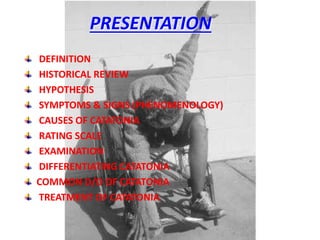
• Motor- posturing, catalepsy, stereotypy, mannerism, rigidity,
waxy flexibility, echopraxia, echolalia.
• Behavioral- withdrawal, excitement, grimace, stupor, mutism,
staring, negativism, verbigeration, perseveration, automatic
obedience, mitgehen, gegenhalten, ambitendency,
impulsivity, combativeness.
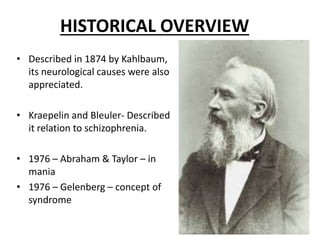
HISTORICAL OVERVIEW
• Described in 1874 by Kahlbaum,
its neurological causes were also
appreciated.
• Kraepelin and Bleuler- Described
it relation to schizophrenia.
• 1976 – Abraham & Taylor – in
mania
• 1976 – Gelenberg – concept of
syndrome
• DSM-IV (1994) Diagnostic Criteria for Catatonic Disorder Due
to a General Medical Condition and also they classify it in
affective disorder “with catatonic symptoms” thus placing the
syndrome beyond the limits of schizophrenia.
HYPOTHESIS OF CATATONIA
• G-aminobuteric acid (GABA) HYPOACTIVITY at the GABAA
receptor.
• Dopamine HYPOACTIVITY at the D2 receptor.
• Glutamate HYPOACTIVITY at the N-methyl-D-aspartate
(NDMA) receptor.
• Serotonin HYPERACTIVITY at the 5-HT1A receptor and
HYPOACTIVITY at the 5-HT2A receptor.
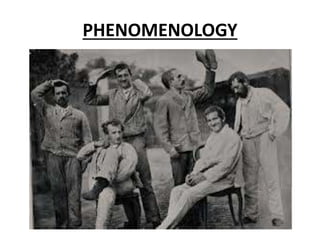
PHENOMENOLOGY
PHENOMENOLOGY
• Excitement-
Extreme hyperactivity, constant motor unrest which is
apparently non purposeful. Not to be attributed to akathisia
or goal directed agitation.
• Immobility/ stupor-
Extreme hypo activity, immobile, minimally responsive to
stimuli.
• Mutism-
Verbally unresponsive or minimally responsive.
• Staring-
Fixed gaze, little no visual scanning of environment,
decreased blinking.
• Posturing/ catalepsy-
Spontaneous maintenance of posture(s), including mundane.
(e.g. sitting or standing for long period without reacting)
PHENOMENOLOGY
• Grimacing-
Maintenance of odd facial expression.
• Echopraxia/ echolalia-
Mimicking of examiner’s movement or speech.
• Stereotype-
Repetitive non goal directed motor activity (e.g. finger
play, repeatedly touching, pitting or rubbing self);
abnormality not inherent in act but in frequency.
PHENOMENOLOGY
• Mannerism-
Odd, purposeful movement (hopping or walking tip toe, or
exaggerated caricatures of mundane movements);
abnormality inherent in act itself.
• Verbigerations-
Repeatation of phrases or sentences (like a scratched record);
it does not require stimulus to occur.
PHENOMENOLOGY
• Rigidity-
Maintenance of rigid position despite of efforts to be moved,
exclude if cogwheel or tremors present.
• Negativism-
Apparently motiveless resistance to instructions or attempt to
move/ examine patient. Contrary behavior does exact
opposite of instructions.
PHENOMENOLOGY
• Waxy flexibility-
During reposturing of patient, patient offers initial resistance
before allowing himself to be repositioned (similar to that of
bending candle).
• Withdrawal-
Refusal to eat, drink and/ or make eye contact.
PHENOMENOLOGY
• Impulsivity-
Patient suddenly engages in inappropriate behavior
without provocation (e.g. runs down hallway, starts
screaming or takes off clothes). Afterwards can give no or
only facile explanation.
• Automatic obedience-
Exaggerated cooperation with examiners request or
spontaneous continuation of movement requested.
Mitgehen and mitmachen are types of automatic
obedience
PHENOMENOLOGY
• Mitgehen-
Arm raising in response to light pressure of finger, despite
instruction to the contrary.
• Gegenhalten-
Resistance to passive movement which is proportional to
strength of the stimulus, appears automatic rather than
willful.
PHENOMENOLOGY
• Ambitendancy-
Patient appears motorically “stuck” in indecisive, hesitant
movement.
• Grasp reflex-
As per neuro exam
• Perseveration-
Repeatedly returns to same topic or persists with movement.
even after stimulus is removed.
PHENOMENOLOGY
• Combativeness-
Usually in undirected manner with no or only facile
explanations afterwards.
• Autonomic abnormality-
Temp, BP, pulse, RR, diaphoresis.
PHENOMENOLOGY
DSM IV
• Mutism: refusal to speak
• Immobility: lack or paucity of movement
• Stereotypes: purposeless, repetitive movements
• Negativism: active or passive refusal to follow commands
• Mannerisms: repetitive, purposeful movements
• Posturing: maintenance of bizarre postures
• Grimacing: repetitive facial posturing
• Catalepsy or Waxy Flexibility: maintenance of posture
• Echopraxia or Echolalia: repetition of words or the imitation of
actions
• Excitement: purposeless, excessive movement
DSM IV
• 1 criterion needed for general medical
condition or substance induced catatonia
• 2 criteria for catatonia that is associated with
a psychiatric condition
ICD 10
• Only under psychotic disorders.
• NO ORGANIC CATATONIA DESCRIBED !!
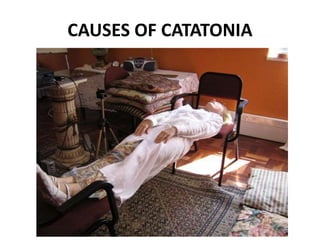
CAUSES OF CATATONIA
CAUSES OF CATATONIA
• Organic (Secondary) –
1. Neurological
2. Metabolic
3. Nutritional
4. Drug related
5. Misc
• Functional (Primary) –
1. Schizophrenia
2. Mood disease (mania commonly)
3. Other Ψ
4. OCD
5. PTSD etc
Organic catatonia - Neurological
• Brain stem, diencephalic, basal ganglia, lesions near III
ventricle, amygdala.
• Frontal lobe, Parietal lobe ds.
• Limbic & temporal lobe ds.
• Head injury, dementia, MS, atrophy.
• Encephalitis & other infections
• Epilepsy
Organic catatonia - Metabolic
• Periodic catatonia
• DM, in DKA
• Thyroid dysfunction
• Hepatic failure
• Renal failure
• Porphyrias
• Nutritional- Wernickes, pellagra, B12 deficiency.
Organic catatonia – Drugs
• Neuroleptics
• Alcohol
• Opioids
• Cannabis
• Disulfiram
• SSRI, TCA
Common organic etiologies
• CNS structural damage/ Neoplasm
• Encephalitis and other CNS infections
• Seizures or EEG with epileptiform activity
• Metabolic disturbances
• Phencyclidine exposure
• Neuroleptic exposure
• CNS lupus
• Corticosteroids
• Porphyria and other conditions
• CVA
• Wernicke's encephalopathy
• Posttraumatic
• Multiple sclerosis
• Cerebral malaria
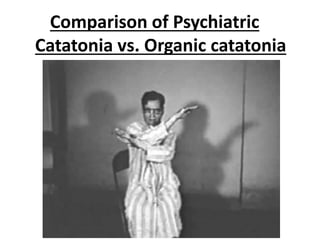
Comparison of Psychiatric
Catatonia vs. Organic catatonia
PRIMARY AND SECONDARY
CATATONIA
In Primary catatonia:
1. Patient responds to painful stimuli.
2. Patient usually keeps his eyes open most of the
times.
3. Patient’s reflexes would be normal.
4. No focal neurological deficits.
5. Patient avoid self injury. (arm test)
6. Overflow incontinence seen.
7. EEG pattern is that of awake test.
8. Lorezapam injection improves or continues to be
same.
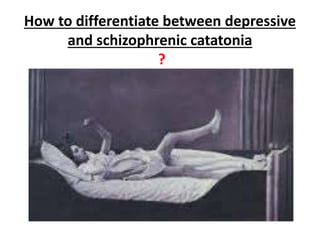
How to differentiate between depressive
and schizophrenic catatonia
?
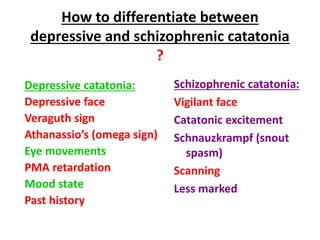
How to differentiate between
depressive and schizophrenic catatonia
?
Depressive catatonia:
Depressive face
Veraguth sign
Athanassio’s (omega sign)
Eye movements
PMA retardation
Mood state
Past history
Schizophrenic catatonia:
Vigilant face
Catatonic excitement
Schnauzkrampf (snout
spasm)
Scanning
Less marked
Rating Scale
1. Bush-Francis Catatonia Rating Scale
2. Braunig Catatonia Rating Scale
3. Modified Roger’s scale
Bush-Francis Catatonia Rating
Scale
• Use the presence or absence of items 1 - 14
for screening.
• Use the 0 - 3 scale for items 1 -23 to rate
severity.
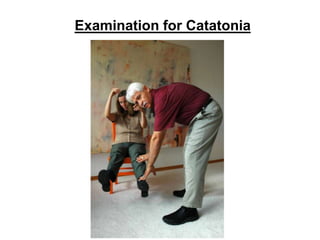
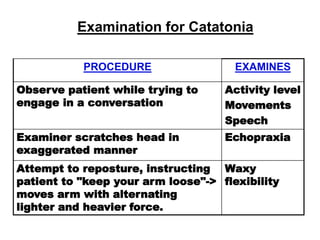
Examination for Catatonia
PROCEDURE EXAMINES
Observe patient while trying to
engage in a conversation
Activity level
Movements
Speech
Examiner scratches head in
exaggerated manner
Echopraxia
Attempt to reposture, instructing
patient to "keep your arm loose"->
moves arm with alternating
lighter and heavier force.
Waxy
flexibility
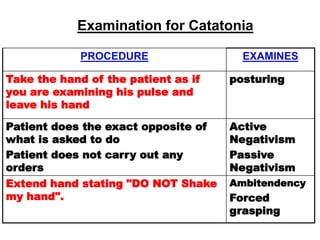
Examination for Catatonia
PROCEDURE EXAMINES
Take the hand of the patient as if
you are examining his pulse and
leave his hand
posturing
Patient does the exact opposite of
what is asked to do
Patient does not carry out any
orders
Active
Negativism
Passive
Negativism
Extend hand stating "DO NOT Shake
my hand".
Ambitendency
Forced
grasping
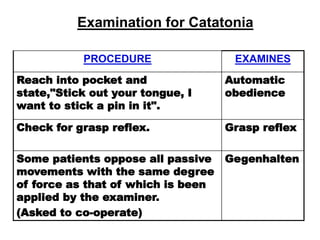
Examination for Catatonia
PROCEDURE EXAMINES
Reach into pocket and
state,"Stick out your tongue, I
want to stick a pin in it".
Automatic
obedience
Check for grasp reflex. Grasp reflex
Some patients oppose all passive
movements with the same degree
of force as that of which is been
applied by the examiner.
(Asked to co-operate)
Gegenhalten
Examination for Catatonia
PROCEDURE EXAMINES
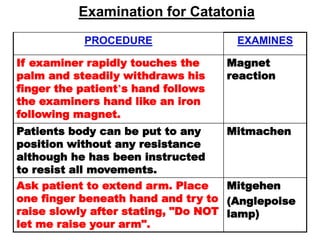
If examiner rapidly touches the
palm and steadily withdraws his
finger the patient’s hand follows
the examiners hand like an iron
following magnet.
Magnet
reaction
Patients body can be put to any
position without any resistance
although he has been instructed
to resist all movements.
Mitmachen
Ask patient to extend arm. Place
one finger beneath hand and try to
raise slowly after stating, "Do NOT
let me raise your arm".
Mitgehen
(Anglepoise
lamp)
Examination for Catatonia
• Check chart for reports of previous 24-hour
period. In particular check for oral intake, I/O
Chart, vital signs, and any incidents.
• Attempt to observe patient indirectly, at least for
a brief period, each day.
• Record findings of one week in MSE.
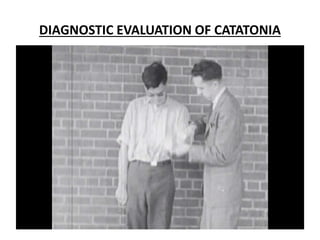
DIAGNOSTIC EVALUATION OF CATATONIA
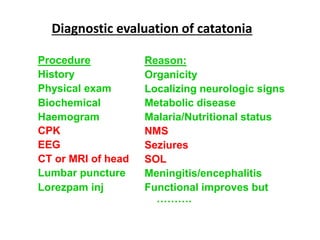
Diagnostic evaluation of catatonia
Procedure
History
Physical exam
Biochemical
Haemogram
CPK
EEG
CT or MRI of head
Lumbar puncture
Lorezpam inj
Reason:
Organicity
Localizing neurologic signs
Metabolic disease
Malaria/Nutritional status
NMS
Seziures
SOL
Meningitis/encephalitis
Functional improves but
……….
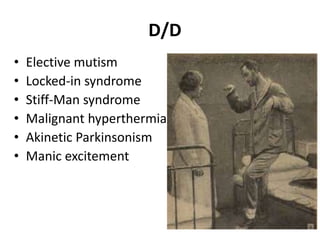
D/D
• Elective mutism
• Locked-in syndrome
• Stiff-Man syndrome
• Malignant hyperthermia
• Akinetic Parkinsonism
• Manic excitement
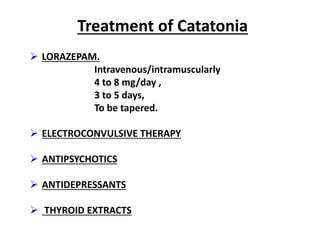
Treatment of Catatonia
 LORAZEPAM.
Intravenous/intramuscularly
4 to 8 mg/day ,
3 to 5 days,
To be tapered.
 ELECTROCONVULSIVE THERAPY
 ANTIPSYCHOTICS
 ANTIDEPRESSANTS
 THYROID EXTRACTS
Lethal Catatonia
• A severe form of Catatonia.
EARLY SIGNS –
• Increasing mental and physical agitation.
• Progresses to wild agitation and chorea which can
alternate with rigidity, stupor, mutism and refusal of
food / fluids.
OTHERS:
• Fever, hypotension and diaphoresis.
(which are similar to NMS)
SEVERE END STAGE CASES
• Convulsions, delirium, coma and even death.
DISTINCTION BETWEEN NMS & LETHAL CATATONIA
• Lethal Catatonia usually has a longer prodrome
of days to weeks.
• NMS also has the abnormal laboratory values.
• Treatment:
 Supportive care.
 ECT.
 Restarting or increase in antipsychotic dose.
 Short term use of lorazepam.
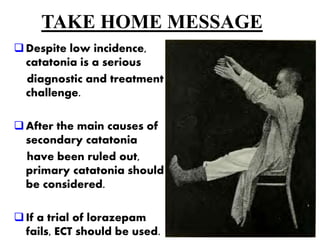
TAKE HOME MESSAGE
Despite low incidence,
catatonia is a serious
diagnostic and treatment
challenge.
After the main causes of
secondary catatonia
have been ruled out,
primary catatonia should
be considered.
If a trial of lorazepam
fails, ECT should be used.
T
h
a
n
k
Y
o
u
Catatonia

Catatonia

  • 1.
    Catatonia : AnOverview Kapil S Kulkarni Resident Doctor, Jagjivan Ram Hospital, Mumbai Central Guided by- Dr Pinto, Dr Rawat, Dr Dave
  • 2.
    PRESENTATION DEFINITION HISTORICAL REVIEW HYPOTHESIS SYMPTOMS &SIGNS (PHENOMENOLOGY) CAUSES OF CATATONIA RATING SCALE EXAMINATION DIFFERENTIATING CATATONIA COMMON D/D OF CATATONIA TREATMENT OF CATATONIA
  • 6.
    DEFINITION • A syndromeof multiple etiologies (organic or functional) presenting with different features. • Features are classified as motor and behavioral. • Motor- posturing, catalepsy, stereotypy, mannerism, rigidity, waxy flexibility, echopraxia, echolalia. • Behavioral- withdrawal, excitement, grimace, stupor, mutism, staring, negativism, verbigeration, perseveration, automatic obedience, mitgehen, gegenhalten, ambitendency, impulsivity, combativeness.
  • 7.
    HISTORICAL OVERVIEW • Describedin 1874 by Kahlbaum, its neurological causes were also appreciated. • Kraepelin and Bleuler- Described it relation to schizophrenia. • 1976 – Abraham & Taylor – in mania • 1976 – Gelenberg – concept of syndrome
  • 8.
    • DSM-IV (1994)Diagnostic Criteria for Catatonic Disorder Due to a General Medical Condition and also they classify it in affective disorder “with catatonic symptoms” thus placing the syndrome beyond the limits of schizophrenia.
  • 9.
    HYPOTHESIS OF CATATONIA •G-aminobuteric acid (GABA) HYPOACTIVITY at the GABAA receptor. • Dopamine HYPOACTIVITY at the D2 receptor. • Glutamate HYPOACTIVITY at the N-methyl-D-aspartate (NDMA) receptor. • Serotonin HYPERACTIVITY at the 5-HT1A receptor and HYPOACTIVITY at the 5-HT2A receptor.
  • 10.
  • 11.
    PHENOMENOLOGY • Excitement- Extreme hyperactivity,constant motor unrest which is apparently non purposeful. Not to be attributed to akathisia or goal directed agitation. • Immobility/ stupor- Extreme hypo activity, immobile, minimally responsive to stimuli.
  • 12.
    • Mutism- Verbally unresponsiveor minimally responsive. • Staring- Fixed gaze, little no visual scanning of environment, decreased blinking. • Posturing/ catalepsy- Spontaneous maintenance of posture(s), including mundane. (e.g. sitting or standing for long period without reacting) PHENOMENOLOGY
  • 13.
    • Grimacing- Maintenance ofodd facial expression. • Echopraxia/ echolalia- Mimicking of examiner’s movement or speech. • Stereotype- Repetitive non goal directed motor activity (e.g. finger play, repeatedly touching, pitting or rubbing self); abnormality not inherent in act but in frequency. PHENOMENOLOGY
  • 14.
    • Mannerism- Odd, purposefulmovement (hopping or walking tip toe, or exaggerated caricatures of mundane movements); abnormality inherent in act itself. • Verbigerations- Repeatation of phrases or sentences (like a scratched record); it does not require stimulus to occur. PHENOMENOLOGY
  • 15.
    • Rigidity- Maintenance ofrigid position despite of efforts to be moved, exclude if cogwheel or tremors present. • Negativism- Apparently motiveless resistance to instructions or attempt to move/ examine patient. Contrary behavior does exact opposite of instructions. PHENOMENOLOGY
  • 16.
    • Waxy flexibility- Duringreposturing of patient, patient offers initial resistance before allowing himself to be repositioned (similar to that of bending candle). • Withdrawal- Refusal to eat, drink and/ or make eye contact. PHENOMENOLOGY
  • 17.
    • Impulsivity- Patient suddenlyengages in inappropriate behavior without provocation (e.g. runs down hallway, starts screaming or takes off clothes). Afterwards can give no or only facile explanation. • Automatic obedience- Exaggerated cooperation with examiners request or spontaneous continuation of movement requested. Mitgehen and mitmachen are types of automatic obedience PHENOMENOLOGY
  • 18.
    • Mitgehen- Arm raisingin response to light pressure of finger, despite instruction to the contrary. • Gegenhalten- Resistance to passive movement which is proportional to strength of the stimulus, appears automatic rather than willful. PHENOMENOLOGY
  • 19.
    • Ambitendancy- Patient appearsmotorically “stuck” in indecisive, hesitant movement. • Grasp reflex- As per neuro exam • Perseveration- Repeatedly returns to same topic or persists with movement. even after stimulus is removed. PHENOMENOLOGY
  • 20.
    • Combativeness- Usually inundirected manner with no or only facile explanations afterwards. • Autonomic abnormality- Temp, BP, pulse, RR, diaphoresis. PHENOMENOLOGY
  • 21.
    DSM IV • Mutism:refusal to speak • Immobility: lack or paucity of movement • Stereotypes: purposeless, repetitive movements • Negativism: active or passive refusal to follow commands • Mannerisms: repetitive, purposeful movements • Posturing: maintenance of bizarre postures • Grimacing: repetitive facial posturing • Catalepsy or Waxy Flexibility: maintenance of posture • Echopraxia or Echolalia: repetition of words or the imitation of actions • Excitement: purposeless, excessive movement
  • 22.
    DSM IV • 1criterion needed for general medical condition or substance induced catatonia • 2 criteria for catatonia that is associated with a psychiatric condition ICD 10 • Only under psychotic disorders. • NO ORGANIC CATATONIA DESCRIBED !!
  • 23.
  • 24.
    CAUSES OF CATATONIA •Organic (Secondary) – 1. Neurological 2. Metabolic 3. Nutritional 4. Drug related 5. Misc • Functional (Primary) – 1. Schizophrenia 2. Mood disease (mania commonly) 3. Other Ψ 4. OCD 5. PTSD etc
  • 25.
    Organic catatonia -Neurological • Brain stem, diencephalic, basal ganglia, lesions near III ventricle, amygdala. • Frontal lobe, Parietal lobe ds. • Limbic & temporal lobe ds. • Head injury, dementia, MS, atrophy. • Encephalitis & other infections • Epilepsy
  • 26.
    Organic catatonia -Metabolic • Periodic catatonia • DM, in DKA • Thyroid dysfunction • Hepatic failure • Renal failure • Porphyrias • Nutritional- Wernickes, pellagra, B12 deficiency.
  • 27.
    Organic catatonia –Drugs • Neuroleptics • Alcohol • Opioids • Cannabis • Disulfiram • SSRI, TCA
  • 28.
    Common organic etiologies •CNS structural damage/ Neoplasm • Encephalitis and other CNS infections • Seizures or EEG with epileptiform activity • Metabolic disturbances • Phencyclidine exposure • Neuroleptic exposure • CNS lupus • Corticosteroids • Porphyria and other conditions • CVA • Wernicke's encephalopathy • Posttraumatic • Multiple sclerosis • Cerebral malaria
  • 29.
  • 30.
    PRIMARY AND SECONDARY CATATONIA InPrimary catatonia: 1. Patient responds to painful stimuli. 2. Patient usually keeps his eyes open most of the times. 3. Patient’s reflexes would be normal. 4. No focal neurological deficits. 5. Patient avoid self injury. (arm test) 6. Overflow incontinence seen. 7. EEG pattern is that of awake test. 8. Lorezapam injection improves or continues to be same.
  • 31.
    How to differentiatebetween depressive and schizophrenic catatonia ?
  • 32.
    How to differentiatebetween depressive and schizophrenic catatonia ? Depressive catatonia: Depressive face Veraguth sign Athanassio’s (omega sign) Eye movements PMA retardation Mood state Past history Schizophrenic catatonia: Vigilant face Catatonic excitement Schnauzkrampf (snout spasm) Scanning Less marked
  • 33.
    Rating Scale 1. Bush-FrancisCatatonia Rating Scale 2. Braunig Catatonia Rating Scale 3. Modified Roger’s scale
  • 34.
    Bush-Francis Catatonia Rating Scale •Use the presence or absence of items 1 - 14 for screening. • Use the 0 - 3 scale for items 1 -23 to rate severity.
  • 35.
  • 36.
    Examination for Catatonia PROCEDUREEXAMINES Observe patient while trying to engage in a conversation Activity level Movements Speech Examiner scratches head in exaggerated manner Echopraxia Attempt to reposture, instructing patient to "keep your arm loose"-> moves arm with alternating lighter and heavier force. Waxy flexibility
  • 37.
    Examination for Catatonia PROCEDUREEXAMINES Take the hand of the patient as if you are examining his pulse and leave his hand posturing Patient does the exact opposite of what is asked to do Patient does not carry out any orders Active Negativism Passive Negativism Extend hand stating "DO NOT Shake my hand". Ambitendency Forced grasping
  • 38.
    Examination for Catatonia PROCEDUREEXAMINES Reach into pocket and state,"Stick out your tongue, I want to stick a pin in it". Automatic obedience Check for grasp reflex. Grasp reflex Some patients oppose all passive movements with the same degree of force as that of which is been applied by the examiner. (Asked to co-operate) Gegenhalten
  • 39.
    Examination for Catatonia PROCEDUREEXAMINES If examiner rapidly touches the palm and steadily withdraws his finger the patient’s hand follows the examiners hand like an iron following magnet. Magnet reaction Patients body can be put to any position without any resistance although he has been instructed to resist all movements. Mitmachen Ask patient to extend arm. Place one finger beneath hand and try to raise slowly after stating, "Do NOT let me raise your arm". Mitgehen (Anglepoise lamp)
  • 40.
    Examination for Catatonia •Check chart for reports of previous 24-hour period. In particular check for oral intake, I/O Chart, vital signs, and any incidents. • Attempt to observe patient indirectly, at least for a brief period, each day. • Record findings of one week in MSE.
  • 41.
  • 42.
    Diagnostic evaluation ofcatatonia Procedure History Physical exam Biochemical Haemogram CPK EEG CT or MRI of head Lumbar puncture Lorezpam inj Reason: Organicity Localizing neurologic signs Metabolic disease Malaria/Nutritional status NMS Seziures SOL Meningitis/encephalitis Functional improves but ……….
  • 43.
    D/D • Elective mutism •Locked-in syndrome • Stiff-Man syndrome • Malignant hyperthermia • Akinetic Parkinsonism • Manic excitement
  • 44.
    Treatment of Catatonia LORAZEPAM. Intravenous/intramuscularly 4 to 8 mg/day , 3 to 5 days, To be tapered.  ELECTROCONVULSIVE THERAPY  ANTIPSYCHOTICS  ANTIDEPRESSANTS  THYROID EXTRACTS
  • 45.
    Lethal Catatonia • Asevere form of Catatonia. EARLY SIGNS – • Increasing mental and physical agitation. • Progresses to wild agitation and chorea which can alternate with rigidity, stupor, mutism and refusal of food / fluids. OTHERS: • Fever, hypotension and diaphoresis. (which are similar to NMS) SEVERE END STAGE CASES • Convulsions, delirium, coma and even death.
  • 46.
    DISTINCTION BETWEEN NMS& LETHAL CATATONIA • Lethal Catatonia usually has a longer prodrome of days to weeks. • NMS also has the abnormal laboratory values. • Treatment:  Supportive care.  ECT.  Restarting or increase in antipsychotic dose.  Short term use of lorazepam.
  • 47.
    TAKE HOME MESSAGE Despitelow incidence, catatonia is a serious diagnostic and treatment challenge. After the main causes of secondary catatonia have been ruled out, primary catatonia should be considered. If a trial of lorazepam fails, ECT should be used.
  • 48.