D I S O R D E R S O F T H O U G H T
C O N T E N T
P R E S E N T E D B Y - D R . S A S W I N D E R
K A U R ( P G S T U D E N T )
C H A I R P E R S O N - D R . S H I V A N A N D
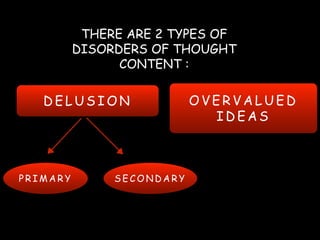
THERE ARE 2 TYPES OF
DISORDERS OF THOUGHT
CONTENT :
D E L U S I O N O V E R V A L U E D
I D E A S
P R I M A R Y S E C O N D A R Y
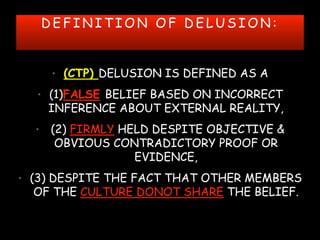
D E F I N I T I O N O F D E L U S I O N :
• (CTP) DELUSION IS DEFINED AS A
• (1)FALSE BELIEF BASED ON INCORRECT
INFERENCE ABOUT EXTERNAL REALITY,
• (2) FIRMLY HELD DESPITE OBJECTIVE &
OBVIOUS CONTRADICTORY PROOF OR
EVIDENCE,
• (3) DESPITE THE FACT THAT OTHER MEMBERS
OF THE CULTURE DONOT SHARE THE BELIEF.
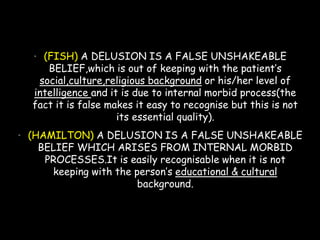
• (FISH) A DELUSION IS A FALSE UNSHAKEABLE
BELIEF,which is out of keeping with the patient’s
social,culture,religious background or his/her level of
intelligence and it is due to internal morbid process(the
fact it is false makes it easy to recognise but this is not
its essential quality).
• (HAMILTON) A DELUSION IS A FALSE UNSHAKEABLE
BELIEF WHICH ARISES FROM INTERNAL MORBID
PROCESSES.It is easily recognisable when it is not
keeping with the person’s educational & cultural
background.
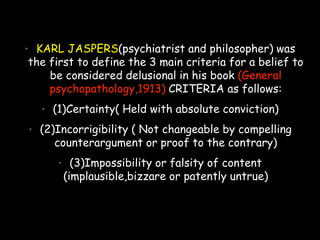
• KARL JASPERS(psychiatrist and philosopher) was
the first to define the 3 main criteria for a belief to
be considered delusional in his book (General
psychopathology,1913) CRITERIA as follows:
• (1)Certainty( Held with absolute conviction)
• (2)Incorrigibility ( Not changeable by compelling
counterargument or proof to the contrary)
• (3)Impossibility or falsity of content
(implausible,bizzare or patently untrue)
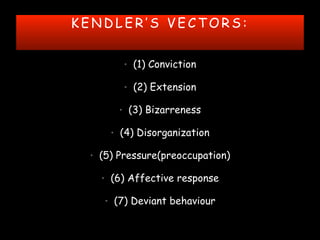
K E N D L E R ’ S V E C T O R S :
• (1) Conviction
• (2) Extension
• (3) Bizarreness
• (4) Disorganization
• (5) Pressure(preoccupation)
• (6) Affective response
• (7) Deviant behaviour
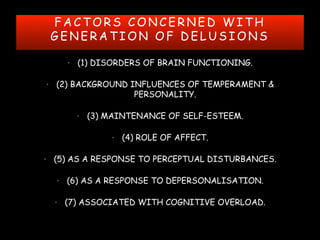
F A C T O R S C O N C E R N E D W I T H
G E N E R A T I O N O F D E L U S I O N S
• (1) DISORDERS OF BRAIN FUNCTIONING.
• (2) BACKGROUND INFLUENCES OF TEMPERAMENT &
PERSONALITY.
• (3) MAINTENANCE OF SELF-ESTEEM.
• (4) ROLE OF AFFECT.
• (5) AS A RESPONSE TO PERCEPTUAL DISTURBANCES.
• (6) AS A RESPONSE TO DEPERSONALISATION.
• (7) ASSOCIATED WITH COGNITIVE OVERLOAD.
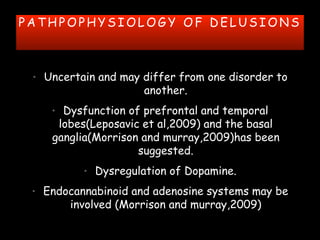
P A T H P O P H Y S I O L O G Y O F D E L U S I O N S
• Uncertain and may differ from one disorder to
another.
• Dysfunction of prefrontal and temporal
lobes(Leposavic et al,2009) and the basal
ganglia(Morrison and murray,2009)has been
suggested.
• Dysregulation of Dopamine.
• Endocannabinoid and adenosine systems may be
involved (Morrison and murray,2009)
• PRIMARY DELUSION - True delusions,result of primary
delusional experience ( due to faulty thinking and self-
monitoring) which cannot be deduced from any other
morbid phenomena(diagnostic of schizophrenia but may be
seen in organic disorders like epileptic psychoses).
• SECONDARY DELUSION - Delusion-like ideas which can
be understandably derived from some other morbid
psychological phenomena;( perceptual disturbances,intense
emotions & personality disorder).
• OVERVALUED IDEAS - False belief which can occur in
healthy people & in mentally ill, which because of the
associated feeling tone, takes precedence over all other
ideas & maintain this precedence permanently or for a long
period of time.
P R I M A R Y D E L U S I O N
( 1 ) D E L U S I O N A L M O O D - I N T H I S S T A T E P A T I E N T
H A S T H E K N O W L E D G E T H A T T H E R E I S S O M E T H I N G
G O I N G O N A R O U N D H I M W H I C H C O N C E R N S H I M ,
B U T H E D O E S N O T K N O W W H A T I T I S .
( 2 ) S U D D E N D E L U S I O N A L I D E A - A L S O K N O W N A S
“ A U T O C H T H O N O U S D E L U S I O N ” I T S U D D E N L Y
A P P E A R S F U L L Y F O R M E D I N P A T I E N T ’ S M I N D B U T
T H E Y A R E N O T D I A G N O S T I C O F S C H I Z O P H R E N I A
U N L E S S T H E Y A R E B I Z A R R E , A N D S E C O N D L Y T H E Y
C A N O C C U R I N N O R M A L I N D I V I D U A L S S E C O N D A R Y
T O M O O D & P E R S O N A L I T Y D I S O R D E R .
• (3) DELUSIONAL PERCEPTION (APOPHANOUS)-
ATTRIBUTION OF A NEW MEANING, usually in the sense of self-
reference, to a normally perceived object & which cannot be
understood from patient’s affective state/previous attitudes.
• SCHNEIDER CLAIMS DELUSIONAL PERCEPTION TO BE
DIAGNOSTIC OF SCHIZOPHRENIA & IMP. FEATURE BEING “TWO
MEMBEREDNESS” i.e a link from the perceived object to the
subject’s perception of
this object and a second link to the new significance of this
perception(memory of normal perception with a new meaning).
• DELUSIONAL MISINTERPRETATION- new meaning can be
understood as arising from the patient’s affective state/previous
attitude.
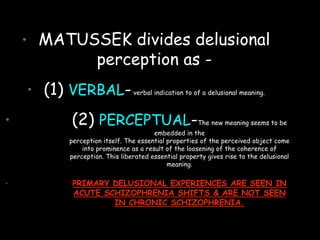
• MATUSSEK divides delusional
perception as -
• (1) VERBAL-verbal indication to of a delusional meaning.
• (2) PERCEPTUAL-The new meaning seems to be
embedded in the
perception itself. The essential properties of the perceived object come
into prominence as a result of the loosening of the coherence of
perception. This liberated essential property gives rise to the delusional
meaning.
• PRIMARY DELUSIONAL EXPERIENCES ARE SEEN IN
ACUTE SCHIZOPHRENIA SHIFTS & ARE NOT SEEN
IN CHRONIC SCHIZOPHRENIA.
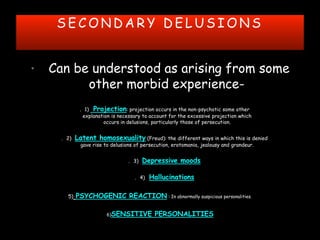
S E C O N D A R Y D E L U S I O N S
• Can be understood as arising from some
other morbid experience-
. 1) Projection: projection occurs in the non-psychotic some other
explanation is necessary to account for the excessive projection which
occurs in delusions, particularly those of persecution.
. 2) Latent homosexuality (Freud): the different ways in which this is denied
gave rise to delusions of persecution, erotomania, jealousy and grandeur.
. 3) Depressive moods
. 4) Hallucinations
5) PSYCHOGENIC REACTION : In abnormally suspicious personalities.
6)SENSITIVE PERSONALITIES
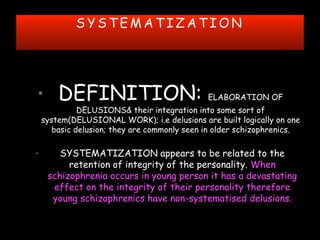
S Y S T E M A T I Z A T I O N
• DEFINITION: ELABORATION OF
DELUSIONS& their integration into some sort of
system(DELUSIONAL WORK); i.e delusions are built logically on one
basic delusion; they are commonly seen in older schizophrenics.
• SYSTEMATIZATION appears to be related to the
retention of integrity of the personality. When
schizophrenia occurs in young person it has a devastating
effect on the integrity of their personality therefore
young schizophrenics have non-systematised delusions.
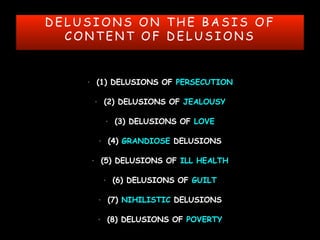
D E L U S I O N S O N T H E B A S I S O F
C O N T E N T O F D E L U S I O N S
• (1) DELUSIONS OF PERSECUTION
• (2) DELUSIONS OF JEALOUSY
• (3) DELUSIONS OF LOVE
• (4) GRANDIOSE DELUSIONS
• (5) DELUSIONS OF ILL HEALTH
• (6) DELUSIONS OF GUILT
• (7) NIHILISTIC DELUSIONS
• (8) DELUSIONS OF POVERTY
D E L U S I O N O F P E R S E C T I O N
I L O V E H I M - I D O N O T L O V E H I M - I H A T E H I M - H E H A T E S M E
• Result of apophanous experiences, auditory hallucinations, bodily
hallucinations and experiences of passivity.
Can take many forms:
Delusions of reference: Pt. knows that people are talking about him,
slandering him or spying on him.
Belief that they or their loved ones are about to be killed.
Being robbed or deprived of their just inheritance.
Have special knowledge which the persecutors want to take.
Being poisoned – these are often explanatory delusions or based on
hallucinations of smell and taste.
Delusions of influence: are logical results of experiences of passivity,which are
diagnostic of schizophrenia.
• DELUSIONS OF PERSECUTION ARE SEEN IN :
• (1) SCHIZOPHRENIA
• (2) DEPRESSIVE ILLNESSES
• (3) PSYCHOGENIC REACTIONS
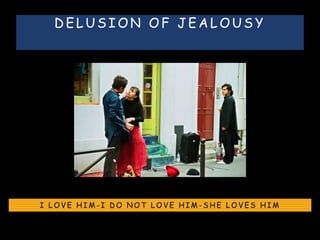
D E L U S I O N O F J E A L O U S Y
I L O V E H I M - I D O N O T L O V E H I M - S H E L O V E S H I M
• The term is a misnomer
Often the pt. has been suspicious, sensitive and mildly jealous before
the
onset of the illness or psychogenic reaction.
The severity of the condition fluctuates in the course of time, so that
sometimes it seems to be a series of psychogenic reactions.
• DELUSION OF
JEALOUSY(INFIDELITY) are seen
in :
• (1) Alcohol addiction
• (2) Schizophrenia
• (3) Affective psychosis
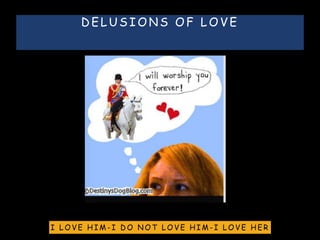
D E L U S I O N S O F L O V E
I L O V E H I M - I D O N O T L O V E H I M - I L O V E H E R
• Also called as “the fantasy lover” & “erotomania”
• Patients are convinced that some person is in
love with them although the alleged lover may
never have spoken to them.
• They are seen in :
• (1) Abnormal personality development.
• (2) Schizophrenia (early cases).
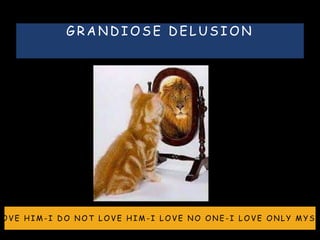
G R A N D I O S E D E L U S I O N
L O V E H I M - I D O N O T L O V E H I M - I L O V E N O O N E - I L O V E O N L Y M Y S E
• The expansive delusions may be supported by hallucinatory
voices(voices telling the patient that he is important).
• They may be supported by confabulations when, the
patient gives a detailed account of his coronation or of
her marriage to king.
• It may be a part of fantastic hallucinosis in which all
forms of hallucination occur.
• GRANDIOSITY has to be differentiated from
mania(absence of well held expansive delusion).
• GRANDIOSE DELUSION are seen in :
• (1) Organic brain syndrome
• (2) Drug dependence
• (3) Schizophrenia
• (4) General paresis
• (5) Happiness psychosis
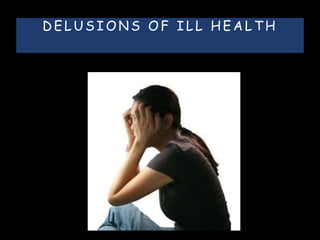
D E L U S I O N S O F I L L H E A L T H
• Characteristic picture of DEPRESSIVE
ILLNESS- result of an uncovering of the patients
worries.
• DEPRESSIVE DELUSIONS of ill-health may
involve the patient’s spouse & children (post-
partum psychosis).
• Moderately depressed patient believe that they
are becoming incurably insane(therefore,hesitate
to take medical help)
• DELUSIONS OF ILL-HEALTH
may also be seen in :
• (1) Schizophrenia - early stages
secondary to depression; chronic
cases due to somatic hallucination.
• (2) Personality development
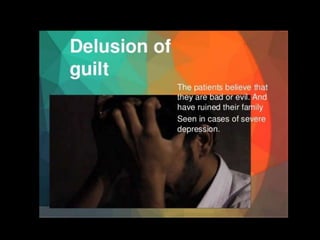
• Mainly seen in DEPRESSIVE ILLNESSES.
• MILD DEPRESSION- patient is self-critical & self-
reproachful (this differentiates true depression from
reactive depression)
• SEVERE DEPRESSION- (delusion of guilt) patient
believes he is wicked sinner who has ruined his family -
this may take on a somewhat grandiose character-
“wickedest man in the world will be punished for
eternity”.
• DELUSIONS OF GUILT CAN GIVE RISE TO DELUSIONS OF PERSECUTION.
N I H I L I S T I C D E L U S I O N S
• Also known as DELUSION OF NEGATION
(as patient denies the existence of his
body,his mind,his loved ones & the world
around him.)
• Sometimes they may be associated with
DELUSION OF ENORMITY, when the
patient believes that he can produce a
catastrophe by some action.
• NIHILISTIC DELUSIONS are seen
in:
• (1) Severe agitated
depression(Involutional melancholia)
• (2) Subacute delirious state
• (3) Schizophrenia
• Patient is convinced that he is
impoverished and believes that
destitution is facing him & his
family.
• They are commonly seen in:
• DEPRESSION
R E A L I T Y O F D E L U S I O N S
Delusions or overvalued IDEAS OF JEALOUSY seem to be the most
dangerous kind of delusion and overvalued idea.
Action is more likely to be taken on the basis of delusion-like or
overvalued ideas than on the basis of true delusions.
Attack or assault on alleged persecutors in acute schizophrenia with
true delusions is not common.
S C A L E S T O A S S E S S D E L U S I O N S
• (1) BROWN ASSESSMENT OF BELIEFS
SCALE(BABS).
• (2 THE 21-ITEM Peters et al. Delusional
Inventory(PDI) scale.)
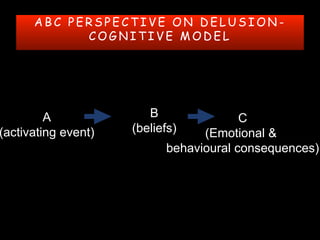
A B C P E R S P E C T I V E O N D E L U S I O N -
C O G N I T I V E M O D E L
A
(activating event)
B
(beliefs)
C
(Emotional &
behavioural consequences)
R E F E R E N C E S
• (1) Max Hamilton; Disorders of Thought and Speech; Fish’s Clinical
Psychopathology (Signs and Symptoms in Psychiatry);Varghese
publishing house; Second edition; 43-53.
• (2) Chandra Kiran & Suprakash Chaudhary ;Understanding
Delusions ;Industrial Psychiatry Journal 2009 Jan-Jun; 18(1);3-18.
• (3) Femi Oyebode; Delusions and other erroneous ideas;
SIMS’symptoms in the mind; Reed Elsevier India Pvt limited; Fifth
edition;111-134.
• (4) JANE L. EISEN, M.D.1
KATHARINE A. PHILLIPS, M.D.1
DOUGLAS BEER, M.D.1
KATHERINE D. ATALA, M.D.2
STEVEN A.
RASMUSSEN, M.D.1
LEE BAER, Ph.D. BABS
T H A N K Y O U !

Delusion ppt

  • 1.
    D I SO R D E R S O F T H O U G H T C O N T E N T P R E S E N T E D B Y - D R . S A S W I N D E R K A U R ( P G S T U D E N T ) C H A I R P E R S O N - D R . S H I V A N A N D
  • 2.
    THERE ARE 2TYPES OF DISORDERS OF THOUGHT CONTENT : D E L U S I O N O V E R V A L U E D I D E A S P R I M A R Y S E C O N D A R Y
  • 3.
    D E FI N I T I O N O F D E L U S I O N : • (CTP) DELUSION IS DEFINED AS A • (1)FALSE BELIEF BASED ON INCORRECT INFERENCE ABOUT EXTERNAL REALITY, • (2) FIRMLY HELD DESPITE OBJECTIVE & OBVIOUS CONTRADICTORY PROOF OR EVIDENCE, • (3) DESPITE THE FACT THAT OTHER MEMBERS OF THE CULTURE DONOT SHARE THE BELIEF.
  • 4.
    • (FISH) ADELUSION IS A FALSE UNSHAKEABLE BELIEF,which is out of keeping with the patient’s social,culture,religious background or his/her level of intelligence and it is due to internal morbid process(the fact it is false makes it easy to recognise but this is not its essential quality). • (HAMILTON) A DELUSION IS A FALSE UNSHAKEABLE BELIEF WHICH ARISES FROM INTERNAL MORBID PROCESSES.It is easily recognisable when it is not keeping with the person’s educational & cultural background.
  • 5.
    • KARL JASPERS(psychiatristand philosopher) was the first to define the 3 main criteria for a belief to be considered delusional in his book (General psychopathology,1913) CRITERIA as follows: • (1)Certainty( Held with absolute conviction) • (2)Incorrigibility ( Not changeable by compelling counterargument or proof to the contrary) • (3)Impossibility or falsity of content (implausible,bizzare or patently untrue)
  • 6.
    K E ND L E R ’ S V E C T O R S : • (1) Conviction • (2) Extension • (3) Bizarreness • (4) Disorganization • (5) Pressure(preoccupation) • (6) Affective response • (7) Deviant behaviour
  • 7.
    F A CT O R S C O N C E R N E D W I T H G E N E R A T I O N O F D E L U S I O N S • (1) DISORDERS OF BRAIN FUNCTIONING. • (2) BACKGROUND INFLUENCES OF TEMPERAMENT & PERSONALITY. • (3) MAINTENANCE OF SELF-ESTEEM. • (4) ROLE OF AFFECT. • (5) AS A RESPONSE TO PERCEPTUAL DISTURBANCES. • (6) AS A RESPONSE TO DEPERSONALISATION. • (7) ASSOCIATED WITH COGNITIVE OVERLOAD.
  • 8.
    P A TH P O P H Y S I O L O G Y O F D E L U S I O N S • Uncertain and may differ from one disorder to another. • Dysfunction of prefrontal and temporal lobes(Leposavic et al,2009) and the basal ganglia(Morrison and murray,2009)has been suggested. • Dysregulation of Dopamine. • Endocannabinoid and adenosine systems may be involved (Morrison and murray,2009)
  • 9.
    • PRIMARY DELUSION- True delusions,result of primary delusional experience ( due to faulty thinking and self- monitoring) which cannot be deduced from any other morbid phenomena(diagnostic of schizophrenia but may be seen in organic disorders like epileptic psychoses). • SECONDARY DELUSION - Delusion-like ideas which can be understandably derived from some other morbid psychological phenomena;( perceptual disturbances,intense emotions & personality disorder). • OVERVALUED IDEAS - False belief which can occur in healthy people & in mentally ill, which because of the associated feeling tone, takes precedence over all other ideas & maintain this precedence permanently or for a long period of time.
  • 11.
    P R IM A R Y D E L U S I O N ( 1 ) D E L U S I O N A L M O O D - I N T H I S S T A T E P A T I E N T H A S T H E K N O W L E D G E T H A T T H E R E I S S O M E T H I N G G O I N G O N A R O U N D H I M W H I C H C O N C E R N S H I M , B U T H E D O E S N O T K N O W W H A T I T I S . ( 2 ) S U D D E N D E L U S I O N A L I D E A - A L S O K N O W N A S “ A U T O C H T H O N O U S D E L U S I O N ” I T S U D D E N L Y A P P E A R S F U L L Y F O R M E D I N P A T I E N T ’ S M I N D B U T T H E Y A R E N O T D I A G N O S T I C O F S C H I Z O P H R E N I A U N L E S S T H E Y A R E B I Z A R R E , A N D S E C O N D L Y T H E Y C A N O C C U R I N N O R M A L I N D I V I D U A L S S E C O N D A R Y T O M O O D & P E R S O N A L I T Y D I S O R D E R .
  • 12.
    • (3) DELUSIONALPERCEPTION (APOPHANOUS)- ATTRIBUTION OF A NEW MEANING, usually in the sense of self- reference, to a normally perceived object & which cannot be understood from patient’s affective state/previous attitudes. • SCHNEIDER CLAIMS DELUSIONAL PERCEPTION TO BE DIAGNOSTIC OF SCHIZOPHRENIA & IMP. FEATURE BEING “TWO MEMBEREDNESS” i.e a link from the perceived object to the subject’s perception of this object and a second link to the new significance of this perception(memory of normal perception with a new meaning). • DELUSIONAL MISINTERPRETATION- new meaning can be understood as arising from the patient’s affective state/previous attitude.
  • 13.
    • MATUSSEK dividesdelusional perception as - • (1) VERBAL-verbal indication to of a delusional meaning. • (2) PERCEPTUAL-The new meaning seems to be embedded in the perception itself. The essential properties of the perceived object come into prominence as a result of the loosening of the coherence of perception. This liberated essential property gives rise to the delusional meaning. • PRIMARY DELUSIONAL EXPERIENCES ARE SEEN IN ACUTE SCHIZOPHRENIA SHIFTS & ARE NOT SEEN IN CHRONIC SCHIZOPHRENIA.
  • 14.
    S E CO N D A R Y D E L U S I O N S • Can be understood as arising from some other morbid experience- . 1) Projection: projection occurs in the non-psychotic some other explanation is necessary to account for the excessive projection which occurs in delusions, particularly those of persecution. . 2) Latent homosexuality (Freud): the different ways in which this is denied gave rise to delusions of persecution, erotomania, jealousy and grandeur. . 3) Depressive moods . 4) Hallucinations 5) PSYCHOGENIC REACTION : In abnormally suspicious personalities. 6)SENSITIVE PERSONALITIES
  • 15.
    S Y ST E M A T I Z A T I O N • DEFINITION: ELABORATION OF DELUSIONS& their integration into some sort of system(DELUSIONAL WORK); i.e delusions are built logically on one basic delusion; they are commonly seen in older schizophrenics. • SYSTEMATIZATION appears to be related to the retention of integrity of the personality. When schizophrenia occurs in young person it has a devastating effect on the integrity of their personality therefore young schizophrenics have non-systematised delusions.
  • 16.
    D E LU S I O N S O N T H E B A S I S O F C O N T E N T O F D E L U S I O N S • (1) DELUSIONS OF PERSECUTION • (2) DELUSIONS OF JEALOUSY • (3) DELUSIONS OF LOVE • (4) GRANDIOSE DELUSIONS • (5) DELUSIONS OF ILL HEALTH • (6) DELUSIONS OF GUILT • (7) NIHILISTIC DELUSIONS • (8) DELUSIONS OF POVERTY
  • 17.
    D E LU S I O N O F P E R S E C T I O N I L O V E H I M - I D O N O T L O V E H I M - I H A T E H I M - H E H A T E S M E
  • 18.
    • Result ofapophanous experiences, auditory hallucinations, bodily hallucinations and experiences of passivity. Can take many forms: Delusions of reference: Pt. knows that people are talking about him, slandering him or spying on him. Belief that they or their loved ones are about to be killed. Being robbed or deprived of their just inheritance. Have special knowledge which the persecutors want to take. Being poisoned – these are often explanatory delusions or based on hallucinations of smell and taste. Delusions of influence: are logical results of experiences of passivity,which are diagnostic of schizophrenia.
  • 19.
    • DELUSIONS OFPERSECUTION ARE SEEN IN : • (1) SCHIZOPHRENIA • (2) DEPRESSIVE ILLNESSES • (3) PSYCHOGENIC REACTIONS
  • 20.
    D E LU S I O N O F J E A L O U S Y I L O V E H I M - I D O N O T L O V E H I M - S H E L O V E S H I M
  • 21.
    • The termis a misnomer Often the pt. has been suspicious, sensitive and mildly jealous before the onset of the illness or psychogenic reaction. The severity of the condition fluctuates in the course of time, so that sometimes it seems to be a series of psychogenic reactions.
  • 22.
    • DELUSION OF JEALOUSY(INFIDELITY)are seen in : • (1) Alcohol addiction • (2) Schizophrenia • (3) Affective psychosis
  • 23.
    D E LU S I O N S O F L O V E I L O V E H I M - I D O N O T L O V E H I M - I L O V E H E R
  • 24.
    • Also calledas “the fantasy lover” & “erotomania” • Patients are convinced that some person is in love with them although the alleged lover may never have spoken to them. • They are seen in : • (1) Abnormal personality development. • (2) Schizophrenia (early cases).
  • 25.
    G R AN D I O S E D E L U S I O N L O V E H I M - I D O N O T L O V E H I M - I L O V E N O O N E - I L O V E O N L Y M Y S E
  • 26.
    • The expansivedelusions may be supported by hallucinatory voices(voices telling the patient that he is important). • They may be supported by confabulations when, the patient gives a detailed account of his coronation or of her marriage to king. • It may be a part of fantastic hallucinosis in which all forms of hallucination occur. • GRANDIOSITY has to be differentiated from mania(absence of well held expansive delusion).
  • 27.
    • GRANDIOSE DELUSIONare seen in : • (1) Organic brain syndrome • (2) Drug dependence • (3) Schizophrenia • (4) General paresis • (5) Happiness psychosis
  • 28.
    D E LU S I O N S O F I L L H E A L T H
  • 29.
    • Characteristic pictureof DEPRESSIVE ILLNESS- result of an uncovering of the patients worries. • DEPRESSIVE DELUSIONS of ill-health may involve the patient’s spouse & children (post- partum psychosis). • Moderately depressed patient believe that they are becoming incurably insane(therefore,hesitate to take medical help)
  • 30.
    • DELUSIONS OFILL-HEALTH may also be seen in : • (1) Schizophrenia - early stages secondary to depression; chronic cases due to somatic hallucination. • (2) Personality development
  • 32.
    • Mainly seenin DEPRESSIVE ILLNESSES. • MILD DEPRESSION- patient is self-critical & self- reproachful (this differentiates true depression from reactive depression) • SEVERE DEPRESSION- (delusion of guilt) patient believes he is wicked sinner who has ruined his family - this may take on a somewhat grandiose character- “wickedest man in the world will be punished for eternity”. • DELUSIONS OF GUILT CAN GIVE RISE TO DELUSIONS OF PERSECUTION.
  • 33.
    N I HI L I S T I C D E L U S I O N S
  • 34.
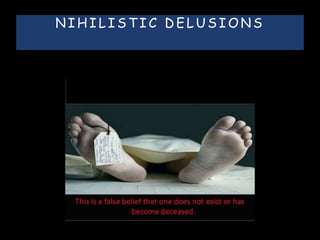
    • Also knownas DELUSION OF NEGATION (as patient denies the existence of his body,his mind,his loved ones & the world around him.) • Sometimes they may be associated with DELUSION OF ENORMITY, when the patient believes that he can produce a catastrophe by some action.
  • 35.
    • NIHILISTIC DELUSIONSare seen in: • (1) Severe agitated depression(Involutional melancholia) • (2) Subacute delirious state • (3) Schizophrenia
  • 37.
    • Patient isconvinced that he is impoverished and believes that destitution is facing him & his family. • They are commonly seen in: • DEPRESSION
  • 38.
    R E AL I T Y O F D E L U S I O N S Delusions or overvalued IDEAS OF JEALOUSY seem to be the most dangerous kind of delusion and overvalued idea. Action is more likely to be taken on the basis of delusion-like or overvalued ideas than on the basis of true delusions. Attack or assault on alleged persecutors in acute schizophrenia with true delusions is not common.
  • 39.
    S C AL E S T O A S S E S S D E L U S I O N S • (1) BROWN ASSESSMENT OF BELIEFS SCALE(BABS). • (2 THE 21-ITEM Peters et al. Delusional Inventory(PDI) scale.)
  • 40.
    A B CP E R S P E C T I V E O N D E L U S I O N - C O G N I T I V E M O D E L A (activating event) B (beliefs) C (Emotional & behavioural consequences)
  • 41.
    R E FE R E N C E S • (1) Max Hamilton; Disorders of Thought and Speech; Fish’s Clinical Psychopathology (Signs and Symptoms in Psychiatry);Varghese publishing house; Second edition; 43-53. • (2) Chandra Kiran & Suprakash Chaudhary ;Understanding Delusions ;Industrial Psychiatry Journal 2009 Jan-Jun; 18(1);3-18. • (3) Femi Oyebode; Delusions and other erroneous ideas; SIMS’symptoms in the mind; Reed Elsevier India Pvt limited; Fifth edition;111-134. • (4) JANE L. EISEN, M.D.1 KATHARINE A. PHILLIPS, M.D.1 DOUGLAS BEER, M.D.1 KATHERINE D. ATALA, M.D.2 STEVEN A. RASMUSSEN, M.D.1 LEE BAER, Ph.D. BABS
  • 42.
    T H AN K Y O U !