Project Management
A Managerial Approach
Scheduling
Scheduling
A schedule is the conversion of a
project action plan into an operating
timetable
It serves as the basis for monitoring
and controlling project activity
Taken together with the plan and
budget, it is probably the major tool
for the management of projects
Chapter 8-1
Scheduling
The basic approach of all scheduling
techniques is to form a network of
activity and event relationships
This network should graphically portray
the sequential relations between the
tasks in a project
Tasks that must precede or follow
other tasks are then clearly identified,
in time as well as function
Chapter 8-3
Scheduling
Such networks are a powerful tool for
planning and controlling a project and
have the following benefits:
It is a consistent framework for planning,
scheduling, monitoring, and controlling the
project
It illustrates the interdependence of all
tasks, work packages, and work elements
It denotes the times when specific
individuals must be available for work on a
given task Chapter 8-4
Scheduling
Network benefits (cont.):
It aids in ensuring that the proper
communications take place between
departments and functions
It determines an expected project completion
date
It identifies so-called critical activities that, if
delayed, will delay the project completion time
It identifies activities with slack that can be
delayed for specific periods without penalty
Chapter 8-5
Scheduling
Network benefits (cont.):
It determines the dates on which tasks may be
started - or must be started if the project is to
stay on schedule
It illustrates which tasks must be coordinated
to avoid resource timing conflicts
It illustrates which tasks may run, or must be
run, in parallel to achieve the predetermined
project completion date
It relieves some interpersonal conflict by clearly
showing task dependencies Chapter 8-6
Network Techniques:
PERT and CPM
With the exception of Gantt charts, the most
common approach to scheduling is the use of
network techniques such as PERT and CPM
The Program Evaluation and Review
Technique was developed by the U.S. Navy in
1958
The Critical Path Method was developed by
DuPont, Inc during the same time period
Chapter 8-7
Network Techniques:
PERT and CPM
PERT has been primarily used for
research and development projects
CPM was designed for construction
projects and has been generally
embraced by the construction industry
Chapter 8-8
Terminology
Activity - A specific task or set of tasks that
are required by the project, use up resources,
and take time to complete
Event - The result of completing one or more
activities. An identifiable end state occurring
at a particular time. Events use no resources.
Network - The combination of all activities
and events define the project and the activity
precedence relationships
Chapter 8-9
Terminology
Path - The series of connected activities
(or intermediate events) between any two
events in a network
Critical - Activities, events, or paths
which, if delayed, will delay the
completion of the project. A project’s
critical path is understood to mean that
sequence of critical activities that connect
the project’s start event to its finish event
Chapter 8-10
Terminology
An activity can be in any of these
conditions:
It may have a successor(s) but no
predecessor(s) - starts a network
It may have a predecessor(s) but no
successor(s) - ends a network
It may have both predecessor(s) and
successor(s) - in the middle of a network
The interconnections depend on the
technological relationships described in the
action plan
Chapter 8-11
Scheduling
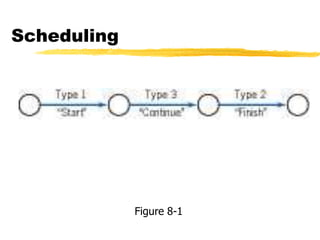
Figure 8-1
Drawing Networks
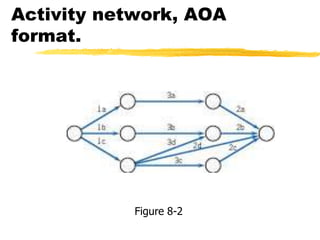
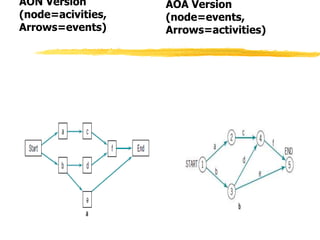
Activity-on-Arrow (AOA) networks use arrows
to represent activities while nodes stand for
events Also called as Arrow Diagramming
Method (ADM).
Chapter 8-12
Activity network, AOA
format.
Figure 8-2
Drawing Networks
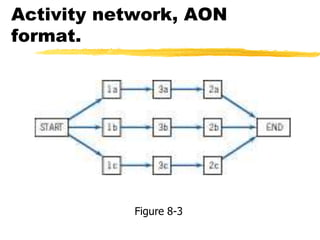
Activity-on-Node (AON) networks use
nodes to represent activities with arrows
to show precedence relationships Also
called as Precedence Diagramming
Method (PDM).
The choice between AOA and AON
representation is largely a matter of
personal preference
Activity network, AON
format.
Figure 8-3
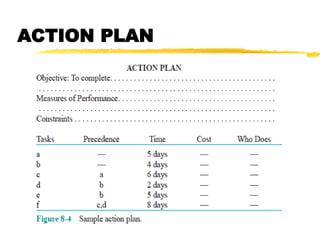
ACTION PLAN
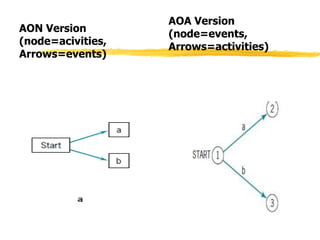
AON Version
(node=acivities,
Arrows=events)
AOA Version
(node=events,
Arrows=activities)
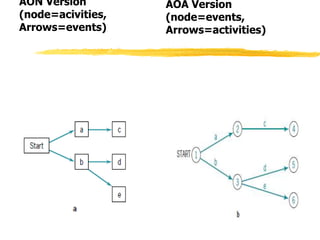
AON Version
(node=acivities,
Arrows=events)
AOA Version
(node=events,
Arrows=activities)
AON Version
(node=acivities,
Arrows=events)
AOA Version
(node=events,
Arrows=activities)
Assignment
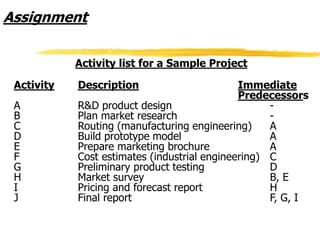
Activity list for a Sample Project
Activity Description Immediate
Predecessors
A R&D product design -
B Plan market research -
C Routing (manufacturing engineering) A
D Build prototype model A
E Prepare marketing brochure A
F Cost estimates (industrial engineering) C
G Preliminary product testing D
H Market survey B, E
I Pricing and forecast report H
J Final report F, G, I
Assignment
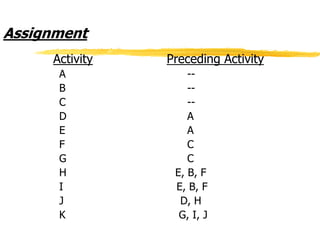
Activity Preceding Activity
A --
B --
C --
D A
E A
F C
G C
H E, B, F
I E, B, F
J D, H
K G, I, J
Assignment
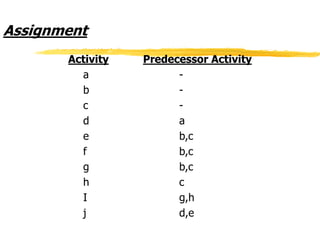
Activity Predecessor Activity
a -
b -
c -
d a
e b,c
f b,c
g b,c
h c
I g,h
j d,e

Scheduling

  • 1.
  • 2.
    Scheduling A schedule isthe conversion of a project action plan into an operating timetable It serves as the basis for monitoring and controlling project activity Taken together with the plan and budget, it is probably the major tool for the management of projects Chapter 8-1
  • 3.
    Scheduling The basic approachof all scheduling techniques is to form a network of activity and event relationships This network should graphically portray the sequential relations between the tasks in a project Tasks that must precede or follow other tasks are then clearly identified, in time as well as function Chapter 8-3
  • 4.
    Scheduling Such networks area powerful tool for planning and controlling a project and have the following benefits: It is a consistent framework for planning, scheduling, monitoring, and controlling the project It illustrates the interdependence of all tasks, work packages, and work elements It denotes the times when specific individuals must be available for work on a given task Chapter 8-4
  • 5.
    Scheduling Network benefits (cont.): Itaids in ensuring that the proper communications take place between departments and functions It determines an expected project completion date It identifies so-called critical activities that, if delayed, will delay the project completion time It identifies activities with slack that can be delayed for specific periods without penalty Chapter 8-5
  • 6.
    Scheduling Network benefits (cont.): Itdetermines the dates on which tasks may be started - or must be started if the project is to stay on schedule It illustrates which tasks must be coordinated to avoid resource timing conflicts It illustrates which tasks may run, or must be run, in parallel to achieve the predetermined project completion date It relieves some interpersonal conflict by clearly showing task dependencies Chapter 8-6
  • 7.
    Network Techniques: PERT andCPM With the exception of Gantt charts, the most common approach to scheduling is the use of network techniques such as PERT and CPM The Program Evaluation and Review Technique was developed by the U.S. Navy in 1958 The Critical Path Method was developed by DuPont, Inc during the same time period Chapter 8-7
  • 8.
    Network Techniques: PERT andCPM PERT has been primarily used for research and development projects CPM was designed for construction projects and has been generally embraced by the construction industry Chapter 8-8
  • 9.
    Terminology Activity - Aspecific task or set of tasks that are required by the project, use up resources, and take time to complete Event - The result of completing one or more activities. An identifiable end state occurring at a particular time. Events use no resources. Network - The combination of all activities and events define the project and the activity precedence relationships Chapter 8-9
  • 10.
    Terminology Path - Theseries of connected activities (or intermediate events) between any two events in a network Critical - Activities, events, or paths which, if delayed, will delay the completion of the project. A project’s critical path is understood to mean that sequence of critical activities that connect the project’s start event to its finish event Chapter 8-10
  • 11.
    Terminology An activity canbe in any of these conditions: It may have a successor(s) but no predecessor(s) - starts a network It may have a predecessor(s) but no successor(s) - ends a network It may have both predecessor(s) and successor(s) - in the middle of a network The interconnections depend on the technological relationships described in the action plan Chapter 8-11
  • 12.
  • 13.
    Drawing Networks Activity-on-Arrow (AOA)networks use arrows to represent activities while nodes stand for events Also called as Arrow Diagramming Method (ADM). Chapter 8-12
  • 14.
  • 15.
    Drawing Networks Activity-on-Node (AON)networks use nodes to represent activities with arrows to show precedence relationships Also called as Precedence Diagramming Method (PDM). The choice between AOA and AON representation is largely a matter of personal preference
  • 16.
  • 17.
  • 18.
  • 19.
  • 20.
  • 21.
    Assignment Activity list fora Sample Project Activity Description Immediate Predecessors A R&D product design - B Plan market research - C Routing (manufacturing engineering) A D Build prototype model A E Prepare marketing brochure A F Cost estimates (industrial engineering) C G Preliminary product testing D H Market survey B, E I Pricing and forecast report H J Final report F, G, I
  • 22.
    Assignment Activity Preceding Activity A-- B -- C -- D A E A F C G C H E, B, F I E, B, F J D, H K G, I, J
  • 23.
    Assignment Activity Predecessor Activity a- b - c - d a e b,c f b,c g b,c h c I g,h j d,e