© Business Studies Online: Slide 1 
Critical Path AnalysisCritical Path Analysis 
Critical Path Analysis (CPA), is sometimes called 
Network Analysis 
It is a tool used to plan activities so that a job can be 
completed in the shortest time 
It breaks a job down into a number of tasks, and looks 
at the dependency of them 
For example, list the activities that must be completed in order 
to make a cup of coffee 
It is used commonly in manufacturing and construction
© Business Studies Online: Slide 2 
Parts of the NetworkParts of the Network 
A network consists of 2 things: 
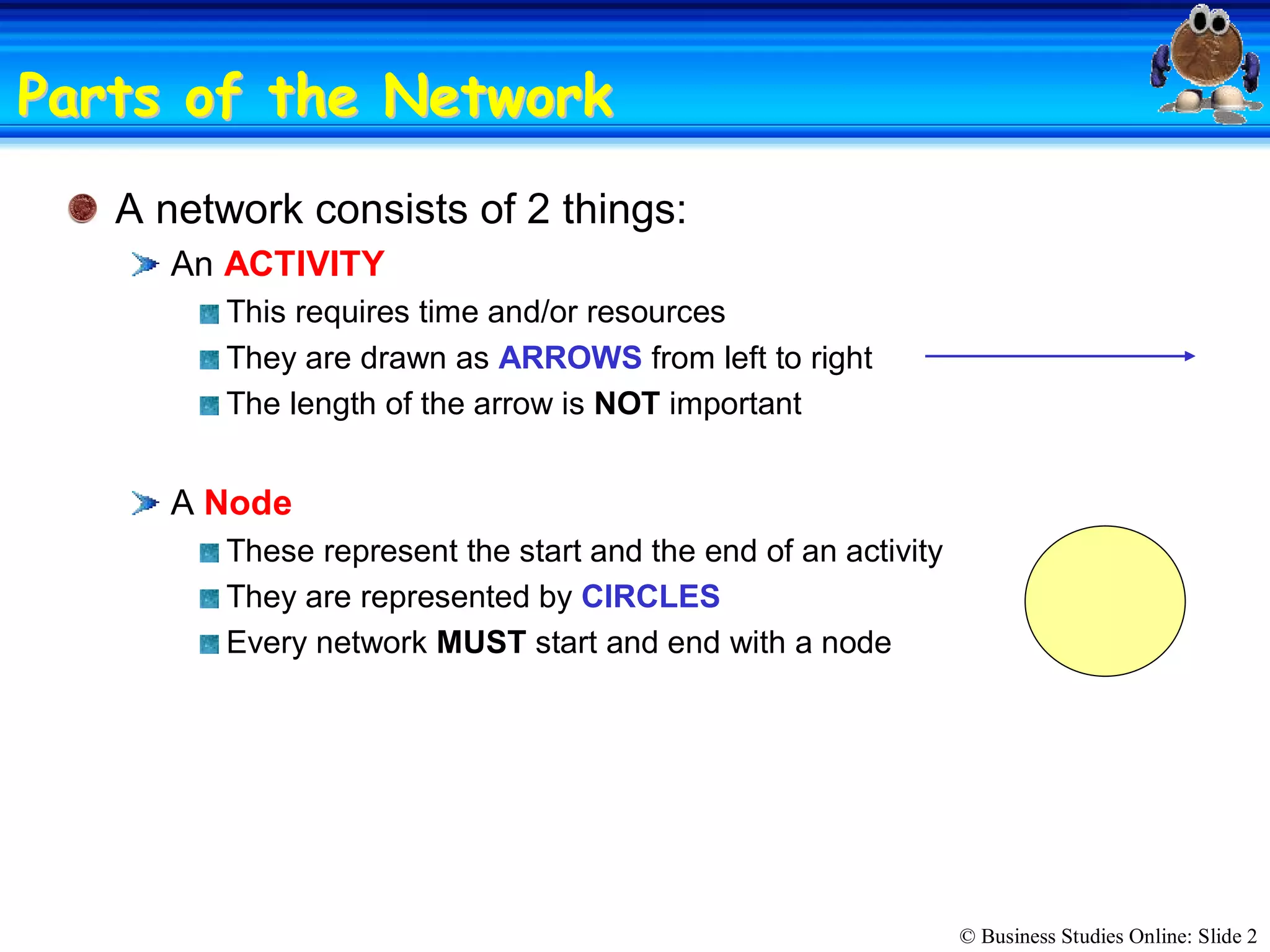
An ACTIVITY 
This requires time and/or resources 
They are drawn as ARROWS from left to right 
The length of the arrow is NOT important 
A Node 
These represent the start and the end of an activity 
They are represented by CIRCLES 
Every network MUST start and end with a node
© Business Studies Online: Slide 3 
A Simple Network DiagramA Simple Network Diagram 
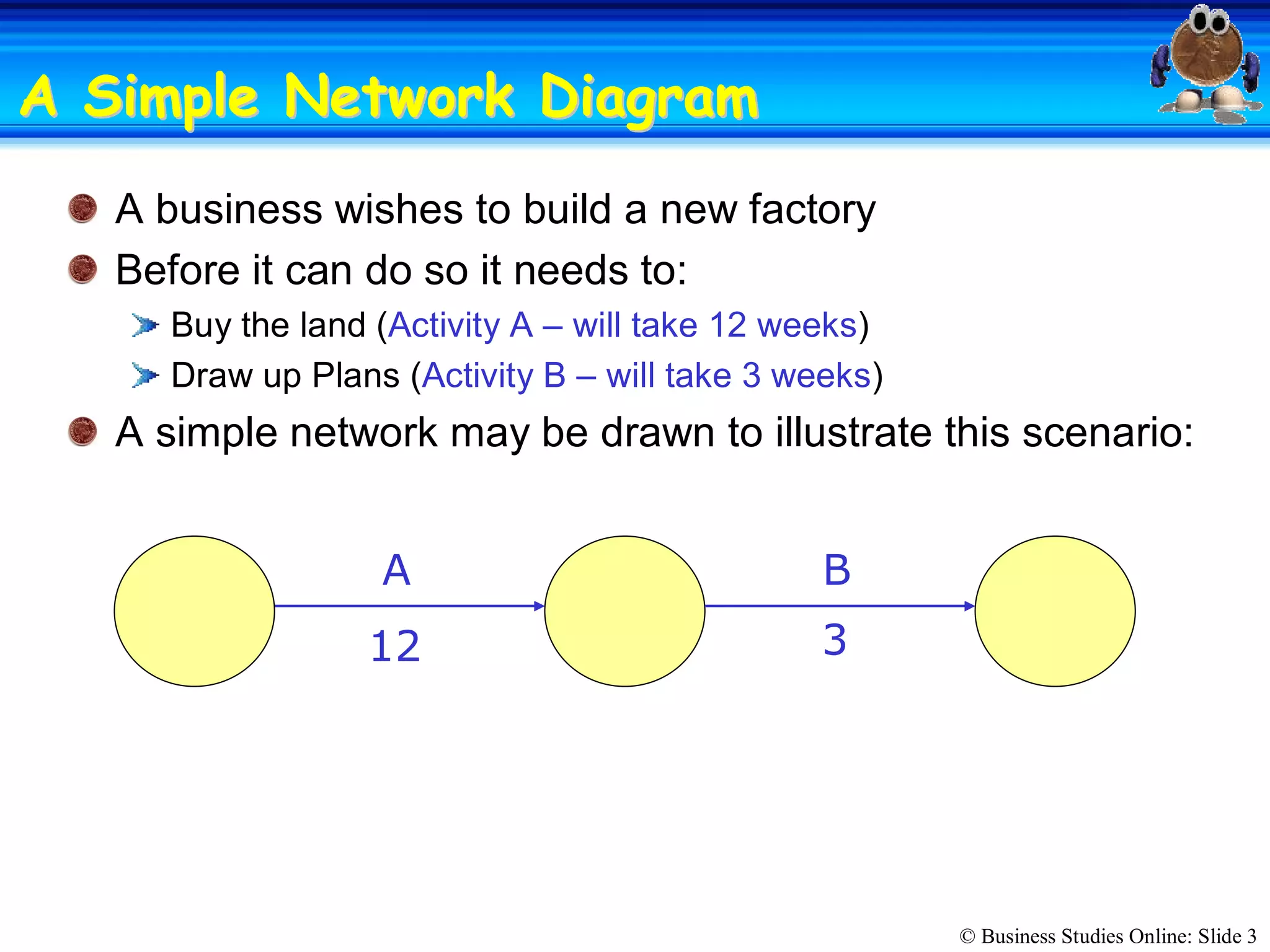
A business wishes to build a new factory 
Before it can do so it needs to: 
Buy the land (Activity A – will take 12 weeks) 
Draw up Plans (Activity B – will take 3 weeks) 
A simple network may be drawn to illustrate this scenario: 
A  B 
12  3
© Business Studies Online: Slide 4 
Illustrating Simultaneous ActivitiesIllustrating Simultaneous Activities 
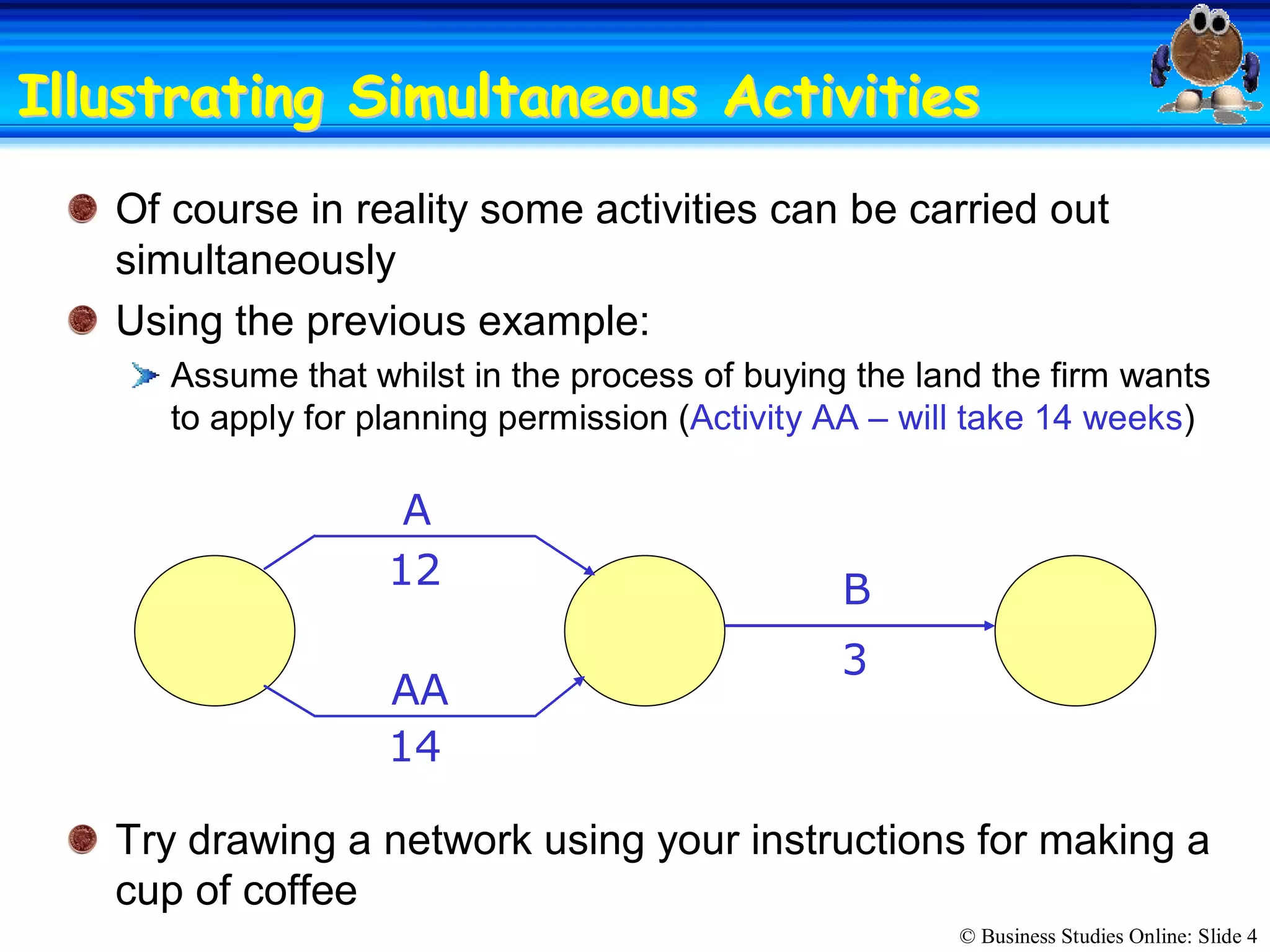
Of course in reality some activities can be carried out 
simultaneously 
Using the previous example: 
Assume that whilst in the process of buying the land the firm wants 
to apply for planning permission (Activity AA – will take 14 weeks) 
Try drawing a network using your instructions for making a 
cup of coffee 
A 
B 
AA 
12 
3 
14
© Business Studies Online: Slide 5 
Developing The NetworkDeveloping The Network 
There are a number of problems with our previous 
example: 
There is no way of identifying the nodes 
It doesn’t help us identify the crucial activities 
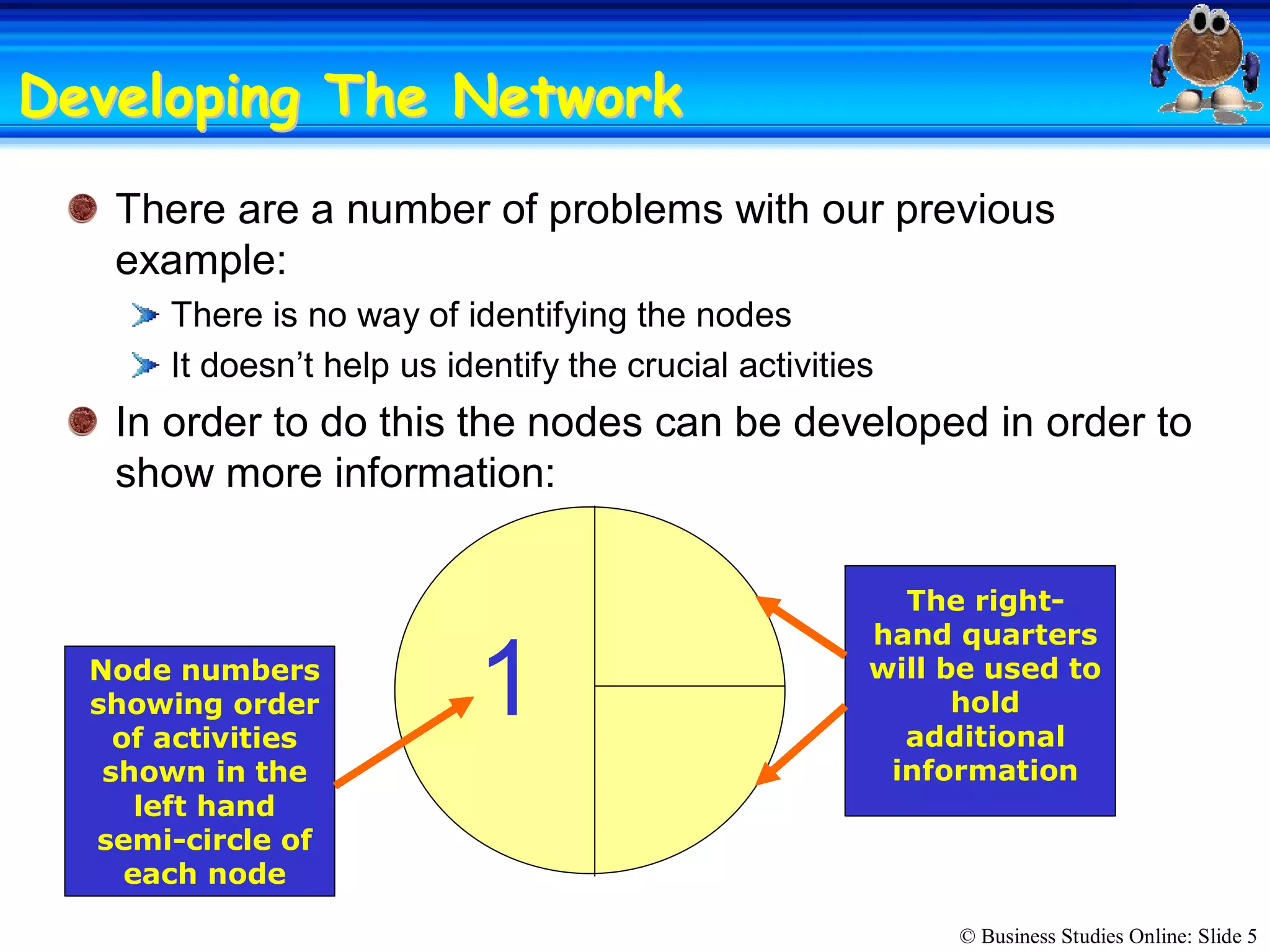
In order to do this the nodes can be developed in order to 
show more information: 
1 Node numbers 
showing order 
of activities 
shown in the 
left hand 
semi­circle of 
each node 
The right­ 
hand quarters 
will be used to 
hold 
additional 
information
© Business Studies Online: Slide 6 
Calculating The Earliest Start TimeCalculating The Earliest Start Time 
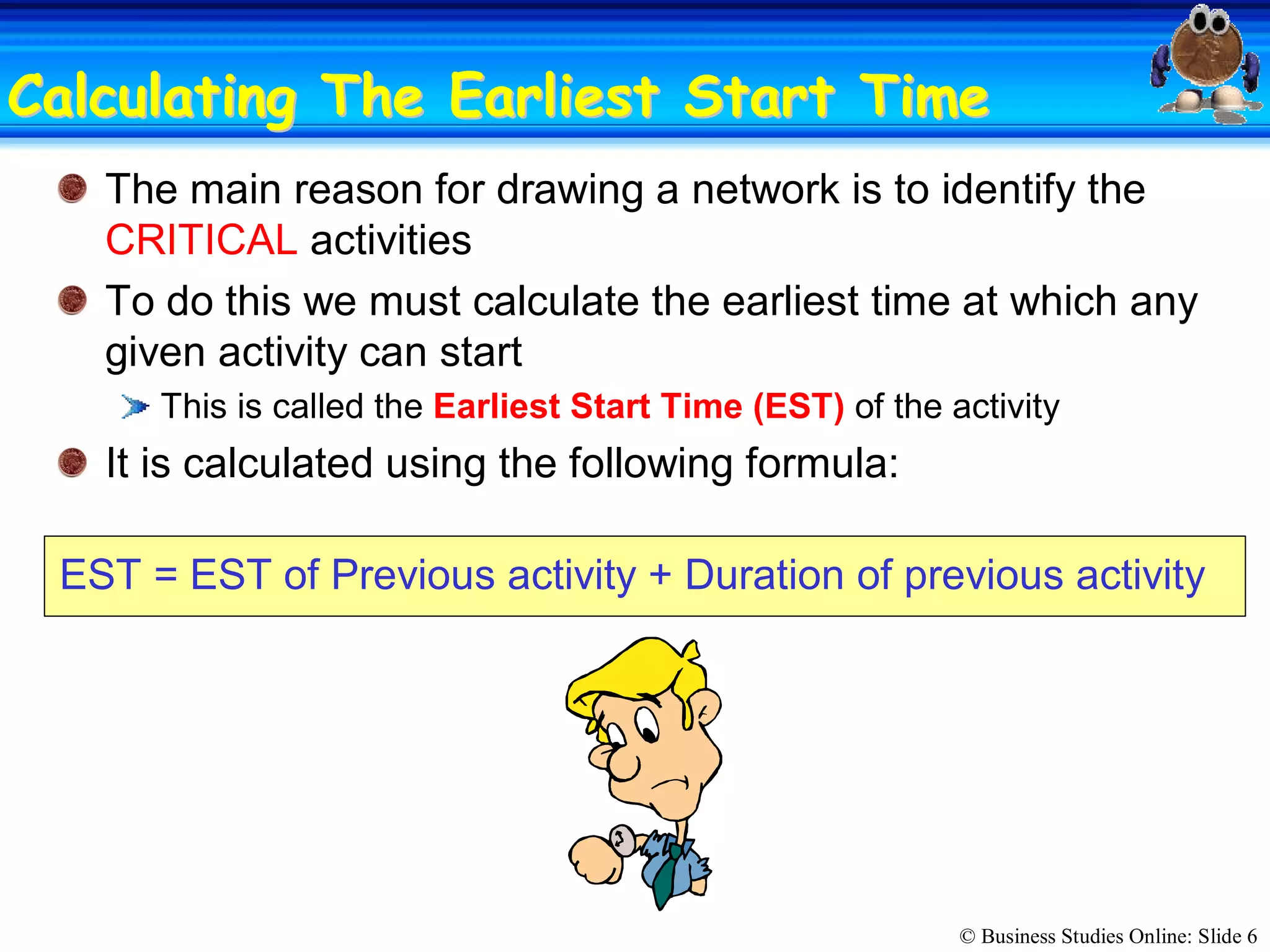
The main reason for drawing a network is to identify the 
CRITICAL activities 
To do this we must calculate the earliest time at which any 
given activity can start 
This is called the Earliest Start Time (EST) of the activity 
It is calculated using the following formula: 
EST = EST of Previous activity + Duration of previous activity
© Business Studies Online: Slide 7 
Calculating The Earliest Start TimeCalculating The Earliest Start Time 
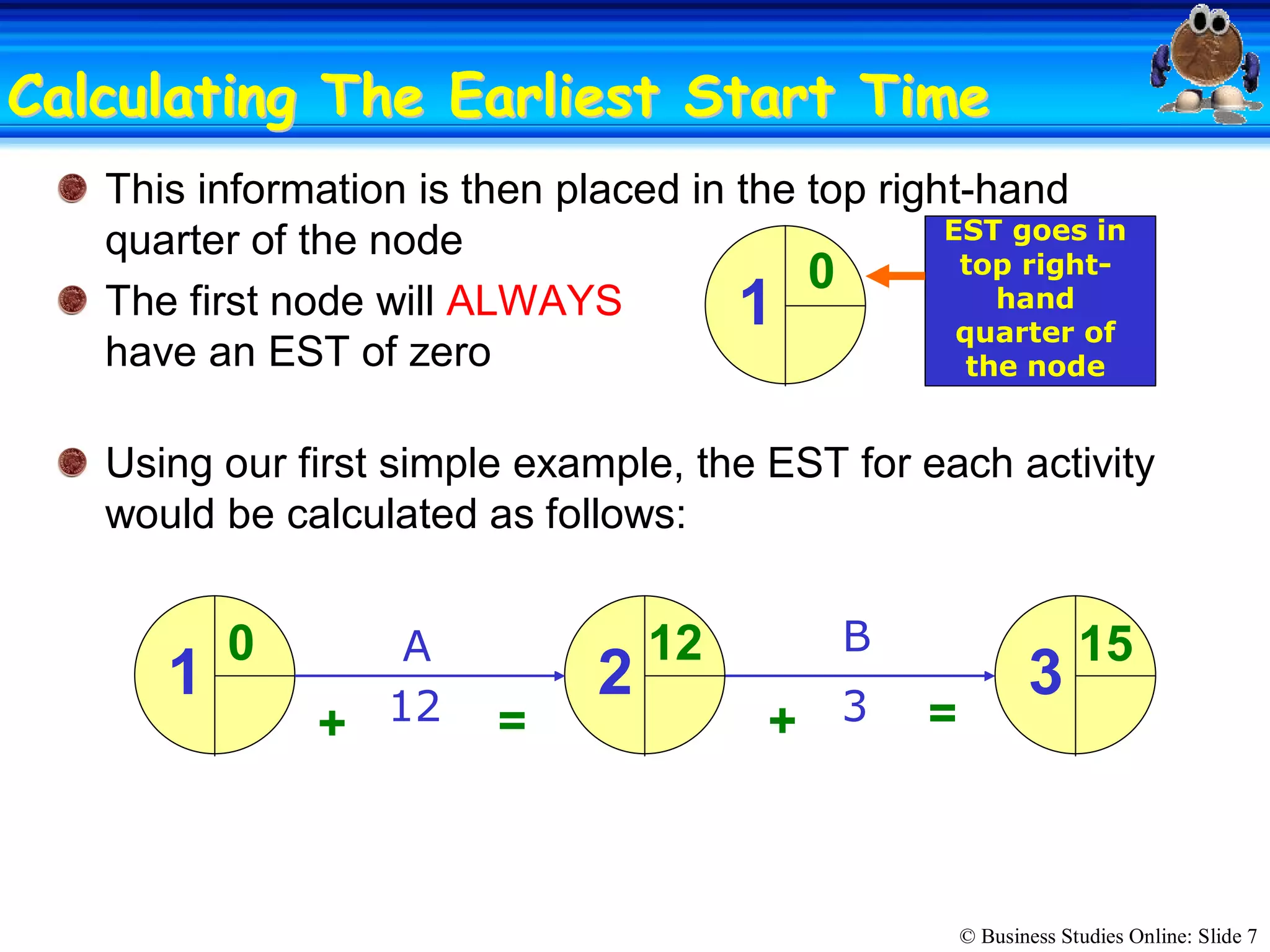
This information is then placed in the top right­hand 
quarter of the node 
The first node will ALWAYS 
have an EST of zero 
Using our first simple example, the EST for each activity 
would be calculated as follows: 
EST goes in 
top right­ 
hand 
quarter of 
the node 
1 
0 
A  B 
12  3 
1  2  3 
0  12  15 
+  =  +  =
© Business Studies Online: Slide 8 
The EST and Simultaneous ActivitiesThe EST and Simultaneous Activities 
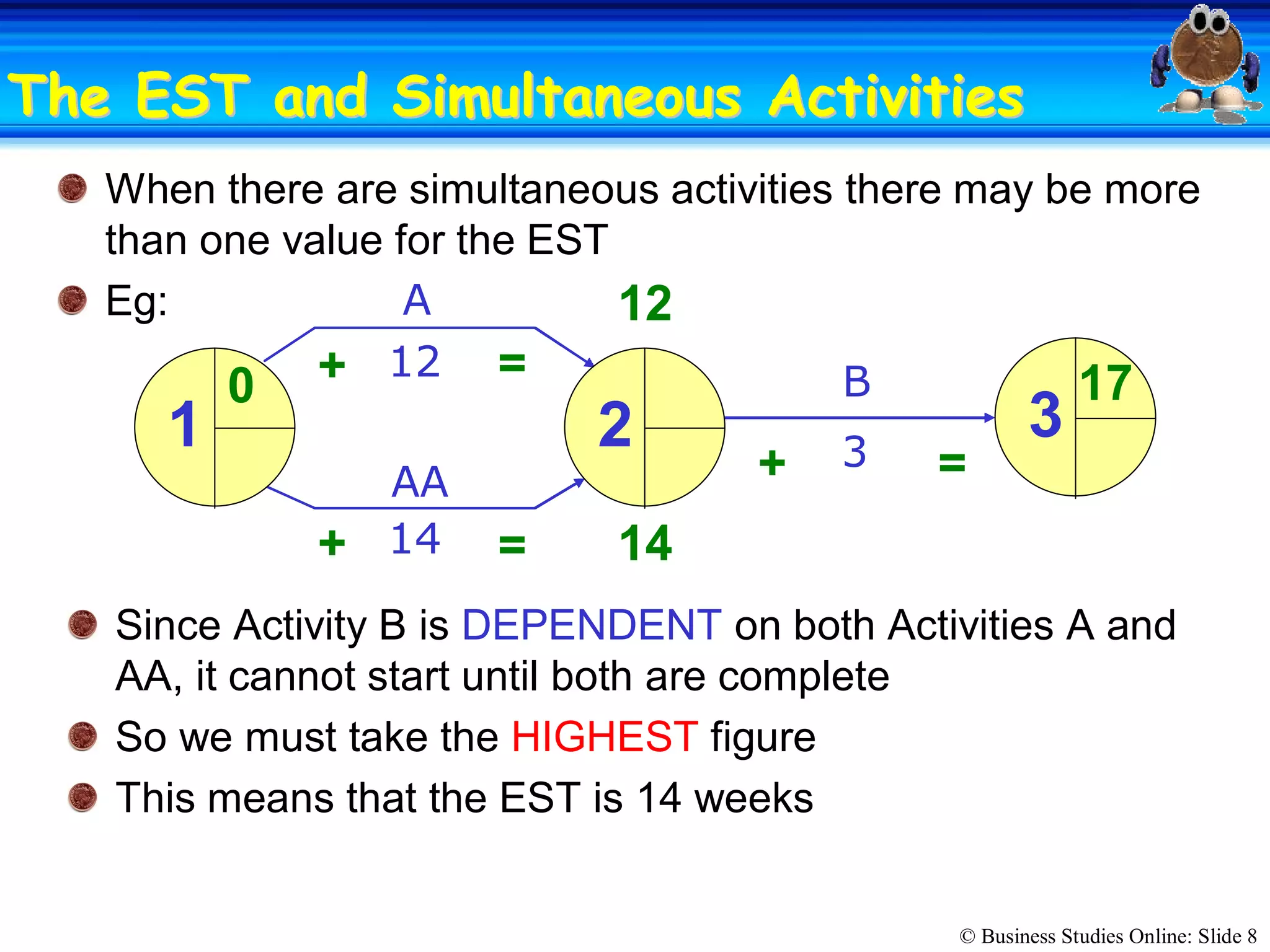
When there are simultaneous activities there may be more 
than one value for the EST 
Eg:  A 
B 
AA 
12 
3 
14 
1  2  3 
0  +  = 
= + 
12 
14 
Since Activity B is DEPENDENT on both Activities A and 
AA, it cannot start until both are complete 
So we must take the HIGHEST figure 
This means that the EST is 14 weeks 
+  = 
17
© Business Studies Online: Slide 9 
Recap of The Earliest Start TimeRecap of The Earliest Start Time 
The EST of the first activity is always zero 
Calculate the EST by working left to right across a network 
It is calculated using the following formula: 
EST = EST of Previous activity + Duration of previous activity 
When there are 2 simultaneous activities the HIGHEST 
figure is used as the EST
© Business Studies Online: Slide 10 
Calculating The Latest Finishing TimeCalculating The Latest Finishing Time 
There is one final piece of information needed to complete 
our network diagram 
To identify the CRITICAL activities we must also know the 
latest time at which any given activity must end 
This is called the Latest Finishing Time (LFT) of the activity 
It is calculated by working BACKWARDS across the 
network using the following formula: 
LFT = LFT at end of following activity ­ Duration of following activity
© Business Studies Online: Slide 11 
Calculating The Latest Finishing TimeCalculating The Latest Finishing Time 
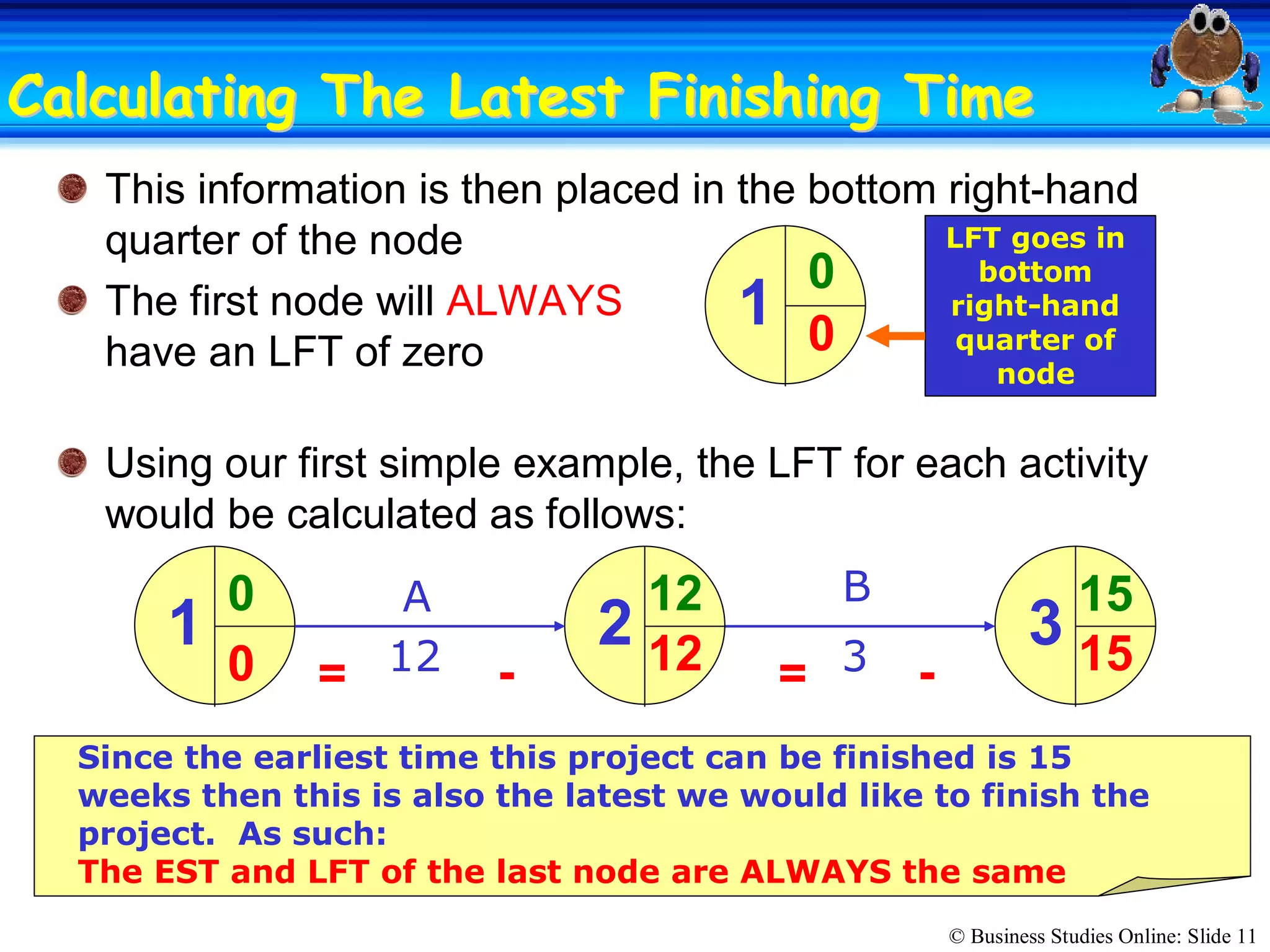
This information is then placed in the bottom right­hand 
quarter of the node 
The first node will ALWAYS 
have an LFT of zero 
Using our first simple example, the LFT for each activity 
would be calculated as follows: 
LFT goes in 
bottom 
right­hand 
quarter of 
node 
1 
0 
A  B 
12  3 
1  2  3 
0  12  15 
=  ­  ­ = 
0 
15 
15 
12 0 
Since the earliest time this project can be finished is 15 
weeks then this is also the latest we would like to finish the 
project.  As such: 
The EST and LFT of the last node are ALWAYS the same
© Business Studies Online: Slide 12 
The LFT and Simultaneous ActivitiesThe LFT and Simultaneous Activities 
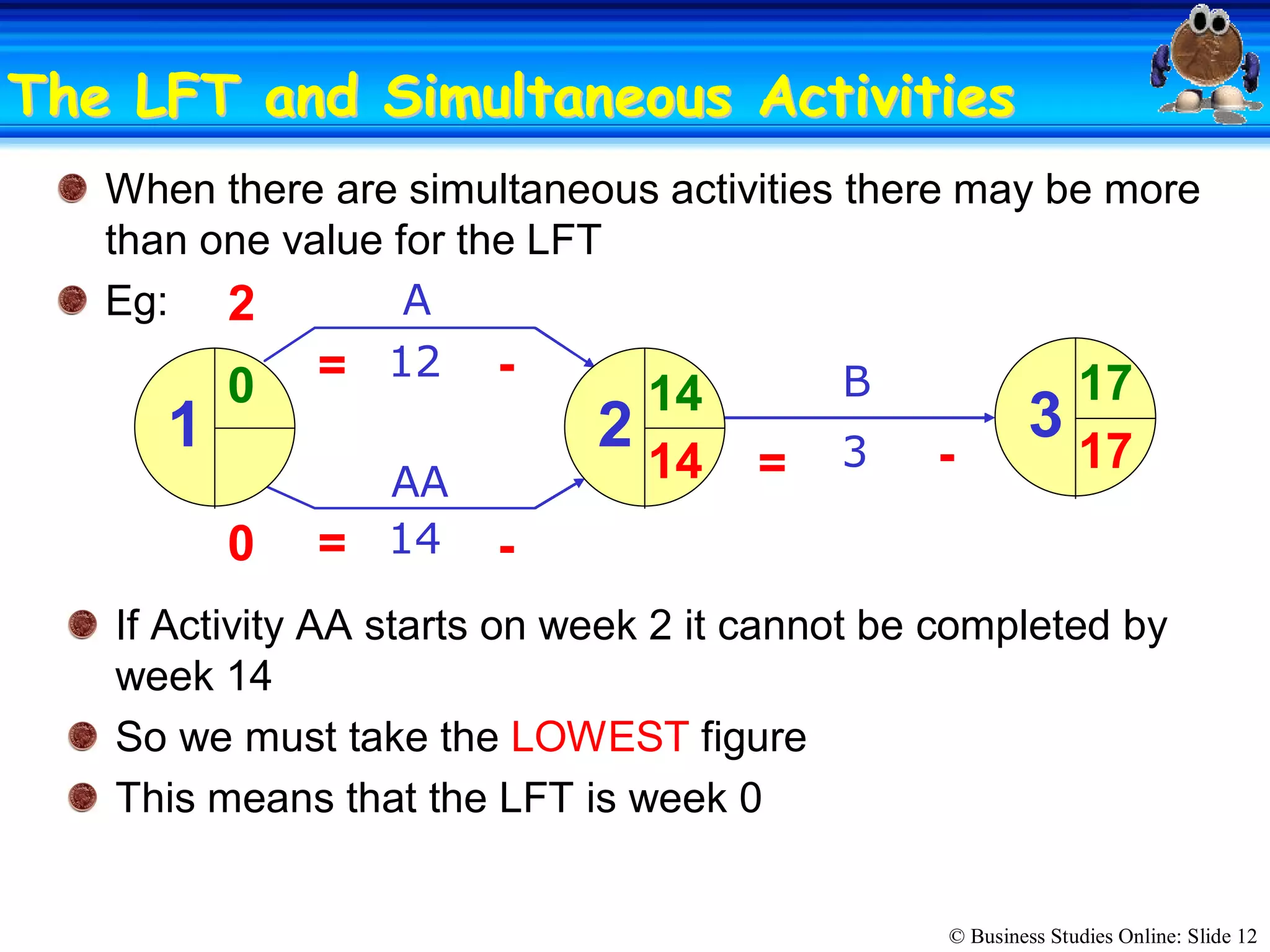
When there are simultaneous activities there may be more 
than one value for the LFT 
Eg:  A 
B 
AA 
12 
3 
14 
1  2  3 
0  =  ­ 
­ = 
14 
0 
If Activity AA starts on week 2 it cannot be completed by 
week 14 
So we must take the LOWEST figure 
This means that the LFT is week 0 
=  ­ 
17 
17 14 
2
© Business Studies Online: Slide 13 
Recap of The Latest Finishing TimeRecap of The Latest Finishing Time 
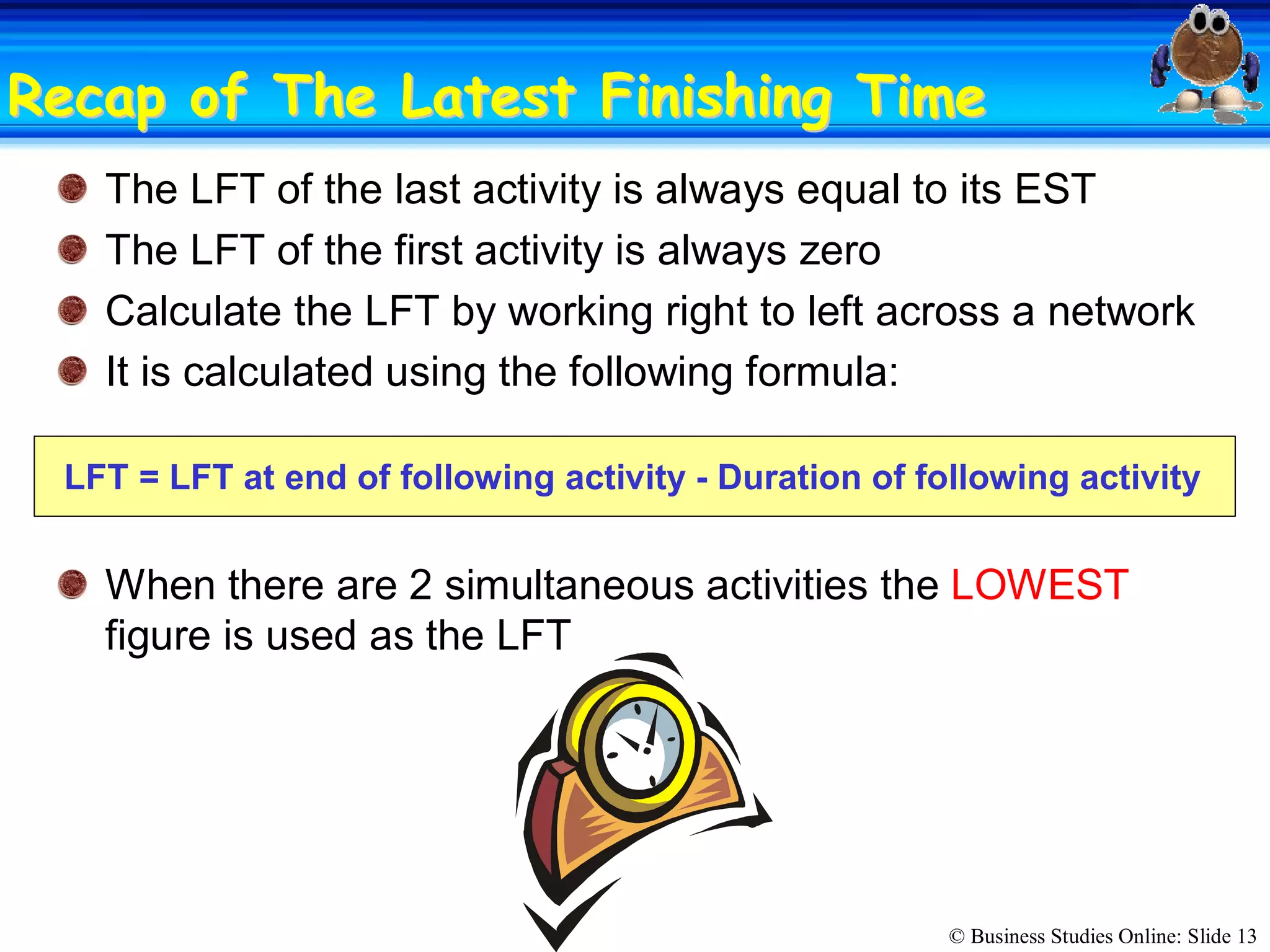
The LFT of the last activity is always equal to its EST 
The LFT of the first activity is always zero 
Calculate the LFT by working right to left across a network 
It is calculated using the following formula: 
LFT = LFT at end of following activity ­ Duration of following activity 
When there are 2 simultaneous activities the LOWEST 
figure is used as the LFT
© Business Studies Online: Slide 14 
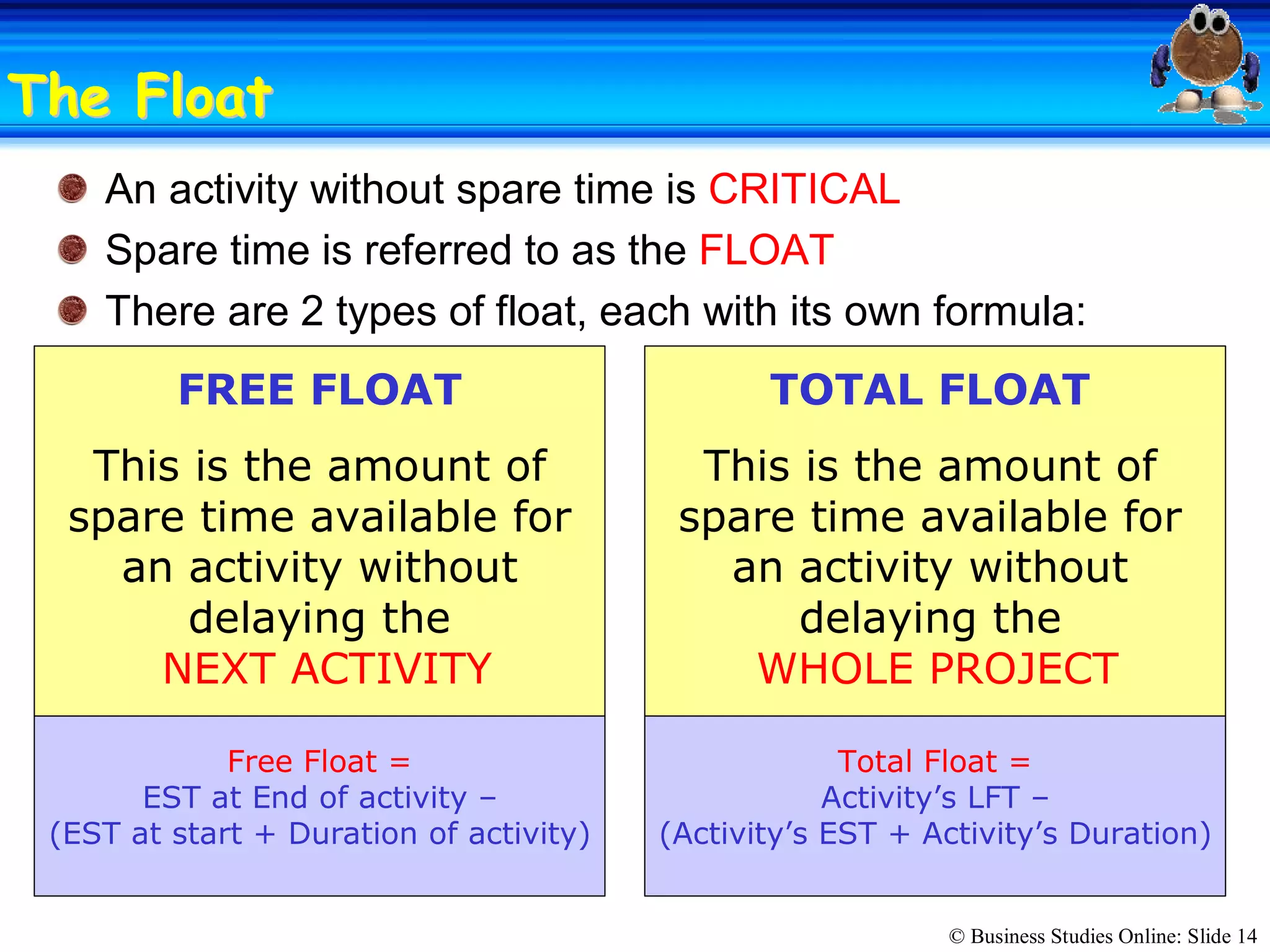
The FloatThe Float 
An activity without spare time is CRITICAL 
Spare time is referred to as the FLOAT 
There are 2 types of float, each with its own formula: 
FREE FLOAT 
This is the amount of 
spare time available for 
an activity without 
delaying the 
NEXT ACTIVITY 
TOTAL FLOAT 
This is the amount of 
spare time available for 
an activity without 
delaying the 
WHOLE PROJECT 
Free Float = 
EST at End of activity – 
(EST at start + Duration of activity) 
Total Float = 
Activity’s LFT – 
(Activity’s EST + Activity’s Duration)
© Business Studies Online: Slide 15 
Calculating The FloatCalculating The Float 
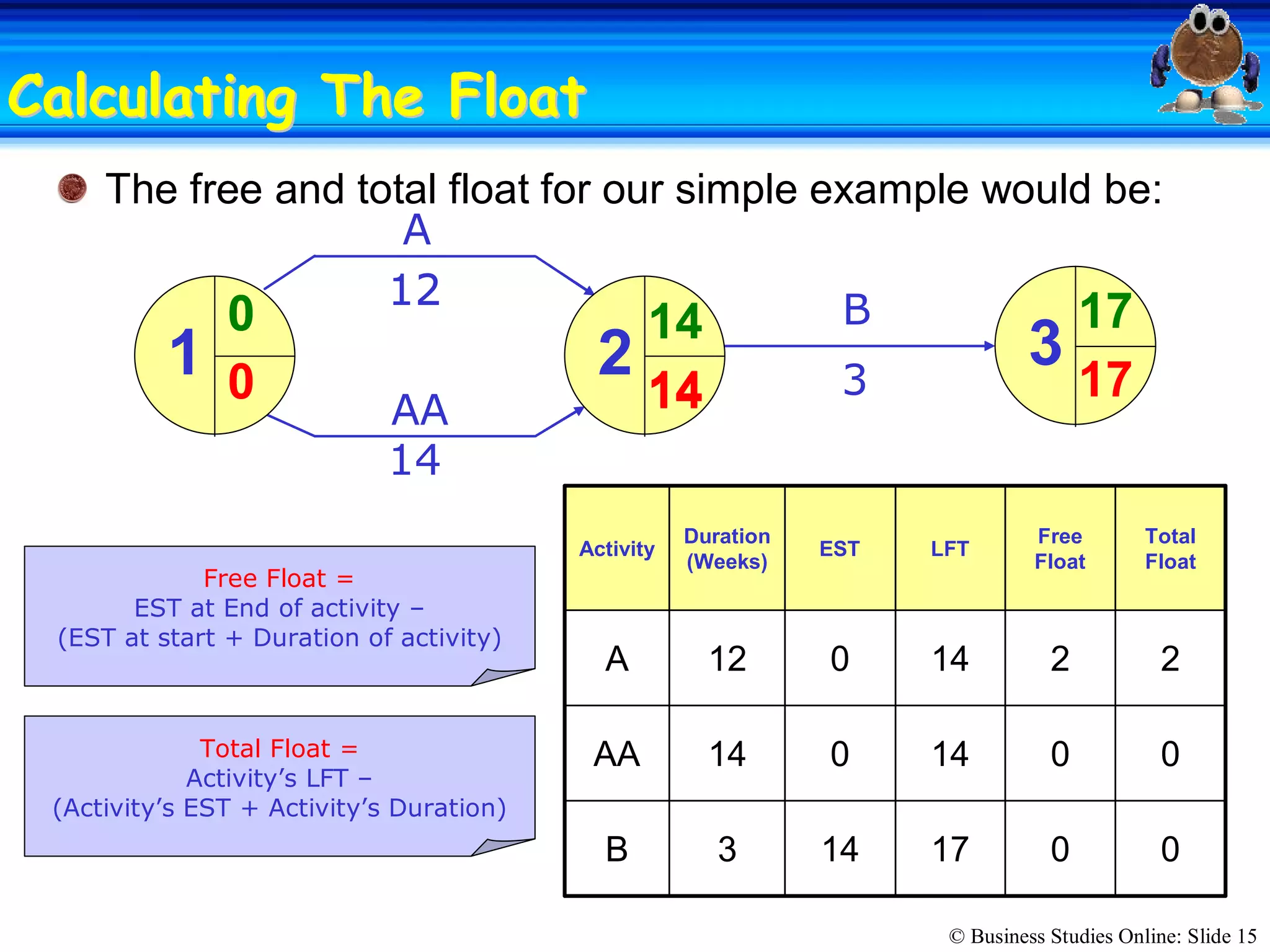
The free and total float for our simple example would be: 
A 
B 
AA 
12 
3 
14 
1  2  3 
0  14 
0 
17 
17 14 
0 0 17 14 3 B 
0 0 14 0 14 AA 
2 2 14 0 12 A 
Total 
Float 
Free 
Float 
LFT EST 
Duration 
(Weeks) 
Activity 
Total Float = 
Activity’s LFT – 
(Activity’s EST + Activity’s Duration) 
0 
12 
14 
Free Float = 
EST at End of activity – 
(EST at start + Duration of activity)
© Business Studies Online: Slide 16 
What Does This Mean?What Does This Mean? 
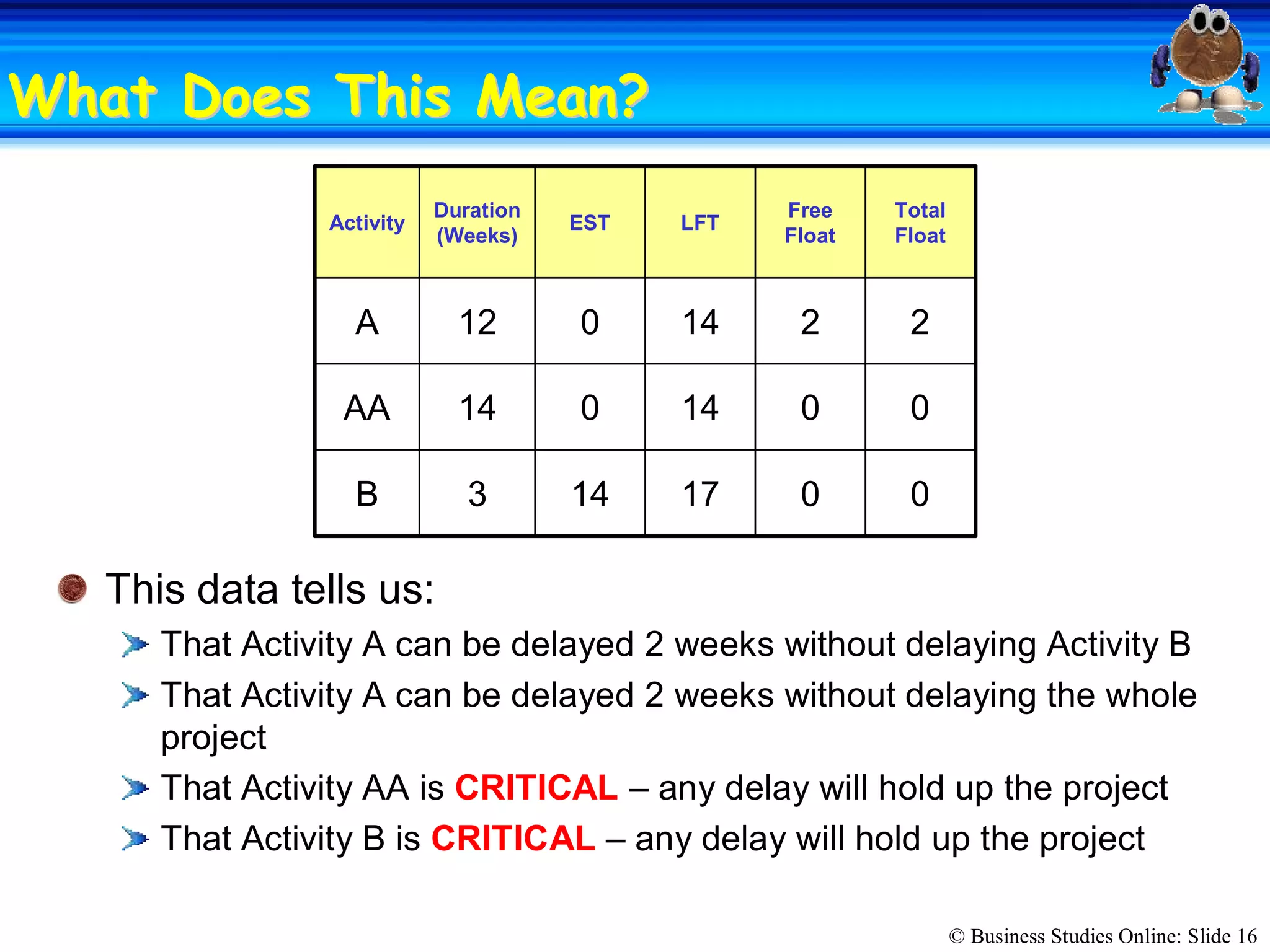
This data tells us: 
That Activity A can be delayed 2 weeks without delaying Activity B 
That Activity A can be delayed 2 weeks without delaying the whole 
project 
That Activity AA is CRITICAL – any delay will hold up the project 
That Activity B is CRITICAL – any delay will hold up the project 
0 0 17 14 3 B 
0 0 14 0 14 AA 
2 2 14 0 12 A 
Total 
Float 
Free 
Float 
LFT EST 
Duration 
(Weeks) 
Activity
© Business Studies Online: Slide 17 
Identifying The Critical PathIdentifying The Critical Path 
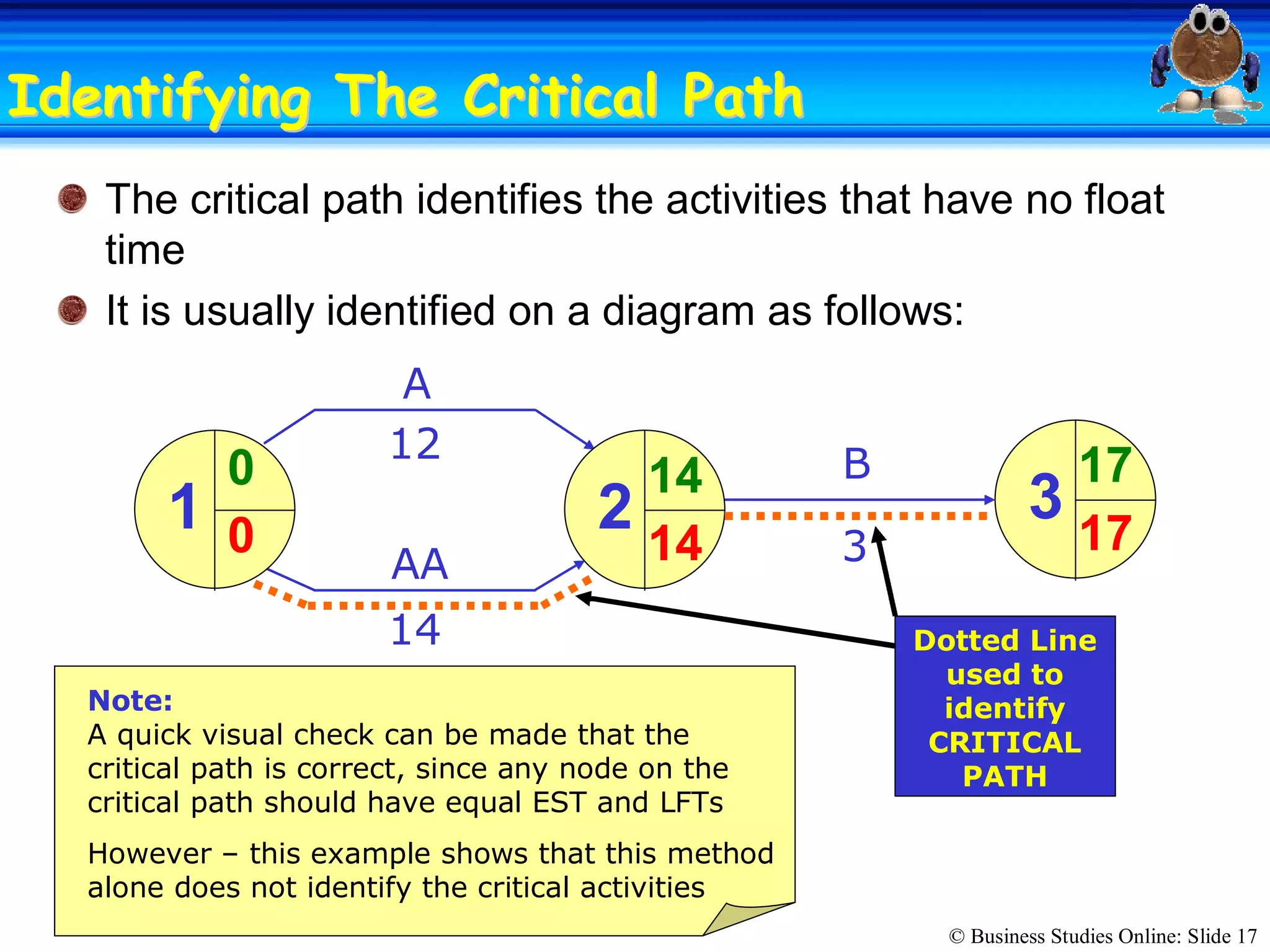
The critical path identifies the activities that have no float 
time 
It is usually identified on a diagram as follows: 
A 
B 
AA 
12 
3 
1  2  3 
0  14 
0 
17 
17 14 
14  Dotted Line 
used to 
identify 
CRITICAL 
PATH 
Note: 
A quick visual check can be made that the 
critical path is correct, since any node on the 
critical path should have equal EST and LFTs 
However – this example shows that this method 
alone does not identify the critical activities
© Business Studies Online: Slide 18 
QuestionQuestion 
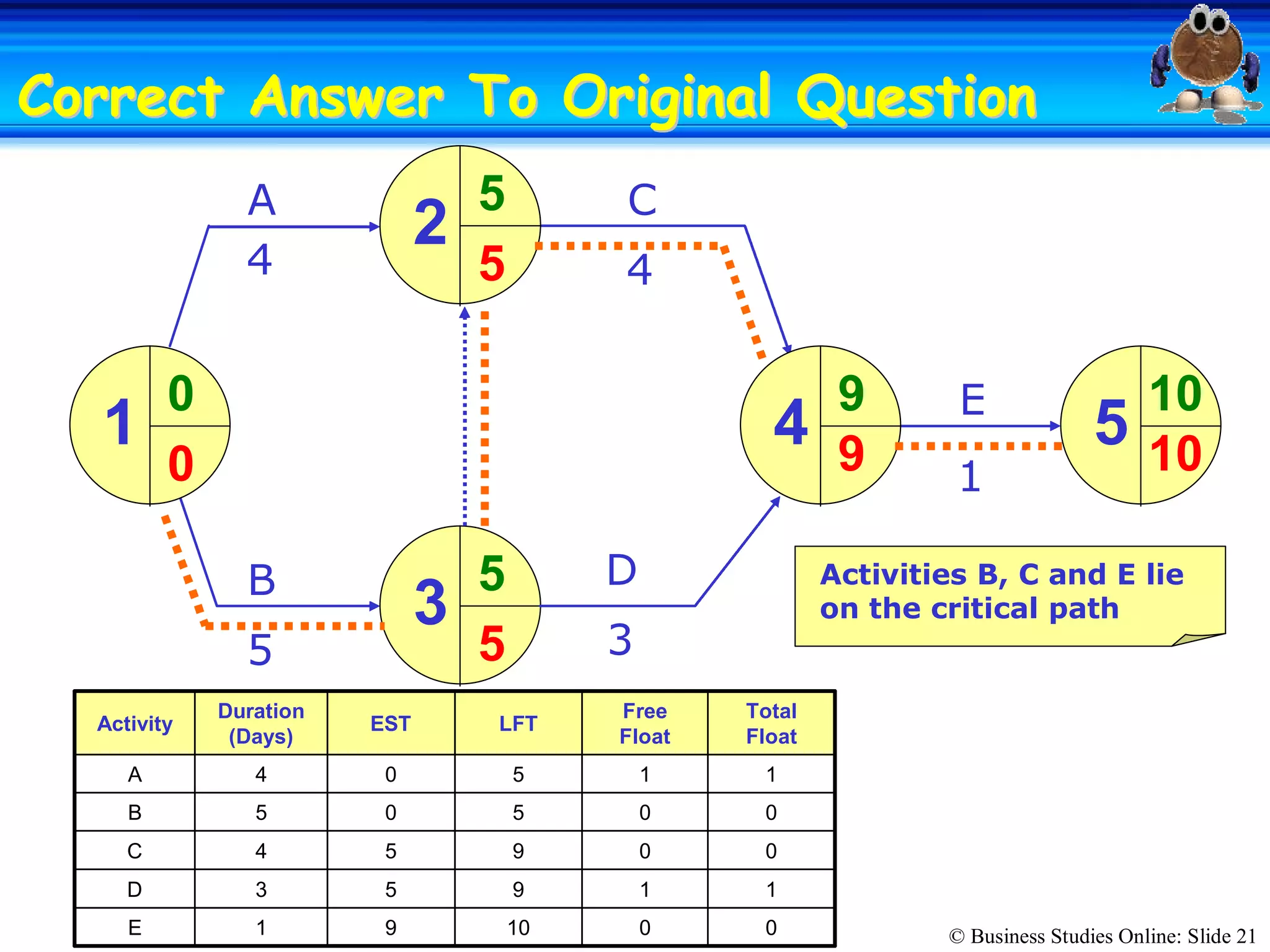
Create and complete a network diagram to represent the 
following project: 
Activities A (4 days) and B (5 days) can start simultaneously 
Activitiy C (4 days) can begin once activities A and B are complete 
Activity D (3 days) can begin once activity B is complete 
Activity E (1 day) ends the project and can begin once activities C 
and D are complete
© Business Studies Online: Slide 19 
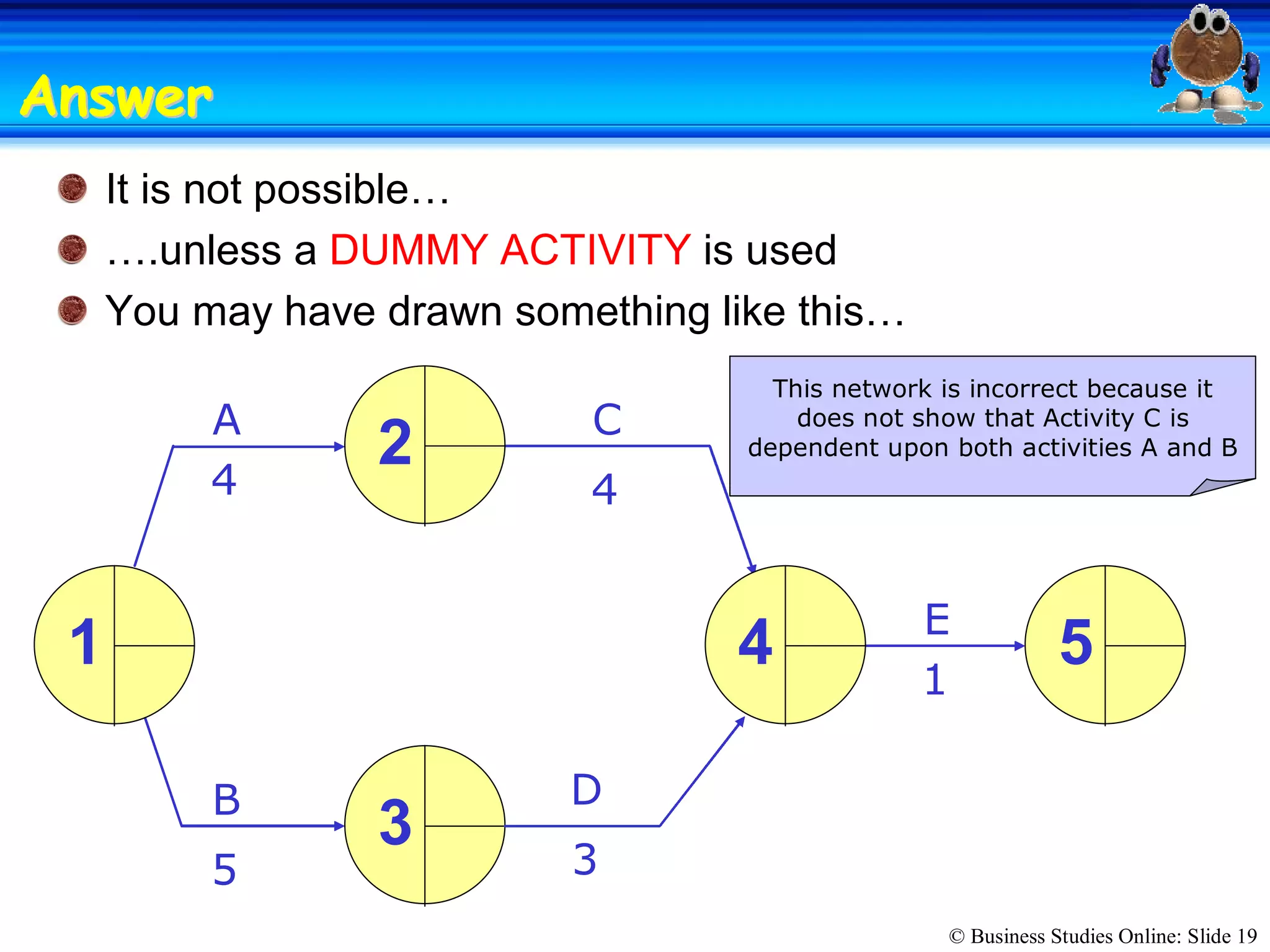
It is not possible… 
….unless a DUMMY ACTIVITY is used 
You may have drawn something like this… 
AnswerAnswer 
A 
D 
4 
3 
B 
C 
E 
5 
1 
1 
2 
3 
5 
4 
4 
This network is incorrect because it 
does not show that Activity C is 
dependent upon both activities A and B
© Business Studies Online: Slide 20 
Dummy ActivitiesDummy Activities 
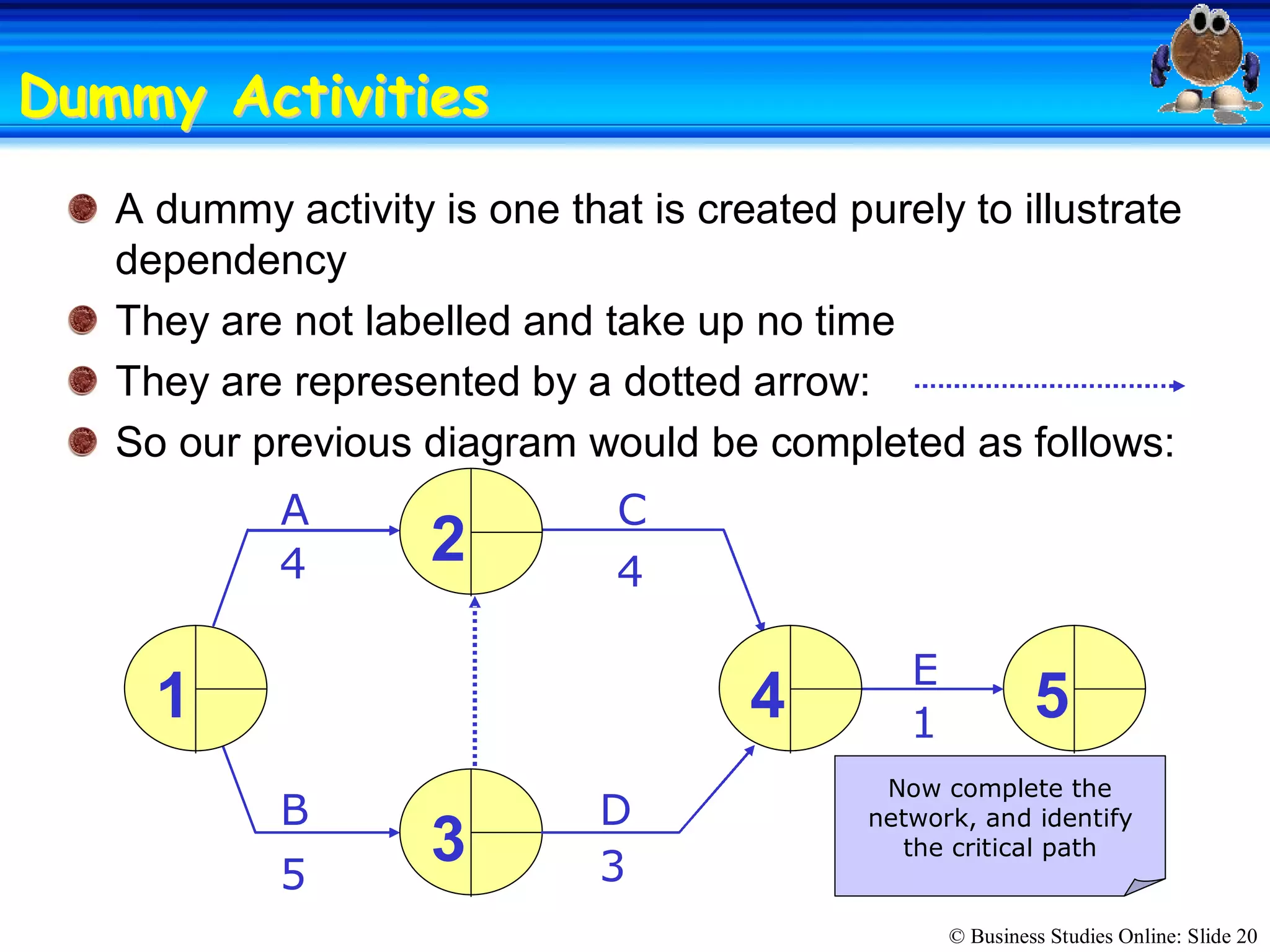
A dummy activity is one that is created purely to illustrate 
dependency 
They are not labelled and take up no time 
They are represented by a dotted arrow: 
So our previous diagram would be completed as follows: 
A 
D 
4 
3 
B 
C 
E 
5 
1 1 
2 
3 
5 
4 
4 
Now complete the 
network, and identify 
the critical path
© Business Studies Online: Slide 21 
Correct Answer To Original QuestionCorrect Answer To Original Question 
A 
D 
4 
3 
B 
C 
E 
5 
1 
1 
2 
3 
5 
4 
4 
0 
5 
5 
9  10 
10 9 
5 
5 
0 
0 0 10 9 1 E 
1 1 9 5 3 D 
0 0 9 5 4 C 
0 0 5 0 5 B 
1 1 5 0 4 A 
Total 
Float 
Free 
Float 
LFT EST 
Duration 
(Days) 
Activity 
Activities B, C and E lie 
on the critical path
© Business Studies Online: Slide 22 
Advantages of Using CPAAdvantages of Using CPA 
It requires careful planning 
so projects should run smoothly 
Improves efficiency and cash flow 
Materials can be ordered to arrive only as they are needed 
If problems occur the implications can be identified quickly 
This means informed decisions can be made
© Business Studies Online: Slide 23 
Disadvantages of CPADisadvantages of CPA 
Diagrams can become unmanageable 
Although software is available to help produce networks 
Plan will only work if relevant staff have been consulted 
E.g. timescales need to be realistic 
Gantt charts tend to be preferred since they visually show 
the time­span of activities

05 critical path analysis