Unit 3 Activity Planning 9
Dr. Pallawi Bulakh
Contents
• 3.1. Objectives
3.2. Project Schedule
3.3. Sequencing and Scheduling Activities
3.4. Network Planning Models
3.4.1. Forward Pass
3.4.2. Backward Pass
3.5. Activity Float
3.6. Shortening Project Duration
3.7. Activity on Arrow Networks
What is an Activity in Project Management?
• In project management, an "activity" is simply a specific task or job that needs to be done for a
project.
• These activities are important because they help break down the project into smaller, manageable
parts, making it easier to plan and organize.
• Each activity has its own start and end dates, and it needs certain resources and people to get done.
• By identifying and defining activities, project managers can create a clear plan for the project, assign
resources effectively, and keep track of progress.
• Activities are the building blocks of the project schedule, ensuring that everything gets done on time
and within budget.
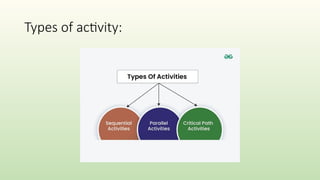
Types of activity:
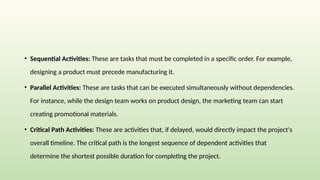
• Sequential Activities: These are tasks that must be completed in a specific order. For example,
designing a product must precede manufacturing it.
• Parallel Activities: These are tasks that can be executed simultaneously without dependencies.
For instance, while the design team works on product design, the marketing team can start
creating promotional materials.
• Critical Path Activities: These are activities that, if delayed, would directly impact the project's
overall timeline. The critical path is the longest sequence of dependent activities that
determine the shortest possible duration for completing the project.
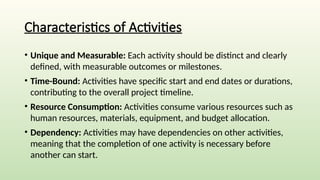
Characteristics of Activities
• Unique and Measurable: Each activity should be distinct and clearly
defined, with measurable outcomes or milestones.
• Time-Bound: Activities have specific start and end dates or durations,
contributing to the overall project timeline.
• Resource Consumption: Activities consume various resources such as
human resources, materials, equipment, and budget allocation.
• Dependency: Activities may have dependencies on other activities,
meaning that the completion of one activity is necessary before
another can start.
Types of Activity Relationships
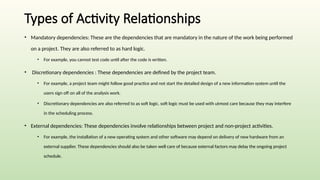
• Mandatory dependencies: These are the dependencies that are mandatory in the nature of the work being performed
on a project. They are also referred to as hard logic.
• For example, you cannot test code until after the code is written.
• Discretionary dependencies : These dependencies are defined by the project team.
• For example, a project team might follow good practice and not start the detailed design of a new information system until the
users sign off on all of the analysis work.
• Discretionary dependencies are also referred to as soft logic. soft logic must be used with utmost care because they may interfere
in the scheduling process.
• External dependencies: These dependencies involve relationships between project and non-project activities.
• For example, the installation of a new operating system and other software may depend on delivery of new hardware from an
external supplier. These dependencies should also be taken well care of because external factors may delay the ongoing project
schedule.
Types of relationships
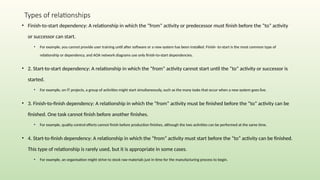
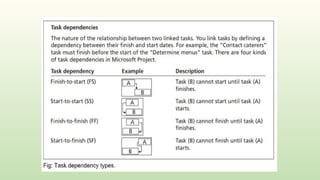
• Finish-to-start dependency: A relationship in which the “from” activity or predecessor must finish before the “to” activity
or successor can start.
• For example, you cannot provide user training until after software or a new system has been installed. Finish- to-start is the most common type of
relationship or dependency, and AOA network diagrams use only finish-to-start dependencies.
• 2. Start-to-start dependency: A relationship in which the “from” activity cannot start until the “to” activity or successor is
started.
• For example, on IT projects, a group of activities might start simultaneously, such as the many tasks that occur when a new system goes live.
• 3. Finish-to-finish dependency: A relationship in which the “from” activity must be finished before the “to” activity can be
finished. One task cannot finish before another finishes.
• For example, quality control efforts cannot finish before production finishes, although the two activities can be performed at the same time.
• 4. Start-to-finish dependency: A relationship in which the “from” activity must start before the “to” activity can be finished.
This type of relationship is rarely used, but it is appropriate in some cases.
• For example, an organisation might strive to stock raw materials just in time for the manufacturing process to begin.
Introduction to Activity Planning Objectives
• Definition: Activity planning involves breaking down the project into
manageable tasks and scheduling them effectively.
• Ensures efficient resource utilization.
• Helps identify dependencies and potential risks.
• Aligns project activities with deadlines and goals.
What is Activity Planning?
• Definition:
Activity planning is the process of identifying, organizing, and
scheduling tasks to ensure the successful execution of a software
project.
• Purpose:
• Establish a roadmap for completing the project.
• Ensure efficient use of resources.
• Set realistic timelines and milestones.
Why Activity Planning Matters?
• Activity planning is crucial for translating project goals into actionable tasks.
• Objectives ensure the project progresses efficiently and meets deadlines.
• It forms the backbone of project execution and control.
Core Objectives of Activity Planning
• Define Project Activities: Break down the project into smaller, manageable tasks.
• Establish Task Dependencies: Identify relationships and sequencing of tasks.
• Optimize Resource Allocation: Ensure resources are effectively distributed to
avoid under/overutilization.
• Set Realistic Timelines: Determine achievable deadlines for all activities.
• Facilitate Risk Management: Anticipate and plan for potential obstacles or delays.
Benefits of Meeting Planning Objectives
• Improved Coordination: Enhances communication and collaboration among
team members.
• Increased Efficiency: Reduces wasted time and resources through structured
execution.
• Reduced Risks: Identifies and mitigates potential delays or issues early.
• Goal Alignment: Ensures all activities contribute to the overarching project
goals.
• On-Time Delivery: Achieves timely project completion with minimal
disruption.
Steps in Activity Planning
• Define Activities:
• Break the project into smaller, manageable tasks.
• Use Work Breakdown Structure (WBS) for clarity.
• Sequence Activities:
• Identify task dependencies (e.g., finish-to-start, start-to-start).
• Create a precedence diagram.
• Estimate Resources:
• Allocate resources such as personnel, tools, and equipment.
• Estimate Time:
• Use techniques like expert judgment, historical data, or three-point estimation.
• Develop the Schedule:
• Create a timeline using Gantt charts, PERT (Program Evaluation and Review Technique), or CPM
(Critical Path Method).
Activity Relationships
• A dependency or relationship in project activities defines the
sequencing of project activities or tasks.
• for example there are some activities which needs to be performed
before some other activities.
• Or there are some activities which depends upon the external
resources and so on.
• A project manager must determine these relationships or
dependencies for managing the project schedule.
• There are three basic reasons for dependencies among project
activities:
Project schedule
• A project schedule in SPM is a detailed plan that outlines when
project tasks will be completed, who will complete them, and the
sequence in which they will occur.
• It serves as a roadmap for the project team to manage time
effectively and ensures that the project progresses in a structured
manner.
Key Components of a Project Schedule:
• Tasks/Activities:
• All tasks required to complete the project are listed and defined.
• Timeline:
• Start and end dates for each task are specified.
• Dependencies:
• Logical relationships between tasks (e.g., Task B cannot start until Task A is completed).
• Resources:
• Allocation of resources (team members, tools, etc.) to specific tasks.
• Milestones:
• Key points or achievements within the project timeline that indicate progress.
• Critical Path:
• The sequence of dependent tasks that determines the shortest possible project duration.
Tools for Project Scheduling:
• Gantt Charts:
Visual representation of the schedule, showing tasks, durations, and dependencies.
• PERT (Program Evaluation and Review Technique):
Used for analyzing and estimating project timelines.
• Critical Path Method (CPM):
Identifies critical tasks and helps in optimizing project completion time.
• Software Tools:
Microsoft Project, Jira, Trello, Monday.com, etc.
• Throughout a project, we will require a schedule that clearly indicates
when each of the project’s activities is planned to occur and what
resources it will need.
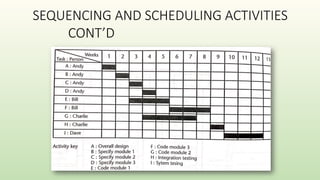
• One way of presenting such a plan is to use a bar chart as shown in
the next slide.
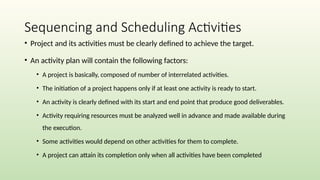
Sequencing and Scheduling Activities
• Project and its activities must be clearly defined to achieve the target.
• An activity plan will contain the following factors:
• A project is basically, composed of number of interrelated activities.
• The initiation of a project happens only if at least one activity is ready to start.
• An activity is clearly defined with its start and end point that produce good deliverables.
• Activity requiring resources must be analyzed well in advance and made available during
the execution.
• Some activities would depend on other activities for them to complete.
• A project can attain its completion only when all activities have been completed
SEQUENCING AND SCHEDULING ACTIVITIES
CONT’D
SEQUENCING AND SCHEDULING ACTIVITIE
CONT’D
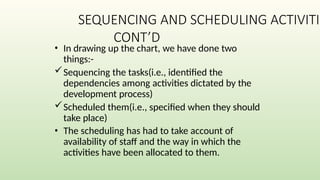
• In drawing up the chart, we have done two
things:-
Sequencing the tasks(i.e., identified the
dependencies among activities dictated by the
development process)
Scheduled them(i.e., specified when they should
take place)
• The scheduling has had to take account of
availability of staff and the way in which the
activities have been allocated to them.
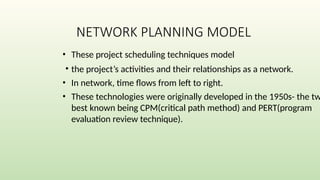
NETWORK PLANNING MODEL
• These project scheduling techniques model
• the project’s activities and their relationships as a network.
• In network, time flows from left to right.
• These technologies were originally developed in the 1950s- the tw
best known being CPM(critical path method) and PERT(program
evaluation review technique).
NETWORK PLANNING MODEL CONT’d
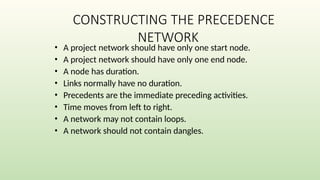
• Both of these techniques used an activity-on-
arrow approach to visualizing the project as a
network where activities are drawn as arrows
joining circles or nodes, which represent the
possible start and/or completion of an activity or
set of activities.
• Now, precedence networks has become popular
which use activity-on-node networks where
activities are represented as nodes and the links
between nodes represents precedence (or
sequencing) requirements.
CONSTRUCTING THE PRECEDENCE
NETWORK
• A project network should have only one start node.
• A project network should have only one end node.
• A node has duration.
• Links normally have no duration.
• Precedents are the immediate preceding activities.
• Time moves from left to right.
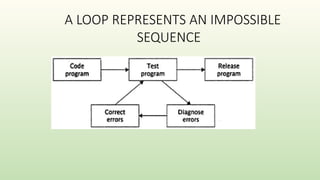
• A network may not contain loops.
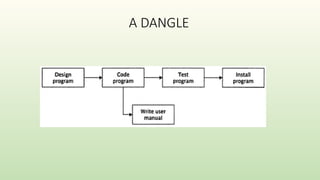
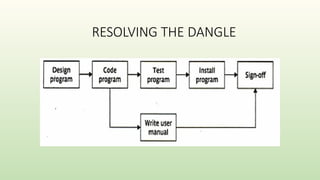
• A network should not contain dangles.
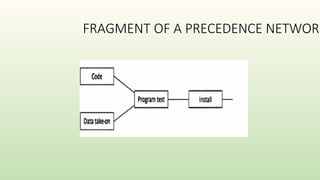
FRAGMENT OF A PRECEDENCE NETWORK
A LOOP REPRESENTS AN IMPOSSIBLE
SEQUENCE
A DANGLE
RESOLVING THE DANGLE
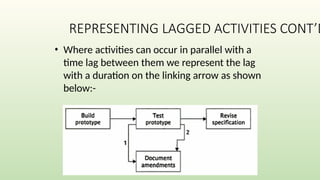
REPRESENTING LAGGED ACTIVITIES
• We might come across situation where we
wished to undertake two activities in parallel
so long as there is a lag between the two.
• We might wish to document amendments to a
program as it was being tested- particularly if
evaluating a prototype.
• In such a case we could designate an activity
‘test and document amendments’.
REPRESENTING LAGGED ACTIVITIES CONT’D
• Where activities can occur in parallel with a
time lag between them we represent the lag
with a duration on the linking arrow as shown
below:-
ADDING TIME DIMENSIONS
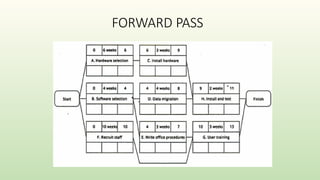
• The method requires that for each activity we have an estimate of
duration.
• The forward pass
• calculate the earliest start dates of the activities
• To calculate the project completion date
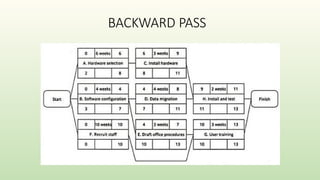
• The backward pass
• calculate the latest start dates for activities
• identify the critical path from the graph
ADDING TIME DIMENSIONS CONT’D
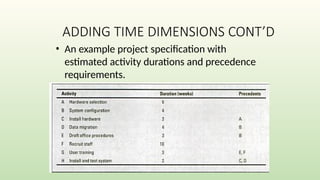
• An example project specification with
estimated activity durations and precedence
requirements.
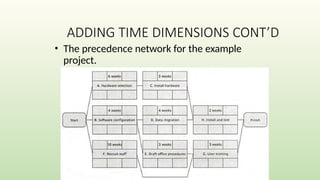
ADDING TIME DIMENSIONS CONT’D
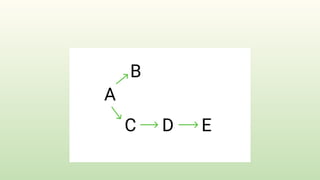
• The precedence network for the example
project.
What Is a Forward Pass in Project Management?
• A forward pass in project management is a technique used to move
through a project network diagram.
• The forward pass helps you understand the project duration and
calculate the early start and early finish values (meaning, the earliest
day each project task can begin and wrap up).
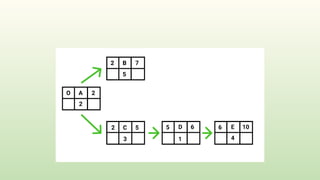
FORWARD PASS
BACKWARD PASS
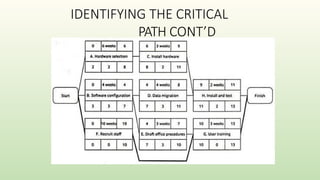
IDENTIFYING THE CRITICAL PATH
• There will be at least one path through the
network (i.e., one set of successive activities)
that defines the duration of the project.
• This is known as the critical path.
• Any delay to any activities on this critical path
will delay the completion of the project.
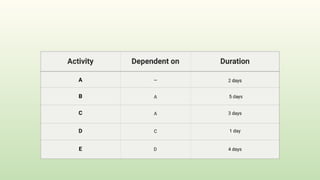
Forward Pass Example
• Imagine that you’re tackling a project that has five different tasks or
activities (A, B, C, D, and E).
• You’ve already figured out what each activity is dependent on
(otherwise known as that task’s predecessors) and how long each one
should take.
• Here’s what that looks like:
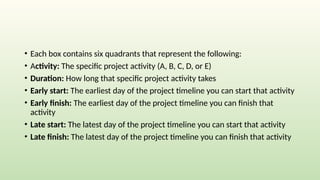
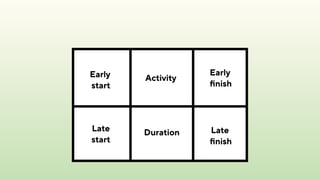
• Each box contains six quadrants that represent the following:
• Activity: The specific project activity (A, B, C, D, or E)
• Duration: How long that specific project activity takes
• Early start: The earliest day of the project timeline you can start that activity
• Early finish: The earliest day of the project timeline you can finish that
activity
• Late start: The latest day of the project timeline you can start that activity
• Late finish: The latest day of the project timeline you can finish that activity
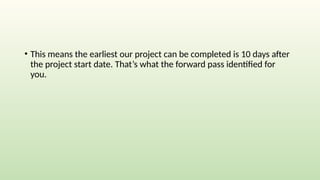
• This means the earliest our project can be completed is 10 days after
the project start date. That’s what the forward pass identified for
you.
IDENTIFYING THE CRITICAL
PATH CONT’D
Backward Pass
• A backward pass in project management is a technique used to move
through a project network diagram.
• The backward pass identifies your late start and late finish values, so
that you can understand the project’s duration and eventually find
the critical path.
ACTIVITY FLOAT
• The difference between an activity’s earliest
start date and its latest start date is known as
the activity’s float which is a measure of how
much the start or completion of an activity
may be delayed without affecting the end
date of the project.
MEASURES OF ACTIVITY FLOAT
• There are number of other measures of activity
float, including the following:
• Free float: the time by which an activity may be
delayed without affecting any subsequent
activity. It is calculated as the difference between
the earliest completion date for the activity and
the earliest start date of succeeding activity.
• Interfering float: the difference between total
float and free float.
SHORTENING THE PROJECT DURATION
• How can you shorten the schedule?
• Via
– Reducing scope (or quality)
– Adding resources
– Concurrency (perform tasks in parallel)
– Substitution of activities
Software Project Management UNIT 3 Activity planning

Software Project Management UNIT 3 Activity planning

  • 1.
    Unit 3 ActivityPlanning 9 Dr. Pallawi Bulakh
  • 2.
    Contents • 3.1. Objectives 3.2.Project Schedule 3.3. Sequencing and Scheduling Activities 3.4. Network Planning Models 3.4.1. Forward Pass 3.4.2. Backward Pass 3.5. Activity Float 3.6. Shortening Project Duration 3.7. Activity on Arrow Networks
  • 3.
    What is anActivity in Project Management? • In project management, an "activity" is simply a specific task or job that needs to be done for a project. • These activities are important because they help break down the project into smaller, manageable parts, making it easier to plan and organize. • Each activity has its own start and end dates, and it needs certain resources and people to get done. • By identifying and defining activities, project managers can create a clear plan for the project, assign resources effectively, and keep track of progress. • Activities are the building blocks of the project schedule, ensuring that everything gets done on time and within budget.
  • 4.
  • 5.
    • Sequential Activities:These are tasks that must be completed in a specific order. For example, designing a product must precede manufacturing it. • Parallel Activities: These are tasks that can be executed simultaneously without dependencies. For instance, while the design team works on product design, the marketing team can start creating promotional materials. • Critical Path Activities: These are activities that, if delayed, would directly impact the project's overall timeline. The critical path is the longest sequence of dependent activities that determine the shortest possible duration for completing the project.
  • 6.
    Characteristics of Activities •Unique and Measurable: Each activity should be distinct and clearly defined, with measurable outcomes or milestones. • Time-Bound: Activities have specific start and end dates or durations, contributing to the overall project timeline. • Resource Consumption: Activities consume various resources such as human resources, materials, equipment, and budget allocation. • Dependency: Activities may have dependencies on other activities, meaning that the completion of one activity is necessary before another can start.
  • 7.
    Types of ActivityRelationships • Mandatory dependencies: These are the dependencies that are mandatory in the nature of the work being performed on a project. They are also referred to as hard logic. • For example, you cannot test code until after the code is written. • Discretionary dependencies : These dependencies are defined by the project team. • For example, a project team might follow good practice and not start the detailed design of a new information system until the users sign off on all of the analysis work. • Discretionary dependencies are also referred to as soft logic. soft logic must be used with utmost care because they may interfere in the scheduling process. • External dependencies: These dependencies involve relationships between project and non-project activities. • For example, the installation of a new operating system and other software may depend on delivery of new hardware from an external supplier. These dependencies should also be taken well care of because external factors may delay the ongoing project schedule.
  • 8.
    Types of relationships •Finish-to-start dependency: A relationship in which the “from” activity or predecessor must finish before the “to” activity or successor can start. • For example, you cannot provide user training until after software or a new system has been installed. Finish- to-start is the most common type of relationship or dependency, and AOA network diagrams use only finish-to-start dependencies. • 2. Start-to-start dependency: A relationship in which the “from” activity cannot start until the “to” activity or successor is started. • For example, on IT projects, a group of activities might start simultaneously, such as the many tasks that occur when a new system goes live. • 3. Finish-to-finish dependency: A relationship in which the “from” activity must be finished before the “to” activity can be finished. One task cannot finish before another finishes. • For example, quality control efforts cannot finish before production finishes, although the two activities can be performed at the same time. • 4. Start-to-finish dependency: A relationship in which the “from” activity must start before the “to” activity can be finished. This type of relationship is rarely used, but it is appropriate in some cases. • For example, an organisation might strive to stock raw materials just in time for the manufacturing process to begin.
  • 10.
    Introduction to ActivityPlanning Objectives • Definition: Activity planning involves breaking down the project into manageable tasks and scheduling them effectively. • Ensures efficient resource utilization. • Helps identify dependencies and potential risks. • Aligns project activities with deadlines and goals.
  • 11.
    What is ActivityPlanning? • Definition: Activity planning is the process of identifying, organizing, and scheduling tasks to ensure the successful execution of a software project. • Purpose: • Establish a roadmap for completing the project. • Ensure efficient use of resources. • Set realistic timelines and milestones.
  • 12.
    Why Activity PlanningMatters? • Activity planning is crucial for translating project goals into actionable tasks. • Objectives ensure the project progresses efficiently and meets deadlines. • It forms the backbone of project execution and control.
  • 13.
    Core Objectives ofActivity Planning • Define Project Activities: Break down the project into smaller, manageable tasks. • Establish Task Dependencies: Identify relationships and sequencing of tasks. • Optimize Resource Allocation: Ensure resources are effectively distributed to avoid under/overutilization. • Set Realistic Timelines: Determine achievable deadlines for all activities. • Facilitate Risk Management: Anticipate and plan for potential obstacles or delays.
  • 14.
    Benefits of MeetingPlanning Objectives • Improved Coordination: Enhances communication and collaboration among team members. • Increased Efficiency: Reduces wasted time and resources through structured execution. • Reduced Risks: Identifies and mitigates potential delays or issues early. • Goal Alignment: Ensures all activities contribute to the overarching project goals. • On-Time Delivery: Achieves timely project completion with minimal disruption.
  • 15.
    Steps in ActivityPlanning • Define Activities: • Break the project into smaller, manageable tasks. • Use Work Breakdown Structure (WBS) for clarity. • Sequence Activities: • Identify task dependencies (e.g., finish-to-start, start-to-start). • Create a precedence diagram. • Estimate Resources: • Allocate resources such as personnel, tools, and equipment. • Estimate Time: • Use techniques like expert judgment, historical data, or three-point estimation. • Develop the Schedule: • Create a timeline using Gantt charts, PERT (Program Evaluation and Review Technique), or CPM (Critical Path Method).
  • 16.
    Activity Relationships • Adependency or relationship in project activities defines the sequencing of project activities or tasks. • for example there are some activities which needs to be performed before some other activities. • Or there are some activities which depends upon the external resources and so on. • A project manager must determine these relationships or dependencies for managing the project schedule. • There are three basic reasons for dependencies among project activities:
  • 17.
    Project schedule • Aproject schedule in SPM is a detailed plan that outlines when project tasks will be completed, who will complete them, and the sequence in which they will occur. • It serves as a roadmap for the project team to manage time effectively and ensures that the project progresses in a structured manner.
  • 18.
    Key Components ofa Project Schedule: • Tasks/Activities: • All tasks required to complete the project are listed and defined. • Timeline: • Start and end dates for each task are specified. • Dependencies: • Logical relationships between tasks (e.g., Task B cannot start until Task A is completed). • Resources: • Allocation of resources (team members, tools, etc.) to specific tasks. • Milestones: • Key points or achievements within the project timeline that indicate progress. • Critical Path: • The sequence of dependent tasks that determines the shortest possible project duration.
  • 19.
    Tools for ProjectScheduling: • Gantt Charts: Visual representation of the schedule, showing tasks, durations, and dependencies. • PERT (Program Evaluation and Review Technique): Used for analyzing and estimating project timelines. • Critical Path Method (CPM): Identifies critical tasks and helps in optimizing project completion time. • Software Tools: Microsoft Project, Jira, Trello, Monday.com, etc.
  • 20.
    • Throughout aproject, we will require a schedule that clearly indicates when each of the project’s activities is planned to occur and what resources it will need. • One way of presenting such a plan is to use a bar chart as shown in the next slide.
  • 21.
    Sequencing and SchedulingActivities • Project and its activities must be clearly defined to achieve the target. • An activity plan will contain the following factors: • A project is basically, composed of number of interrelated activities. • The initiation of a project happens only if at least one activity is ready to start. • An activity is clearly defined with its start and end point that produce good deliverables. • Activity requiring resources must be analyzed well in advance and made available during the execution. • Some activities would depend on other activities for them to complete. • A project can attain its completion only when all activities have been completed
  • 22.
    SEQUENCING AND SCHEDULINGACTIVITIES CONT’D
  • 23.
    SEQUENCING AND SCHEDULINGACTIVITIE CONT’D • In drawing up the chart, we have done two things:- Sequencing the tasks(i.e., identified the dependencies among activities dictated by the development process) Scheduled them(i.e., specified when they should take place) • The scheduling has had to take account of availability of staff and the way in which the activities have been allocated to them.
  • 24.
    NETWORK PLANNING MODEL •These project scheduling techniques model • the project’s activities and their relationships as a network. • In network, time flows from left to right. • These technologies were originally developed in the 1950s- the tw best known being CPM(critical path method) and PERT(program evaluation review technique).
  • 25.
    NETWORK PLANNING MODELCONT’d • Both of these techniques used an activity-on- arrow approach to visualizing the project as a network where activities are drawn as arrows joining circles or nodes, which represent the possible start and/or completion of an activity or set of activities. • Now, precedence networks has become popular which use activity-on-node networks where activities are represented as nodes and the links between nodes represents precedence (or sequencing) requirements.
  • 26.
    CONSTRUCTING THE PRECEDENCE NETWORK •A project network should have only one start node. • A project network should have only one end node. • A node has duration. • Links normally have no duration. • Precedents are the immediate preceding activities. • Time moves from left to right. • A network may not contain loops. • A network should not contain dangles.
  • 27.
    FRAGMENT OF APRECEDENCE NETWORK
  • 28.
    A LOOP REPRESENTSAN IMPOSSIBLE SEQUENCE
  • 29.
  • 30.
  • 31.
    REPRESENTING LAGGED ACTIVITIES •We might come across situation where we wished to undertake two activities in parallel so long as there is a lag between the two. • We might wish to document amendments to a program as it was being tested- particularly if evaluating a prototype. • In such a case we could designate an activity ‘test and document amendments’.
  • 32.
    REPRESENTING LAGGED ACTIVITIESCONT’D • Where activities can occur in parallel with a time lag between them we represent the lag with a duration on the linking arrow as shown below:-
  • 33.
    ADDING TIME DIMENSIONS •The method requires that for each activity we have an estimate of duration. • The forward pass • calculate the earliest start dates of the activities • To calculate the project completion date • The backward pass • calculate the latest start dates for activities • identify the critical path from the graph
  • 34.
    ADDING TIME DIMENSIONSCONT’D • An example project specification with estimated activity durations and precedence requirements.
  • 35.
    ADDING TIME DIMENSIONSCONT’D • The precedence network for the example project.
  • 36.
    What Is aForward Pass in Project Management? • A forward pass in project management is a technique used to move through a project network diagram. • The forward pass helps you understand the project duration and calculate the early start and early finish values (meaning, the earliest day each project task can begin and wrap up).
  • 37.
  • 38.
  • 39.
    IDENTIFYING THE CRITICALPATH • There will be at least one path through the network (i.e., one set of successive activities) that defines the duration of the project. • This is known as the critical path. • Any delay to any activities on this critical path will delay the completion of the project.
  • 40.
    Forward Pass Example •Imagine that you’re tackling a project that has five different tasks or activities (A, B, C, D, and E). • You’ve already figured out what each activity is dependent on (otherwise known as that task’s predecessors) and how long each one should take. • Here’s what that looks like:
  • 43.
    • Each boxcontains six quadrants that represent the following: • Activity: The specific project activity (A, B, C, D, or E) • Duration: How long that specific project activity takes • Early start: The earliest day of the project timeline you can start that activity • Early finish: The earliest day of the project timeline you can finish that activity • Late start: The latest day of the project timeline you can start that activity • Late finish: The latest day of the project timeline you can finish that activity
  • 46.
    • This meansthe earliest our project can be completed is 10 days after the project start date. That’s what the forward pass identified for you.
  • 47.
  • 48.
    Backward Pass • Abackward pass in project management is a technique used to move through a project network diagram. • The backward pass identifies your late start and late finish values, so that you can understand the project’s duration and eventually find the critical path.
  • 50.
    ACTIVITY FLOAT • Thedifference between an activity’s earliest start date and its latest start date is known as the activity’s float which is a measure of how much the start or completion of an activity may be delayed without affecting the end date of the project.
  • 51.
    MEASURES OF ACTIVITYFLOAT • There are number of other measures of activity float, including the following: • Free float: the time by which an activity may be delayed without affecting any subsequent activity. It is calculated as the difference between the earliest completion date for the activity and the earliest start date of succeeding activity. • Interfering float: the difference between total float and free float.
  • 52.
    SHORTENING THE PROJECTDURATION • How can you shorten the schedule? • Via – Reducing scope (or quality) – Adding resources – Concurrency (perform tasks in parallel) – Substitution of activities