KNOWLEDGE
MANAGEMENT
(KM)
Knowledge management is a
method to simplify and
improve the processes of
creating, capturing, sharing,
distributing, understanding
and using the knowledge in a
company.
What is Knowledge
Management? 1/9
Knowledge
management is
managing knowledge-
intensive activities in a
company.
What is Knowledge
Management? 2/9
Knowledge management
refers to identifying and
leveraging the collective
knowledge in a company
to help the company
compete.
What is Knowledge
Management? 3/9
Knowledge management is a
method for achieving corporate
goals by collecting, creating,
synthesizing and sharing
information, insights,
reflections, thoughts, and
experiences.
What is Knowledge
Management? 4/9
Knowledge management is a
discipline focused on systematic
and innovative methods, practices,
and tools for managing the
generation, acquisition, exchange,
protection, distribution, and
utilization of knowledge,
intellectual capital and intangible
assets.
What is Knowledge
Management? 5/9
Knowledge management is a discipline
that promotes an integrated approach to
identifying, innovating, managing and
sharing all of an enterprise’s
information needs. These information
assets may include databases,
documents, policies and procedures as
well as previously unarticulated
expertise and experience resident in
individual workers.”
What is Knowledge
Management? 6/9
Knowledge Management
is a discipline to help
companies …..
Create, Share, and Apply
Knowledge more
effectively!
What is Knowledge
Management? 7/9
What is Knowledge
Management? 8/9
• KM, a strategy to enable people to develop
a set of practices to create, capture, share
and apply knowledge to gain advantage in
the market.
• KM focuses on:
– People who create and apply knowledge.
– Processes and Technologies by which knowledge is
created, maintained, accessed and shared.
– Artifacts in which knowledge is stored (manuals,
databases, intranets, portals, and books.
KM is a discipline
to enhance organizational performance
by explicitly designing and implementing
tools, processes, systems, structures and
cultures to improve the Creation, Sharing
and Application of all kinds of knowledge
that are critical for business performance.
What is Knowledge
Management? 9/9
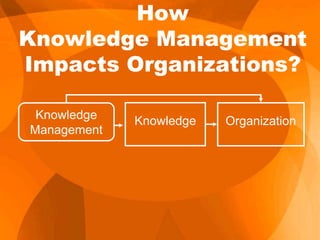
Knowledge OrganizationKnowledge
Management
How
Knowledge Management
Impacts Organizations?
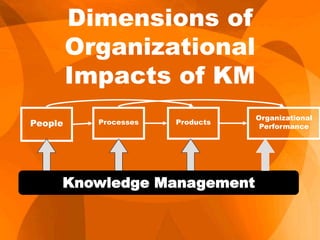
People ProductsProcesses
Organizational
Performance
Knowledge Management
Dimensions of
Organizational
Impacts of KM
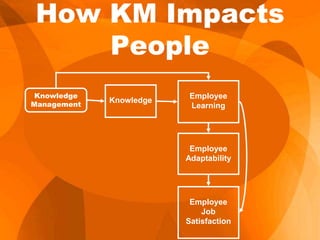
Knowledge
Employee
Learning
Knowledge
Management
Employee
Adaptability
Employee
Job
Satisfaction
How KM Impacts
People
Knowledge Management ,
Innovation
and Organizational Benefits:
People
Learning
Knowledge
Creation
Insights New
Ideas
Conversion
•New Products
•New Markets
•Smarter
Problem-Solving
•Value-added
Innovation
•Better
Customer
Service
•More efficient
Processes
•More
experienced
Staff
Benefits
Knowledge
Process Efficiency
• Productivity improvement
• Cost savings
Knowledge
Management
Process Innovation
• Improved brainstorming
• Better exploitation of new ideas
Process Effectiveness
• Fewer mistakes
• Adaptation to changed
circumstances
How KM Impacts
Organizational Processes?
Impact on Products
• Impact on
products can be
– Value added
products
– Knowledge based
products
Knowledge
• Value-added Products
• Knowledge-based
products
Knowledge
Management
Knowledge
• Vision
• Strategy
• Revenues
• Costs
Knowledge
Management
Organizational Performance
• Scale economies
• Scope economies
• Sustainable competitive
advantage
How Knowledge Management
Impacts Organizational
Performance

Final p pt km 15

  • 1.
  • 2.
    Knowledge management isa method to simplify and improve the processes of creating, capturing, sharing, distributing, understanding and using the knowledge in a company. What is Knowledge Management? 1/9
  • 3.
    Knowledge management is managing knowledge- intensiveactivities in a company. What is Knowledge Management? 2/9
  • 4.
    Knowledge management refers toidentifying and leveraging the collective knowledge in a company to help the company compete. What is Knowledge Management? 3/9
  • 5.
    Knowledge management isa method for achieving corporate goals by collecting, creating, synthesizing and sharing information, insights, reflections, thoughts, and experiences. What is Knowledge Management? 4/9
  • 6.
    Knowledge management isa discipline focused on systematic and innovative methods, practices, and tools for managing the generation, acquisition, exchange, protection, distribution, and utilization of knowledge, intellectual capital and intangible assets. What is Knowledge Management? 5/9
  • 7.
    Knowledge management isa discipline that promotes an integrated approach to identifying, innovating, managing and sharing all of an enterprise’s information needs. These information assets may include databases, documents, policies and procedures as well as previously unarticulated expertise and experience resident in individual workers.” What is Knowledge Management? 6/9
  • 8.
    Knowledge Management is adiscipline to help companies ….. Create, Share, and Apply Knowledge more effectively! What is Knowledge Management? 7/9
  • 9.
    What is Knowledge Management?8/9 • KM, a strategy to enable people to develop a set of practices to create, capture, share and apply knowledge to gain advantage in the market. • KM focuses on: – People who create and apply knowledge. – Processes and Technologies by which knowledge is created, maintained, accessed and shared. – Artifacts in which knowledge is stored (manuals, databases, intranets, portals, and books.
  • 10.
    KM is adiscipline to enhance organizational performance by explicitly designing and implementing tools, processes, systems, structures and cultures to improve the Creation, Sharing and Application of all kinds of knowledge that are critical for business performance. What is Knowledge Management? 9/9
  • 11.
  • 12.
  • 13.
  • 14.
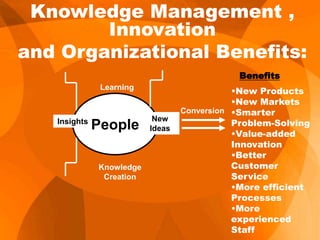
    Knowledge Management , Innovation andOrganizational Benefits: People Learning Knowledge Creation Insights New Ideas Conversion •New Products •New Markets •Smarter Problem-Solving •Value-added Innovation •Better Customer Service •More efficient Processes •More experienced Staff Benefits
  • 15.
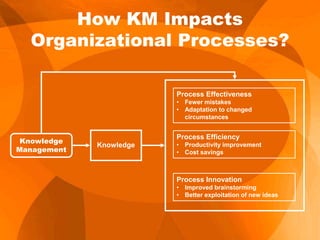
    Knowledge Process Efficiency • Productivityimprovement • Cost savings Knowledge Management Process Innovation • Improved brainstorming • Better exploitation of new ideas Process Effectiveness • Fewer mistakes • Adaptation to changed circumstances How KM Impacts Organizational Processes?
  • 16.
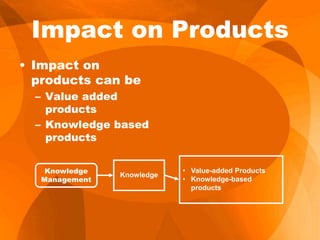
    Impact on Products •Impact on products can be – Value added products – Knowledge based products Knowledge • Value-added Products • Knowledge-based products Knowledge Management
  • 17.
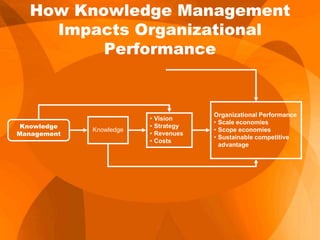
    Knowledge • Vision • Strategy •Revenues • Costs Knowledge Management Organizational Performance • Scale economies • Scope economies • Sustainable competitive advantage How Knowledge Management Impacts Organizational Performance