PRESENTED BY- MS. SAHELI C
PROGRAMME
EVALUATION
REVIEW
TECHNIQUE
❖ PERT was developed in the late 1950 by the US Navy
submarine missile programme and was applied in 1958
❖ PERT shows the time taken by each component of project &the
total time required for its completion.
❖ PERT breaks down theproject into events, activity & lays down
their proper sequence relationship & duration in the form of
network.
❖ PERT is a technique of representing project plan innetwork.
❖ This is represented in a graphic form known as network diagram.
The programme (or project) evaluation and review
technique commonly abbreviated as ‘PERT’; is a
statistical tool, used in project management, which was
designed to analyze and represent the tasks involved in
completing a given project & to illustrate the flow of
events in a project.
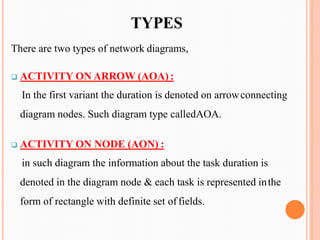
There are two types of network diagrams,
❑ ACTIVITY ON ARROW (AOA) :
In the first variant the duration is denoted on arrowconnecting
diagram nodes. Such diagram type calledAOA.
❑ ACTIVITY ON NODE (AON) :
in such diagram the information about the task duration is
denoted in the diagram node & each task is represented inthe
form of rectangle with definite set of fields.
❖ Prediction of deliverables
❖ Planning resource requirement
❖ Controlling resourceallocation
❖ Internal programme review
❖ Performance evaluation
❖ Uniform wide acceptance
❖ Reduction in cost
❖ Saving time
❖ Determination of activities
❖ Elimination of risk in complex activities
❖ Flexibility
❖ Evaluation of alternatives
❖ Useful effective control
❖ Useful decision making
❖ Useful research work
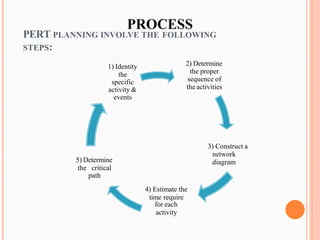
PERT PLANNING INVOLVE THE FOLLOWING
STEPS:
2) Determine
the proper
sequence of
the activities
3) Construct a
network
diagram
4) Estimate the
time require
for each
activity
5) Determine
the critical
path
1) Identity
the
specific
activity &
events
1. Identity Activities & events :
The activities are tasks require to complete the project. The
events marking the beginning & end of one or more
activities. It is helpful to list the tasks in a table that in later
steps can be expanded to include on sequence is duration .
2.Determine the proper sequence of the activities :
This steps may be combine with the activity identification
steps since the activity sequence is event for some task .
Other tasks may require more analysis to determine exact
order in which they must be perform .
3.Construct a network diagram :
Using the activity sequence information , a network diagram
can be drawn showing the sequence of the serial is & parallel
activities .For the original activity –on-are model, the activities
are depicted by arrowed lines & milestones are depicted by
circles.
4.Estimate the time required for activity:
Adistinguishing feature of PERTis its ability to dealwith
uncertainty in activity completiontimes
For each activity , the model usually includes threetime
estimates;-
A) Optimistic time:
Generally the shortest time in which the activity canbe
completed .
B) Most likely time :
The completion time having the highest probability notethat
this time is different for the expected time.
C) Pessimistic time :
The longest time that an activity might require.
5. Determine the critical path :
The critical path is determine by adding the times for the
activities in each sequence & determining the longest pathin
project. The critical path determines the total timerequire.
6.Update the PERT chart as the project progresses :
Make adjustment in the PERT chart as the projectprogresses.
As the project unfolds ,the estimated times can be replaced
with actual times. The PERT chart may be modified&
improved to reflect the new situation.
❑ Simple to understand and use.
❑ Show whether the project is on schedule; or behind /aheadof
the schedule.
❑ Identify the activities that need closerattention
❑ Determine the flexibility available withactivities
❑ Show potential risk with activities
❑ Provide good documentation of the project activities
❑ Help to set priorities among activities & resource allocationas
per priority
Used in research and development projects
For developing, tooling and introducing a new project
Toplan and execute the acquisition and installation of an
electronic system
Development and administration of various training
programmes
For management development and organizational planning
❑ Amajor disadvantages of PERT has been its emphasisonly
on time, not on costs.
❑ The cost of setting up such systemare extensive.
❑ It is difficult to estimate accurate time & cost of various
activities involved in a project
❑ Errors in estimation makesthe PERT chart unreliable as a
control aid.
❑ These systems will not help managers to solve all their
problem.
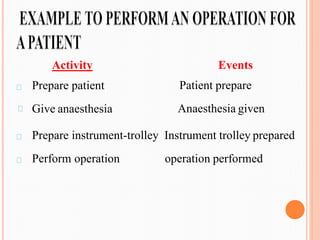
Activity
Prepare patient
Give anaesthesia
Events
Patient prepare
Anaesthesia given
Prepare instrument-trolley Instrument trolley prepared
Perform operation operation performed
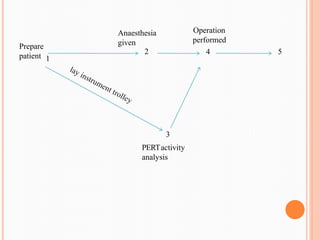
Operation
performed
4 5
3
PERTactivity
analysis
Prepare
patient 1
Anaesthesia
given
2
Programme evaluation review technique

Programme evaluation review technique

  • 1.
    PRESENTED BY- MS.SAHELI C PROGRAMME EVALUATION REVIEW TECHNIQUE
  • 2.
    ❖ PERT wasdeveloped in the late 1950 by the US Navy submarine missile programme and was applied in 1958 ❖ PERT shows the time taken by each component of project &the total time required for its completion. ❖ PERT breaks down theproject into events, activity & lays down their proper sequence relationship & duration in the form of network. ❖ PERT is a technique of representing project plan innetwork. ❖ This is represented in a graphic form known as network diagram.
  • 3.
    The programme (orproject) evaluation and review technique commonly abbreviated as ‘PERT’; is a statistical tool, used in project management, which was designed to analyze and represent the tasks involved in completing a given project & to illustrate the flow of events in a project.
  • 4.
    There are twotypes of network diagrams, ❑ ACTIVITY ON ARROW (AOA) : In the first variant the duration is denoted on arrowconnecting diagram nodes. Such diagram type calledAOA. ❑ ACTIVITY ON NODE (AON) : in such diagram the information about the task duration is denoted in the diagram node & each task is represented inthe form of rectangle with definite set of fields.
  • 5.
    ❖ Prediction ofdeliverables ❖ Planning resource requirement ❖ Controlling resourceallocation ❖ Internal programme review ❖ Performance evaluation ❖ Uniform wide acceptance ❖ Reduction in cost ❖ Saving time
  • 6.
    ❖ Determination ofactivities ❖ Elimination of risk in complex activities ❖ Flexibility ❖ Evaluation of alternatives ❖ Useful effective control ❖ Useful decision making ❖ Useful research work
  • 7.
    PERT PLANNING INVOLVETHE FOLLOWING STEPS: 2) Determine the proper sequence of the activities 3) Construct a network diagram 4) Estimate the time require for each activity 5) Determine the critical path 1) Identity the specific activity & events
  • 8.
    1. Identity Activities& events : The activities are tasks require to complete the project. The events marking the beginning & end of one or more activities. It is helpful to list the tasks in a table that in later steps can be expanded to include on sequence is duration . 2.Determine the proper sequence of the activities : This steps may be combine with the activity identification steps since the activity sequence is event for some task . Other tasks may require more analysis to determine exact order in which they must be perform .
  • 9.
    3.Construct a networkdiagram : Using the activity sequence information , a network diagram can be drawn showing the sequence of the serial is & parallel activities .For the original activity –on-are model, the activities are depicted by arrowed lines & milestones are depicted by circles. 4.Estimate the time required for activity: Adistinguishing feature of PERTis its ability to dealwith uncertainty in activity completiontimes
  • 10.
    For each activity, the model usually includes threetime estimates;- A) Optimistic time: Generally the shortest time in which the activity canbe completed . B) Most likely time : The completion time having the highest probability notethat this time is different for the expected time. C) Pessimistic time : The longest time that an activity might require.
  • 11.
    5. Determine thecritical path : The critical path is determine by adding the times for the activities in each sequence & determining the longest pathin project. The critical path determines the total timerequire.
  • 12.
    6.Update the PERTchart as the project progresses : Make adjustment in the PERT chart as the projectprogresses. As the project unfolds ,the estimated times can be replaced with actual times. The PERT chart may be modified& improved to reflect the new situation.
  • 13.
    ❑ Simple tounderstand and use. ❑ Show whether the project is on schedule; or behind /aheadof the schedule. ❑ Identify the activities that need closerattention ❑ Determine the flexibility available withactivities ❑ Show potential risk with activities ❑ Provide good documentation of the project activities ❑ Help to set priorities among activities & resource allocationas per priority
  • 14.
    Used in researchand development projects For developing, tooling and introducing a new project Toplan and execute the acquisition and installation of an electronic system Development and administration of various training programmes For management development and organizational planning
  • 15.
    ❑ Amajor disadvantagesof PERT has been its emphasisonly on time, not on costs. ❑ The cost of setting up such systemare extensive. ❑ It is difficult to estimate accurate time & cost of various activities involved in a project ❑ Errors in estimation makesthe PERT chart unreliable as a control aid. ❑ These systems will not help managers to solve all their problem.
  • 16.
    Activity Prepare patient Give anaesthesia Events Patientprepare Anaesthesia given Prepare instrument-trolley Instrument trolley prepared Perform operation operation performed
  • 17.