Scaffolding Strategies To Use With
Your Students
Lev Vygotsky Scaffolding Strategies
Scaffolding
• Definition
• Strategies
• Who is Lev Vygotsky?
• Lev Vygotsky scaffolding strategies
• How we can apply it in the class
What does scaffolding mean?
• In general: it is a kind of assistance or help offered by a teacher
or peer to support learning.
• it is an instructional technique whereby the teacher models
the desired learning strategy or task, then gradually shifts the
responsibility to the students.
• We can call it a supporting framework
Scaffolding Strategies
• Visuals and realia
• Modeling /gesturing
• Graphic organizers
• Connect to background knowledge
• Sentence structures /starters
• Read aloud
• Intentional small group /partner work
• Use of first language
• Give time to talk
• Pause, ask questions, review
Who is Lev Vygotsky?
• He was born in western Russia.
• He has written several articles & books on the subject of his
theories.
• His research in how children solve their problems that
surpassed their level of development; led him to create the
zone of proximal development theory (ZPD).
Lev Vygotsky scaffolding theory:
• Vygotsky believed that when a student is in the ZPD for a particular
task, by providing the appropriate assistance will give the student
enough of a boost to achieve the task.
• The ZPD has become synonymous in the literature with the term
scaffolding.
• However it is important to note that Vygotsky never used the term
of “scaffolding” in his writing and it was introduced by WOOD ET
AL(1976).
• In order to meet students where they are and scaffold a lesson or
differentiate instruction, you have to know the individual &
collective ZPD of your learners.
• The ZPD is the distance between what children can do by themselves &
the next learning that they can be helped to achieve with competent
assistance.
• Vygotsky suggested that teachers use cooperative learning exercises
where less component children develop with help from more skillful
peers within the zone of proximal development.
• According to Vygotsky, language( in particular speech) is fundamental to
children’s cognitive growth because language provides purpose and
intention so that behaviors can be better understood.
• Through the use of speech, children are able to communicate and learn
from others through dialogue; which is an important tool in the ZPD.
• In it child’s unsystematic, disorganized, and spontaneous concepts are
met with the more systematic, logic, and rational concepts of the skilled
helper.
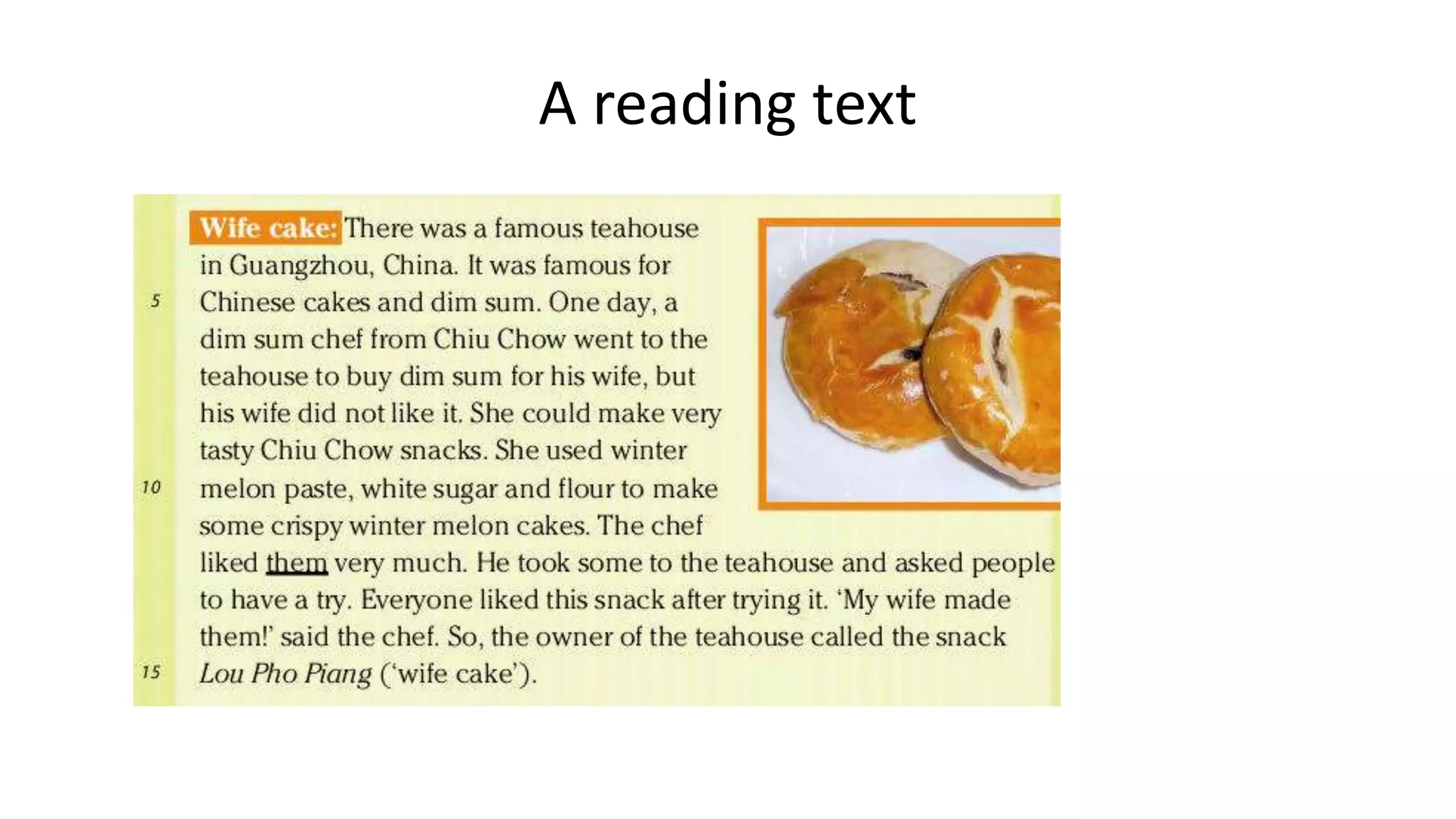
A reading text
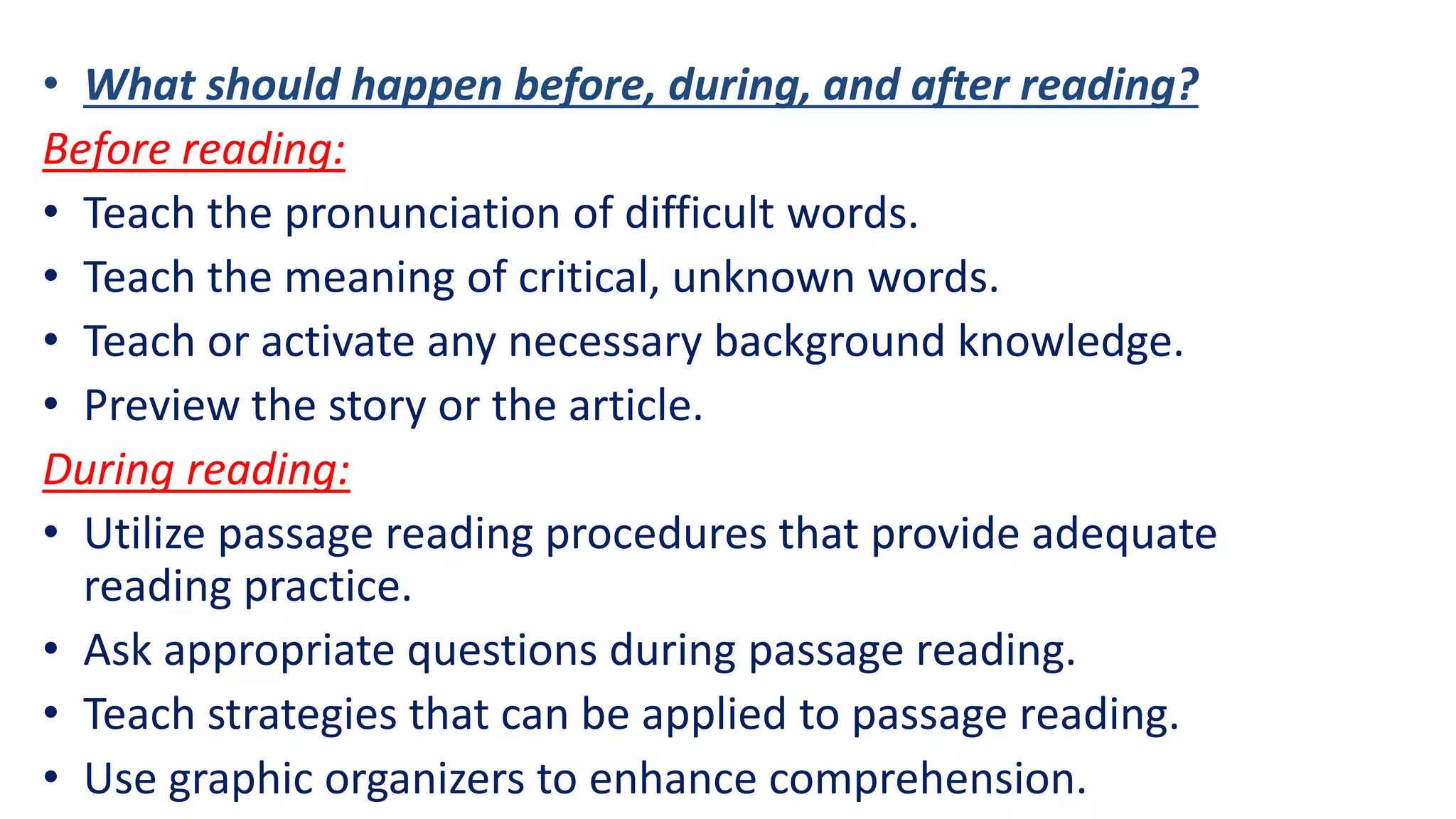
• What should happen before, during, and after reading?
Before reading:
• Teach the pronunciation of difficult words.
• Teach the meaning of critical, unknown words.
• Teach or activate any necessary background knowledge.
• Preview the story or the article.
During reading:
• Utilize passage reading procedures that provide adequate
reading practice.
• Ask appropriate questions during passage reading.
• Teach strategies that can be applied to passage reading.
• Use graphic organizers to enhance comprehension.
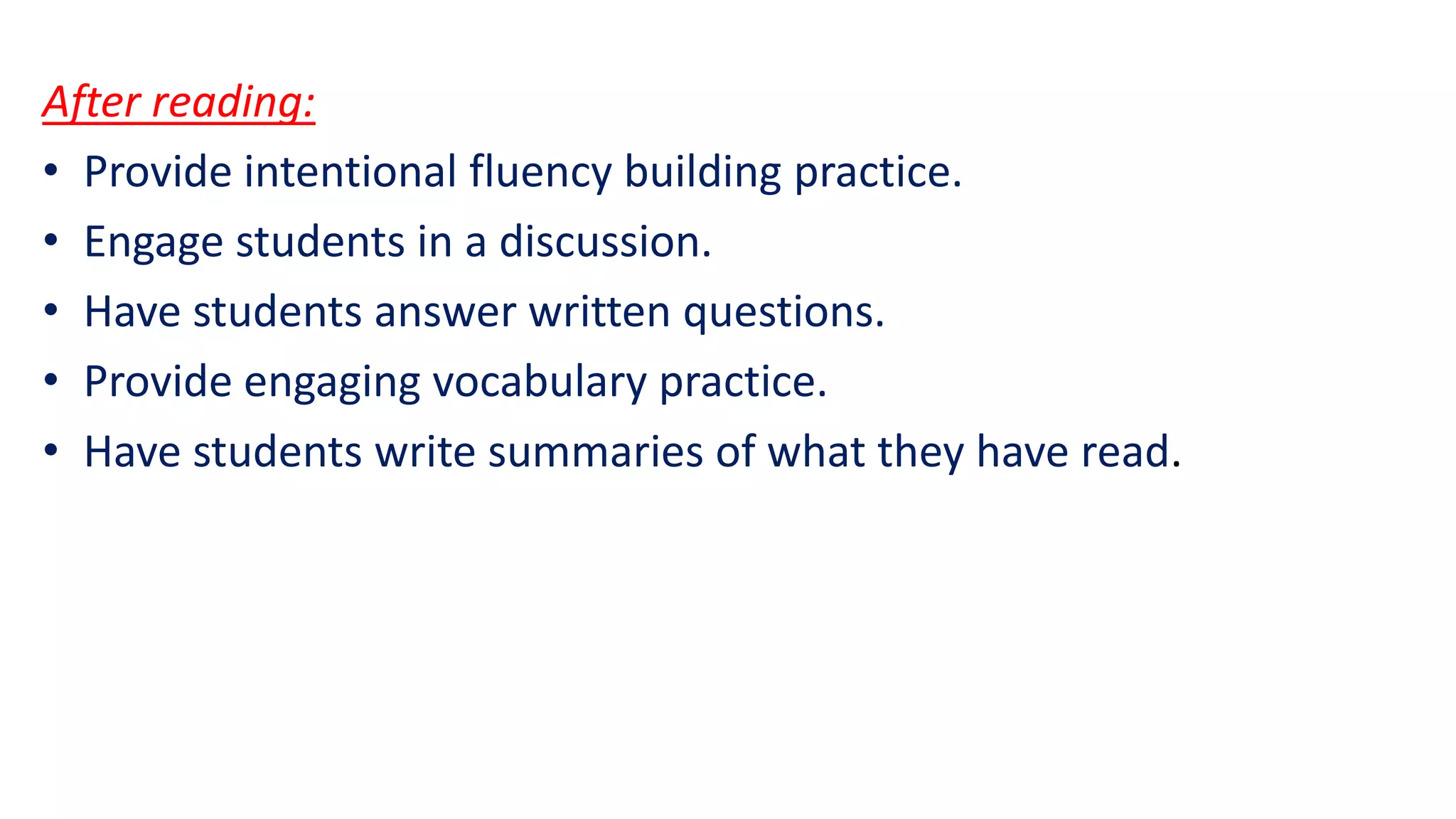
After reading:
• Provide intentional fluency building practice.
• Engage students in a discussion.
• Have students answer written questions.
• Provide engaging vocabulary practice.
• Have students write summaries of what they have read.

Scaffolding strategies to_use_with_your_students

  • 1.
    Scaffolding Strategies ToUse With Your Students Lev Vygotsky Scaffolding Strategies
  • 2.
    Scaffolding • Definition • Strategies •Who is Lev Vygotsky? • Lev Vygotsky scaffolding strategies • How we can apply it in the class
  • 3.
    What does scaffoldingmean? • In general: it is a kind of assistance or help offered by a teacher or peer to support learning. • it is an instructional technique whereby the teacher models the desired learning strategy or task, then gradually shifts the responsibility to the students. • We can call it a supporting framework
  • 4.
    Scaffolding Strategies • Visualsand realia • Modeling /gesturing • Graphic organizers • Connect to background knowledge • Sentence structures /starters • Read aloud • Intentional small group /partner work • Use of first language • Give time to talk • Pause, ask questions, review
  • 5.
    Who is LevVygotsky? • He was born in western Russia. • He has written several articles & books on the subject of his theories. • His research in how children solve their problems that surpassed their level of development; led him to create the zone of proximal development theory (ZPD).
  • 6.
    Lev Vygotsky scaffoldingtheory: • Vygotsky believed that when a student is in the ZPD for a particular task, by providing the appropriate assistance will give the student enough of a boost to achieve the task. • The ZPD has become synonymous in the literature with the term scaffolding. • However it is important to note that Vygotsky never used the term of “scaffolding” in his writing and it was introduced by WOOD ET AL(1976). • In order to meet students where they are and scaffold a lesson or differentiate instruction, you have to know the individual & collective ZPD of your learners.
  • 7.
    • The ZPDis the distance between what children can do by themselves & the next learning that they can be helped to achieve with competent assistance. • Vygotsky suggested that teachers use cooperative learning exercises where less component children develop with help from more skillful peers within the zone of proximal development. • According to Vygotsky, language( in particular speech) is fundamental to children’s cognitive growth because language provides purpose and intention so that behaviors can be better understood. • Through the use of speech, children are able to communicate and learn from others through dialogue; which is an important tool in the ZPD. • In it child’s unsystematic, disorganized, and spontaneous concepts are met with the more systematic, logic, and rational concepts of the skilled helper.
  • 8.
  • 9.
    • What shouldhappen before, during, and after reading? Before reading: • Teach the pronunciation of difficult words. • Teach the meaning of critical, unknown words. • Teach or activate any necessary background knowledge. • Preview the story or the article. During reading: • Utilize passage reading procedures that provide adequate reading practice. • Ask appropriate questions during passage reading. • Teach strategies that can be applied to passage reading. • Use graphic organizers to enhance comprehension.
  • 10.
    After reading: • Provideintentional fluency building practice. • Engage students in a discussion. • Have students answer written questions. • Provide engaging vocabulary practice. • Have students write summaries of what they have read.