Social constructivism of Vygotsky
Suresh BabuG
Assistant Professor
CTE CPAS Paippad, Kottayam
Social constructivism
of Vygotsky
The theory of social constructivism is proposed by
Lev Semyonovich Vygotsky (1896-1934) , a
Russian psychologist, who applied the Marxist
social theory to individual psychology.
The theory considers learning as a social and
communicative process whereby knowledge is
shared and understandings are constructed in
culturally formed social settings.
It emphasizes the importance of culture and
context in understanding what occurs in society
and constructing knowledge based on this
understanding.
Basic Principles of
Social Constructivism
 Children construct their knowledge.
 Development cannot be separated from its
social context.
 Learning can lead to development.
 Language plays a central role in mental
development.
Components of Social
Constructivism
The important components of the social
constructivist theory proposed by Vygotsky are:
1. Construction of knowledge occurs only when
the learner interacts in a social context.
2. Learning occurs through the internalization of a
socially negotiated mental function.
3. Language is a tool for understanding outer
world and constructing knowledge.
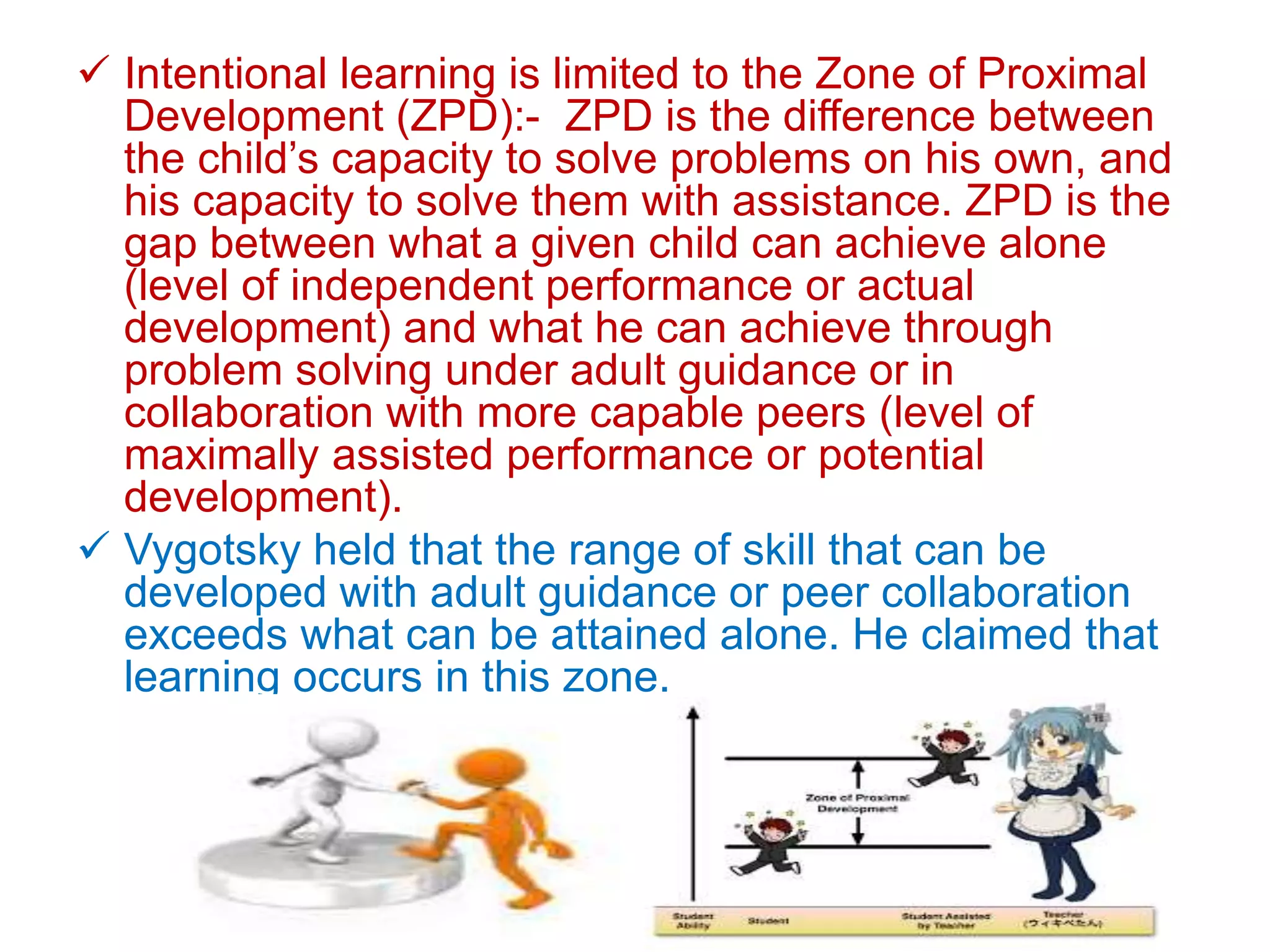
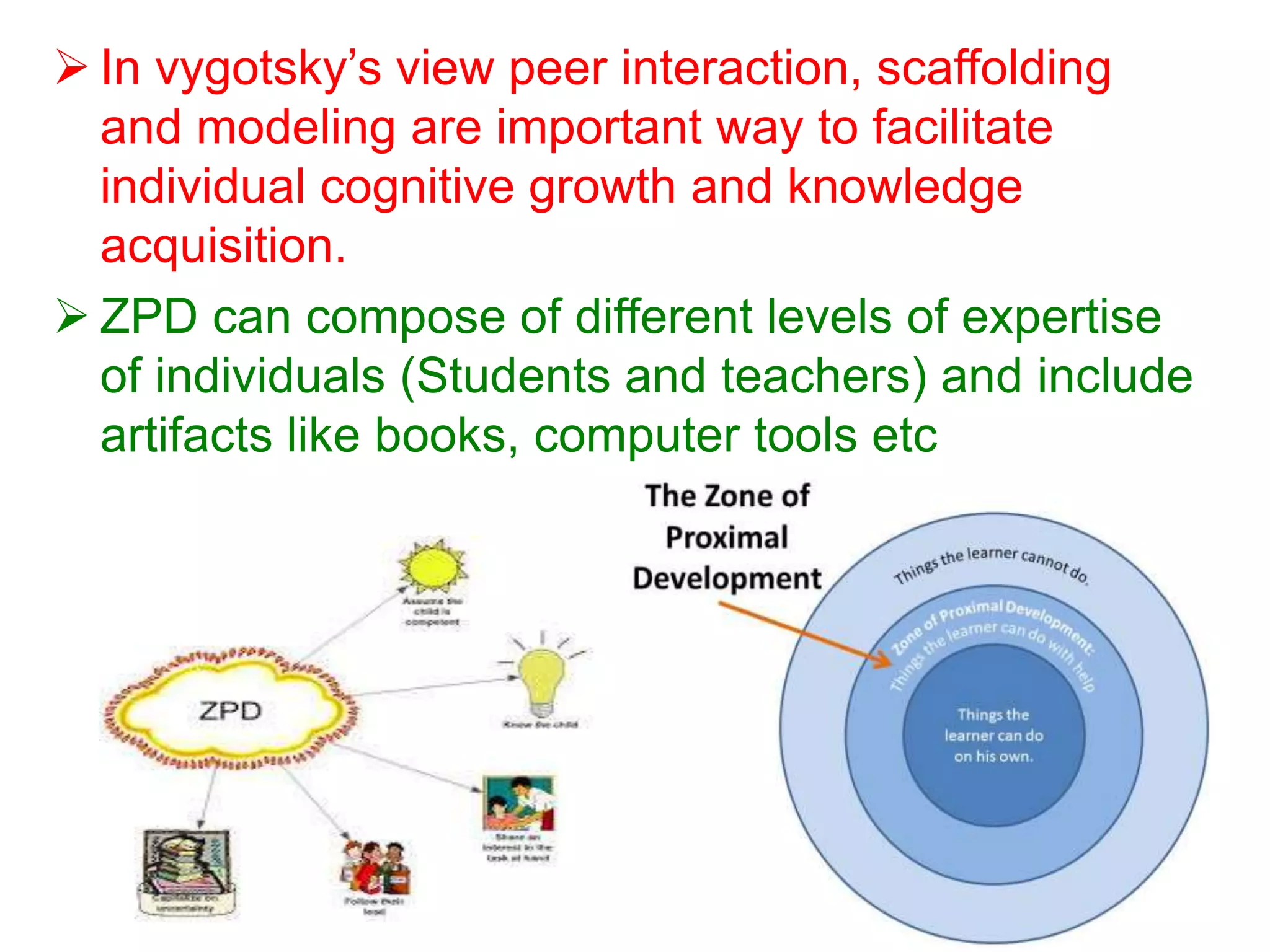
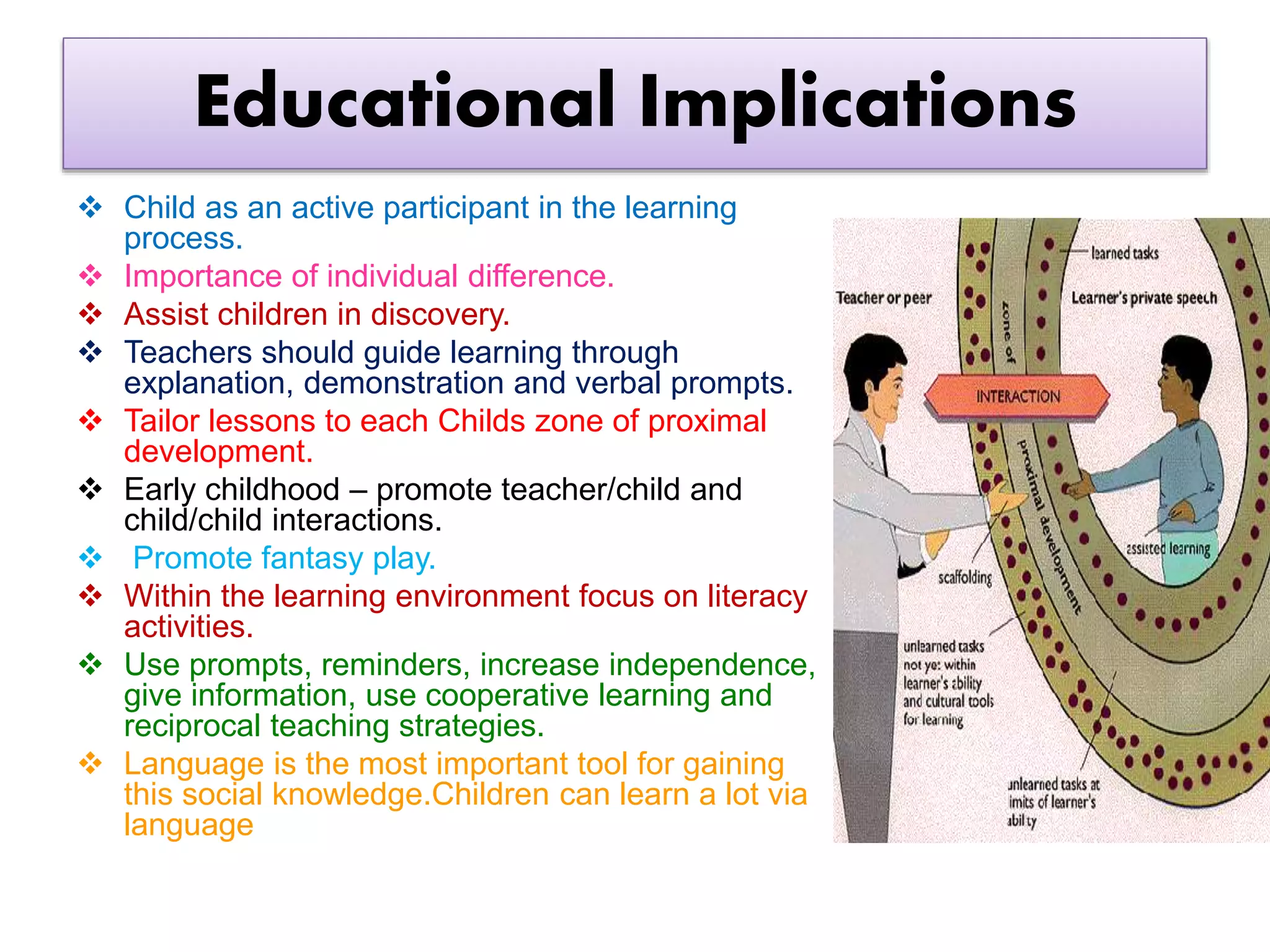
 Intentional learning is limited to the Zone of Proximal
Development (ZPD):- ZPD is the difference between
the child’s capacity to solve problems on his own, and
his capacity to solve them with assistance. ZPD is the
gap between what a given child can achieve alone
(level of independent performance or actual
development) and what he can achieve through
problem solving under adult guidance or in
collaboration with more capable peers (level of
maximally assisted performance or potential
development).
 Vygotsky held that the range of skill that can be
developed with adult guidance or peer collaboration
exceeds what can be attained alone. He claimed that
learning occurs in this zone.
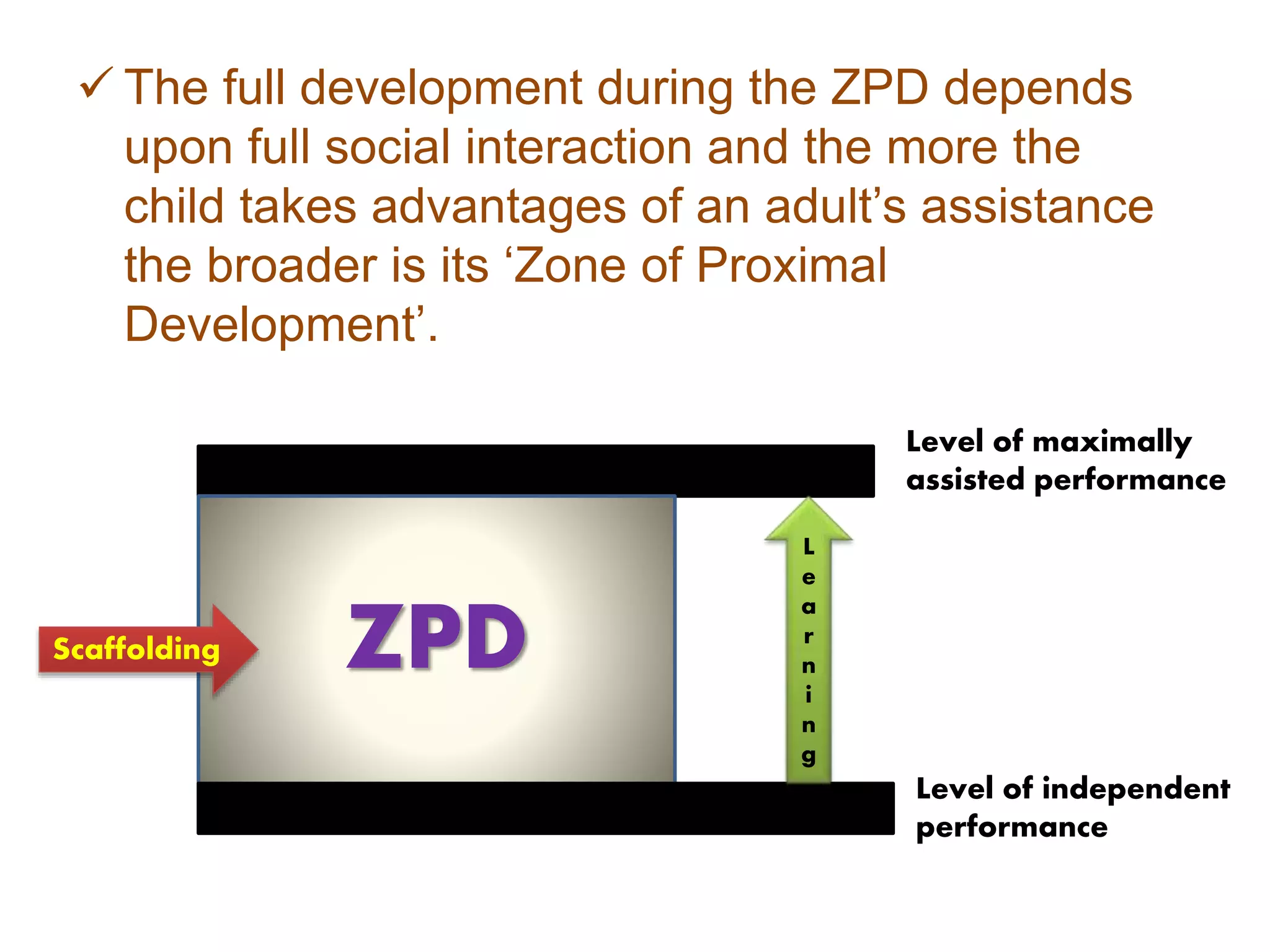
 The full development during the ZPD depends
upon full social interaction and the more the
child takes advantages of an adult’s assistance
the broader is its ‘Zone of Proximal
Development’.
ZPD
L
e
a
r
n
i
n
g
Scaffolding
Level of maximally
assisted performance
Level of independent
performance
 In vygotsky’s view peer interaction, scaffolding
and modeling are important way to facilitate
individual cognitive growth and knowledge
acquisition.
 ZPD can compose of different levels of expertise
of individuals (Students and teachers) and include
artifacts like books, computer tools etc
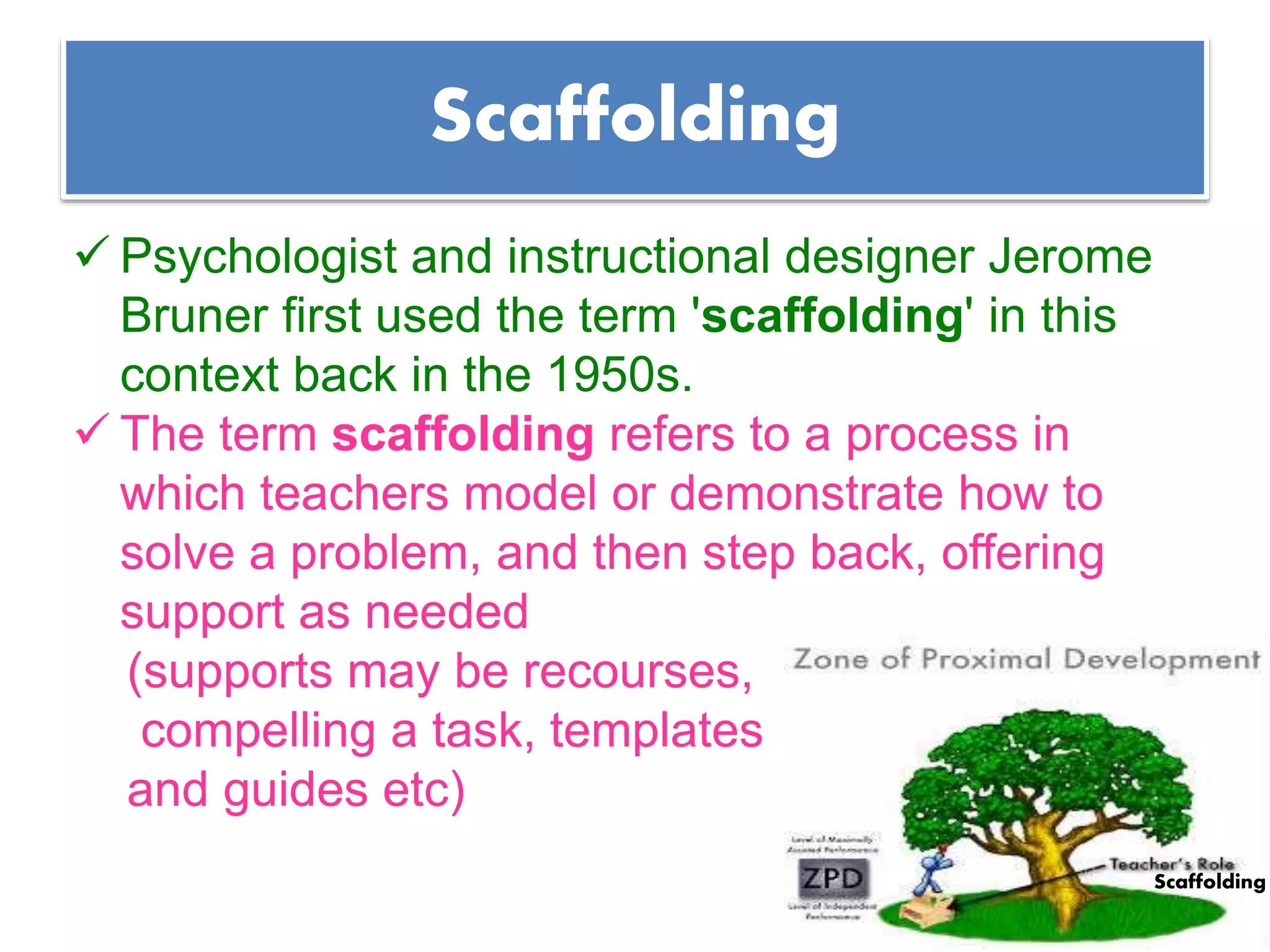
Scaffolding
 Psychologist and instructional designer Jerome
Bruner first used the term 'scaffolding' in this
context back in the 1950s.
 The term scaffolding refers to a process in
which teachers model or demonstrate how to
solve a problem, and then step back, offering
support as needed
(supports may be recourses,
compelling a task, templates
and guides etc)
Scaffolding
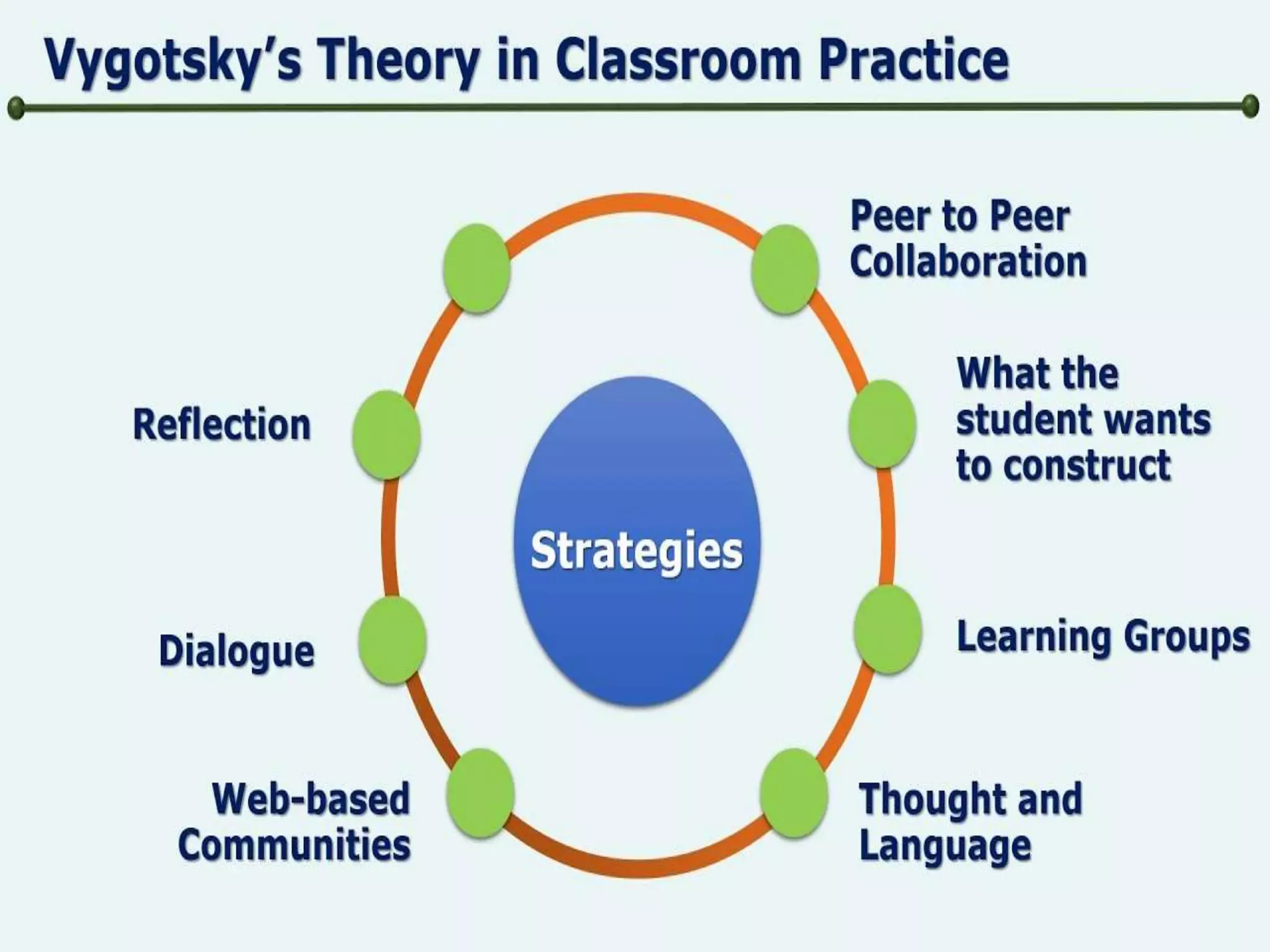
Educational Implications
 Child as an active participant in the learning
process.
 Importance of individual difference.
 Assist children in discovery.
 Teachers should guide learning through
explanation, demonstration and verbal prompts.
 Tailor lessons to each Childs zone of proximal
development.
 Early childhood – promote teacher/child and
child/child interactions.
 Promote fantasy play.
 Within the learning environment focus on literacy
activities.
 Use prompts, reminders, increase independence,
give information, use cooperative learning and
reciprocal teaching strategies.
 Language is the most important tool for gaining
this social knowledge.Children can learn a lot via
language
Social Constructivism of Vygotsky

Social Constructivism of Vygotsky

  • 1.
    Social constructivism ofVygotsky Suresh BabuG Assistant Professor CTE CPAS Paippad, Kottayam
  • 2.
    Social constructivism of Vygotsky Thetheory of social constructivism is proposed by Lev Semyonovich Vygotsky (1896-1934) , a Russian psychologist, who applied the Marxist social theory to individual psychology. The theory considers learning as a social and communicative process whereby knowledge is shared and understandings are constructed in culturally formed social settings. It emphasizes the importance of culture and context in understanding what occurs in society and constructing knowledge based on this understanding.
  • 3.
    Basic Principles of SocialConstructivism  Children construct their knowledge.  Development cannot be separated from its social context.  Learning can lead to development.  Language plays a central role in mental development.
  • 4.
    Components of Social Constructivism Theimportant components of the social constructivist theory proposed by Vygotsky are: 1. Construction of knowledge occurs only when the learner interacts in a social context. 2. Learning occurs through the internalization of a socially negotiated mental function. 3. Language is a tool for understanding outer world and constructing knowledge.
  • 5.
     Intentional learningis limited to the Zone of Proximal Development (ZPD):- ZPD is the difference between the child’s capacity to solve problems on his own, and his capacity to solve them with assistance. ZPD is the gap between what a given child can achieve alone (level of independent performance or actual development) and what he can achieve through problem solving under adult guidance or in collaboration with more capable peers (level of maximally assisted performance or potential development).  Vygotsky held that the range of skill that can be developed with adult guidance or peer collaboration exceeds what can be attained alone. He claimed that learning occurs in this zone.
  • 6.
     The fulldevelopment during the ZPD depends upon full social interaction and the more the child takes advantages of an adult’s assistance the broader is its ‘Zone of Proximal Development’. ZPD L e a r n i n g Scaffolding Level of maximally assisted performance Level of independent performance
  • 7.
     In vygotsky’sview peer interaction, scaffolding and modeling are important way to facilitate individual cognitive growth and knowledge acquisition.  ZPD can compose of different levels of expertise of individuals (Students and teachers) and include artifacts like books, computer tools etc
  • 8.
    Scaffolding  Psychologist andinstructional designer Jerome Bruner first used the term 'scaffolding' in this context back in the 1950s.  The term scaffolding refers to a process in which teachers model or demonstrate how to solve a problem, and then step back, offering support as needed (supports may be recourses, compelling a task, templates and guides etc) Scaffolding
  • 11.
    Educational Implications  Childas an active participant in the learning process.  Importance of individual difference.  Assist children in discovery.  Teachers should guide learning through explanation, demonstration and verbal prompts.  Tailor lessons to each Childs zone of proximal development.  Early childhood – promote teacher/child and child/child interactions.  Promote fantasy play.  Within the learning environment focus on literacy activities.  Use prompts, reminders, increase independence, give information, use cooperative learning and reciprocal teaching strategies.  Language is the most important tool for gaining this social knowledge.Children can learn a lot via language