Training conducted at EERC Theramx Ltd. On 24 & 25 Sep
                                               2012 BY
                                       Mr. V N Parbhu
SCAFFOLD:
“A temporary elevated platform and its
  supporting structure used for supporting
  workmen, materials, or both" in
  the construction or repair of buildings an
  d other large structures.
Types of scaffolds
   Categories
     Suspended
     Supported, tubular
     Rolling
   Tubular scaffolding are further
    divided in 3 groups:
        Pipe & coupler ( Clamp)
        H frame
        Cuplock
Tubular scaffolding
 Frequently used in construction work.
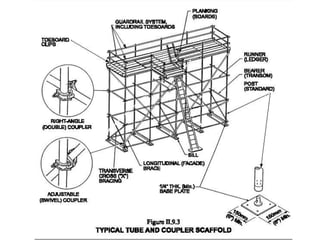
 TUBE & COUPLER SCAFFOLD: “A
  scaffold constructed of steel tubing that
  serves as
  standards, ledgers, transoms, braces, a
  nd ties and specially designed scaffold
  couplers that serve to connect the
  various members”.
Independent                      Guard Rail (Approx 1.0 m high)
                               Brick Guard
  Tied
                               Intermediate guard rail (Max gap of 470 mm)
  Scaffold       END OF
                               Toe Board (Min 150 mm high)
                SCAFFOLD

                                Scaffolding Planks
                                (Deck area min of 600 mm wide)

                                Transom

                                Facade Brace
                                                                    Large
Through Tie                 Ledger Brace                            Eye Bolt

 Reveal Tie

                            Couplers at joints

                            Ledger

                            Standard

                                                       Eye Bolt
                                                       and Strap
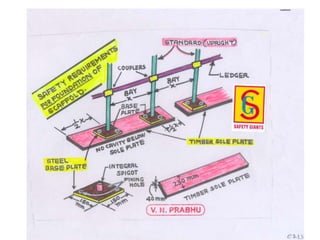
                           Base Plates
                            Sole Plates
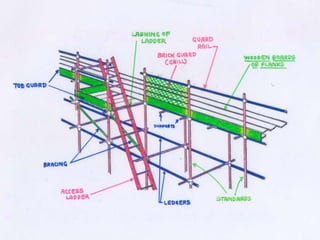
VARIOUS PARTS OF
SCAFFOLDS
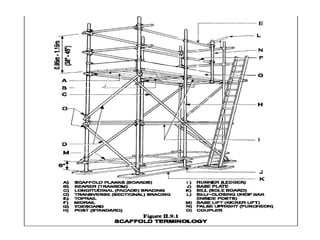
   STANDARD: “Vertical scaffold tube that bears the weight of the Scaffold”.
   LEDGER: “A lengthwise horizontal scaffold tube that extends from standard
    to standard, that supports the transoms and that forms a tie between the
    standards”.
   TRANSOM: “A horizontal transverse scaffold member, that may support
    platform units, and which is supported by at least two ledgers or connected
    directly to at least two standards”.
   COUPLER: “A component or device used to fix scaffold tubes together”.
   PLANK: “An individual timber board or fabricated component that serves as
    a flooring member of a platform”.
   HANDRAIL: “A barrier consisting of pipes erected to prevent workers from
    falling off an elevated work area”.
   TOE BOARD: A barrier min 150 mm height to prevent slip/fall of material
    from platform.
   MID RAIL
   MUDSILL(SOLE PLATE): IT IS A WOODEN PLATE THAT IS USED TO
    DISTRIBUTE THE SCAFFOLDING LOAD OVER A SUITABLE GROUND
    AREA.
   BASE PLATE:
   DIAGONAL BRACING
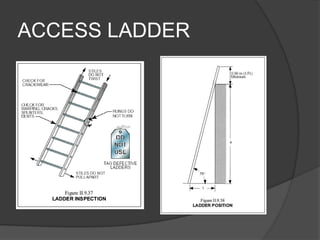
   ACCESS LADDER
MUDSILL(SOLE PLATE)

 IT IS A WOODEN PLATE THAT IS USED
  TO DISTRIBUTE THE SCAFFOLDING
  LOAD OVER A SUITABLE GROUND
  AREA.
 THE SIZE OF MUDSILL IS DETERMINED
  BY THE LOAD CARRIED OVER A
  PARTICULAR GROUND AREA, AND BY
  THE NATURE OF THE SOIL
  SUPPORTING THESE SILLS.
BASE PLATE
 IT SPREADS CROSS-
  SECTIONAL AREA OF
  THE STANDARD TO
  LARGE AREA.
 IT PREVENTS SINKING
  OF STANDARDS.
 IT PREVENTS
  OVERTURNING OF
  SCAFFOLD.
 IT CARRIES THE
  WEIGHT OF
  SCAFFOLD.
Guardrail & Midrail
“These barriers used to prevent fall of any persons from
  platform.”
 General Requirements for guardrail & midrail:-
 NOMINAL DIA.- AT LEAST 1.5 INCHES.
 SPACING OF POSTS- NOT MORE THAN 8 FEET.
 MUST BE CAPABLE OF WITHSTANDING A LOAD OF
  200 POUNDS WHEN APPLIED FROM ANY
  DIRECTION & AT ANY POINT ON THE TOP RAIL.
 THE HEIGHT OF TOP RAILSHOULD BE 42 INCHES
  FROM THE TOP OF RAIL TO PLATFORM LEVEL.
 MIDRAIL TO BE PLACED HALF WAY.
TOEBOARD

 HEIGHT OF TOE BOARD SHOULD BE AT
  LEAST 4 INCHES.
 TO BE MOUNTED WITHIN ¼ INCHES OF
  THE WORKING PLATFORM.
 PURPOSE IS TO STOP SUDDEN TRAVEL
  OF A PERSON ON SCAFFOLD PLATFORM
  AFTER SLIPPING.
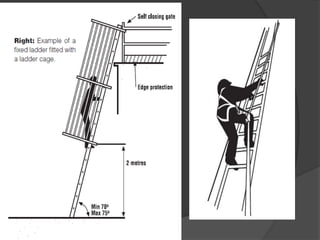
   MANY FATAL ACCIDENTS HAVE OCCURRED WHEN PERSONS HAVE
    FALLEN DOWN FROM A SCAFFOLD DURING THE PROCESS OF
    CLIMBING OR WHILE GETTING DOWN.
   MUST PROVIDE SAFE ACCESS TO SCAFFOLD & SCAFFOLD
    PLATFORM.
   THE BOTTOM STEP OR RUNG OF LADDER ( hook-on ladder , attachable
    ladder or stairway type ladder whichever the case may be ) MUST NOT
    BE MORE THAN 24 INCHES ABOVE OR BELOW THE SCAFFOLD
    SUPPORTING LEVEL.
   FOR SUPPORTED SCAFFOLDS OF MORE THAN 35 FEET HEIGHT
    , PROVIDE A REST PLATFORM AT 35 FEET HEIGHT.
   PROVIDE A REST PLATFORM EVERY 12 FEET IN CASE OF STAIRWAY
    TYPE ACCESS LADDER
   Rungs should be round type only.
ACCESS LADDER
5 MAJOR MISHAPS.
1.   Person falling while climbing up or
     coming down.
2.   Person falling from the working
     platform / deck.
3.   Objects falling from a scaffold on to
     someone below.
4.   Object falling from above on to a
     worker on the scaffold.
5.   Tilting of scaffold or collapse of
     scaffold.
TAGS
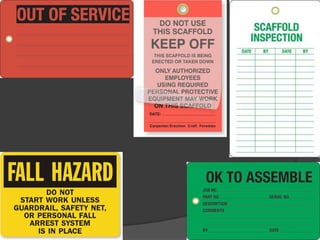
   Types:-
     a) Caution Tag
     b)Danger Tag
     c)Ok Tag
    Important Features of Tags-
       Abrasive and chemical resistance
       Water Proof(salt water/steam resistance)
       Ultraviolet radiation
       High visibility
       Made as per privilege standard
       Reusable feature
       Color as per the message
       Size & thickness of letters as per standard
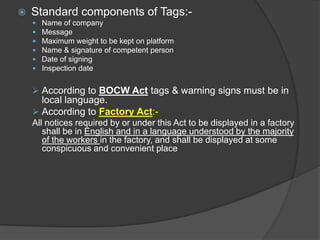
   Standard components of Tags:-
       Name of company
       Message
       Maximum weight to be kept on platform
       Name & signature of competent person
       Date of signing
       Inspection date


     According to BOCW Act tags & warning signs must be in
      local language.
     According to Factory Act:-
    All notices required by or under this Act to be displayed in a factory
       shall be in English and in a language understood by the majority
       of the workers in the factory, and shall be displayed at some
       conspicuous and convenient place
Applicable Act’s:-
    BOCW ACT 1996
                     &
FACTORIES ACT 1948
BOCW ACT 1996
   Chapter XXIII
     Scaffold
   215. Scaffold construction
   216. Supervision by a responsible person
   217. Maintenance
   218. Standards, ledger, putlogs
   219. Working platform
   220. Board, plank and decking
   221. Repair of damaged scaffold
   222. Opening
   223. Guardrails
BOCW ACT 1996
 224. Scaffold used by building workers of
  different employers
 225. Protection against electric power line
 226. Screening net and wire-nets
 227. Tower scaffold
 228. Gear for suspension of scaffold
 229. Trestle scaffold and cantilever scaffold:-
 230. Scaffold supported by building
 231. Use of winches and climbers for
  suspended scaffold
 232. Safety devices for suspended scaffold
FACTORIES ACT 1948

 Under Section 32:-
 (c) when any person has to work at a
  height from where he is likely to
  fall, provision shall be made, so far as is
  reasonably practicable, by fencing or
  otherwise, to ensure the safety of the
  person so working.
 {Here Act clearly indicates there must be
  “Prevent fall” rather than additional
  provision’s like safety ne etc.}
Inspection Points
   Scaffold must be
   inspected and should
   be documented at start
   of each shift or after
   modifications by a
   competent person
   . Do a Visual Inspection
   for Obvious Issues:
   . Access
   . Full Planking
   . Guardrails
   . Plumbness
   Competent Person Checklist:
   1. When was the last time the scaffold was inspected?
   2. Were the planks looked at? (checked for saw cuts, fungi, dents,
   face breaks, and splits)
   3. Is there a ladder? (obstructed access, three feet above, within
    two
   feet of the bottom, built in)
   4. Who trained the erecting & dismantling crew?
   5. Last time the users were trained?
   6. What is the maximum intended load of this scaffold?
   7. What is the maximum load you intend to put on it?
   8. Plum, square, level?
   9. Base plates, mudsills?.(what is the foundation like)
   10. Working levels fully planked? (holes, max. 9 1/2.)
   11. Extensions of planks over the end frame? (6.-12.)
   12. Fall protection? (when & what)
   13. Securing the scaffold at 4:1? (width of frame)
   Maintain clearance near ALL power lines
   Scaffolding must be fully Planked

Scaffolding

  • 1.
    Training conducted atEERC Theramx Ltd. On 24 & 25 Sep 2012 BY Mr. V N Parbhu
  • 2.
    SCAFFOLD: “A temporary elevatedplatform and its supporting structure used for supporting workmen, materials, or both" in the construction or repair of buildings an d other large structures.
  • 3.
    Types of scaffolds  Categories  Suspended  Supported, tubular  Rolling  Tubular scaffolding are further divided in 3 groups:  Pipe & coupler ( Clamp)  H frame  Cuplock
  • 4.
    Tubular scaffolding  Frequentlyused in construction work.  TUBE & COUPLER SCAFFOLD: “A scaffold constructed of steel tubing that serves as standards, ledgers, transoms, braces, a nd ties and specially designed scaffold couplers that serve to connect the various members”.
  • 5.
    Independent Guard Rail (Approx 1.0 m high) Brick Guard Tied Intermediate guard rail (Max gap of 470 mm) Scaffold END OF Toe Board (Min 150 mm high) SCAFFOLD Scaffolding Planks (Deck area min of 600 mm wide) Transom Facade Brace Large Through Tie Ledger Brace Eye Bolt Reveal Tie Couplers at joints Ledger Standard Eye Bolt and Strap Base Plates Sole Plates
  • 6.
    VARIOUS PARTS OF SCAFFOLDS  STANDARD: “Vertical scaffold tube that bears the weight of the Scaffold”.  LEDGER: “A lengthwise horizontal scaffold tube that extends from standard to standard, that supports the transoms and that forms a tie between the standards”.  TRANSOM: “A horizontal transverse scaffold member, that may support platform units, and which is supported by at least two ledgers or connected directly to at least two standards”.  COUPLER: “A component or device used to fix scaffold tubes together”.  PLANK: “An individual timber board or fabricated component that serves as a flooring member of a platform”.  HANDRAIL: “A barrier consisting of pipes erected to prevent workers from falling off an elevated work area”.  TOE BOARD: A barrier min 150 mm height to prevent slip/fall of material from platform.  MID RAIL  MUDSILL(SOLE PLATE): IT IS A WOODEN PLATE THAT IS USED TO DISTRIBUTE THE SCAFFOLDING LOAD OVER A SUITABLE GROUND AREA.  BASE PLATE:  DIAGONAL BRACING  ACCESS LADDER
  • 9.
    MUDSILL(SOLE PLATE)  ITIS A WOODEN PLATE THAT IS USED TO DISTRIBUTE THE SCAFFOLDING LOAD OVER A SUITABLE GROUND AREA.  THE SIZE OF MUDSILL IS DETERMINED BY THE LOAD CARRIED OVER A PARTICULAR GROUND AREA, AND BY THE NATURE OF THE SOIL SUPPORTING THESE SILLS.
  • 11.
    BASE PLATE  ITSPREADS CROSS- SECTIONAL AREA OF THE STANDARD TO LARGE AREA.  IT PREVENTS SINKING OF STANDARDS.  IT PREVENTS OVERTURNING OF SCAFFOLD.  IT CARRIES THE WEIGHT OF SCAFFOLD.
  • 12.
    Guardrail & Midrail “Thesebarriers used to prevent fall of any persons from platform.”  General Requirements for guardrail & midrail:-  NOMINAL DIA.- AT LEAST 1.5 INCHES.  SPACING OF POSTS- NOT MORE THAN 8 FEET.  MUST BE CAPABLE OF WITHSTANDING A LOAD OF 200 POUNDS WHEN APPLIED FROM ANY DIRECTION & AT ANY POINT ON THE TOP RAIL.  THE HEIGHT OF TOP RAILSHOULD BE 42 INCHES FROM THE TOP OF RAIL TO PLATFORM LEVEL.  MIDRAIL TO BE PLACED HALF WAY.
  • 13.
    TOEBOARD  HEIGHT OFTOE BOARD SHOULD BE AT LEAST 4 INCHES.  TO BE MOUNTED WITHIN ¼ INCHES OF THE WORKING PLATFORM.  PURPOSE IS TO STOP SUDDEN TRAVEL OF A PERSON ON SCAFFOLD PLATFORM AFTER SLIPPING.
  • 14.
    MANY FATAL ACCIDENTS HAVE OCCURRED WHEN PERSONS HAVE FALLEN DOWN FROM A SCAFFOLD DURING THE PROCESS OF CLIMBING OR WHILE GETTING DOWN.  MUST PROVIDE SAFE ACCESS TO SCAFFOLD & SCAFFOLD PLATFORM.  THE BOTTOM STEP OR RUNG OF LADDER ( hook-on ladder , attachable ladder or stairway type ladder whichever the case may be ) MUST NOT BE MORE THAN 24 INCHES ABOVE OR BELOW THE SCAFFOLD SUPPORTING LEVEL.  FOR SUPPORTED SCAFFOLDS OF MORE THAN 35 FEET HEIGHT , PROVIDE A REST PLATFORM AT 35 FEET HEIGHT.  PROVIDE A REST PLATFORM EVERY 12 FEET IN CASE OF STAIRWAY TYPE ACCESS LADDER  Rungs should be round type only.
  • 15.
  • 18.
    5 MAJOR MISHAPS. 1. Person falling while climbing up or coming down. 2. Person falling from the working platform / deck. 3. Objects falling from a scaffold on to someone below. 4. Object falling from above on to a worker on the scaffold. 5. Tilting of scaffold or collapse of scaffold.
  • 19.
    TAGS  Types:-  a) Caution Tag  b)Danger Tag  c)Ok Tag Important Features of Tags-  Abrasive and chemical resistance  Water Proof(salt water/steam resistance)  Ultraviolet radiation  High visibility  Made as per privilege standard  Reusable feature  Color as per the message  Size & thickness of letters as per standard
  • 20.
    Standard components of Tags:-  Name of company  Message  Maximum weight to be kept on platform  Name & signature of competent person  Date of signing  Inspection date  According to BOCW Act tags & warning signs must be in local language.  According to Factory Act:- All notices required by or under this Act to be displayed in a factory shall be in English and in a language understood by the majority of the workers in the factory, and shall be displayed at some conspicuous and convenient place
  • 22.
    Applicable Act’s:- BOCW ACT 1996 & FACTORIES ACT 1948
  • 23.
    BOCW ACT 1996  Chapter XXIII  Scaffold  215. Scaffold construction  216. Supervision by a responsible person  217. Maintenance  218. Standards, ledger, putlogs  219. Working platform  220. Board, plank and decking  221. Repair of damaged scaffold  222. Opening  223. Guardrails
  • 24.
    BOCW ACT 1996 224. Scaffold used by building workers of different employers  225. Protection against electric power line  226. Screening net and wire-nets  227. Tower scaffold  228. Gear for suspension of scaffold  229. Trestle scaffold and cantilever scaffold:-  230. Scaffold supported by building  231. Use of winches and climbers for suspended scaffold  232. Safety devices for suspended scaffold
  • 25.
    FACTORIES ACT 1948 Under Section 32:-  (c) when any person has to work at a height from where he is likely to fall, provision shall be made, so far as is reasonably practicable, by fencing or otherwise, to ensure the safety of the person so working.  {Here Act clearly indicates there must be “Prevent fall” rather than additional provision’s like safety ne etc.}
  • 26.
    Inspection Points  Scaffold must be  inspected and should  be documented at start  of each shift or after  modifications by a  competent person  . Do a Visual Inspection  for Obvious Issues:  . Access  . Full Planking  . Guardrails  . Plumbness
  • 27.
    Competent Person Checklist:  1. When was the last time the scaffold was inspected?  2. Were the planks looked at? (checked for saw cuts, fungi, dents,  face breaks, and splits)  3. Is there a ladder? (obstructed access, three feet above, within two  feet of the bottom, built in)  4. Who trained the erecting & dismantling crew?  5. Last time the users were trained?  6. What is the maximum intended load of this scaffold?  7. What is the maximum load you intend to put on it?  8. Plum, square, level?  9. Base plates, mudsills?.(what is the foundation like)  10. Working levels fully planked? (holes, max. 9 1/2.)  11. Extensions of planks over the end frame? (6.-12.)  12. Fall protection? (when & what)  13. Securing the scaffold at 4:1? (width of frame)  Maintain clearance near ALL power lines  Scaffolding must be fully Planked