

PAPER-XIII(b)
TEACHER EDUCATION INSTITUTIONS
AND FIELD WORK
SANA FATIMA
M.ED (SEM-III)
GHULAM AHMED COLLEGE OF
EDUCATION, BANJARA HILLS, HYD.
OSMANIA UNIVERSITY
SUBJECT:PSYCHOLOGY OF
CHILDHOOD AND ADOLESCENCE
UNIT- 4 PERSPECTIVES ON
LEARNING
4.4- CONSTRUCTIVIST APPROACH
IN LEARNING (VYGOTSKY)
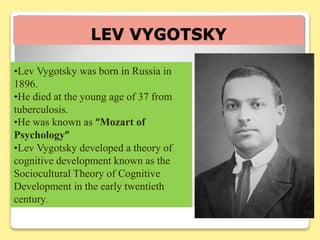
LEV VYGOTSKY
•Lev Vygotsky was born in Russia in
1896.
•He died at the young age of 37 from
tuberculosis.
•He was known as “Mozart of
Psychology”
•Lev Vygotsky developed a theory of
cognitive development known as the
Sociocultural Theory of Cognitive
Development in the early twentieth
century.
LEV VYGOTSKY’S
CONSTRUCTIVIST THEORY
 The main assertion of the Vygotsky
theory is that the cognitive
development of children is advanced
through social interaction with other
people, particularly those who are more
skilled. In other words, Vygotsky
believed that social learning comes
before cognitive development, and that
children construct knowledge actively.
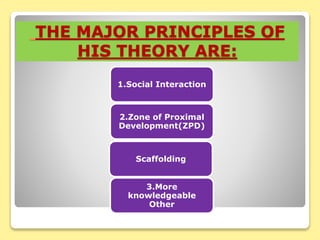
THE MAJOR PRINCIPLES OF
HIS THEORY ARE:
1.Social Interaction
2.Zone of Proximal
Development(ZPD)
Scaffolding
3.More
knowledgeable
Other
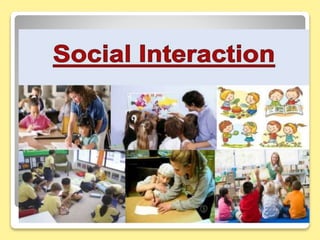
 Vygotsky placed more emphasis on social
contributions to the process of
development. This theory suggests that
social-interaction leads to continuous
step-by-step changes in children’s thought
and behavior that can vary greatly from
culture to culture.
The three cultural tools are:
i)Imitative learning
ii)Instructed learning
iii)Collaborative learning.
2 .ZONE OF PROXIMAL
DEVELOPMENT(ZPD):
 Vygotsky is most
recognized for his
concept of Zone of
Proximal
Development
(ZPD) pertaining to the
learning process of
children.
 It relates to the
difference between what
a child can achieve
independently and what
a child can achieve with
guidance and
encouragement from a
skilled partner.
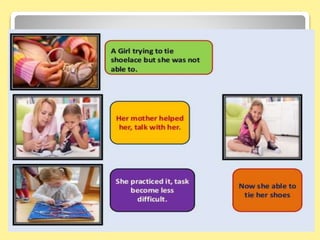
SCAFFOLDING
 Vygotsky’s concept of scaffolding is
closely related to the concept of the Zone
of Proximal Development.
 Scaffolding refers to the temporary
support given to a child by a More
Knowledgeable Other that enables the
child to perform a task until such time
that the child can perform this task
independently.
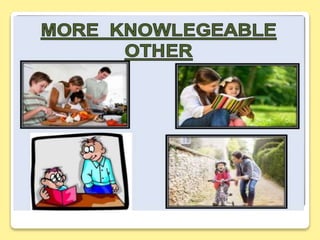
3.MORE KNOWLEDGEABLE OTHER:
 A person with a better understanding and
considerably higher or superior level of
ability, skill or knowledge about a particular
subject, task or process,than the person who
is attempting to learn (also called the
learner).
 The MKO often comes in the person of a
teacher, a superior at work, or a peer with
more experience.There are instances when he
could be someone younger, but with more
cultivated knowledge and skill.In this digital
age, the MKO may even be a computer or
any intelligent machine.In the eyes of a child,
adults are the MKO’s.
EDUCATIONAL IMPLICATIONS:
 Vygotsky's zpd helps us realize that learners
can achieve independence in classroom
activities if
given an appropriate amount of assistance.
 Teachers should act as facilitators.
 Learning is an experience based process of
inquiring,discovering,exploring and doing.
 Learning is achieved best through a socially
interactive process.
 Children construct their knowledge.
Evaluation
 1.Lev Vygotsky’s Constructivist theory is
also known as?
 2.What are the major principles of
Vygotsky’s theory?
 3.What is ZPD?
 4.Scaffolding is closely related to which
aspect of vygotsky’s theory?
CONSTRUCTIVIST APPROACH IN LEARNING (VYGOTSKY)

CONSTRUCTIVIST APPROACH IN LEARNING (VYGOTSKY)

  • 1.
    PAPER-XIII(b) TEACHER EDUCATION INSTITUTIONS ANDFIELD WORK SANA FATIMA M.ED (SEM-III) GHULAM AHMED COLLEGE OF EDUCATION, BANJARA HILLS, HYD. OSMANIA UNIVERSITY
  • 2.
    SUBJECT:PSYCHOLOGY OF CHILDHOOD ANDADOLESCENCE UNIT- 4 PERSPECTIVES ON LEARNING 4.4- CONSTRUCTIVIST APPROACH IN LEARNING (VYGOTSKY)
  • 3.
    LEV VYGOTSKY •Lev Vygotskywas born in Russia in 1896. •He died at the young age of 37 from tuberculosis. •He was known as “Mozart of Psychology” •Lev Vygotsky developed a theory of cognitive development known as the Sociocultural Theory of Cognitive Development in the early twentieth century.
  • 4.
    LEV VYGOTSKY’S CONSTRUCTIVIST THEORY The main assertion of the Vygotsky theory is that the cognitive development of children is advanced through social interaction with other people, particularly those who are more skilled. In other words, Vygotsky believed that social learning comes before cognitive development, and that children construct knowledge actively.
  • 5.
    THE MAJOR PRINCIPLESOF HIS THEORY ARE: 1.Social Interaction 2.Zone of Proximal Development(ZPD) Scaffolding 3.More knowledgeable Other
  • 7.
     Vygotsky placedmore emphasis on social contributions to the process of development. This theory suggests that social-interaction leads to continuous step-by-step changes in children’s thought and behavior that can vary greatly from culture to culture. The three cultural tools are: i)Imitative learning ii)Instructed learning iii)Collaborative learning.
  • 8.
    2 .ZONE OFPROXIMAL DEVELOPMENT(ZPD):  Vygotsky is most recognized for his concept of Zone of Proximal Development (ZPD) pertaining to the learning process of children.  It relates to the difference between what a child can achieve independently and what a child can achieve with guidance and encouragement from a skilled partner.
  • 11.
    SCAFFOLDING  Vygotsky’s conceptof scaffolding is closely related to the concept of the Zone of Proximal Development.  Scaffolding refers to the temporary support given to a child by a More Knowledgeable Other that enables the child to perform a task until such time that the child can perform this task independently.
  • 13.
    3.MORE KNOWLEDGEABLE OTHER: A person with a better understanding and considerably higher or superior level of ability, skill or knowledge about a particular subject, task or process,than the person who is attempting to learn (also called the learner).  The MKO often comes in the person of a teacher, a superior at work, or a peer with more experience.There are instances when he could be someone younger, but with more cultivated knowledge and skill.In this digital age, the MKO may even be a computer or any intelligent machine.In the eyes of a child, adults are the MKO’s.
  • 14.
    EDUCATIONAL IMPLICATIONS:  Vygotsky'szpd helps us realize that learners can achieve independence in classroom activities if given an appropriate amount of assistance.  Teachers should act as facilitators.  Learning is an experience based process of inquiring,discovering,exploring and doing.  Learning is achieved best through a socially interactive process.  Children construct their knowledge.
  • 15.
    Evaluation  1.Lev Vygotsky’sConstructivist theory is also known as?  2.What are the major principles of Vygotsky’s theory?  3.What is ZPD?  4.Scaffolding is closely related to which aspect of vygotsky’s theory?