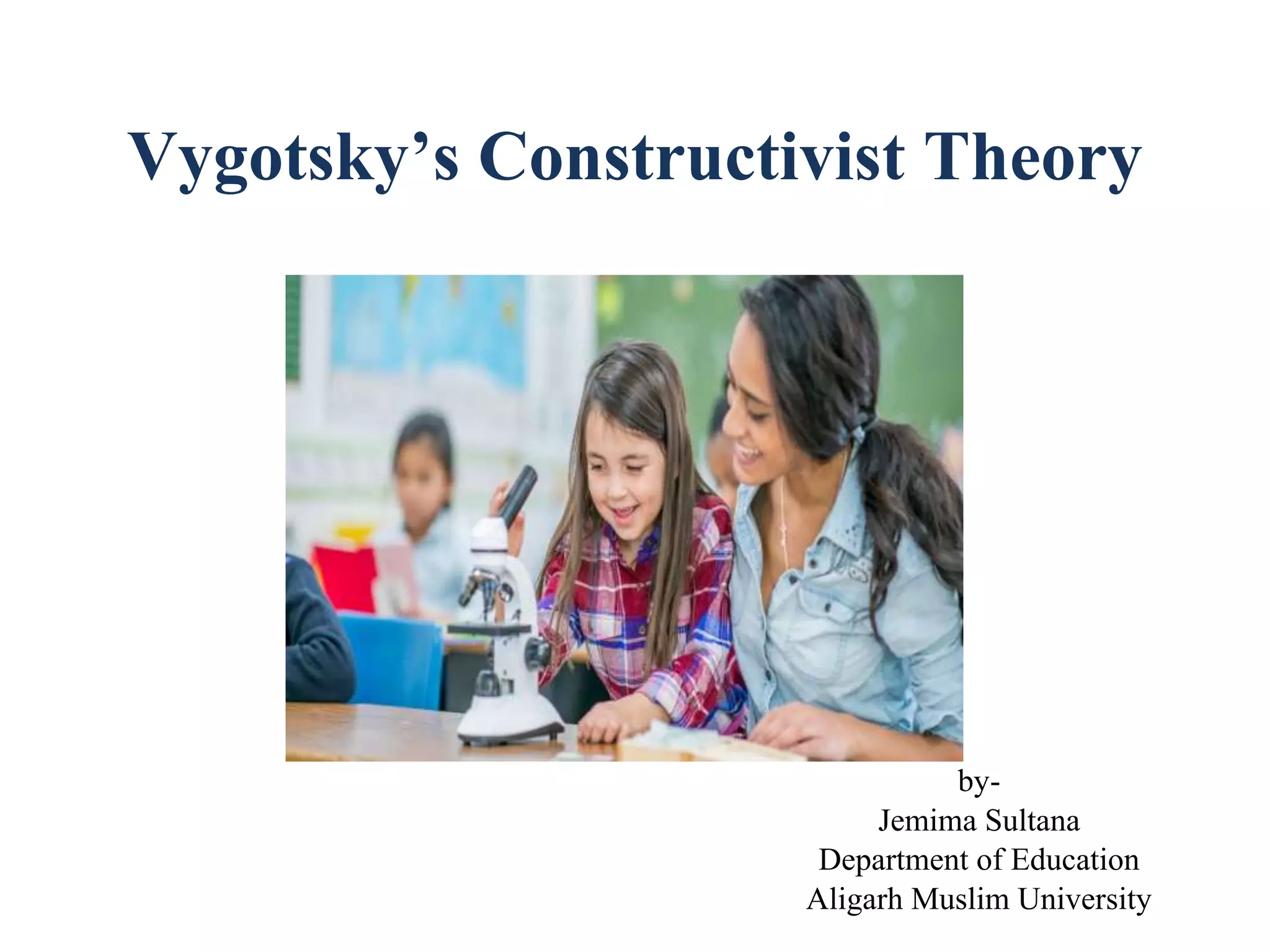
Vygotsky’s Constructivist Theory
by-
Jemima Sultana
Department of Education
Aligarh Muslim University
Contents:
• Introduction
• Who was Lev Vygotsky?
• Constructivism
• Vygotsky’s Constructivist Theory
• Major themes on this Theory:
1. Internalization
2. Zone of Proximal Development(ZPD)
3. More Knowledgeable Other(MKO)
4. Scaffolding with view of Knowledge and Thoughts
5. Language and Thoughts
• Relationship between Language and Thought
• Educational Implications
• Conclusion
• References
Introduction
Social constructivism is a variety of cognitive constructivism that emphasizes
the collaborative nature of much learning. Vygotsky was a cognitivist, but
rejected the assumption made by cognitivists such as Piaget that who separate
learning from its social context. He argued that all cognitive functions
originate in, and must therefore be explained as products of social interactions
and that learning was not simply the assimilation and accommodation of new
knowledge by learners; it was the process by which learners were integrated
into a knowledge community.
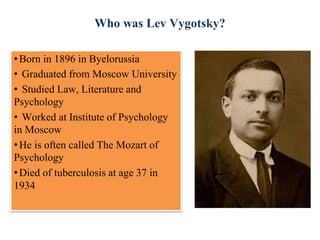
Who was Lev Vygotsky?
•Born in 1896 in Byelorussia
• Graduated from Moscow University
• Studied Law, Literature and
Psychology
• Worked at Institute of Psychology
in Moscow
•He is often called The Mozart of
Psychology
•Died of tuberculosis at age 37 in
1934
What is Constructivism?
Constructivism is an important learning theory that educators use to help their students
learn. Constructivism is based on the idea that people actively construct or make their own
knowledge, and that reality is determined by your experiences as a learner. Basically,
learners use their previous knowledge as a foundation and build on it with new things that
they learn. So everyone's individual experiences make their learning unique to them.
Cognitive constructivism: Cognitive constructivism focuses on the idea that learners
actively construct their knowledge in interaction with the environment. Cognitive
constructivism comes from Jean Piaget’s work on cognitive development in children.
Social constructivism: Social constructivism focuses on the collaborative nature of
learning. Knowledge develops from how people interact with each other, their culture, and
society at large. It comes from Vygotsky, and is closely connected to cognitive
constructivism with the added element of societal and peer influence.
Vygotsky’s Constructivist Theory
•Vygotsky's approach to child development is a form of social constructivism,
based on the idea that cognitive functions are the products of social
interactions.
•Vygotsky emphasized the collaborative nature of learning by the
construction of knowledge through social negotiation.
•He rejected the assumption made by Piaget that it was possible to separate
learning from its social context.
•Vygotsky believed everything is learned on two levels. First, through
interaction with others, and then integrated into the individual’s mental
structure.
Major Themes on this Theory
1. Internalization
2. Zone of Proximal Development(ZPD)
3. More Knowledgeable Other(MKO)
4. Scaffolding- i. View of Knowledge and
ii. View of Motivation
5. Language and Thought
Internalization
•Vygotsky’s theory was an attempt to explain consciousness at the end
product of socialization.
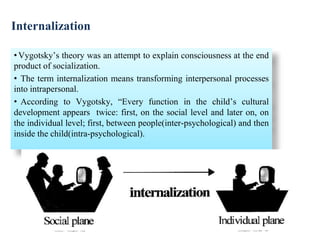
• The term internalization means transforming interpersonal processes
into intrapersonal.
• According to Vygotsky, “Every function in the child’s cultural
development appears twice: first, on the social level and later on, on
the individual level; first, between people(inter-psychological) and then
inside the child(intra-psychological).
Zone of Proximal Development(ZPD)
•The zone of proximal development (ZPD)
is defined as the difference between a child's
“actual developmental level as determined
by independent problem solving” and the
child's “potential development as
determined through problem solving under
adult guidance or in collaboration with more
capable peers”.
• “Proximal” simply means “next”. So,
ZPD is the stage where learner can learn
assisted but not alone.
More Knowledgeable Other(MKO)
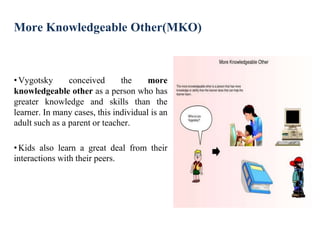
•Vygotsky conceived the more
knowledgeable other as a person who has
greater knowledge and skills than the
learner. In many cases, this individual is an
adult such as a parent or teacher.
•Kids also learn a great deal from their
interactions with their peers.
Scaffolding
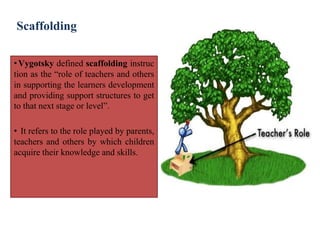
•Vygotsky defined scaffolding instruc
tion as the “role of teachers and others
in supporting the learners development
and providing support structures to get
to that next stage or level”.
• It refers to the role played by parents,
teachers and others by which children
acquire their knowledge and skills.
View of Knowledge:
•According to Vygotsky, language and culture play an important role in human
knowledge development and in how human perceive the world.
•Vygotsky states , “A special feature of human perception…..is the perception of
real objects…..I do not see the world simply in colour and shape but also as a
world wit sense and meaning. I do not merely see something round and black with
two hand; I see a clock…..”
View of Motivation:
•Social constructivists see motivation as both extrinsic and intrinsic.
•Because is essentially a social phenomenon, learners are partially motivated by
rewards provided by the knowledge community.
•However, because knowledge is actively constructed by the learner, learning also
depends on the learner’s internal drive to understand and promote the learning
process.
Example
Language and Thought
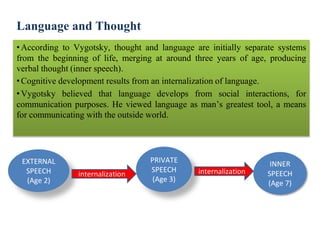
•According to Vygotsky, thought and language are initially separate systems
from the beginning of life, merging at around three years of age, producing
verbal thought (inner speech).
•Cognitive development results from an internalization of language.
•Vygotsky believed that language develops from social interactions, for
communication purposes. He viewed language as man’s greatest tool, a means
for communicating with the outside world.
EXTERNAL
SPEECH
(Age 2)
internalization
PRIVATE
SPEECH
(Age 3)
internalization
INNER
SPEECH
(Age 7)
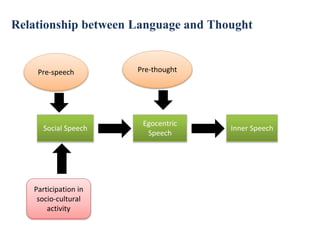
Relationship between Language and Thought
Social Speech
Egocentric
Speech
Inner Speech
Pre-speech Pre-thought
Participation in
socio-cultural
activity
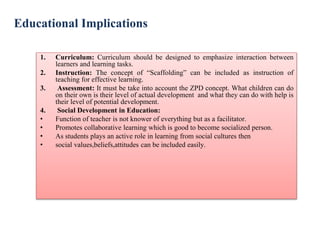
Educational Implications
1. Curriculum: Curriculum should be designed to emphasize interaction between
learners and learning tasks.
2. Instruction: The concept of “Scaffolding” can be included as instruction of
teaching for effective learning.
3. Assessment: It must be take into account the ZPD concept. What children can do
on their own is their level of actual development and what they can do with help is
their level of potential development.
4. Social Development in Education:
• Function of teacher is not knower of everything but as a facilitator.
• Promotes collaborative learning which is good to become socialized person.
• As students plays an active role in learning from social cultures then
• social values,beliefs,attitudes can be included easily.
Conclusion
Vygotsky believed that individual development could not be
understood without reference to the social and cultural
context within which such development is embedded. There
is a great role of more knowledgeable others who can give
scaffolding to the learners to fill the gap between actual level
and potential level which is known as zone of proximal
development.
References
•Theories in Psychology: Vygotsky
http://www.psy.pdx.edu/psicafe/key-theories/vygotsky.htm
•Vygotsky and Language acquisition
http://www.sk.com.br/sk-vygot.html
•Zone of Proximal Development
http://www.ncrel.org/scrls/areas/isues/students/learning/lrlzpd.htm
•Panda M.(2018) Learning and Teaching, Kolkata, Aaheli Publishers
•Vygotsky’s Social Learning
http://www.learningtheories.com/vygotskys-social-learning-theory.html
Thank
You

Vygotsky’s Constructivist Theory

  • 1.
    Vygotsky’s Constructivist Theory by- JemimaSultana Department of Education Aligarh Muslim University
  • 2.
    Contents: • Introduction • Whowas Lev Vygotsky? • Constructivism • Vygotsky’s Constructivist Theory • Major themes on this Theory: 1. Internalization 2. Zone of Proximal Development(ZPD) 3. More Knowledgeable Other(MKO) 4. Scaffolding with view of Knowledge and Thoughts 5. Language and Thoughts • Relationship between Language and Thought • Educational Implications • Conclusion • References
  • 3.
    Introduction Social constructivism isa variety of cognitive constructivism that emphasizes the collaborative nature of much learning. Vygotsky was a cognitivist, but rejected the assumption made by cognitivists such as Piaget that who separate learning from its social context. He argued that all cognitive functions originate in, and must therefore be explained as products of social interactions and that learning was not simply the assimilation and accommodation of new knowledge by learners; it was the process by which learners were integrated into a knowledge community.
  • 4.
    Who was LevVygotsky? •Born in 1896 in Byelorussia • Graduated from Moscow University • Studied Law, Literature and Psychology • Worked at Institute of Psychology in Moscow •He is often called The Mozart of Psychology •Died of tuberculosis at age 37 in 1934
  • 5.
    What is Constructivism? Constructivismis an important learning theory that educators use to help their students learn. Constructivism is based on the idea that people actively construct or make their own knowledge, and that reality is determined by your experiences as a learner. Basically, learners use their previous knowledge as a foundation and build on it with new things that they learn. So everyone's individual experiences make their learning unique to them. Cognitive constructivism: Cognitive constructivism focuses on the idea that learners actively construct their knowledge in interaction with the environment. Cognitive constructivism comes from Jean Piaget’s work on cognitive development in children. Social constructivism: Social constructivism focuses on the collaborative nature of learning. Knowledge develops from how people interact with each other, their culture, and society at large. It comes from Vygotsky, and is closely connected to cognitive constructivism with the added element of societal and peer influence.
  • 6.
    Vygotsky’s Constructivist Theory •Vygotsky'sapproach to child development is a form of social constructivism, based on the idea that cognitive functions are the products of social interactions. •Vygotsky emphasized the collaborative nature of learning by the construction of knowledge through social negotiation. •He rejected the assumption made by Piaget that it was possible to separate learning from its social context. •Vygotsky believed everything is learned on two levels. First, through interaction with others, and then integrated into the individual’s mental structure.
  • 7.
    Major Themes onthis Theory 1. Internalization 2. Zone of Proximal Development(ZPD) 3. More Knowledgeable Other(MKO) 4. Scaffolding- i. View of Knowledge and ii. View of Motivation 5. Language and Thought
  • 8.
    Internalization •Vygotsky’s theory wasan attempt to explain consciousness at the end product of socialization. • The term internalization means transforming interpersonal processes into intrapersonal. • According to Vygotsky, “Every function in the child’s cultural development appears twice: first, on the social level and later on, on the individual level; first, between people(inter-psychological) and then inside the child(intra-psychological).
  • 9.
    Zone of ProximalDevelopment(ZPD) •The zone of proximal development (ZPD) is defined as the difference between a child's “actual developmental level as determined by independent problem solving” and the child's “potential development as determined through problem solving under adult guidance or in collaboration with more capable peers”. • “Proximal” simply means “next”. So, ZPD is the stage where learner can learn assisted but not alone.
  • 10.
    More Knowledgeable Other(MKO) •Vygotskyconceived the more knowledgeable other as a person who has greater knowledge and skills than the learner. In many cases, this individual is an adult such as a parent or teacher. •Kids also learn a great deal from their interactions with their peers.
  • 11.
    Scaffolding •Vygotsky defined scaffoldinginstruc tion as the “role of teachers and others in supporting the learners development and providing support structures to get to that next stage or level”. • It refers to the role played by parents, teachers and others by which children acquire their knowledge and skills.
  • 12.
    View of Knowledge: •Accordingto Vygotsky, language and culture play an important role in human knowledge development and in how human perceive the world. •Vygotsky states , “A special feature of human perception…..is the perception of real objects…..I do not see the world simply in colour and shape but also as a world wit sense and meaning. I do not merely see something round and black with two hand; I see a clock…..” View of Motivation: •Social constructivists see motivation as both extrinsic and intrinsic. •Because is essentially a social phenomenon, learners are partially motivated by rewards provided by the knowledge community. •However, because knowledge is actively constructed by the learner, learning also depends on the learner’s internal drive to understand and promote the learning process.
  • 13.
  • 14.
    Language and Thought •Accordingto Vygotsky, thought and language are initially separate systems from the beginning of life, merging at around three years of age, producing verbal thought (inner speech). •Cognitive development results from an internalization of language. •Vygotsky believed that language develops from social interactions, for communication purposes. He viewed language as man’s greatest tool, a means for communicating with the outside world. EXTERNAL SPEECH (Age 2) internalization PRIVATE SPEECH (Age 3) internalization INNER SPEECH (Age 7)
  • 15.
    Relationship between Languageand Thought Social Speech Egocentric Speech Inner Speech Pre-speech Pre-thought Participation in socio-cultural activity
  • 16.
    Educational Implications 1. Curriculum:Curriculum should be designed to emphasize interaction between learners and learning tasks. 2. Instruction: The concept of “Scaffolding” can be included as instruction of teaching for effective learning. 3. Assessment: It must be take into account the ZPD concept. What children can do on their own is their level of actual development and what they can do with help is their level of potential development. 4. Social Development in Education: • Function of teacher is not knower of everything but as a facilitator. • Promotes collaborative learning which is good to become socialized person. • As students plays an active role in learning from social cultures then • social values,beliefs,attitudes can be included easily.
  • 17.
    Conclusion Vygotsky believed thatindividual development could not be understood without reference to the social and cultural context within which such development is embedded. There is a great role of more knowledgeable others who can give scaffolding to the learners to fill the gap between actual level and potential level which is known as zone of proximal development.
  • 18.
    References •Theories in Psychology:Vygotsky http://www.psy.pdx.edu/psicafe/key-theories/vygotsky.htm •Vygotsky and Language acquisition http://www.sk.com.br/sk-vygot.html •Zone of Proximal Development http://www.ncrel.org/scrls/areas/isues/students/learning/lrlzpd.htm •Panda M.(2018) Learning and Teaching, Kolkata, Aaheli Publishers •Vygotsky’s Social Learning http://www.learningtheories.com/vygotskys-social-learning-theory.html
  • 19.