Success Through Scaffolding
Practical application of verbal,
procedural and instructional scaffolds to
develop language and academic
proficiency in ALL our students
Presented by DHS SIOP Coaches Carla Huck and Beth Amaral
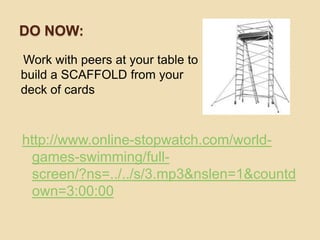
DO NOW:
Work with peers at your table to
build a SCAFFOLD from your
deck of cards
http://www.online-stopwatch.com/world-
games-swimming/full-
screen/?ns=../../s/3.mp3&nslen=1&countd
own=3:00:00
Think-Pair-Share
 What does scaffolding mean to you?
 How do you scaffold content within
your classroom?
 What would you like to know more
about this topic?
Objectives
Content Objectives:
(1) We will be able to identify effective teaching strategies, tools
and techniques that lead to academic content and language
learning in all classes.
(2) We will be able to organize instruction so that student
learning is scaffolded throughout each lesson -- using
verbal, procedural and instructional scaffolds.
Language Objectives:
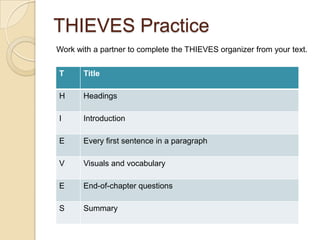
(1) We will read a text and complete a THIEVES organizer.
(2) We will view a video clip and listen for 10 new vocabulary
words to turn into a summary as part of a GIST exercise.
(3) We will discuss different types of scaffolds in a CONGA LINE
and ways to implement them in our own classes.
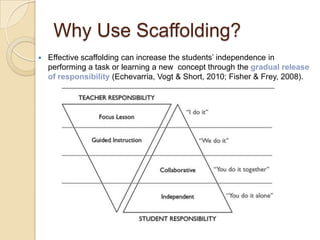
Why Use Scaffolding?
 Effective scaffolding can increase the students’ independence in
performing a task or learning a new concept through the gradual release
of responsibility (Echevarria, Vogt & Short, 2010; Fisher & Frey, 2008).
The Three Types of
Scaffolding
1. Verbal scaffolds are techniques focused on
language development:
 Paraphrasing
 Using “think-alouds”
 Reinforcing contextual definitions
 Providing correct pronunciation by repeating
students’ responses
 Slowing speech, increasing pauses, and speaking
in phrases
 Purposefully using synonyms, antonyms and
cognates
Verbal Scaffolding
Student: I am having a hard time answering this question.
Teacher: Let me take a look at it. Ok, the question is: “What was
significant about the Spanish Armada?”
Let’s look back through the chapter and try to find the word Armada. I
see it here, it is in bold. Do you know what that word means? How
about significant - is that a cognate?
Student: “Significativo” – it means important.
Teacher: Are there any pictures on the page to help us visualize an
Armada? Yes, look at the picture and compare the size of the Spanish
ships to the English ships.
Now let’s read the sentence it is in, the sentence before and the
sentence after and try to see if the answer we are looking for can be
found there.
(Philip built up a mighty fleet, or a group of warships under one
command. It was called the Armada. The Armada was the largest fleet
of ships that Europe had ever seen.)
Ok, now can we determine the answer?
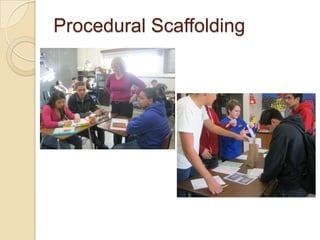
2. Procedural Scaffolds are techniques that relate
to grouping and activity structures:
 Using an instructional framework that includes
explicit teaching, modeling, and practice
opportunities with others, with expectations for
independent application.
 Providing opportunities for peer collaboration and
tutoring.
 Cooperative learning activities. Students support
one another as they are learning the subject matter
and accomplishing their roles. They practice their
oral language skills as they interact verbally.
 Use of routines
 Process writing, which focuses on the process of
creating writing and learning the stages of the
writing process, rather than the end product.
Procedural Scaffolding
3. Instructional scaffolds are tools that support
learning
 visuals and imagery
 manipulatives
 models and diagrams
 making a variety of resources available in the
classroom, e.g. dictionary, thesaurus, computers.
 posting schedules and project timelines
 graphic organizers (GIST)
 chapter outlines (THIEVES)
 word walls
 pictographs
 sentence starters and academic language frames
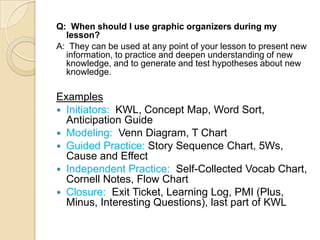
Q: When should I use graphic organizers during my
lesson?
A: They can be used at any point of your lesson to present new
information, to practice and deepen understanding of new
knowledge, and to generate and test hypotheses about new
knowledge.
Examples
 Initiators: KWL, Concept Map, Word Sort,
Anticipation Guide
 Modeling: Venn Diagram, T Chart
 Guided Practice: Story Sequence Chart, 5Ws,
Cause and Effect
 Independent Practice: Self-Collected Vocab Chart,
Cornell Notes, Flow Chart
 Closure: Exit Ticket, Learning Log, PMI (Plus,
Minus, Interesting Questions), last part of KWL
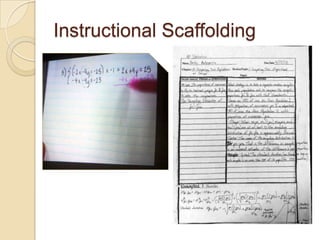
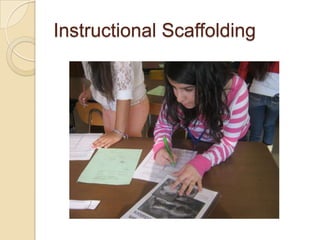
Instructional Scaffolding
How many scaffolds can you
find?
Teacher A arrives at class with
lecture notes in hand. She
writes on the board "Three
States of Matter: Solid,
Liquid, Gas." After her 20
minute oral presentation,
students are directed to read
a portion of their science
book and to answer the
questions at the end of the
section.
As students work, she
circulates among them and
answers questions
individually when hands are
raised.
Teacher B also arrives at class with lecture
notes. In addition, she carries a box full of
equipment, including many bowls, a small
hot plate, and a bag of ice cubes. Teacher
B also writes "Three States of Matter:
Solid, Liquid, Gas" on the board. But
underneath each word she adds a drawing
to represent each concept and illustrate
the molecular structure. As Teacher B
lectures she in turn melts ice, boils water,
and, under the drawings on the board,
writes ice, water, and steam.
Students in class B are also assigned a
portion of the text to read. But instead of
answering the questions in the text, they
are asked to work in pairs to write down
comprehension questions for their peers
to answer about the passage.
As students begin to read the text, Teacher B
sits down with a group of four beginning
ESL students to review the main ideas,
prepare the students to participate in the
next day's lesson, and show them that
they are to copy and label the drawings of
the three molecular structures into their
science journals.
THIEVES Practice
Work with a partner to complete the THIEVES organizer from your text.
T Title
H Headings
I Introduction
E Every first sentence in a paragraph
V Visuals and vocabulary
E End-of-chapter questions
S Summary
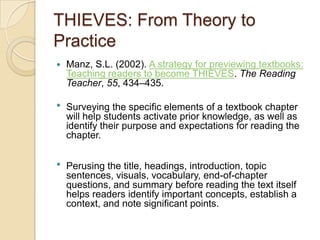
THIEVES: From Theory to
Practice
 Manz, S.L. (2002). A strategy for previewing textbooks:
Teaching readers to become THIEVES. The Reading
Teacher, 55, 434–435.
 Surveying the specific elements of a textbook chapter
will help students activate prior knowledge, as well as
identify their purpose and expectations for reading the
chapter.
 Perusing the title, headings, introduction, topic
sentences, visuals, vocabulary, end-of-chapter
questions, and summary before reading the text itself
helps readers identify important concepts, establish a
context, and note significant points.
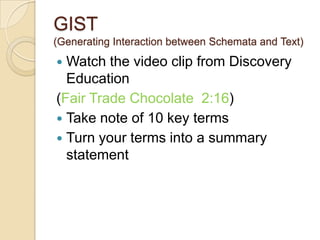
GIST
(Generating Interaction between Schemata and Text)
 Watch the video clip from Discovery
Education
(Fair Trade Chocolate 2:16)
 Take note of 10 key terms
 Turn your terms into a summary
statement
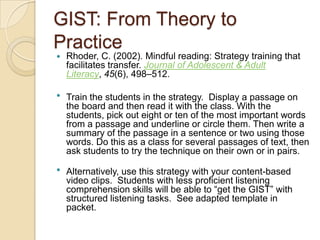
GIST: From Theory to
Practice
 Rhoder, C. (2002). Mindful reading: Strategy training that
facilitates transfer. Journal of Adolescent & Adult
Literacy, 45(6), 498–512.
 Train the students in the strategy. Display a passage on
the board and then read it with the class. With the
students, pick out eight or ten of the most important words
from a passage and underline or circle them. Then write a
summary of the passage in a sentence or two using those
words. Do this as a class for several passages of text, then
ask students to try the technique on their own or in pairs.
 Alternatively, use this strategy with your content-based
video clips. Students with less proficient listening
comprehension skills will be able to “get the GIST” with
structured listening tasks. See adapted template in
packet.
CONGA LINE
 Count off by twos
 Form two lines of “ones” and “twos” facing each
other
 For 30 seconds, ones will share their GIST
summary with the person across from them and
how they will implement this strategy in the
classroom.
 After 30 seconds, the “twos” will share.
 Then, the head of the line of “twos” will conga
through the center to the end of the “twos” line and
everyone will shift up one, giving everyone a new
partner.
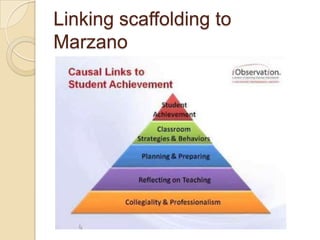
Linking scaffolding to
Marzano
Design Questions
Take a look at the Marzano Framework in your folder:
Domain 1: Classroom Strategies and Behaviors
 DQ2: What will I do to help students effectively interact with
new knowledge?
 DQ3: What will I do to help students practice and deepen
new knowledge?
 DQ4: What will I do to help students generate and test
hypotheses about new knowledge?
Domain 2: Planning and Preparing
 DQ10: What will I do to develop effective lessons organized
into a cohesive unit?
Closure
 Did we meet our objectives?
 Please complete your 3-2-1 Exit
Ticket:
3 things I learned today
2 ideas I will implement in my
classroom
1 strategy I would recommend to a
colleague
 Other comments and suggestions
appreciated - submit to our

Success through Scaffolding

  • 1.
    Success Through Scaffolding Practicalapplication of verbal, procedural and instructional scaffolds to develop language and academic proficiency in ALL our students Presented by DHS SIOP Coaches Carla Huck and Beth Amaral
  • 2.
    DO NOW: Work withpeers at your table to build a SCAFFOLD from your deck of cards http://www.online-stopwatch.com/world- games-swimming/full- screen/?ns=../../s/3.mp3&nslen=1&countd own=3:00:00
  • 3.
    Think-Pair-Share  What doesscaffolding mean to you?  How do you scaffold content within your classroom?  What would you like to know more about this topic?
  • 4.
    Objectives Content Objectives: (1) Wewill be able to identify effective teaching strategies, tools and techniques that lead to academic content and language learning in all classes. (2) We will be able to organize instruction so that student learning is scaffolded throughout each lesson -- using verbal, procedural and instructional scaffolds. Language Objectives: (1) We will read a text and complete a THIEVES organizer. (2) We will view a video clip and listen for 10 new vocabulary words to turn into a summary as part of a GIST exercise. (3) We will discuss different types of scaffolds in a CONGA LINE and ways to implement them in our own classes.
  • 5.
    Why Use Scaffolding? Effective scaffolding can increase the students’ independence in performing a task or learning a new concept through the gradual release of responsibility (Echevarria, Vogt & Short, 2010; Fisher & Frey, 2008).
  • 6.
    The Three Typesof Scaffolding 1. Verbal scaffolds are techniques focused on language development:  Paraphrasing  Using “think-alouds”  Reinforcing contextual definitions  Providing correct pronunciation by repeating students’ responses  Slowing speech, increasing pauses, and speaking in phrases  Purposefully using synonyms, antonyms and cognates
  • 7.
    Verbal Scaffolding Student: Iam having a hard time answering this question. Teacher: Let me take a look at it. Ok, the question is: “What was significant about the Spanish Armada?” Let’s look back through the chapter and try to find the word Armada. I see it here, it is in bold. Do you know what that word means? How about significant - is that a cognate? Student: “Significativo” – it means important. Teacher: Are there any pictures on the page to help us visualize an Armada? Yes, look at the picture and compare the size of the Spanish ships to the English ships. Now let’s read the sentence it is in, the sentence before and the sentence after and try to see if the answer we are looking for can be found there. (Philip built up a mighty fleet, or a group of warships under one command. It was called the Armada. The Armada was the largest fleet of ships that Europe had ever seen.) Ok, now can we determine the answer?
  • 8.
    2. Procedural Scaffoldsare techniques that relate to grouping and activity structures:  Using an instructional framework that includes explicit teaching, modeling, and practice opportunities with others, with expectations for independent application.  Providing opportunities for peer collaboration and tutoring.  Cooperative learning activities. Students support one another as they are learning the subject matter and accomplishing their roles. They practice their oral language skills as they interact verbally.  Use of routines  Process writing, which focuses on the process of creating writing and learning the stages of the writing process, rather than the end product.
  • 9.
  • 10.
    3. Instructional scaffoldsare tools that support learning  visuals and imagery  manipulatives  models and diagrams  making a variety of resources available in the classroom, e.g. dictionary, thesaurus, computers.  posting schedules and project timelines  graphic organizers (GIST)  chapter outlines (THIEVES)  word walls  pictographs  sentence starters and academic language frames
  • 11.
    Q: When shouldI use graphic organizers during my lesson? A: They can be used at any point of your lesson to present new information, to practice and deepen understanding of new knowledge, and to generate and test hypotheses about new knowledge. Examples  Initiators: KWL, Concept Map, Word Sort, Anticipation Guide  Modeling: Venn Diagram, T Chart  Guided Practice: Story Sequence Chart, 5Ws, Cause and Effect  Independent Practice: Self-Collected Vocab Chart, Cornell Notes, Flow Chart  Closure: Exit Ticket, Learning Log, PMI (Plus, Minus, Interesting Questions), last part of KWL
  • 12.
  • 13.
  • 14.
    How many scaffoldscan you find? Teacher A arrives at class with lecture notes in hand. She writes on the board "Three States of Matter: Solid, Liquid, Gas." After her 20 minute oral presentation, students are directed to read a portion of their science book and to answer the questions at the end of the section. As students work, she circulates among them and answers questions individually when hands are raised. Teacher B also arrives at class with lecture notes. In addition, she carries a box full of equipment, including many bowls, a small hot plate, and a bag of ice cubes. Teacher B also writes "Three States of Matter: Solid, Liquid, Gas" on the board. But underneath each word she adds a drawing to represent each concept and illustrate the molecular structure. As Teacher B lectures she in turn melts ice, boils water, and, under the drawings on the board, writes ice, water, and steam. Students in class B are also assigned a portion of the text to read. But instead of answering the questions in the text, they are asked to work in pairs to write down comprehension questions for their peers to answer about the passage. As students begin to read the text, Teacher B sits down with a group of four beginning ESL students to review the main ideas, prepare the students to participate in the next day's lesson, and show them that they are to copy and label the drawings of the three molecular structures into their science journals.
  • 15.
    THIEVES Practice Work witha partner to complete the THIEVES organizer from your text. T Title H Headings I Introduction E Every first sentence in a paragraph V Visuals and vocabulary E End-of-chapter questions S Summary
  • 16.
    THIEVES: From Theoryto Practice  Manz, S.L. (2002). A strategy for previewing textbooks: Teaching readers to become THIEVES. The Reading Teacher, 55, 434–435.  Surveying the specific elements of a textbook chapter will help students activate prior knowledge, as well as identify their purpose and expectations for reading the chapter.  Perusing the title, headings, introduction, topic sentences, visuals, vocabulary, end-of-chapter questions, and summary before reading the text itself helps readers identify important concepts, establish a context, and note significant points.
  • 17.
    GIST (Generating Interaction betweenSchemata and Text)  Watch the video clip from Discovery Education (Fair Trade Chocolate 2:16)  Take note of 10 key terms  Turn your terms into a summary statement
  • 18.
    GIST: From Theoryto Practice  Rhoder, C. (2002). Mindful reading: Strategy training that facilitates transfer. Journal of Adolescent & Adult Literacy, 45(6), 498–512.  Train the students in the strategy. Display a passage on the board and then read it with the class. With the students, pick out eight or ten of the most important words from a passage and underline or circle them. Then write a summary of the passage in a sentence or two using those words. Do this as a class for several passages of text, then ask students to try the technique on their own or in pairs.  Alternatively, use this strategy with your content-based video clips. Students with less proficient listening comprehension skills will be able to “get the GIST” with structured listening tasks. See adapted template in packet.
  • 19.
    CONGA LINE  Countoff by twos  Form two lines of “ones” and “twos” facing each other  For 30 seconds, ones will share their GIST summary with the person across from them and how they will implement this strategy in the classroom.  After 30 seconds, the “twos” will share.  Then, the head of the line of “twos” will conga through the center to the end of the “twos” line and everyone will shift up one, giving everyone a new partner.
  • 20.
  • 21.
    Design Questions Take alook at the Marzano Framework in your folder: Domain 1: Classroom Strategies and Behaviors  DQ2: What will I do to help students effectively interact with new knowledge?  DQ3: What will I do to help students practice and deepen new knowledge?  DQ4: What will I do to help students generate and test hypotheses about new knowledge? Domain 2: Planning and Preparing  DQ10: What will I do to develop effective lessons organized into a cohesive unit?
  • 22.
    Closure  Did wemeet our objectives?  Please complete your 3-2-1 Exit Ticket: 3 things I learned today 2 ideas I will implement in my classroom 1 strategy I would recommend to a colleague  Other comments and suggestions appreciated - submit to our

Editor's Notes

  • #6 One of the main benefits of scaffolded instruction is that it provides for a supportive learning environment in which students are free to ask questions, provide feedback and support their peers in learning new material. When you incorporate scaffolding in the classroom, you become more of a mentor and facilitator of knowledge rather than the dominant content expert.
  • #7 Insert a Goanimate video here
  • #13 Projecting/modeling with doc camera; note taking outline eg Cornell Notes
  • #20 This is procedural scaffolding