Serial ATA
2010/01
Outline
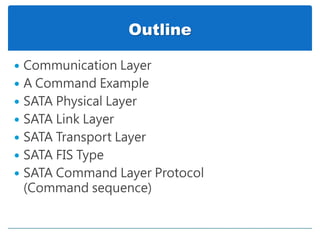
 Communication Layer
 A Command Example
 SATA Physical Layer
 SATA Link Layer
 SATA Transport Layer
 SATA FIS Type
 SATA Command Layer Protocol
(Command sequence)
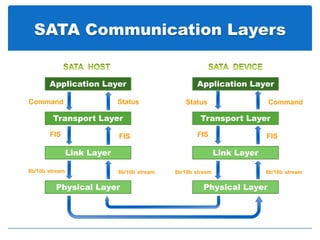
SATA Communication Layers
Application Layer
Transport Layer
Link Layer
Physical Layer
8b/10b stream
Status
FIS
8b/10b stream
FIS
Command
Application Layer
Transport Layer
Link Layer
Physical Layer
8b/10b stream
Status
FIS
8b/10b stream
FIS
Command
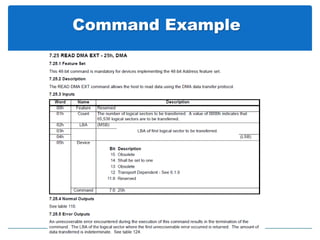
Command Example
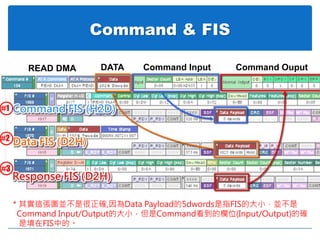
Command & FIS
#2
#1
#3
READ DMA Command Input Command OuputDATA
*其實這張圖並不是很正確,因為Data Payload的5dwords是指FIS的大小,並不是
Command Input/Output的大小,但是Command看到的欄位(Input/Output)的確
是填在FIS中的。
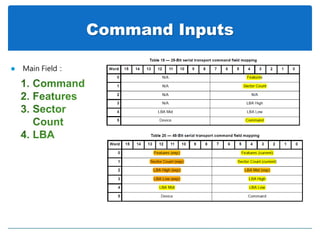
Command Inputs
 Main Field:
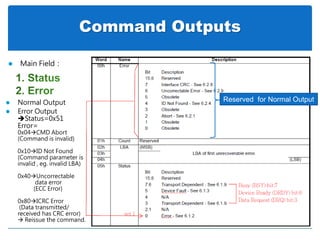
Command Outputs
Reserved for Normal Output
 Main Field:
 Normal Output
 Error Output
Status=0x51
Error=
0x04CMD Abort
(Command is invalid)
0x10ID Not Found
(Command parameter is
invalid , eg. invalid LBA)
0x40Uncorrectable
data error
(ECC Error)
0x80ICRC Error
(Data transmitted/
received has CRC error)
 Reissue the command.
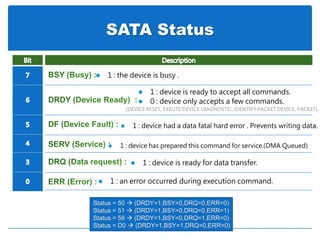
SATA Status
 1 : the device is busy .
 1 : device is ready to accept all commands.
 0 : device only accepts a few commands.
(DEVICE RESET, EXEUTE DEVICE DIAGNOSTIC, IDENTIFY PACKET DEVICE, PACKET).
 1 : device had a data fatal hard error . Prevents writing data.
 1 : device is ready for data transfer.
 1 : an error occurred during execution command.
 1 : device has prepared this command for service.(DMA Queued)
Status = 50  (DRDY=1,BSY=0,DRQ=0,ERR=0)
Status = 51  (DRDY=1,BSY=0,DRQ=0,ERR=1)
Status = 58  (DRDY=1,BSY=0,DRQ=1.ERR=0)
Status = D0  (DRDY=1,BSY=1,DRQ=0,ERR=0)
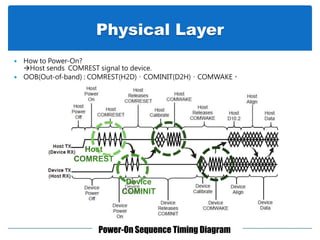
Physical Layer
 How to Power-On?
Host sends COMREST signal to device.
 OOB(Out-of-band) : COMREST(H2D)、COMINIT(D2H)、COMWAKE。
Power-On Sequence Timing Diagram
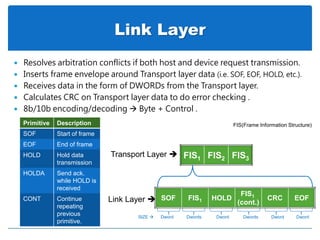
Link Layer
 Resolves arbitration conflicts if both host and device request transmission.
 Inserts frame envelope around Transport layer data (i.e. SOF, EOF, HOLD, etc.).
 Receives data in the form of DWORDs from the Transport layer.
 Calculates CRC on Transport layer data to do error checking .
 8b/10b encoding/decoding  Byte + Control .
Primitive Description
SOF Start of frame
EOF End of frame
HOLD Hold data
transmission
HOLDA Send ack.
while HOLD is
received
CONT Continue
repeating
previous
primitive.
SOF FIS1 HOLD
FIS1
(cont.)
CRC EOFLink Layer 
FIS1 FIS2 FIS3
Transport Layer 
Dword DwordDwordDwordsDwordDwordsSIZE 
FIS(Frame Information Structure)
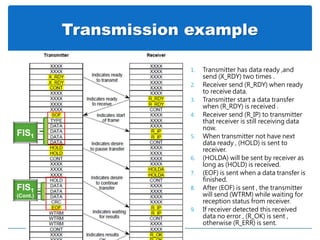
Transmission example
FIS1
FIS1
(Cont.)
1. Transmitter has data ready ,and
send (X_RDY) two times .
2. Receiver send (R_RDY) when ready
to receive data.
3. Transmitter start a data transfer
when (R_RDY) is received .
4. Receiver send (R_IP) to transmitter
that receiver is still receiving data
now.
5. When transmitter not have next
data ready , (HOLD) is sent to
receiver.
6. (HOLDA) will be sent by receiver as
long as (HOLD) is received.
7. (EOF) is sent when a data transfer is
finished.
8. After (EOF) is sent , the transmitter
will send (WTRM) while waiting for
reception status from receiver.
9. If receiver detected this received
data no error , (R_OK) is sent ,
otherwise (R_ERR) is sent.
Transport Layer
1. Constructs Frame Information Structures (FISes) for
transmission
2. Decomposes received Frame Information Structures
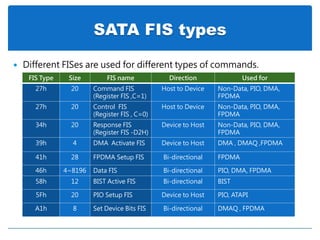
SATA FIS types
 Different FISes are used for different types of commands.
FIS Type Size FIS name Direction Used for
27h 20 Command FIS
(Register FIS ,C=1)
Host to Device Non-Data, PIO, DMA,
FPDMA
27h 20 Control FIS
(Register FIS , C=0)
Host to Device Non-Data, PIO, DMA,
FPDMA
34h 20 Response FIS
(Register FIS -D2H)
Device to Host Non-Data, PIO, DMA,
FPDMA
39h 4 DMA Activate FIS Device to Host DMA , DMAQ ,FPDMA
41h 28 FPDMA Setup FIS Bi-directional FPDMA
46h 4~8196 Data FIS Bi-directional PIO, DMA, FPDMA
58h 12 BIST Active FIS Bi-directional BIST
5Fh 20 PIO Setup FIS Device to Host PIO, ATAPI
A1h 8 Set Device Bits FIS Bi-directional DMAQ , FPDMA
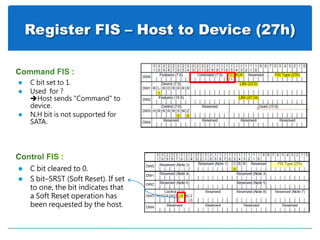
Register FIS – Host to Device (27h)
 C bit set to 1.
 Used for ?
Host sends "Command" to
device.
 N,H bit is not supported for
SATA.
 C bit cleared to 0.
 S bit–SRST (Soft Reset). If set
to one, the bit indicates that
a Soft Reset operation has
been requested by the host.
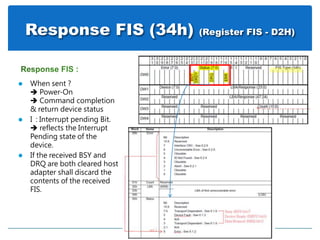
Response FIS (34h) (Register FIS - D2H)
 When sent ?
 Power-On
 Command completion
& return device status
 I : Interrupt pending Bit.
 reflects the Interrupt
Pending state of the
device.
 If the received BSY and
DRQ are both cleared host
adapter shall discard the
contents of the received
FIS.
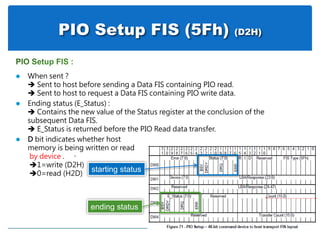
PIO Setup FIS (5Fh) (D2H)
 When sent ?
 Sent to host before sending a Data FIS containing PIO read.
 Sent to host to request a Data FIS containing PIO write data.
 Ending status (E_Status) :
 Contains the new value of the Status register at the conclusion of the
subsequent Data FIS.
 E_Status is returned before the PIO Read data transfer.
 D bit indicates whether host
memory is being written or read
by device .
1=write (D2H)
0=read (H2D)
starting status
ending status
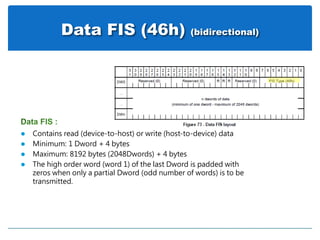
Data FIS (46h) (bidirectional)
 Contains read (device-to-host) or write (host-to-device) data
 Minimum: 1 Dword + 4 bytes
 Maximum: 8192 bytes (2048Dwords) + 4 bytes
 The high order word (word 1) of the last Dword is padded with
zeros when only a partial Dword (odd number of words) is to be
transmitted.
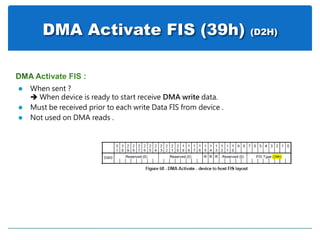
DMA Activate FIS (39h) (D2H)
 When sent ?
 When device is ready to start receive DMA write data.
 Must be received prior to each write Data FIS from device .
 Not used on DMA reads .
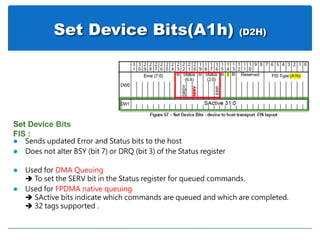
Set Device Bits(A1h) (D2H)
 Sends updated Error and Status bits to the host
 Does not alter BSY (bit 7) or DRQ (bit 3) of the Status register
 Used for DMA Queuing
 To set the SERV bit in the Status register for queued commands.
 Used for FPDMA native queuing
 SActive bits indicate which commands are queued and which are completed.
 32 tags supported .
SERV
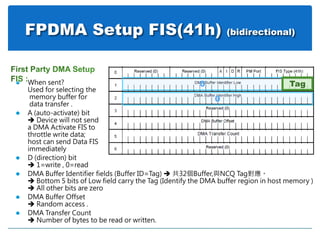
FPDMA Setup FIS(41h) (bidirectional)
 When sent?
Used for selecting the
memory buffer for
data transfer .
 A (auto-activate) bit
 Device will not send
a DMA Activate FIS to
throttle write data;
host can send Data FIS
immediately
 D (direction) bit
 1=write , 0=read
 DMA Buffer Identifier fields (Buffer ID=Tag)  共32個Buffer,與NCQ Tag對應。
 Bottom 5 bits of Low field carry the Tag (Identify the DMA buffer region in host memory )
 All other bits are zero
 DMA Buffer Offset
 Random access .
 DMA Transfer Count
 Number of bytes to be read or written.
0
0
Tag
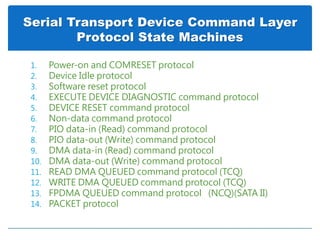
Serial Transport Device Command Layer
Protocol State Machines
1. Power-on and COMRESET protocol
2. Device Idle protocol
3. Software reset protocol
4. EXECUTE DEVICE DIAGNOSTIC command protocol
5. DEVICE RESET command protocol
6. Non-data command protocol
7. PIO data-in (Read) command protocol
8. PIO data-out (Write) command protocol
9. DMA data-in (Read) command protocol
10. DMA data-out (Write) command protocol
11. READ DMA QUEUED command protocol (TCQ)
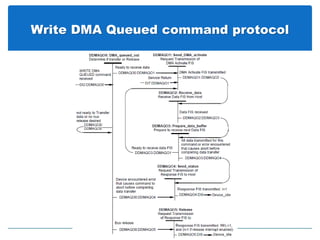
12. WRITE DMA QUEUED command protocol (TCQ)
13. FPDMA QUEUED command protocol (NCQ)(SATA II)
14. PACKET protocol
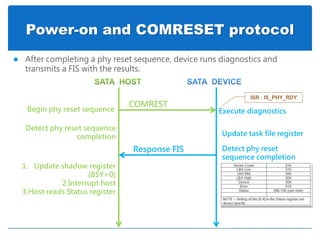
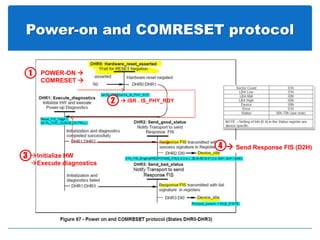
Power-on and COMRESET protocol
 After completing a phy reset sequence, device runs diagnostics and
transmits a FIS with the results.
COMREST
Begin phy reset sequence Execute diagnostics
Response FIS (I=0)
Detect phy reset sequence
completion
1. Update shadow register
(BSY=0)
2.Interrupt host
3.Host reads Status register
Update task file register
Detect phy reset
sequence completion
ISR . IS_PHY_RDY
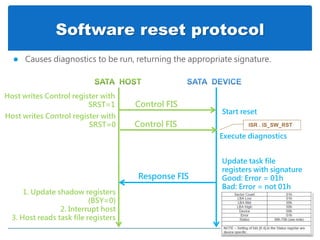
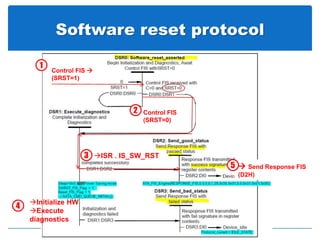
Software reset protocol
 Causes diagnostics to be run, returning the appropriate signature.
Control FIS
Host writes Control register with
SRST=1
Start reset
Response FIS (I=0)
Host writes Control register with
SRST=0
1. Update shadow registers
(BSY=0)
2. Interrupt host
3. Host reads task file registers
Execute diagnostics
Update task file
registers with signature
Good: Error = 01h
Bad: Error = not 01h
Control FIS ISR . IS_SW_RST
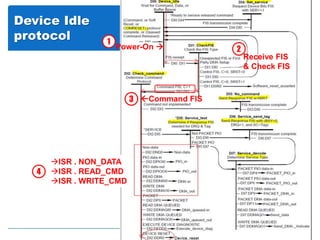
Device Idle
protocol
Power-On 
Command FIS
1
Receive FIS
& Check FIS
2
3
ISR . NON_DATA
ISR . READ_CMD
ISR . WRITE_CMD
4
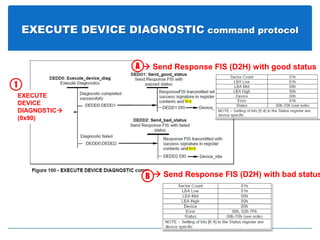
EXECUTE DEVICE DIAGNOSTIC command protocol
EXECUTE
DEVICE
DIAGNOSTIC
(0x90)
1
 Send Response FIS (D2H) with good statusA
 Send Response FIS (D2H) with bad statusB
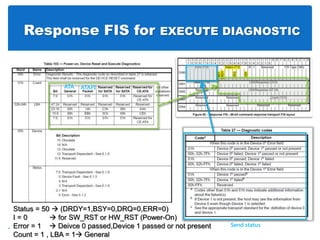
Response FIS for EXECUTE DIAGNOSTIC
Status = 50  (DRDY=1,BSY=0,DRQ=0,ERR=0)
I = 0  for SW_RST or HW_RST (Power-On)
Error = 1  Deivce 0 passed,Device 1 passed or not present
Count = 1 , LBA = 1 General
Send status
ATA ATAPI
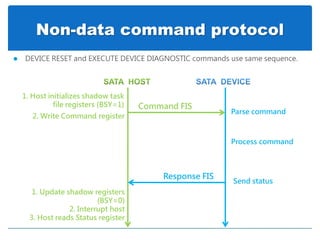
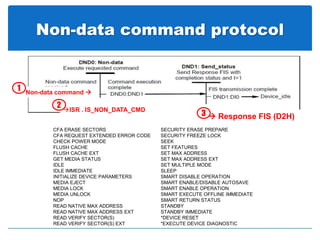
Non-data command protocol
 DEVICE RESET and EXECUTE DEVICE DIAGNOSTIC commands use same sequence.
Command FIS
1. Host initializes shadow task
file registers (BSY=1)
Parse command
Response FIS
2. Write Command register
1. Update shadow registers
(BSY=0)
2. Interrupt host
3. Host reads Status register
Process command
Send status
Non-data command protocol
Non-data command 
1
ISR . IS_NON_DATA_CMD
2
 Response FIS (D2H)3
CFA ERASE SECTORS
CFA REQUEST EXTENDED ERROR CODE
CHECK POWER MODE
FLUSH CACHE
FLUSH CACHE EXT
GET MEDIA STATUS
IDLE
IDLE IMMEDIATE
INITIALIZE DEVICE PARAMETERS
MEDIA EJECT
MEDIA LOCK
MEDIA UNLOCK
NOP
READ NATIVE MAX ADDRESS
READ NATIVE MAX ADDRESS EXT
READ VERIFY SECTOR(S)
READ VERIFY SECTOR(S) EXT
SECURITY ERASE PREPARE
SECURITY FREEZE LOCK
SEEK
SET FEATURES
SET MAX ADDRESS
SET MAX ADDRESS EXT
SET MULTIPLE MODE
SLEEP
SMART DISABLE OPERATION
SMART ENABLE/DISABLE AUTOSAVE
SMART ENABLE OPERATION
SMART EXECUTE OFFLINE IMMEDIATE
SMART RETURN STATUS
STANDBY
STANDBY IMMEDIATE
*DEVICE RESET
*EXECUTE DEVICE DIAGNOSTIC
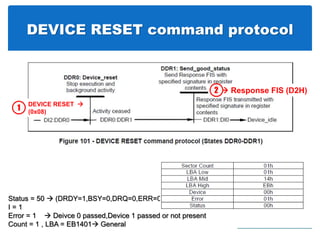
DEVICE RESET command protocol
DEVICE RESET 
(0x08)
1
Status = 50  (DRDY=1,BSY=0,DRQ=0,ERR=0)
I = 1
Error = 1  Deivce 0 passed,Device 1 passed or not present
Count = 1 , LBA = EB1401 General
 Response FIS (D2H)2
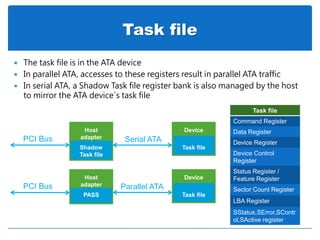
Task file
 The task file is in the ATA device
 In parallel ATA, accesses to these registers result in parallel ATA traffic
 In serial ATA, a Shadow Task file register bank is also managed by the host
to mirror the ATA device’s task file
Serial ATA
Host
adapter
Shadow
Task file
Device
Task file
PCI Bus
Parallel ATA
Host
adapter
PASS
Device
Task file
PCI Bus
Task file
Command Register
Data Register
Device Register
Device Control
Register
Status Register /
Feature Register
Sector Count Register
LBA Register
SStatus,SError,SContr
ol,SActive register
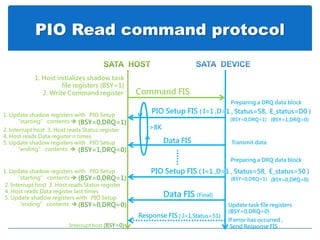
PIO Read command protocol
Command FIS
1. Host initializes shadow task
file registers (BSY=1)
PIO Setup FIS ( I=1 ,D=1 , Status=58, E_status=D0 )
2. Write Command register
Data FIS
(BSY=0,DRQ=1) (BSY=1,DRQ=0)
PIO Setup FIS ( I=1 ,D=1 , Status=58, E_status=50 )
(BSY=0,DRQ=1) (BSY=0,DRQ=0)
Update task file registers
(BSY=0,DRQ=0)
Data FIS (Final)
(BSY=0,DRQ=1)
(BSY=1,DRQ=0)
(BSY=0,DRQ=1)
(BSY=0,DRQ=0)
1. Update shadow registers with PIO Setup
“starting” contents 
2. Interrupt host 3. Host reads Status register
4. Host reads Data register n times
5. Update shadow registers with PIO Setup
“ending” contents 
>8K
1. Update shadow registers with PIO Setup
“starting” contents 
2. Interrupt host 3. Host reads Status register
4. Host reads Data register last times
5. Update shadow registers with PIO Setup
“ending” contents 
Preparing a DRQ data block
Transmit data
If error has occurred ,
Send Response FIS
Response FIS ( I=1,Status=51)
Interrupt host (BSY=0)
Preparing a DRQ data block
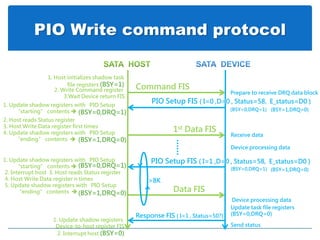
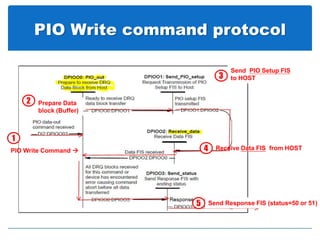
PIO Write command protocol
Response FIS ( I=1 , Status=50?)
Data FIS
1. Update shadow registers
Device-to-host register FIS
2. Interrupt host (BSY=0)
Command FIS
1. Host initializes shadow task
file registers (BSY=1)
PIO Setup FIS ( I=0 ,D=0 , Status=58, E_status=D0 )
2. Write Command register
3.Wait Device return FIS
(BSY=0,DRQ=1) (BSY=1,DRQ=0)
PIO Setup FIS ( I=1 ,D=0 , Status=58, E_status=D0 )
(BSY=0,DRQ=1) (BSY=1,DRQ=0)
Update task file registers
(BSY=0,DRQ=0)
(BSY=0,DRQ=1)
(BSY=1,DRQ=0)
(BSY=0,DRQ=1)
(BSY=1,DRQ=0)
1. Update shadow registers with PIO Setup
“starting” contents 
2. Host reads Status register
3. Host Write Data register first times
4. Update shadow registers with PIO Setup
“ending” contents 
>8K
1. Update shadow registers with PIO Setup
“starting” contents 
2. Interrupt host 3. Host reads Status register
4. Host Write Data register n times
5. Update shadow registers with PIO Setup
“ending” contents 
1st Data FIS
Prepare to receive DRQ data block
Receive data
Send status
Device processing data
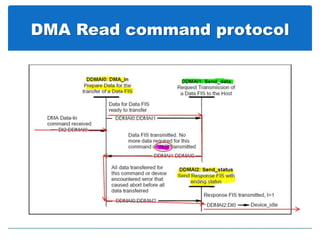
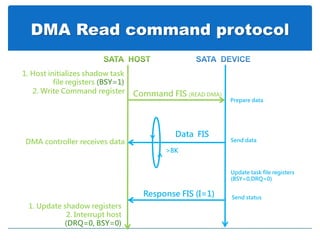
DMA Read command protocol
Command FIS (READ DMA)
1. Host initializes shadow task
file registers (BSY=1)
Data FIS
2. Write Command register
DMA controller receives data
Response FIS (I=1)
1. Update shadow registers
2. Interrupt host
(DRQ=0, BSY=0)
>8K
Send status
Update task file registers
(BSY=0,DRQ=0)
Send data
Prepare data
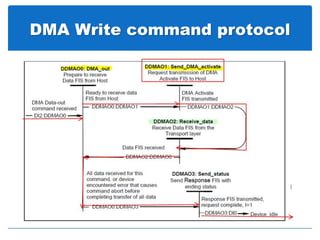
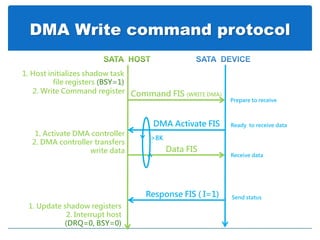
DMA Write command protocol
Command FIS (WRITE DMA)
1. Host initializes shadow task
file registers (BSY=1)
DMA Activate FIS
2. Write Command register
1. Activate DMA controller
2. DMA controller transfers
write data
Response FIS ( I=1)
1. Update shadow registers
2. Interrupt host
(DRQ=0, BSY=0)
Data FIS
>8K
Send status
Receive data
Prepare to receive
Ready to receive data
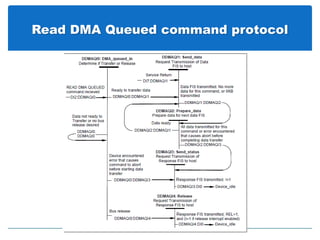
Read DMA Queued command protocol
Response FIS (Status=50)
Response FIS ( I=1 , Status=50?)
Interrupt host (BSY=0,DRQ=0)
1. Host initializes DMA controller
(BSY=1)
 ( BSY=01 ,REL= Count[2]=1,
I/O = Count[1] = 0 , Count[0]=1 ,
I=1 if release interrupt enabled )
2. Send READ DMA QUEUED Command
Count[7:3] = TAG
Response FIS ( Status=58, Count[7:3]=TAG )
(BSY=0,DRQ=1)
Update task file registers
(BSY=0,DRQ=0)
(BSY=1)
1. Interrupt host
2. Host deactivates 3rd DMA controller
3. Host issue SERVICE command
>8K
Read TAG & backup DMA controller context
Queue command
Command FIS (READ DMA QUEUED)
Set Device Bits FIS ( SERV=1 , I=1 )Device is ready to transfer data
& Service request
Command FIS (SERVICE)
Host release bus / command
(BSY=0,DRQ=1)
(BSY=0)
more commads
Data FIS Send data
DMA controller receives data
 ( REL= Count[2]=0,
I/O = Count[1] = 1 ,
Count[0]=0)
 ( REL= Count[2]=0,
I/O = Count[1] = 1 ,
Count[0]=1)
Response with command that
ready to execute
Device processing data
Wait for the CPU to respond to the interrupt  Deactivate the 3rd party DMA engine
Send status
last command queued in(BSY=1)
more queued commands not complete
Write DMA Queued command protocol
Response FIS (Status=50)
Response FIS ( I=1 , Status=50?)
Interrupt host (BSY=0,DRQ=0)
1. Host initializes DMA controller
(BSY=1)
 ( BSY=01 ,REL= Count[2]=1,
I/O = Count[1] = 0 , Count[0]=1 ,
I=1 if release interrupt enabled )
2. Send READ DMA QUEUED Command
Count[7:3] = TAG
Response FIS ( Status=58, Count[7:3]=TAG )
(BSY=0,DRQ=1)
Update task file registers
(BSY=0,DRQ=0)
(BSY=1)
1. Interrupt host
2. Host deactivates DMA
controller
3. Host issue SERVICE command
>8K
Read TAG & restore DMA controller context
Queue command
Command FIS (WRITE DMA QUEUED)
Set Device Bits FIS ( SERV=1 , I=1 ) Device is ready to transfer data
& Service request
Command FIS (SERVICE)
Host release bus / command
(BSY=0,DRQ=1)
(BSY=0)
more commads
DMA Activate FIS
Receive data
DMA controller sends data
 ( REL= Count[2]=0,
I/O = Count[1] = 1 ,
Count[0]=0)
 ( REL= Count[2]=0,
I/O = Count[1] = 1 ,
Count[0]=1)
Response with command that
ready to execute
Send status
last command queued in(BSY=1)
more queued commands not complete
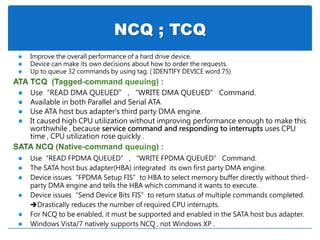
NCQ ; TCQ
 Use“READ FPDMA QUEUED” , “WRITE FPDMA QUEUED” Command.
 The SATA host bus adapter(HBA) integrated its own first party DMA engine.
 Device issues“FPDMA Setup FIS”to HBA to select memory buffer directly without third-
party DMA engine and tells the HBA which command it wants to execute.
 Device issues“Send Device Bits FIS”to return status of multiple commands completed.
Drastically reduces the number of required CPU interrupts.
 For NCQ to be enabled, it must be supported and enabled in the SATA host bus adapter.
 Windows Vista/7 natively supports NCQ , not Windows XP .
 Use“READ DMA QUEUED” , “WRITE DMA QUEUED” Command.
 Available in both Parallel and Serial ATA
 Use ATA host bus adapter's third party DMA engine.
 It caused high CPU utilization without improving performance enough to make this
worthwhile , because service command and responding to interrupts uses CPU
time , CPU utilization rose quickly .
 Improve the overall performance of a hard drive device.
 Device can make its own decisions about how to order the requests.
 Up to queue 32 commands by using tag. ( IDENTIFY DEVICE word 75)
FPDMA Read command protocol
Response FIS (Status=50)
Interrupt host (BSY=0,DRQ=0)
(BSY=0)
 ( BSY=0 ,DRQ= 0 , I=0 )
Send READ FPDMA QUEUED Command
Count[7:3] = NCQ TAG (BSY=1)
Update task file registers
(BSY=0)
Select the DMA engine context by TAG
(DMA Buffer ID)
Host loads PRD pointer into DMA engine
DMA controller receives data
Command FIS (READ FPDMA QUEUED)
Host sets SActive Register
(BSY=0)
more commads
Data FIS
Send data
DMA Setup FIS
Set Device Bits FIS (BSY=0 , I=1 , SActive )
(DMA Buffer ID= TAG , D=1 , I=0,
Transfer count )
this command not complete
Transfer count not exhausted
bit n in SActive field set to one
where n = TAG for each command
TAG value that has completed
Queue command
& store NCQ TAG in SActive
Send status
Multiple commands can be indicated as complete at a time
more queued commands not complete
Update Host copy SActive Register
FPDMA Write command protocol
Response FIS (Status=50)
Interrupt host (BSY=0,DRQ=0)
(BSY=0)
 ( BSY=0 ,DRQ= 0 , I=0 )
Send WRITE FPDMA QUEUED Command
Count[7:3] = NCQ TAG (BSY=1)
Update task file registers
(BSY=0)
Select the DMA engine context by TAG
(DMA Buffer ID)
Host loads PRD pointer into DMA engine
DMA controller sends data
Command FIS (WRITE FPDMA QUEUED)
(BSY=0)
more commads
DMA Activate FIS
Receive data
DMA Setup FIS
Set Device Bits FIS (BSY=0 , I=1 ,SActive)
(DMA Buffer ID= TAG , D=0 , I=0,
Auto-Activate=1 ,Transfer count )
this command not complete
Transfer count not exhausted
bit n in SActive field set to one
where n = TAG for each command
TAG value that has completed
Queue command
& store NCQ TAG in SActive
Data FIS
if Auto-Activate==0
Send status
more queued commands not complete
Multiple commands can be indicated as complete at a time
Host sets SActive Register
Update Host copy SActive Register
END
2010/01
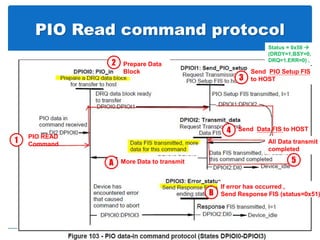
PIO Read command protocol
PIO READ
Command
1
Prepare Data
Block
2
Send PIO Setup FIS
to HOST3
Status = 0x58 
(DRDY=1,BSY=0,
DRQ=1.ERR=0) ,
More Data to transmitA
All Data transmit
completed
5
If error has occurred ,
Send Response FIS (status=0x51)B
4 Send Data FIS to HOST
PIO Write command protocol
PIO Write Command 
1
Prepare Data
block (Buffer)
2
Send PIO Setup FIS
to HOST3
4 Receive Data FIS from HOST
Send Response FIS (status=50 or 51)5
DMA Read command protocol
DMA Write command protocol
Read DMA Queued command protocol
Write DMA Queued command protocol
Power-on and COMRESET protocol
POWER-ON 
COMRESET 
1
Initialize HW
Execute diagnostics
3
 Send Response FIS (D2H)4
 ISR . IS_PHY_RDY2
Software reset protocol
ISR . IS_SW_RST3
Control FIS 
(SRST=1)
1
Control FIS
(SRST=0)
2
Initialize HW
Execute
diagnostics
4
 Send Response FIS
(D2H)
5

SATA Introduction

  • 1.
  • 2.
    Outline  Communication Layer A Command Example  SATA Physical Layer  SATA Link Layer  SATA Transport Layer  SATA FIS Type  SATA Command Layer Protocol (Command sequence)
  • 3.
    SATA Communication Layers ApplicationLayer Transport Layer Link Layer Physical Layer 8b/10b stream Status FIS 8b/10b stream FIS Command Application Layer Transport Layer Link Layer Physical Layer 8b/10b stream Status FIS 8b/10b stream FIS Command
  • 4.
  • 5.
    Command & FIS #2 #1 #3 READDMA Command Input Command OuputDATA *其實這張圖並不是很正確,因為Data Payload的5dwords是指FIS的大小,並不是 Command Input/Output的大小,但是Command看到的欄位(Input/Output)的確 是填在FIS中的。
  • 6.
  • 7.
    Command Outputs Reserved forNormal Output  Main Field:  Normal Output  Error Output Status=0x51 Error= 0x04CMD Abort (Command is invalid) 0x10ID Not Found (Command parameter is invalid , eg. invalid LBA) 0x40Uncorrectable data error (ECC Error) 0x80ICRC Error (Data transmitted/ received has CRC error)  Reissue the command.
  • 8.
    SATA Status  1: the device is busy .  1 : device is ready to accept all commands.  0 : device only accepts a few commands. (DEVICE RESET, EXEUTE DEVICE DIAGNOSTIC, IDENTIFY PACKET DEVICE, PACKET).  1 : device had a data fatal hard error . Prevents writing data.  1 : device is ready for data transfer.  1 : an error occurred during execution command.  1 : device has prepared this command for service.(DMA Queued) Status = 50  (DRDY=1,BSY=0,DRQ=0,ERR=0) Status = 51  (DRDY=1,BSY=0,DRQ=0,ERR=1) Status = 58  (DRDY=1,BSY=0,DRQ=1.ERR=0) Status = D0  (DRDY=1,BSY=1,DRQ=0,ERR=0)
  • 9.
    Physical Layer  Howto Power-On? Host sends COMREST signal to device.  OOB(Out-of-band) : COMREST(H2D)、COMINIT(D2H)、COMWAKE。 Power-On Sequence Timing Diagram
  • 10.
    Link Layer  Resolvesarbitration conflicts if both host and device request transmission.  Inserts frame envelope around Transport layer data (i.e. SOF, EOF, HOLD, etc.).  Receives data in the form of DWORDs from the Transport layer.  Calculates CRC on Transport layer data to do error checking .  8b/10b encoding/decoding  Byte + Control . Primitive Description SOF Start of frame EOF End of frame HOLD Hold data transmission HOLDA Send ack. while HOLD is received CONT Continue repeating previous primitive. SOF FIS1 HOLD FIS1 (cont.) CRC EOFLink Layer  FIS1 FIS2 FIS3 Transport Layer  Dword DwordDwordDwordsDwordDwordsSIZE  FIS(Frame Information Structure)
  • 11.
    Transmission example FIS1 FIS1 (Cont.) 1. Transmitterhas data ready ,and send (X_RDY) two times . 2. Receiver send (R_RDY) when ready to receive data. 3. Transmitter start a data transfer when (R_RDY) is received . 4. Receiver send (R_IP) to transmitter that receiver is still receiving data now. 5. When transmitter not have next data ready , (HOLD) is sent to receiver. 6. (HOLDA) will be sent by receiver as long as (HOLD) is received. 7. (EOF) is sent when a data transfer is finished. 8. After (EOF) is sent , the transmitter will send (WTRM) while waiting for reception status from receiver. 9. If receiver detected this received data no error , (R_OK) is sent , otherwise (R_ERR) is sent.
  • 12.
    Transport Layer 1. ConstructsFrame Information Structures (FISes) for transmission 2. Decomposes received Frame Information Structures
  • 13.
    SATA FIS types Different FISes are used for different types of commands. FIS Type Size FIS name Direction Used for 27h 20 Command FIS (Register FIS ,C=1) Host to Device Non-Data, PIO, DMA, FPDMA 27h 20 Control FIS (Register FIS , C=0) Host to Device Non-Data, PIO, DMA, FPDMA 34h 20 Response FIS (Register FIS -D2H) Device to Host Non-Data, PIO, DMA, FPDMA 39h 4 DMA Activate FIS Device to Host DMA , DMAQ ,FPDMA 41h 28 FPDMA Setup FIS Bi-directional FPDMA 46h 4~8196 Data FIS Bi-directional PIO, DMA, FPDMA 58h 12 BIST Active FIS Bi-directional BIST 5Fh 20 PIO Setup FIS Device to Host PIO, ATAPI A1h 8 Set Device Bits FIS Bi-directional DMAQ , FPDMA
  • 14.
    Register FIS –Host to Device (27h)  C bit set to 1.  Used for ? Host sends "Command" to device.  N,H bit is not supported for SATA.  C bit cleared to 0.  S bit–SRST (Soft Reset). If set to one, the bit indicates that a Soft Reset operation has been requested by the host.
  • 15.
    Response FIS (34h)(Register FIS - D2H)  When sent ?  Power-On  Command completion & return device status  I : Interrupt pending Bit.  reflects the Interrupt Pending state of the device.  If the received BSY and DRQ are both cleared host adapter shall discard the contents of the received FIS.
  • 16.
    PIO Setup FIS(5Fh) (D2H)  When sent ?  Sent to host before sending a Data FIS containing PIO read.  Sent to host to request a Data FIS containing PIO write data.  Ending status (E_Status) :  Contains the new value of the Status register at the conclusion of the subsequent Data FIS.  E_Status is returned before the PIO Read data transfer.  D bit indicates whether host memory is being written or read by device . 1=write (D2H) 0=read (H2D) starting status ending status
  • 17.
    Data FIS (46h)(bidirectional)  Contains read (device-to-host) or write (host-to-device) data  Minimum: 1 Dword + 4 bytes  Maximum: 8192 bytes (2048Dwords) + 4 bytes  The high order word (word 1) of the last Dword is padded with zeros when only a partial Dword (odd number of words) is to be transmitted.
  • 18.
    DMA Activate FIS(39h) (D2H)  When sent ?  When device is ready to start receive DMA write data.  Must be received prior to each write Data FIS from device .  Not used on DMA reads .
  • 19.
    Set Device Bits(A1h)(D2H)  Sends updated Error and Status bits to the host  Does not alter BSY (bit 7) or DRQ (bit 3) of the Status register  Used for DMA Queuing  To set the SERV bit in the Status register for queued commands.  Used for FPDMA native queuing  SActive bits indicate which commands are queued and which are completed.  32 tags supported . SERV
  • 20.
    FPDMA Setup FIS(41h)(bidirectional)  When sent? Used for selecting the memory buffer for data transfer .  A (auto-activate) bit  Device will not send a DMA Activate FIS to throttle write data; host can send Data FIS immediately  D (direction) bit  1=write , 0=read  DMA Buffer Identifier fields (Buffer ID=Tag)  共32個Buffer,與NCQ Tag對應。  Bottom 5 bits of Low field carry the Tag (Identify the DMA buffer region in host memory )  All other bits are zero  DMA Buffer Offset  Random access .  DMA Transfer Count  Number of bytes to be read or written. 0 0 Tag
  • 21.
    Serial Transport DeviceCommand Layer Protocol State Machines 1. Power-on and COMRESET protocol 2. Device Idle protocol 3. Software reset protocol 4. EXECUTE DEVICE DIAGNOSTIC command protocol 5. DEVICE RESET command protocol 6. Non-data command protocol 7. PIO data-in (Read) command protocol 8. PIO data-out (Write) command protocol 9. DMA data-in (Read) command protocol 10. DMA data-out (Write) command protocol 11. READ DMA QUEUED command protocol (TCQ) 12. WRITE DMA QUEUED command protocol (TCQ) 13. FPDMA QUEUED command protocol (NCQ)(SATA II) 14. PACKET protocol
  • 22.
    Power-on and COMRESETprotocol  After completing a phy reset sequence, device runs diagnostics and transmits a FIS with the results. COMREST Begin phy reset sequence Execute diagnostics Response FIS (I=0) Detect phy reset sequence completion 1. Update shadow register (BSY=0) 2.Interrupt host 3.Host reads Status register Update task file register Detect phy reset sequence completion ISR . IS_PHY_RDY
  • 23.
    Software reset protocol Causes diagnostics to be run, returning the appropriate signature. Control FIS Host writes Control register with SRST=1 Start reset Response FIS (I=0) Host writes Control register with SRST=0 1. Update shadow registers (BSY=0) 2. Interrupt host 3. Host reads task file registers Execute diagnostics Update task file registers with signature Good: Error = 01h Bad: Error = not 01h Control FIS ISR . IS_SW_RST
  • 24.
    Device Idle protocol Power-On  CommandFIS 1 Receive FIS & Check FIS 2 3 ISR . NON_DATA ISR . READ_CMD ISR . WRITE_CMD 4
  • 25.
    EXECUTE DEVICE DIAGNOSTICcommand protocol EXECUTE DEVICE DIAGNOSTIC (0x90) 1  Send Response FIS (D2H) with good statusA  Send Response FIS (D2H) with bad statusB
  • 26.
    Response FIS forEXECUTE DIAGNOSTIC Status = 50  (DRDY=1,BSY=0,DRQ=0,ERR=0) I = 0  for SW_RST or HW_RST (Power-On) Error = 1  Deivce 0 passed,Device 1 passed or not present Count = 1 , LBA = 1 General Send status ATA ATAPI
  • 27.
    Non-data command protocol DEVICE RESET and EXECUTE DEVICE DIAGNOSTIC commands use same sequence. Command FIS 1. Host initializes shadow task file registers (BSY=1) Parse command Response FIS 2. Write Command register 1. Update shadow registers (BSY=0) 2. Interrupt host 3. Host reads Status register Process command Send status
  • 28.
    Non-data command protocol Non-datacommand  1 ISR . IS_NON_DATA_CMD 2  Response FIS (D2H)3 CFA ERASE SECTORS CFA REQUEST EXTENDED ERROR CODE CHECK POWER MODE FLUSH CACHE FLUSH CACHE EXT GET MEDIA STATUS IDLE IDLE IMMEDIATE INITIALIZE DEVICE PARAMETERS MEDIA EJECT MEDIA LOCK MEDIA UNLOCK NOP READ NATIVE MAX ADDRESS READ NATIVE MAX ADDRESS EXT READ VERIFY SECTOR(S) READ VERIFY SECTOR(S) EXT SECURITY ERASE PREPARE SECURITY FREEZE LOCK SEEK SET FEATURES SET MAX ADDRESS SET MAX ADDRESS EXT SET MULTIPLE MODE SLEEP SMART DISABLE OPERATION SMART ENABLE/DISABLE AUTOSAVE SMART ENABLE OPERATION SMART EXECUTE OFFLINE IMMEDIATE SMART RETURN STATUS STANDBY STANDBY IMMEDIATE *DEVICE RESET *EXECUTE DEVICE DIAGNOSTIC
  • 29.
    DEVICE RESET commandprotocol DEVICE RESET  (0x08) 1 Status = 50  (DRDY=1,BSY=0,DRQ=0,ERR=0) I = 1 Error = 1  Deivce 0 passed,Device 1 passed or not present Count = 1 , LBA = EB1401 General  Response FIS (D2H)2
  • 30.
    Task file  Thetask file is in the ATA device  In parallel ATA, accesses to these registers result in parallel ATA traffic  In serial ATA, a Shadow Task file register bank is also managed by the host to mirror the ATA device’s task file Serial ATA Host adapter Shadow Task file Device Task file PCI Bus Parallel ATA Host adapter PASS Device Task file PCI Bus Task file Command Register Data Register Device Register Device Control Register Status Register / Feature Register Sector Count Register LBA Register SStatus,SError,SContr ol,SActive register
  • 31.
    PIO Read commandprotocol Command FIS 1. Host initializes shadow task file registers (BSY=1) PIO Setup FIS ( I=1 ,D=1 , Status=58, E_status=D0 ) 2. Write Command register Data FIS (BSY=0,DRQ=1) (BSY=1,DRQ=0) PIO Setup FIS ( I=1 ,D=1 , Status=58, E_status=50 ) (BSY=0,DRQ=1) (BSY=0,DRQ=0) Update task file registers (BSY=0,DRQ=0) Data FIS (Final) (BSY=0,DRQ=1) (BSY=1,DRQ=0) (BSY=0,DRQ=1) (BSY=0,DRQ=0) 1. Update shadow registers with PIO Setup “starting” contents  2. Interrupt host 3. Host reads Status register 4. Host reads Data register n times 5. Update shadow registers with PIO Setup “ending” contents  >8K 1. Update shadow registers with PIO Setup “starting” contents  2. Interrupt host 3. Host reads Status register 4. Host reads Data register last times 5. Update shadow registers with PIO Setup “ending” contents  Preparing a DRQ data block Transmit data If error has occurred , Send Response FIS Response FIS ( I=1,Status=51) Interrupt host (BSY=0) Preparing a DRQ data block
  • 32.
    PIO Write commandprotocol Response FIS ( I=1 , Status=50?) Data FIS 1. Update shadow registers Device-to-host register FIS 2. Interrupt host (BSY=0) Command FIS 1. Host initializes shadow task file registers (BSY=1) PIO Setup FIS ( I=0 ,D=0 , Status=58, E_status=D0 ) 2. Write Command register 3.Wait Device return FIS (BSY=0,DRQ=1) (BSY=1,DRQ=0) PIO Setup FIS ( I=1 ,D=0 , Status=58, E_status=D0 ) (BSY=0,DRQ=1) (BSY=1,DRQ=0) Update task file registers (BSY=0,DRQ=0) (BSY=0,DRQ=1) (BSY=1,DRQ=0) (BSY=0,DRQ=1) (BSY=1,DRQ=0) 1. Update shadow registers with PIO Setup “starting” contents  2. Host reads Status register 3. Host Write Data register first times 4. Update shadow registers with PIO Setup “ending” contents  >8K 1. Update shadow registers with PIO Setup “starting” contents  2. Interrupt host 3. Host reads Status register 4. Host Write Data register n times 5. Update shadow registers with PIO Setup “ending” contents  1st Data FIS Prepare to receive DRQ data block Receive data Send status Device processing data Device processing data
  • 33.
    DMA Read commandprotocol Command FIS (READ DMA) 1. Host initializes shadow task file registers (BSY=1) Data FIS 2. Write Command register DMA controller receives data Response FIS (I=1) 1. Update shadow registers 2. Interrupt host (DRQ=0, BSY=0) >8K Send status Update task file registers (BSY=0,DRQ=0) Send data Prepare data
  • 34.
    DMA Write commandprotocol Command FIS (WRITE DMA) 1. Host initializes shadow task file registers (BSY=1) DMA Activate FIS 2. Write Command register 1. Activate DMA controller 2. DMA controller transfers write data Response FIS ( I=1) 1. Update shadow registers 2. Interrupt host (DRQ=0, BSY=0) Data FIS >8K Send status Receive data Prepare to receive Ready to receive data
  • 35.
    Read DMA Queuedcommand protocol Response FIS (Status=50) Response FIS ( I=1 , Status=50?) Interrupt host (BSY=0,DRQ=0) 1. Host initializes DMA controller (BSY=1)  ( BSY=01 ,REL= Count[2]=1, I/O = Count[1] = 0 , Count[0]=1 , I=1 if release interrupt enabled ) 2. Send READ DMA QUEUED Command Count[7:3] = TAG Response FIS ( Status=58, Count[7:3]=TAG ) (BSY=0,DRQ=1) Update task file registers (BSY=0,DRQ=0) (BSY=1) 1. Interrupt host 2. Host deactivates 3rd DMA controller 3. Host issue SERVICE command >8K Read TAG & backup DMA controller context Queue command Command FIS (READ DMA QUEUED) Set Device Bits FIS ( SERV=1 , I=1 )Device is ready to transfer data & Service request Command FIS (SERVICE) Host release bus / command (BSY=0,DRQ=1) (BSY=0) more commads Data FIS Send data DMA controller receives data  ( REL= Count[2]=0, I/O = Count[1] = 1 , Count[0]=0)  ( REL= Count[2]=0, I/O = Count[1] = 1 , Count[0]=1) Response with command that ready to execute Device processing data Wait for the CPU to respond to the interrupt  Deactivate the 3rd party DMA engine Send status last command queued in(BSY=1) more queued commands not complete
  • 36.
    Write DMA Queuedcommand protocol Response FIS (Status=50) Response FIS ( I=1 , Status=50?) Interrupt host (BSY=0,DRQ=0) 1. Host initializes DMA controller (BSY=1)  ( BSY=01 ,REL= Count[2]=1, I/O = Count[1] = 0 , Count[0]=1 , I=1 if release interrupt enabled ) 2. Send READ DMA QUEUED Command Count[7:3] = TAG Response FIS ( Status=58, Count[7:3]=TAG ) (BSY=0,DRQ=1) Update task file registers (BSY=0,DRQ=0) (BSY=1) 1. Interrupt host 2. Host deactivates DMA controller 3. Host issue SERVICE command >8K Read TAG & restore DMA controller context Queue command Command FIS (WRITE DMA QUEUED) Set Device Bits FIS ( SERV=1 , I=1 ) Device is ready to transfer data & Service request Command FIS (SERVICE) Host release bus / command (BSY=0,DRQ=1) (BSY=0) more commads DMA Activate FIS Receive data DMA controller sends data  ( REL= Count[2]=0, I/O = Count[1] = 1 , Count[0]=0)  ( REL= Count[2]=0, I/O = Count[1] = 1 , Count[0]=1) Response with command that ready to execute Send status last command queued in(BSY=1) more queued commands not complete
  • 37.
    NCQ ; TCQ Use“READ FPDMA QUEUED” , “WRITE FPDMA QUEUED” Command.  The SATA host bus adapter(HBA) integrated its own first party DMA engine.  Device issues“FPDMA Setup FIS”to HBA to select memory buffer directly without third- party DMA engine and tells the HBA which command it wants to execute.  Device issues“Send Device Bits FIS”to return status of multiple commands completed. Drastically reduces the number of required CPU interrupts.  For NCQ to be enabled, it must be supported and enabled in the SATA host bus adapter.  Windows Vista/7 natively supports NCQ , not Windows XP .  Use“READ DMA QUEUED” , “WRITE DMA QUEUED” Command.  Available in both Parallel and Serial ATA  Use ATA host bus adapter's third party DMA engine.  It caused high CPU utilization without improving performance enough to make this worthwhile , because service command and responding to interrupts uses CPU time , CPU utilization rose quickly .  Improve the overall performance of a hard drive device.  Device can make its own decisions about how to order the requests.  Up to queue 32 commands by using tag. ( IDENTIFY DEVICE word 75)
  • 38.
    FPDMA Read commandprotocol Response FIS (Status=50) Interrupt host (BSY=0,DRQ=0) (BSY=0)  ( BSY=0 ,DRQ= 0 , I=0 ) Send READ FPDMA QUEUED Command Count[7:3] = NCQ TAG (BSY=1) Update task file registers (BSY=0) Select the DMA engine context by TAG (DMA Buffer ID) Host loads PRD pointer into DMA engine DMA controller receives data Command FIS (READ FPDMA QUEUED) Host sets SActive Register (BSY=0) more commads Data FIS Send data DMA Setup FIS Set Device Bits FIS (BSY=0 , I=1 , SActive ) (DMA Buffer ID= TAG , D=1 , I=0, Transfer count ) this command not complete Transfer count not exhausted bit n in SActive field set to one where n = TAG for each command TAG value that has completed Queue command & store NCQ TAG in SActive Send status Multiple commands can be indicated as complete at a time more queued commands not complete Update Host copy SActive Register
  • 39.
    FPDMA Write commandprotocol Response FIS (Status=50) Interrupt host (BSY=0,DRQ=0) (BSY=0)  ( BSY=0 ,DRQ= 0 , I=0 ) Send WRITE FPDMA QUEUED Command Count[7:3] = NCQ TAG (BSY=1) Update task file registers (BSY=0) Select the DMA engine context by TAG (DMA Buffer ID) Host loads PRD pointer into DMA engine DMA controller sends data Command FIS (WRITE FPDMA QUEUED) (BSY=0) more commads DMA Activate FIS Receive data DMA Setup FIS Set Device Bits FIS (BSY=0 , I=1 ,SActive) (DMA Buffer ID= TAG , D=0 , I=0, Auto-Activate=1 ,Transfer count ) this command not complete Transfer count not exhausted bit n in SActive field set to one where n = TAG for each command TAG value that has completed Queue command & store NCQ TAG in SActive Data FIS if Auto-Activate==0 Send status more queued commands not complete Multiple commands can be indicated as complete at a time Host sets SActive Register Update Host copy SActive Register
  • 40.
  • 41.
    PIO Read commandprotocol PIO READ Command 1 Prepare Data Block 2 Send PIO Setup FIS to HOST3 Status = 0x58  (DRDY=1,BSY=0, DRQ=1.ERR=0) , More Data to transmitA All Data transmit completed 5 If error has occurred , Send Response FIS (status=0x51)B 4 Send Data FIS to HOST
  • 42.
    PIO Write commandprotocol PIO Write Command  1 Prepare Data block (Buffer) 2 Send PIO Setup FIS to HOST3 4 Receive Data FIS from HOST Send Response FIS (status=50 or 51)5
  • 43.
  • 44.
  • 45.
    Read DMA Queuedcommand protocol
  • 46.
    Write DMA Queuedcommand protocol
  • 47.
    Power-on and COMRESETprotocol POWER-ON  COMRESET  1 Initialize HW Execute diagnostics 3  Send Response FIS (D2H)4  ISR . IS_PHY_RDY2
  • 48.
    Software reset protocol ISR. IS_SW_RST3 Control FIS  (SRST=1) 1 Control FIS (SRST=0) 2 Initialize HW Execute diagnostics 4  Send Response FIS (D2H) 5

Editor's Notes

  • #9 bit4 = DSC (Device Seek Complete) bit. (SERV) Service bit , Deferred Write Error (DWE) bit
  • #11 CRC(Cyclic Redundancy Check) 8b/10b DC-balanced SOF(Start of frame) EOF(End Of Frame) FIS(Frame Information Structure) The smallest unit of communication is a Dword Frame Transmission When requested by the Transport layer to transmit a frame, the Link layer provides the following services: Negotiates with its peer Link layer to transmit a frame, resolves arbitration conflicts if both host and device request transmission Inserts frame envelope around Transport layer data (i.e., SOFP, CRC, EOFP, etc.). Receives data in the form of Dwords from the Transport layer. Calculates CRC on Transport layer data. Transmits frame. Provides frame flow control in response to requests from the FIFO or the peer Link layer. Receives frame receipt acknowledge from peer Link layer. Reports good transmission or Link/Phy layer errors to Transport layer. Performs 8b/10b encoding Scrambles data Dwords in such a way to distribute the potential EMI emissions over a broader range 9.1.2 Frame Reception When data is received from the Phy layer, the Link layer provides the following services: Acknowledges to the peer Link layer readiness to receive a frame. Receives data in the form of encoded characters from the Phy layer. Decodes the encoded 8b/10b character stream into aligned Dwords of data. Removes the envelope around frames (i.e., SOFP, CRC, EOFP). Calculates CRC on the received Dwords. Provides frame flow control in response to requests from the FIFO or the peer Link layer. Compares the calculated CRC to the received CRC. Reports good reception or Link/Phy layer errors to Transport layer and the peer Link layer. Descrambles data Dwords received from a peer Link layer.
  • #12 CONT, is Continue previous primitives Type : FIS Type Data : FIS payload Data Primitive handshakes HOLD  HOLDA WTRM  R_OK / R_ERR PMREQ_P / PMREQ_S  PMACK / PMNAK
  • #14 5Dwords Serial ATA Revision 2.6 ATA8-AST
  • #24 SRST (Software Reset) bit – Used to force a soft device – Decodes of writes to this bit could be done by low-power hardware in parallel ATA • Not as simple for serial ATA
  • #26 SerialATA_Revision_2_6_Gold.pdf ( p.392) When in this state, the device shall request that the Transport layer transmit a Register FIS to the host, with the Interrupt bit set to one. If the device does not implement the PACKET command feature set the register content shall be:
  • #27 SATA上的裝置都是device0 ATA_FIS_Engine(RESPONSE_FIS,FALSE,FALSE,FALSE,FALSE,1,28,0x50,0x00,FALSE,FALSE,0x01,0x01,0x00); //STATUS=50, INT=1 ,Error=1( Deivce 0 passed,Device 1 passed or not present),Count=1(Reserved for SATA),LBA=1(Reserved)
  • #30 ATA_FIS_Engine(RESPONSE_FIS,FALSE,FALSE,FALSE,FALSE,1,28,0x50,0x01,FALSE,FALSE,0x01,0xEB1401,0x00);
  • #31 由FIS(I=1)對Host中斷,Host 讀完 status register (BSY=0,DRQ=0) 以後 會把中斷清零
  • #32  傳輸超過8K,須再傳一次Setup PIO FIS 給 Host Status = 0x58 -> (DRDY=1,BSY=0,DRQ=1.ERR=0) , I=1 1.BSY=0 , DRQ=1, I=1 E_STATUS = 0xD0 : DRDY=1 , BSY=1 , DRQ=0 E_STATUS = 0x50 : DRDY=1 , BSY=0 , DRQ=0 IDENTIFY DEVICE //Temp_SATA_ISR&SATA_IS_IDENTIFY_CMD IDENTIFY PACKET DEVICE READ BUFFER READ LOG EXT READ MULTIPLE READ MULTIPLE EXT READ SECTOR(S) READ SECTOR(S) EXT SMART READ DATA SMART READ LOG SECTOR
  • #33 BSY=1  告訴Host , device再忙,忙著準備data CFA WRITE MULTIPLE WITHOUT ERASE CFA WRITE SECTORS WITHOUT ERASE DOWNLOAD MICROCODE SECURITY DISABLE PASSWORD SECURITY ERASE UNIT SECURITY SET PASSWORD SECURITY UNLOCK SMART WRITE LOG SECTOR WRITE BUFFER WRITE LOG EXT WRITE MULTIPLE WRITE MULTIPLE EXT WRITE SECTOR(S) WRITE SECTOR(S) EXT
  • #34 READ DMA READ DMA EXT
  • #35 WRITE DMA WRITE DMA EXT
  • #36 When a drive was ready for a transfer, it had to interrupt the CPU, wait for the CPU to ask the disk what command was ready to execute, respond with the command that it was ready to execute, wait for the CPU to program the host bus adapter's third party DMA engine based on the result of that command, wait for the third party DMA engine to execute the command, and then had to interrupt the CPU again to notify it when the DMA engine finished the task so that the CPU could notify the thread that requested the task that the requested task was finished. DMA Controller : DMA BufferID ,Transfer Conut READ DMA QUEUED READ DMA QUEUED EXT
  • #38 SATA 2.5規範收錄了原先SATA II所轄的大部分功能:3Gb/s、NCQ、Staggered Spin-up、Hot Plug、Port Multiplier以eSATA。 FPDMA 傳輸主動權掌握在了硬碟自己手上 在FPDMA的説明下,硬碟可以自行決定資料讀取傳輸的時間 NCQ differs from ATA TCQ in that in NCQ, the host bus adapter programmed its own first party DMA engine with the DMA parameters that the CPU gave when it issued the command, and that in ATA TCQ, the CPU must be interrupted by the ATA device so that the CPU can ask the ATA device which command is ready to be executed so that the CPU can program the ATA host bus adapter's third party DMA engine
  • #39 Interrupt Aggregation & race-free (Returning status)Multiple commands can be indicated as complete at a time 還有 就算 device 同時(非常短的時間內) 發出兩個 SDB FIS, 第二個FIS若 再處理第一個中斷前 送達, 2個interrupt自動合併成一個interrupt給host去一次處理中斷
  • #42 IDENTIFY DEVICE //Temp_SATA_ISR&SATA_IS_IDENTIFY_CMD IDENTIFY PACKET DEVICE READ BUFFER READ LOG EXT READ MULTIPLE READ MULTIPLE EXT READ SECTOR(S) READ SECTOR(S) EXT SMART READ DATA SMART READ LOG SECTOR
  • #43 CFA WRITE MULTIPLE WITHOUT ERASE CFA WRITE SECTORS WITHOUT ERASE DOWNLOAD MICROCODE SECURITY DISABLE PASSWORD SECURITY ERASE UNIT SECURITY SET PASSWORD SECURITY UNLOCK SMART WRITE LOG SECTOR WRITE BUFFER WRITE LOG EXT WRITE MULTIPLE WRITE MULTIPLE EXT WRITE SECTOR(S) WRITE SECTOR(S) EXT
  • #44 READ DMA READ DMA EXT
  • #45 WRITE DMA WRITE DMA EXT
  • #46  READ DMA QUEUED READ DMA QUEUED EXT
  • #47 READ DMA READ DMA EXT