A Topical Approach to   LIFE-SPAN DEVELOPMENT John W. Santrock Chapter Six: Cognitive Developmental Approaches
Piaget’s Theory of Cognitive Development Processes of development Concepts for constructing knowledge Piaget identified how children develop, use them Schemes Assimilation and accommodation Organization Equilibrium and disequilibrium Equilibration
Piaget’s Theory of Cognitive Development Processes of development Schemes   Actions or mental representations that organize knowledge Behavioral (physical) in infancy Mental (cognitive) in childhood
Piaget’s Theory of Cognitive Development Processes of development Assimilation   Incorporate new information or experience into existing knowledge schemes Accommodation Adjust existing schemes to take in new information and experiences
Piaget’s Theory of Cognitive Development Processes of development Organization Grouping isolated behaviors into a higher-order cognitive system Undergoes continual refinement Cognitive organization of experiences
Piaget’s Theory of Cognitive Development Processes of development Equilibration Explanation of cognitive shift (qualitative) from one stage of thought to next Disequilibrium : cognitive conflict motivation for change Equilibrium : resolve conflict through assimilation and accommodation, to reach a new balance of thought
Piaget’s Theory of Cognitive Development Theory  Unifies experiences and biological maturation to explain cognitive development Motivation is internal search for equilibrium Four stages of development…progressively advanced and qualitatively different
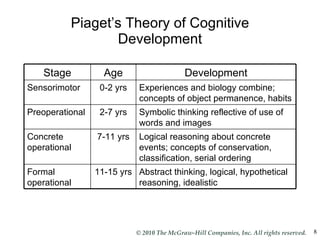
Piaget’s Theory of Cognitive Development Stage Age Development Sensorimotor  0-2 yrs Experiences and biology combine; concepts of object permanence, habits Preoperational 2-7 yrs Symbolic thinking reflective of use of words and images Concrete operational 7-11 yrs Logical reasoning about concrete events; concepts of conservation, classification, serial ordering Formal operational 11-15 yrs Abstract thinking, logical, hypothetical reasoning, idealistic
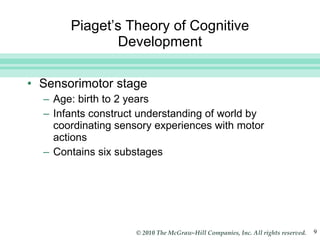
Piaget’s Theory of Cognitive Development Sensorimotor stage Age: birth to 2 years Infants construct understanding of world by coordinating sensory experiences with motor actions Contains six substages
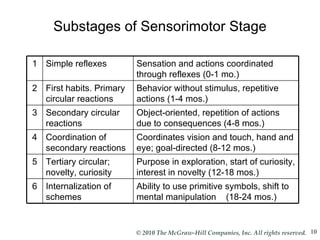
Substages of Sensorimotor Stage 1 Simple reflexes Sensation and actions coordinated through reflexes (0-1 mo.) 2 First habits. Primary circular reactions Behavior without stimulus, repetitive actions (1-4 mos.) 3 Secondary circular reactions Object-oriented, repetition of actions due to consequences (4-8 mos.) 4 Coordination of secondary reactions Coordinates vision and touch, hand and eye; goal-directed (8-12 mos.) 5 Tertiary circular; novelty, curiosity Purpose in exploration, start of curiosity, interest in novelty (12-18 mos.) 6 Internalization of schemes Ability to use primitive symbols, shift to mental manipulation  (18-24 mos.)
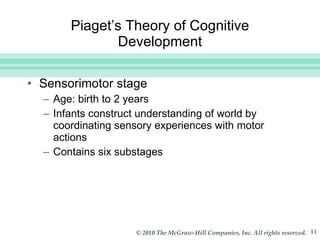
Piaget’s Theory of Cognitive Development Sensorimotor stage Age: birth to 2 years Infants construct understanding of world by coordinating sensory experiences with motor actions Contains six substages
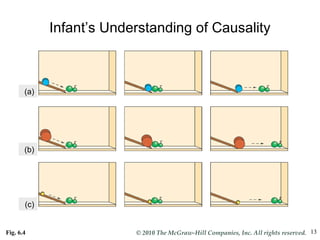
Piaget’s Theory of Cognitive Development Sensorimotor stage Object permanence Understanding that objects still exist when not seen, heard, or touched One of infant’s most important accomplishments Acquired in stages Causality and violation of expectations testing
Infant’s Understanding of Causality Fig. 6.4 (b) (c) (a)
Evaluating Piaget’s Sensorimotor Stage New research: theory needs to be modified Some abilities develop earlier Intermodal perception; substantiality and permanence of object Transitions not as clear-cut; A B  error No general theory on how development changes in cognition and nature-nurture issue
Piaget’s Theory of Cognitive Development Preoperational stage Second stage; ages 2-7 years Children begin to represent the world with words, images, and drawings Not ready to perform  operations Internalized actions that allow children to do mentally what they only did physically before Reversible mental actions
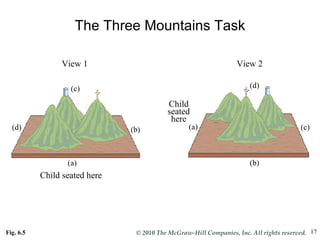
Piaget’s Theory of Cognitive Development Preoperational stage Two substages Symbolic function  (ages 2-4) Gains ability to mentally represent an object  that is not present  Egocentrism : inability to distinguish own view from another’s view Animism : lifelike qualities given to inanimate objects
The Three Mountains Task Fig. 6.5 View 1 Child seated here (a) (b) (d) (c) View 2 Child seated here (a) (b) (d) (c)
Piaget’s Theory of Cognitive Development Preoperational stage Two substages Intuitive Thought  (ages 4-7) Use of primitive reasoning, seeks answers to all sorts of questions Why?  questions exhaust adults Certainty of knowledge in absence of rational thinking
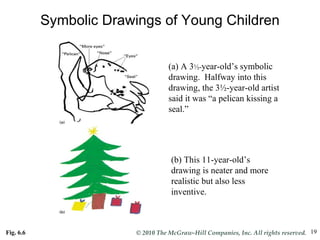
Symbolic Drawings of Young Children (a) A 3 ½- year-old’s symbolic drawing.  Halfway into this drawing, the 3½-year-old artist said it was “a pelican kissing a seal.” (b) This 11-year-old’s drawing is neater and more realistic but also less inventive. Fig. 6.6
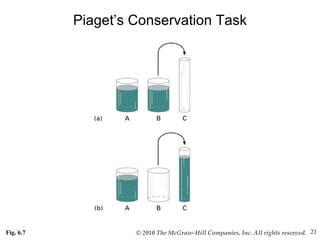
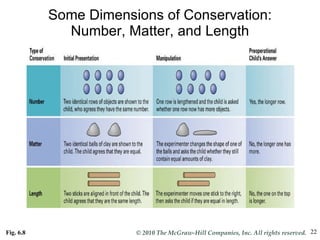
Piaget’s Theory of Cognitive Development Preoperational stage Centration : focusing attention on one characteristic to exclusion of all others Evidenced in lack of conservation Conservation : object or substance amount stays same regardless of changing appearance; lacking in preoperational stage
Piaget’s Conservation Task Fig. 6.7
Some Dimensions of Conservation: Number, Matter, and Length Fig. 6.8
Piaget’s Theory of Cognitive Development Concrete operational stage Ages: 7-11 years Children can perform  concrete operations Logical reasoning replaces intuitive reasoning if applied to specific, concrete examples  Consider several characteristics of object at once Cross-cultural variations exist
Piaget’s Theory of Cognitive Development Concrete operational stage Concrete operations: child understands one person can be father, brother, and grandson Seriation:  involves stimuli along quantitative dimension (e.g. length) Transitivity:  relationships between objects — if (a) equals (b)  and  (b) equals (c),  then  (a) equals (c)
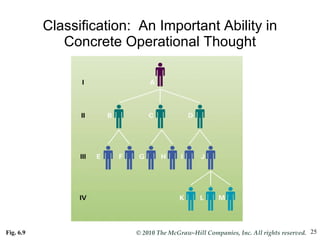
Classification:  An Important Ability in Concrete Operational Thought Fig. 6.9
Piaget’s Theory of Cognitive Development Formal operational stage Ages: 11-15 years Moves beyond concrete operations; thinks in more abstract and logical ways Abstract, Idealistic, and Logical Thinking Verbal problem-solving ability increases Increased ability to think about thought itself Thought is full of idealism and possibilities
Piaget’s Theory of Cognitive Development Formal operational stage Children: problems solved by trial-and-error Adolescents: think more like scientists Hypothetical-deductive reasoning Cognitive ability to develop hypotheses, and systematically find best way to solve problem Assimilation dominates initial development Adolescent Egocentrism
Piaget’s Theory of Cognitive Development Formal operational stage Imaginary audience   Belief that others are as interested in them as they are Involves attention-getting behavior motivated by desire to be noticed, visible, and “on stage” Personal fable   —  adolescent’s sense of uniqueness and invincibility
Applying and Evaluating Piaget’s Theory Piaget and education Take a constructivist approach Facilitate rather than direct learning Consider child’s knowledge, level of thinking Use ongoing assessment Promote the student’s intellectual health Turn classroom into exploration, discovery setting
Applying and Evaluating Piaget’s Theory Piaget’s contributions Vision of children as active, constructive thinkers Criticisms of theory Some estimates of children’s competence is inaccurate  Development not uniformly stage-like  Effects of training underestimated Culture and education influence development
Vygotsky’s Theory of  Cognitive Development Children actively construct their knowledge and understanding Learn through social interactions Society provides tools for learning Minds are shaped by cultural context  Language very important in this process
Vygotsky’s Theory of  Cognitive Development Zone of Proximal Development (ZPD) Range of tasks too difficult for child to master alone; can be mastered with guidance and assistance from more-skilled person Scaffolding Changing level of support over course of a teaching session to fit child’s current performance level;  dialogue  is important tool
Vygotsky’s Theory of  Cognitive Development Language and thought Child uses language to plan, guide, and monitor behavior Language and thought initially develop independently, then merge Private speech : language of self-regulation Self talk (3 to 7 years of age) Inner speech :  child’s thoughts
Vygotsky’s Theory of  Cognitive Development Teaching strategies Effectively assess child’s ZPD Use child’s ZPD in teaching Use more-skilled peers as teachers Monitor and encourage private speech Place instruction in meaningful context Transform classroom with Vygotskian ideas
Vygotsky’s Theory of  Cognitive Development Tools of the Mind Emphasizes self-regulation by child Give special attention to at-risk children Poverty Difficult conditions (e.g. homeless, drugs) Dramatic play has central role in classroom Child writings are important
Vygotsky’s Theory of  Cognitive Development Evaluating Vygotsky’s theory Social constructionist approach Importance of skills valued by specific culture Knowledge constructed through social interactions  Criticisms:  Overemphasize role of language Facilitators may be too helpful, overcontrolling
Cognitive Changes in Adulthood Piaget’s view Thinking qualitatively in formal operations same as adolescents Adults have more knowledge Research shows: Many don’t reach highest level until adulthood Many adults don’t use formal operational thinking
Cognitive Changes in Adulthood Realistic and pragmatic thinking Young adults’ thinking changes from adolescence Realistic : Idealism decreases in face of real world constraints Pragmatic : Switch from acquiring knowledge to applying it
Cognitive Changes in Adulthood Reflective and relativistic thinking Move away from absolutist thinking of adolescence Reflective thinking: indicates change to adulthood  Increasing complexity of cultures in world  Indicates changing nature of knowledge Adulthood – “worldview” is subjective Greatest influence on thinking — education
Cognitive Changes in Adulthood Is there a fifth, postformal stage? Postformal thought is Reflective,  relativistic, and contextual Provisional Realistic Open to emotions and subjective More research needed Another possible stage may be  wisdom
The End

Santrock tls ppt ch06-1

  • 1.
    A Topical Approachto LIFE-SPAN DEVELOPMENT John W. Santrock Chapter Six: Cognitive Developmental Approaches
  • 2.
    Piaget’s Theory ofCognitive Development Processes of development Concepts for constructing knowledge Piaget identified how children develop, use them Schemes Assimilation and accommodation Organization Equilibrium and disequilibrium Equilibration
  • 3.
    Piaget’s Theory ofCognitive Development Processes of development Schemes Actions or mental representations that organize knowledge Behavioral (physical) in infancy Mental (cognitive) in childhood
  • 4.
    Piaget’s Theory ofCognitive Development Processes of development Assimilation Incorporate new information or experience into existing knowledge schemes Accommodation Adjust existing schemes to take in new information and experiences
  • 5.
    Piaget’s Theory ofCognitive Development Processes of development Organization Grouping isolated behaviors into a higher-order cognitive system Undergoes continual refinement Cognitive organization of experiences
  • 6.
    Piaget’s Theory ofCognitive Development Processes of development Equilibration Explanation of cognitive shift (qualitative) from one stage of thought to next Disequilibrium : cognitive conflict motivation for change Equilibrium : resolve conflict through assimilation and accommodation, to reach a new balance of thought
  • 7.
    Piaget’s Theory ofCognitive Development Theory Unifies experiences and biological maturation to explain cognitive development Motivation is internal search for equilibrium Four stages of development…progressively advanced and qualitatively different
  • 8.
    Piaget’s Theory ofCognitive Development Stage Age Development Sensorimotor 0-2 yrs Experiences and biology combine; concepts of object permanence, habits Preoperational 2-7 yrs Symbolic thinking reflective of use of words and images Concrete operational 7-11 yrs Logical reasoning about concrete events; concepts of conservation, classification, serial ordering Formal operational 11-15 yrs Abstract thinking, logical, hypothetical reasoning, idealistic
  • 9.
    Piaget’s Theory ofCognitive Development Sensorimotor stage Age: birth to 2 years Infants construct understanding of world by coordinating sensory experiences with motor actions Contains six substages
  • 10.
    Substages of SensorimotorStage 1 Simple reflexes Sensation and actions coordinated through reflexes (0-1 mo.) 2 First habits. Primary circular reactions Behavior without stimulus, repetitive actions (1-4 mos.) 3 Secondary circular reactions Object-oriented, repetition of actions due to consequences (4-8 mos.) 4 Coordination of secondary reactions Coordinates vision and touch, hand and eye; goal-directed (8-12 mos.) 5 Tertiary circular; novelty, curiosity Purpose in exploration, start of curiosity, interest in novelty (12-18 mos.) 6 Internalization of schemes Ability to use primitive symbols, shift to mental manipulation (18-24 mos.)
  • 11.
    Piaget’s Theory ofCognitive Development Sensorimotor stage Age: birth to 2 years Infants construct understanding of world by coordinating sensory experiences with motor actions Contains six substages
  • 12.
    Piaget’s Theory ofCognitive Development Sensorimotor stage Object permanence Understanding that objects still exist when not seen, heard, or touched One of infant’s most important accomplishments Acquired in stages Causality and violation of expectations testing
  • 13.
    Infant’s Understanding ofCausality Fig. 6.4 (b) (c) (a)
  • 14.
    Evaluating Piaget’s SensorimotorStage New research: theory needs to be modified Some abilities develop earlier Intermodal perception; substantiality and permanence of object Transitions not as clear-cut; A B error No general theory on how development changes in cognition and nature-nurture issue
  • 15.
    Piaget’s Theory ofCognitive Development Preoperational stage Second stage; ages 2-7 years Children begin to represent the world with words, images, and drawings Not ready to perform operations Internalized actions that allow children to do mentally what they only did physically before Reversible mental actions
  • 16.
    Piaget’s Theory ofCognitive Development Preoperational stage Two substages Symbolic function (ages 2-4) Gains ability to mentally represent an object that is not present Egocentrism : inability to distinguish own view from another’s view Animism : lifelike qualities given to inanimate objects
  • 17.
    The Three MountainsTask Fig. 6.5 View 1 Child seated here (a) (b) (d) (c) View 2 Child seated here (a) (b) (d) (c)
  • 18.
    Piaget’s Theory ofCognitive Development Preoperational stage Two substages Intuitive Thought (ages 4-7) Use of primitive reasoning, seeks answers to all sorts of questions Why? questions exhaust adults Certainty of knowledge in absence of rational thinking
  • 19.
    Symbolic Drawings ofYoung Children (a) A 3 ½- year-old’s symbolic drawing. Halfway into this drawing, the 3½-year-old artist said it was “a pelican kissing a seal.” (b) This 11-year-old’s drawing is neater and more realistic but also less inventive. Fig. 6.6
  • 20.
    Piaget’s Theory ofCognitive Development Preoperational stage Centration : focusing attention on one characteristic to exclusion of all others Evidenced in lack of conservation Conservation : object or substance amount stays same regardless of changing appearance; lacking in preoperational stage
  • 21.
  • 22.
    Some Dimensions ofConservation: Number, Matter, and Length Fig. 6.8
  • 23.
    Piaget’s Theory ofCognitive Development Concrete operational stage Ages: 7-11 years Children can perform concrete operations Logical reasoning replaces intuitive reasoning if applied to specific, concrete examples Consider several characteristics of object at once Cross-cultural variations exist
  • 24.
    Piaget’s Theory ofCognitive Development Concrete operational stage Concrete operations: child understands one person can be father, brother, and grandson Seriation: involves stimuli along quantitative dimension (e.g. length) Transitivity: relationships between objects — if (a) equals (b) and (b) equals (c), then (a) equals (c)
  • 25.
    Classification: AnImportant Ability in Concrete Operational Thought Fig. 6.9
  • 26.
    Piaget’s Theory ofCognitive Development Formal operational stage Ages: 11-15 years Moves beyond concrete operations; thinks in more abstract and logical ways Abstract, Idealistic, and Logical Thinking Verbal problem-solving ability increases Increased ability to think about thought itself Thought is full of idealism and possibilities
  • 27.
    Piaget’s Theory ofCognitive Development Formal operational stage Children: problems solved by trial-and-error Adolescents: think more like scientists Hypothetical-deductive reasoning Cognitive ability to develop hypotheses, and systematically find best way to solve problem Assimilation dominates initial development Adolescent Egocentrism
  • 28.
    Piaget’s Theory ofCognitive Development Formal operational stage Imaginary audience Belief that others are as interested in them as they are Involves attention-getting behavior motivated by desire to be noticed, visible, and “on stage” Personal fable — adolescent’s sense of uniqueness and invincibility
  • 29.
    Applying and EvaluatingPiaget’s Theory Piaget and education Take a constructivist approach Facilitate rather than direct learning Consider child’s knowledge, level of thinking Use ongoing assessment Promote the student’s intellectual health Turn classroom into exploration, discovery setting
  • 30.
    Applying and EvaluatingPiaget’s Theory Piaget’s contributions Vision of children as active, constructive thinkers Criticisms of theory Some estimates of children’s competence is inaccurate Development not uniformly stage-like Effects of training underestimated Culture and education influence development
  • 31.
    Vygotsky’s Theory of Cognitive Development Children actively construct their knowledge and understanding Learn through social interactions Society provides tools for learning Minds are shaped by cultural context Language very important in this process
  • 32.
    Vygotsky’s Theory of Cognitive Development Zone of Proximal Development (ZPD) Range of tasks too difficult for child to master alone; can be mastered with guidance and assistance from more-skilled person Scaffolding Changing level of support over course of a teaching session to fit child’s current performance level; dialogue is important tool
  • 33.
    Vygotsky’s Theory of Cognitive Development Language and thought Child uses language to plan, guide, and monitor behavior Language and thought initially develop independently, then merge Private speech : language of self-regulation Self talk (3 to 7 years of age) Inner speech : child’s thoughts
  • 34.
    Vygotsky’s Theory of Cognitive Development Teaching strategies Effectively assess child’s ZPD Use child’s ZPD in teaching Use more-skilled peers as teachers Monitor and encourage private speech Place instruction in meaningful context Transform classroom with Vygotskian ideas
  • 35.
    Vygotsky’s Theory of Cognitive Development Tools of the Mind Emphasizes self-regulation by child Give special attention to at-risk children Poverty Difficult conditions (e.g. homeless, drugs) Dramatic play has central role in classroom Child writings are important
  • 36.
    Vygotsky’s Theory of Cognitive Development Evaluating Vygotsky’s theory Social constructionist approach Importance of skills valued by specific culture Knowledge constructed through social interactions Criticisms: Overemphasize role of language Facilitators may be too helpful, overcontrolling
  • 37.
    Cognitive Changes inAdulthood Piaget’s view Thinking qualitatively in formal operations same as adolescents Adults have more knowledge Research shows: Many don’t reach highest level until adulthood Many adults don’t use formal operational thinking
  • 38.
    Cognitive Changes inAdulthood Realistic and pragmatic thinking Young adults’ thinking changes from adolescence Realistic : Idealism decreases in face of real world constraints Pragmatic : Switch from acquiring knowledge to applying it
  • 39.
    Cognitive Changes inAdulthood Reflective and relativistic thinking Move away from absolutist thinking of adolescence Reflective thinking: indicates change to adulthood Increasing complexity of cultures in world Indicates changing nature of knowledge Adulthood – “worldview” is subjective Greatest influence on thinking — education
  • 40.
    Cognitive Changes inAdulthood Is there a fifth, postformal stage? Postformal thought is Reflective, relativistic, and contextual Provisional Realistic Open to emotions and subjective More research needed Another possible stage may be wisdom
  • 41.