Jean Piaget’s Theory of
Cognitive Development
Outline
•   (1) General introduction.
•   (2) Sensory-Motor period.
•   (3) Pre-operational period.
•   (4) Concrete operations.
•   (5) Formal operations.
•   (6) Evaluation.
I: Terms and concepts.
Genetic Epistemology: A
         constructivist theory
• No innate ideas...not a nativist theory.
• Nor is the child a “tabula rasa” with the
  “real” world out there waiting to be
  discovered.
• Instead, mind is constructed through
  interaction with the environment; what is
  real depends on how developed one’s
  knowledge is
How does Piaget describe
      developmental change?
• Development occurs in stages, with a
  qualitative shift in the organization and
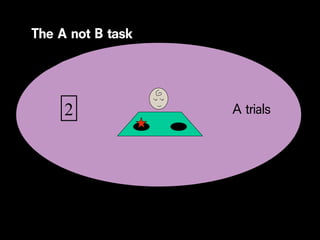
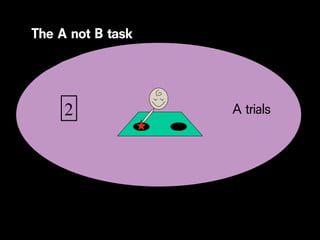
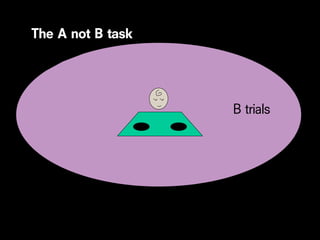
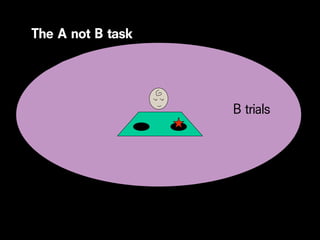
  complexity of cognition at each stage.
• Thus, children not simply slower, or less
  knowledgeable than adults  instead, they
  understand the world in a qualitatively
  different way.
• Stages form an invariant sequence.
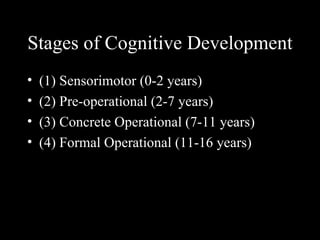
Stages of Cognitive Development
•   (1) Sensorimotor (0-2 years)
•   (2) Pre-operational (2-7 years)
•   (3) Concrete Operational (7-11 years)
•   (4) Formal Operational (11-16 years)
What develops? Cognitive
            structures
• Cognitive structures are the means by which
  experience is interpreted and organized:
  reality very much in the eye of the beholder
• Early on, cognitive structures are quite
  basic, and consist of reflexes like sucking
  and grasping.
• Piaget referred to these structures as
  schemes.
How do cognitive structures
           develop?
• Through assimilation and accomodation.
• Assimilation: The incorporation of new
  experiences into existing structures.
• Accommodation: The changing of an old
  structures so that new experiences can be
  processed.
• Assimilation is conservative, while
  accommodation is progressive.
Why accommodate?
• Normally, the mind is in a state of
  equilibrium: existing structures are stable,
  and assimilation is mostly occurring.
• However, a discrepant experience can lead
  to disequilibrium or cognitive “instability”
• Child forced to accommodate existing
  structures.
Active view of development
• Child as scientist
• Mental structures intrinsically active 
  constantly being applied to experience
• Leads to curiosity and the desire to know
• Development proceeds as the child actively
  refines his/her knowledge of the world
  through many “small experiments”
Instructional learning viewed as
        relatively unimportant
• Teachers should not try to transmit
  knowledge, but should provide
  opportunities for discovery
• Child needs to construct or reinvent
  knowledge  adult knowledge cannot be
  formally communicated to the child
• Limited importance of socio-cultural
  context; importance of peer interaction.
II: The Sensorimotor Period
            (0-2 years)
• Only some basic motor reflexes grasping,
  sucking, eye movements, orientation to
  sound, etc
• By exercising and coordinating these basic
  reflexes, infant develops intentionality and
  an understanding of object permanence.
II: The Sensorimotor Period
            (0-2 years)
• Intentionality refers to the ability to act in a
  goal-directed manner  in other words, to
  do one thing in order that something else
  occurs.
• Requires an understanding of cause and
  effect
II: The Sensorimotor Period
            (0-2 years)
• Object permanence refers to the
  understanding that objects continue to exist
  even when no longer in view.
• Need to distinguish between an action and
  the thing acted on.
Stage 1 (0-1 month)
• Stage of reflex activity.
• Many reflexes like reaching, grasping
  sucking all operating independently.
• Objects like "sensory pictures".
• Subjectivity and objectivity fused.
• Schemes activated by chance: No
  intentionality.
Stage 2 (1-4 months)
• Stage of Primary Circular Reactions.
• Infant’s behaviour, by chance, leads to an
  interesting result & is repeated.
• Circular: repetition.
• Primary: centre on infant's own body.
• Example: thumb-sucking.
Object concept at stage 2
• Passive expectation: if object disappears,
  infant will continue looking to the location
  where it disappeared, but will not search.
• In the infant mind, the existence of the
  object still very closely tied to schemes
  applied to experience
Intentions at stage 2
• Intentionality beginning to emerge: infant
  can now self-initiate certain schemes (e.g.,
  thumb-sucking)
Stage 3 (4-8 months)
• Stage of Secondary Circular Reactions
• Repetition of simple actions on external
  objects.
• Example: bang a toy to make a noise.
Intentionality at stage 3
• Poor understanding of the connection
  between causes and effect limits their
  ability to act intentionality.
• “Magical causality”  accidentally banging
  toy makes many interesting things happen
Object concept at stage 3
• Visual anticipation.
• If infant drops an object, and it disappears,
  the infant will visually search for it.
• Will also search for partially hidden objects
• But will not search for completely hidden
  objects.
Stage 4 (8-12 months)
• Co-ordination of secondary circular
  reactions.
• Secondary schemes combined to create new
  action sequences.
Intentionality at Stage 4
• First appearance of intentional or in Piaget’s
  terms, means-end behavior.
• Infant learns to use one secondary scheme
  (e.g., pulling a towel) in order that another
  secondary scheme can be activated (e.g.,
  reaching and grasping a toy)
Object concept at stage 4
• Infant will search for hidden objects.
• Does infant understand the object as
  something that exists separate from the
  scheme applied to find the object?
• No. Evidence?
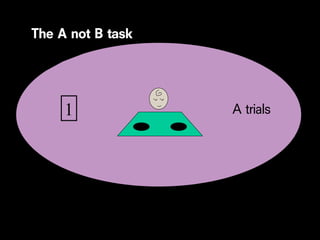
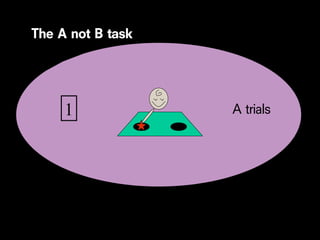
• A not B error.
The A not B task
 The A not B task


      1             A trials
The A not B task
 The A not B task


      1             A trials
The A not B task
 The A not B task


      1             A trials
The A not B task
 The A not B task


      2             A trials
The A not B task
 The A not B task


      2             A trials
The A not B task
 The A not B task


      2             A trials
The A not B task
 The A not B task


                    B trials
The A not B task
 The A not B task


                    B trials
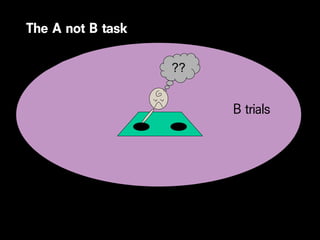
The A not B task

                   ??


                        B trials
A not B error
• Infant continues to search at the first hiding
  location after object is hidden in the new
  location.
• Object still subjectively understood.
• Object remains associated with a previously
  successful scheme.
Stage 5 (12-18 months)
•   Stage of Tertiary Circular Reactions.
•   Actions varied in an experimental fashion.
•   Pursuit of novelty
•   New means are discovered.
•   Limited to physical actions taken on objects
Object concept at stage 5.
• Can solve A not B.
• Cannot solve A not B with invisible
  displacement (Example from Piaget).
Stage 5 and invisible
             displacement
• Can only imagine the object as existing
  where it was last hidden.
• Invisible displacement requires the infant to
  mentally calculate the new location of the
  object.
Stage 6 (18-24 months)
• Can solve object search with invisible
  displacement.
• Infants now mentally represent physically
  absent objects.
• Understands object as something that exists
  independently of sensory-motor action.
Stage 6 (18-24 months)
• Sensori-motor period culminates with the
  emergence of the Symbolic function
• An idea or mental image is used to stand-in
  for a perceptually absent object
• Trial-and-error problem solving does not
  need to enacted but can undertaken through
  mental combination.
Summary
• Sensori-motor period culminates in the
  emergence of symbolic representation.
• Object permanence understood.
• Basic means-ends skills have emerged.
Piaget – Part 2

Beyond the sensorimotor period
III: The pre-operational period
• Symbolic thought without operations.
• Operations: logical principles that are
  applied to symbols rather than objects.
• 3 examples: reversibility, compensation,
  and identity
• In the absence of operations, thinking is
  governed more by appearance than logical
  necessity.
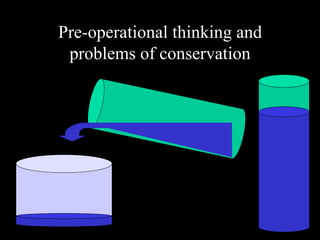
Pre-operational thinking and
 problems of conservation
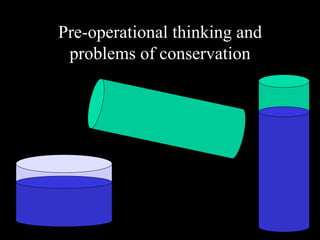
Pre-operational thinking and
      problems of conservation

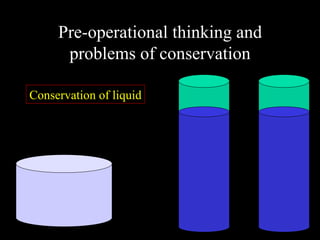
Conservation of liquid
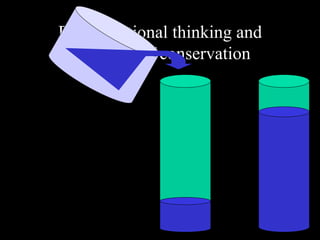
Pre-operational thinking and
 problems of conservation
Pre-operational thinking and
 problems of conservation
Pre-operational thinking and
 problems of conservation
Pre-operational thinking and
 problems of conservation
Pre-operational thinking and
 problems of conservation
Pre-operational thinking and
 problems of conservation
Pre-operational thinking and
      problems of conservation
• Why do pre-operational children fail
  problems of conservation?
• Because their thinking is not governed by
  principles of reversibility, compensation
  and identity
Pre-operational thinking and
          problems of conservation
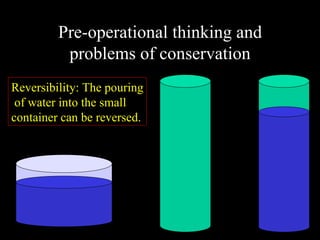
Reversibility: The pouring
 of water into the small
container can be reversed.
Pre-operational thinking and
           problems of conservation
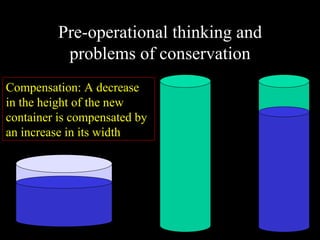
Compensation: A decrease
in the height of the new
container is compensated by
an increase in its width
Pre-operational thinking and
           problems of conservation
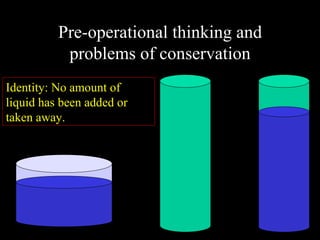
Identity: No amount of
liquid has been added or
taken away.
Pre-operational thinking and
      problems of conservation
• Why do pre-operational children fail
  problems of conservation?
• Because their thinking is not governed by
  principles of reversibility, compensation
  and identity
• If children applied these principles, they
  would conclude liquid is conserved
Characteristics of Pre-Operational
               Thinking
• Not governed by logical operations
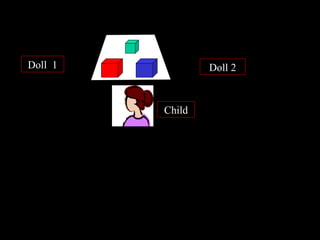
• Consequently, it appears egocentric (e.g., 3
  mountains task) and intuitive (e.g.,
  conservation tasks)
3 Mountains Task


 Doll 1                    Doll 2


                   Child
3 Mountains Task


 Doll 1                    Doll 2


                   Child
Characteristics of Pre-Operational
              Thinking
• (1) Egocentric
• (2) Intuitive  problem solving is not
  reasoned or logical
Nature of intuitive reasoning
• No reversibility  Cannot mentally undo a
  given action.
• Perceptual centration Focus on only one
  dimension of a problem.
• States versus transformations 
  Transformations relating different states
  ignored.
What makes Pre-operational
        thinking stage-like?
•   Because it appears to be a general
    characteristic of children’s thinking at this
    age.
What makes Pre-operational
        thinking stage-like?
•   Because it appears to be a general
    characteristic of children’s thinking at this
    age.
• Examples:
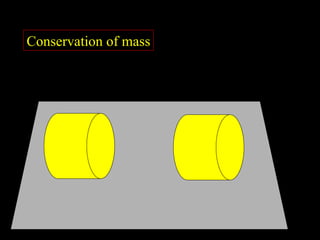
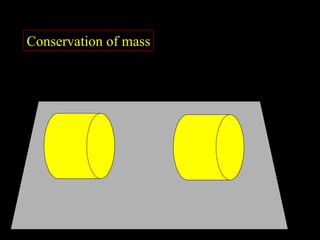
(3) Other conservation problems.
Conservation of mass
What makes Pre-operational
        thinking stage-like?
•   Because it appears to be a general
    characteristic of children’s thinking at this
    age.
• Examples:
(3) Other conservation problems.
What makes Pre-operational
        thinking stage-like?
•   Because it appears to be a general
    characteristic of children’s thinking at this
    age.
• Examples:
(3) Other conservation problems.
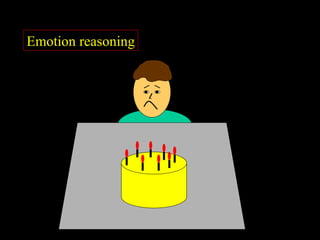
(4) Emotion reasoning.
Emotion reasoning
What makes Pre-operational
        thinking stage-like?
•   Because it appears to be a general
    characteristic of children’s thinking at this
    age.
• Examples:
(3) Other conservation problems.
(4) Emotion reasoning.
(5) Moral reasoning.
What makes Pre-operational
        thinking stage-like?
•   Because it appears to be a general
    characteristic of children’s thinking at this
    age.
•   Examples:
•   Other conservation problems.
•   Emotion reasoning.
•   Moral reasoning.  focus on consequences
IV: Concrete operational thinking

              (7-12 years)
• Qualitatively different reasoning in
  conservation problems.
• Flexible and decentered.
• Co-ordination of multiple dimensions.
• Logical vs. empirical problem solving.
• Reversibility.
• Awareness of transformations.
IV: Concrete operational thinking

               (7-12 years)
• Physical operations now internalized and
  have become cognitive
• Still, logic directed at physical or concrete
  problems
Horizontal decalage
• Different conservation problems solved at
  different ages.
• Some claim it is a threat to Piaget’s domain
  general view of cognitive development
• Example: volume vs mass
• But, invariant sequence observed.
V: Formal operations
• Thought no longer applied strictly to
  concrete problems.
• Directed inward: thought becomes the
  object of thought.
• Advances in use of deductive and inductive
  logic
V: Formal operations
• Deductive thought in period of concrete
  operations confined to familiar everyday
  experience: “If Sam steals Tim’s toy, then
  how will Tim feel?”
• Formal operations: “If we could eliminate
  injustice, would the world live in peace?”
• Thinking goes beyond experience, more
  abstract
Inductive reasoning
• Example: Pendulum problem
• Scientific thinking: from specific
  observations to general conclusions through
  hypothesis-testing
Inductive reasoning
• Example: Pendulum problem


             How fast?
Inductive reasoning
• Formal operational children will
  systematically test all possibilities before
  arriving at a conclusion
VI: Evaluating Piaget
• Difficult.
• An enormous theory.
• Covers many ages and issues in
  development.
Strengths
• Active rather than passive view of the child.
• Revealed important invariants in cognitive
  development.
• Errors informative.
• Perceptual-motor learning rather than
  language important for development.
• Tasks.
Weaknesses
• The competence-performance distinction
Competence
• Knowledge, rules, and concepts that form
  the basis of cognition.
• Inferred from behaviour.
Performance
• Energy level, interest, attention, language
  skills, motivation etc.
• Factors that effect the expression of a
  competence.
Competence-performance
          distinction.
• Piaget attributed infants success (or lack of
  success) to competence.
• However, he gave no consideration to
  performance factors that may have
  constrained the expression of knowledge.
• Example: A not B
Performance-competence
      distinction and A not B
• A not B errors thought to indicate poor
  understanding of objects.
• However, motor components of the task
  may constrain the expression of infants
  knowledge.
• Example: Baillergeon.
• Object permanence observed in 5 month-
  olds using a looking time task.
Other examples
• Borke (1975) & the 3 mountains task.
• Bruner (1966) & the liquid conservation
  task.

• More detailed task analysis required.
Stages?
• Stage like progression only observed if one
  assumes a bird-eye view.
• Closer inspection reveals more continuous
  changes (Siegler, 1988).
Summary
• Piaget’s theory is wide-ranging and
  influential.
• Source of continued controversy.
• People continue to address many of the
  questions he raised, but using different
  methods and concepts.

Piaget

  • 1.
    Jean Piaget’s Theoryof Cognitive Development
  • 2.
    Outline • (1) General introduction. • (2) Sensory-Motor period. • (3) Pre-operational period. • (4) Concrete operations. • (5) Formal operations. • (6) Evaluation.
  • 3.
    I: Terms andconcepts.
  • 4.
    Genetic Epistemology: A constructivist theory • No innate ideas...not a nativist theory. • Nor is the child a “tabula rasa” with the “real” world out there waiting to be discovered. • Instead, mind is constructed through interaction with the environment; what is real depends on how developed one’s knowledge is
  • 5.
    How does Piagetdescribe developmental change? • Development occurs in stages, with a qualitative shift in the organization and complexity of cognition at each stage. • Thus, children not simply slower, or less knowledgeable than adults  instead, they understand the world in a qualitatively different way. • Stages form an invariant sequence.
  • 6.
    Stages of CognitiveDevelopment • (1) Sensorimotor (0-2 years) • (2) Pre-operational (2-7 years) • (3) Concrete Operational (7-11 years) • (4) Formal Operational (11-16 years)
  • 7.
    What develops? Cognitive structures • Cognitive structures are the means by which experience is interpreted and organized: reality very much in the eye of the beholder • Early on, cognitive structures are quite basic, and consist of reflexes like sucking and grasping. • Piaget referred to these structures as schemes.
  • 8.
    How do cognitivestructures develop? • Through assimilation and accomodation. • Assimilation: The incorporation of new experiences into existing structures. • Accommodation: The changing of an old structures so that new experiences can be processed. • Assimilation is conservative, while accommodation is progressive.
  • 9.
    Why accommodate? • Normally,the mind is in a state of equilibrium: existing structures are stable, and assimilation is mostly occurring. • However, a discrepant experience can lead to disequilibrium or cognitive “instability” • Child forced to accommodate existing structures.
  • 10.
    Active view ofdevelopment • Child as scientist • Mental structures intrinsically active  constantly being applied to experience • Leads to curiosity and the desire to know • Development proceeds as the child actively refines his/her knowledge of the world through many “small experiments”
  • 11.
    Instructional learning viewedas relatively unimportant • Teachers should not try to transmit knowledge, but should provide opportunities for discovery • Child needs to construct or reinvent knowledge  adult knowledge cannot be formally communicated to the child • Limited importance of socio-cultural context; importance of peer interaction.
  • 12.
    II: The SensorimotorPeriod (0-2 years) • Only some basic motor reflexes grasping, sucking, eye movements, orientation to sound, etc • By exercising and coordinating these basic reflexes, infant develops intentionality and an understanding of object permanence.
  • 13.
    II: The SensorimotorPeriod (0-2 years) • Intentionality refers to the ability to act in a goal-directed manner  in other words, to do one thing in order that something else occurs. • Requires an understanding of cause and effect
  • 14.
    II: The SensorimotorPeriod (0-2 years) • Object permanence refers to the understanding that objects continue to exist even when no longer in view. • Need to distinguish between an action and the thing acted on.
  • 15.
    Stage 1 (0-1month) • Stage of reflex activity. • Many reflexes like reaching, grasping sucking all operating independently. • Objects like "sensory pictures". • Subjectivity and objectivity fused. • Schemes activated by chance: No intentionality.
  • 16.
    Stage 2 (1-4months) • Stage of Primary Circular Reactions. • Infant’s behaviour, by chance, leads to an interesting result & is repeated. • Circular: repetition. • Primary: centre on infant's own body. • Example: thumb-sucking.
  • 17.
    Object concept atstage 2 • Passive expectation: if object disappears, infant will continue looking to the location where it disappeared, but will not search. • In the infant mind, the existence of the object still very closely tied to schemes applied to experience
  • 18.
    Intentions at stage2 • Intentionality beginning to emerge: infant can now self-initiate certain schemes (e.g., thumb-sucking)
  • 19.
    Stage 3 (4-8months) • Stage of Secondary Circular Reactions • Repetition of simple actions on external objects. • Example: bang a toy to make a noise.
  • 20.
    Intentionality at stage3 • Poor understanding of the connection between causes and effect limits their ability to act intentionality. • “Magical causality”  accidentally banging toy makes many interesting things happen
  • 21.
    Object concept atstage 3 • Visual anticipation. • If infant drops an object, and it disappears, the infant will visually search for it. • Will also search for partially hidden objects • But will not search for completely hidden objects.
  • 22.
    Stage 4 (8-12months) • Co-ordination of secondary circular reactions. • Secondary schemes combined to create new action sequences.
  • 23.
    Intentionality at Stage4 • First appearance of intentional or in Piaget’s terms, means-end behavior. • Infant learns to use one secondary scheme (e.g., pulling a towel) in order that another secondary scheme can be activated (e.g., reaching and grasping a toy)
  • 24.
    Object concept atstage 4 • Infant will search for hidden objects. • Does infant understand the object as something that exists separate from the scheme applied to find the object? • No. Evidence? • A not B error.
  • 25.
    The A notB task The A not B task 1 A trials
  • 26.
    The A notB task The A not B task 1 A trials
  • 27.
    The A notB task The A not B task 1 A trials
  • 28.
    The A notB task The A not B task 2 A trials
  • 29.
    The A notB task The A not B task 2 A trials
  • 30.
    The A notB task The A not B task 2 A trials
  • 31.
    The A notB task The A not B task B trials
  • 32.
    The A notB task The A not B task B trials
  • 33.
    The A notB task ?? B trials
  • 34.
    A not Berror • Infant continues to search at the first hiding location after object is hidden in the new location. • Object still subjectively understood. • Object remains associated with a previously successful scheme.
  • 35.
    Stage 5 (12-18months) • Stage of Tertiary Circular Reactions. • Actions varied in an experimental fashion. • Pursuit of novelty • New means are discovered. • Limited to physical actions taken on objects
  • 36.
    Object concept atstage 5. • Can solve A not B. • Cannot solve A not B with invisible displacement (Example from Piaget).
  • 37.
    Stage 5 andinvisible displacement • Can only imagine the object as existing where it was last hidden. • Invisible displacement requires the infant to mentally calculate the new location of the object.
  • 38.
    Stage 6 (18-24months) • Can solve object search with invisible displacement. • Infants now mentally represent physically absent objects. • Understands object as something that exists independently of sensory-motor action.
  • 39.
    Stage 6 (18-24months) • Sensori-motor period culminates with the emergence of the Symbolic function • An idea or mental image is used to stand-in for a perceptually absent object • Trial-and-error problem solving does not need to enacted but can undertaken through mental combination.
  • 40.
    Summary • Sensori-motor periodculminates in the emergence of symbolic representation. • Object permanence understood. • Basic means-ends skills have emerged.
  • 41.
    Piaget – Part2 Beyond the sensorimotor period
  • 42.
    III: The pre-operationalperiod • Symbolic thought without operations. • Operations: logical principles that are applied to symbols rather than objects. • 3 examples: reversibility, compensation, and identity • In the absence of operations, thinking is governed more by appearance than logical necessity.
  • 43.
    Pre-operational thinking and problems of conservation
  • 44.
    Pre-operational thinking and problems of conservation Conservation of liquid
  • 45.
    Pre-operational thinking and problems of conservation
  • 46.
    Pre-operational thinking and problems of conservation
  • 47.
    Pre-operational thinking and problems of conservation
  • 48.
    Pre-operational thinking and problems of conservation
  • 49.
    Pre-operational thinking and problems of conservation
  • 50.
    Pre-operational thinking and problems of conservation
  • 51.
    Pre-operational thinking and problems of conservation • Why do pre-operational children fail problems of conservation? • Because their thinking is not governed by principles of reversibility, compensation and identity
  • 52.
    Pre-operational thinking and problems of conservation Reversibility: The pouring of water into the small container can be reversed.
  • 53.
    Pre-operational thinking and problems of conservation Compensation: A decrease in the height of the new container is compensated by an increase in its width
  • 54.
    Pre-operational thinking and problems of conservation Identity: No amount of liquid has been added or taken away.
  • 55.
    Pre-operational thinking and problems of conservation • Why do pre-operational children fail problems of conservation? • Because their thinking is not governed by principles of reversibility, compensation and identity • If children applied these principles, they would conclude liquid is conserved
  • 56.
    Characteristics of Pre-Operational Thinking • Not governed by logical operations • Consequently, it appears egocentric (e.g., 3 mountains task) and intuitive (e.g., conservation tasks)
  • 57.
    3 Mountains Task Doll 1 Doll 2 Child
  • 58.
    3 Mountains Task Doll 1 Doll 2 Child
  • 59.
    Characteristics of Pre-Operational Thinking • (1) Egocentric • (2) Intuitive  problem solving is not reasoned or logical
  • 60.
    Nature of intuitivereasoning • No reversibility  Cannot mentally undo a given action. • Perceptual centration Focus on only one dimension of a problem. • States versus transformations  Transformations relating different states ignored.
  • 61.
    What makes Pre-operational thinking stage-like? • Because it appears to be a general characteristic of children’s thinking at this age.
  • 62.
    What makes Pre-operational thinking stage-like? • Because it appears to be a general characteristic of children’s thinking at this age. • Examples: (3) Other conservation problems.
  • 63.
  • 64.
  • 65.
  • 66.
    What makes Pre-operational thinking stage-like? • Because it appears to be a general characteristic of children’s thinking at this age. • Examples: (3) Other conservation problems.
  • 67.
    What makes Pre-operational thinking stage-like? • Because it appears to be a general characteristic of children’s thinking at this age. • Examples: (3) Other conservation problems. (4) Emotion reasoning.
  • 68.
  • 69.
    What makes Pre-operational thinking stage-like? • Because it appears to be a general characteristic of children’s thinking at this age. • Examples: (3) Other conservation problems. (4) Emotion reasoning. (5) Moral reasoning.
  • 70.
    What makes Pre-operational thinking stage-like? • Because it appears to be a general characteristic of children’s thinking at this age. • Examples: • Other conservation problems. • Emotion reasoning. • Moral reasoning.  focus on consequences
  • 71.
    IV: Concrete operationalthinking (7-12 years) • Qualitatively different reasoning in conservation problems. • Flexible and decentered. • Co-ordination of multiple dimensions. • Logical vs. empirical problem solving. • Reversibility. • Awareness of transformations.
  • 72.
    IV: Concrete operationalthinking (7-12 years) • Physical operations now internalized and have become cognitive • Still, logic directed at physical or concrete problems
  • 73.
    Horizontal decalage • Differentconservation problems solved at different ages. • Some claim it is a threat to Piaget’s domain general view of cognitive development • Example: volume vs mass • But, invariant sequence observed.
  • 74.
    V: Formal operations •Thought no longer applied strictly to concrete problems. • Directed inward: thought becomes the object of thought. • Advances in use of deductive and inductive logic
  • 75.
    V: Formal operations •Deductive thought in period of concrete operations confined to familiar everyday experience: “If Sam steals Tim’s toy, then how will Tim feel?” • Formal operations: “If we could eliminate injustice, would the world live in peace?” • Thinking goes beyond experience, more abstract
  • 76.
    Inductive reasoning • Example:Pendulum problem • Scientific thinking: from specific observations to general conclusions through hypothesis-testing
  • 77.
    Inductive reasoning • Example:Pendulum problem How fast?
  • 78.
    Inductive reasoning • Formaloperational children will systematically test all possibilities before arriving at a conclusion
  • 79.
    VI: Evaluating Piaget •Difficult. • An enormous theory. • Covers many ages and issues in development.
  • 80.
    Strengths • Active ratherthan passive view of the child. • Revealed important invariants in cognitive development. • Errors informative. • Perceptual-motor learning rather than language important for development. • Tasks.
  • 81.
  • 82.
    Competence • Knowledge, rules,and concepts that form the basis of cognition. • Inferred from behaviour.
  • 83.
    Performance • Energy level,interest, attention, language skills, motivation etc. • Factors that effect the expression of a competence.
  • 84.
    Competence-performance distinction. • Piaget attributed infants success (or lack of success) to competence. • However, he gave no consideration to performance factors that may have constrained the expression of knowledge. • Example: A not B
  • 85.
    Performance-competence distinction and A not B • A not B errors thought to indicate poor understanding of objects. • However, motor components of the task may constrain the expression of infants knowledge. • Example: Baillergeon. • Object permanence observed in 5 month- olds using a looking time task.
  • 86.
    Other examples • Borke(1975) & the 3 mountains task. • Bruner (1966) & the liquid conservation task. • More detailed task analysis required.
  • 87.
    Stages? • Stage likeprogression only observed if one assumes a bird-eye view. • Closer inspection reveals more continuous changes (Siegler, 1988).
  • 88.
    Summary • Piaget’s theoryis wide-ranging and influential. • Source of continued controversy. • People continue to address many of the questions he raised, but using different methods and concepts.