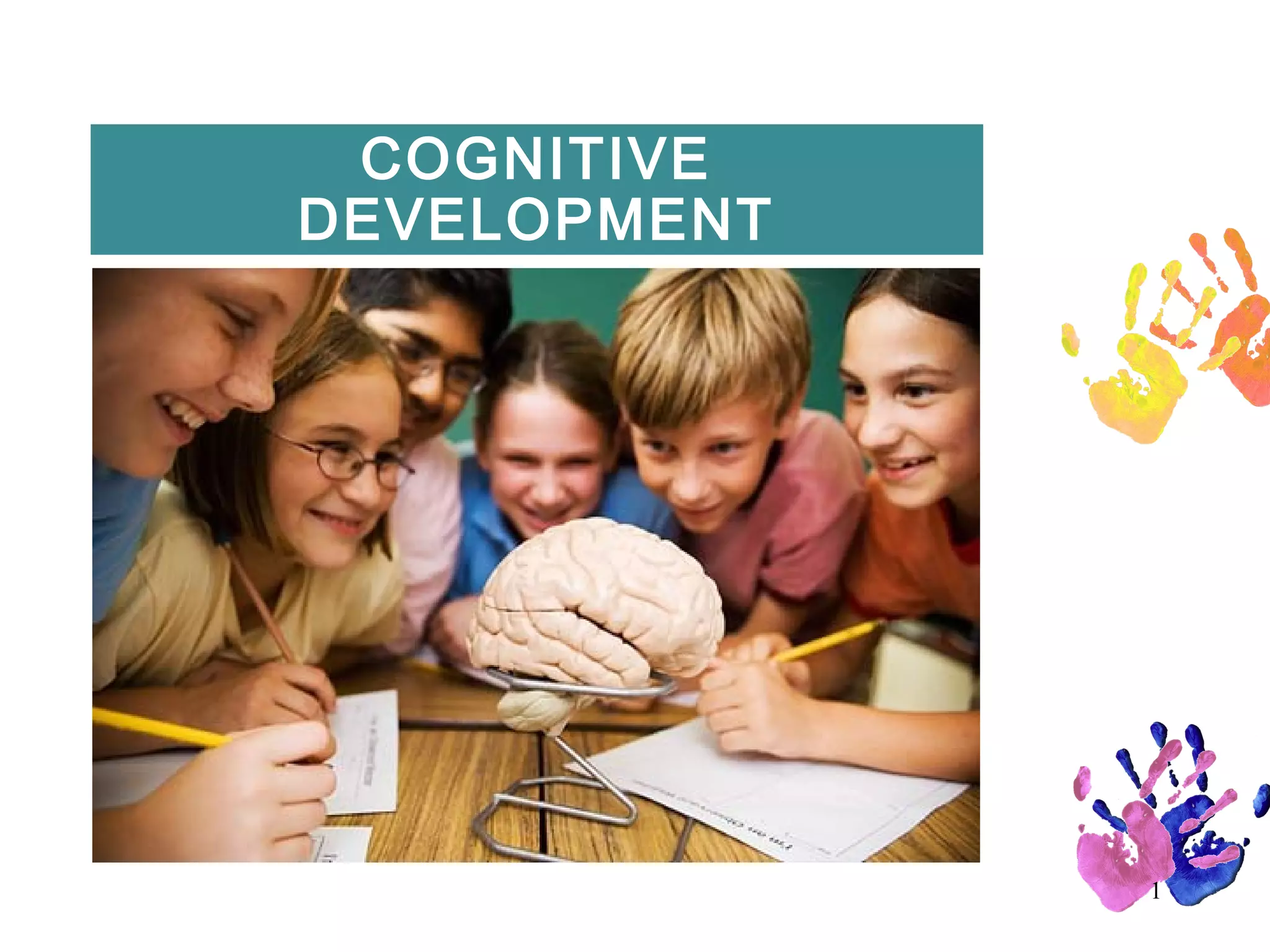
COGNITIVE
DEVELOPMENT
Thinking
Moral Reasoning
Memory & Mnemonics
Information-Processing Skills
Intelligence
Language
School Achievement
1
PIAGETIAN APPROACH
THE CONCRETE OPERATIONAL CHILD
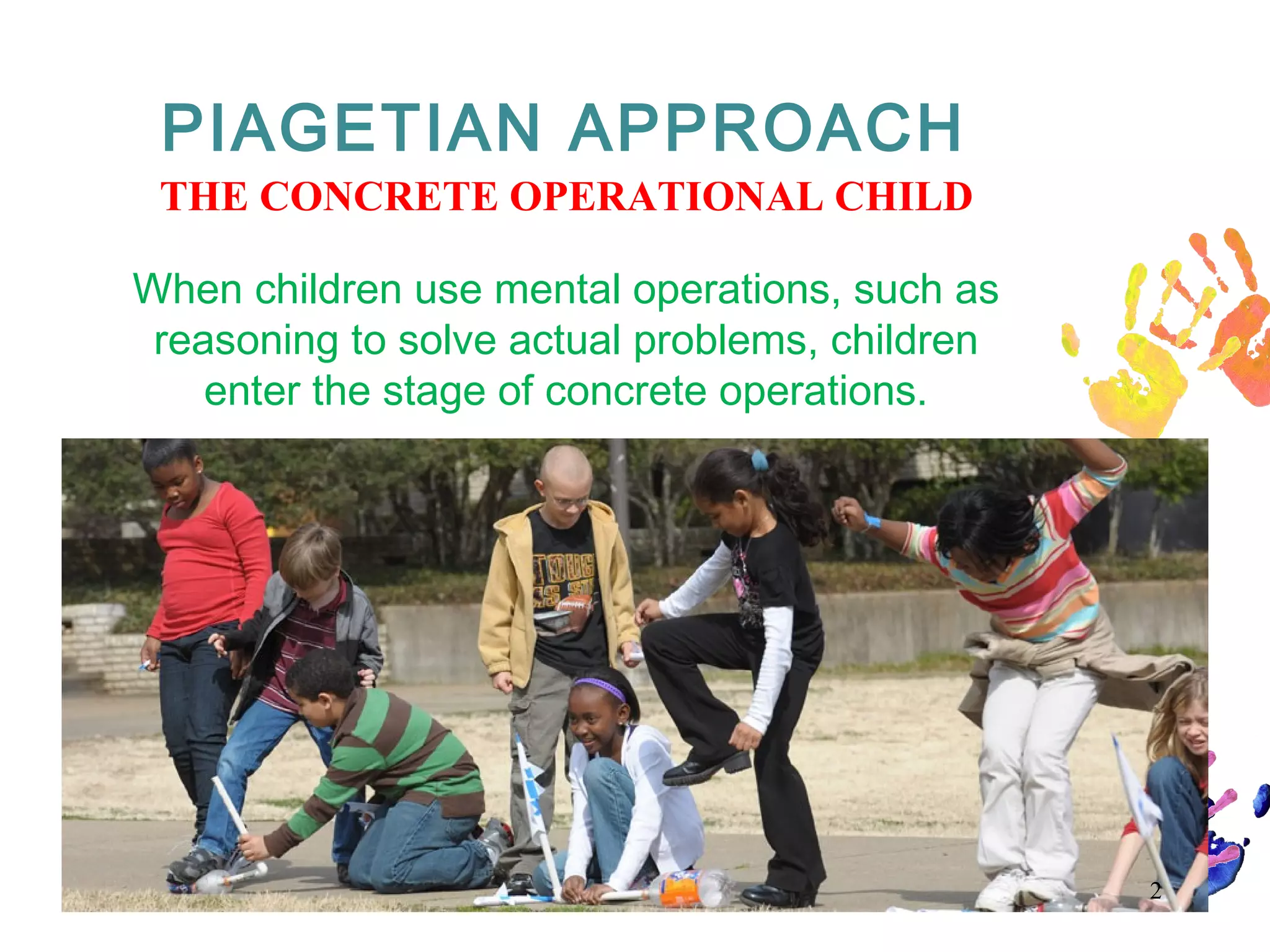
When children use mental operations, such as
reasoning to solve actual problems, children
enter the stage of concrete operations.
2
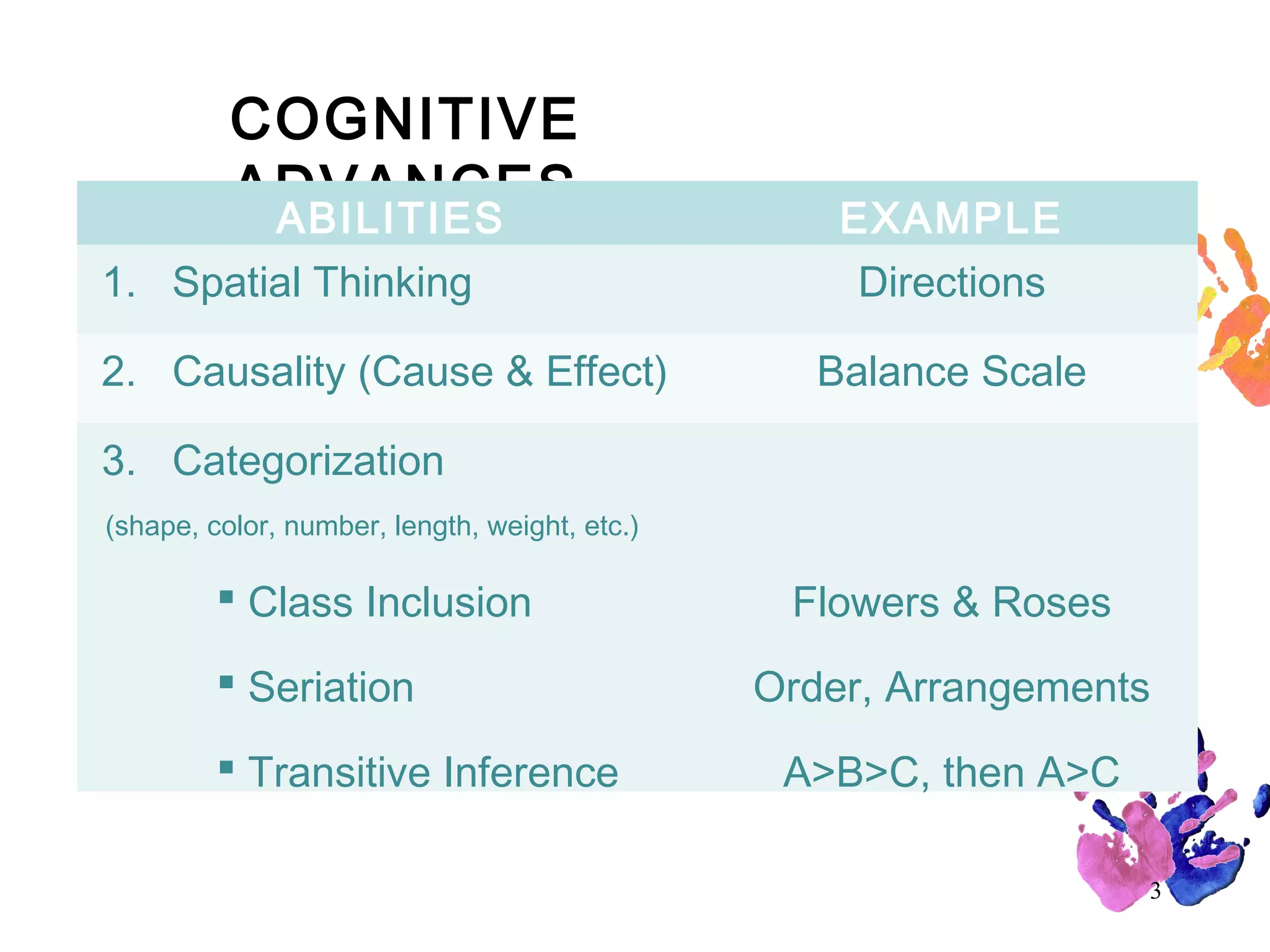
COGNITIVE
ADVANCESABILITIES EXAMPLE
1. Spatial Thinking Directions
2. Causality (Cause & Effect) Balance Scale
3. Categorization
(shape, color, number, length, weight, etc.)
 Class Inclusion
 Seriation
 Transitive Inference
Flowers & Roses
Order, Arrangements
A>B>C, then A>C
3
All of these are flowers.
Which is more in number?
ROSES? or FLOWERS?
CLASS INCLUSION
4
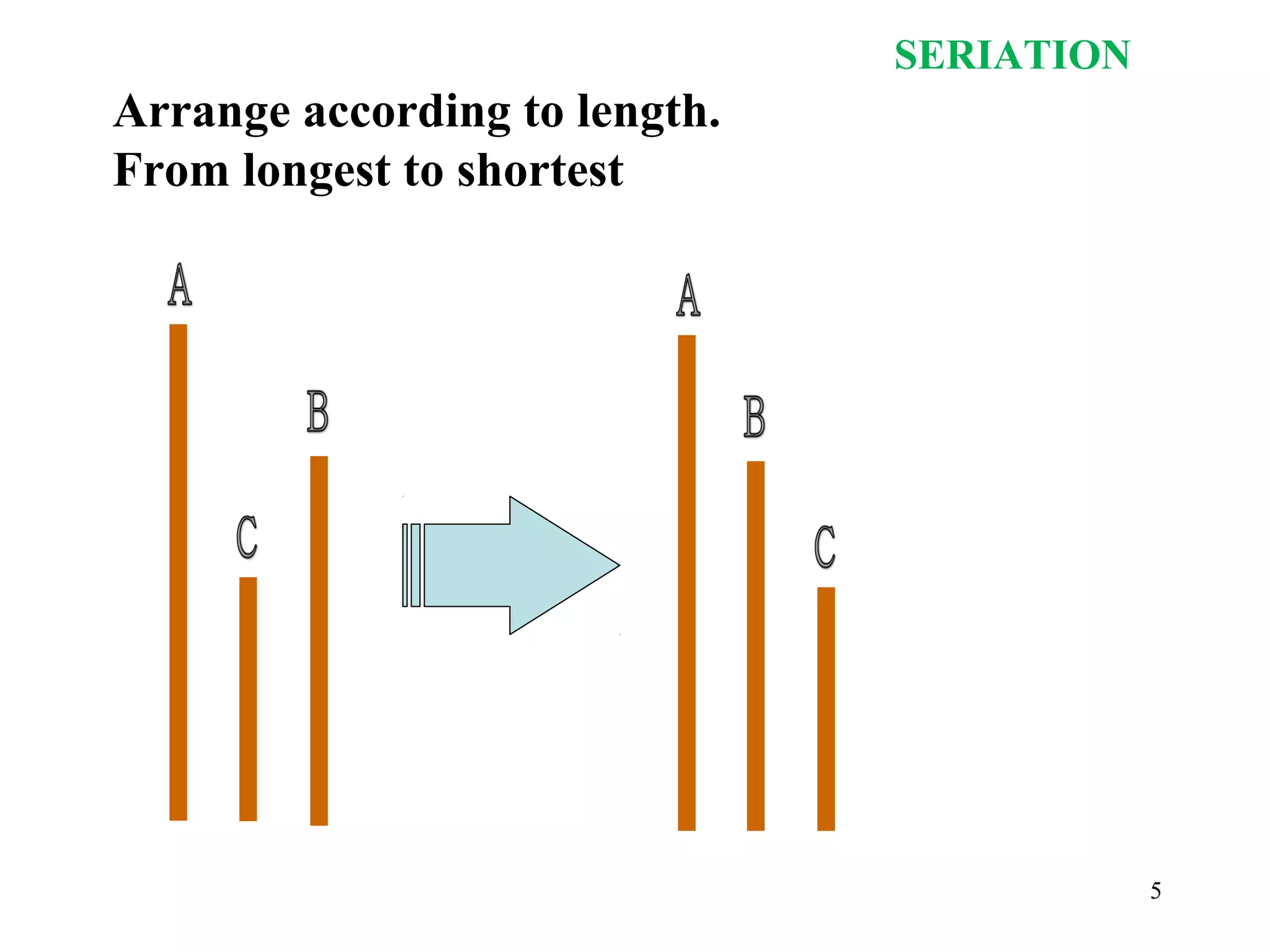
Arrange according to length.
From longest to shortest
SERIATION
5
A > B > C, then A > C
TRANSITIVE
INFERENCE
then
6
COGNITIVE
ADVANCESABILITIES EXAMPLE
4. Inductive & Deductive
Reasoning
Particular & General
Premises
5. Conservation
Principle of Identity
Principle of Reversibility
Decentering
Clay
6. Number & Mathematics Counting in the head
7
8
Decentering &
Reversibility
9
So, during middle childhood, cognitive
advances continue and the development
of concrete operational skills becomes
more established.
• Children at this stage can
understand such concepts
as relationships between
time and speed…
10
At the beginning of the concrete operational
stage, kids reason that the 2 cars on these
routes are traveling the same speed even though
they arrive at the same time. Later, they realize
the correct relationship between speed &
distance.
11
COGNITIVE
ADVANCESABILITIES EXAMPLE
4. Inductive & Deductive
Reasoning
Particular & General
Premises
5. Conservation
Principle of Identity
Principle of Reversibility
Decentering
Clay
6. Number & Mathematics Counting in the head
12
Examples:
1.) 5 + 5 =
2.) You went to a fruit store with P15.00.
You bought 2 apples for P4.00 each.
You received a change.
How much did you receive?
ANSWER:
10 – 2(4) = 2
13
• Despite the obvious advances
that occur during the
concrete operational stage,
children still experience a big
limitation in their thinking:
They are still tied to concrete
physical reality!
(no understanding of
abstract/hypothetical/logic)
14
Moral Development
QUESTION: WHO’s NAUGHTIER?WHO’s NAUGHTIER?
DANIEL HARRY
INK BLOTINK BLOT
ON THE TABLEON THE TABLE
IMMATUREIMMATURE
MORALMORAL
JUDGEMENTS:JUDGEMENTS:
DEGREE OF
OFFENSE:
MOREMORE
DEGREE OF
OFFENSE:
LESSLESS
MATURE MORALMATURE MORAL
JUDGEMENTS:JUDGEMENTS:
INTENT:
UNINTENTIONAUNINTENTIONA
LL
INTENT:
INTENTIONALINTENTIONAL
15
3 STAGES OF MORAL
REASONING
1st
Stage (approximately ages 2 – 7)
*RIGID OBEDIENCE TO AUTHORITY*
-egocentric
-rules cannot be bent or changed
-behavior is wither right or wrong
-any offense deserves punishment,
regardless of intent
16
3 STAGES OF MORAL
REASONING
2nd
Stage (ages 7 or 8 to 10 or 11)
*INCREASING FLEXIBILITY*
-wider range of viewpoints
-discard the idea: absolute right&wrong
-sense of justice based on fairness or
equal treatment for all
-more subtle moral judgements
17
3 STAGES OF MORAL
REASONING
3rd Stage (around age 11 0r 12)
*EQUITY*
-taking specific circumstances
into account
end of Piagetian approach 18
• Encoding Recorded in memory
(Keyboard)
• Storage Saved in memory
(on hard drive)
• Retrieved Brought into awareness
(on screen)
INFORMATION PROCESSING
APPROACH
(Planning, Attention, and Memory)
19
INFORMATION PROCESSING
APPROACH
(Planning, Attention, and Memory)
Children in middle childhood make
steady progress in the abilities to
regulate and sustain attention, process
and retain information, & plan and
monitor their behavior.
EXECUTIVE FUNCTION which is the
conscious control of thoughts, emotions,
and actions to accomplish goals or solve
problems.
20
INFORMATION PROCESSING
APPROACH
(Planning, Attention, and Memory)
The development of the Executive Function
accompanies the development of the brain,
in particular, the prefrontal cortex
(planning, judgment, and decision making).
Unneeded synapses are pruned away and
pathways become myelinated, processing
speed.
Home environment also contributes to
the development of the executive skills.
21
MNEMONICS:
Strategies For Remembering
4 COMMON MEMORY STRATEGIES
STRATEGY DEFINITION EXAMPLE
External
Memory
Aids
Prompting by
something outside the
person
Making a list of
something you have to
do today
Rehearsal Conscious repetition Memorizing notes by
saying it over and over
again
Organization Grouping by
categories
Recalling animals in
the zoo first in
mammals, reptiles,
amphibians, fish, then
birds
Elaboration Associating items to
be remembered with
something else
(phrase, scene, or
story)
Colors of the rainbow:
(ROY G. BIV)
Music: (E,G,B,D,F)
Every Good Boy Does Fine 22
PSYCHOMETRIC
APPROACH:
Assessment of Intelligence
23
IQ Tests
• Wechsler Intelligence Scale
for Children (WISC-III)
A test for children (6-16) that provides
separate measures of verbal and
performance (nonverbal) skills as well
as a total score.
• Otis-Lennon School Ability
Test (OLSAT8)
A test for kindergarten through 12th
grade.
24
The IQ Controversy
ACTIVITY: DEBATE
Group or Representative
• Group yourselves into 2
• 1 Group for “FOR IQ TESTS”
• 1 Group for “AGAINST IQ TESTS”
25
The IQ Controversy
ACTIVITY: DEBATE
“IQ TESTS ACCURATELY ASSESS
CHILDREN’S INTELLIGENCE”
You are given 5 minutes to think it over
before the debate will start.
3 minutes to speak your argument.
26
The IQ Controversy
START
27
INFLUENCES ON INTELLIGENCE
1. Influences of Brain Development
2. Influence of Schooling
3. Influences of Race/Ethnicity and
SES
4. Influence of Culture
28
Is There More Than One
Intelligence?
Theory of Multiple Intelligences
by
HOWARD GARDNER
And
Triarchic Theory of Intelligence
by
Robert Sternberg
29
INTELLIGENCE DEFINITION FIELDS
Verbal/Linguistic
(Word Smart)
Ability to use & understand words
and nuances of meaning
Writing, editing,
translating
Logical-
Mathematical
(Number Smart)
Ability to manipulate numbers and
solve logical problems
Science, business,
medicine
Visual/Spatial
(Picture Smart)
Ability to find one’s way around in an
environment & judge relationships
between objects in space
Architecture, carpentry,
city planning
Interpersonal
(People Smart)
Ability to understand and
communicate with others
Teaching, acting, politics
Musical
(Music Smart)
Ability to perceive & create patterns
of pitch and rhythm
Musical composition,
conducting
Naturalist
(Nature Smart)
Ability to distinguish species and their
characteristics
Hunting, fishing, farming,
gardening, cooking
Bodily-Kinesthetic
(Body Smart)
Ability to move with precision Dancing, athletics,
surgery
Intrapersonal
(Myself Smart)
Ability to understand the self Counseling, psychiatry,
spiritual leadership
Howard Gardner
30
31
Interpretation:
What intelligences are above the line?
What intelligences are below the line?
Are any intelligences above the line more dominant than others?
Are they all much the same?
Read the descriptions for all intelligence types. Do you agree?
Intelligences above the line indicate preferred intelligences, whereas
intelligences below the line are the ones that you don't show any
preference towards and would be considered 'uncharacteristic for you'.
It's not unusual to have 3 intelligences with a similar strength.
In this case, it just shows that you are 'well balanced’ from an intelligence
point of view and exhibit characteristics of several intelligence types.
TRIARCHIC THEORY OF INTELLIGENCE
(Robert Sternberg)
COMPONENTIAL
ELEMENT
Analytic
It determines how efficiently people process
information; it tells people how to solve problems,
monitor solutions, and evaluate the results
EXPERIENTIAL
ELEMENT
Insightful or Creative
It determines people how to approach novel or
familiar tasks; it allows people to compare new
information with what they already know and to
come up with new ways of putting facts together–to
think originally
CONTEXTUAL
ELEMENT
Practical
It determines how people deal with their
environment; it is the ability to size up a situation
and decide what to do: adapt to it, change it, or get
out of it
32
Language Development
During Middle Childhood
• Vocabulary continues to increase during the
school years.
• School-age children's mastery of grammar
improves.
• Children's understanding of syntax, the rules
that indicate how words and phrases can be
combined to form sentences, grows during
childhood.
• Certain phonemes, units of sound, remain
troublesome (j, v, h, zh).
33
• School-age children may have difficulty
decoding sentences when the meaning
depends on intonation, or tone of voice.
• Children become more competent in their use
of pragmatics, the rules governing the use of
language to communicate in a social context.
• Language helps children control their
behavior.
• One of the most significant developments in
middle childhood is the increase in
METALINGUISTIC AWARENESS, an
understanding of one's own use of language.
Language Development
During Middle Childhood
34
 BILINGUALISM is the use of
more than one language.
• Being bilingual may have
cognitive advantages.
• greater cognitive flexibility
• greater metalinguistic awareness
• may improve scores on IQ tests
Language Development
During Middle Childhood
35
• The effectiveness of language immersion
programs where subjects are taught in a foreign
language show mixed results.
– All subjects in a school taught in a foreign
language!
~Benefits include increased self esteem
~Negative results common when minority
groups immersed in English only programs
~Positive results when children (especially
majority group children) are learning
languages not spoken by the dominant
culture
Language Development
During Middle Childhood
36
• School marks the time when society formally
attempts to transfer its body of knowledge,
beliefs, values, and accumulated wisdom to
new generations.
• In the U. S., a primary school education is
both a universal right and a legal
requirement.
• More than 160 million of the world's children
do not have access to education.
• Close to a billion people (2/3 of them
women) are illiterate throughout their lives.
The Child In School
37
Schooling in Middle
Childhood
• In developing countries, females
receive less formal education
than males.
• In developed countries, women
still receive less education than
men on average, particularly in
science & technology topics.
~Why?
-Widespread cultural & parental
biases favoring males over
females
38
When are kids ready for school?
• Recent research suggests that age
is not a critical indicator of when
children should start school.
• Some research suggests that
delaying children’s entrance into
school based on age may actually
be harmful!
~Developmental readiness is a
better measure (family support,
etc.)
39
Reading: Learning Meaning
 Development of reading skill generally occurs
in several broad, frequently overlapping
stages.
• Stage 0
– lasts from birth to the start of first grade
– children learn the essential prerequisites for
reading, including identification of the
letters in the alphabet, writing their names,
and reading a few words.
40
(stages of reading development)
• Stage 1
– first and second grade
– is the first real reading, but it is
largely phonological decoding skill
where children can sound out words
by sounding out and blending
letters
41
(development of reading skill)
• Stage 2, typically around second and
third grades, children learn to read aloud
with fluency.
• Stage 3 extends from fourth to eighth
grades where reading becomes a means
to an end and an enjoyable way to learn.
• Stage 4 is where the child understands
reading in terms of reflecting multiple
points of view.
42
 There is an ongoing debate among educators
regarding the most effective way to teach reading.
• Code-based approaches to reading
emphasize phonics and how letters and
sounds are combined to make words.
• Whole-language approaches to reading are
based on the notion that children should
learn to read as they learn to talk, by
exposure to complete writing and being
immersed in literature.
• The National Research Council, in a landmark
decision in 1998, argued that the optimum
approach was to use a combination of
elements from both approaches.
43
44
Success in School
• Culture: achievement motivation is an
acquired culturally based drive
• Gender: accounts for some differences,
but this is often due to environmental
factors rather than brain physiology
• Parents: parents of successful children:
– Have realistic beliefs about their
children
– Have high expectations
– Are authoritative parents
– Talk to, listen to, and read to their
children
45
Developmental
Disorders
1- Mental Retardation
2- Depression
3- Attention Deficit
Disorder
4- Learning Disabilities
46
1- Mental Retardation
(Causes)
• Genetic anomalies
• Prenatal exposure to diseases and
drugs
• Anoxia at birth
• Extreme malnutrition during birth
or during infancy
• Family can have a debilitating or a
facilitating effect on the child’s
intellectual development
47
The Diagnostic and Statistical
Manuel (DSM-IV)
• Criteria that a child should
meet to be diagnosed as
mentally retarded:
1- Significantly subaverage
functioning based on IQ test
scores
2- Significantly impaired adaptive
behaviors in areas such as self-
care, self-direction, and general
functioning
3- Onset before age 18
48
4 Levels of Mental
Retardation
1- Mild Retardation (IQ of 55 to 70)
Can reach 3rd
and 6th
grade
Can hold jobs and function
independently
Psychological retardation
2- Moderate (IQ of 40 to 55)
Slow to develop language and motor
skills
Generally cannot progress beyond 2nd
grade
Capable of training in social skills but
need supervision
Psychological Retardation
49
3- Severe (IQ of 25 to 40)
Generally don’t profit from training
Are unlikely to support themselves
Need 24-hour care
4- Profound (IQ below 25)
Are not vegetative
Usually suffer from neurological
and physiological disabilities
(biological retardation)
4 Levels of Mental
Retardation
50
2- Depression
Childhood Depression
exaggerated fear, clinginess,
avoidance of everyday activities
Depression in Older Children
Sulking, school problems, acts of
delinquency
Adult Depression
Profound sadness and
hopelessness, negative outlook on
life, suicidal thoughts
51
Depression
Prozac
• Prescribing Prozac for children
has become very popular.
• No antidepressant has been
approved by governmental
regulators for use with children.
• Because it is approved for adults,
it is perfectly legal for physicians
to write prescriptions for children.
52
What’s Wrong with
Antidepressants for Children?
• There is little evidence that
antidepressant drugs have long
term effectiveness.
• We don’t know the consequences
of the use of antidepressants on
the developing brains of children.
• The drugs in orange or mint-
flavored syrups might lead to
overdoses or perhaps encourage
the use of illegal drugs.
53
3- Attention Deficit
Hyperactivity Disorder
• Patients with ADD/ADHD suffer
from an underactivation of the
brain.
• Their IQ is usually above average.
• A gap between potential and
performance occurs.
• They often show an excess of
Theta brainwaves (focused
behavior) or insufficient Beta
brainwaves (unfocused behavior)
54
ADD/ADHD Medication
• ADD/ADHD is the result of low levels of
dopamine
• Ritalin is a stimulant that increases
dopamine levels. Sensing that the
levels of dopamine are abnormally high,
the brain may reduce its own production
of dopamine. Thus, when Ritalin is
discontinued, the ADD?ADHD patient
may be more ADD/ADHD than before
taking the drug.
• The brain compensating mechanism
would kick in to get rid of the extra
dopamine.
55
Diagnostic Criteria for
Attention-Deficit Hyperactivity
Disorder
• Symptoms must persist for at
least six months
• Symptoms must have begun
before age seven
• Symptoms present in at least
two situations
• Disorder impairs functioning
56
Diagnostic Criteria for
Attention-Deficit Hyperactivity
Disorder
• Symptoms not explained by
another disorder such as:
• Anxiety
• Schizophrenia
• Mania
• Dissociative Disorder
• Personality Disorder
• Developmental Disorder
57
4- Learning Disabilities
• 1- Reading Disorder
(Dyslexia)
• 2- Disorder of Written
Expression (Dysgraphia)
• 3- Mathematics Disorder
(Dyscalculia)
Gifted Children
58
• Creativity
• Convergent Thinking
• Divergent Thinking
• Enrichment Programs
• Acceleration Programs
59

Middle Childhood: Cognitive Development

  • 1.
    COGNITIVE DEVELOPMENT Thinking Moral Reasoning Memory &Mnemonics Information-Processing Skills Intelligence Language School Achievement 1
  • 2.
    PIAGETIAN APPROACH THE CONCRETEOPERATIONAL CHILD When children use mental operations, such as reasoning to solve actual problems, children enter the stage of concrete operations. 2
  • 3.
    COGNITIVE ADVANCESABILITIES EXAMPLE 1. SpatialThinking Directions 2. Causality (Cause & Effect) Balance Scale 3. Categorization (shape, color, number, length, weight, etc.)  Class Inclusion  Seriation  Transitive Inference Flowers & Roses Order, Arrangements A>B>C, then A>C 3
  • 4.
    All of theseare flowers. Which is more in number? ROSES? or FLOWERS? CLASS INCLUSION 4
  • 5.
    Arrange according tolength. From longest to shortest SERIATION 5
  • 6.
    A > B> C, then A > C TRANSITIVE INFERENCE then 6
  • 7.
    COGNITIVE ADVANCESABILITIES EXAMPLE 4. Inductive& Deductive Reasoning Particular & General Premises 5. Conservation Principle of Identity Principle of Reversibility Decentering Clay 6. Number & Mathematics Counting in the head 7
  • 8.
  • 9.
  • 10.
    So, during middlechildhood, cognitive advances continue and the development of concrete operational skills becomes more established. • Children at this stage can understand such concepts as relationships between time and speed… 10
  • 11.
    At the beginningof the concrete operational stage, kids reason that the 2 cars on these routes are traveling the same speed even though they arrive at the same time. Later, they realize the correct relationship between speed & distance. 11
  • 12.
    COGNITIVE ADVANCESABILITIES EXAMPLE 4. Inductive& Deductive Reasoning Particular & General Premises 5. Conservation Principle of Identity Principle of Reversibility Decentering Clay 6. Number & Mathematics Counting in the head 12
  • 13.
    Examples: 1.) 5 +5 = 2.) You went to a fruit store with P15.00. You bought 2 apples for P4.00 each. You received a change. How much did you receive? ANSWER: 10 – 2(4) = 2 13
  • 14.
    • Despite theobvious advances that occur during the concrete operational stage, children still experience a big limitation in their thinking: They are still tied to concrete physical reality! (no understanding of abstract/hypothetical/logic) 14
  • 15.
    Moral Development QUESTION: WHO’sNAUGHTIER?WHO’s NAUGHTIER? DANIEL HARRY INK BLOTINK BLOT ON THE TABLEON THE TABLE IMMATUREIMMATURE MORALMORAL JUDGEMENTS:JUDGEMENTS: DEGREE OF OFFENSE: MOREMORE DEGREE OF OFFENSE: LESSLESS MATURE MORALMATURE MORAL JUDGEMENTS:JUDGEMENTS: INTENT: UNINTENTIONAUNINTENTIONA LL INTENT: INTENTIONALINTENTIONAL 15
  • 16.
    3 STAGES OFMORAL REASONING 1st Stage (approximately ages 2 – 7) *RIGID OBEDIENCE TO AUTHORITY* -egocentric -rules cannot be bent or changed -behavior is wither right or wrong -any offense deserves punishment, regardless of intent 16
  • 17.
    3 STAGES OFMORAL REASONING 2nd Stage (ages 7 or 8 to 10 or 11) *INCREASING FLEXIBILITY* -wider range of viewpoints -discard the idea: absolute right&wrong -sense of justice based on fairness or equal treatment for all -more subtle moral judgements 17
  • 18.
    3 STAGES OFMORAL REASONING 3rd Stage (around age 11 0r 12) *EQUITY* -taking specific circumstances into account end of Piagetian approach 18
  • 19.
    • Encoding Recordedin memory (Keyboard) • Storage Saved in memory (on hard drive) • Retrieved Brought into awareness (on screen) INFORMATION PROCESSING APPROACH (Planning, Attention, and Memory) 19
  • 20.
    INFORMATION PROCESSING APPROACH (Planning, Attention,and Memory) Children in middle childhood make steady progress in the abilities to regulate and sustain attention, process and retain information, & plan and monitor their behavior. EXECUTIVE FUNCTION which is the conscious control of thoughts, emotions, and actions to accomplish goals or solve problems. 20
  • 21.
    INFORMATION PROCESSING APPROACH (Planning, Attention,and Memory) The development of the Executive Function accompanies the development of the brain, in particular, the prefrontal cortex (planning, judgment, and decision making). Unneeded synapses are pruned away and pathways become myelinated, processing speed. Home environment also contributes to the development of the executive skills. 21
  • 22.
    MNEMONICS: Strategies For Remembering 4COMMON MEMORY STRATEGIES STRATEGY DEFINITION EXAMPLE External Memory Aids Prompting by something outside the person Making a list of something you have to do today Rehearsal Conscious repetition Memorizing notes by saying it over and over again Organization Grouping by categories Recalling animals in the zoo first in mammals, reptiles, amphibians, fish, then birds Elaboration Associating items to be remembered with something else (phrase, scene, or story) Colors of the rainbow: (ROY G. BIV) Music: (E,G,B,D,F) Every Good Boy Does Fine 22
  • 23.
  • 24.
    IQ Tests • WechslerIntelligence Scale for Children (WISC-III) A test for children (6-16) that provides separate measures of verbal and performance (nonverbal) skills as well as a total score. • Otis-Lennon School Ability Test (OLSAT8) A test for kindergarten through 12th grade. 24
  • 25.
    The IQ Controversy ACTIVITY:DEBATE Group or Representative • Group yourselves into 2 • 1 Group for “FOR IQ TESTS” • 1 Group for “AGAINST IQ TESTS” 25
  • 26.
    The IQ Controversy ACTIVITY:DEBATE “IQ TESTS ACCURATELY ASSESS CHILDREN’S INTELLIGENCE” You are given 5 minutes to think it over before the debate will start. 3 minutes to speak your argument. 26
  • 27.
  • 28.
    INFLUENCES ON INTELLIGENCE 1.Influences of Brain Development 2. Influence of Schooling 3. Influences of Race/Ethnicity and SES 4. Influence of Culture 28
  • 29.
    Is There MoreThan One Intelligence? Theory of Multiple Intelligences by HOWARD GARDNER And Triarchic Theory of Intelligence by Robert Sternberg 29
  • 30.
    INTELLIGENCE DEFINITION FIELDS Verbal/Linguistic (WordSmart) Ability to use & understand words and nuances of meaning Writing, editing, translating Logical- Mathematical (Number Smart) Ability to manipulate numbers and solve logical problems Science, business, medicine Visual/Spatial (Picture Smart) Ability to find one’s way around in an environment & judge relationships between objects in space Architecture, carpentry, city planning Interpersonal (People Smart) Ability to understand and communicate with others Teaching, acting, politics Musical (Music Smart) Ability to perceive & create patterns of pitch and rhythm Musical composition, conducting Naturalist (Nature Smart) Ability to distinguish species and their characteristics Hunting, fishing, farming, gardening, cooking Bodily-Kinesthetic (Body Smart) Ability to move with precision Dancing, athletics, surgery Intrapersonal (Myself Smart) Ability to understand the self Counseling, psychiatry, spiritual leadership Howard Gardner 30
  • 31.
    31 Interpretation: What intelligences areabove the line? What intelligences are below the line? Are any intelligences above the line more dominant than others? Are they all much the same? Read the descriptions for all intelligence types. Do you agree? Intelligences above the line indicate preferred intelligences, whereas intelligences below the line are the ones that you don't show any preference towards and would be considered 'uncharacteristic for you'. It's not unusual to have 3 intelligences with a similar strength. In this case, it just shows that you are 'well balanced’ from an intelligence point of view and exhibit characteristics of several intelligence types.
  • 32.
    TRIARCHIC THEORY OFINTELLIGENCE (Robert Sternberg) COMPONENTIAL ELEMENT Analytic It determines how efficiently people process information; it tells people how to solve problems, monitor solutions, and evaluate the results EXPERIENTIAL ELEMENT Insightful or Creative It determines people how to approach novel or familiar tasks; it allows people to compare new information with what they already know and to come up with new ways of putting facts together–to think originally CONTEXTUAL ELEMENT Practical It determines how people deal with their environment; it is the ability to size up a situation and decide what to do: adapt to it, change it, or get out of it 32
  • 33.
    Language Development During MiddleChildhood • Vocabulary continues to increase during the school years. • School-age children's mastery of grammar improves. • Children's understanding of syntax, the rules that indicate how words and phrases can be combined to form sentences, grows during childhood. • Certain phonemes, units of sound, remain troublesome (j, v, h, zh). 33
  • 34.
    • School-age childrenmay have difficulty decoding sentences when the meaning depends on intonation, or tone of voice. • Children become more competent in their use of pragmatics, the rules governing the use of language to communicate in a social context. • Language helps children control their behavior. • One of the most significant developments in middle childhood is the increase in METALINGUISTIC AWARENESS, an understanding of one's own use of language. Language Development During Middle Childhood 34
  • 35.
     BILINGUALISM isthe use of more than one language. • Being bilingual may have cognitive advantages. • greater cognitive flexibility • greater metalinguistic awareness • may improve scores on IQ tests Language Development During Middle Childhood 35
  • 36.
    • The effectivenessof language immersion programs where subjects are taught in a foreign language show mixed results. – All subjects in a school taught in a foreign language! ~Benefits include increased self esteem ~Negative results common when minority groups immersed in English only programs ~Positive results when children (especially majority group children) are learning languages not spoken by the dominant culture Language Development During Middle Childhood 36
  • 37.
    • School marksthe time when society formally attempts to transfer its body of knowledge, beliefs, values, and accumulated wisdom to new generations. • In the U. S., a primary school education is both a universal right and a legal requirement. • More than 160 million of the world's children do not have access to education. • Close to a billion people (2/3 of them women) are illiterate throughout their lives. The Child In School 37
  • 38.
    Schooling in Middle Childhood •In developing countries, females receive less formal education than males. • In developed countries, women still receive less education than men on average, particularly in science & technology topics. ~Why? -Widespread cultural & parental biases favoring males over females 38
  • 39.
    When are kidsready for school? • Recent research suggests that age is not a critical indicator of when children should start school. • Some research suggests that delaying children’s entrance into school based on age may actually be harmful! ~Developmental readiness is a better measure (family support, etc.) 39
  • 40.
    Reading: Learning Meaning Development of reading skill generally occurs in several broad, frequently overlapping stages. • Stage 0 – lasts from birth to the start of first grade – children learn the essential prerequisites for reading, including identification of the letters in the alphabet, writing their names, and reading a few words. 40
  • 41.
    (stages of readingdevelopment) • Stage 1 – first and second grade – is the first real reading, but it is largely phonological decoding skill where children can sound out words by sounding out and blending letters 41
  • 42.
    (development of readingskill) • Stage 2, typically around second and third grades, children learn to read aloud with fluency. • Stage 3 extends from fourth to eighth grades where reading becomes a means to an end and an enjoyable way to learn. • Stage 4 is where the child understands reading in terms of reflecting multiple points of view. 42
  • 43.
     There isan ongoing debate among educators regarding the most effective way to teach reading. • Code-based approaches to reading emphasize phonics and how letters and sounds are combined to make words. • Whole-language approaches to reading are based on the notion that children should learn to read as they learn to talk, by exposure to complete writing and being immersed in literature. • The National Research Council, in a landmark decision in 1998, argued that the optimum approach was to use a combination of elements from both approaches. 43
  • 44.
    44 Success in School •Culture: achievement motivation is an acquired culturally based drive • Gender: accounts for some differences, but this is often due to environmental factors rather than brain physiology • Parents: parents of successful children: – Have realistic beliefs about their children – Have high expectations – Are authoritative parents – Talk to, listen to, and read to their children
  • 45.
    45 Developmental Disorders 1- Mental Retardation 2-Depression 3- Attention Deficit Disorder 4- Learning Disabilities
  • 46.
    46 1- Mental Retardation (Causes) •Genetic anomalies • Prenatal exposure to diseases and drugs • Anoxia at birth • Extreme malnutrition during birth or during infancy • Family can have a debilitating or a facilitating effect on the child’s intellectual development
  • 47.
    47 The Diagnostic andStatistical Manuel (DSM-IV) • Criteria that a child should meet to be diagnosed as mentally retarded: 1- Significantly subaverage functioning based on IQ test scores 2- Significantly impaired adaptive behaviors in areas such as self- care, self-direction, and general functioning 3- Onset before age 18
  • 48.
    48 4 Levels ofMental Retardation 1- Mild Retardation (IQ of 55 to 70) Can reach 3rd and 6th grade Can hold jobs and function independently Psychological retardation 2- Moderate (IQ of 40 to 55) Slow to develop language and motor skills Generally cannot progress beyond 2nd grade Capable of training in social skills but need supervision Psychological Retardation
  • 49.
    49 3- Severe (IQof 25 to 40) Generally don’t profit from training Are unlikely to support themselves Need 24-hour care 4- Profound (IQ below 25) Are not vegetative Usually suffer from neurological and physiological disabilities (biological retardation) 4 Levels of Mental Retardation
  • 50.
    50 2- Depression Childhood Depression exaggeratedfear, clinginess, avoidance of everyday activities Depression in Older Children Sulking, school problems, acts of delinquency Adult Depression Profound sadness and hopelessness, negative outlook on life, suicidal thoughts
  • 51.
    51 Depression Prozac • Prescribing Prozacfor children has become very popular. • No antidepressant has been approved by governmental regulators for use with children. • Because it is approved for adults, it is perfectly legal for physicians to write prescriptions for children.
  • 52.
    52 What’s Wrong with Antidepressantsfor Children? • There is little evidence that antidepressant drugs have long term effectiveness. • We don’t know the consequences of the use of antidepressants on the developing brains of children. • The drugs in orange or mint- flavored syrups might lead to overdoses or perhaps encourage the use of illegal drugs.
  • 53.
    53 3- Attention Deficit HyperactivityDisorder • Patients with ADD/ADHD suffer from an underactivation of the brain. • Their IQ is usually above average. • A gap between potential and performance occurs. • They often show an excess of Theta brainwaves (focused behavior) or insufficient Beta brainwaves (unfocused behavior)
  • 54.
    54 ADD/ADHD Medication • ADD/ADHDis the result of low levels of dopamine • Ritalin is a stimulant that increases dopamine levels. Sensing that the levels of dopamine are abnormally high, the brain may reduce its own production of dopamine. Thus, when Ritalin is discontinued, the ADD?ADHD patient may be more ADD/ADHD than before taking the drug. • The brain compensating mechanism would kick in to get rid of the extra dopamine.
  • 55.
    55 Diagnostic Criteria for Attention-DeficitHyperactivity Disorder • Symptoms must persist for at least six months • Symptoms must have begun before age seven • Symptoms present in at least two situations • Disorder impairs functioning
  • 56.
    56 Diagnostic Criteria for Attention-DeficitHyperactivity Disorder • Symptoms not explained by another disorder such as: • Anxiety • Schizophrenia • Mania • Dissociative Disorder • Personality Disorder • Developmental Disorder
  • 57.
    57 4- Learning Disabilities •1- Reading Disorder (Dyslexia) • 2- Disorder of Written Expression (Dysgraphia) • 3- Mathematics Disorder (Dyscalculia)
  • 58.
    Gifted Children 58 • Creativity •Convergent Thinking • Divergent Thinking • Enrichment Programs • Acceleration Programs
  • 59.